


Registry Cost Is Not Just One Extra Payment
When people plan to buy a property, most of the discussion happens around the basic price. A buyer usually asks: What is the rate per square foot? What is the plot size? What is the payment plan? Is the location good?
But one of the most important costs is often discussed at the last stage — the registry cost.
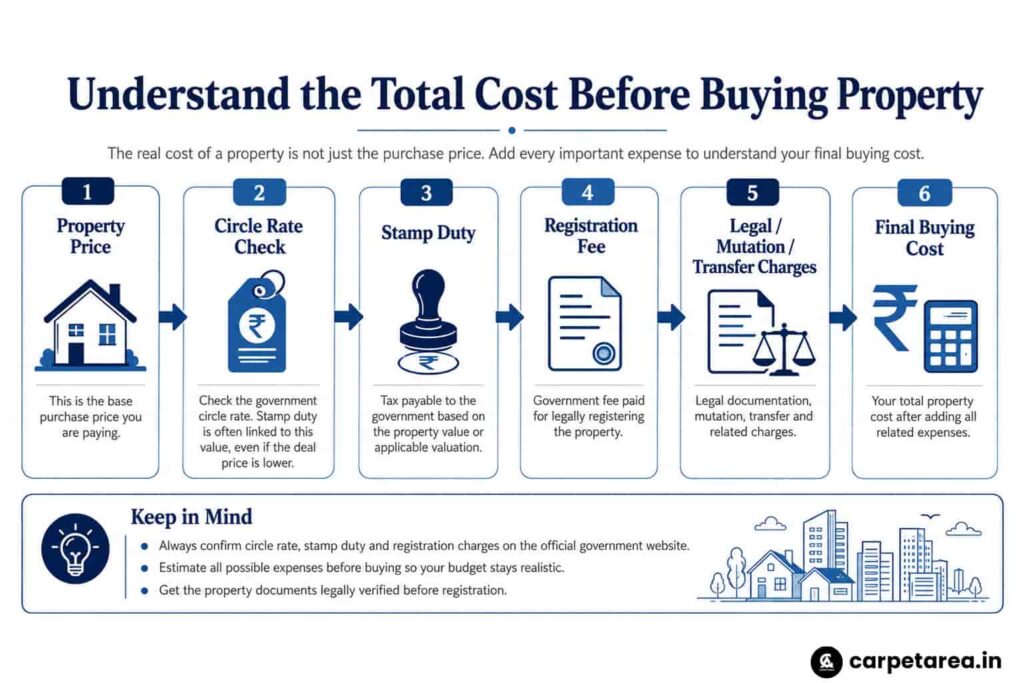
For a serious homebuyer, the actual budget should not stop at the sale price. The buyer must also calculate stamp duty, registration fee, circle-rate impact, documentation charges, mutation or name-transfer cost, legal checking and other authority-related expenses wherever applicable.
This is why registry cost should be understood before finalising the deal, not after making the booking payment.
What Is Registry in Property Buying?
Registry is the formal legal registration of a property document with the concerned government registration department. In normal property transactions, this usually means registration of a sale deed, conveyance deed, gift deed, lease deed or another property-related document.
Once the document is registered, the transaction becomes part of official records. This is why buyers should not treat registry as a formality. It is a key step in recording ownership transfer and protecting the buyer’s interest.
However, registry does not mean every risk automatically disappears. Buyers should still verify title, RERA details, approvals, dues, possession status, local authority records and the seller’s right to sell the property.
What Is Circle Rate?
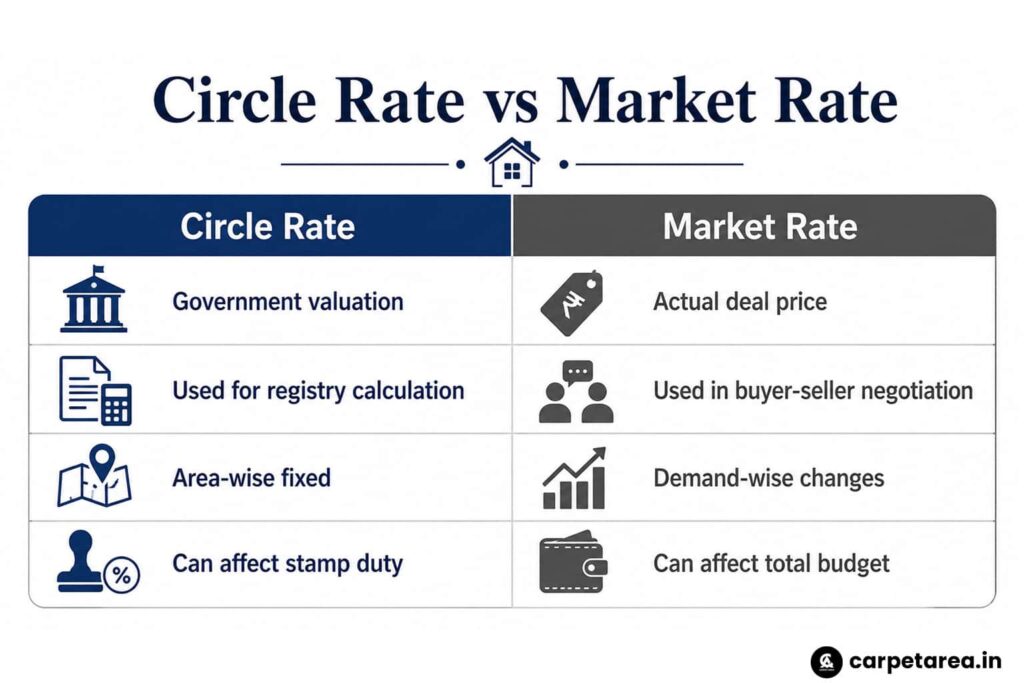
Circle rate is the minimum government valuation rate fixed for a particular area or category of property. It is used by the registration department to calculate the minimum value on which stamp duty and registration charges may be applicable.
In simple words, the circle rate is the government’s reference value for registration purposes.
For example, if the market price of a property is lower than the applicable circle-rate value, the registration department may still calculate stamp duty on the circle-rate valuation. This is why buyers must check circle rate before finalising the registry budget.
Different areas, roads, sectors, villages, wards and property types can have different valuation rates. A flat, residential plot, commercial property, agricultural land or institutional plot may not be valued in the same manner.
Circle Rate vs Market Rate: What Is the Difference?
This is one of the biggest confusions among property buyers.
Market rate is the price at which the buyer and seller are actually agreeing to the transaction. This may depend on location, demand, negotiation, construction quality, floor, road width, builder brand, authority sector and future infrastructure.
Circle rate is the government valuation rate used for stamp-duty and registration purposes.
A property may be sold above the circle rate if the market demand is strong. But if a transaction is shown below the applicable government value, stamp duty may still be calculated on the higher applicable valuation.
So, before buying a property, a buyer should not only ask, “What is the deal price?” The buyer should also ask, “What is the valuation for registry?”
Why Registry Cost Can Change the Final Budget?
Registry cost can become a major part of the buyer’s total expense. For many buyers, this amount runs into lakhs of rupees.
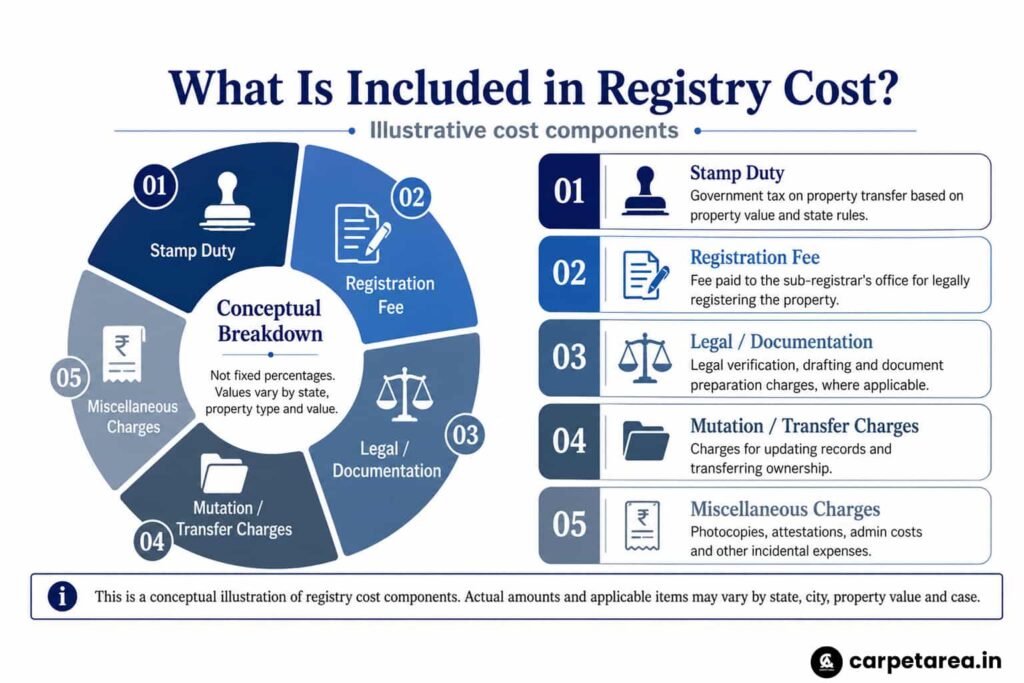
The final registry cost may depend on state rules, property location, circle rate, sale value, property type, gender of buyer, joint ownership, document type, registration fee, local body charges, mutation cost, authority transfer charges and legal documentation expenses.
This is why a property that looks affordable on paper may become expensive after adding registry and related costs.
Stamp Duty: The Biggest Part of Registry Cost
Stamp duty is the tax or duty paid to the government on the property document. It is usually calculated on the transaction value or the applicable government valuation, depending on the rule and case.
The percentage is not the same across India. Stamp duty varies from state to state. In some places, women buyers may get a lower rate. In some cases, joint ownership may also affect the calculation.
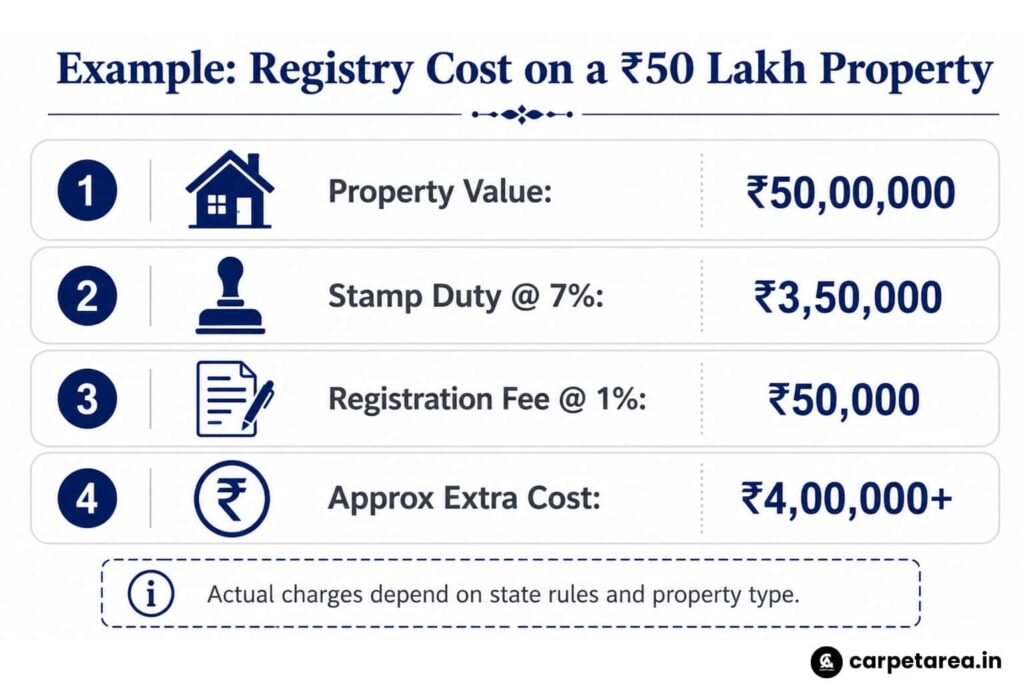
For example, if a property value is ₹50 lakh and the applicable stamp duty is 7%, the stamp duty alone becomes ₹3.5 lakh. If registration fee and other charges are added, the buyer’s total outflow increases further.
That is why buyers should calculate this amount before deciding the final payment plan.
Registration Fee: Separate From Stamp Duty
Many buyers think stamp duty and registration fee are the same. They are not.
Stamp duty is one major charge. Registration fee is a separate amount paid for registering the document. Some states calculate registration fee as a percentage of the property value, while some may have caps or additional minor charges.
Before going for registry, a buyer should ask for a clear breakup of stamp duty, registration fee, documentation charges, legal verification cost, mutation or name-transfer charges and any authority transfer charges, wherever applicable.
This helps avoid last-minute confusion.
Why Circle Rate Matters for Flat Buyers?
Flat buyers often focus only on the builder’s price list. But the registration cost may be calculated using the value accepted by the registration department.
In a flat purchase, valuation can depend on carpet area, built-up area, super area, floor, location, project type and applicable state rules. In some places, parking, club membership, common facilities or other charges may also create confusion in calculation.
A flat buyer should check whether the registry value is clear in the sale deed, whether the project details match the sale agreement, whether the builder has received necessary approvals and whether the bank loan amount includes stamp duty or not.
This is especially important for first-time homebuyers.
Why Circle Rate Matters for Plot Buyers?
In plot transactions, circle rate becomes even more important because the value may depend on land use, road width, sector, village, authority area, corner location, frontage and commercial potential.
For authority plots, buyers should also check whether any transfer charges, lease rent, extension charges, mortgage permission or dues are pending.
A plot may look attractive because the seller is offering a lower price, but the buyer should check whether the registry valuation is higher than the negotiated price. If yes, the stamp duty burden may increase.
Registry Cost in Resale Property
In resale property, buyers should be more careful. A resale transaction is not only about paying the seller and completing registry.
The buyer should check previous sale deed, chain of ownership, loan status, society dues, authority dues, mutation status, possession letter, completion or occupancy certificate, property tax record and whether the seller has full right to sell.
Registry cost should be calculated only after the property papers are checked properly.
Common Mistakes Buyers Make
Many buyers make these mistakes:
- Calculating only the basic property price
- Ignoring stamp duty until the final stage
- Not checking circle rate before agreement
- Assuming registry cost is the same in every city
- Not checking whether female ownership benefit is available
- Ignoring authority transfer charges
- Confusing registration fee with stamp duty
- Not checking whether the registry value and sale value match properly
- Depending only on broker calculation
- Not verifying official government portals
These mistakes can disturb the buyer’s budget and delay the transaction.
Simple Example: How Registry Cost Can Affect Budget
?Suppose a buyer is purchasing a property for ₹50 lakh.
If stamp duty is 7%, the stamp duty amount may be ₹3.5 lakh. If registration fee is 1%, that may add another ₹50,000. After adding drafting, documentation, legal checking and other minor charges, the buyer may need around ₹4 lakh or more over and above the basic property price.
This is only an example. Actual charges depend on the state, property type, official valuation and local rules.
The lesson is simple: a buyer should never plan a property budget without registry cost.
Buyer Checklist Before Registry
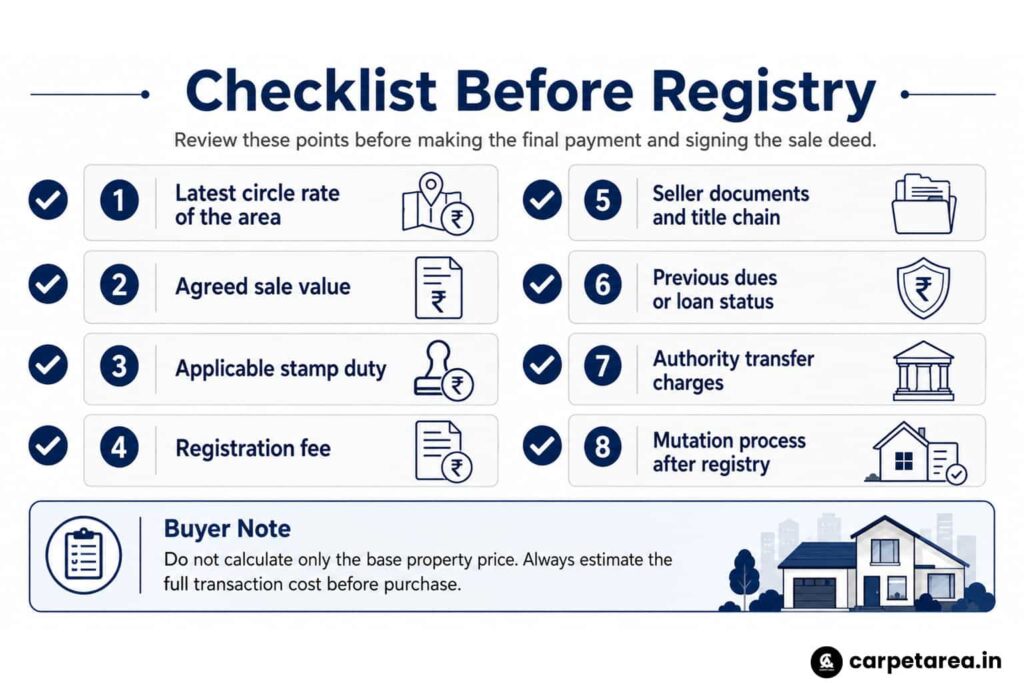
Before making the final payment, check these points:
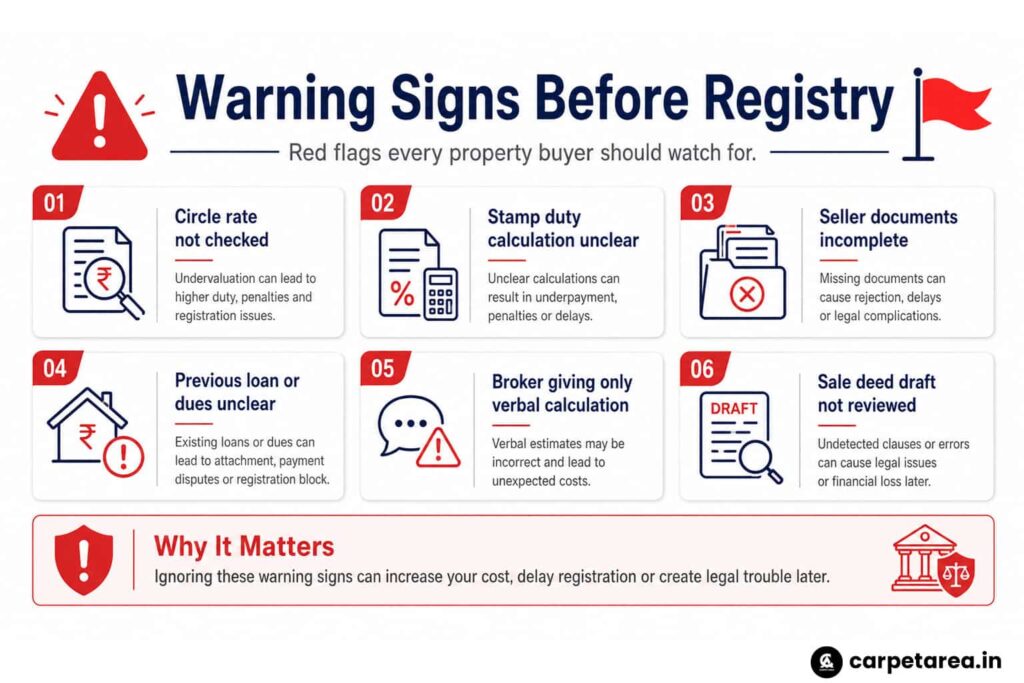
- Latest circle rate of the area
- Agreed sale value
- Applicable stamp duty
- Registration fee
- Seller documents and title chain
- Previous dues or loan status
- Authority transfer charges
- Mutation process after registry
This checklist can protect buyers from financial surprises.
Final Word
Registry cost is not a small side expense. It is a major part of the property-buying budget.
Before buying a flat, plot, shop or resale property, every buyer should understand circle rate, stamp duty, registration fee and other related charges. The safest approach is to check the latest official valuation list, use the government stamp-fee calculator where available, verify property papers with a legal expert and then finalise the transaction.
A smart property buyer does not ask only one question — “What is the property price?”
A smart buyer asks — “What will be my total cost after registry?”
Disclaimer
This article is for public awareness and buyer education only. Stamp duty, registration fee, circle rate, mutation charges and authority charges may vary by state, city, property type and latest government rules. Buyers should verify the latest details from the official state registration department, local authority, bank, legal advisor and property documents before making any payment.
Sources:-
- UP IGRS Stamp & Registration Fee Calculator
https://igrsup.gov.in/igrsup/stampFeesCalculator.action - UP IGRS Valuation / Circle Rate List
https://igrsup.gov.in/igrsup/getUploadedRateList - Delhi Revenue Department — Property Registration
https://revenue.delhi.gov.in/revenue/property-registration - Delhi Revenue Department — Important Information Regarding Registration of Property
https://revenue.delhi.gov.in/revenue/important-information-regarding-registration-property - Maharashtra Department of Registration & Stamps
https://igrmaharashtra.gov.in/Home - Maharashtra IGR Online Services / e-ASR / e-Valuation / Stamp Duty Services
https://igrmaharashtra.gov.in/Home/index


Leave a Reply