


Mr. Mehra Took Possession, But One Question Remained
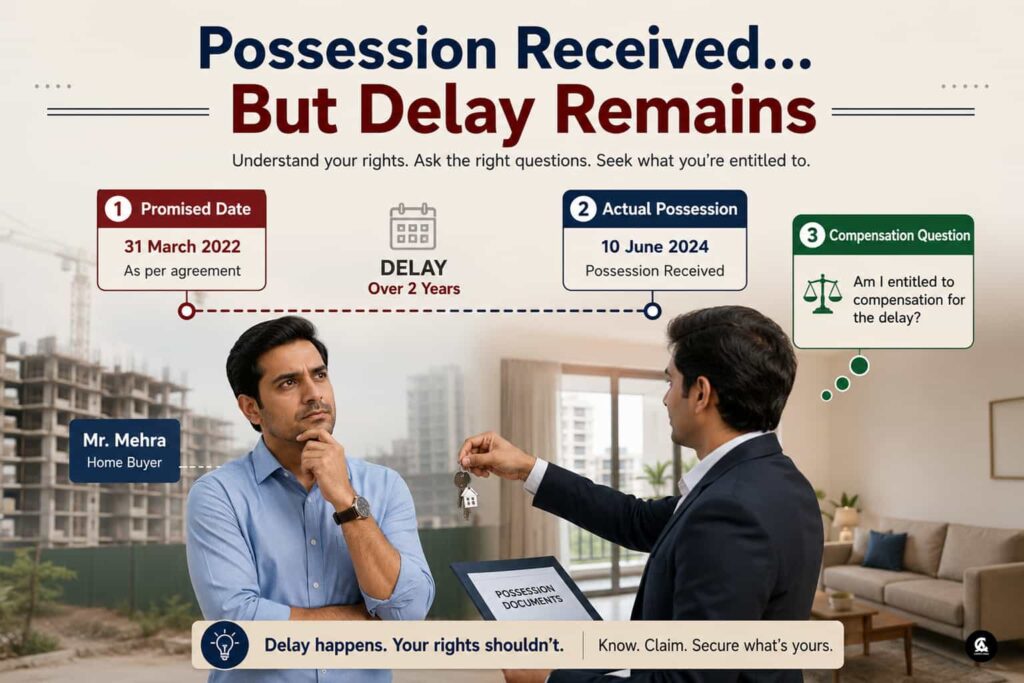
Mr. Mehra had booked a flat with the hope of moving in within the promised timeline. He paid instalments, followed up with the builder, waited through delays and finally received possession much later than expected.
Like many homebuyers, he accepted the keys because waiting further was not practical. Rent was continuing, EMI pressure had started, and the family wanted closure.
But one question remained:
If a buyer accepts possession after delay, does the right to claim delay compensation automatically end?
This question is now important for thousands of homebuyers who have taken delayed possession but still feel that the delay caused financial and mental hardship.
Why this question has become important now?
A recent Supreme Court judgment has brought this issue back into focus. The case was T.K.A. Padmanabhan vs Abhiyan Cooperative Group Housing Society Ltd., Civil Appeal No. 10724 of 2016.
The buyer had filed a consumer complaint alleging deficiency in service because of delay in handing over possession of a flat. Later, the question arose whether the buyer could continue with the complaint even after possession had been received.
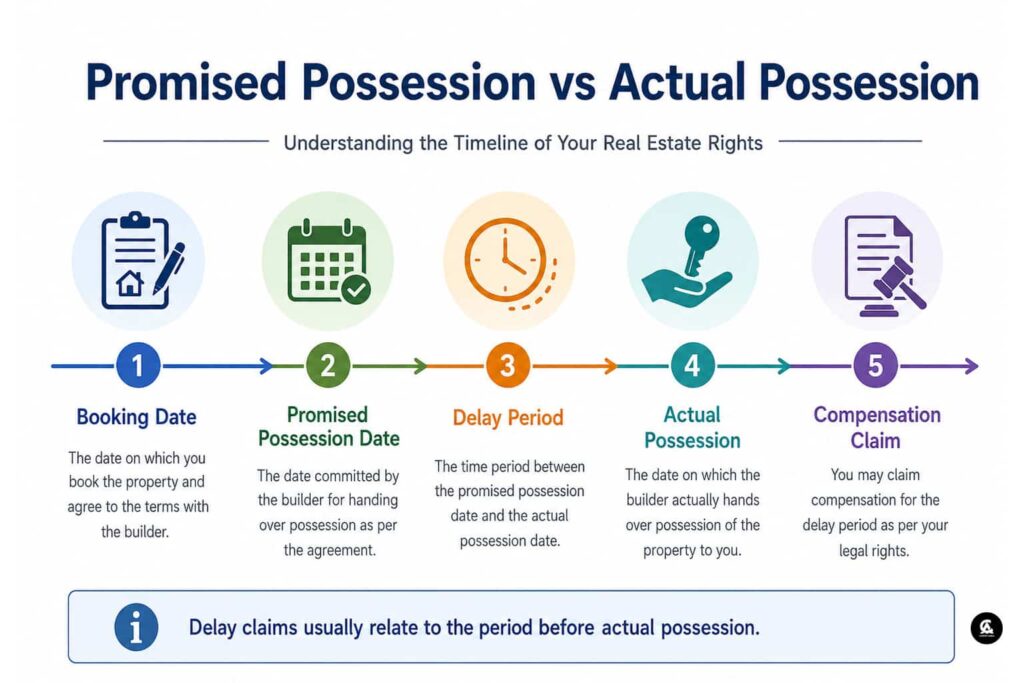
The Supreme Court’s key observation is important for homebuyers: a claim for compensation for delayed possession arises from the period before actual possession is delivered. Therefore, the subsequent receipt of possession cannot, by itself, extinguish the buyer’s right to seek adjudication of that delay-compensation claim.
In simple words, taking possession does not automatically close the issue of delay compensation.
What the Supreme Court actually said?
The Supreme Court did not say that compensation is automatically payable in every delayed-possession case.
Instead, the Court said that important questions still need to be examined on merits, such as whether there was actual delay, whether the delay was attributable to the builder or society, whether possession was accepted unconditionally, whether there was any waiver or settlement, and whether compensation is payable based on the facts.
The Court restored the consumer complaint for adjudication on merits. This means the competent forum must examine the facts, documents, evidence and legal position before deciding whether compensation is payable.
This distinction is very important. The ruling strengthens the buyer’s right to pursue a delay claim, but it does not create an automatic compensation formula for every case.

Why possession does not always end the delay issue?
Many buyers assume that once they take possession, the matter is over.
This is not always correct.
Taking possession may solve one problem: the buyer finally gets access to the flat. But it may not automatically solve the past delay. If the flat was handed over years after the promised date, the buyer may still have a claim relating to the delay period, depending on the agreement, documents and circumstances.
For example, a buyer may have suffered because of rent and EMI running together, extended waiting period, financial planning disruption, repeated possession-date changes, delayed handover despite full payment, or lack of timely communication from the builder.
These issues belong to the period before possession. That is why accepting the flat later may not automatically erase the earlier grievance.
Consumer forum eemedy and arbitration clause
Another important part of the Supreme Court judgment relates to consumer forum jurisdiction.
In the case, the agreement contained an arbitration clause. But the Supreme Court noted that the consumer remedy is an additional statutory remedy and that the existence of an arbitration clause does not, by itself, remove the jurisdiction of the consumer forum.
This is important because many buyers see arbitration clauses in builder-buyer agreements or society documents and assume they cannot approach a consumer forum.
The judgment reinforces a broader principle: a private contractual clause cannot automatically defeat a statutory consumer remedy.
RERA Section 18: The modern real estate angle
For today’s homebuyers, RERA also plays an important role in delayed-possession cases.
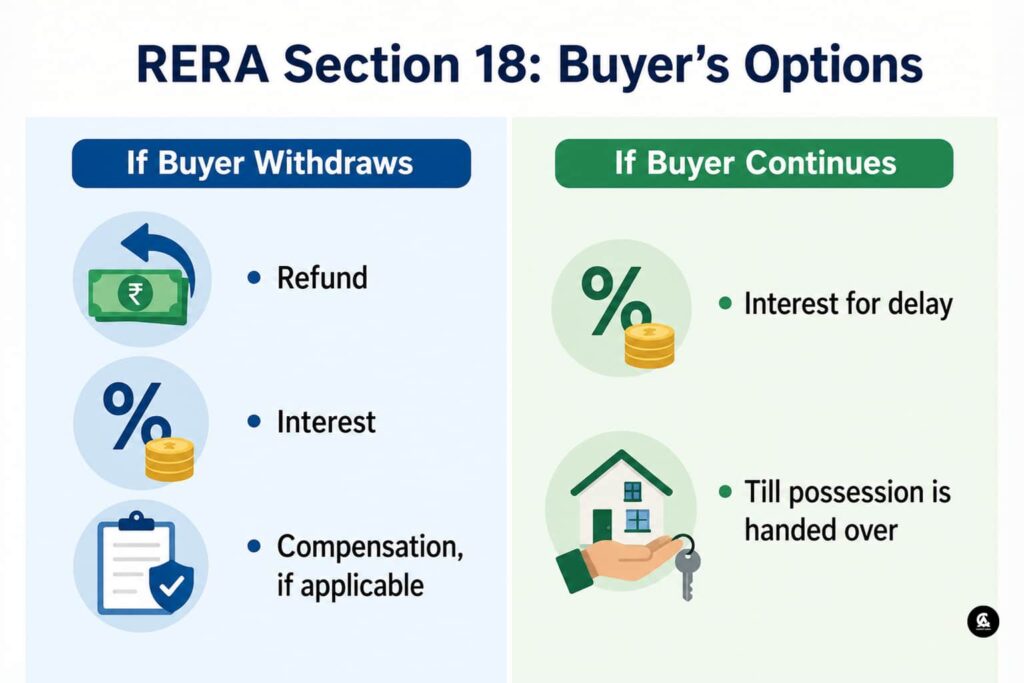
Section 18 of the Real Estate (Regulation and Development) Act, 2016 deals with return of amount and compensation when a promoter fails to complete or is unable to give possession as per the agreement or specified date.
Broadly, RERA gives two important routes:
- If the allottee wants to withdraw from the project, the promoter may be liable to return the amount with interest and compensation as applicable.
- If the allottee does not withdraw, the allottee may be entitled to interest for every month of delay till possession is handed over, at the prescribed rate.
This is why the promised possession date in the agreement is extremely important.
What this means for homebuyers?
The practical message is simple:
Accepting possession does not automatically mean the buyer has waived the right to raise a delay-compensation claim.
However, buyers should not misunderstand this as a guaranteed compensation right in every case.
Delay compensation depends on the builder-buyer agreement, promised possession date, actual possession date, reason for delay, conduct of both parties, waiver terms, settlement documents, and the evidence available.
A buyer’s case becomes stronger when documents are clear and communication is preserved.
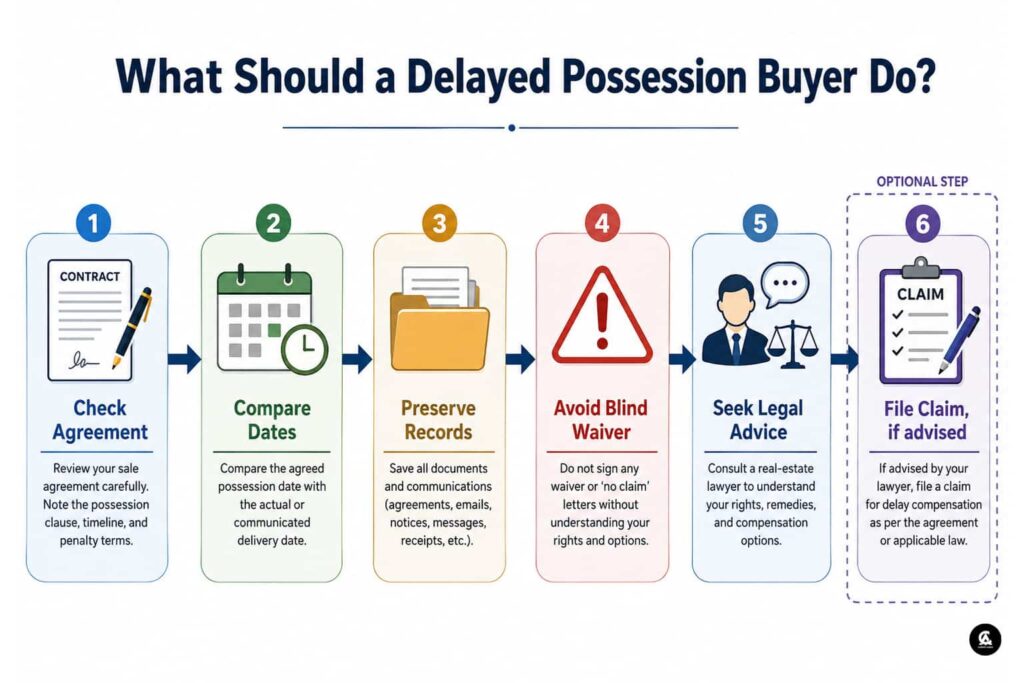
What buyers should preserve?
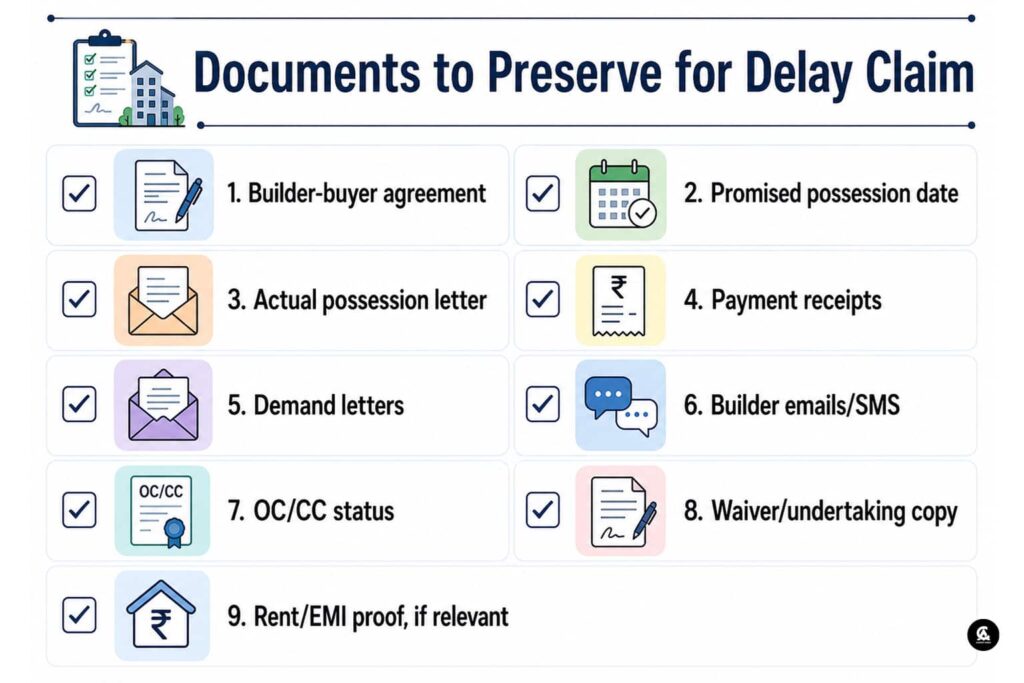
If a buyer wants to claim delay compensation after possession, documents become very important.
Homebuyers should preserve:
- Booking form
- Allotment letter
- Builder-buyer agreement
- Promised possession date
- Payment receipts
- Bank loan records
- Demand letters
- Emails, SMS and WhatsApp messages from builder
- Construction-delay updates
- Possession offer letter
- Actual possession letter
- OC/CC status, where relevant
- Final settlement documents
- Any waiver, undertaking or “no claim” declaration
- Proof of rent and EMI burden, if financial loss is being claimed
The more organised the documents, the easier it becomes to explain the delay.
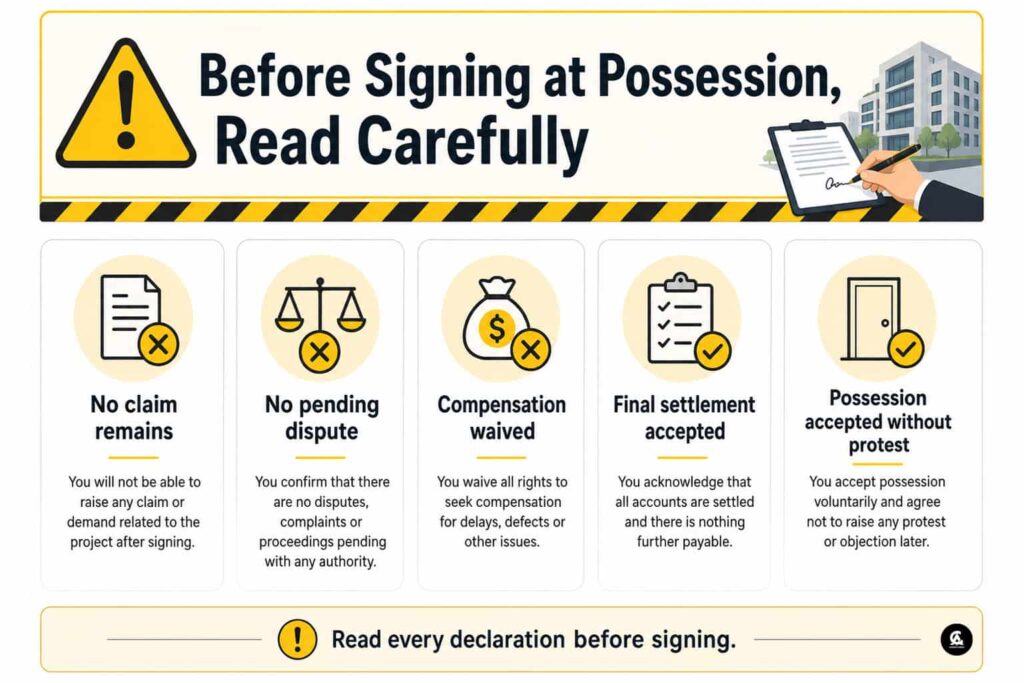
Be careful before signing a waiver at possession
Possession is often an emotional and financial pressure point. Buyers are tired of waiting, and builders may ask them to sign multiple documents before handing over the keys.
Buyers should carefully read any document that says:
- No claim remains
- Buyer accepts possession without protest
- Buyer waives compensation
- Buyer has no pending dispute
- Final settlement is complete
- Buyer cannot raise future claims
Signing such documents without understanding them can weaken a buyer’s claim later.
This does not mean buyers should refuse every possession document. It means they should understand what they are signing and seek legal advice where compensation or waiver language is involved.
When should a buyer consider legal advice?
A buyer should consider legal advice if possession was delayed by several months or years, the builder is refusing to discuss delay compensation, a broad waiver is being demanded, the agreement terms are confusing, or multiple buyers in the same project are facing similar delay.
Legal advice helps the buyer understand the correct forum, limitation period, documents required and realistic claim value.
What buyers Should Not Assume?
Buyers should avoid these assumptions:
Wrong assumption 1: Once possession is taken, delay compensation is impossible.
Correct position: Possession alone may not automatically end the right to seek adjudication of delay compensation.
Wrong assumption 2: Compensation is guaranteed after every delay.
Correct position: Compensation depends on facts, evidence and findings of the competent forum.
Wrong assumption 3: Arbitration clause means consumer forum is closed.
Correct position: Consumer remedy may still remain available depending on law and facts.
Wrong assumption 4: Verbal protest is enough.
Correct position: Written communication and documents are much stronger.
Final Takeaway
The Supreme Court ruling is important because it recognises a practical reality of homebuying.
Many buyers accept delayed possession because they have no real choice. They may be paying rent, EMI, maintenance or other costs. Taking the keys may solve the immediate housing problem, but it may not automatically erase the delay that already happened.
The key lesson is this:
A homebuyer who has taken possession may still seek adjudication of a delayed-possession compensation claim, but the result will depend on the facts, documents and legal findings.
For buyers, the safest approach is to preserve every document, avoid signing broad waivers without understanding them, and seek proper advice before filing a claim.
A smart homebuyer does not ask only:
“When will I get possession?”
A smart homebuyer also asks:
“If possession is delayed, what are my rights and what documents should I preserve?”
Disclaimer
This article is for public awareness and buyer education only. It is not legal advice. Delay compensation, consumer remedy, RERA remedy and waiver-related issues depend on the facts of each case, agreement terms, documents, limitation rules and the competent forum’s findings. Homebuyers should consult a qualified legal professional before filing any claim or signing any waiver, settlement or possession-related document.
Sources:-
- Supreme Court Judgment PDF — T.K.A. Padmanabhan vs Abhiyan Cooperative Group Housing Society Ltd.
https://api.sci.gov.in/supremecourt/2016/6150/6150_2016_2_107_71816_Judgement_04-Jun-2026.pdf - Real Estate (Regulation and Development) Act, 2016 — India Code PDF
https://www.indiacode.nic.in/bitstream/123456789/15131/1/the_real_estate_%28regulation_and_development%29_act%2C_2016.pdf - RERA Section 18 — Return of Amount and Compensation
https://www.indiacode.nic.in/show-data?actid=AC_CEN_17_19_00033_201616_1517807328405&orderno=18§ionId=8642§ionno=18 - Economic Times — Homebuyer delayed possession compensation report
https://economictimes.indiatimes.com/wealth/real-estate/homebuyer-paid-for-a-flat-in-a-delhi-housing-society-in-2003-got-delayed-possession-sought-compensation-for-delay-sc-defends-his-right/articleshow/132031892.cms - Times of India — Homebuyers can seek relief for delay after possession: Supreme Court
https://timesofindia.indiatimes.com/india/homebuyers-can-seek-relief-for-delay-after-possession-supreme-court/articleshow/132026736.cms





Leave a Reply