

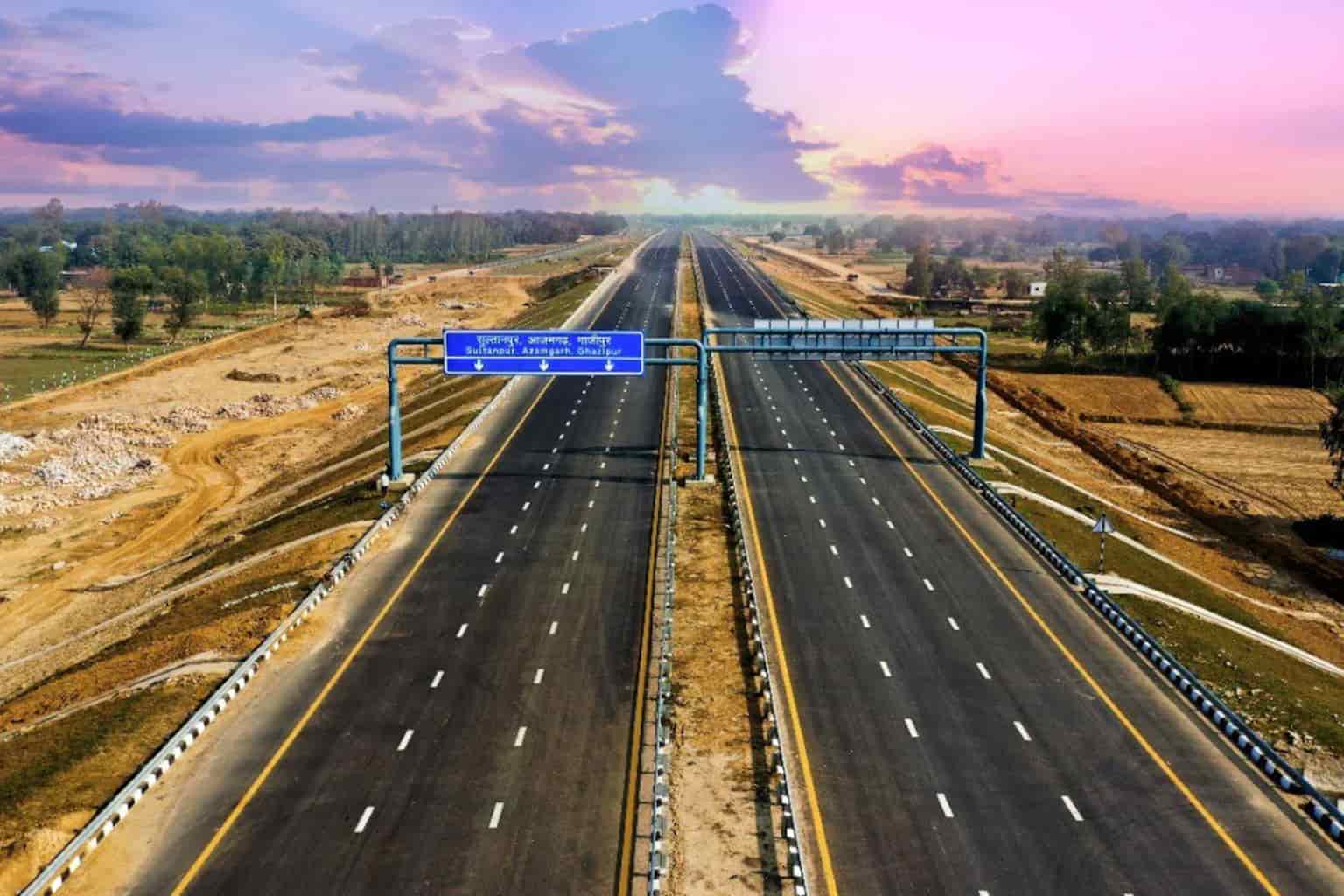
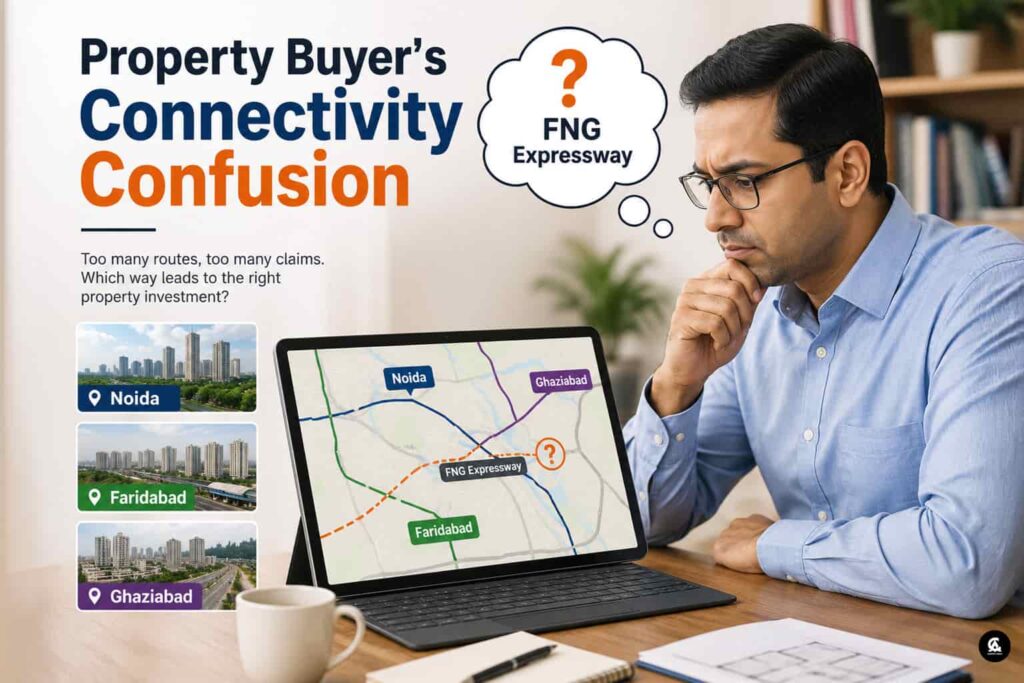
Mr. Verma’s NCR property search started with one simple question
Mr. Verma works in Noida, his relatives live in Faridabad, and he has been exploring property options around Noida Extension, Ghaziabad and the Noida Expressway belt.
On paper, the Faridabad-Noida-Ghaziabad Expressway, commonly known as the FNG Expressway, looks like the perfect solution. One corridor connecting three major NCR cities. One road that can reduce travel pressure. One project that can make several residential pockets more attractive.
But every time Mr. Verma searches for the FNG Expressway, he finds the same question:
Why is this project still delayed?
That question matters not only for daily commuters. It also matters for property buyers, because infrastructure can change the way people judge a location. But delayed infrastructure can also mislead buyers if they invest only on future promises.
What is the FNG Expressway?
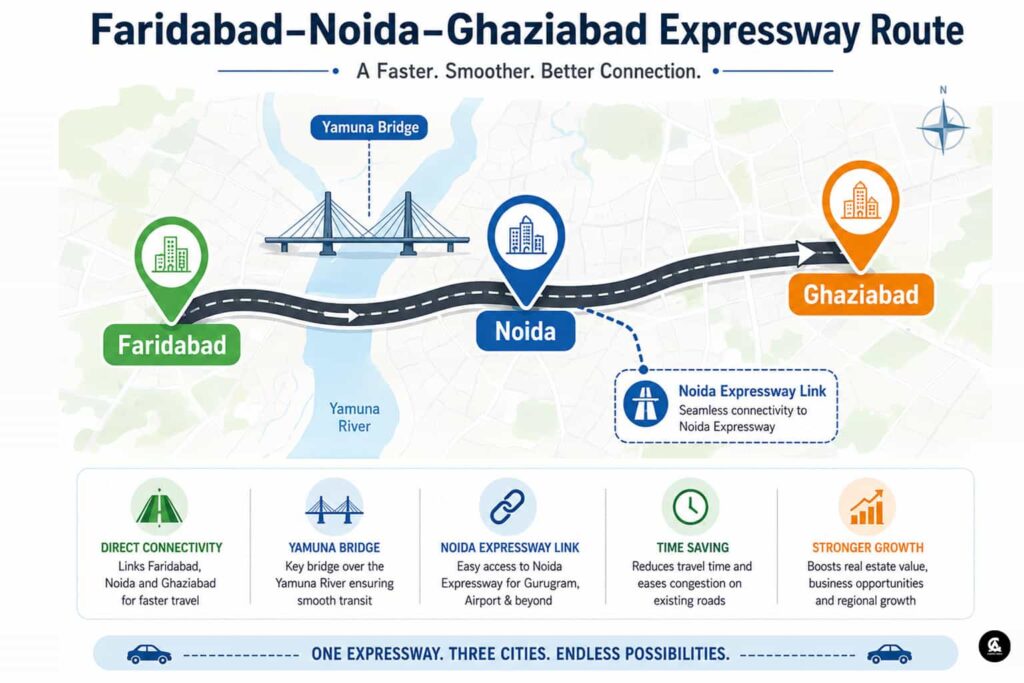
The FNG Expressway stands for Faridabad-Noida-Ghaziabad Expressway.
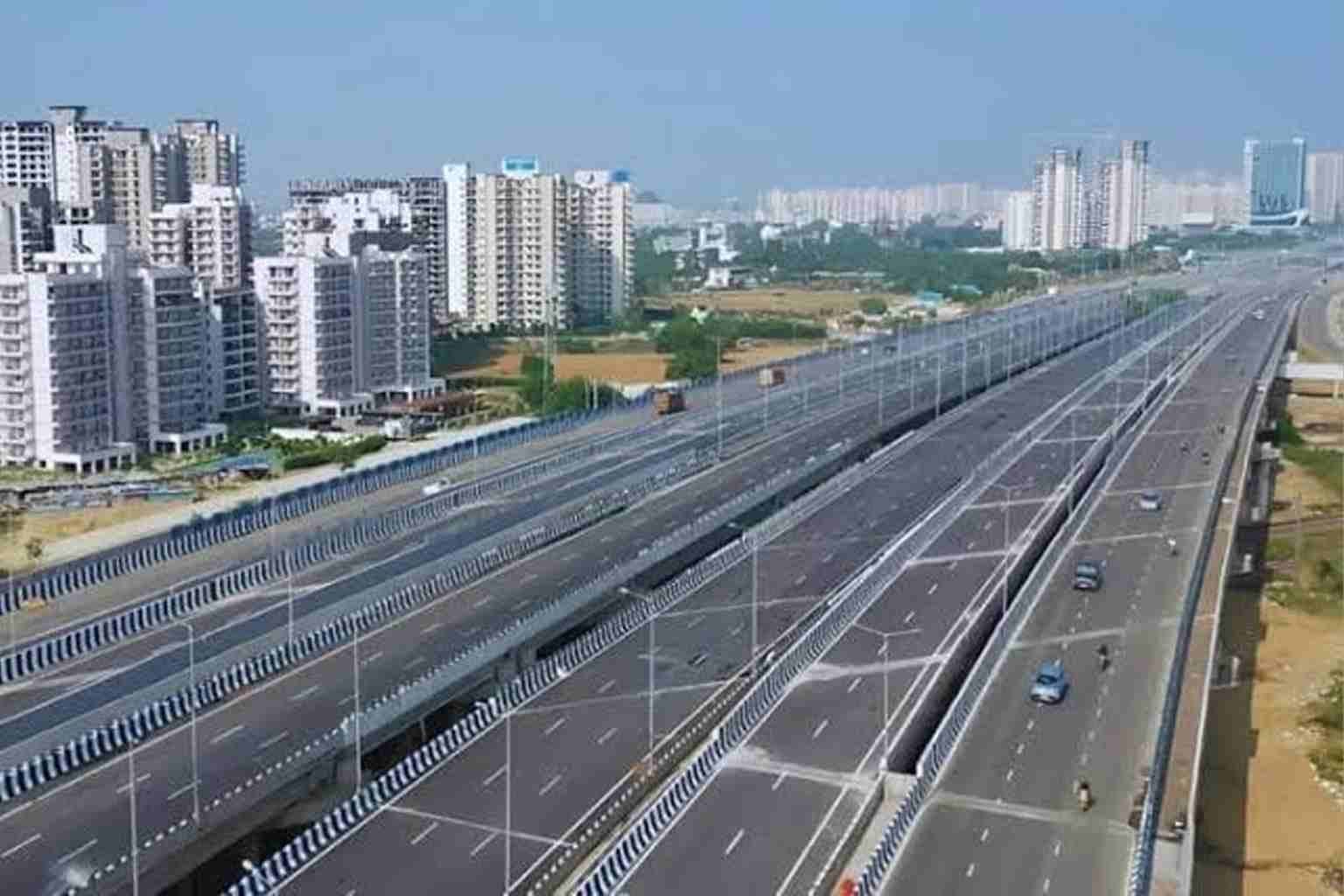
It is planned as a major NCR corridor connecting Faridabad, Noida and Ghaziabad. The purpose is to improve cross-city movement, reduce dependence on congested routes and create smoother regional connectivity.
For property buyers, this is not just a road project. It is a location-impact project.
If completed properly, it can improve access between Faridabad and Noida, Noida and Ghaziabad, Noida Extension, Noida Expressway-side locations and other connected NCR pockets.
That is why the project continues to remain important even after years of delay.
Latest update: Why is the FNG Expressway back in the news?
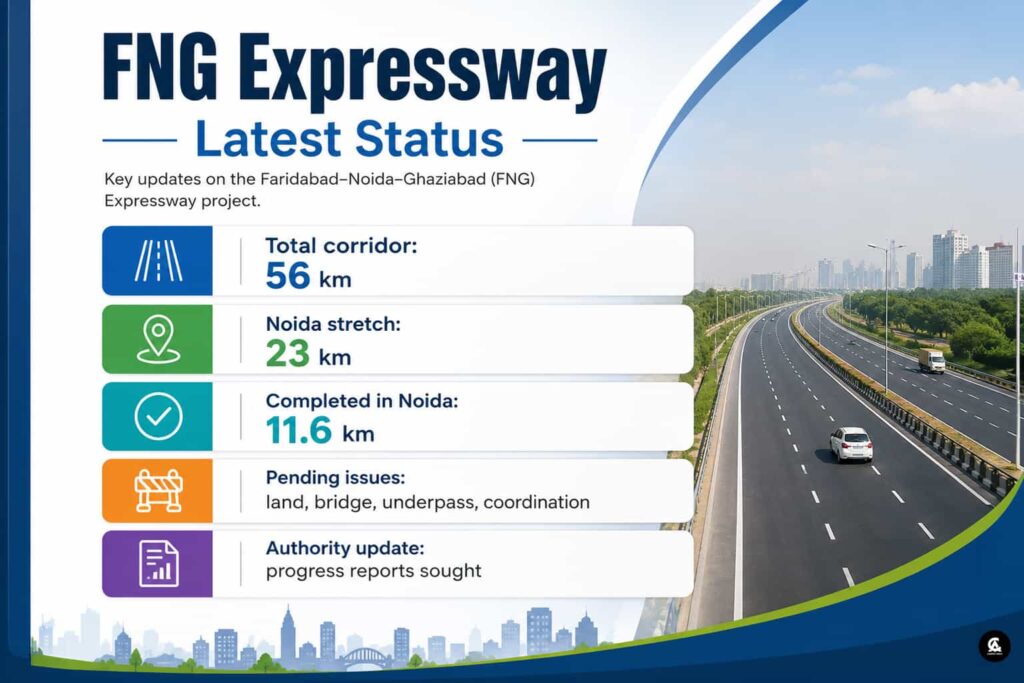
The FNG Expressway is again in focus because Noida Authority has reportedly sought progress reports from its work circles to push the long-delayed project forward.
According to recent reporting, the project is conceived as a 56-km, six-lane corridor connecting Faridabad, Noida and Ghaziabad. The report says the project has faced delays due to land acquisition hurdles, funding issues and poor coordination between Uttar Pradesh and Haryana authorities. Out of the 23-km stretch under Noida’s jurisdiction, 11.6 km has reportedly been completed.
For Mr. Verma, this means one thing: the FNG Expressway is still relevant, but buyers should not treat it as already completed.
Why has the FNG Expressway been delayed?
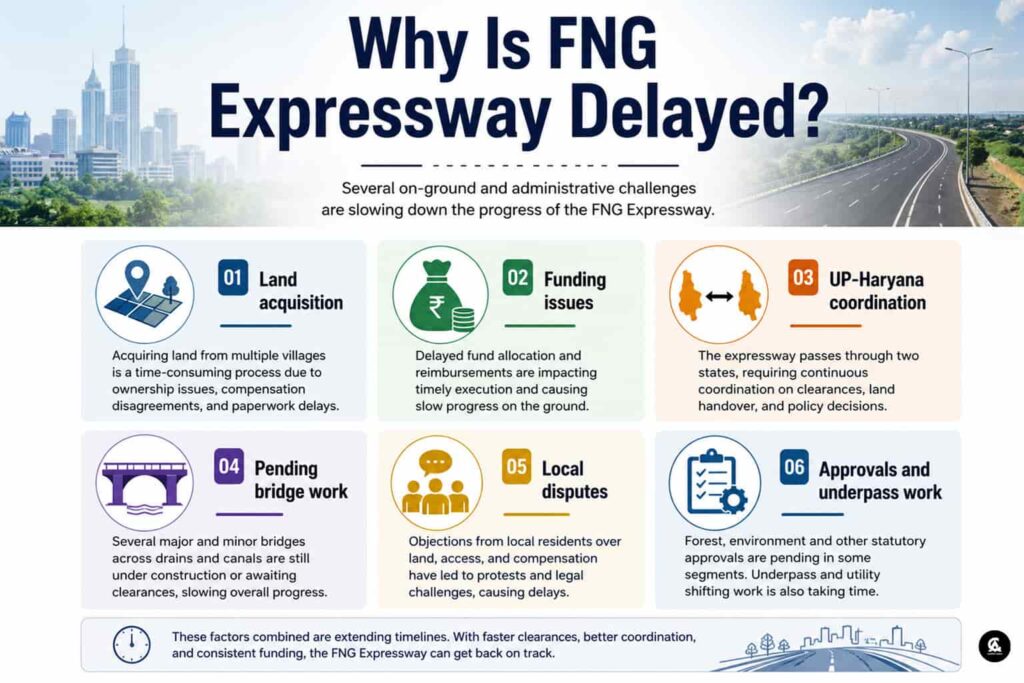
The delay is not because of one single reason. It appears to be a mix of several on-ground and administrative issues.
The major challenges include land acquisition, funding, coordination between Uttar Pradesh and Haryana, pending bridge-related work, local disputes, approval requirements and underpass-related work.
This is common in large infrastructure projects that pass through multiple jurisdictions. A road may look simple on a map, but execution depends on land availability, budget, technical approvals and cooperation between different authorities.
A previous report also highlighted that the FNG project has been stuck for years due to cost-sharing differences and land disputes.
What work is still pending?
Recent reports mention several incomplete or pending components along the corridor.
These include unfinished stretches in Noida, elevated-road requirements, local land-related issues, bridge-related work and approvals around key links. Reports have also mentioned pending work such as a 650-metre elevated road in Chhijarsi, a one-lane section in Sorkha village stalled by a legal dispute, and clearance-related issues near the Hindon River.
This is where property buyers must understand a very important difference:
A corridor may exist in planning, but that does not mean it is fully usable for daily travel.
For buyers, the real question is not only:
Is the FNG Expressway planned?
The real question is:
Can I actually use this route from my property today?
Why does the Yamuna bridge matter?
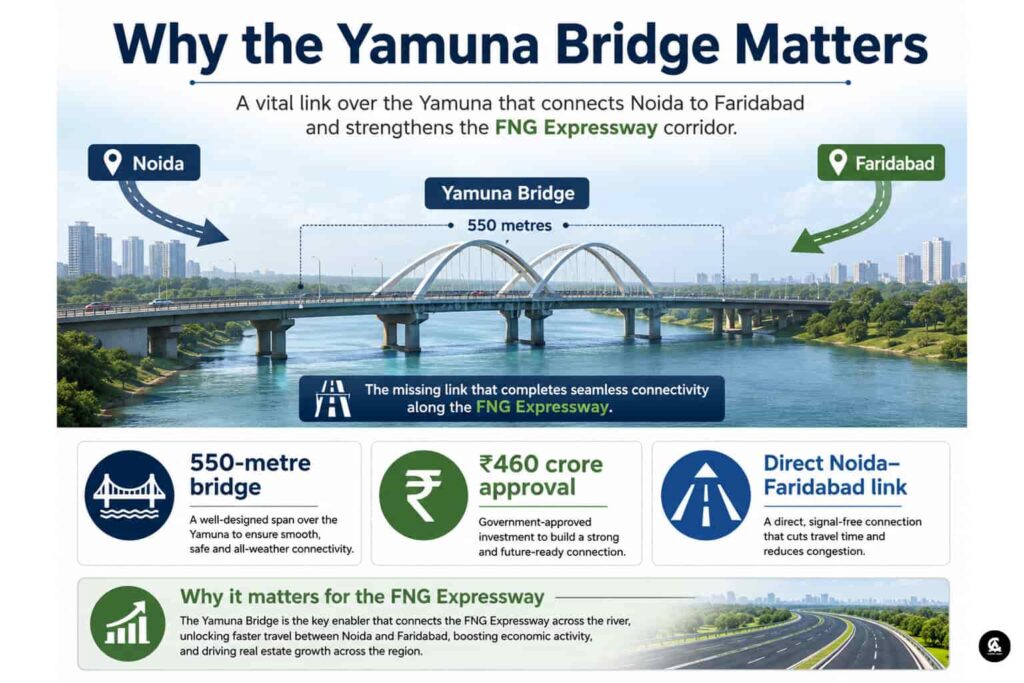
One of the most important missing pieces in the FNG connectivity story is the Yamuna bridge for the direct Noida-Faridabad link.
ETInfra reported that Haryana agreed to fund a ₹460-crore, 550-metre bridge as a key part of the 56-km FNG Expressway connectivity puzzle.
This bridge matters because without strong river-crossing connectivity, the Noida-Faridabad movement cannot deliver the full benefit expected from the FNG corridor.
For buyers, this is an important lesson: do not track only the name of the expressway. Track the bridge, underpass, link roads and completed stretches that will actually make the route usable.
Why does FNG still matter for property buyers?
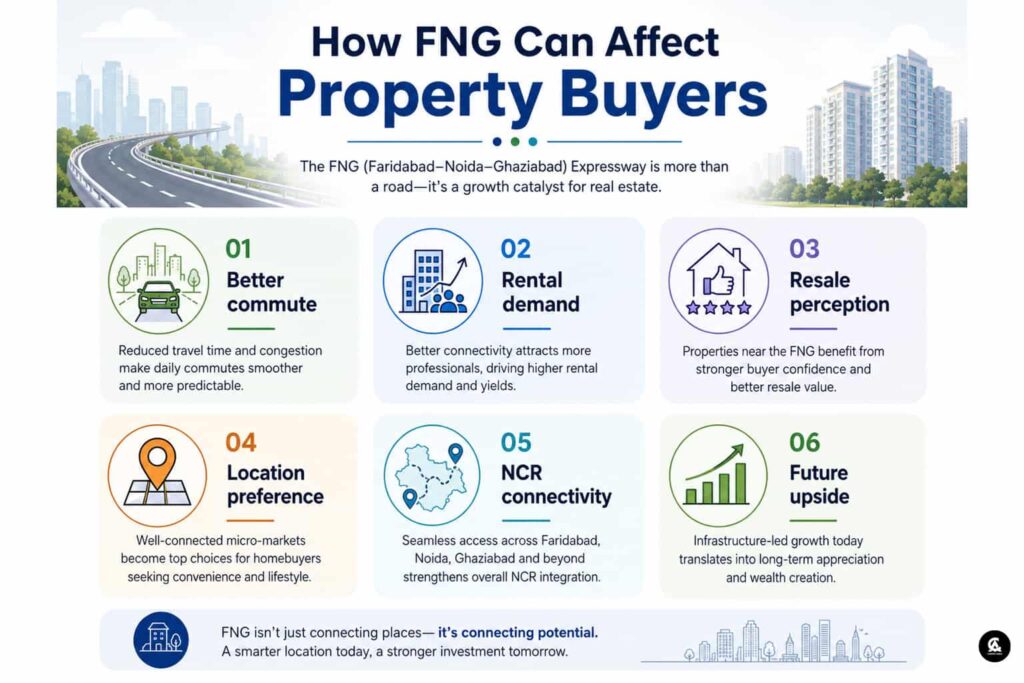
Despite the delay, the FNG Expressway still matters because of its strategic location.
A completed FNG corridor can improve movement between Noida, Faridabad and Ghaziabad. It can reduce dependence on congested routes, support better commute options and make certain micro-markets more attractive.
For example, a buyer working in Noida but frequently travelling toward Faridabad may find a connected location more practical. Similarly, better Noida-Ghaziabad connectivity can improve interest in residential pockets that currently suffer because of travel-time concerns.
For investors, better connectivity can support rental demand, resale perception and long-term location preference.
But this benefit depends on execution.
Connectivity can support real-estate value only when the road becomes usable, reliable and properly connected.
Which locations may benefit?
The impact of the FNG Expressway may be stronger in locations that are close to actual completed stretches, entry-exit points, bridge links and connecting roads.
Broadly, buyers may track:
- Noida sectors near the FNG alignment
- Noida Extension and nearby connectivity pockets
- Ghaziabad-side access points
- Faridabad-side link roads
- Noida Expressway connection points
- Locations near completed or actively developing stretches
However, buyers should not assume that every project marketed as “near FNG” will automatically benefit.
A builder may use the FNG name in marketing, but buyers must check the actual distance, present access, road condition and whether the nearby stretch is complete.
What is the main risk for property buyers?
The biggest risk is not only that the FNG Expressway is delayed.
The bigger risk is buying a property only because someone says:
“FNG Expressway aa raha hai.”
Future infrastructure can be a positive factor, but it should not be the only reason to buy.
If the corridor gets delayed further, the buyer may be left with weak road access, poor rental demand or slower resale movement.
A smart buyer should treat FNG as an upside factor, not the only buying reason.
The property must still make sense based on:
- Current location
- Existing road access
- Metro or public transport availability
- School, hospital and market access
- Employment hubs nearby
- Builder credibility
- RERA status
- Possession timeline
- Present resale and rental demand
If the property works even without FNG, then the future expressway can become an added advantage. But if the property depends completely on FNG, the buyer should be more cautious.
What should buyers check before buying near FNG?
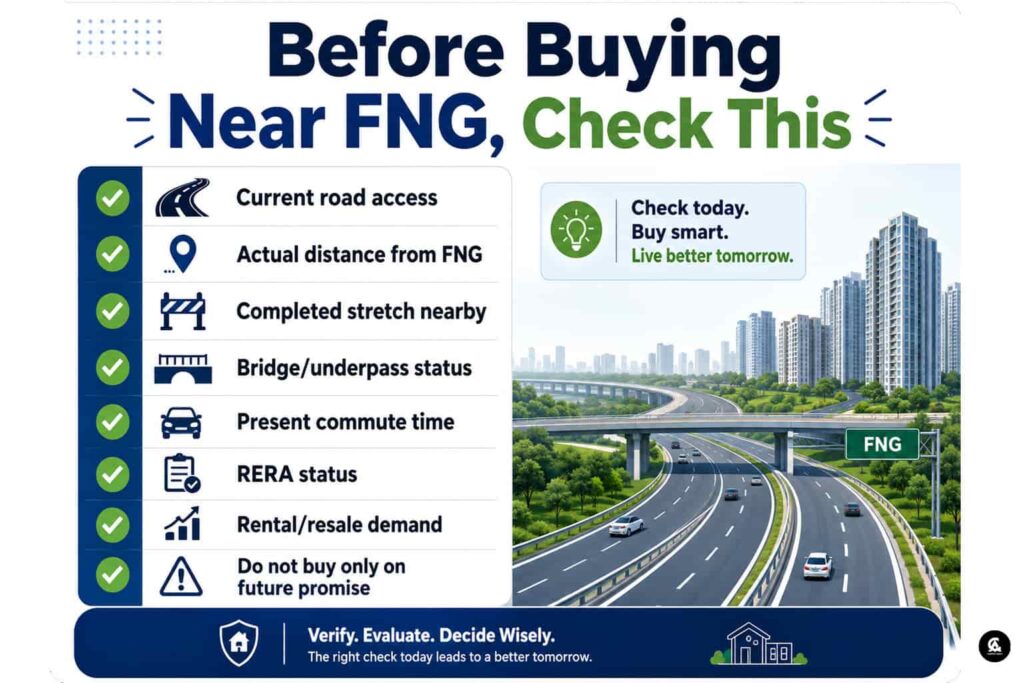
Before buying a flat, plot or commercial property marketed around the FNG Expressway, buyers should ask these questions:
- Which exact FNG stretch is near the property?
- Is that stretch completed or still proposed?
- Is the road usable today?
- What is the present travel time to Noida, Faridabad or Ghaziabad?
- Is any bridge, underpass or land parcel still pending?
- Does the location have existing connectivity without FNG?
- Is the builder using FNG only as a marketing point?
- What is the RERA status of the project?
- What is the rental and resale demand today?
- Does the property make sense even if FNG is delayed further?
These questions can protect buyers from speculative decisions.
Should buyers wait for FNG before buying?
The answer depends on the buyer’s purpose.
If someone is buying for self-use, present-day connectivity should matter more than future promises. The buyer should check office travel, school access, hospitals, markets, metro connectivity and daily road conditions as they exist today.
If someone is buying for investment, the FNG Expressway can be tracked as a long-term connectivity trigger. But paying a heavy premium only because the road may come in the future can be risky.
The safer approach is:
Buy the location for today’s value. Treat FNG as tomorrow’s possible upside.
What does this mean for Noida, Faridabad and Ghaziabad?
For Noida, the FNG Expressway can improve cross-city movement and reduce pressure on existing routes.
For Faridabad, it can create a more direct connection to Noida’s employment and commercial zones.
For Ghaziabad, it can strengthen regional access and improve its position within NCR’s larger connectivity grid.
But the actual impact will depend on execution. Until missing stretches, bridge links and authority coordination are resolved, the project remains a corridor with strong potential but clear execution risk.
Final takeaway
Mr. Verma’s confusion is the same confusion many NCR buyers have.
The FNG Expressway is delayed, but it is not irrelevant.
It still matters because it can improve connectivity between Noida, Faridabad and Ghaziabad. It can reduce travel pressure, support future real-estate demand and improve the value of locations that are genuinely connected to the corridor.
But buyers must remain practical.
A delayed infrastructure project should be tracked carefully, not blindly trusted.
The best buyer approach is simple:
Check the current connectivity. Track the future project. Do not buy only on promises.
A smart buyer does not ask only:
“FNG kab banega?”
A smart buyer asks:
“Even if FNG is delayed, does this property still make sense today?”
Disclaimer
This article is for public awareness and real-estate education only. Infrastructure timelines, project costs, route details and development status may change based on authority decisions, land acquisition, approvals, funding and inter-state coordination. Buyers should verify the latest official updates, project documents, location access, RERA details and legal records before making any property decision.
Sources:-
- Times of India — FNG Expressway delay and Noida Authority progress report update
https://timesofindia.indiatimes.com/city/noida/why-fng-eway-lagging-noida-seeks-status-reports/articleshow/132100668.cms - ETInfra — Haryana approval for Yamuna bridge
https://infra.economictimes.indiatimes.com/news/roads-highways/haryana-agrees-to-fund-yamuna-bridge-for-direct-noida-faridabad-link/119590336 - Times of India — FNG project background, delay and cost-sharing issues
https://timesofindia.indiatimes.com/city/ghaziabad/bridging-the-gap-stuck-for-years-fng-eway-project-gathers-steam/articleshow/97632881.cms - Times of India — FNG pending stretch and green makeover background
https://timesofindia.indiatimes.com/city/noida/a-road-to-recovery-5km-fng-stretch-set-in-noida-for-green-makeover/articleshow/123049260.cms - Noida Authority — Master plan page
https://noidaauthorityonline.in/en/article/master-plan-for-noida


Leave a Reply