


Mr. Sharma’s view of Yamuna Expressway real estate is changing
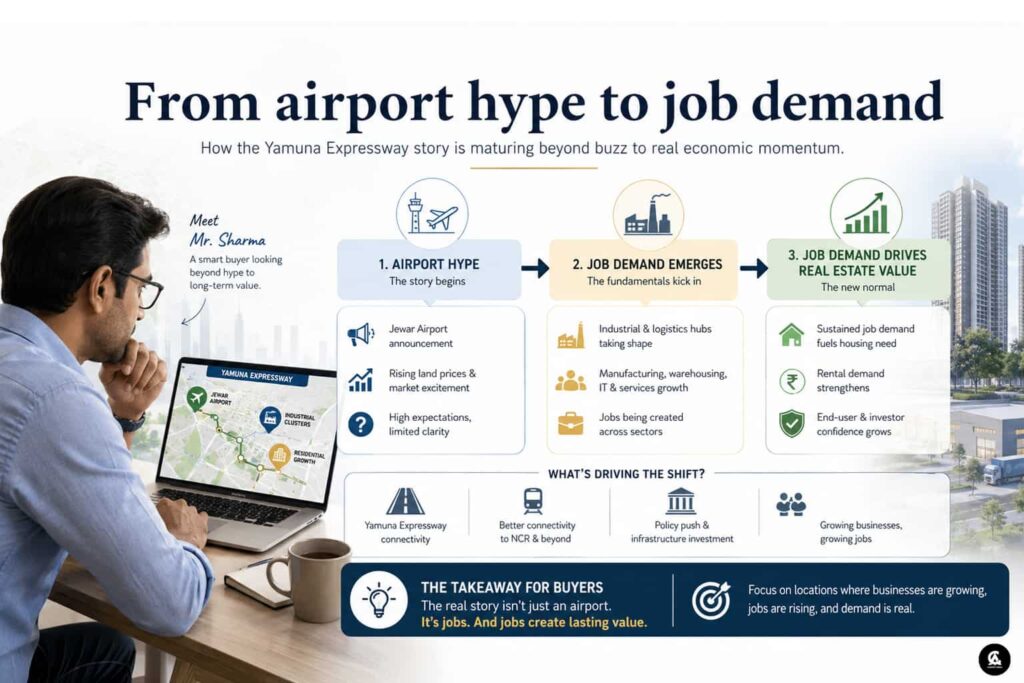
Mr. Sharma has been tracking Yamuna Expressway real estate for the last two years. Like many buyers, his interest first started because of Jewar Airport, YEIDA plot schemes and the hope of future appreciation.
Earlier, his question was simple:
Should I buy a plot near Jewar Airport?
But now, after reading that YEIDA has approved industrial projects worth around ₹3,181 crore with expected job generation of more than 18,000 people, his question has changed:
Is Yamuna Expressway real estate moving from airport-based excitement to employment-based demand?
That is a more serious and practical question. Real estate does not become strong only because of future promises. It becomes stronger when a region starts creating jobs, attracting working populations and generating daily-use demand for housing, transport and services.
What has YEIDA approved?
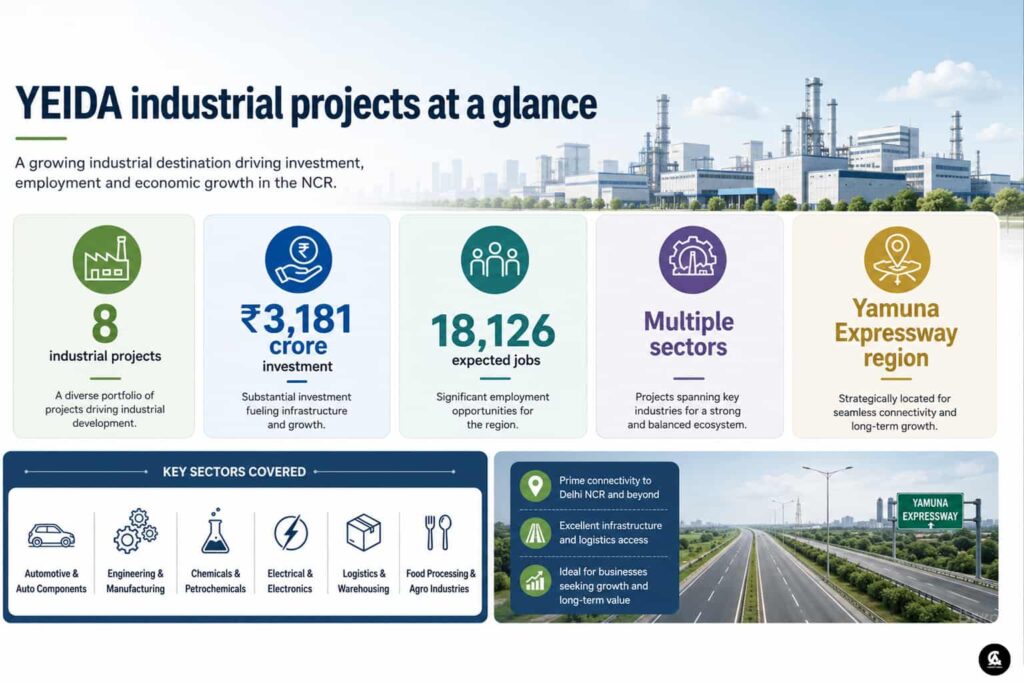
YEIDA has reportedly issued letters of intent to eight industrial investors. Together, these projects are expected to bring investment of around ₹3,181 crore and generate approximately 18,126 jobs.
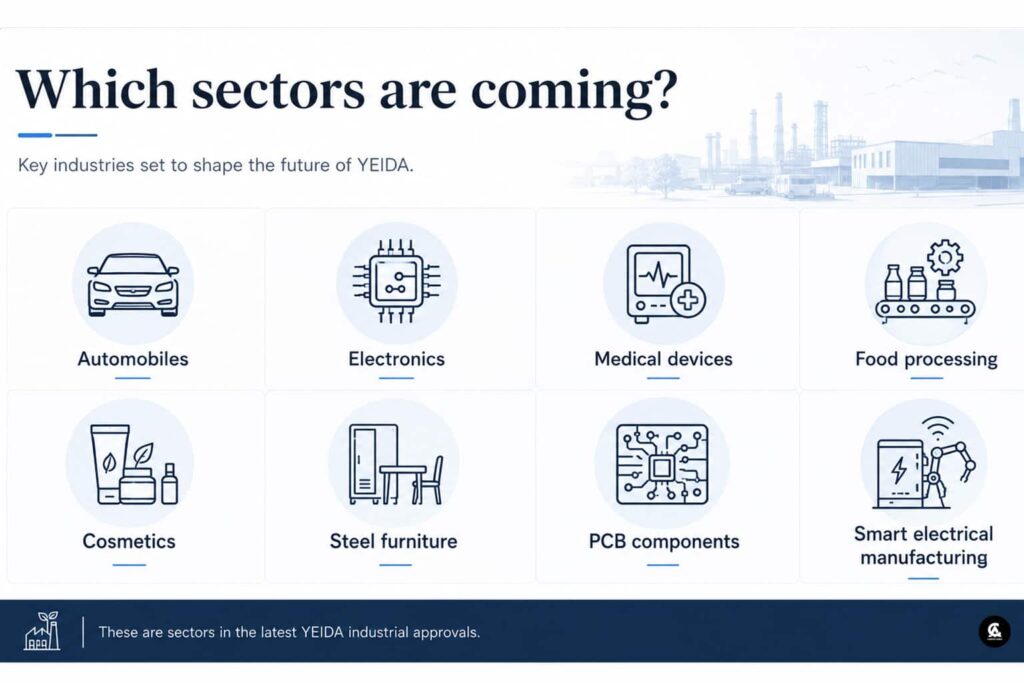
The sectors involved include:
- automobile components
- electronics
- medical and healthcare products
- food processing
- cosmetics and personal care
- steel furniture
- smart electrical manufacturing
- PCB and electronic components
For a general reader, this may sound like an industrial-development update. But for property buyers, this is much more than that.
This is a signal that the Yamuna Expressway region is not being developed only as a plot-investment zone. It is also being shaped as a future industrial and employment corridor.
Which companies and sectors are part of the update?
The list of companies is important because it shows that the development is spread across different industries, not limited to a single sector.
According to reports, Samvardhana Motherson International is expected to invest in an automotive components manufacturing project. Balar Marketing is linked to a smart electrical manufacturing unit. Triveni Almirah is associated with a steel furniture and almirah manufacturing unit. Anondita Healthcare is expected to develop a healthcare gloves-related project.
The list also includes food processing and packaging units, a perfume and cosmetics manufacturing project, and an electronics-components unit.
This diversity matters because a multi-sector industrial base usually creates a wider mix of employment. That, in turn, can support different forms of real-estate demand.
Why do industrial projects matter for real estate?
This is the most important part for Carpet Area readers.
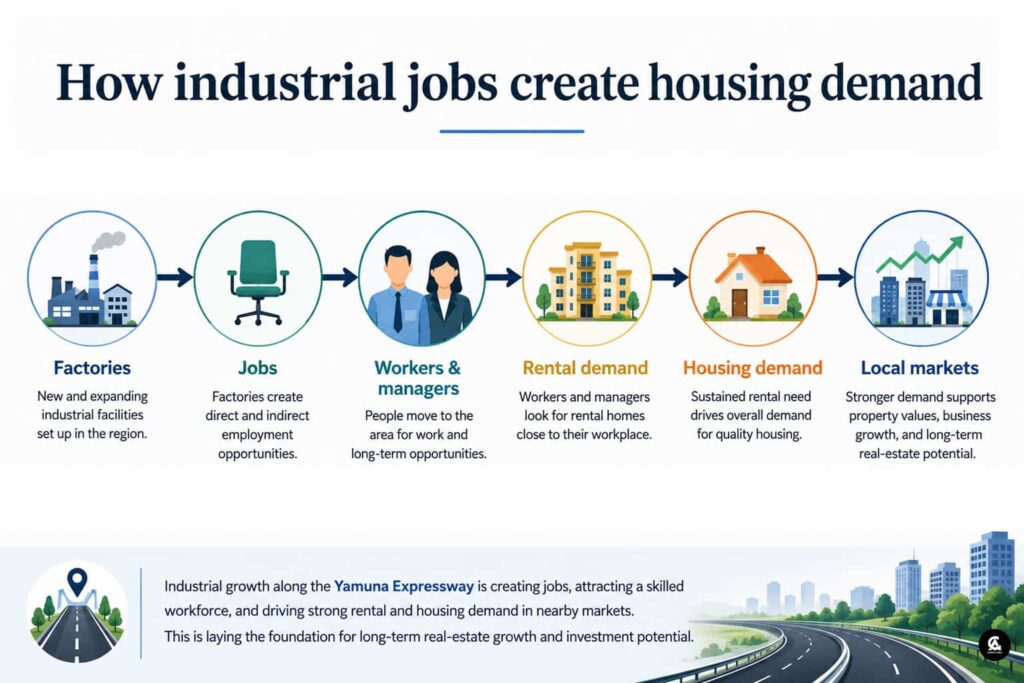
Industrial investment matters because jobs create real housing demand.
When industrial units become operational, they attract different kinds of people to the area:
- factory workers
- engineers
- managers
- logistics staff
- service providers
- transport operators
- small business owners
- vendors and suppliers
These people do not only work in the region. Many of them eventually need:
- rental housing
- affordable flats
- mid-income homes
- worker accommodation
- shops and local markets
- commercial services
- transport access
- schools and clinics
That is why this update matters for real estate. Employment can create actual occupancy demand, which is more durable than hype-driven demand.
Why does this matter near Jewar Airport?
Jewar Airport has already made the Yamuna Expressway region one of the most watched real-estate corridors in North India. Many investors entered the market because of airport-led optimism.
But airport-based growth becomes far more meaningful when it is backed by industries, manufacturing, logistics and services.
That is the larger significance of this news.
The latest industrial approvals suggest that the region is being positioned not only as an airport zone, but as a larger growth ecosystem. In practical terms, that means the future story of Yamuna Expressway may depend on the combination of:
- Noida International Airport
- industrial sectors
- logistics activity
- employment generation
- housing demand
- internal road connectivity
- commercial growth
This is a stronger and healthier real-estate story than a market driven only by speculative expectations.
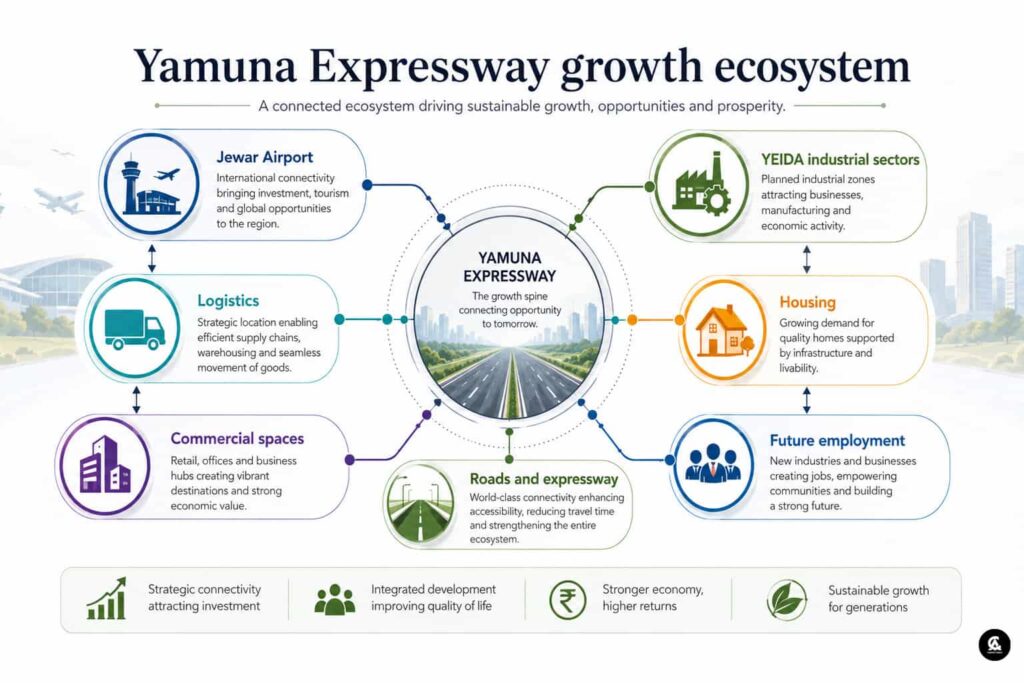
Is Yamuna Expressway moving from speculation to employment-led demand?
That is the central question behind this update.
For a long time, Yamuna Expressway real estate was discussed mainly in terms of future appreciation. Buyers tracked airport news, plot schemes and infrastructure announcements, hoping that property values would rise.
Now the conversation is beginning to mature.
If these industrial projects move from approval stage to land allotment, construction and operations, then the region may begin to see real, employment-led property demand.
That is the difference between speculative attention and genuine usage-based growth.
For Mr. Sharma, this changes the way he should think. Instead of asking only whether prices may rise, he should also ask whether people may actually live and work in the region in the coming years.
What kind of property demand may come?
If these industrial projects become operational, the demand may not be limited to one housing category.
Different groups may create different types of demand.
For example:
- senior executives may prefer better residential projects or plotted homes
- middle-level employees may look for rental apartments and affordable flats
- workers may create demand for budget housing or staff accommodation
- local entrepreneurs may need commercial shops or service spaces
- logistics and vendor networks may create demand for warehouses and small industrial support units
This means the impact could spread across:
- residential property
- rental housing
- plotted development
- small commercial spaces
- local retail
- service infrastructure
That is why the real-estate effect of industrial growth can be much wider than many buyers initially assume.
Why should YEIDA plot buyers track this update?
For many buyers, YEIDA is mainly associated with residential plot schemes. But this update adds a new layer to that thinking.
Now, buyers should not look only at allotment rates, airport distance and future appreciation. They should also start looking at employment proximity.
A location that is close to future industrial activity and supported by roads, services and daily-use infrastructure may have stronger long-term real-estate logic than a location that depends only on speculative resale expectations.
However, this does not mean every YEIDA sector will benefit equally. The impact will depend on:
- distance from industrial sectors
- road connectivity
- development status
- current liveability
- future transport links
- rental demand
- actual execution of the projects
A sector near real employment clusters may behave very differently from a sector that is still underdeveloped on the ground.
What should buyers be careful about?
This is where buyers need to be disciplined.
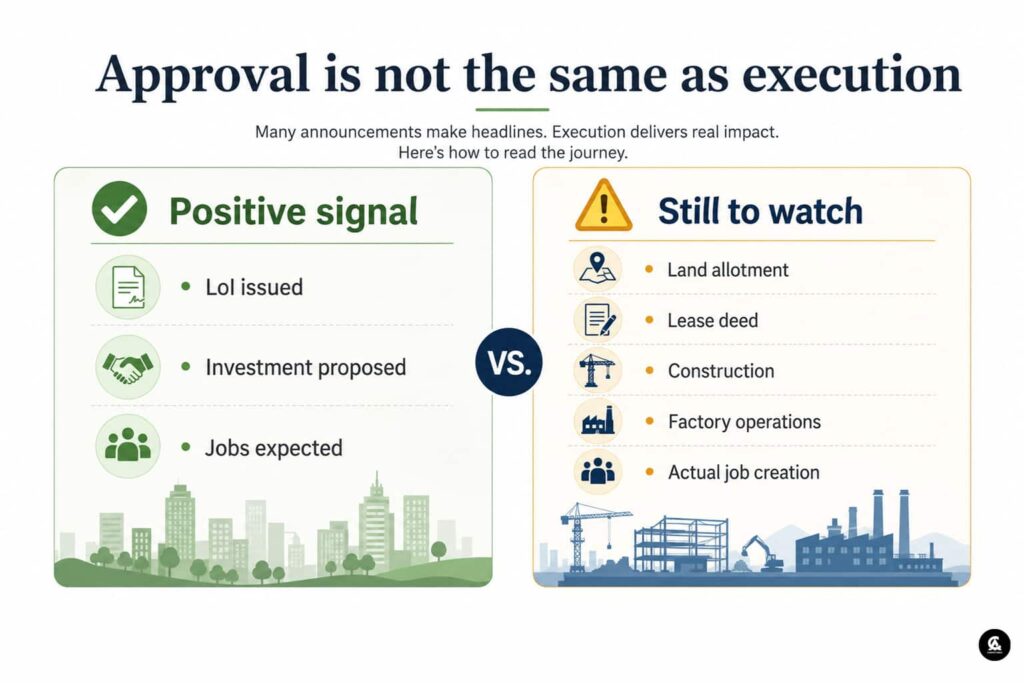
An approval or letter of intent is a positive development, but it is not the same as full execution.
There is a big difference between:
- project approval
- land allotment
- lease deed execution
- factory construction
- commissioning
- actual operations
- real job creation
This difference matters because the market often reacts to news much faster than development happens on the ground.
A buyer should not assume that immediate real-estate appreciation is guaranteed just because a big investment figure has been announced.
This is why the safest approach is to track the next milestones carefully.
Should buyers invest only because of this news?
No. Buyers should not invest only because of this update.
This news should be treated as a positive long-term signal, not as an instant property-price trigger.
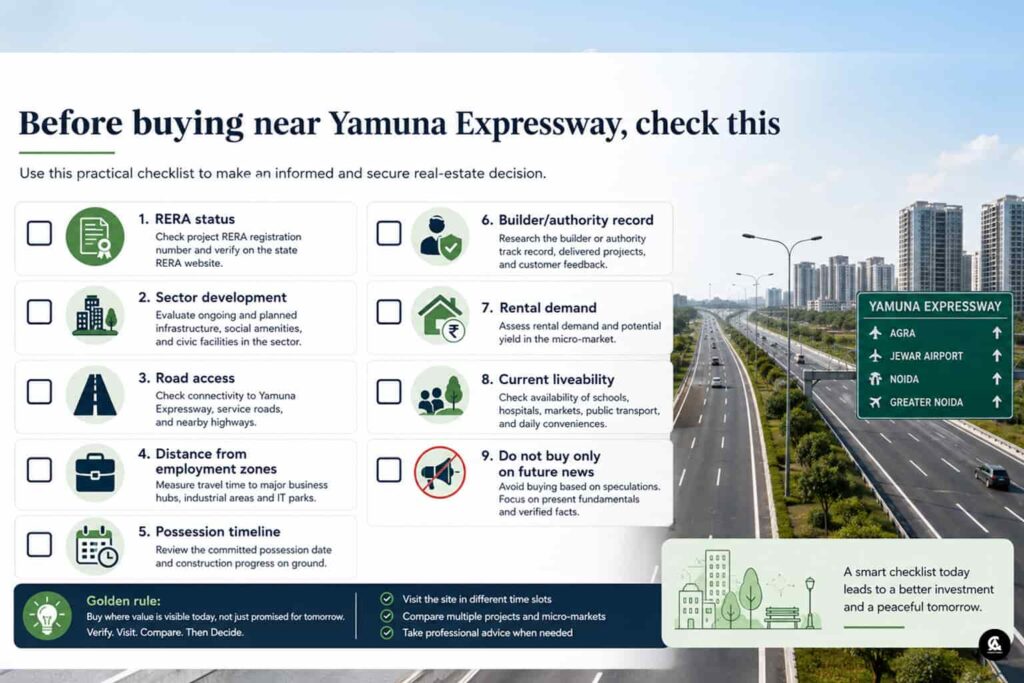
A smart property decision should still be based on a wider set of checks, including:
- current road access
- sector development status
- RERA status
- possession timeline
- builder or authority credibility
- legal clarity
- current liveability
- rental potential
- resale activity
- actual proximity to future employment zones
If the property makes sense even without short-term excitement, then industrial growth may become an added advantage later.
But if the property depends only on projected future demand, the risk becomes higher.
What does this mean for Yamuna Expressway real estate?
The latest YEIDA update shows that Yamuna Expressway real estate is slowly entering a more grounded phase.
The region is no longer only about airport excitement or plot-scheme discussions. The stronger long-term story now may be built around a combination of:
- airport-led connectivity
- industrial investment
- manufacturing growth
- logistics demand
- employment generation
- housing demand
- commercial and service activity
If these elements move together, Yamuna Expressway can develop into a genuine economic corridor rather than remaining only a speculative real-estate destination.
That is the bigger meaning of this news.
Final takeaway
Mr. Sharma’s question is the same question many smart buyers are asking today.
Earlier, Yamuna Expressway real estate was mostly discussed through the lens of Jewar Airport and future appreciation. Now, with YEIDA approving industrial projects worth ₹3,181 crore, the conversation is gradually shifting toward employment-led demand.
That is a healthier and more sustainable real-estate signal.
A location becomes stronger when people do not just invest there, but also need to work there, rent there and live there.
For buyers, the conclusion is simple:
This industrial-investment update is a positive sign for Yamuna Expressway real estate, but the real impact will depend on execution, job creation and actual demand on the ground.
A smart buyer should not ask only:
Will prices rise after this news?
A smart buyer should ask:
Will this region create real jobs, real housing demand and real liveability over time?
That is the difference between short-term excitement and informed property thinking.
Disclaimer
This article is for public awareness and real-estate education only. Industrial investment, job creation, timelines and real-estate impact depend on actual execution, approvals, construction, operations, infrastructure development and market conditions. Property buyers should verify official records, RERA details, location status and legal documents before making any purchase or investment decision.
Sources:-
- Times of India — YEIDA issues letters of intent to eight industrial investors with proposed investment of around ₹3,181 crore and expected employment of 18,126 jobs
https://timesofindia.indiatimes.com/city/noida/med-to-cosmetics-yeida-oks-8-projects-worth-rs-3-2k-crore/articleshow/132101030.cms - YEIDA official website
https://www.yamunaexpresswayauthority.com/web/ - YEIDA industrial property page
https://www.yamunaexpresswayauthority.com/web/property/industrial/ - YEIDA medical device park page
https://www.yamunaexpresswayauthority.com/web/projects/medical-device-park/ - Hindustan Times — earlier industrial-allotment and airport-linked development context
https://www.hindustantimes.com/cities/noida-news/yeida-eyes-5-800-cr-investment-10k-jobs-after-plot-allocations-to-17-firms-101779649949726.html




Leave a Reply