


The change rarely happens overnight.
A daughter begins reminding her mother about medicines. A son starts managing his father’s hospital appointments. Gradually, the children take responsibility for bills, domestic staff, home repairs and medical decisions.
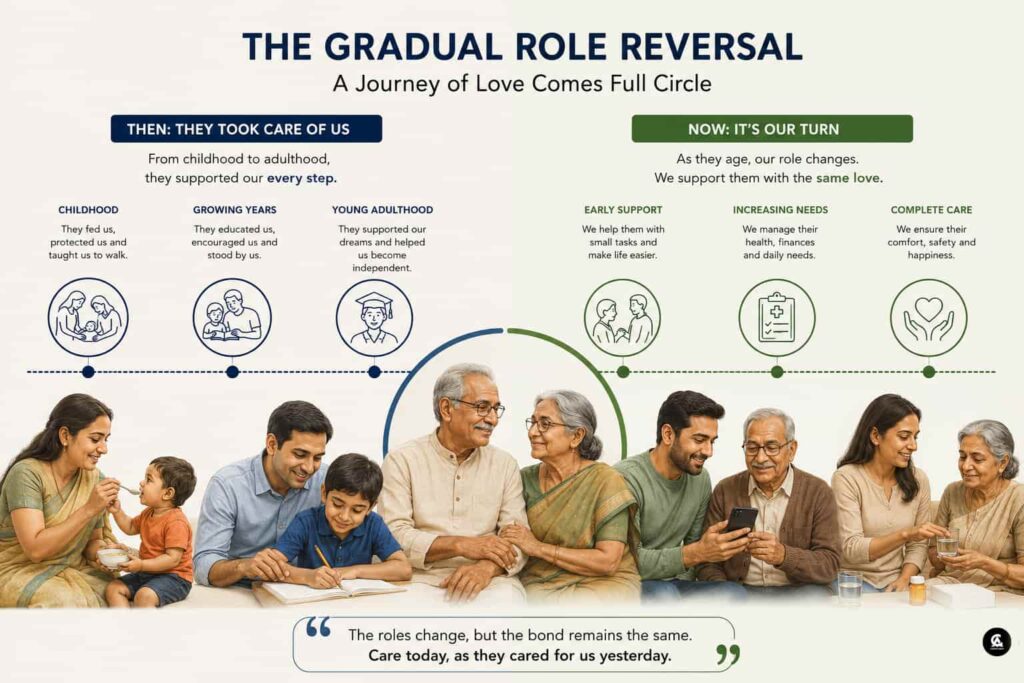
What begins as occasional help can slowly become a complete reversal of roles.
The children believe they are protecting their parents. The parents may feel that they are losing control over their own lives.
This phase is sometimes described as reverse parenting. However, the term can be misunderstood. It does not mean treating elderly parents like children. It means accepting greater responsibility while continuing to respect them as adults with their own preferences, identity and decision-making rights.
Ageing may increase dependence, but it does not cancel adulthood.
Reverse parenting is not about reversing authority
When children were young, parents made decisions because the children were not yet ready to manage them independently.
The situation is different with ageing parents.
An elderly person may need help with execution without losing the right to make the decision.
For example:
- A parent may need assistance paying an electricity bill but still understand personal finances.
- A senior may need transportation to a hospital but remain capable of selecting a doctor.
- A parent may need help taking medicines on time but still want to understand the treatment.
- A senior may require a caregiver without wanting the family to decide everything without consultation.
The purpose of reverse parenting should therefore be to add support—not to replace the parent’s authority with the child’s authority.
The five stages of reverse parenting
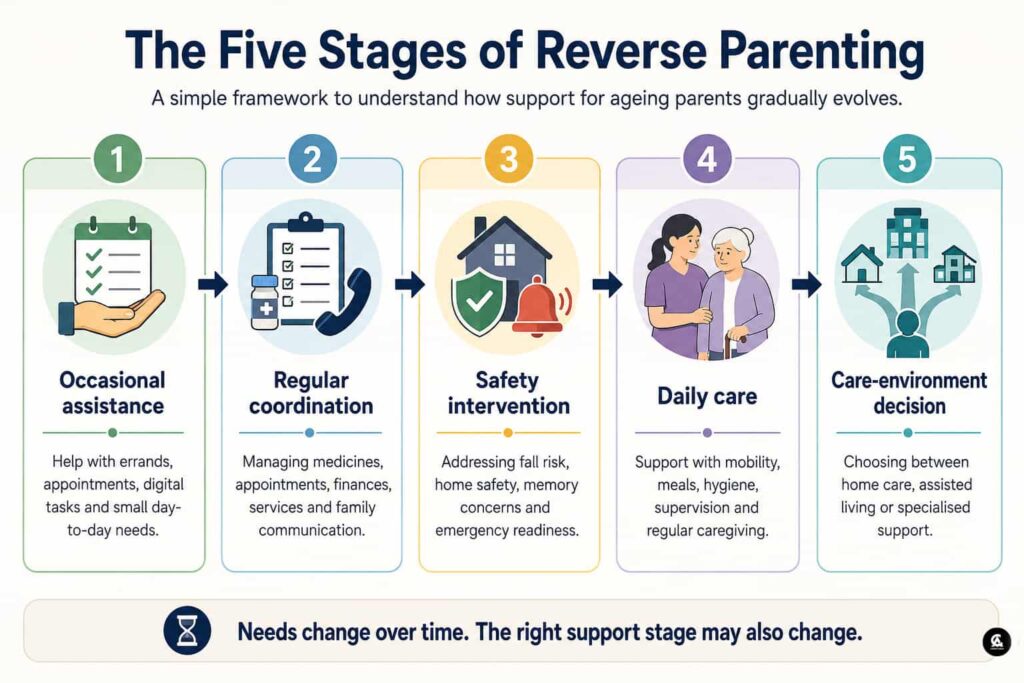
Every family does not reach the same level of responsibility at the same time. The change usually progresses through five practical stages.
Stage 1: Occasional assistance
The parent is largely independent but needs occasional help with:
- Digital payments
- Online appointments
- Travel bookings
- Insurance documentation
- Property paperwork
- Technology
- Home repairs
At this stage, the child is primarily a facilitator.
Stage 2: Regular coordination
The child begins managing recurring responsibilities such as:
- Medicines
- Doctor appointments
- Groceries
- Domestic help
- Utility bills
- Pension documentation
- Property maintenance
The parent may still live independently, but the arrangement now depends on regular coordination.
Stage 3: Safety intervention
A health event or visible warning sign makes greater involvement necessary.
This may include:
- A fall
- Missed medicines
- Confusion outside the home
- Unsafe driving
- Unpaid bills
- Spoiled food
- Repeated hospitalisation
- Unexplained financial transactions
The family must now determine what has become difficult, unsafe or unreliable.
Stage 4: Daily care dependency
The parent may require regular support with:
- Bathing
- Dressing
- Toileting
- Mobility
- Meals
- Medication
- Supervision
- Night-time assistance
The family is no longer coordinating only tasks. It is managing a care system.
Stage 5: Care-environment decision
At this stage, the family may need to evaluate:
- Home modification
- Full-time caregiver support
- Separate day and night caregivers
- Nursing at home
- Moving parents closer to children
- Assisted living
- Dementia-care support
The final decision should not be based only on emotion or monthly price. It should consider safety, continuity, dignity and long-term sustainability.
Care and control can look similar from the outside
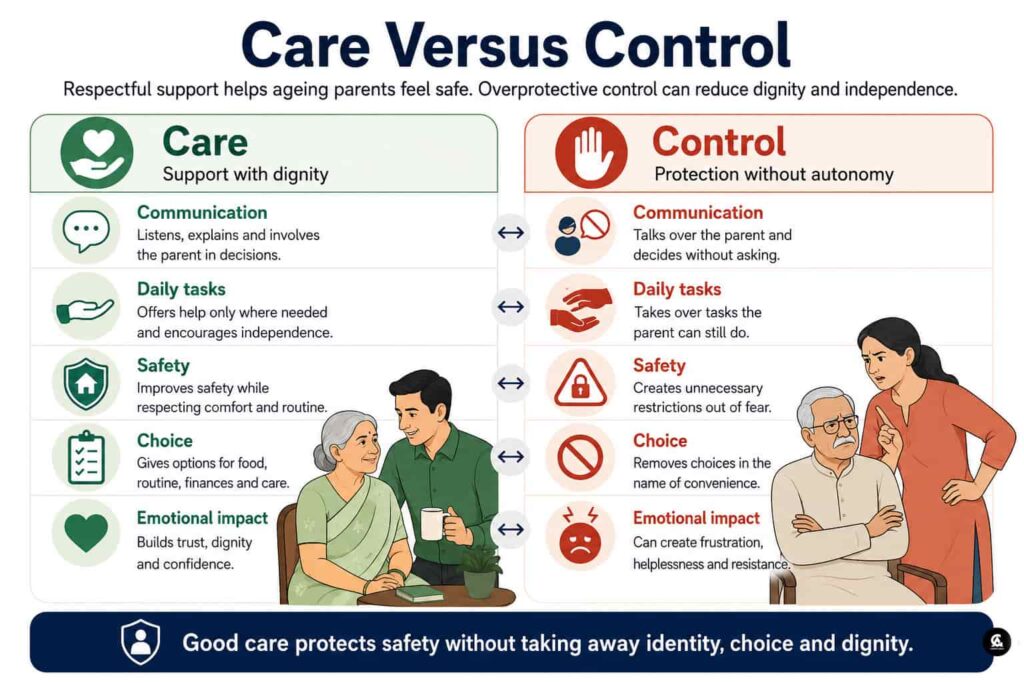
Most adult children do not intentionally control their parents.
Control often begins as protection.
A child worries about a fall and stops the parent from going outside. A daughter worries about financial fraud and takes over every bank transaction. A son worries about medicines and begins issuing instructions rather than explaining choices.
The intention may be good, but the parent may experience the result as loss of freedom.
| Supportive care | Excessive control |
|---|---|
| Asking what the parent prefers | Deciding without consultation |
| Offering practical options | Giving only instructions |
| Helping with difficult tasks | Taking over everything |
| Making activities safer | Stopping all activity |
| Managing money transparently | Controlling accounts secretly |
| Reviewing ability regularly | Assuming inability because of age |
| Explaining medical decisions | Discussing treatment without the parent |
| Encouraging independence | Creating unnecessary dependence |
A useful rule is:
Provide help where ability has reduced, but preserve choice wherever decision-making remains intact.
Is the parent becoming dependent—or is the house creating dependence?
This is one of the most important questions families overlook.
Sometimes the senior’s health has changed. At other times, the house itself is making ordinary life difficult.
Consider a parent who struggles to reach a first-floor bedroom. The problem may not be complete physical dependence. The problem may be the staircase.
A senior may appear dependent because:
- The bathroom has no grab bars
- The bedroom is upstairs
- The building lift is unreliable
- There is no lift power backup
- Doorways are too narrow for a wheelchair
- Lighting is poor
- The kitchen is difficult to use safely
- The home is far from hospitals
- The property is too large to maintain
- The neighbourhood has limited social access
A person who struggles in a large duplex may remain more independent in a smaller, accessible apartment.
The property should therefore be assessed as part of the care plan.
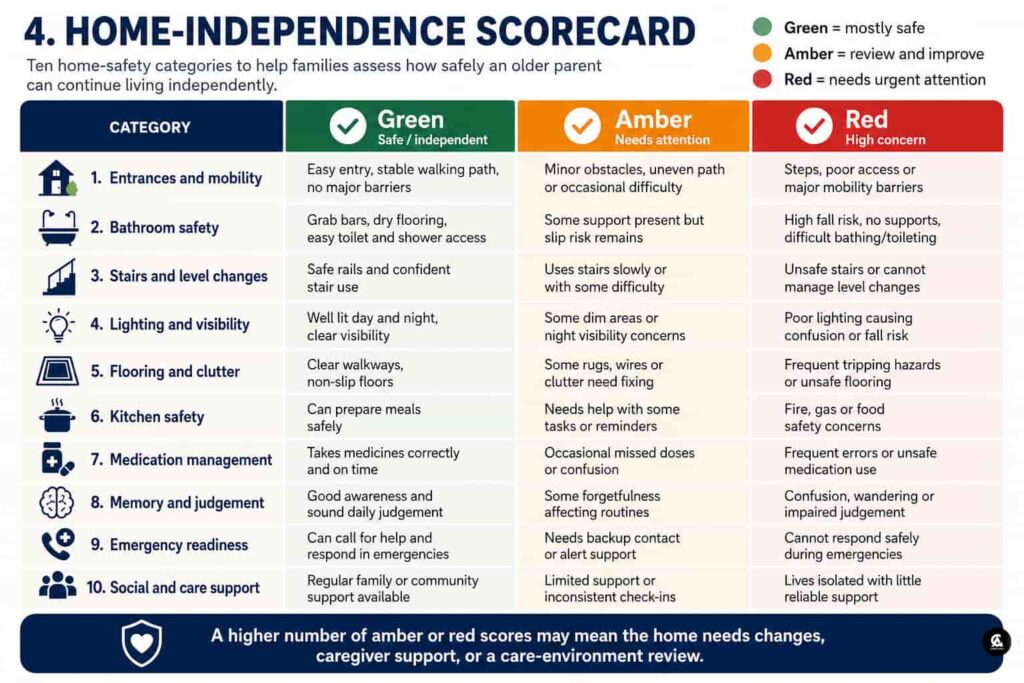
The home-independence score
Families can use the following screening tool before deciding whether an ageing parent can continue living safely at home.
Score every item:
- 0: Unsafe or unavailable
- 1: Available but limited
- 2: Safe and suitable
| Area assessed | Score: 0–2 |
| Step-free entrance | |
| Reliable lift | |
| Lift power backup | |
| Senior-friendly bathroom | |
| Bedroom on an accessible level | |
| Space for walker or wheelchair | |
| Emergency calling system | |
| Ambulance access | |
| Nearby hospital and pharmacy | |
| Family or neighbour availability |
Understanding the score
- 16–20: The home may support ageing with limited changes.
- 10–15: Modifications and additional support are likely to be required.
- Below 10: The long-term suitability of the home should be reconsidered.
This score is a practical family screening tool, not a medical or architectural certification.
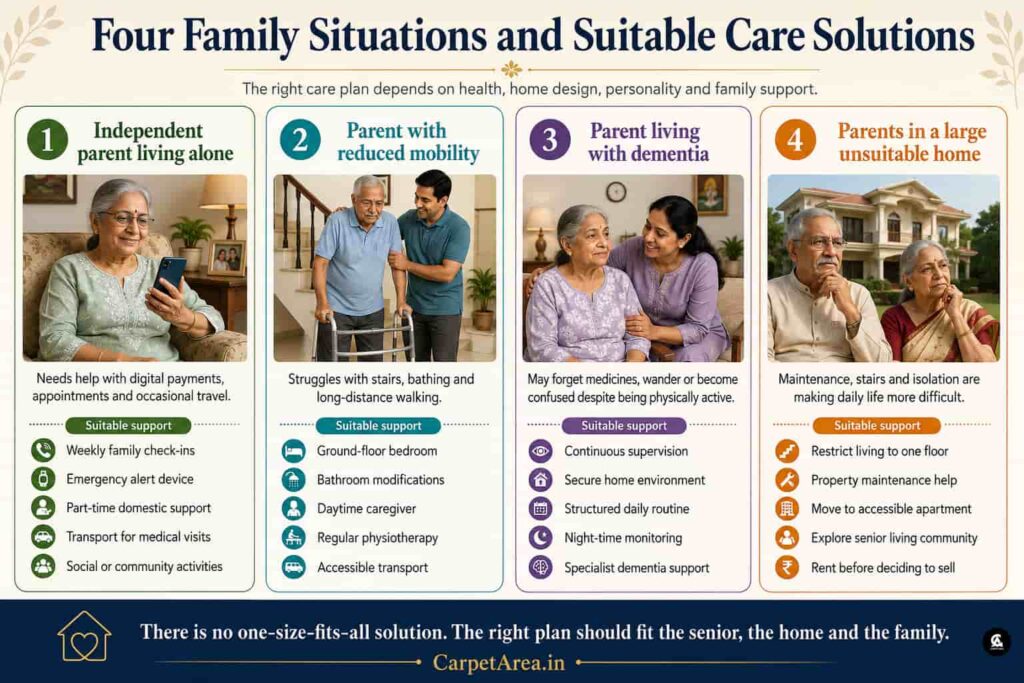
Four family situations—and four different solutions
There is no single correct model of reverse parenting.
The right response depends on the parent’s health, home, personality and family structure.
Situation 1: An independent mother living alone
She cooks simple meals, manages personal hygiene and walks without assistance. However, she struggles with digital payments and hospital visits.
A suitable support plan may include:
- Weekly family coordination
- Emergency alert device
- Part-time domestic support
- Scheduled transportation
- Social or community activities
Moving her immediately may reduce independence rather than improve it.
Situation 2: A father with reduced mobility
He remains mentally active but struggles with stairs, bathing and long-distance walking.
A suitable plan may include:
- Moving the bedroom to the ground floor
- Installing bathroom grab bars
- Adding anti-skid flooring
- Hiring a daytime caregiver
- Regular physiotherapy
In this case, modifying the property may preserve independence.
Situation 3: A parent living with dementia
The parent is physically active but forgets medicines, leaves appliances switched on or wanders outside.
Physical strength does not mean the person can live without supervision.
The family may need:
- Continuous monitoring
- A secure environment
- Structured routines
- Trained dementia support
- Night supervision
- Specialist residential care, if home care becomes unreliable
Situation 4: Elderly parents living in a large villa
The parents are emotionally attached to the property, but maintenance, internal stairs and isolation are increasing.
The family may consider:
- Restricting living to one floor
- Hiring property-maintenance support
- Moving to a nearby accessible apartment
- Renting the original property
- Exploring a senior-living community
Selling the family home does not have to be the first step. Families can evaluate reversible options before making a permanent decision.
Warning signs that support must increase
Families often delay planning until a crisis forces an urgent decision.
The following signs deserve attention:
- Repeated falls
- Missed or duplicated medicines
- Poor personal hygiene
- Significant weight loss
- Unpaid bills
- Frequent confusion
- Spoiled food in the kitchen
- Unsafe driving
- Isolation
- Repeated caregiver disputes
- Unexplained bank withdrawals
- Increased hospital visits
- Fear of staying alone
- Difficulty managing toileting or bathing
One incident does not automatically mean the parent can no longer live independently.
However, repeated incidents indicate that the existing arrangement should be reviewed.
Financial support must remain transparent
Money is one of the most sensitive parts of reverse parenting.
Adult children may need to assist with:
- Pension management
- Utility payments
- Medical expenses
- Caregiver salaries
- Insurance claims
- Property tax
- Banking
- Fraud protection
Support should not quietly become financial control.
Where the parent retains decision-making capacity:
- The money remains the parent’s money.
- Expenses should be explained.
- Account access should be transparent.
- Important transactions should be documented.
- Property decisions should not be taken under pressure.
- Other siblings should be informed where appropriate.
A secure financial system should protect the parent without making the parent feel excluded.
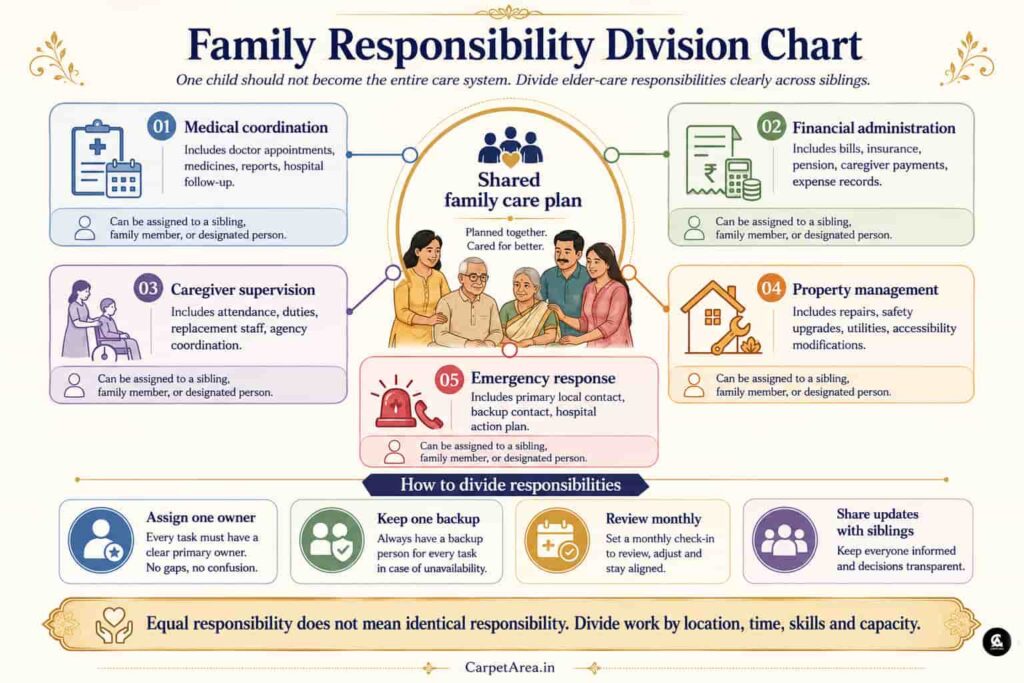
One child should not become the entire care system
In many families, one sibling becomes the default caregiver.
That person may manage appointments, caregivers, hospital visits, bills and emergencies while others assume that everything is under control.
This often creates exhaustion and resentment.
Responsibilities can be divided into five areas:
| Responsibility | Possible owner |
| Medical coordination | Sibling living nearby |
| Financial administration | Sibling experienced with accounts |
| Caregiver supervision | Local family member or agency |
| Property maintenance | Assigned sibling or professional manager |
| Emergency response | Local contact with backup person |
Equal responsibility does not always mean identical responsibility.
A sibling living abroad may contribute financially or manage documentation. A sibling living nearby may coordinate medical visits. The important point is that the arrangement should be discussed, documented and reviewed.
Better language can prevent resistance
Parents often resist help because the conversation makes them feel incapable.
The wording matters.
Instead of saying:
“You cannot manage alone anymore.”
Say:
“Which parts of your routine are becoming tiring, and where would you like support?”
Instead of:
“You must stop driving.”
Say:
“Let us review whether driving still feels safe and what transport alternatives would preserve your routine.”
Instead of:
“We have decided that you should move.”
Say:
“Let us compare what staying here safely would require and what another living arrangement could provide.”
Instead of:
“Give me control of your bank account.”
Say:
“Let us create a secure and transparent way to manage payments while keeping you informed.”
A respectful conversation reduces defensiveness and produces better decisions.
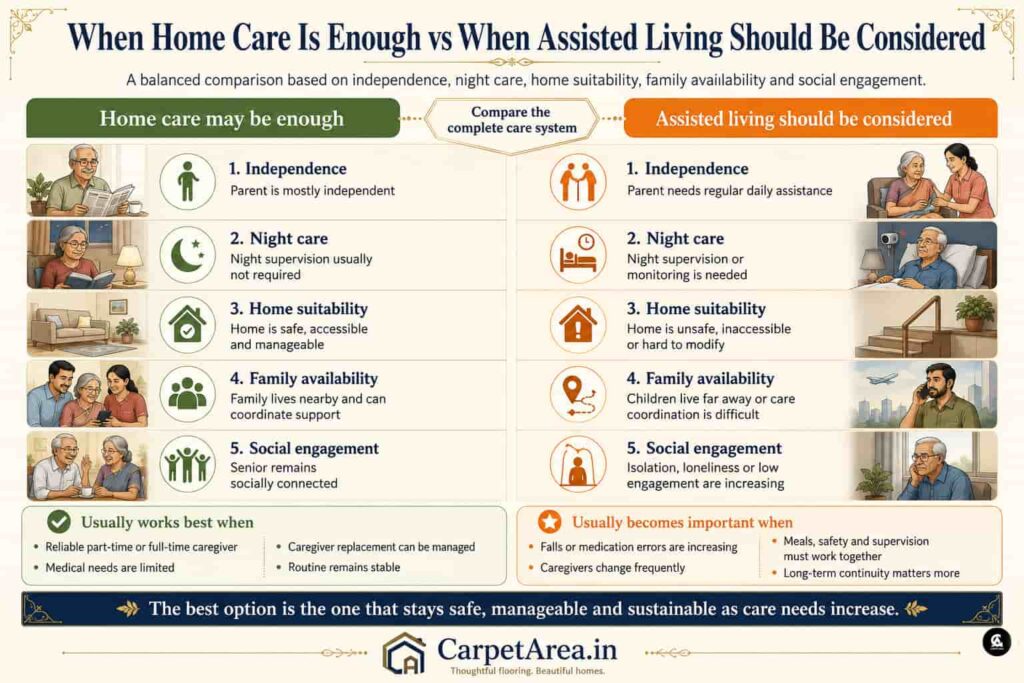
When home care may be sufficient?
Home care may work well when:
- The parent is mostly independent
- The house is accessible
- Family lives nearby
- Night supervision is not required
- A reliable caregiver is available
- Medical needs are limited
- The senior remains socially connected
- Caregiver replacement can be managed
The emotional value of a familiar home should not be underestimated.
However, familiarity alone does not make the arrangement safe.
When assisted living deserves consideration?
Assisted living may be appropriate when:
- The parent lives alone
- Children live in another city or country
- Caregivers change frequently
- Falls are increasing
- Night supervision is necessary
- The home cannot be modified adequately
- Social isolation is affecting emotional health
- Medication errors are recurring
- Family coordination has become unsustainable
- The senior needs meals, care, activities and emergency support together
Choosing assisted living is not automatically abandonment.
In some cases, it creates continuity and social engagement that the family home can no longer provide.
Loving parents does not make children trained caregivers
Adult children may have:
- Full-time jobs
- Their own children
- Health limitations
- Financial commitments
- Marriage and household responsibilities
- Long-distance living arrangements
Love does not automatically provide the time, training or physical ability required for continuous care.
This is not a moral failure.
The responsible approach is to recognise the family’s limits before the arrangement becomes unsafe for the parent and exhausting for the child.
Professional support should be seen as an extension of family care—not as a substitute for affection.
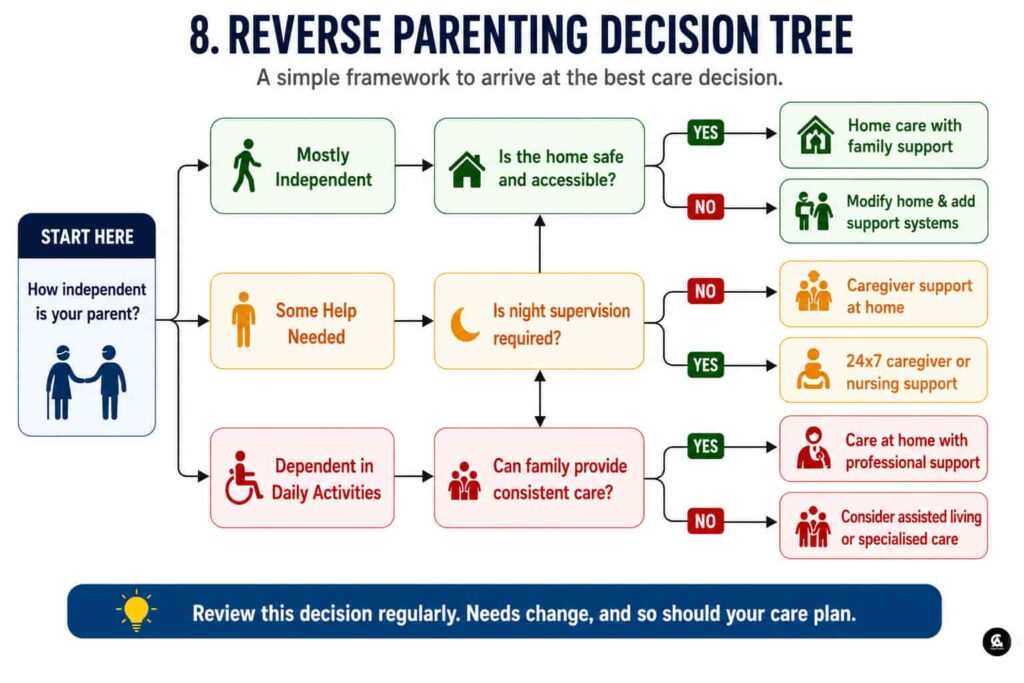
A seven-question family decision framework
Before increasing care, modifying the home or discussing relocation, ask:
- What can the parent still manage independently?
- What has become difficult or unsafe?
- Is the house supporting or reducing independence?
- Who will coordinate care consistently?
- Is supervision required during the night?
- Is the parent socially engaged?
- Can the arrangement continue if dependency increases?
The parent should remain part of this discussion wherever decision-making capacity is intact.
Reverse parenting should preserve dignity, not remove authority
Reverse parenting is not about becoming the parent of your parent.
It is about accepting that the balance of responsibility has changed.
The child may now coordinate appointments, manage caregivers, improve the house or plan a safer living arrangement. But support should be added carefully, gradually and transparently.
The best arrangement is not the one that gives children maximum control.
It is the one that allows ageing parents to retain the greatest possible independence while remaining safe, supported and socially connected.
Before taking over a responsibility, ask one question:
Does my parent genuinely need me to make this decision, or do they only need help carrying it out?
That distinction can protect both dignity and family relationships.






Leave a Reply