

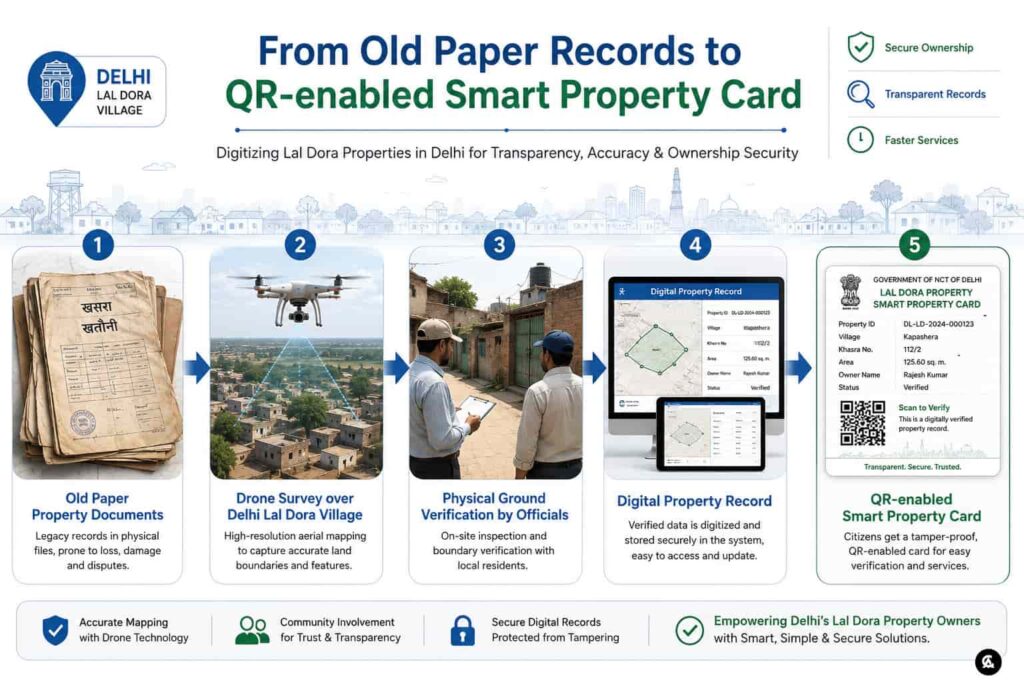
For nearly three decades, Rajesh’s family had lived in an ancestral house inside a Delhi Lal Dora village.
The family knew where their portion ended and where the neighbour’s property began. Electricity and water connections were available, local residents recognised their possession, and several old papers had been preserved carefully.
But when Rajesh tried to sell one floor of the property, the buyer asked questions that were difficult to answer clearly:
- Where was the officially mapped boundary?
- Who legally owned each family member’s share?
- Was the property free from competing claims?
- Could a bank finance the purchase?
- Would the transaction be registered without difficulty?
The property existed physically, but its documentation did not give the buyer complete confidence.
Delhi’s proposed QR-enabled Smart Property Card system could improve this situation for thousands of Lal Dora and Abadi property holders.
The Delhi government is surveying village-abadi properties under the central SVAMITVA scheme and plans to issue digitally verified Smart Property Cards to eligible beneficiaries. The initiative is intended to create more systematic, secure and transparent property records.
But one critical question remains:
Will the Smart Property Card make a Lal Dora property fully legal and safe to purchase—or will buyers still need complete legal due diligence?
What is the latest Delhi Lal Dora property update?
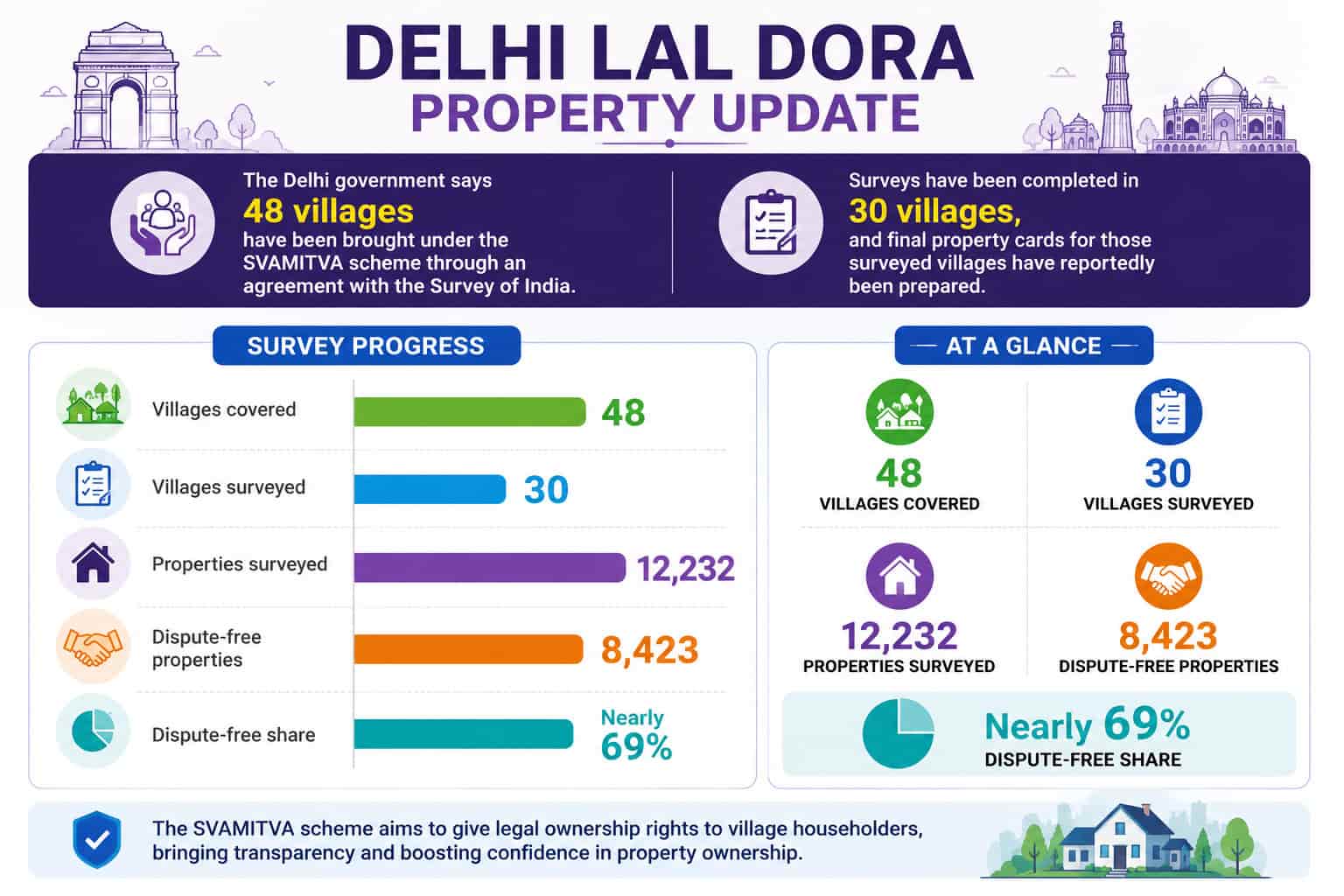
The Delhi government says 48 villages have been brought under the SVAMITVA scheme through an agreement with the Survey of India.
Surveys have been completed in 30 villages, and final property cards for those surveyed villages have reportedly been prepared.
So far:
| Survey progress | Reported figure |
|---|---|
| Villages covered | 48 |
| Villages surveyed | 30 |
| Properties surveyed | 12,232 |
| Dispute-free properties | 8,423 |
| Dispute-free share | Nearly 69% |
The process of integrating digital signatures and beginning the Smart Property Card rollout is stated to be in its final stage. The government has said the cards will be issued to eligible beneficiaries, but a complete public distribution schedule has not yet been announced.
What is a Lal Dora area?
Lal Dora areas are traditional village-habitation zones marked with a red line in revenue records to distinguish residential settlement areas from surrounding agricultural land.
These areas have historically operated under a distinct documentation and development framework. As a result, owners and buyers may encounter uncertainty involving boundaries, occupancy, construction status, title records and registration.
Why are Smart Property Cards being introduced?
The government has acknowledged that the absence of systematic and authenticated property records has created long-standing difficulties for Lal Dora residents.
The Smart Property Card initiative aims to provide:
- a unique digital identity for each mapped property;
- verified property details;
- clearer mapped boundaries;
- occupier and co-occupant information;
- a QR-linked digital record;
- easier updating and verification of records.
The records are expected to be linked with the Delhi Online Registration Information System, or DORIS, so that they can remain updated digitally.
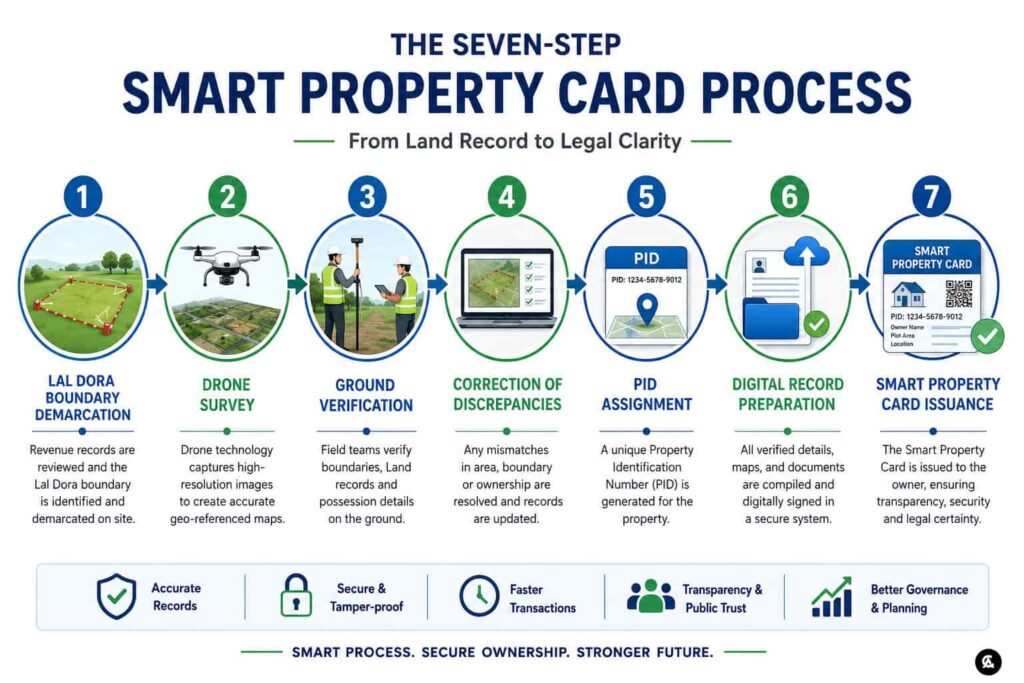
How will a Lal Dora property move from survey to Smart Property Card?
The process is more detailed than simply scanning old documents.
Step 1: Lal Dora boundary demarcation
The boundary of the village habitation area is identified using available revenue records.
Step 2: Drone survey
The Survey of India conducts an aerial survey to create high-resolution property maps.
Step 3: Ground verification
Delhi Revenue Department officials compare the drone-generated map with the actual physical position of houses and plots.
Step 4: Correction of discrepancies
If the aerial map and ground situation do not match, the discrepancy is referred to the Survey of India for correction.
Step 5: Property identification
Each verified property is assigned a unique Property Identification Number, or PID.
Step 6: Digital record preparation
Property details, area, occupancy and mapped boundaries are compiled into the digital record.
Step 7: Card issuance
Eligible properties receive the Smart Property Card after verification and completion of the prescribed process.
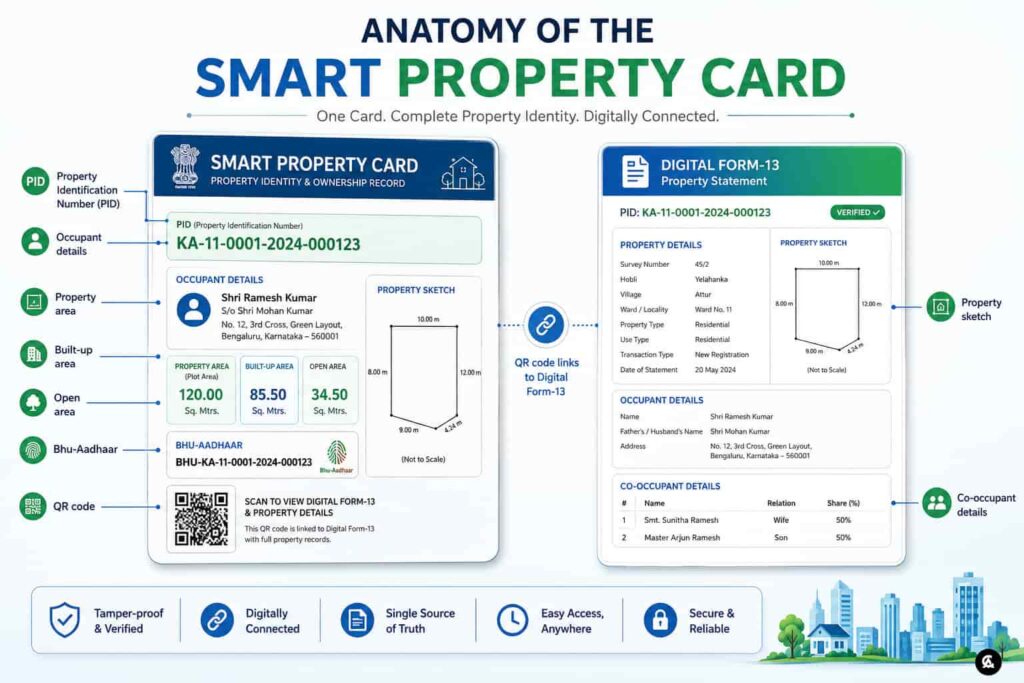
What information will the Smart Property Card contain?
According to the reported government details, the Smart PVC Property Card is expected to include:
- Property Identification Number;
- date of issue;
- village;
- subdivision;
- district;
- occupant’s name;
- father’s or husband’s name;
- share in the property;
- total property area;
- built-up area;
- open area;
- Bhu-Aadhaar number;
- co-occupant details;
- contact information;
- QR code.
Scanning the QR code is expected to open the property’s Digital Form-13. This may contain:
- detailed property sketch;
- mapped boundaries;
- neighbouring property PIDs;
- Khasra number;
- co-occupant details;
- family-member details;
- Tehsildar’s digital signature;
- official seal;
- Certificate of Occupancy under the relevant Delhi rules.
Who is likely to receive the Smart Property Card?
The government announcement refers to eligible beneficiaries or eligible property owners in surveyed Lal Dora and Abadi areas.
A property is more likely to move towards card issuance when:
- its survey has been completed;
- its mapped boundary is verified;
- occupancy details are clear;
- no unresolved dispute is recorded;
- discrepancies have been corrected;
- the property has been assigned a PID.
Of the 12,232 surveyed properties, 8,423 have been identified as dispute-free so far. Work is reportedly continuing on the remaining cases.
Who may have to wait?
Card issuance may take longer where there are:
- overlapping boundary claims;
- disputes between family members;
- unclear inheritance;
- multiple occupancy claims;
- objection to the survey map;
- mismatch between physical possession and old records;
- unresolved litigation.
The current reports do not provide a complete public objection, correction or appeal procedure. Property holders should wait for detailed instructions from the Delhi Revenue Department before assuming how disputed cases will be resolved.
Will owners have to apply separately?
The project is currently described as a government-led survey and verification exercise.
The publicly reported information does not yet provide a complete:
- online application link;
- application fee;
- official document checklist;
- deadline;
- correction portal;
- objection procedure;
- card-distribution schedule.
Owners should avoid paying private agents who claim they can guarantee early issuance unless an official process is notified.
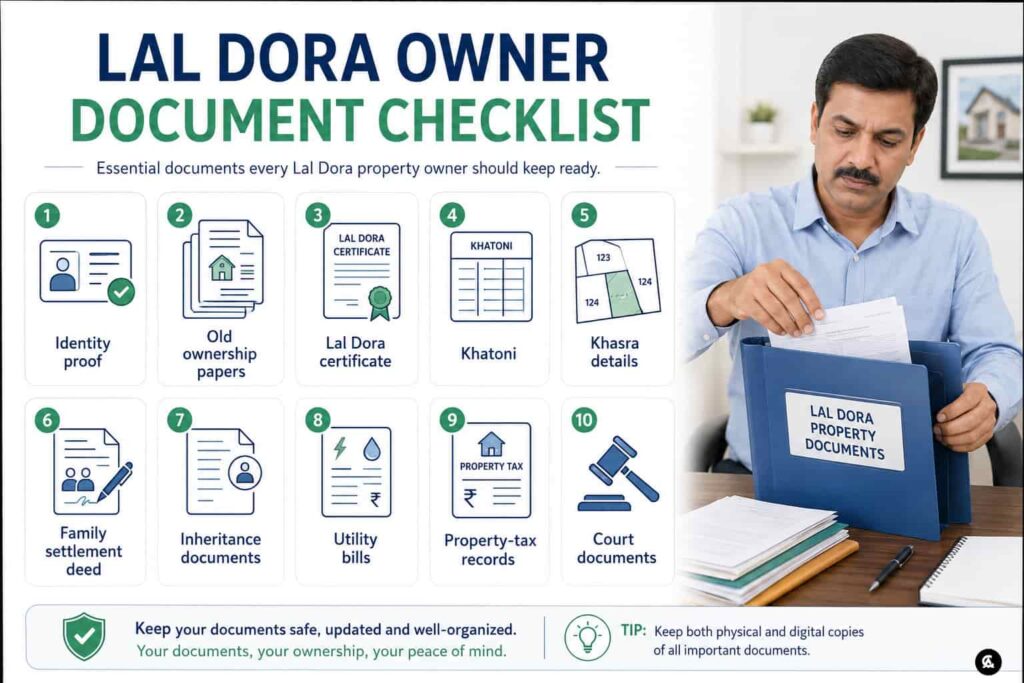
What should owners prepare in advance?
Although the government has not published a final universal checklist for this rollout, owners can organise a practical property file containing:
- identity proof;
- old property documents;
- Lal Dora certificate, where available;
- Khatoni or revenue records;
- family settlement papers;
- inheritance documents;
- previous sale or transfer documents;
- electricity and water bills;
- property-tax records;
- property sketch;
- co-owner consent;
- court orders, if any.
Delhi Revenue Department guidance for Lal Dora-related certificates already refers to documents such as ownership details, Khasra information, Aksh Sizra and Khatoni.
Does the Smart Property Card prove complete ownership?
This requires a careful answer.
The national SVAMITVA framework is intended to map rural-abadi properties and provide property cards or records of rights to household owners. The Delhi initiative is designed to create digitally verified records for eligible Lal Dora properties.
However, buyers should not assume that possession of a Smart Property Card automatically proves:
- perfect and marketable title;
- legality of every building or floor;
- valid construction approval;
- correct land use;
- absence of inheritance claims;
- absence of unregistered agreements;
- guaranteed registration;
- assured bank finance;
- freedom from every court case.
The card may become an important ownership and occupancy document, but it should form part of a broader legal verification process.
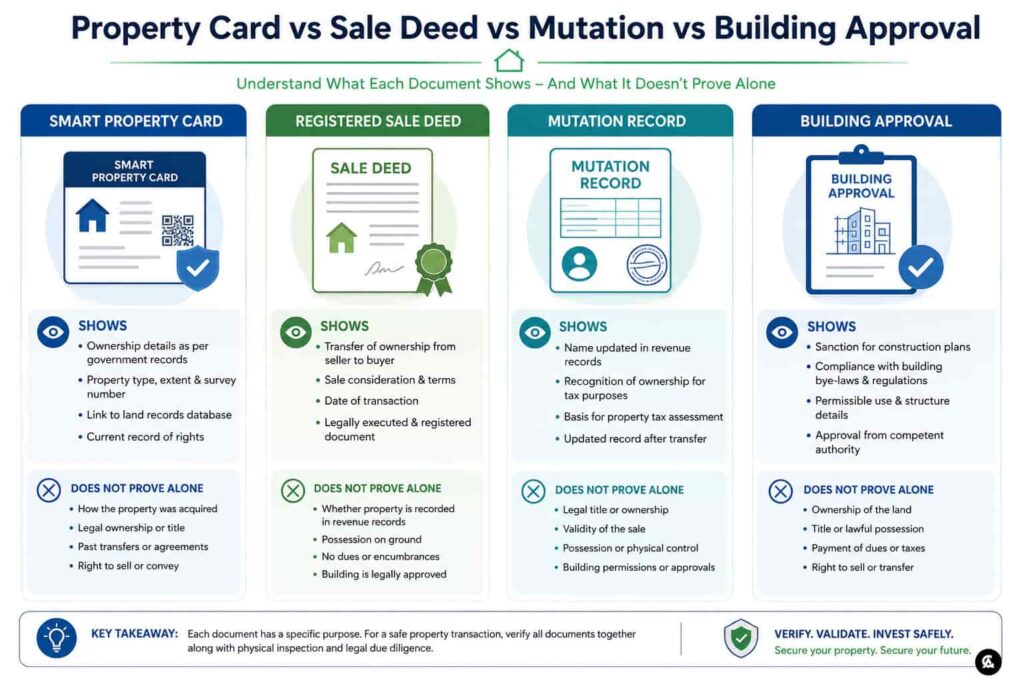
Property Card versus Sale Deed versus Mutation
These documents serve different purposes.
| Document | What it generally establishes | What it may not prove alone |
|---|---|---|
| Smart Property Card | Mapped property identity, area and occupancy-related details | Complete marketable title or construction legality |
| Registered sale deed | Transfer through a registered transaction | Absence of later disputes or updated mutation |
| Mutation record | Update of ownership details in government records | Conclusive ownership in every legal dispute |
| Lal Dora certificate | Property’s location or ownership claim in village-abadi area | Full title chain or building approval |
| Building approval | Permission for sanctioned construction | Ownership of the underlying property |
| Encumbrance search | Registered transactions and charges | Every unregistered claim or family dispute |
Delhi Revenue Department itself provides separate systems for checking registration records, encumbrances, court cases, prohibited properties and revenue maps. This shows why buyers should not rely on one document alone.
Rajesh receives a card—but can the buyer safely pay?
Return to Rajesh’s situation.
Suppose his property receives a Smart Property Card showing:
- a unique PID;
- mapped area;
- occupant details;
- property sketch;
- co-occupants;
- QR-linked digital record.
The buyer scans the QR code and confirms that the property exists in the new digital system.
This is valuable—but it is still not the right moment to transfer the full payment.
The buyer must also verify:
- how Rajesh acquired the property;
- whether all legal heirs consent;
- whether his share can be sold independently;
- whether there is a mortgage or court dispute;
- whether the construction matches the permitted use;
- whether the sale can be registered;
- whether access to the property is legally available;
- whether a bank will accept the property as security.
The Smart Property Card can improve transparency, but it does not remove the buyer’s duty to investigate the title.
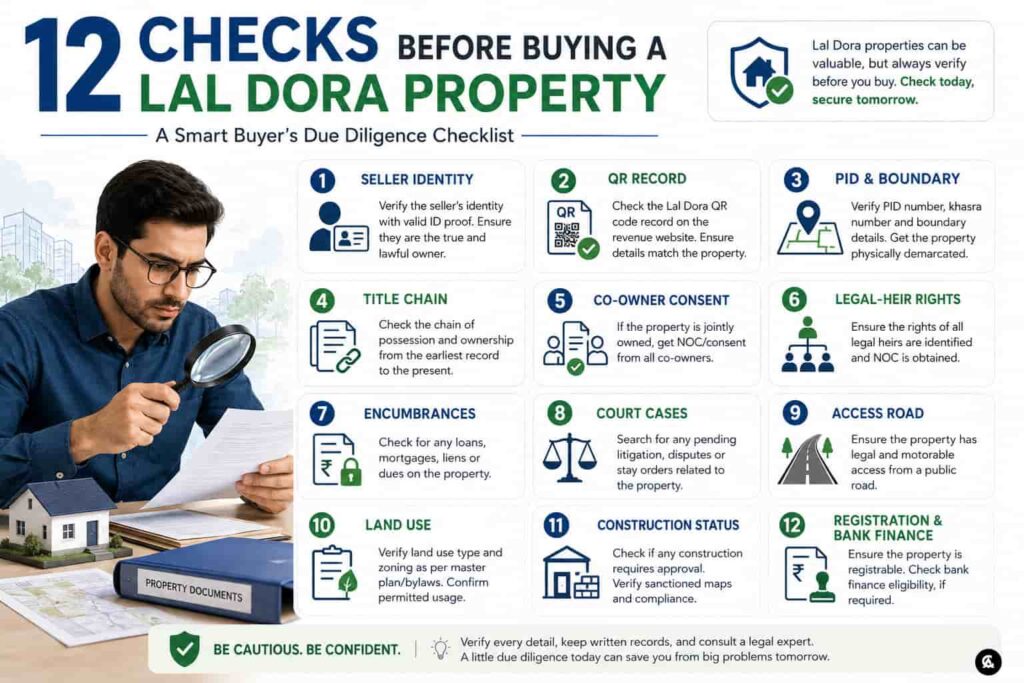
What should a buyer check before paying token money?
Use this practical checklist:
- Match the seller’s identity with the property record.
- Scan and verify the QR-linked record.
- Check the PID and mapped boundary.
- Verify the complete title chain.
- Confirm the rights of co-owners and legal heirs.
- Search for registered encumbrances.
- Check revenue and civil court cases.
- Verify access road and right of way.
- Examine land use and construction status.
- Confirm whether the transaction can be registered.
- Ask banks whether the property is financeable.
- Obtain an independent property-lawyer’s opinion.
Delhi’s official property-registration guidance provides facilities for searching earlier registrations, court cases, prohibited properties, encumbrances and revenue maps.
Will banks give loans against the Smart Property Card?
The broader SVAMITVA scheme aims to help property holders use documented property as a financial asset, and the national portal highlights cases where property cards have supported access to bank loans.
For Delhi Lal Dora properties, however, a card should not be presented as an automatic loan guarantee.
Banks may still examine:
- title continuity;
- registration status;
- access to the property;
- construction legality;
- permitted land use;
- valuation;
- marketability;
- dispute history;
- ability to enforce the security.
One bank may approve a property that another bank rejects.
Owners and buyers should seek a written or documented response from the lender rather than relying on verbal assurance from a broker.
Will Lal Dora property prices rise?
The Smart Property Card may improve:
- buyer confidence;
- property identification;
- mapped-boundary clarity;
- digital verification;
- record transparency;
- resale discussions;
- administrative efficiency.
These improvements could support market confidence.
However, price appreciation will still depend on:
- location;
- road access;
- infrastructure;
- title quality;
- construction status;
- registration;
- bank finance;
- local demand;
- permitted use.
It would therefore be misleading to claim that every property will become fully regularised or immediately increase in value.
What does the initiative mean for investors?
For investors, the Smart Property Card may reduce one layer of uncertainty: identifying and verifying the mapped property.
It does not eliminate:
- title risk;
- family disputes;
- unauthorised construction;
- registration limitations;
- financing difficulties;
- resale liquidity risk.
A lower-priced Lal Dora property should not be compared directly with a fully approved urban property without adjusting for these risks.
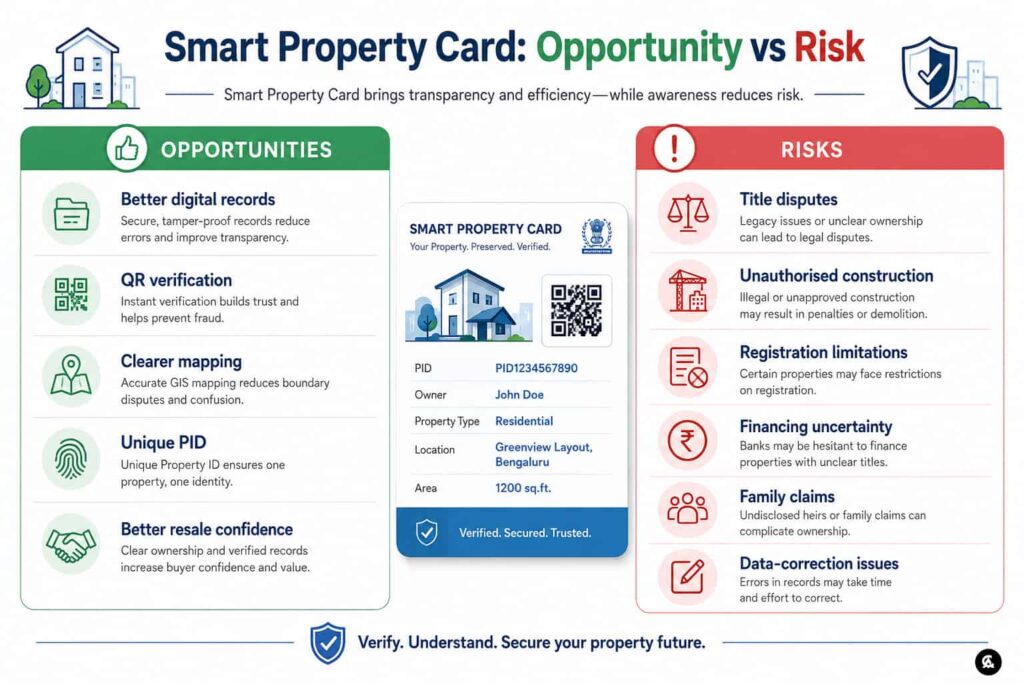
Risk-versus-opportunity assessment
| Factor | Possible opportunity | Remaining risk |
|---|---|---|
| Digital record | Easier property identification | Record may not resolve every title issue |
| QR verification | Faster access to property details | Data accuracy and correction process matter |
| Drone mapping | Better boundary visibility | Family or possession disputes may continue |
| PID | Unique property identity | Does not automatically approve construction |
| DORIS integration | Better record coordination | Registration eligibility must still be checked |
| Bankability | Documentation may improve | Loan approval remains lender-specific |
| Resale | Greater buyer confidence possible | Marketability depends on title and legality |
What is still unclear?
Several important operational questions remain unanswered in the currently available reports:
- When will card distribution begin?
- Which properties will be included in the first phase?
- What is the correction process?
- How can owners file an objection?
- What happens when family members disagree?
- Will there be an online portal?
- Is any fee payable?
- How will disputed properties be handled?
- Will the card support registration in all cases?
- How will banks treat the card?
- Will unauthorised construction remain unaffected?
These points should be updated once the Delhi government issues detailed public instructions.
Frequently asked questions
Will every Lal Dora property receive a Smart Property Card?
Not automatically.
The card is intended for eligible properties after survey, verification and completion of the required process. Disputed or unclear cases may take longer.
Does the card make unauthorised construction legal?
The current announcement does not establish that every existing construction becomes approved merely because a card is issued.
Can the card replace a registered sale deed?
It should not be assumed to replace a sale deed in every transaction. Buyers should verify the registration and transfer process applicable to the specific property.
Does the card guarantee a bank loan?
No.
Loan approval remains subject to the lender’s legal, technical and valuation checks.
Will disputed properties receive cards?
The current data separates dispute-free properties from other surveyed cases. The final procedure for resolving and issuing cards in disputed cases has not yet been fully published.
Can a buyer rely only on the QR code?
No.
The QR record should be checked alongside title documents, co-owner rights, court cases, encumbrances, land use, construction status and registration eligibility.
Is this the same as regularisation?
Not necessarily.
Digital mapping and issuance of property records should not automatically be described as blanket regularisation of every title, structure or land-use violation.
Carpet Area verdict
Delhi’s Lal Dora Smart Property Card initiative is an important documentation reform.
For owners, it may provide:
- clearer mapped identity;
- a unique PID;
- digitally verifiable property information;
- stronger administrative records.
For buyers, it may improve:
- boundary verification;
- access to occupancy information;
- transparency during due diligence.
For investors, it may reduce one part of the documentation risk.
But the Smart Property Card should not be treated as:
- automatic regularisation;
- guaranteed marketable title;
- proof that construction is approved;
- assured registration;
- guaranteed bank finance.
The smartest way to understand the reform is:
The QR card may make a Lal Dora property easier to identify and verify—but not automatically safe to purchase without complete legal due diligence.
Rajesh may finally have a stronger digital record for his ancestral property.
The buyer may finally have more information than before.
But the transaction should proceed only after the property card, title chain, family rights, construction status, registration and encumbrances all tell the same story.
Important disclaimer
This article provides general educational information and does not constitute legal, property, investment or financial advice.
The Smart Property Card rollout is still developing, and detailed procedures may change once the Delhi government issues formal implementation instructions.
Property owners and buyers should consult the Delhi Revenue Department, a qualified property lawyer, the relevant Sub-Registrar and their lender before making any transaction decision.
Sources:-
- The Indian Express — Delhi government to issue Smart Property Cards in 48 Lal Dora villages
https://indianexpress.com/article/cities/delhi/delhi-government-to-issue-smart-property-cards-in-48-lal-dora-villages-10797342/ - The New Indian Express — Delhi government to roll out Smart Property Cards for eligible Lal Dora owners
https://www.newindianexpress.com/states/delhi/2026/Jul/22/delhi-govt-to-roll-out-smart-property-cards-for-eligible-owners-in-lal-dora-areas - Ministry of Panchayati Raj — Official SVAMITVA portal
https://svamitva.nic.in/ - Official SVAMITVA Scheme Framework 2021–2025 PDF
https://svamitva.nic.in/DownloadPDF/Svamitva_Scheme_Framework%282021-2025%29.pdf - Ministry of Panchayati Raj — SVAMITVA Guidelines page
https://panchayat.gov.in/en/document/svamitva-guidelines/ - Delhi Revenue Department — Lal Dora services
https://revenue.delhi.gov.in/revenue/laldora - Delhi Revenue Department — Lal Dora Certificate requirements
https://revenue.delhi.gov.in/revenue/lal-dora-certificate - Delhi Revenue Department — Important property-registration information and searches
https://revenue.delhi.gov.in/revenue/important-information-regarding-registration-property - Delhi Revenue Department — Non-Encumbrance Certificate
https://revenue.delhi.gov.in/revenue/non-encumbrance-certificate - Delhi Revenue Department — Property Registration
https://revenue.delhi.gov.in/revenue/property-registration


Leave a Reply