

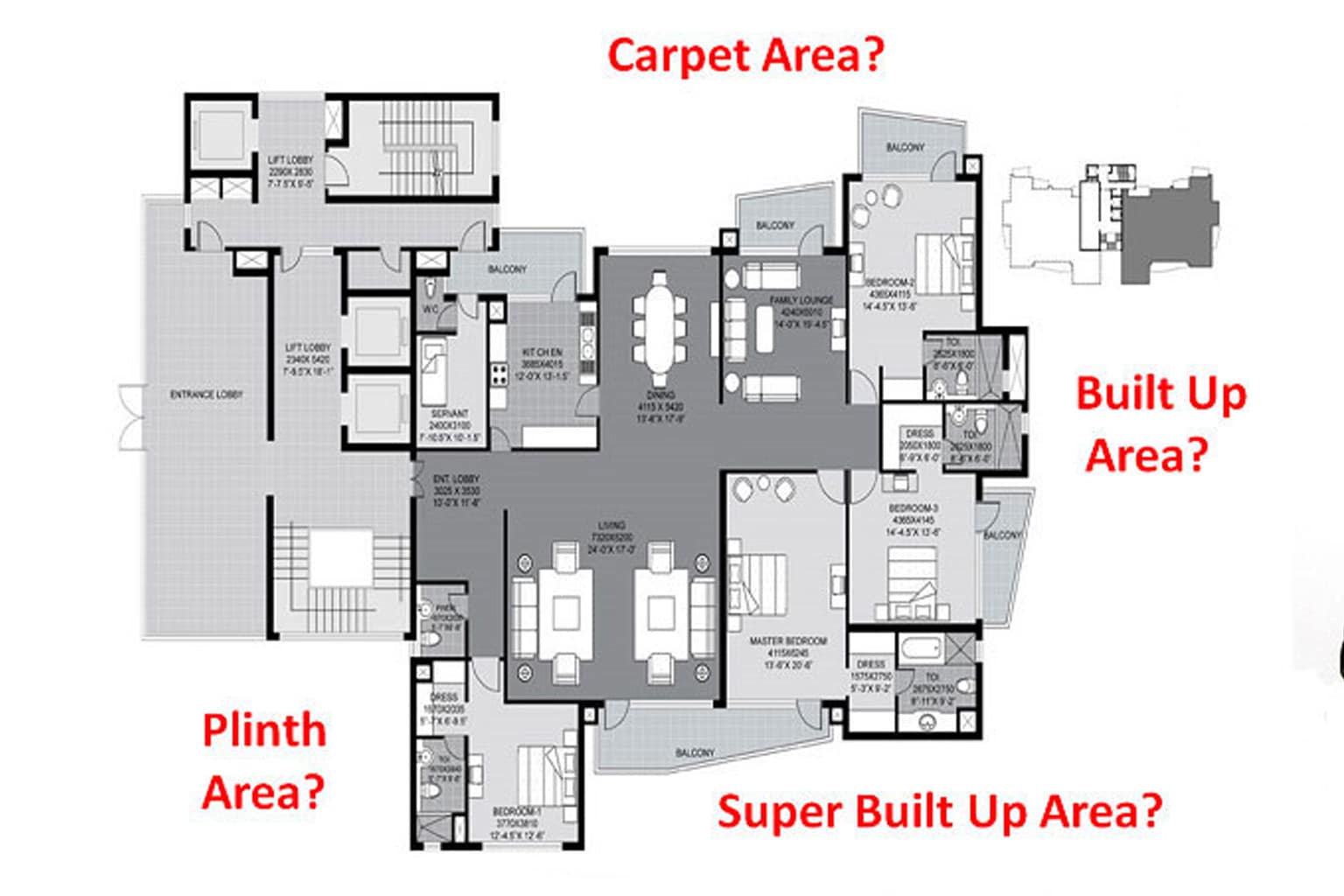
If you have ever tried to buy a flat, you have probably experienced this confusion.
The builder says the flat is 1,200 sq ft, the RERA documents show only 780 sq ft of carpet area, and the buyer is left wondering how much of the home is actually usable.
This confusion can later lead to overpricing, hidden charges, limited usable space, and poor buying decisions.
In this guide, we will explain in simple terms:
What carpet area means
What plinth area means
What super built-up area means
Which area should be given the most importance while buying a flat
How loading is calculated
What buyers should check before booking a property
Why buyers get confused?
One of the biggest traps while buying a flat is the brochure size.
The size mentioned in a brochure is often the super built-up area. However, the area that the buyer can actually use in daily life is the carpet area.
This means:
The brochure size may look large
The usable area may turn out to be much smaller
The effective price may be far higher than your initial calculation
A smart buyer does not make a decision based only on the total price. The decision should be based on the actual usable area of the flat.
What is carpet area?
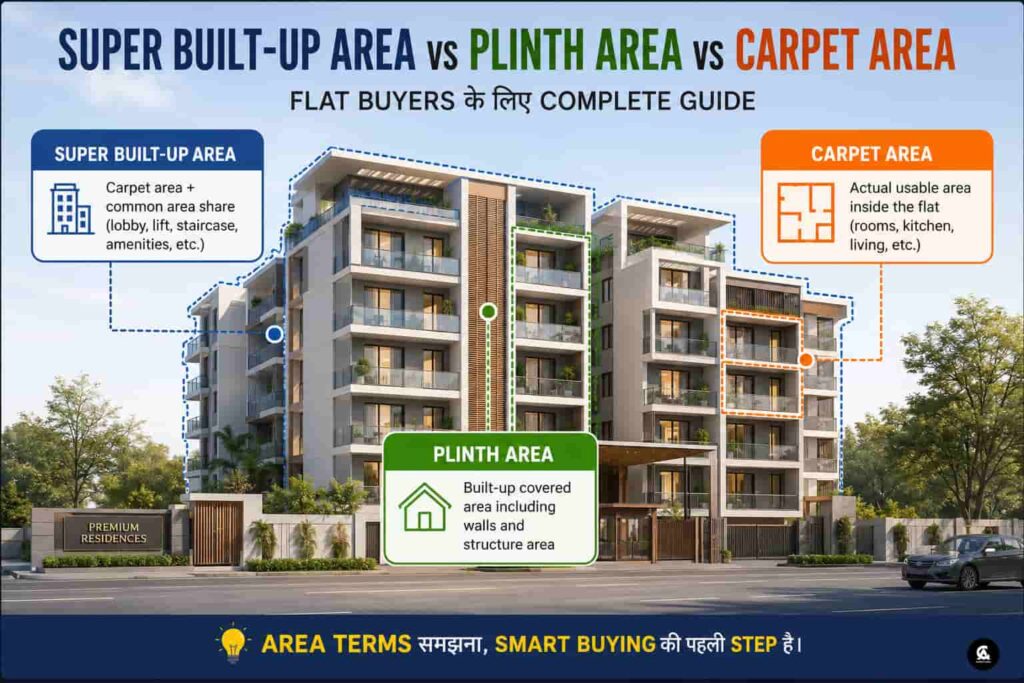
Carpet area is the actual usable floor area inside a home where you can walk, place furniture and carry out your daily activities.
In simple terms:
Carpet area is the area inside the house where you can actually lay a carpet.
It generally includes:
Bedrooms
Living room
Kitchen
Internal passages
Usable space within internal partition walls
It generally does not include:
External walls
Service shafts
Balconies
Verandahs
Open terraces
Common lobby
Staircase
Lift area
What it means for a buyer?
Carpet area is the most important number for understanding the real value and usable size of a flat.
What is plinth area?
Plinth area is a technical construction term. It refers to the total covered built-up area of a structure.
In simple terms:
Plinth area is the covered built-up area of the building or flat.
It may generally include:
Internal wall area
Room area
Covered spaces
Wall thickness
A normal home buyer does not use plinth area as directly as carpet area. This term is more commonly used for construction costing, engineering estimates and building measurements.
What it means for a buyer?
Plinth area can provide useful technical information, but it should not be the primary basis for making a flat-buying decision. Buyers should give more importance to the carpet area.
What is super built-up area?
Super built-up area includes the flat’s built-up area along with the buyer’s proportionate share of common areas.
It may include:
Carpet area
Wall area
Share of the lobby
Share of the staircase
Share of the lift area
Share of the corridor
Proportionate share of common amenities
This is why a flat may be advertised as 1,000 sq ft in the brochure, while the actual usable area may be significantly lower.
What it means for a buyer?
Super built-up area is more of a marketing measurement than a practical measurement.
Instead of getting impressed by the brochure size, the first question a buyer should ask is:
“What is the carpet area?”
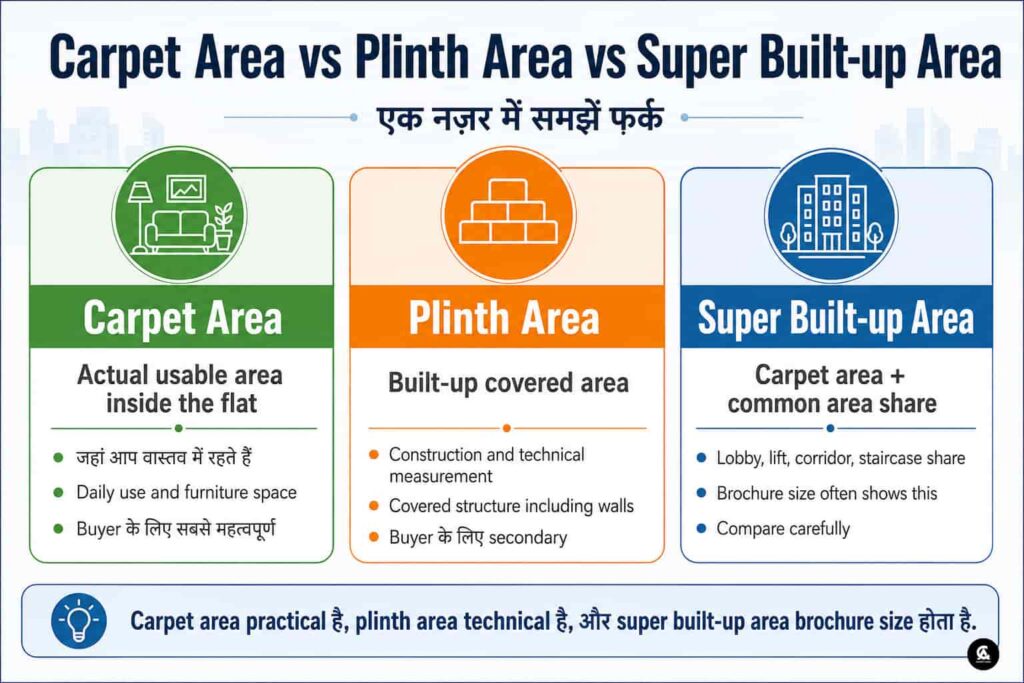
A simple comparison table
| Area type | Simple meaning | Relevance for buyers |
|---|---|---|
| Carpet area | Actual usable area inside the flat | Highest |
| Plinth area | Covered built-up construction area | Medium |
| Super built-up area | Carpet area plus a proportionate share of common areas | Check carefully |
Which area should matter most when buying a flat?
The direct answer is:
Carpet area
This is because:
You will actually live in this space
You will use this area every day
A future resale buyer will also consider the usable area
The value for money largely depends on it
If two flats have the same price but one offers a larger carpet area, that flat generally provides better practical value.
What is loading?
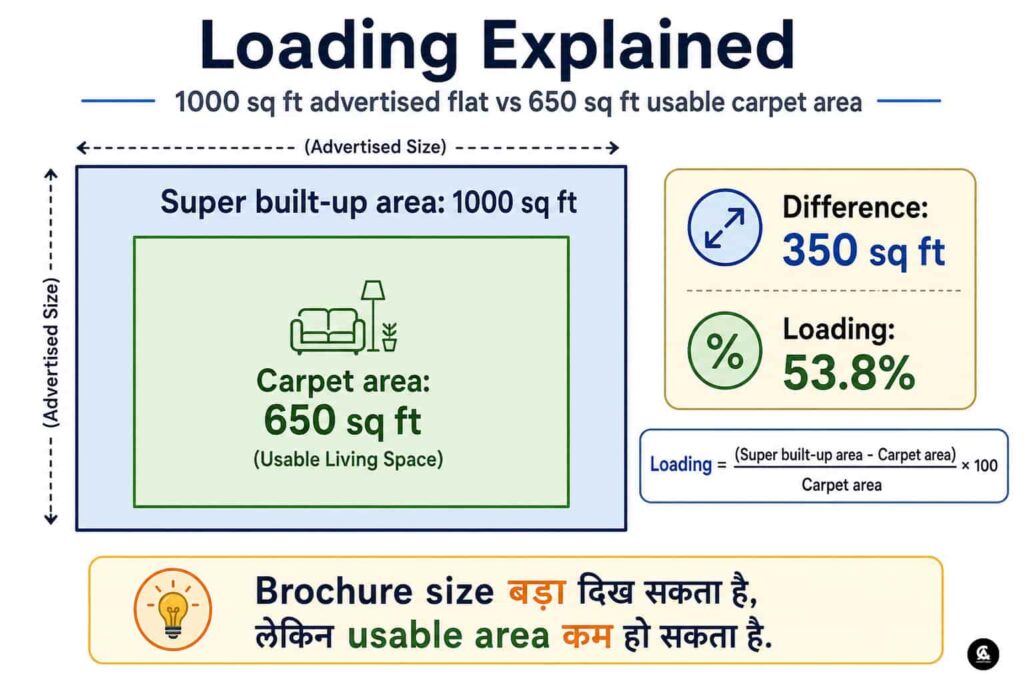
Loading refers to the difference between the super built-up area and the carpet area.
For example:
Super built-up area = 1,000 sq ft
Carpet area = 650 sq ft
The remaining 350 sq ft is not your personal usable space. It may include walls and your proportionate share of common areas.
Loading percentage formula
Loading % = (Super built-up area − Carpet area) ÷ Carpet area × 100
Using the example above:
(1,000 − 650) ÷ 650 × 100 = approximately 53.8%
This may be considered a relatively high loading percentage.
The higher the loading, the lower the usable area available to the buyer.
Real example: Testing the actual value of an ₹80 lakh flat
Suppose a builder quotes the following:
Flat price: ₹80 lakh
Advertised size: 1,000 sq ft
Carpet area: 650 sq ft
The buyer should calculate the effective price as follows:
₹80,00,000 ÷ 650 sq ft = approximately ₹12,307 per sq ft of carpet area
This figure is more useful for understanding the real value of the flat.
Now suppose the carpet area were 800 sq ft:
₹80,00,000 ÷ 800 sq ft = ₹10,000 per sq ft
This means that at the same price of ₹80 lakh, a flat with a larger carpet area may offer better value.
A flat may have a good carpet area but a poor layout
Area figures do not tell the complete story. The layout is equally important.
What to look for in a good layout?
Properly sized rooms
Minimal wastage in corridors and passages
A genuinely usable balcony
A functional kitchen
Smart storage space
Practical furniture placement
Signs of a poor layout
Long and wasteful passages
Awkward corners
Undersized bedrooms
An unusable balcony
Insufficient storage
A poorly planned kitchen
Therefore, do not evaluate a flat only by its area. Check how effectively the available space has been planned and used.
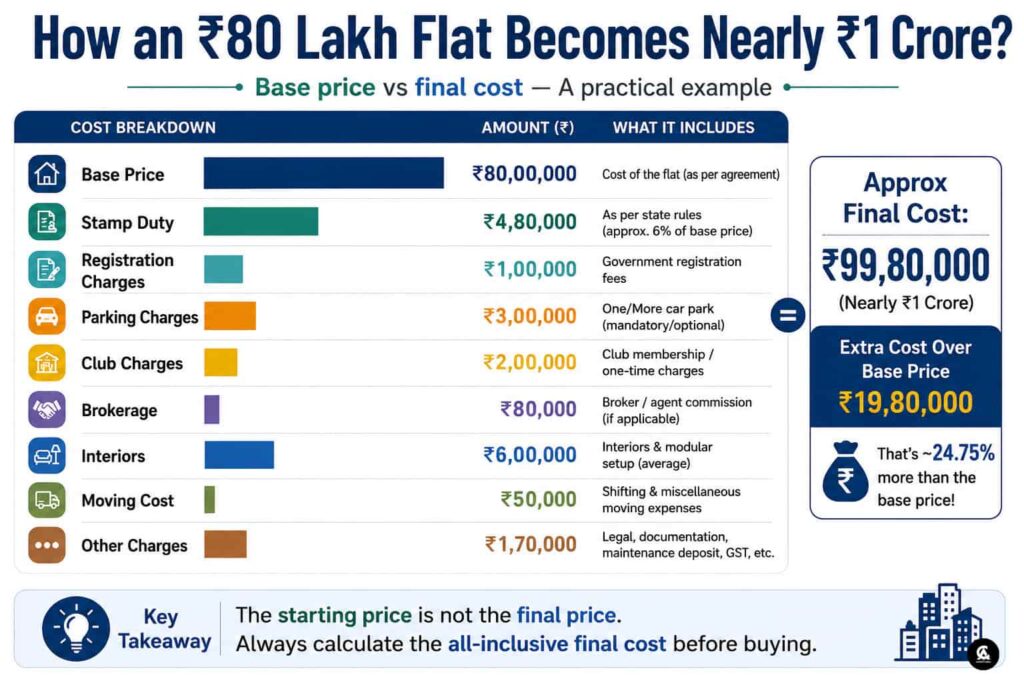
The final cost of a flat is not limited to the base price
One of the most common mistakes buyers make is treating the advertised starting price as the final cost.
However, the total purchase cost may also include:
Stamp duty
Registration charges
Parking charges
Club membership fees
Maintenance deposit
GST, where applicable
Brokerage
Legal verification costs
Home-loan processing fees
Interior work
Moving expenses
This is why a flat advertised at ₹80 lakh may ultimately cost between ₹90 lakh and ₹1 crore in practical terms.
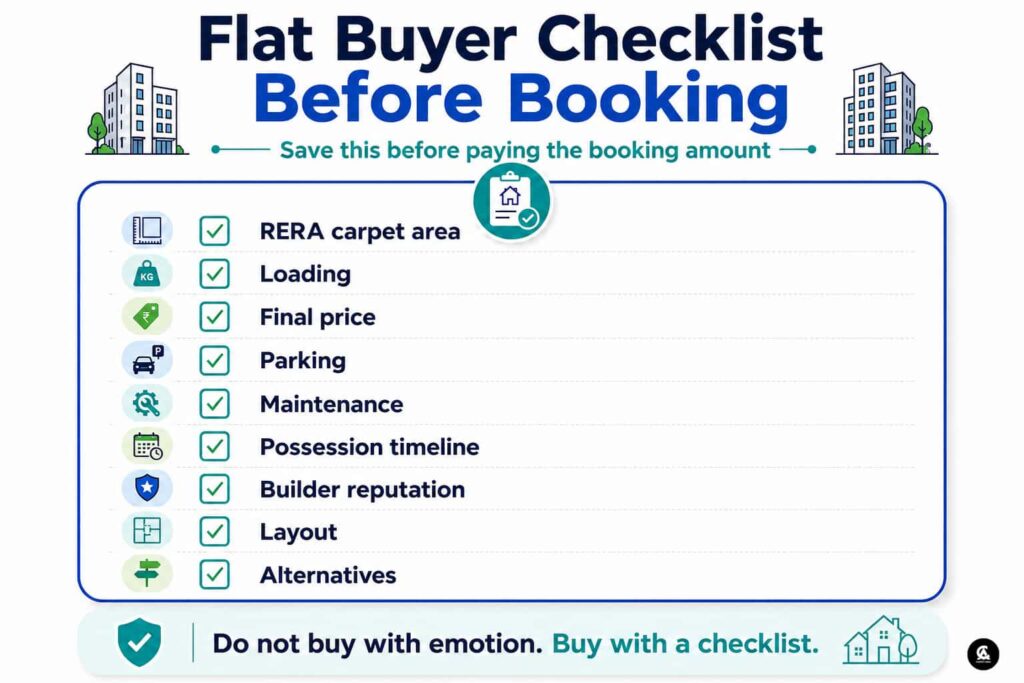
Buyer checklist: What to check before booking a flat?
Before buying a flat, make sure you follow this checklist.
Area and pricing
What is the RERA carpet area?
What is the super built-up area?
What is the loading percentage?
What is the final all-inclusive price?
Additional charges
How much extra will you pay for stamp duty?
What are the registration charges?
Is parking compulsory or optional?
What are the club or amenity charges?
How much are the maintenance charges?
Property quality
Is the layout practical?
Does the sample flat match the actual unit?
Is the balcony genuinely usable or mainly designed to make the brochure look attractive?
Is there sufficient storage space?
Legal and practical checks
Is the project’s RERA registration verified?
What is the promised possession timeline?
What is the builder’s reputation and delivery record?
Is your home-loan eligibility clear?
What alternative projects are available nearby?
Red flags you should not ignore
If you notice any of the following issues, verify the property carefully before proceeding:
The builder is not clearly disclosing the carpet area
The brochure focuses only on the super built-up area
The loading percentage is unusually high
The final price breakdown is unclear
Maintenance charges have not been disclosed
Parking is compulsory, but the terms and charges are unclear
The sample flat feels significantly different from the actual unit
The “starting price” is being presented as though it were the final price
A practical rule of thumb
Follow this three-step rule when buying a flat:
1. Ask for the carpet area
Your first question should be:
How much usable area will I actually get?
2. Calculate the final all-inclusive cost
Do not make a buying decision based only on the base price.
Include all applicable charges, such as parking, club charges, maintenance deposits, taxes, stamp duty and registration costs.
3. Compare the effective rate
Use this formula:
Effective rate = Final all-inclusive price ÷ Carpet area
This figure gives you a more accurate basis for comparing different properties.
Frequently asked questions
1. Which area is the most important when buying a flat?
Carpet area is the most important because it represents the actual usable area inside the flat.
2. Is the super built-up area not useful?
It is useful for understanding the overall marketed size of the property, but it should not be the primary basis for buyer comparison.
3. Why is plinth area less important for a buyer?
Plinth area is mainly a technical and construction-related measurement. It does not directly represent the space a buyer can use in daily life.
4. At what loading percentage should a buyer become concerned?
There is no single universal loading percentage that applies to every project.
However, higher loading generally means a smaller usable area compared with the advertised size. Buyers should therefore compare the carpet area and understand exactly what has been included in the loading.
5. What should I do if the builder mentions only the brochure size?
Ask the builder to provide:
The exact carpet area
The complete cost breakdown
The loading percentage
The project’s RERA registration details
The approved floor plan and unit specifications
Final takeaway
The real value of a flat is not determined by the size printed in the brochure.
It depends on:
Carpet area
Practical layout
Location
Maintenance costs
Final all-inclusive price
A smart buyer does not get impressed by the super built-up area. Instead, they calculate the value based on the carpet area.
If you are planning to buy a flat, understanding these area-related terms is not optional. It is essential for making an informed property decision.
Sources:-
- The Real Estate (Regulation and Development) Act, 2016 — India Code
Read the complete RERA Act
Download the official RERA Act PDF
The statutory definition of carpet area is provided under Section 2(k) of the Act. - Ministry of Housing and Urban Affairs — RERA framework
Official MoHUA RERA page
MoHUA official website State RERA portals for project and carpet-area verification
Buyers should use the RERA portal of the state or Union Territory where the property is located.These portals allow buyers to check project registration, promoter details, carpet area, approvals and project disclosures.
CPWD Plinth Area Rates and measurement guidelines
Download CPWD Plinth Area Rates 2025
CPWD Plinth Area Rates circularsThe 2025 publication includes guidelines for calculating plinth area and prescribed calculation formats.
Official buyer-awareness and project-verification resources
These resources can be used to verify the declared carpet area, project registration, promoter information and other disclosures before booking a flat.
- The Real Estate (Regulation and Development) Act, 2016 — India Code






Leave a Reply