

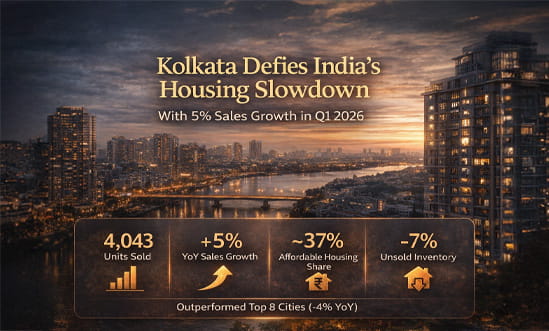
At a time when India’s housing market is beginning to show signs of caution, Kolkata has delivered a different story. While several major cities saw sales soften in the first quarter of 2026, Kolkata moved against the trend and posted growth. That alone makes it worth watching. In a market where rising prices and affordability concerns are starting to shape buyer behaviour, Kolkata’s ability to register a 5% year-on-year rise in residential sales stands out as a strong reminder that India’s real-estate story is not moving in one straight line.
According to reported Q1 2026 data, Kolkata recorded 4,043 residential units sold during the quarter, up 5% from the same period last year. This came even as residential sales across India’s top eight cities declined 4% year on year to 84,827 units. That contrast is what gives Kolkata’s performance its importance. It was not just stable in a weaker market. It actually grew while the broader national housing cycle lost some momentum.
This matters because market slowdowns are usually discussed in broad national terms, but real estate rarely behaves as one uniform market. Every city has its own pricing pattern, buyer base, supply mix, and demand drivers. Kolkata’s Q1 performance shows that local strength can still overcome national caution, especially when a city remains relatively grounded on affordability and end-user demand. In simple terms, Kolkata appears to be benefiting from a more practical market structure at a time when some other cities are facing stronger pressure from high prices.
One reason the city’s performance is drawing attention is the price profile of demand. The market continued to be led by affordable and mid-income housing. Homes priced below ₹50 lakh accounted for 37% of total sales, while the ₹50 lakh to ₹1 crore segment made up 36%. Even more importantly, the ₹50 lakh to ₹1 crore category recorded 8% growth, showing that there is still healthy appetite in the city’s core budget bands. That gives Kolkata a different character from markets where demand has become heavily dependent on premium buyers.
At the same time, Kolkata was not driven only by affordable housing. Higher-value homes also showed notable traction. Sales in the ₹1 crore to ₹2 crore bracket rose 50% year on year, while the ultra-premium ₹5 crore to ₹10 crore segment reportedly surged 163%. There were also 13 homes sold in the ₹10 crore to ₹20 crore bracket during the quarter. This tells us something important: Kolkata’s market is not only stable at the bottom and middle. It is also becoming more layered, with demand visible at higher ticket sizes as well.
That kind of balance is valuable in real estate. When a city shows strength across both end-user categories and select premium segments, it suggests the market is not being carried by one narrow demand pool. Instead, it reflects a broader base of buyers. Some are looking for practical housing within reachable budgets, while others are clearly willing to spend more for premium locations and better assets. For a city like Kolkata, that mix creates a stronger foundation than a market driven only by speculative or luxury-led activity. This is an inference drawn from the segment data reported for the quarter.
New supply also remained active. Kolkata saw 3,475 units launched in Q1 2026, which suggests that developers still see enough confidence in the city to bring projects to market. Launch activity matters because it tells us whether builders believe sales strength can continue. In many cities, slowing demand quickly affects launches. But in Kolkata’s case, the supply pipeline remained present alongside rising sales, which points to a relatively healthy market balance.
There are more positive signs beneath the headline sales number. The city’s weighted average residential price rose 3% year on year to ₹5,937 per square foot. At the same time, unsold inventory fell 7% to 19,062 units. The quarters-to-sell metric also improved from 5 to 4.4. Together, these figures paint a useful picture. Prices are rising, but not in a way that appears to be choking demand. Inventory is reducing, which usually indicates that the market is absorbing available stock more efficiently. And an improving quarters-to-sell number suggests overall market health has strengthened rather than weakened.
For homebuyers, this is one of the more reassuring parts of the story. A market can show sales growth but still feel risky if inventory starts piling up or prices run too far ahead of demand. Kolkata’s current pattern appears more balanced. Demand has risen, unsold stock has fallen, and the market has not lost its connection to practical budget ranges. That combination gives buyers more comfort than a market driven only by hype or premium-led enthusiasm.
For developers, the message is also encouraging. A city that performs better than the national average in a slower quarter becomes more attractive from a planning perspective. It suggests demand is holding, absorption is healthier, and pricing remains within a range that buyers can still engage with. Developers generally look for markets where confidence is not just visible in headlines, but supported by inventory movement and consistent buyer participation. Kolkata’s Q1 numbers suggest that the city currently offers that kind of steadier environment. This interpretation is supported by the sales, launch, inventory, and price figures reported for the quarter.
The bigger significance of Kolkata’s performance lies in what it says about India’s property cycle right now. Nationally, the market is moderating. Knight Frank data reported by Business Standard showed that residential demand across the top eight cities has softened, with affordability pressures and rising prices weighing on buyers. But Kolkata’s growth shows that moderation at the national level does not automatically mean weakness in every city. Some local markets can still find momentum through the right pricing mix, buyer profile, and supply discipline.
That is why this is more than just a city update. It is a useful case study in how local market fundamentals can shape outcomes differently from the national picture. In periods of uncertainty, cities with more grounded pricing and broad-based demand often prove more resilient. Kolkata appears to be showing exactly that kind of resilience right now. It may not be the loudest market in India, but in Q1 2026 it was one of the clearer examples of stability with growth.
In the end, Kolkata’s 5% rise in residential sales is important not just because it beat the national trend, but because of how it did so. The city combined sales growth with lower unsold inventory, improving market absorption, active launches, and strength in both mass and premium segments. That makes this a meaningful real-estate story, not a one-line statistic. At a time when much of the housing conversation is focused on slowdown and caution, Kolkata has offered a different signal: a well-balanced city market can still move forward even when the broader mood turns selective.




Leave a Reply