


Download the Carpet Area Delhi MPD2047 70 Villages Guide
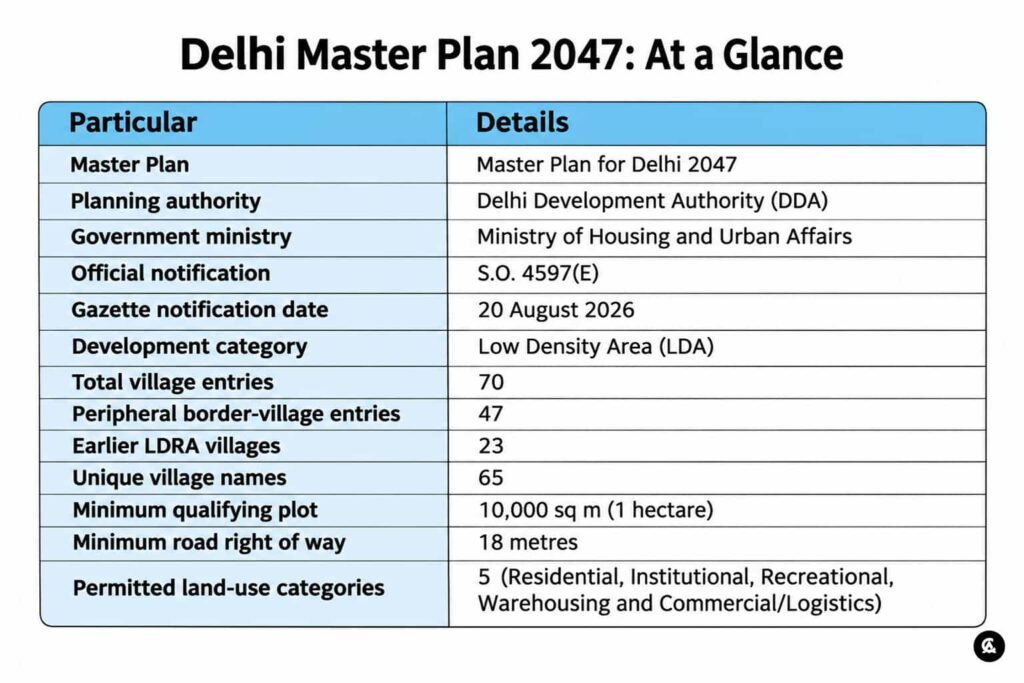
Delhi Master Plan 2047 has introduced a significant change for landowners in the national capital’s peripheral villages. The newly notified Low Density Area (LDA) framework brings together 47 border-village entries and 23 previously designated Low Density Residential Area (LDRA) villages under a common set of development regulations.
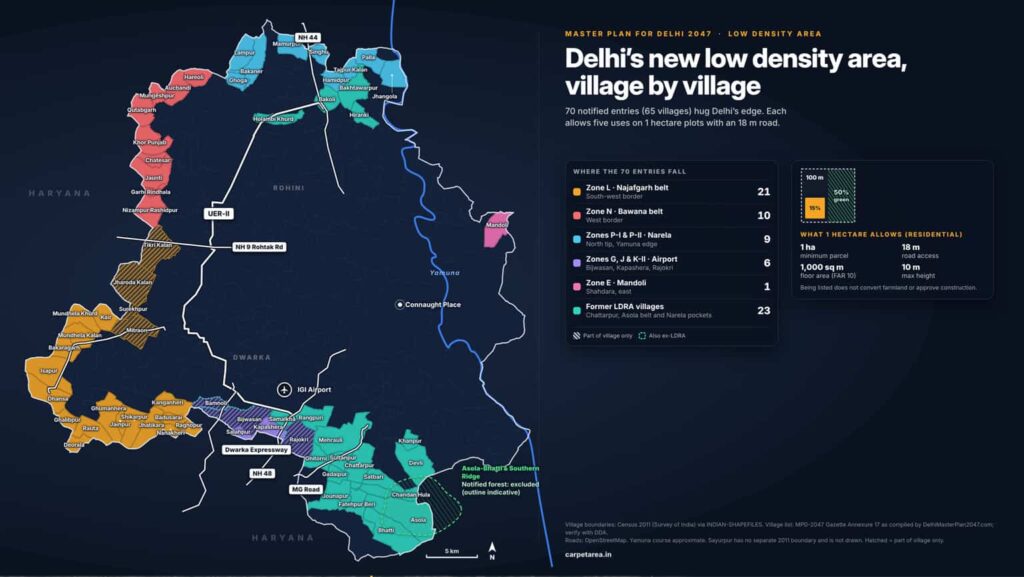
The policy creates opportunities for residential, institutional, commercial, recreational and warehousing development on qualifying land. However, development is subject to strict conditions, including a minimum land parcel of one hectare and access to an 18-metre-wide road.
For property buyers and investors, understanding these restrictions is essential before purchasing land in the affected areas.
What is the low density area under MPD-2047?
The Low Density Area is a planning category that allows specified development activities in eligible parts of Delhi while maintaining restrictions on building density, coverage and land use.
Under the earlier planning framework, a one-village-deep green belt along Delhi’s borders restricted certain urban development activities.
The MPD-2047 framework consolidates eligible peripheral areas and previously identified low-density residential villages into a revised development category.
The policy is intended to accommodate controlled development rather than unrestricted urbanisation.
It is important to understand that inclusion in the LDA does not automatically convert agricultural land into residential property or give landowners permission to begin construction. Individual land parcels must satisfy the applicable planning and statutory requirements.
How did the green development area proposal become LDA?
The policy evolved through several stages.
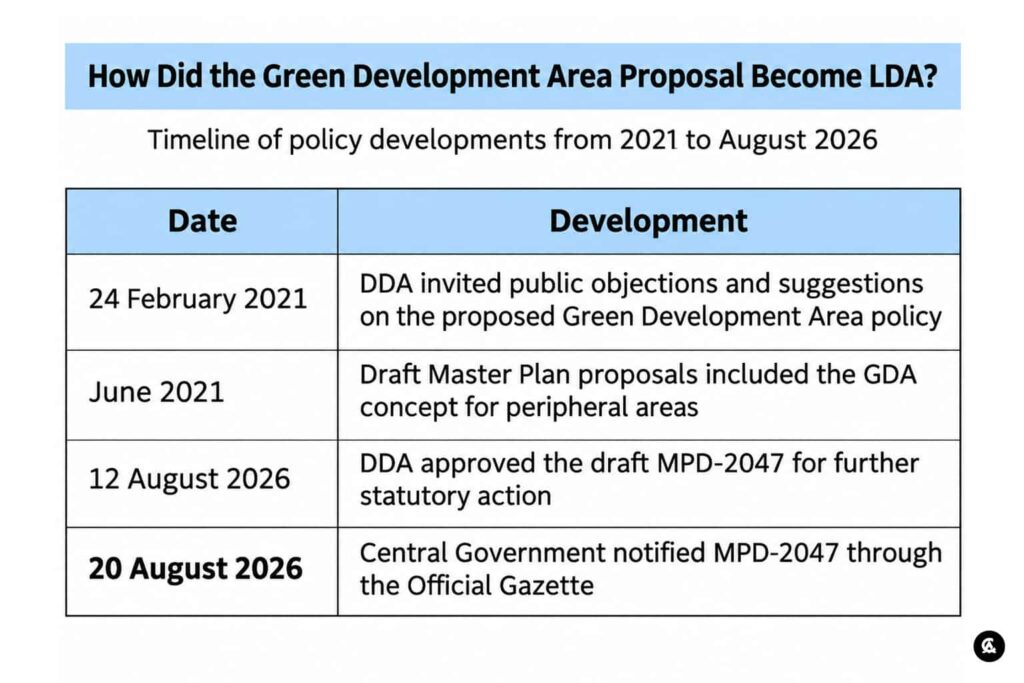
An important difference concerns the minimum land size.
The earlier Green Development Area proposal contemplated different plot-size categories, including 600, 4,000 and 10,000 sq m.
The notified LDA framework described in the official planning guidance uses 10,000 sq m as the minimum qualifying parcel for the five specified development uses.
Consequently, many owners of smaller individual plots may not qualify independently under these provisions.
Which 70 village entries are included in Delhi’s low density area?
The MPD-2047 guide identifies two groups of village entries under Annexure 17.
The first consists of 47 peripheral-zone entries, while the second contains 23 villages that were already associated with the earlier LDRA framework.
Some village names appear in more than one planning zone or category. Therefore, the combined list contains 70 entries representing 65 distinct village names.
47 peripheral border villages: Zone-wise distribution
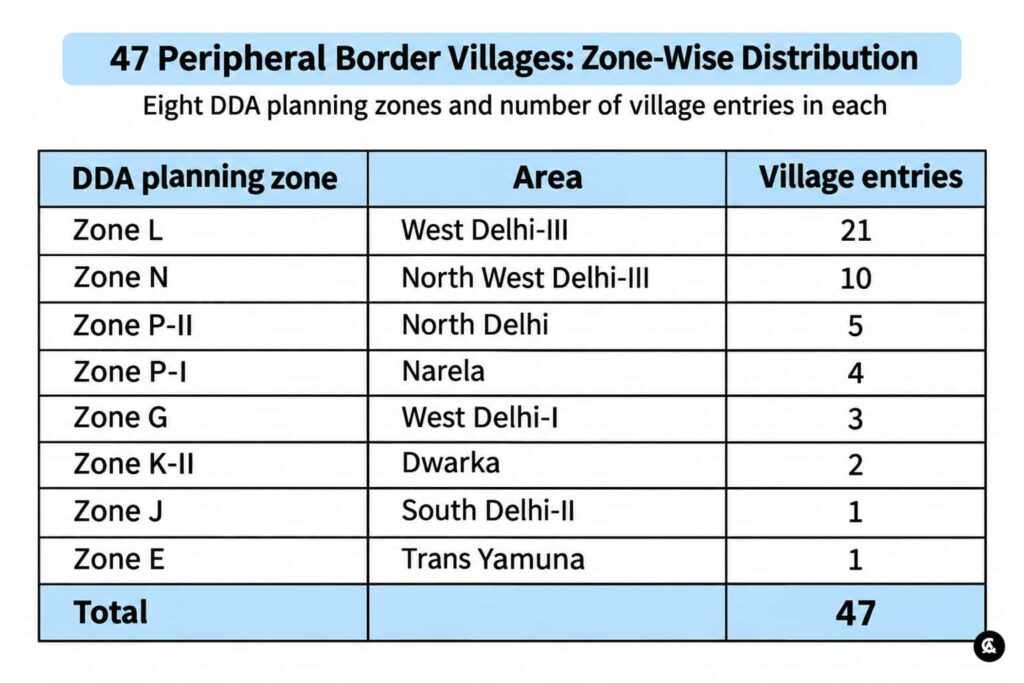
Zone L: 21 Village Entries
The listed villages are Badusarai, Bakaragarh, Deorala, Dhansa, Ghalibpur, Ghumanhera, Isapur, Jainpur, Jharoda Kalan (Part), Jhatikara, Kair, Kanganheri, Mitraon (Part), Mundhela Kalan, Mundhela Khurd, Nanakheri, Raghopur, Rauta, Shikarpur, Surekhpur (Part) and Tikri Kalan (Part).
This zone contains the largest number of peripheral LDA entries.
Zone N: 10 Village Entries
Auchandi, Chatesar, Garhi Rindhala, Hareoli, Jaunti, Khor Punjab, Mungeshpur, Nizampur-Rashidpur, Qutabgarh and Tikri Kalan (Part).
Zone P-II: 5 Villages
Hamidpur, Jhangola, Palla, Singhu and Tajpur Kalan.
Zone P-I: 4 Villages
Bakaner, Ghoga, Lampur and Mamurpur.
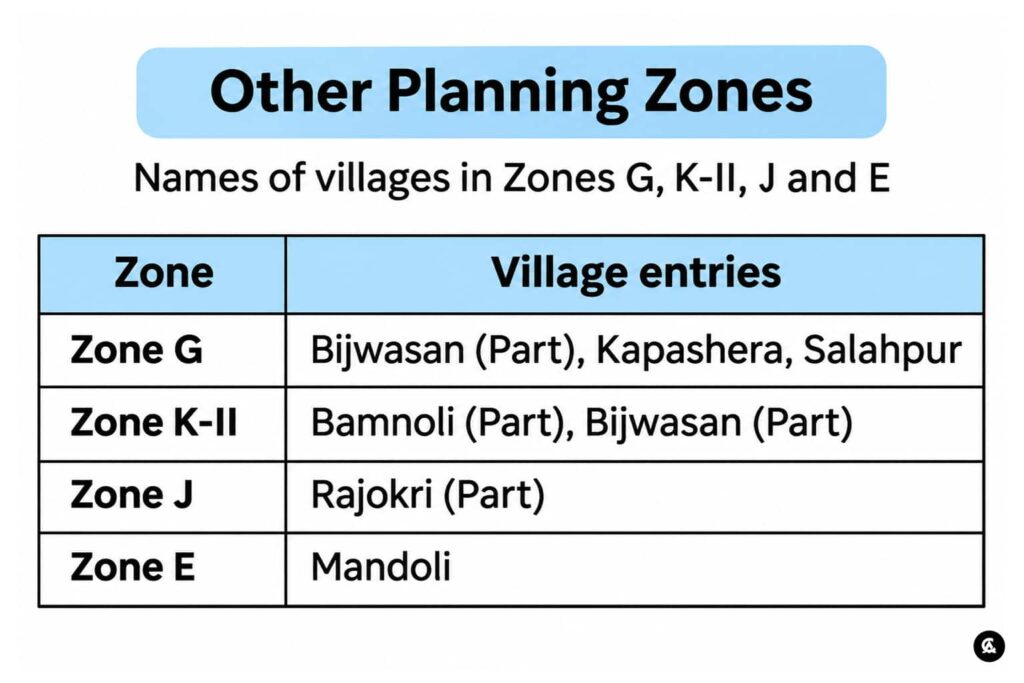
The term “Part” is particularly important. It indicates that the LDA designation applies only to specified portions of the village, not necessarily its complete revenue boundary.
Which 23 villages were previously inder LDRA?
The following villages were included in the earlier Low Density Residential Area category and are identified within the MPD-2047 LDA framework.
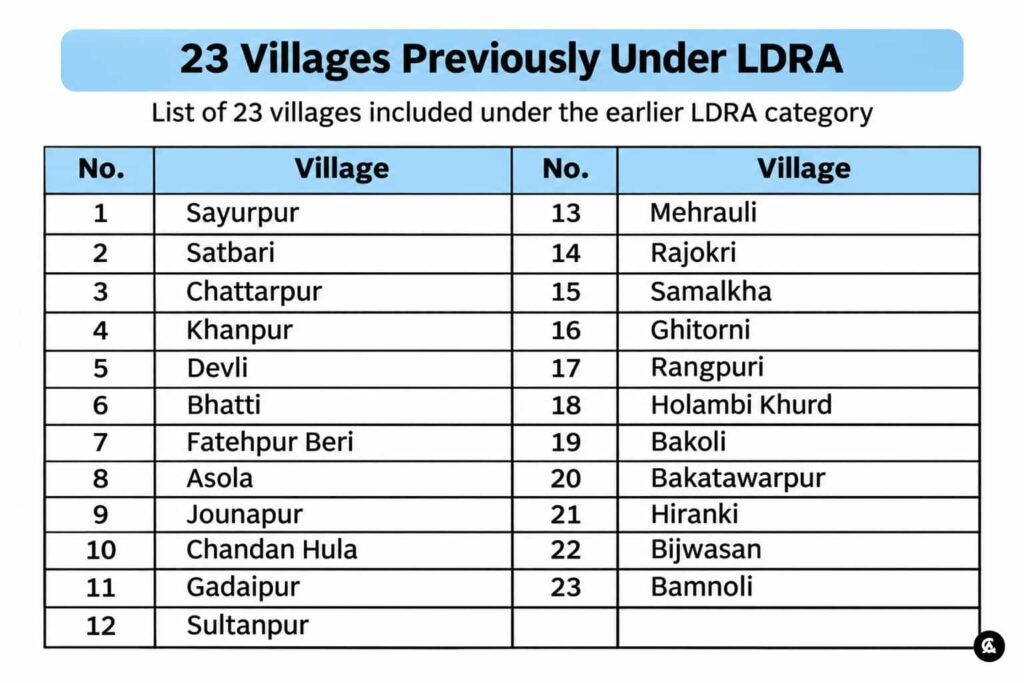
The guide identifies Sayurpur, Satbari, Chattarpur, Khanpur and Devli as subject to authority stipulations arising from Supreme Court orders.
Landowners in these areas should examine the relevant judicial restrictions and DDA conditions before undertaking any development.
What types of development are permitted?
MPD-2047 identifies five land-use categories within the LDA framework:
Residential development.
Institutional development.
Recreational development.
Warehousing.
Commercial and logistics development.
Each category has different Floor Area Ratio (FAR), ground coverage and building-height limits.
Construction limits under MPD-2047
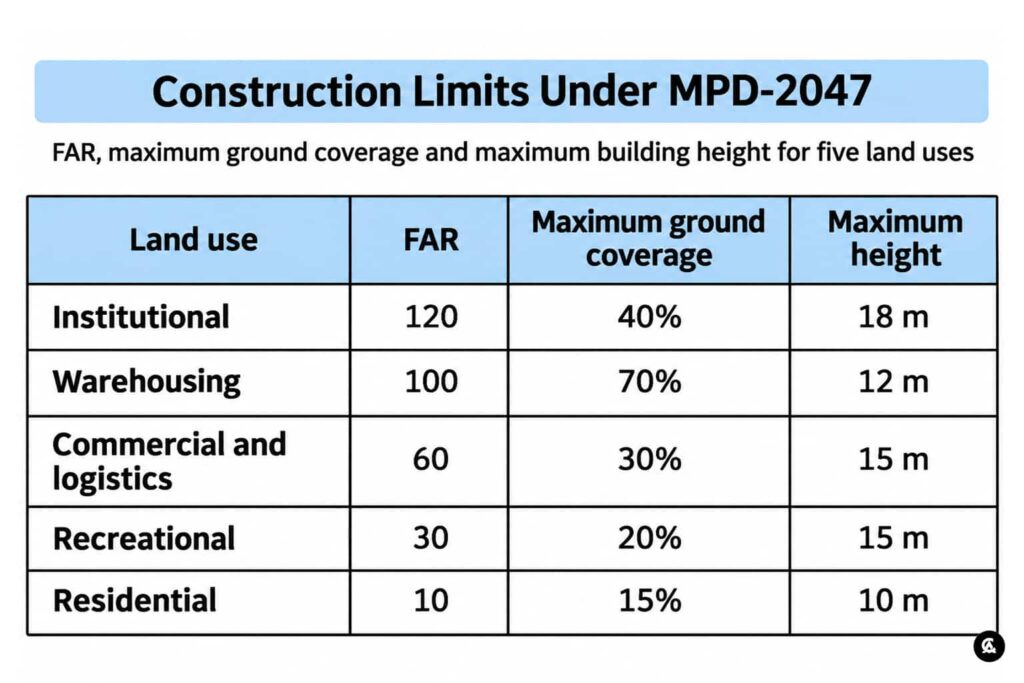
These figures represent prescribed maximum limits, not guaranteed building approvals.
Additional requirements relating to roads, environmental restrictions, land use and building permissions may further limit the development potential of an individual property.
How much can you construct on one hectare?
One hectare equals 10,000 square metres, or approximately 2.47 acres.
FAR determines the total floor area that may be constructed in relation to the plot’s area.
The basic calculation is:
Permissible floor area = Plot area × FAR ÷ 100
For a 10,000 sq m parcel, the illustrative maximum floor areas are:
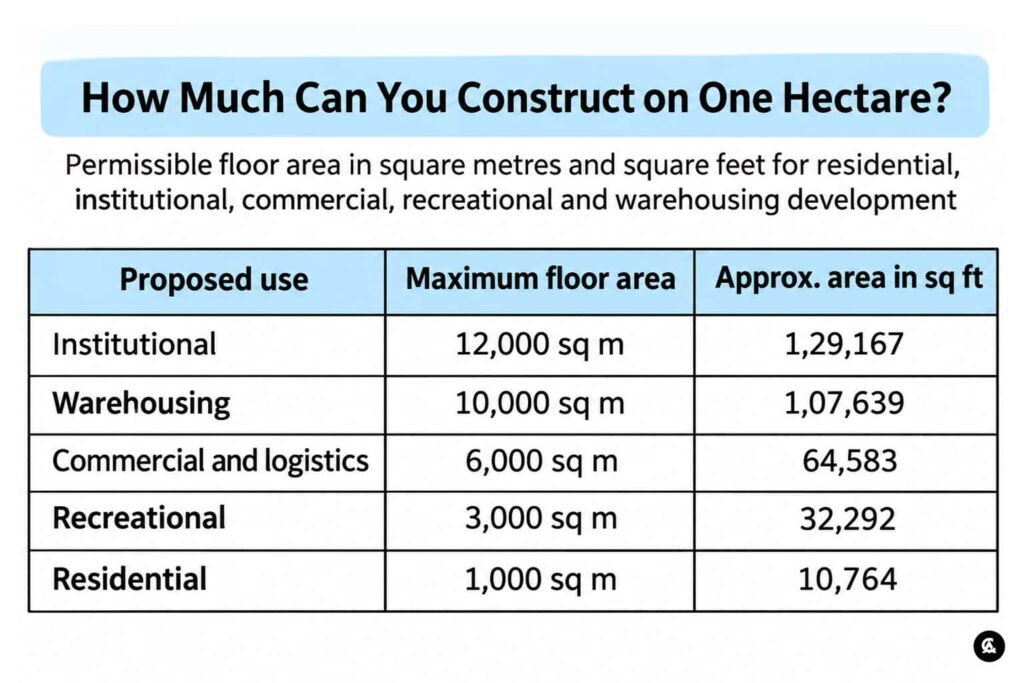
Example: Residential Development
Consider a qualifying residential land parcel measuring 10,000 sq m.
With FAR 10, its maximum total floor area would be 1,000 sq m.
The maximum ground coverage would be 15%, equivalent to 1,500 sq m, while the permitted building height would be limited to 10 metres.
However, these limits apply together. The residential FAR restriction means that the complete allowable floor area cannot exceed 1,000 sq m merely because a larger ground-coverage percentage is mentioned.
The framework also specifies that at least 50% of residential land must remain green, with 30% of that green area under tree canopy.
This demonstrates that the LDA framework is designed for low-density development, not conventional high-rise apartment projects.
Minimum road width & infrastructure requirements
A qualifying LDA plot must have access to a road with a minimum right of way of 18 metres.
Where an existing road is narrower, the guide describes provisions involving land contributions for road widening, subject to applicable planning conditions.
For parcels larger than one hectare, the framework also addresses internal circulation, including a 12-metre internal road provision.
These requirements can materially affect the net usable land area and the financial feasibility of development.
Landowners should verify the proposed and existing road alignments in the relevant DDA planning documents before purchasing or consolidating parcels.
Can existing buildings be regularised?
The guide distinguishes sanctioned development from construction carried out without the required approvals.
Existing legally sanctioned buildings may continue subject to the applicable rules.
For unauthorised development, Clause 4.4.3 is identified as containing provisions under which certain construction may be considered for regularisation, subject to conditions, penalties and charges.
Regularisation is not automatic.
Every case requires examination of the building’s approval history, land status, applicable restrictions and eligibility under the relevant government provisions.
Purchasers should not assume that buying an unauthorised farmhouse or commercial building within an LDA village guarantees future approval.
Which land parcels may be excluded?
The LDA designation does not override every other land-use restriction.
The guide identifies exclusions and special controls involving:
Lal Dora and extended Lal Dora land.
Notified Ridge and forest areas.
Protected monuments and regulated heritage areas.
Land reserved for Master Plan roads.
Other notified planning restrictions and protected land.
An individual parcel may be situated in a listed village but still remain unsuitable for the proposed development because of these restrictions.
The decisive information is the specific khasra’s legal and planning status, not merely the village name.
Is LDA the same as delhi’s land pooling policy?
No. The two frameworks have different objectives and regulatory structures.
Land Pooling concerns planned urban development through the pooling and reconstitution of eligible land.
The Low Density Area framework deals with specified low-density development uses on qualifying parcels.
The uploaded guide states that LDA land falls outside the Land Pooling Policy.
Therefore, any property being marketed simultaneously as LDA land and as eligible land-pooling property should be examined particularly carefully.
Sources
1. Delhi Development Authority – Master Plan for Delhi 2047
https://www.dda.gov.in/master_plan_2047
2. Official MPD-2047 Gazette Notification
https://dda.gov.in/master-plan-delhi-2047-gazette
3. DDA FAQs on MPD-2047
https://www.dda.gov.in/sites/default/files/notice/faqs_on_mpd-2047.pdf
4. MPD-2047 Gazette, S.O. 4597(E), 20 August 2026
https://www.pib.gov.in/PressReleasePage.aspx?PRID=2301684
5. DDA Official Website – Land Use Maps and GIS Planning Resources
6. Background Reference: MPD-2047 Low Density Area Village Lists
https://www.delhimasterplan2047.com/low-density-area-delhi.html
Disclaimer: This article is based on the Carpet Area MPD-2047 research guide and publicly available planning information. The village list in the guide was reproduced from an independent reference and should be checked against the official Gazette Annexure 17. Land-use eligibility, development permissions and construction limits must be verified for the specific parcel with DDA and the relevant authorities. This article is informational and does not constitute legal or investment advice.


Leave a Reply