


For many homebuyers, the biggest fear is not just the price of a property. It is the paperwork behind it. A flat, plot or house may look attractive, but if the ownership record, tax record, khata status or mutation details are unclear, the buyer can face problems later during loan approval, resale, registration or legal verification.
That is why Bengaluru’s “My e-Khata, My Hakku” campaign has become an important property-documentation story for the city’s homeowners and buyers.
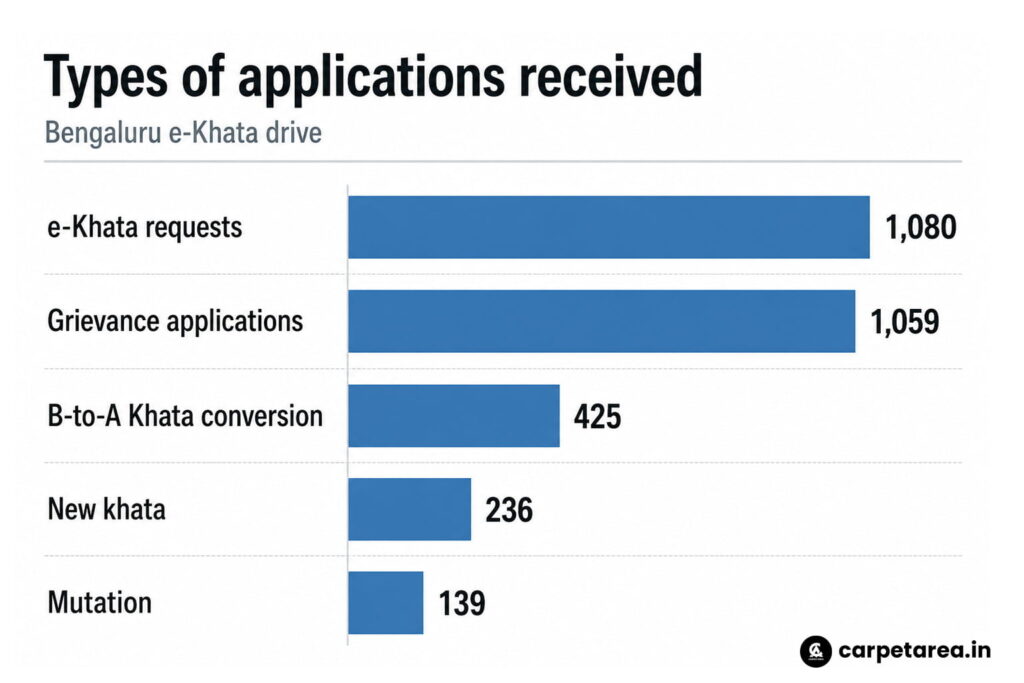
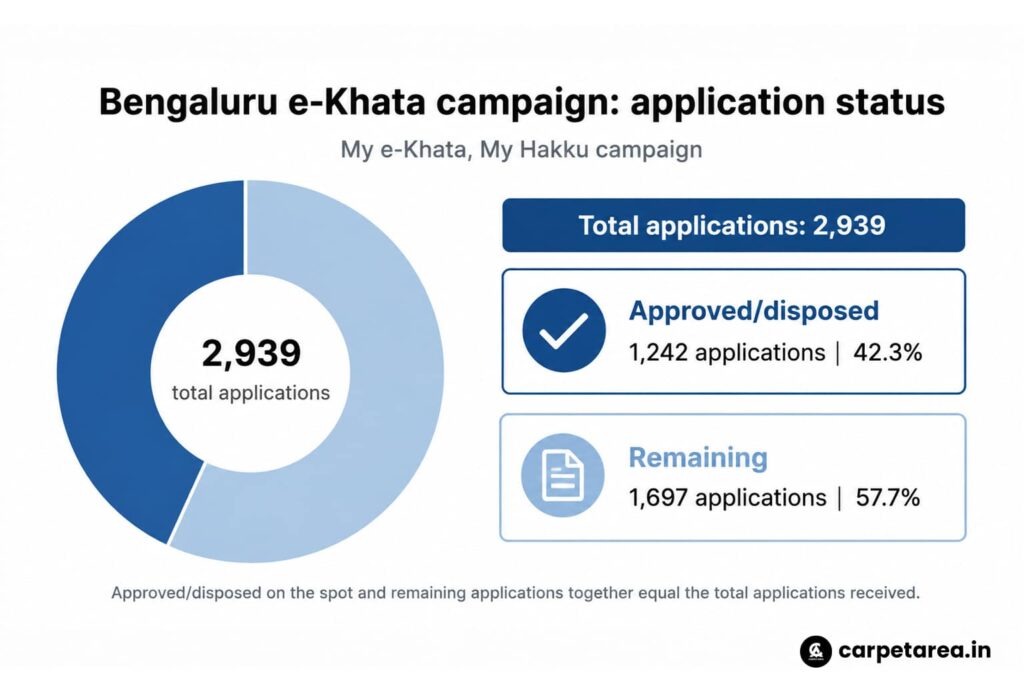
The campaign, launched under Karnataka’s Bhoo Guarantee scheme, received 2,939 applications from property owners. Out of these, 1,242 applications were disposed of on the spot, with final e-Khatas issued immediately after verification. The applications included e-Khata requests, mutation, new khata registrations, B-Khata to A-Khata conversion and grievance redressal.
On the surface, this may look like a regular municipal drive. But for Bengaluru’s real estate market, it carries a bigger message: property documentation is becoming more digital, more structured and more important for buyer confidence.
Why e-Khata matters for homebuyers?
An e-Khata is a digitally maintained municipal property record. It records important details such as ownership information, property classification and tax status in a centralised system managed by civic authorities. According to officials cited in the report, the digital format is meant to reduce manual errors, improve verification and replace older paper-heavy khata records.
For a homebuyer, this matters because property clarity begins before negotiation. A buyer should know whether the property has proper municipal records, whether property tax records are updated, whether mutation is complete and whether there are unresolved documentation issues.
However, one important caution is necessary. An e-Khata can improve documentation clarity, but buyers should still verify title deed, encumbrance certificate, approvals, tax dues, layout status, RERA details where applicable and loan eligibility before buying.
Why the 2,939 applications are important?
The number itself shows that many property owners are actively trying to clean up or formalise their property records. Among the applications, 1,080 were e-Khata requests, out of which 568 were disposed of immediately. Authorities also processed 64 out of 139 mutation applications, approved 90 out of 236 new khata applications, cleared 120 out of 425 B-to-A Khata conversion applications, and resolved 400 out of 1,059 grievance-related applications during the campaign.
This is important because property documentation problems are not always dramatic. Sometimes the problem is a pending mutation. Sometimes the property tax record is not updated. Sometimes the property is in B-Khata status. Sometimes an owner has documents but cannot easily prove them through a clean digital record.
When these issues are resolved, the property becomes easier to understand, easier to verify and potentially easier to transact.
Why B-Khata to A-Khata conversion is a key part of the story?
One of the strongest parts of the campaign is the B-Khata to A-Khata conversion push. Under the Bhoo Guarantee scheme, eligible Bengaluru property owners can convert B-Khata properties to A-Khata by paying 2% of the guidance value instead of the earlier 5%, which is being described as a major fee reduction.
This matters because A-Khata and B-Khata are not just technical words. They affect how easily a property can be financed, sold, approved or trusted in the market. A-Khata properties are generally seen as more compliant with municipal norms, while B-Khata properties often need deeper due diligence because of possible documentation or approval gaps.
For a buyer, this means one simple thing: before buying a Bengaluru property, khata status should not be ignored.
A real-life example
Imagine a family planning to buy a house in Bengaluru. The price is suitable, the location is good and the seller says all documents are available. But during bank loan processing, the buyer discovers that the khata record is unclear or the mutation is pending. Suddenly, the deal slows down. The bank asks for more documents. The buyer becomes unsure. The seller also gets stuck.
Now imagine the same property with a clear e-Khata record, updated tax details and proper municipal documentation. The buyer still has to do legal due diligence, but the basic property record becomes easier to verify.
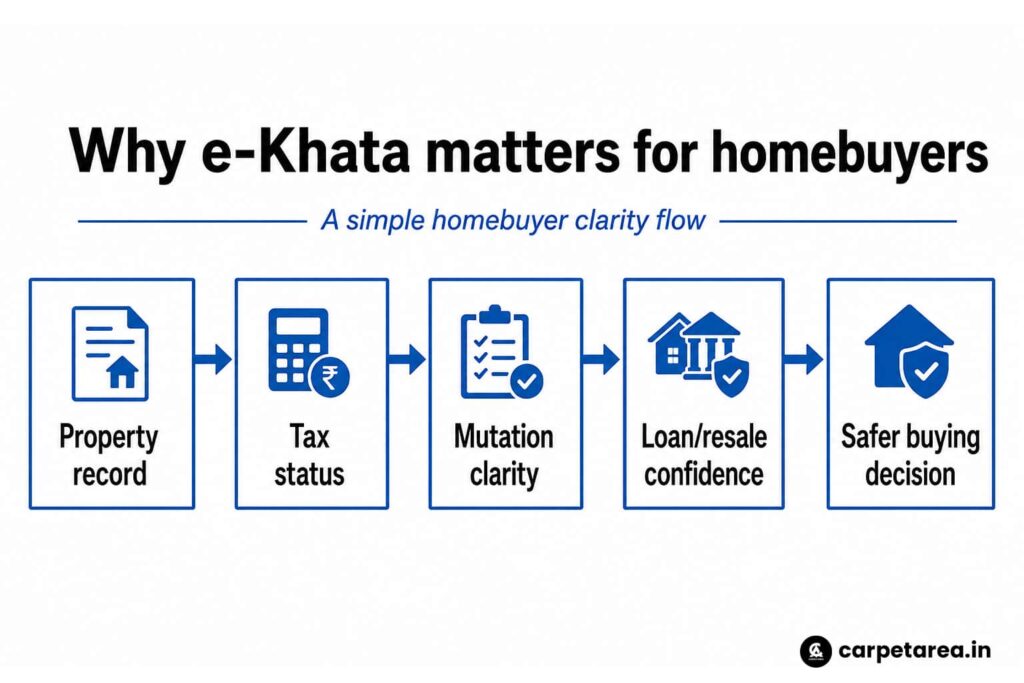
This is why campaigns like My e-Khata, My Hakku matter. They do not just help current owners. They also make the future buying process safer and more transparent.
Why the open house model matters?
The campaign is also important because it is not limited to an online-only process. Reports say GBA planned open house centres across 52 locations in Bengaluru, with services such as final e-Khata issuance, new e-Khata, B-Khata to A-Khata conversion and grievance redressal.
This helps property owners who may not be comfortable with online systems or who need official clarification on documents. A physical help centre can reduce confusion, especially for senior citizens, long-time owners and families trying to regularise inherited or older properties.
The official BBMP/GBA update also listed venue details for the “My e-Khatha My Hakku” campaign, with the date shown as 16-05-2026 and timings from 10 AM to 5 PM.
What homebuyers should learn from this?
For homebuyers, the lesson is clear: property paperwork is not a formality. It is part of the value of the property.
A clean property is not only about location, carpet area, amenities or price. It is also about whether the ownership chain is clear, municipal records are updated, taxes are paid, approvals are in place and the khata status is understandable.
In a city like Bengaluru, where many older layouts, revenue sites, converted lands and documentation-heavy properties exist, e-Khata can become an important verification layer.
What property owners should watch?
Property owners should track whether their e-Khata has been issued, whether mutation is updated, whether tax records match the property details and whether any grievance is pending. The BBMP e-Aasthi portal is an official digital route where owners can check e-Khata status using property-related details.
Owners looking at B-Khata to A-Khata conversion should also understand eligibility, fee calculation, document requirements and the applicable deadline before applying.
Final view
Bengaluru’s e-Khata campaign is not just a municipal paperwork drive. It is part of a larger shift toward digital property records, cleaner ownership documentation and better buyer confidence.
For current owners, it may help regularise records and reduce future transaction problems. For homebuyers, it is a reminder that due diligence should begin with documents, not with brochures. And for Bengaluru’s real estate market, it shows that transparency in property records is becoming as important as location and price.
The safest way to understand this story is simple: e-Khata may not replace legal due diligence, but it can make property ownership records clearer, more accessible and easier to verify.

Leave a Reply