

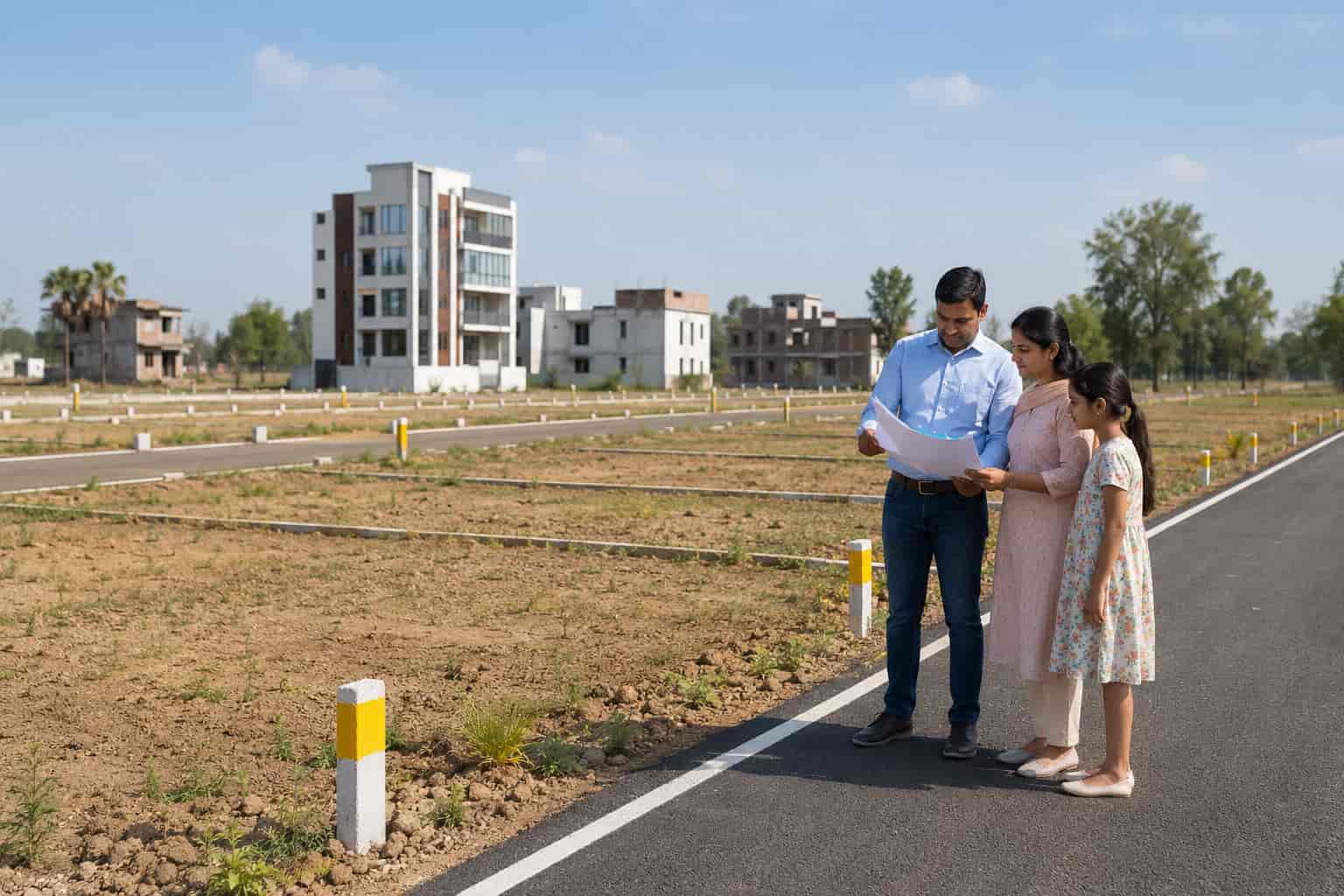
A government authority auction can look very simple from the outside. A notice is issued, registration dates are announced, and buyers start asking one question: is this a good opportunity?
But in a tender-cum-auction, the real decision is not only about whether a plot is available. The real decision is whether the buyer understands the location, property type, reserve rate, earnest money, auction process and payment conditions before participating.
That is why the latest Bareilly Development Authority auction deserves careful attention.
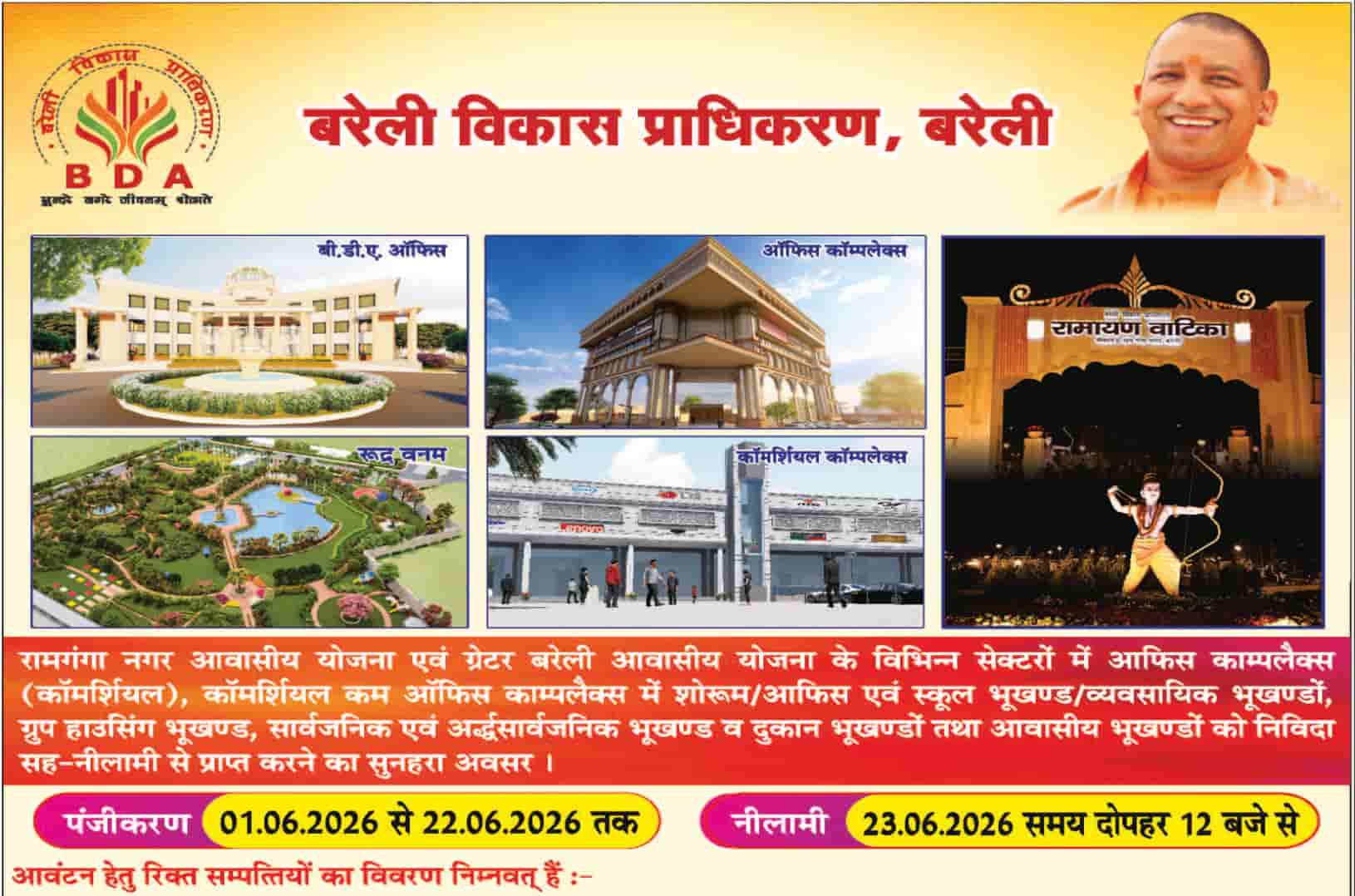
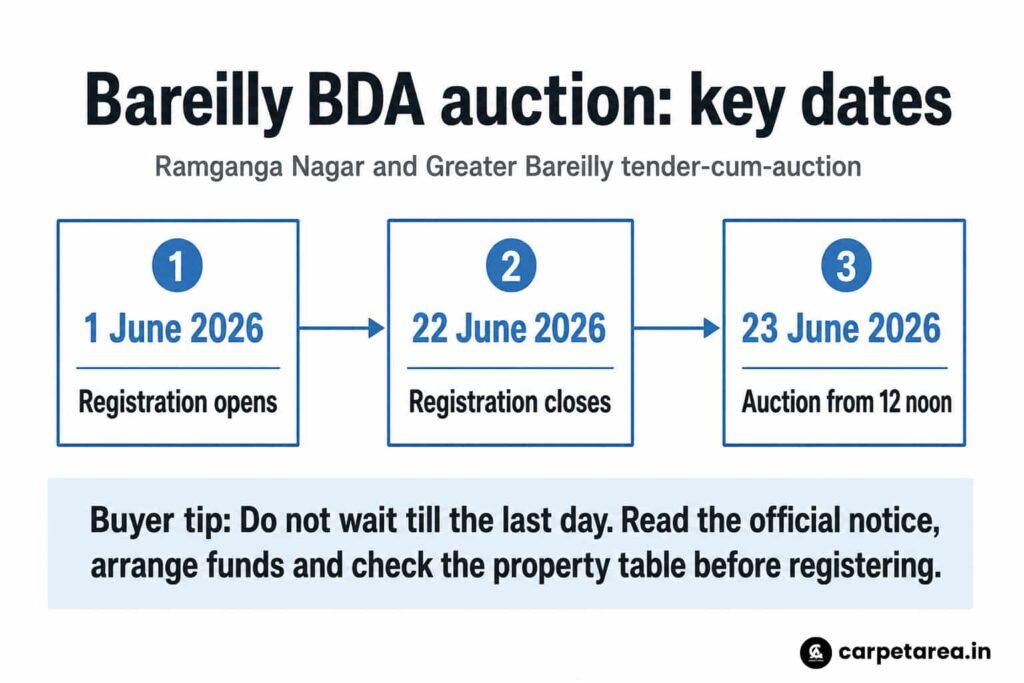
Bareilly Development Authority has issued a notice for properties in Ramganga Nagar Awasiy Yojana and Greater Bareilly Awasiy Yojana. The registration window is from 1 June 2026 to 22 June 2026, and the auction is scheduled for 23 June 2026 from 12 noon.
This makes it an active authority auction story, not just a future scheme update.
What has Bareilly Development Authority announced?
Bareilly Development Authority has offered properties in different sectors of Ramganga Nagar Awasiy Yojana and Greater Bareilly Awasiy Yojana through the tender-cum-auction method.
The official notice includes several property categories such as residential plots, commercial plots, office and showroom spaces, school plots, group housing plots, public and semi-public plots, shop plots and other commercial-use assets.
For buyers, this means the auction is not limited to one kind of property. It covers multiple real estate categories, which makes it useful for different buyer groups.
A family may look at residential plots.
A business owner may look at shops or commercial plots.
An institution may track school or public-use plots.
A developer or investor may study group housing and larger commercial opportunities.
Why is this auction important?
Bareilly is not usually discussed like Noida, Ghaziabad or Lucknow, but that is exactly why this story matters. Smaller and mid-sized cities in Uttar Pradesh are now seeing more structured authority-led real estate activity.
Ramganga Nagar and Greater Bareilly are planned scheme areas under Bareilly Development Authority. When an authority puts properties into a formal tender-cum-auction process, it creates a more transparent route for buyers compared with informal land deals or broker-driven claims.
This can be useful for people who want to enter a developing city market through official channels.
But it also requires discipline. In an auction, the price can move above expectation. A buyer who enters without calculating total cost may later feel pressure.
What are the important dates?
The most important dates are clear.
Registration opens: 1 June 2026
Registration closes: 22 June 2026
Auction date: 23 June 2026
Auction time: 12 noon onward
These dates should be treated seriously. Buyers should not wait till the last day to study the property table, arrange funds, understand earnest money requirements or complete registration.
For any auction, paperwork delays can become a real problem. If a buyer wants to participate, the better approach is to study the official notice early and keep all documents ready before the closing date.
What kind of properties are included?
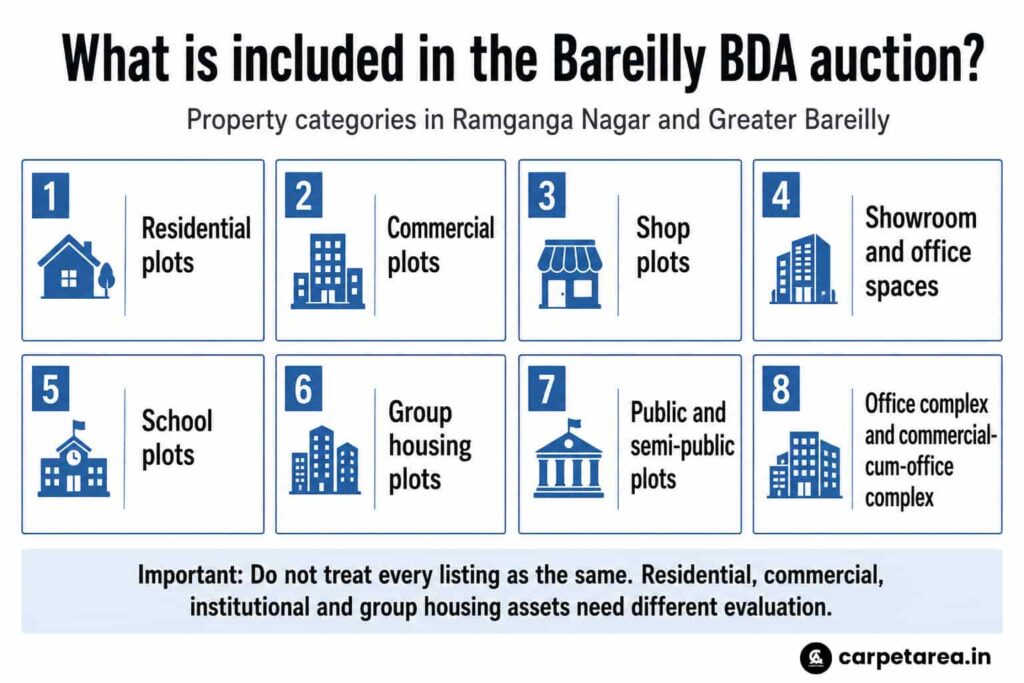
The official notice mentions multiple types of properties across Ramganga Nagar and Greater Bareilly schemes.
These include:
Residential plots.
Commercial plots.
Shop plots.
Showroom and office spaces.
School plots.
Group housing plots.
Public and semi-public plots.
Office complex and commercial-cum-office complex properties.
This wide mix is important because it shows that the auction is not only for end-user homebuyers. It also has a business, commercial and investor angle.
For Carpet Area readers, the key point is simple: do not treat every listing in the auction as the same. A residential plot, a commercial plot, a school plot and a group housing plot have completely different use cases, risk profiles and payment requirements.
What should residential buyers check?
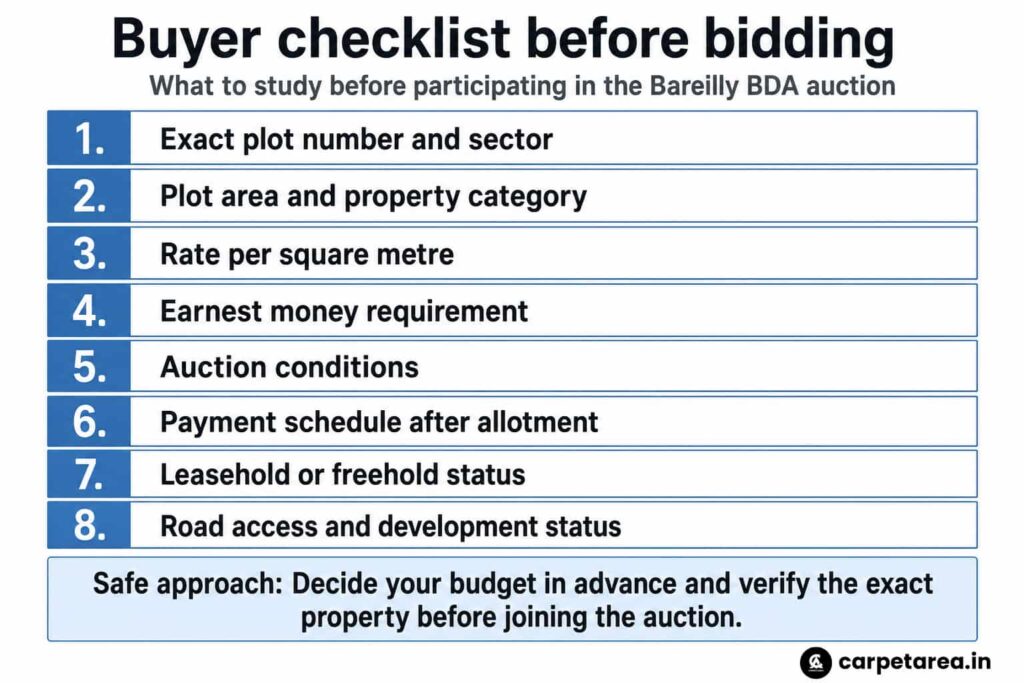
If a buyer is interested in residential plots, the first step is to confirm the exact sector, plot size, rate per square metre, earnest money and location map.
The buyer should also check whether the plot is suitable for immediate end-use or long-term holding. A plotted authority scheme can be attractive, but only if the buyer understands road access, surrounding development, basic amenities and future habitation potential.
Residential buyers should check:
Exact plot number and sector.
Plot area.
Rate per square metre.
Earnest money requirement.
Auction conditions.
Payment schedule after allotment.
Leasehold or freehold status.
Development status of the sector.
Road width and approach.
Nearby residential occupancy.
Expected possession and documentation process.
A plot should not be selected only because it is in an authority scheme. It should be selected because the buyer has studied the plot properly.
What should commercial buyers check?
Commercial buyers need a different checklist.
A shop plot or showroom space depends heavily on visibility, footfall, road width, surrounding residential population and future market activity. A low price in a weak location may not be better than a higher price in a stronger commercial pocket.
Commercial buyers should check:
Frontage.
Approach road.
Expected customer catchment.
Nearby residential density.
Use permission.
Parking availability.
Construction conditions.
Auction reserve price.
Total payment timeline.
Future business demand.
The biggest mistake in commercial property is assuming that every authority commercial plot will automatically become profitable. Location and usage matter more than the label.
Why tender-cum-auction needs extra caution?
A tender-cum-auction process is different from a normal fixed-price scheme.
In a fixed-price housing scheme, the authority usually publishes a price, application process and allotment method. In an auction, buyers compete. The final price can depend on bidding interest.
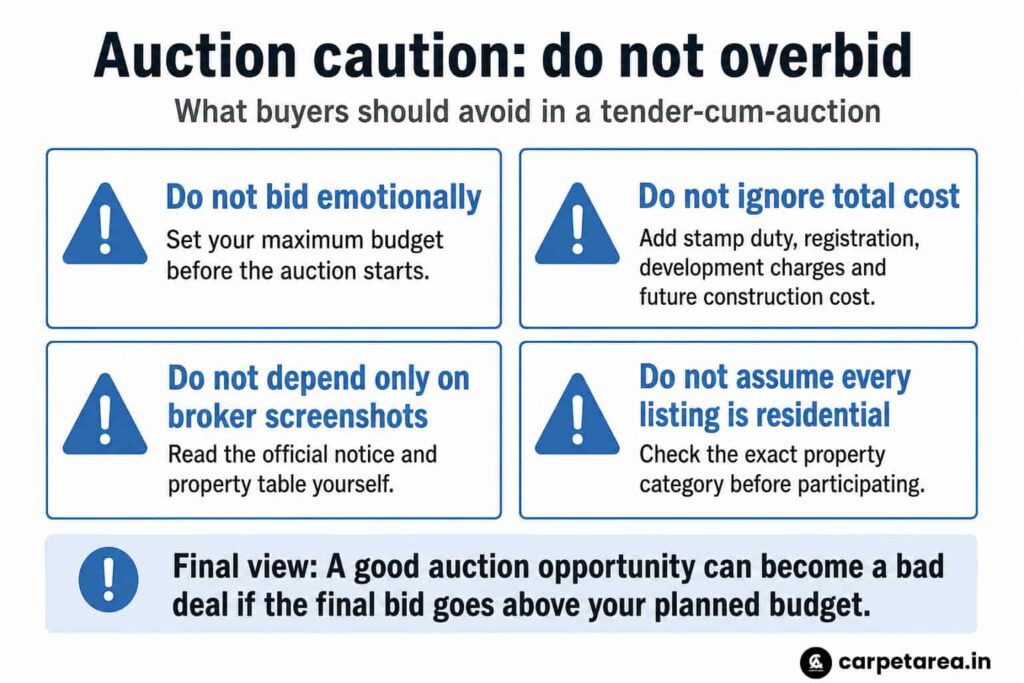
That is why buyers must decide their maximum comfortable bid before the auction begins.
Do not enter an auction emotionally.
Do not keep increasing the bid only because others are bidding.
Do not forget stamp duty, registration cost, development charges, construction cost or future holding cost.
A property may look attractive at reserve price, but it may not remain attractive if the final bid becomes too high.
What should buyers avoid?
Buyers should avoid five common mistakes.
Do not depend only on broker screenshots or forwarded PDF images.
Do not assume every plot is residential.
Do not ignore sector location and plot size.
Do not participate without calculating earnest money and payment capacity.
Do not bid beyond your planned budget because of auction pressure.
Authority auctions can be good opportunities, but they are not risk-free. The risk comes from overbidding, wrong property selection, weak location understanding and incomplete reading of terms.
Is this good for investment?
This auction can be interesting for investors because it includes both residential and commercial categories. Ramganga Nagar and Greater Bareilly are planned authority scheme areas, so they can attract attention from people looking at long-term urban expansion in Bareilly.
But investment quality depends on the exact property.
A residential plot in a developing sector is different from a commercial plot.
A group housing plot is different from a shop.
A school plot is different from a public and semi-public use plot.
Each category has its own buyer profile, holding period and future demand pattern.
For investors, the right approach is not to ask whether the auction is good or bad. The right question is: which exact property category, in which sector, at what final bid price, makes sense?
What is the Carpet Area view?
The Bareilly Development Authority auction is a strong active scheme story because it has an official registration window, an official auction date and multiple property categories across Ramganga Nagar and Greater Bareilly.
For homebuyers, it may offer a chance to look at authority-backed plotted options.
For business owners, it may open commercial and shop opportunities.
For investors, it gives a way to study Bareilly’s planned growth beyond informal land buying.
But the final decision should be made only after reading the official notice, checking the property table, understanding the auction rules and calculating the full cost.
The safe line is simple.
Track the auction carefully before 22 June 2026, but do not bid without understanding the property, payment terms and your maximum budget.
A government authority auction can create opportunity, but only a well-prepared buyer can use it wisely.
Sources:-
Confirms the live tender-cum-auction notice, registration dates 01.06.2026 to 22.06.2026, and auction date 23.06.2026 from 12 noon.
https://bdainfo.org/
Bareilly Development Authority scheme inventory and planned scheme context.
https://bdainfo.org/Account/Schemes
Bareilly Development Authority tender-cum-auction notice dated 01 June 2026
https://bdainfo.org/Website/assets/pdf/AddComm01062026a.pdf



Leave a Reply