


A government land auction can look simple on paper. A list of plots is published, EMD dates are announced, and buyers start checking whether the location fits their budget.
But the Jaipur Development Authority June 2026 e-auction needs more careful reading.
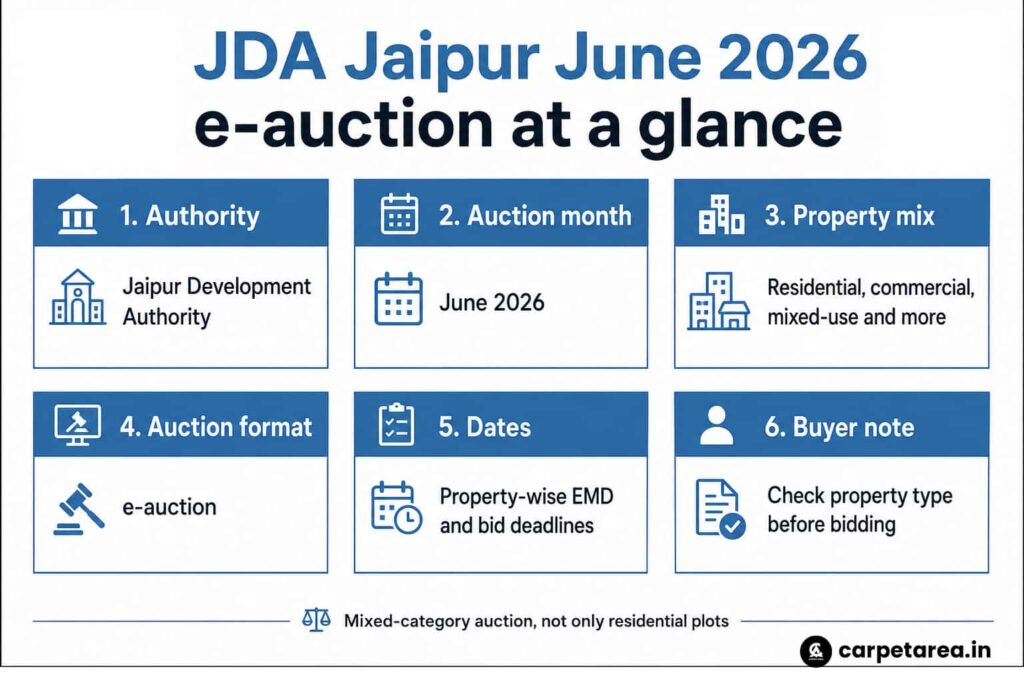
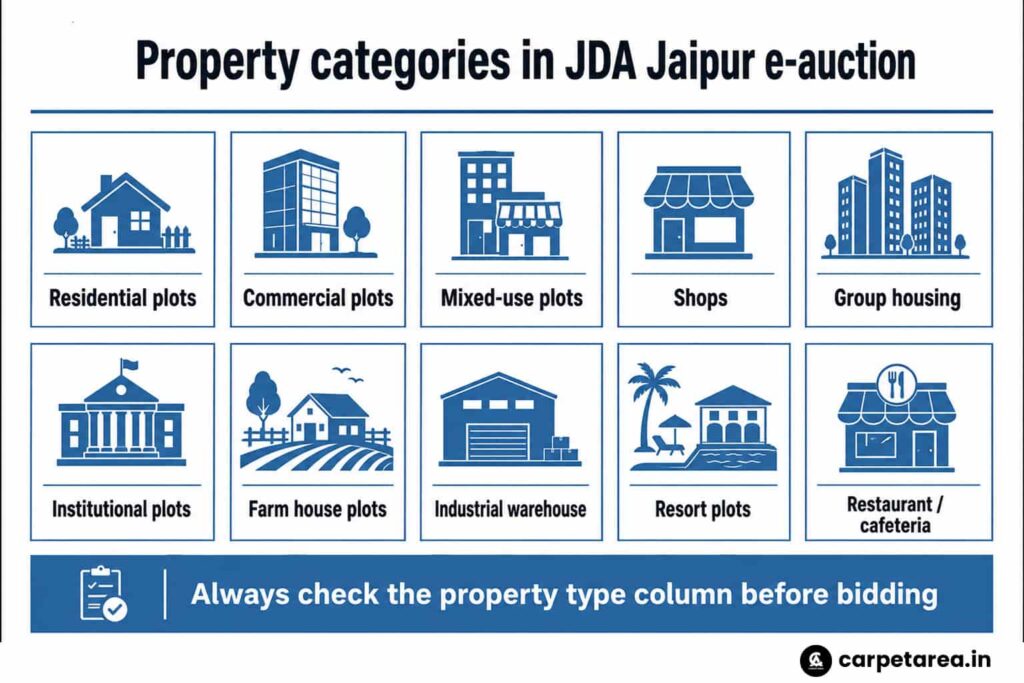
This is not only a residential plot scheme. The official auction document includes different property categories such as residential plots, mixed-use plots, commercial plots, shops, group housing, institutional plots, farm house plots, industrial warehouse plots, resort plots and restaurant or cafeteria plots.
That means every buyer should first understand one basic point: the JDA Jaipur June 2026 e-auction is a mixed property auction, not a single-category housing scheme.
For homebuyers, some entries may be relevant as residential plots. For business owners, shops and commercial plots may be more important. For investors and developers, group housing, mixed-use and larger land parcels may be worth studying. But the correct decision depends on the exact property entry, not only the JDA name.
What has JDA announced?
Jaipur Development Authority has published an e-auction schedule for multiple property categories in Jaipur for June 2026.
The official auction schedule mentions property-wise details such as property description, corner status, zone, area in square metres, property type, EMD amount, base selling price per square metre, bid increment amount, EMD deposit start date, EMD deposit last date, bidding start date and bidding end date.
This makes the document useful for serious buyers because it does not only announce an auction. It gives property-wise financial and timing details.
But it also means buyers cannot rely on a single common date or one common property type. Every listing must be checked individually.
Are these plots only residential?
No. This is the most important clarification.
The auction includes some residential plots, but it also includes commercial plots, mixed-use plots, shops, group housing, institutional properties, farm house plots, industrial warehouse plots, resort plots and restaurant or cafeteria plots.
That is why buyers should not treat this as a normal residential plot scheme.
A person looking for a home plot should check only the entries marked residential.
A business buyer should focus on commercial or shop entries.
A developer or larger investor may study group housing or mixed-use entries.
A hospitality investor may look at resort or restaurant and cafeteria categories.
The safest rule is simple: before checking price, first check the property type.
What are the important dates?
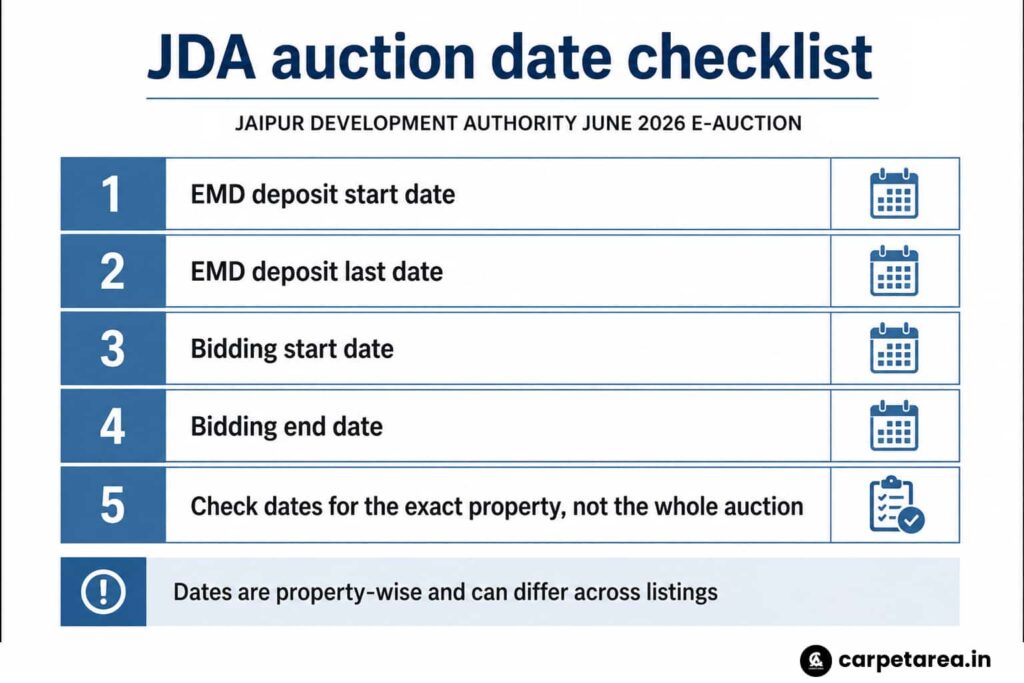
The official auction document shows that the EMD deposit and bidding dates are property-wise.
Some entries have EMD deposit starting from 2 June 2026 and early bidding end dates in the first week of June. Other live auction entries continue later in June, depending on the property.
This is important because a buyer should not assume one common closing date for all properties.
In JDA e-auction, the correct approach is to open the exact auction entry and check:
EMD deposit start date.
EMD deposit last date.
Bidding start date.
Bidding end date.
Property type.
Zone.
Base selling price.
EMD amount.
Bid increment.
If the buyer misses the EMD deposit deadline for a particular property, participation may not be possible even if other auction entries are still active.
What kind of residential entries are visible?
The auction schedule includes residential entries such as residential plots in Patrakar Colony, Beelwa Scheme, Vipra Vihar Scheme, Central Spine Block-G and Atal Scheme, among others.
This confirms that residential opportunities exist in the auction.
But buyers should notice that not every listing with the word “plot” is automatically residential. Some plots are commercial. Some are mixed-use. Some are shops. Some are larger investment-type properties.
For a genuine homebuyer, the first filter should be “Type: Residential.”
After that, the buyer should check area, zone, base selling price, corner status and bidding timeline.
Why should buyers be careful with mixed auctions?
Mixed auctions can create confusion.
A buyer may see a property name, location or scheme name and assume it is suitable for housing. But if the property type is commercial, shop, group housing or mixed-use, the use, pricing, rules and buyer profile will be different.
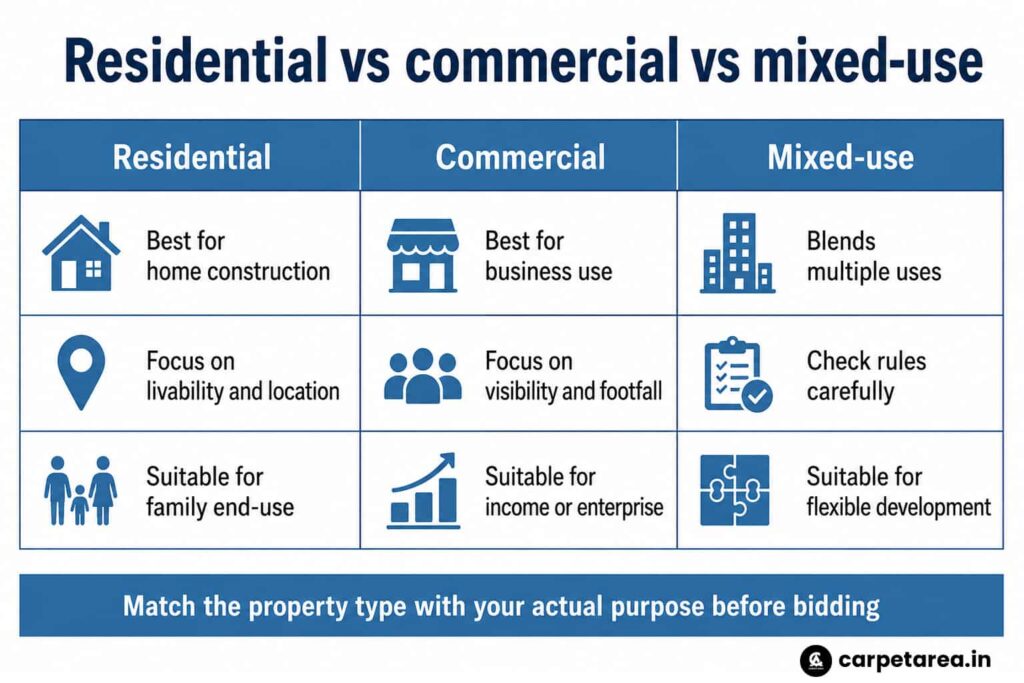
A residential plot is usually evaluated for living, construction and long-term family use.
A commercial plot is evaluated for business potential, visibility and footfall.
A mixed-use plot may have different development possibilities.
A group housing plot is usually not for an individual family buyer.
This is why the auction should be studied category by category.
What should residential buyers check?
A residential buyer should not enter the auction only because it is a JDA property.
Before bidding, check these points:
Property type should clearly be residential.
Exact scheme name and plot number.
Zone and location.
Area in square metres.
Corner status.
Base selling price per square metre.
EMD amount.
Bid increment amount.
Bidding end date.
Surrounding development.
Road access.
Layout and planning status.
Future livability.
A residential buyer should also calculate the approximate total cost before bidding. The final bid can go higher than the base selling price, so budget discipline is important.
What should commercial and investor buyers check?
For commercial buyers and investors, the checklist is different.
A commercial plot or shop should be checked for visibility, surrounding population, access road, business catchment, parking possibility and future market activity.
A group housing or mixed-use plot should be evaluated from a developer or long-term investment angle, not like a normal home plot.
Commercial and investor buyers should check:
Permitted use.
Zone and location.
Area and frontage.
Base selling price.
EMD requirement.
Bid increment.
Future demand.
Approach road.
Nearby residential catchment.
Construction rules.
Exit or resale potential.
A property may look attractive in the auction list, but it becomes meaningful only when the use case matches the buyer’s plan.
Why EMD and bid increment matter?
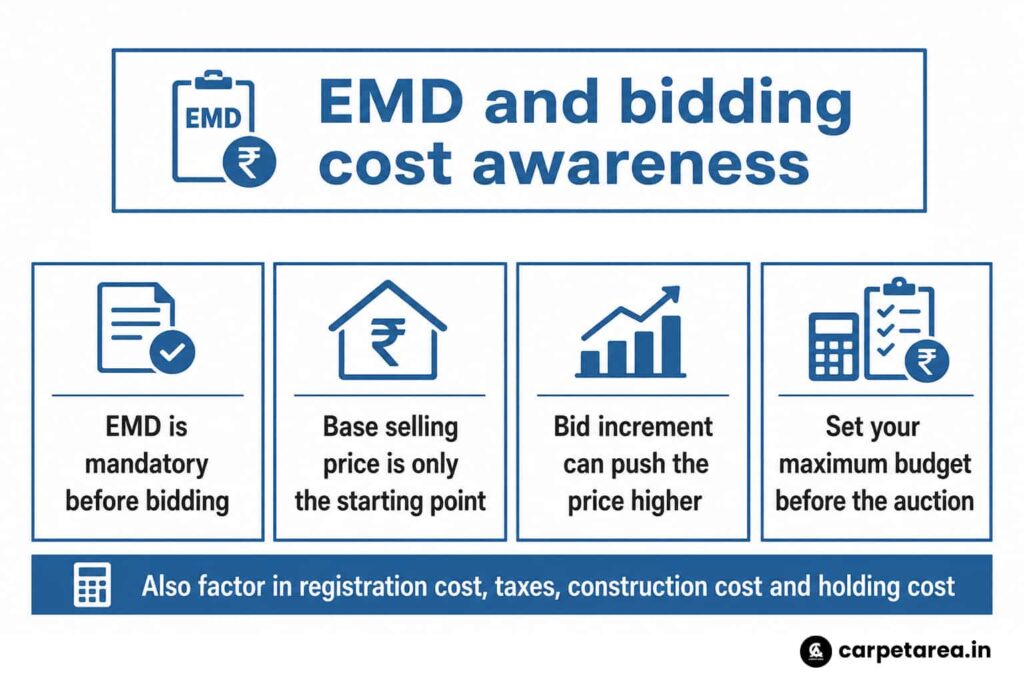
In an e-auction, the base selling price is only the starting point. The final price depends on bidding.
The official document includes EMD amount and bid increment details property-wise. This is important because buyers should know how much money must be deposited before participation and how the bid can move during auction.
A buyer who does not understand EMD and bid increment may enter without full preparation.
Before participating, buyers should decide their maximum comfortable bid. This should include not only the bid amount but also other possible expenses such as registration cost, taxes, development charges, construction cost and holding cost.
What mistakes should buyers avoid?
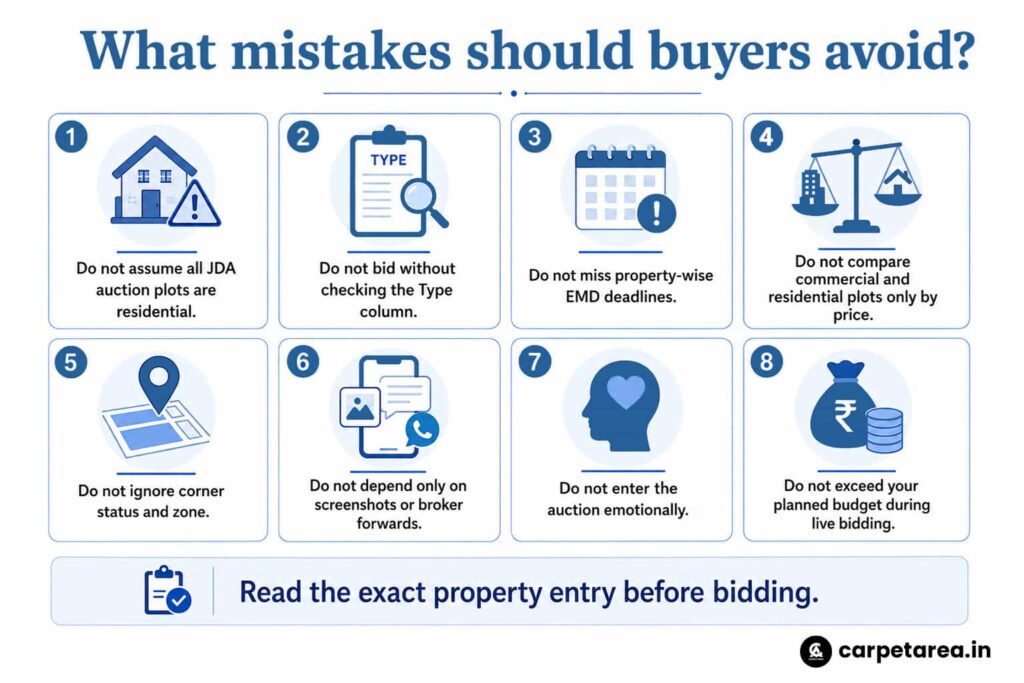
Buyers should avoid these common mistakes:
Do not assume all JDA auction plots are residential.
Do not bid without checking the Type column.
Do not miss property-wise EMD deadlines.
Do not compare commercial and residential plots only by price.
Do not ignore corner status and zone.
Do not depend only on screenshots or broker forwards.
Do not enter the auction emotionally.
Do not exceed your planned budget during live bidding.
A government authority auction can be transparent, but it still requires careful reading. The risk usually comes from wrong property selection, overbidding and incomplete understanding of use conditions.
Is this auction good for homebuyers?
For homebuyers, the auction can be useful only if they find a suitable residential entry in the right location and within their budget.
This is not a scheme where every property is meant for individual housing. That is why homebuyers should shortlist only residential plots and ignore categories that do not match their requirement.
If a residential plot is in a good location, has a manageable area and fits the buyer’s budget, it can be worth studying. But the buyer should still check planning, approach road, future habitation and total cost before bidding.
Is this auction good for investors?
For investors, the auction may be more interesting because it includes multiple property categories.
Commercial plots, mixed-use plots, shops, group housing and larger assets can attract different kinds of buyers. But this also means the risk is category-specific.
A shop depends on footfall.
A commercial plot depends on business catchment.
A mixed-use plot depends on development rules.
A group housing plot depends on development feasibility and market demand.
An investor should not ask whether the auction is good or bad. The better question is: which property type, in which zone, at what final bid price, makes sense?
The Carpet Area view
JDA Jaipur June 2026 e-auction is a strong authority-led real estate story because it includes multiple property categories and gives property-wise auction details.
But it should be reported correctly.
This is not only a residential plot scheme. It is a mixed JDA e-auction covering residential, commercial, mixed-use, shop, group housing and other investment-linked property categories.
For buyers, the safest approach is simple.
First check the property type.
Then check the zone, area, EMD, base selling price and exact bidding dates.
After that, calculate the maximum budget.
Only then should a buyer participate.
A JDA auction can create opportunity, but only for a buyer who reads the official entry carefully and does not bid blindly.
Sources:-
Jaipur Development Authority official Property Auction
https://jda.rajasthan.gov.in/content/raj/udh/jda—jaipur/en/citizen-service/property-auction.html
Rajasthan UDH Live E-Auctions portal
https://udhonline.rajasthan.gov.in/Portal/PortalAuctionList?q=8Kc3Ao4wz0Iu6WN70HQYv%2F12SQygSRgtEXUrMOs8%2FIf7uKfQ7bDX4KrgkkM6BTXJmuz6t7fQyNBbcuWQ8dmhKg%3D%3D
Official JDA June 2026 e-auction schedule document
https://udhonline.rajasthan.gov.in/Portal/ShowDocument?q=r2hkBedDKF%2FzJn4bcDXCbQ%3D%3D
JDA official homepage
https://jda.rajasthan.gov.in/content/raj/udh/jda—jaipur/en/home.html



Leave a Reply