


A retired couple may live in a valuable home, have domestic help and speak to their children every evening.
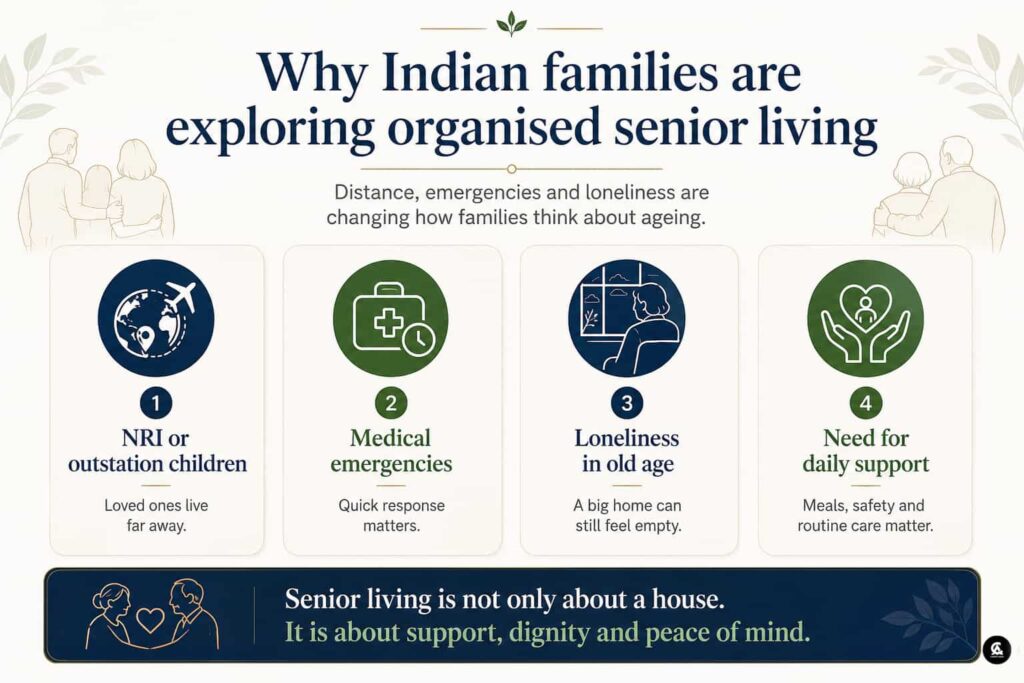
Yet when one of them feels unwell at midnight, the family suddenly discovers a difficult truth: a large house is not the same as an organised support system.
A son working in Dubai may be able to pay for the best treatment, but he cannot personally reach his father within minutes. A daughter building her career in Bengaluru may call her parents several times a day, but she cannot remove Delhi’s traffic during a medical emergency. Parents who move from their hometown to live with their children may gain physical proximity, yet lose the neighbourhood, friendships and familiar routines that made everyday life meaningful.
These are not isolated situations. They represent a wider change in Indian families.
Children are moving for education and employment. Nuclear households are becoming more common. Older adults are living longer, often with greater financial independence, but the informal support systems around them are becoming weaker.
This is where senior living in India is beginning to find its real purpose.
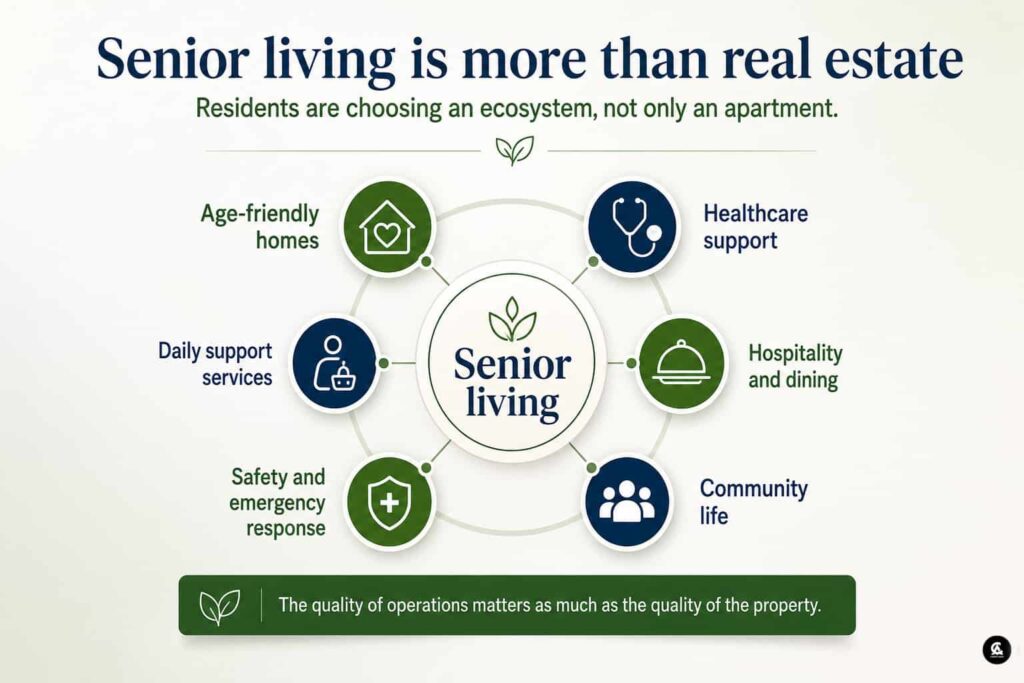
It is not simply about constructing homes for older people. It is about creating an environment where housing, healthcare, hospitality, safety, companionship and daily support work together.
India is young, but it is also ageing rapidly
India’s demographic story is usually told through its young workforce. Less attention is given to the population that has already spent decades building families, careers and assets.
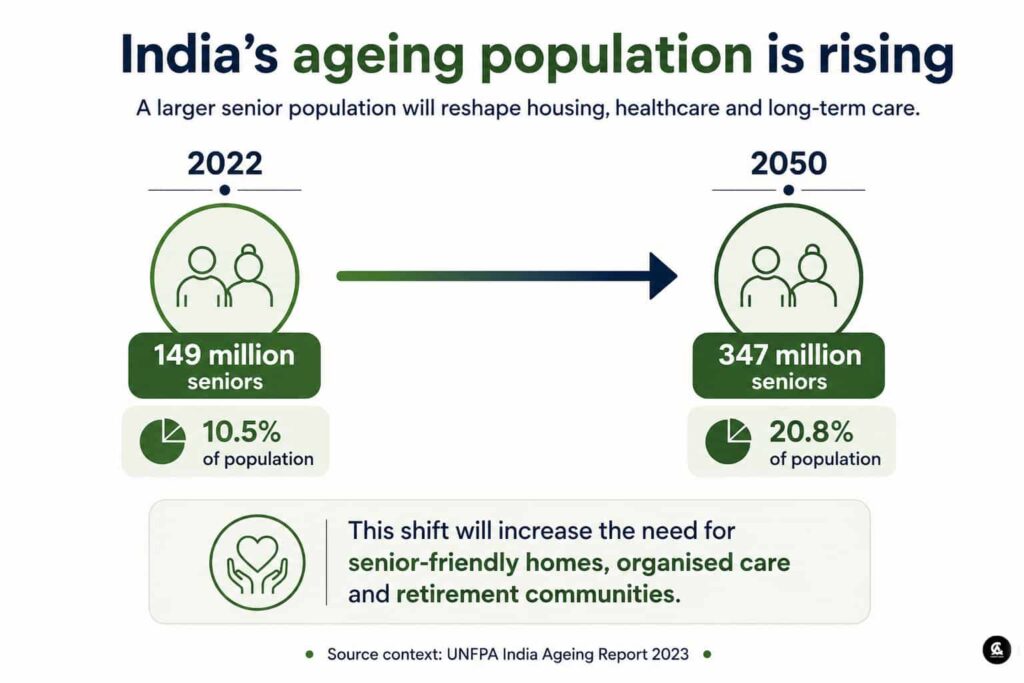
The UNFPA’s India Ageing Report 2023 estimated that India had approximately 149 million people aged 60 and above in 2022, representing around 10.5% of the population. By 2050, this group is projected to reach approximately 347 million, or nearly 20.8% of the population.
This is not merely a population statistic.
It means India will need to rethink:
- housing for older adults,
- emergency healthcare access,
- mobility and accessibility,
- long-term care,
- retirement finance,
- community support,
- and the role of adult children living away from parents.
It is also important to avoid assuming that every older Indian is financially secure. UNFPA notes that a significant share of India’s elderly population faces income insecurity and poverty. The premium senior living market therefore represents one segment of a much larger and economically diverse ageing population.
Why a comfortable home can still become isolating?
Many older adults already own good homes.
Some live in premium apartments. Others remain in large family houses built over decades. They may have a cook, cleaner, driver or neighbourhood chemist.
But these arrangements are often fragmented.
A domestic worker may prepare food but cannot necessarily recognise a medical emergency. A security guard may know that a resident has not stepped outside, but may not have a formal responsibility to check. A driver may take someone to the hospital, but may not be available at night.
The house may provide comfort, but it may not provide:
- round-the-clock emergency response,
- medicine supervision,
- planned social interaction,
- physiotherapy,
- trained caregiving,
- nutritious meals,
- transport coordination,
- or continuity when one service provider is absent.
Over time, even a luxurious home can begin to feel restrictive.
The problem is not always the absence of money. Sometimes, it is the absence of people, routines and dependable systems.
Community is not an amenity; it is part of healthy ageing
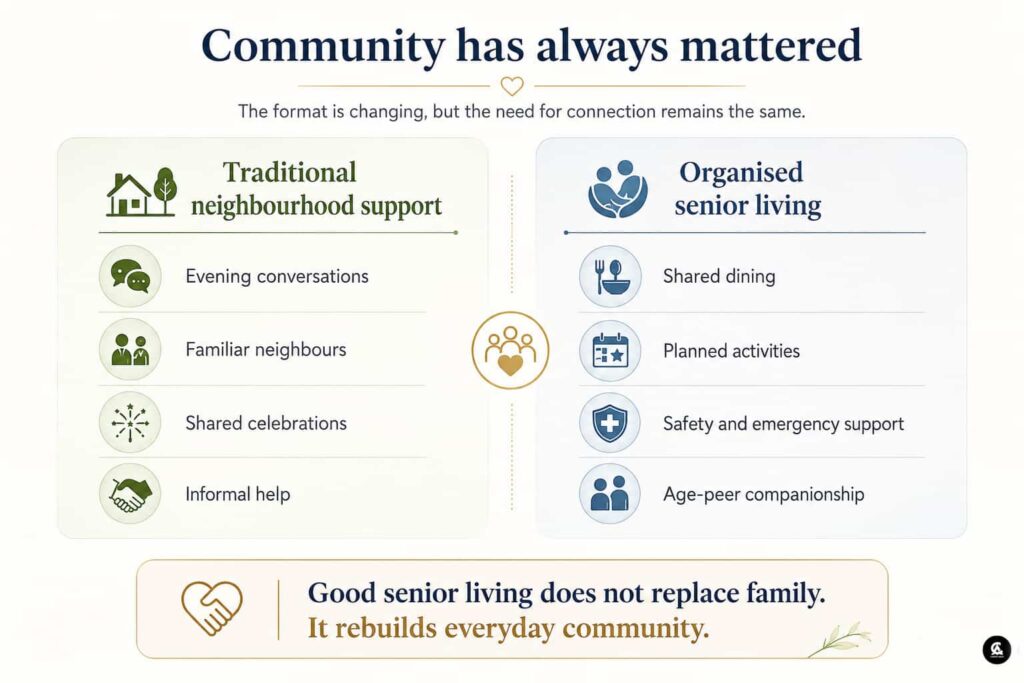
Traditional Indian neighbourhoods often gave older residents an informal social system.
People met outside their homes, sat together in the evening, discussed local matters, celebrated festivals and supported one another during difficult moments. These interactions were not listed as amenities, yet they played an important role in daily life.
Modern urban housing can be more private but less connected.
A senior may live among hundreds of families and still have nobody of a similar age with whom to share a walk, meal or conversation.
Well-managed retirement communities in India attempt to rebuild this missing social environment through:
- common dining,
- morning walks,
- hobby groups,
- cultural activities,
- games,
- resident clubs,
- wellness sessions,
- and shared celebrations.
This does not mean seniors should be forced into constant participation. A strong community respects privacy while making companionship easily available.
What is senior living?
Senior living is a specialised housing and service model designed around the changing needs of older adults.
Unlike a standard apartment project, it may combine:
- age-friendly architecture,
- emergency-response systems,
- housekeeping,
- dining,
- healthcare coordination,
- community activities,
- transportation,
- preventive wellness,
- caregiving,
- and nursing support.
The physical home is only one layer.
The real value comes from how reliably the community operates every day.
A beautifully designed apartment with a panic button is not enough if nobody responds quickly. A premium clubhouse has limited value if activities are rarely organised. A nearby hospital does not replace an ambulance protocol, trained nursing team or documented emergency plan.
In senior living, operations are as important as real estate.
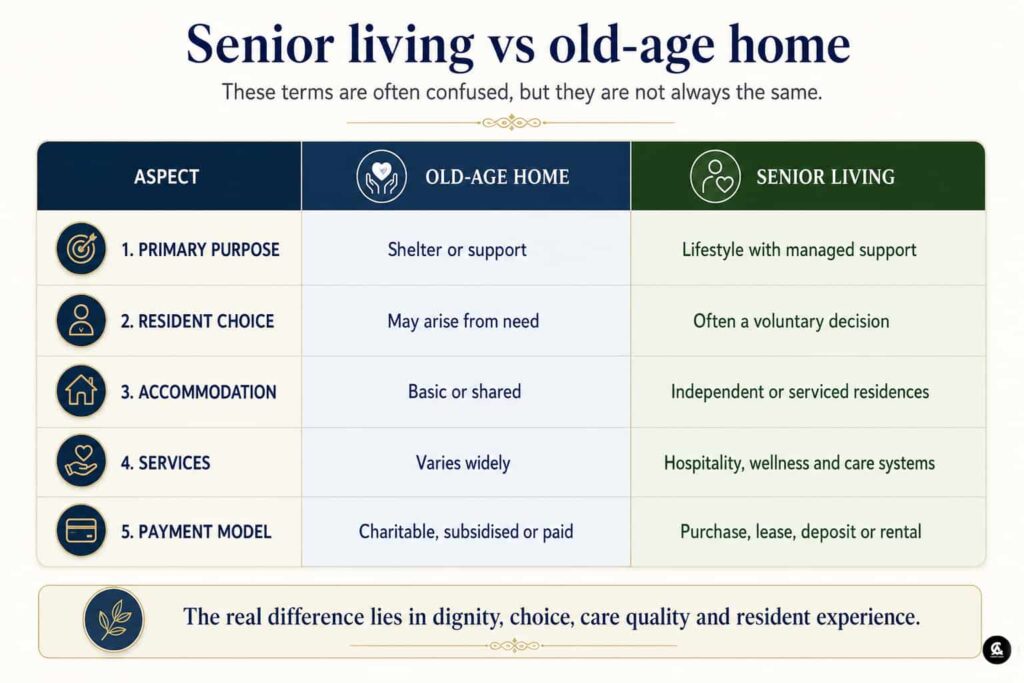
Senior living is not the same as an old-age home
In India, the two terms are often used as though they mean the same thing. They do not.
An old-age home may be charitable, subsidised, affordable or privately operated. Some provide basic shelter, while others offer significant care. The category itself is diverse and should not be treated dismissively.
Modern senior living is generally positioned differently. It is often selected voluntarily by older adults who want a safer, more convenient or more socially engaging lifestyle.
| Factor | Traditional old-age home | Modern senior living |
|---|---|---|
| Primary purpose | Shelter, support or care | Lifestyle, independence and managed support |
| Resident choice | May arise from need or limited options | Commonly a planned personal or family decision |
| Accommodation | Basic, shared or private | Independent, serviced or care-oriented residences |
| Services | Vary significantly | Hospitality, wellness, community and care packages |
| Payment model | Charitable, subsidised or paid | Purchase, lease, deposit or rental |
| Lifestyle facilities | Usually limited | Often includes recreation, dining and organised activities |
The most important distinction is not the label. It is the resident’s experience.
Does the senior have choice? Is privacy respected? Is care reliable? Are costs transparent? Does the resident feel valued?
The main types of senior living in India
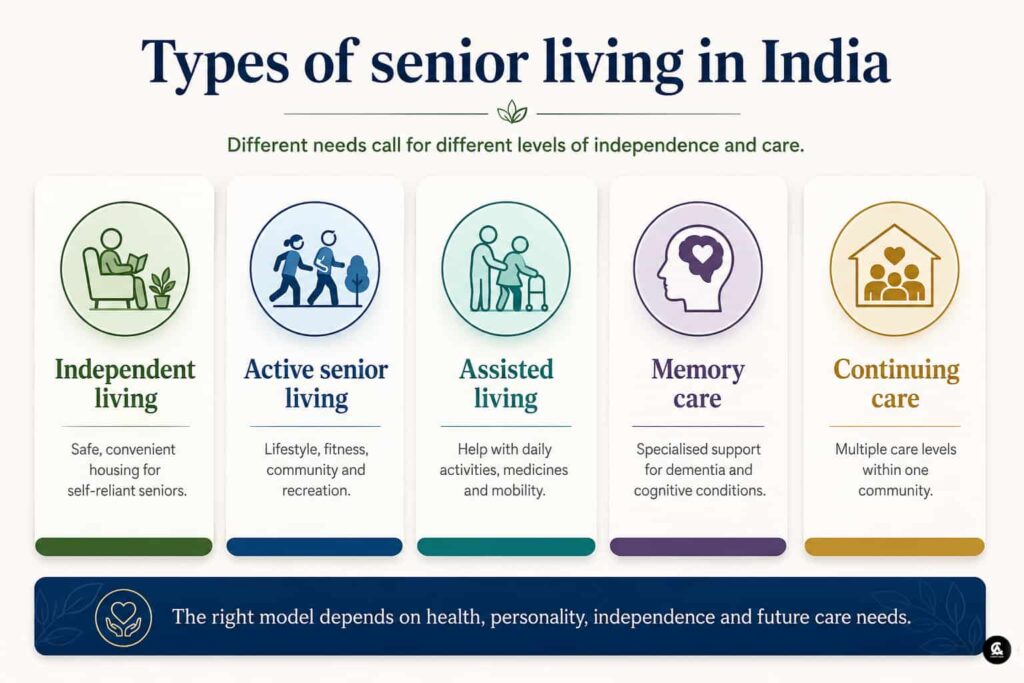
Senior living is not one fixed product. Different residents need different levels of independence and support.
CBRE identifies formats including independent living, assisted living, memory care and continuing-care communities, reflecting how needs may change over time.
Independent senior living
This model is intended for older adults who can manage their daily routine but want:
- safer architecture,
- housekeeping,
- community,
- dining options,
- security,
- and emergency support.
Residents generally retain a high level of independence.
Active senior living
Active senior living adds a stronger lifestyle and wellness component.
It may include:
- club facilities,
- fitness programmes,
- swimming,
- hobby groups,
- cultural events,
- travel,
- dining,
- and resident engagement.
It is often chosen by seniors who want to remain socially and physically active after retirement.
Assisted living
Assisted living is for residents who require help with activities such as:
- medication,
- bathing,
- dressing,
- mobility,
- meals,
- toileting,
- or personal care.
Caregiver and nursing support become more central in this model.
Memory care
Memory-care communities serve residents living with dementia or related cognitive conditions.
They require specialised staffing, secure design, structured routines and closer supervision.
Continuing-care communities
These communities provide more than one care level within the same campus.
A resident may begin in independent living and later move to assisted care or nursing support without leaving the wider community.
Why demand for senior housing is rising?
The growth of the senior living market in India is being driven by several structural changes.
Children are living farther from parents
Employment and education frequently take adult children to another city or country.
The emotional bond remains strong, but everyday support becomes difficult to manage from a distance.
Seniors are more financially independent
Many urban retirees own property, receive pensions, hold investments or have accumulated savings.
For them, retirement spending is gradually shifting from preservation alone towards comfort, wellness and experience.
Family homes are not always age-friendly
Large houses may have stairs, slippery bathrooms, difficult maintenance and limited emergency support.
They may represent wealth but not necessarily practical ageing.
Loneliness is becoming more visible
Living alone does not always mean being neglected. However, reduced daily interaction can affect emotional well-being, appetite, activity and routine.
Healthcare needs increase with age
Longer lives often come with chronic conditions, medication schedules, mobility changes and recurring medical appointments.
Families increasingly need systems rather than isolated service providers.
Social acceptance is changing
Senior living was once seen largely as family abandonment. It is increasingly being discussed as a proactive retirement choice—particularly when the senior participates willingly in the decision.
How large is the opportunity?
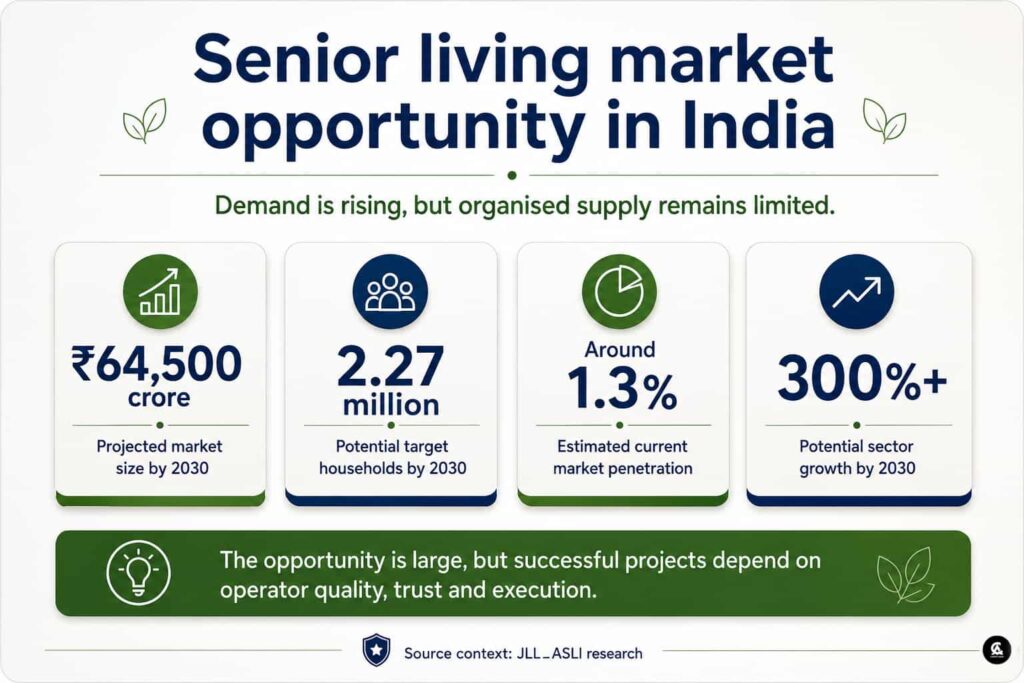
JLL and the Association of Senior Living India estimated that India’s senior living housing sector could grow by more than 300% and reach approximately ₹64,500 crore, or USD 7.7 billion, by 2030. Their research also estimated that the target market could grow from approximately 1.57 million households in 2024 to 2.27 million households by 2030.
The same research placed current market penetration at around 1.3%, compared with more than 6% in mature markets such as the United States and Australia.
These figures demonstrate potential, but they require careful interpretation.
Not every older household can afford organised senior living. Not every senior wants to move. Cultural acceptance differs across families, and suitable supply is concentrated in selected cities.
The opportunity therefore lies not in assuming that every senior is a customer, but in serving the addressable population well.
Why organised supply remains limited?
Senior living is more difficult to develop than an ordinary housing project.
A conventional developer may complete the building, hand over the apartments and reduce its operational role.
A senior living community cannot function that way.
It requires ongoing spending and management across:
- food,
- housekeeping,
- nursing,
- maintenance,
- emergency response,
- transport,
- resident engagement,
- caregiver training,
- and family communication.
The operator must earn trust over years, not only during the sales period.
This is one reason why the apparent demand–supply gap has not been filled quickly. Senior living is not just a construction opportunity. It is an operating business with significant reputational and care responsibilities.
Why southern India developed earlier?
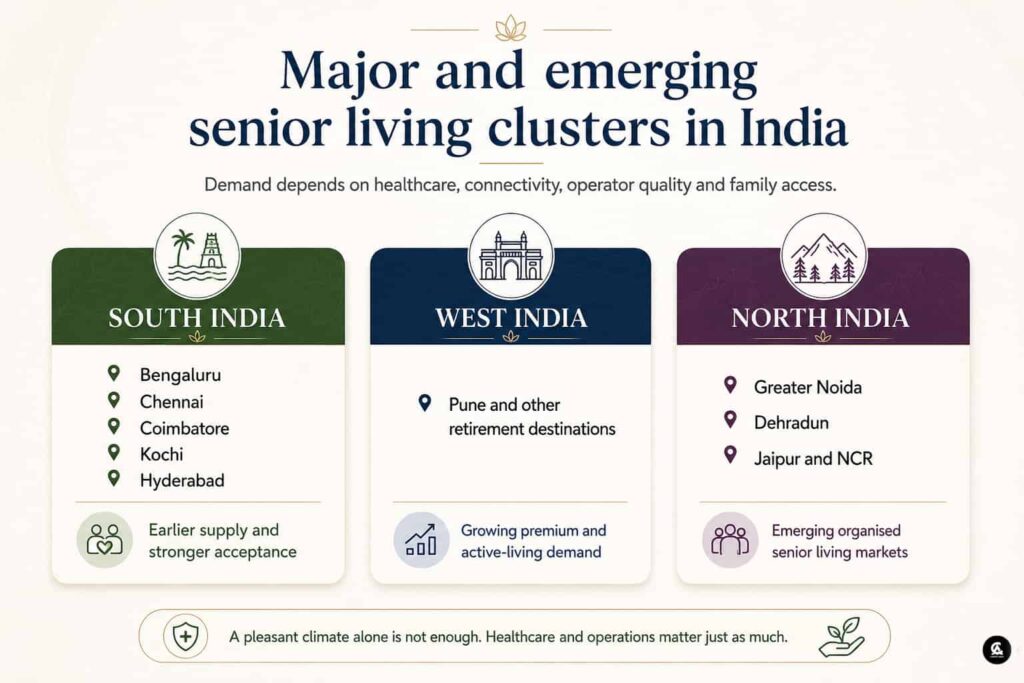
Southern cities have historically accounted for a large share of organised senior living supply.
Several factors may explain this:
- earlier social acceptance,
- retirement migration,
- established healthcare networks,
- comparatively lower-density retirement destinations,
- experienced operators,
- and a deeper base of NRI families in some markets.
Cities such as Bengaluru, Chennai, Coimbatore, Kochi and Hyderabad have therefore become important senior living clusters.
Pune has emerged as a significant western market, while Greater Noida, Dehradun, Jaipur and other northern locations are attracting increasing attention.
Regional opportunity should still be evaluated city by city. Climate alone does not make a successful retirement destination. Healthcare, connectivity, family access, affordability and operator quality are equally important.
What are seniors actually paying for?
A buyer may initially see an apartment, but a resident experiences a system.
The payment may cover some combination of:
Real estate
- apartment or room,
- common spaces,
- senior-friendly architecture,
- accessible bathrooms,
- and emergency infrastructure.
Hospitality
- meals,
- housekeeping,
- laundry,
- maintenance,
- concierge,
- and transportation.
Healthcare support
- nursing,
- doctor visits,
- medication management,
- physiotherapy,
- health monitoring,
- and emergency coordination.
Community
- activities,
- celebrations,
- wellness programmes,
- hobby groups,
- and shared dining.
Care
- bathing support,
- dressing assistance,
- mobility help,
- caregiver supervision,
- and higher-dependency services.
This is why comparing senior living only by price per square foot is misleading.
A lower-priced project with weak operations may provide less value than a more expensive community with dependable staffing, healthcare and resident engagement.
Purchase, rental or care package?
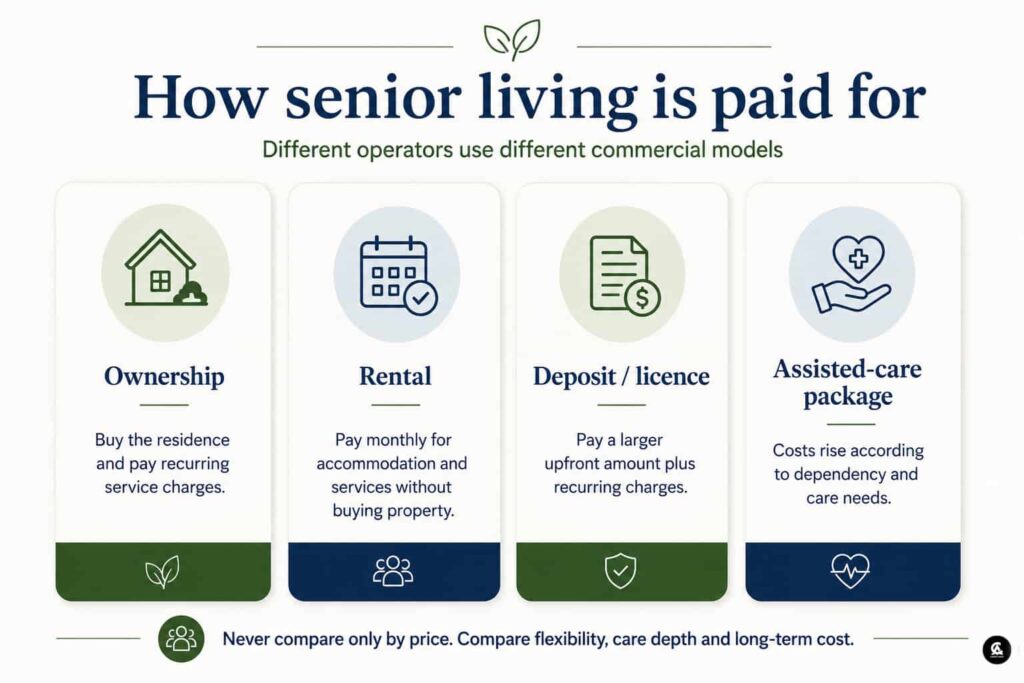
Senior living in India is being offered through different commercial models.
Ownership model
The resident buys the apartment and pays recurring maintenance or service charges.
This may suit people seeking long-term residence, but buyers must verify resale rules, transfer conditions and operator continuity.
Rental model
The resident pays monthly rent and service fees without purchasing the property.
This provides flexibility and may be more suitable when future care needs are uncertain.
Deposit or licence model
A larger deposit may be paid upfront, followed by recurring service charges. Refund conditions must be examined carefully.
Assisted-living package
The resident pays according to accommodation and level of dependency.
Costs can rise when dedicated caregivers, nursing or advanced care become necessary.
What families should check before choosing a project?
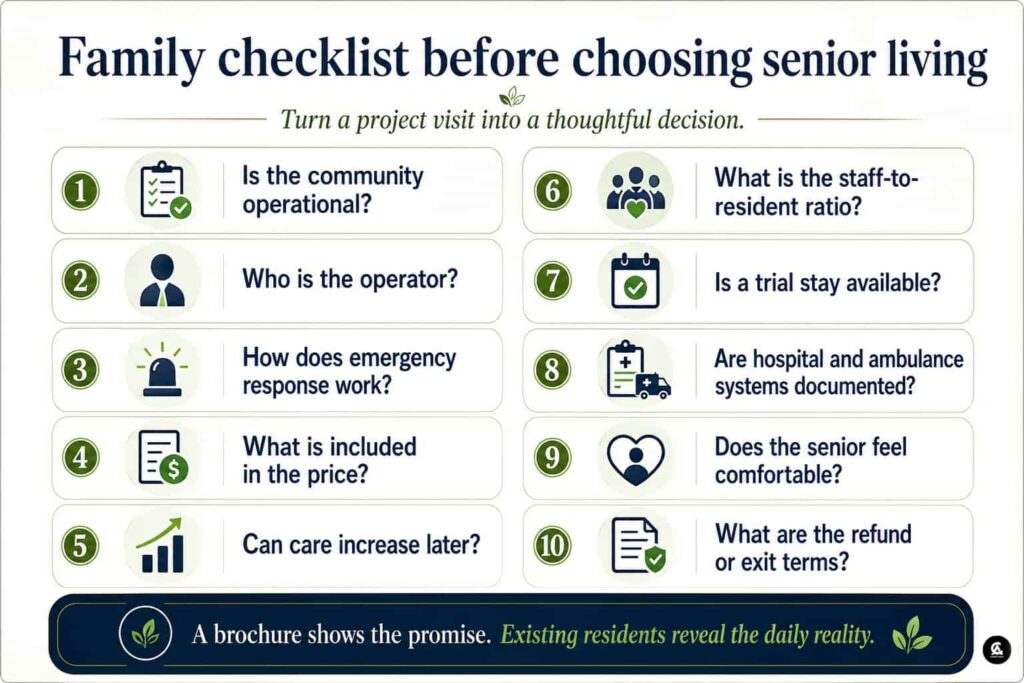
A senior living community should never be selected only through a brochure or model apartment.
Families should inspect the operating environment.
Is the community operational?
A functioning community with existing residents provides more evidence than a future promise.
Who is the operator?
The developer may construct the property, but another company may manage food, healthcare and resident services.
How does emergency response work?
Ask who receives alerts, how quickly staff respond and which hospital handles emergencies.
What is included in the price?
Meals, nursing, physiotherapy, transport and personal care may be included, limited or separately charged.
Can care increase over time?
A healthy resident today may require assisted living later.
What is the staffing level?
Ask about nurses, caregivers, doctors, activity coordinators and night shifts.
Is a trial stay available?
A trial stay allows the senior to experience food, staff behaviour, routine and community culture before committing.
Does the senior feel comfortable?
The senior’s consent should remain central.
A financially attractive project can still be the wrong choice if the resident feels isolated, controlled or emotionally displaced.
Is senior living a good investment?
The demographic and supply trends make the sector interesting, but investors should remain cautious.
A growing market does not guarantee that every project will succeed.
Senior living assets carry risks that ordinary apartments may not.
Operator risk
If service quality falls, the project’s value proposition can deteriorate even when the building remains in good condition.
Occupancy risk
Low resident occupancy can weaken both community experience and operating sustainability.
Resale risk
The buyer pool may be narrower than for a conventional apartment.
Service-charge escalation
Food, staffing, nursing and healthcare expenses can rise faster than standard housing maintenance.
Location risk
A peaceful location may still fail if it is too far from hospitals, families, airports or essential services.
Product mismatch
A luxury active-living project and a care-intensive assisted-living facility serve different residents.
Investors should therefore analyse senior living as both:
- a real-estate asset, and
- an operating service business.
Does senior living fit Indian culture?
The question is often framed incorrectly.
Indian culture is not defined only by parents and children sharing the same address. It is also defined by respect, responsibility, care and dignity.
For some families, multigenerational living works beautifully. Parents, children and grandchildren live together with genuine companionship and dependable support.
Those families may never need senior living.
For others, geography, work, health or family circumstances make daily support difficult. In such cases, organised senior living may be more responsible than leaving an older person alone with an informal patchwork of services.
The decision should not be driven by social judgment.
It should be based on:
- the senior’s wishes,
- health,
- independence,
- emotional needs,
- family situation,
- and financial comfort.
Freedom may matter more than ownership
Many seniors spent their prime years saving, raising children and building family assets.
Retirement can become the first stage of life in which they are free to choose entirely for themselves.
They may choose morning yoga instead of household repairs.
They may prefer dinner with friends rather than eating alone in front of the television.
They may want help nearby without having to ask their children repeatedly.
They may want to live independently without feeling abandoned.
That is the deeper promise of senior living—not luxury for its own sake, but the freedom to age on one’s own terms.
Final assessment
Senior living in India is not merely another real-estate category.
It is a response to a profound social change.
India’s senior population is expanding, families are becoming geographically dispersed and traditional support systems are weakening. At the same time, a growing section of older adults is financially capable, better informed and unwilling to accept isolation as an unavoidable part of ageing.
The sector’s potential is substantial. JLL’s projections indicate strong growth in both the addressable market and overall industry value.
But successful senior living will not be created by buildings alone.
It will depend on:
- trustworthy operators,
- trained people,
- transparent pricing,
- responsive healthcare,
- meaningful community,
- and respect for resident choice.
The future of senior housing in India will not be decided only by how many apartments are constructed.
It will be decided by whether those communities allow older adults to feel safe without feeling restricted, supported without feeling dependent, and connected without losing their privacy.
A long life is valuable.
A long life with freedom, dignity and companionship is far more meaningful.
Sources:-
- UNFPA, India Ageing Report 2023
- UNFPA India, ageing-population projections
- JLL–Association of Senior Living India, senior living market research
- CBRE India, Golden Opportunities from the Silver Economy
- Ministry of Statistics and Programme Implementation, Elderly in India 2021
Disclaimer: Population projections and market estimates are based on published research and may change over time. Senior living costs, services and care standards vary across operators and locations. Families and investors should complete independent legal, financial, medical and operational due diligence before making a decision.

Leave a Reply