


India still speaks about senior living with hesitation.
For many families, the term immediately creates an image of an old-age home: a place chosen only when a senior has no family support or can no longer live independently.
That perception is increasingly outdated.
Modern senior living is not one building type or one care model. It is an ecosystem that can combine age-friendly housing, hospitality, community life, preventive healthcare, emergency support and assisted care.
The proportion of older Indians is rising steadily. UNFPA estimates that India’s population aged 60 and above could increase from roughly 153 million to around 347 million by 2050. People aged 60 and above may account for nearly one-fifth of the country’s population by that point.
This demographic shift will not affect healthcare alone. It will reshape housing, urban planning, family responsibilities, retirement finance and the way adult children support ageing parents.
Having spent eight years working closely with senior living projects, I have seen the sector from more than one angle: construction, product planning, operations, resident engagement and care delivery.
The biggest lesson is simple:
Senior living cannot be judged only by the apartment, clubhouse or brochure. Its real quality becomes visible through daily operations, staff response and the resident’s lived experience.
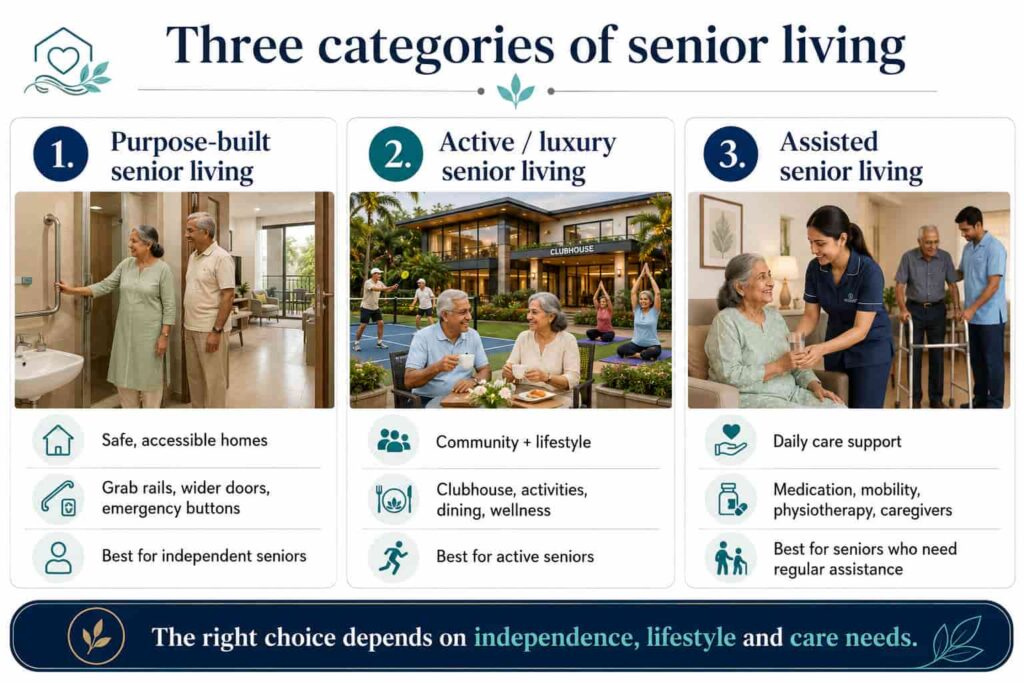
The easiest way to understand the sector is to divide it into three broad categories:
- Purpose-built senior living
- Active or luxury senior living
- Assisted senior living
These categories are connected, but they serve different levels of independence, lifestyle expectation and care need.
Why is senior living becoming more relevant in India?
India may still be a young country, but it is ageing rapidly.
Children increasingly move to different cities or countries for education and employment. Retired parents may remain in the family home, but the support system around that home often becomes weaker.
A domestic worker may help with cooking and cleaning, but that arrangement does not automatically provide:
- emergency response,
- medicine supervision,
- fall prevention,
- companionship,
- physiotherapy,
- trained caregiving,
- organised activities,
- night-time support,
- or continuity when one staff member is absent.
The senior may own a valuable property and still experience insecurity, isolation or dependence.
This is where organised senior living becomes relevant. It attempts to replace an informal and fragmented support arrangement with a planned environment.
The Indian market is still relatively small compared with the potential need. JLL and the Association of Senior Living India estimated that more than 20,000 senior living units had been established nationally and projected the sector could grow by more than 300% to reach approximately ₹64,500 crore by 2030. The same research estimated that the addressable market could rise from about 1.57 million households in 2024 to 2.27 million households by 2030.
These figures indicate opportunity, but they should not be interpreted as guaranteed success for every project. Senior living remains an operations-heavy business in which trust and service quality matter as much as real estate.
Senior living is a spectrum, not a single product
A common mistake is to assume that all senior living projects provide the same level of care.
They do not.
One project may offer independent apartments with senior-friendly architecture but limited medical assistance. Another may provide a luxury lifestyle with managed activities, dining and concierge services. A third may offer caregivers, nursing supervision and help with daily activities.
CBRE describes the sector through formats such as independent living, assisted living, memory care and continuing-care communities, reflecting the fact that senior needs can change significantly over time.
Families must therefore begin by identifying the senior’s actual needs instead of choosing the most attractive-looking property.
Category one: Purpose-built senior living
Purpose-built senior living is designed for seniors who are largely independent but want a safer and more practical home.
The main value lies in architecture.
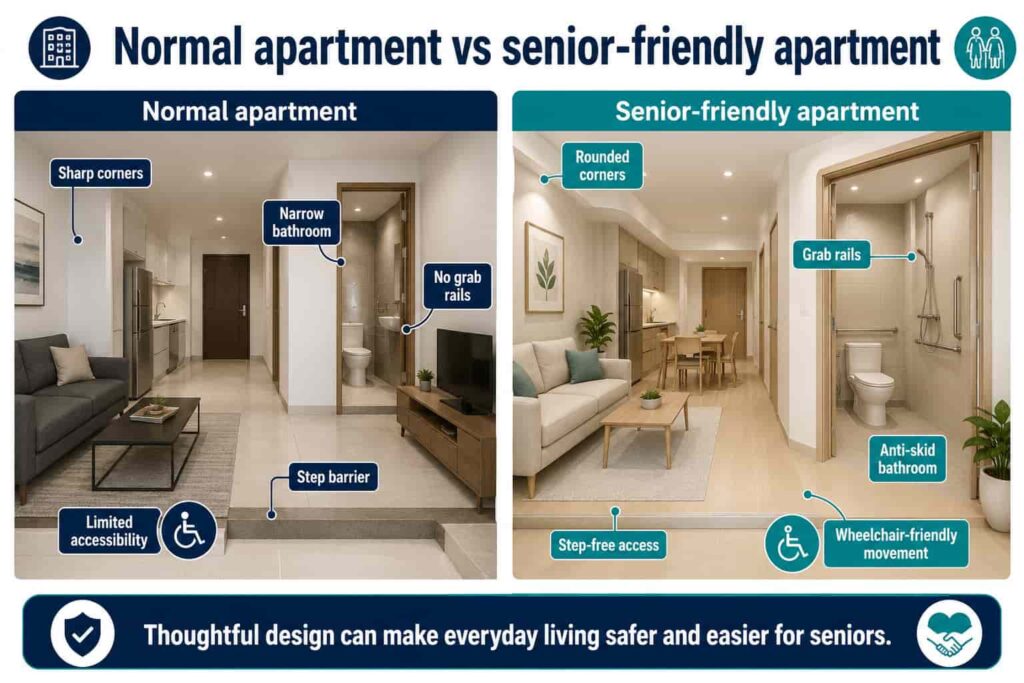
A conventional apartment is typically designed around an able-bodied adult. It may include steps, slippery bathroom surfaces, narrow passages, sharp corners and switches that are difficult to reach.
A purpose-built senior home anticipates reduced mobility, slower reflexes, balance problems and the possibility of emergencies.
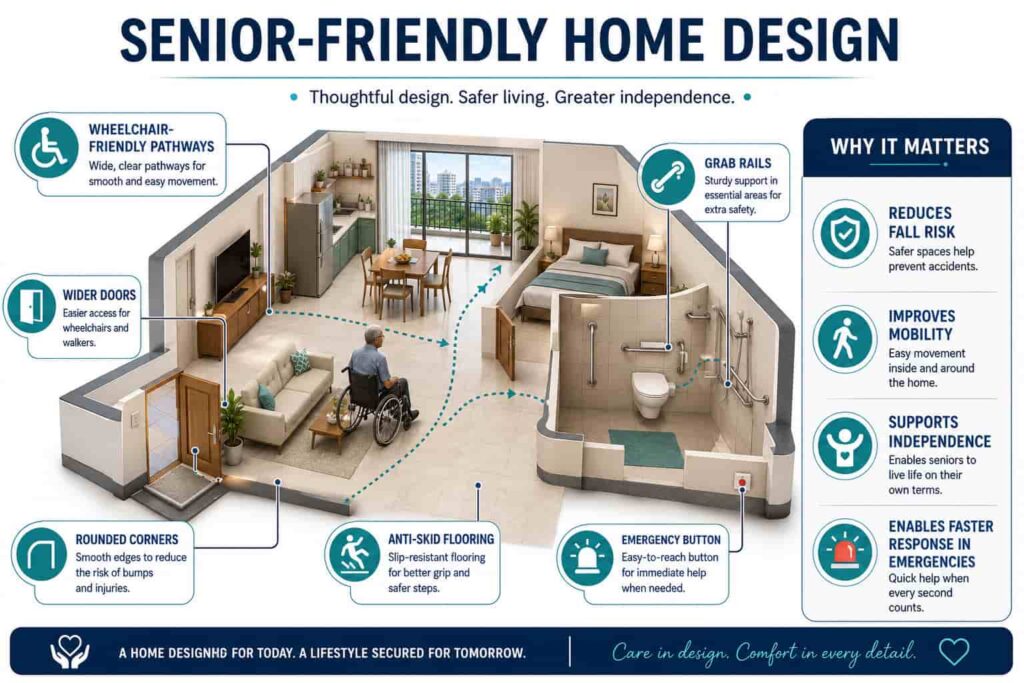
Typical features can include:
- step-free entrances,
- wheelchair-friendly pathways,
- wider doorways,
- anti-skid flooring,
- grab rails,
- rounded corners,
- senior-friendly bathroom fixtures,
- adequate lighting,
- lower switch heights,
- emergency call buttons,
- and safer circulation spaces.
Why do these design details matter?
A minor design flaw can become a serious daily risk for an older resident.
A slippery bathroom floor is not merely inconvenient. A fall can result in hospitalisation, surgery, reduced mobility and long-term dependence.
Similarly, an emergency button is valuable only when it connects to an effective response system. The physical button is the visible part; the staffing protocol behind it determines whether it actually protects the resident.
This distinction is important throughout senior living:
Infrastructure creates capability, but operations determine reliability.
Who should choose purpose-built senior living?
This model may suit:
- independent retired couples,
- healthy seniors living alone,
- parents whose children live elsewhere,
- people planning their retirement home early,
- and seniors who want safety without a care-intensive environment.
The resident may manage medication, bathing, meals and mobility independently. What they require is a home that reduces avoidable risk.
Category two: Active or luxury senior living
Active senior living expands the concept beyond safe housing.
It combines age-friendly residences with community, hospitality, convenience, recreation and wellness.
The project may include:
- a clubhouse,
- dining facilities,
- landscaped walking spaces,
- an amphitheatre,
- fitness and wellness rooms,
- indoor games,
- a library,
- hobby studios,
- transport support,
- housekeeping,
- and professionally organised activities.
The objective is not simply to provide a house. It is to create a managed lifestyle.
What makes active senior living different from an ordinary township?
A normal residential project may also have a clubhouse and landscaped gardens.
The difference lies in resident-focused programming.
In a strong senior living community, amenities are designed and operated around the physical, social and emotional needs of older residents.
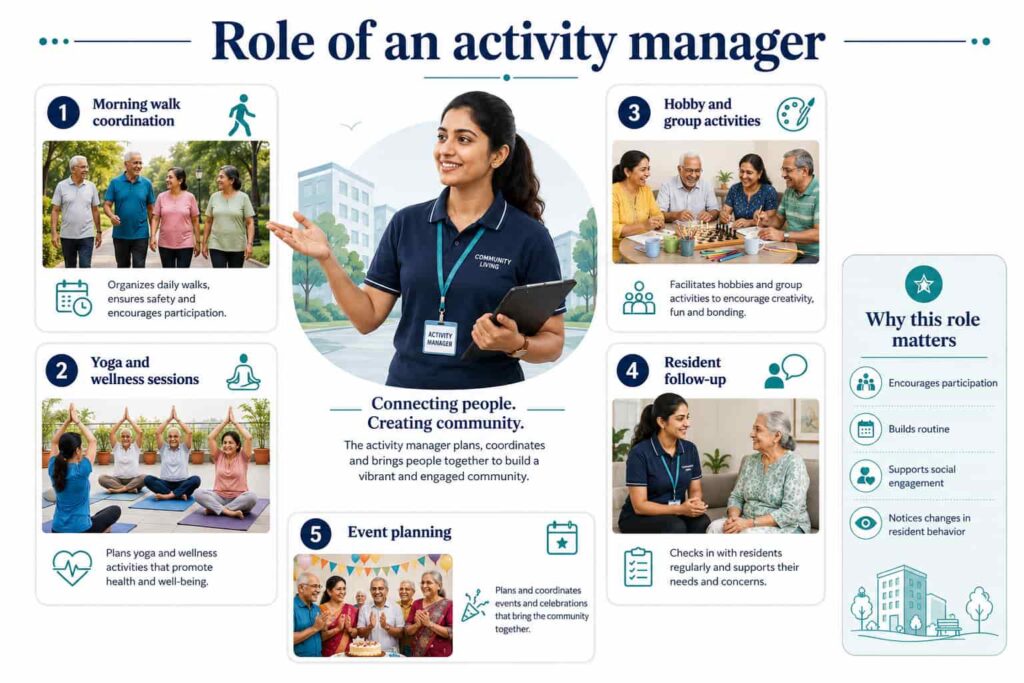
The community may organise:
- morning walks,
- yoga,
- music sessions,
- cultural events,
- hobby clubs,
- group celebrations,
- wellness talks,
- indoor games,
- short excursions,
- and resident-led activities.
An activity manager or community manager helps coordinate participation.
This role should not be misunderstood as deciding every part of the senior’s routine. Residents must retain personal choice and independence.
A good activity manager creates opportunities, notices changes and encourages participation without making community life feel compulsory.
Why is community a core service rather than an amenity?
Loneliness is not solved merely by placing people in the same building.
Community has to be designed and facilitated.
A senior may live in a large house, speak regularly with children and still spend most of the day without meaningful human interaction.
A well-operated senior community makes casual social contact easier. Residents can share meals, walk together, join activities or simply speak to people who understand similar life experiences.
This does not mean every senior wants constant social engagement.
Some residents value privacy more than activities. A mature senior living operator must accommodate both personalities.
The goal should be availability of companionship, not forced participation.
Why is active senior living attracting greater interest?
This category addresses several needs simultaneously:
- independent living,
- safety,
- community,
- convenience,
- hospitality,
- wellness,
- and access to support.
For affluent seniors, HNIs and NRIs planning for their parents, the product is not just an apartment. It is a professionally managed support environment.
JLL’s sector research suggests that India’s senior living market has substantial room to expand as the senior population grows and the addressable household base becomes larger.
However, the most expensive community is not automatically the best one.
Luxury interiors can be photographed easily. Reliable care, low staff turnover and respectful resident engagement are harder to demonstrate but far more important.
Category three: Assisted senior living
Assisted senior living is intended for seniors who need regular support with daily life.
The resident may not require hospitalisation or continuous skilled nursing, but living entirely independently may no longer be safe or practical.
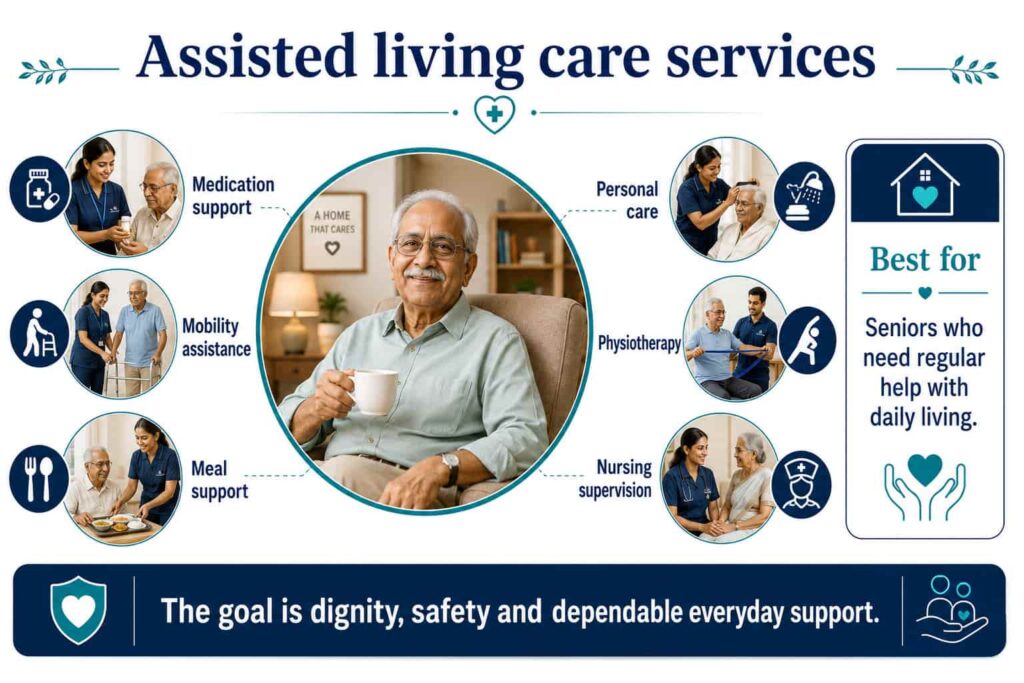
Support may include:
- assistance with bathing and dressing,
- medication reminders,
- mobility support,
- meal assistance,
- toileting support,
- caregiver supervision,
- health monitoring,
- basic physiotherapy,
- emergency response,
- and nursing availability depending on the facility.
What are activities of daily living?
Assisted living is often evaluated by considering whether the senior can independently perform routine tasks, commonly referred to as activities of daily living.
These may include:
- bathing,
- dressing,
- eating,
- transferring from bed to chair,
- walking,
- and using the toilet.
A senior who struggles with one or more of these tasks may need a structured level of assistance.
The requirement is not determined only by age.
A person in their late seventies may be fully independent, while someone younger may require significant help after surgery, a stroke or a mobility-related condition.
Assisted living vs home care
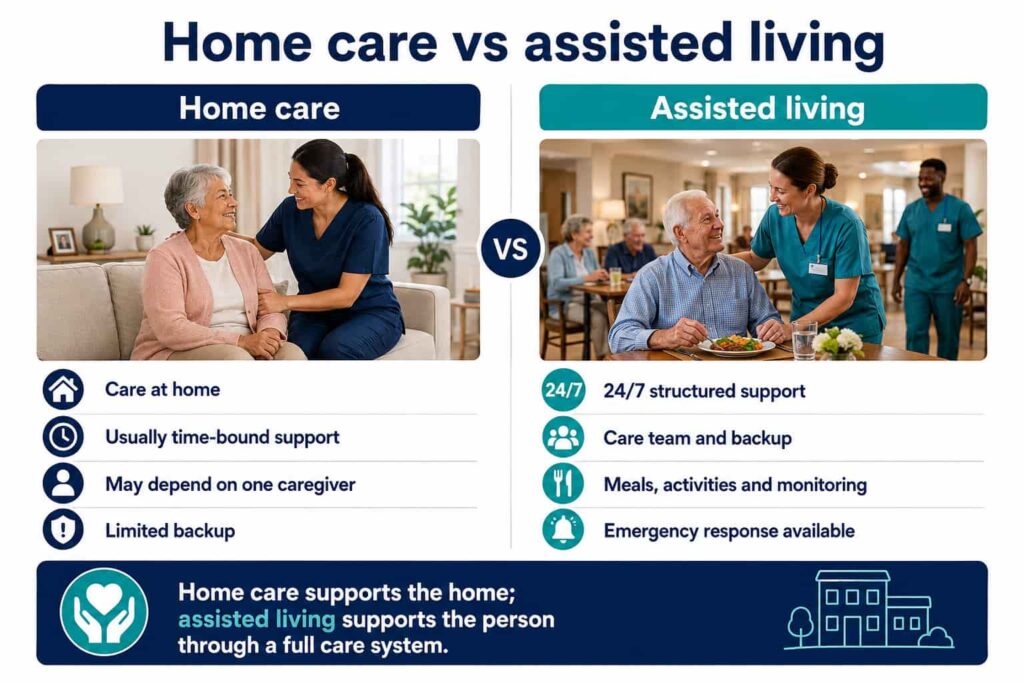
Home care and assisted living can both be useful, but they solve different problems.
Home care usually involves a caregiver visiting or staying in the senior’s own house for a defined period.
This arrangement can work when:
- the home is safe,
- the senior’s needs are limited,
- the family can supervise service quality,
- and dependable backup is available.
The challenge is continuity.
What happens when the caregiver is absent? Who responds at night? Who coordinates with the doctor? Who monitors medication or sudden behavioural changes? Who provides a replacement immediately?
Assisted living offers a broader operating structure in which the resident has access to multiple staff members, emergency protocols and shared services.
Neither model is universally superior.
A senior who is emotionally attached to home and needs only limited help may prefer home care. A senior requiring regular supervision, social engagement and dependable round-the-clock support may benefit more from assisted living.
Assisted living versus a nursing home
These terms should not be used interchangeably.
Assisted living primarily supports daily functioning.
A nursing facility provides a higher level of clinical or skilled nursing care for residents with more complex medical conditions.
Some senior living campuses offer a continuum of care that can include:
- independent living,
- assisted living,
- rehabilitation,
- memory care,
- and skilled nursing.
This model can reduce the disruption of moving to an entirely new facility as the resident’s needs increase.
However, families must verify which services are genuinely available on-site. Marketing material may use broad healthcare language even when the actual clinical capability is limited.
Why is assisted living commonly offered on rent?
Independent senior housing may be sold as a property, but assisted living frequently operates through a rental or monthly service model.
The reason is straightforward: the resident is paying for both accommodation and ongoing care.
A monthly package may combine:
- the room or apartment,
- meals,
- housekeeping,
- laundry,
- caregiver assistance,
- nursing supervision,
- activities,
- physiotherapy,
- emergency response,
- and common services.
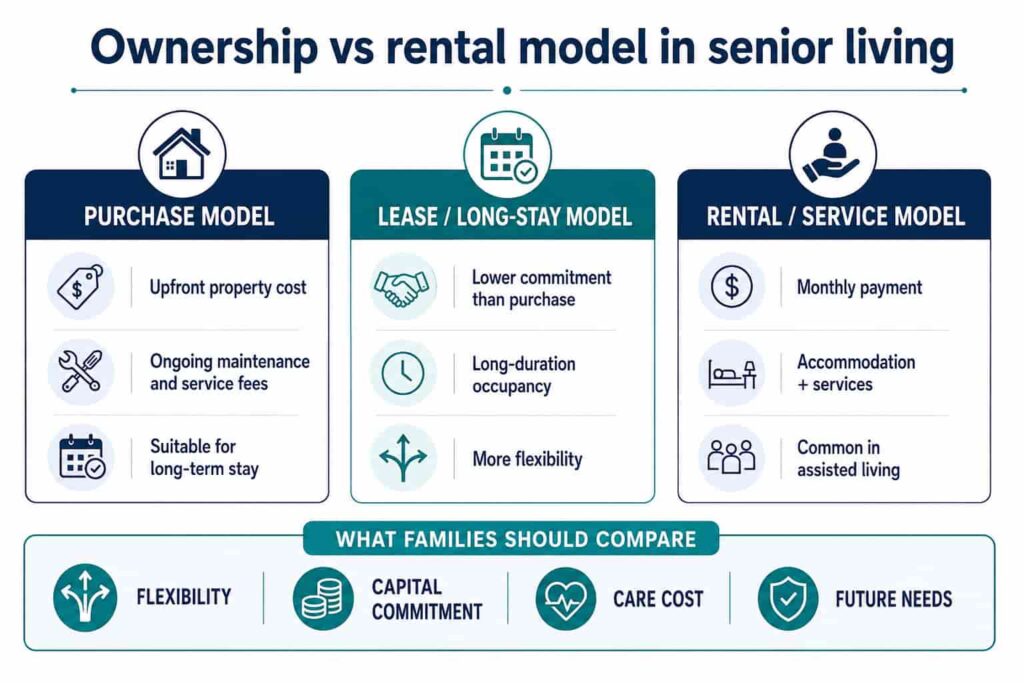
A care-heavy model requires continuous staffing and operating expenditure. Buying the room does not remove the monthly cost of services.
Families must therefore separate two calculations:
- Property or accommodation cost
- Recurring care and service cost
A project may appear affordable at the booking stage but become financially difficult if care charges rise substantially with dependency.
Ownership versus rental: Which model is better?
There is no universally correct answer.
Ownership may make sense when:
- the senior expects to live there for a long period,
- the project has a transparent resale mechanism,
- the family understands maintenance and service charges,
- the operator has a strong long-term track record,
- and the property retains utility beyond the current resident.
Rental may make sense when:
- care needs are changing,
- the family wants flexibility,
- the senior wishes to test the community,
- the expected stay is uncertain,
- or the model is primarily service-driven.
A trial stay can be especially valuable in assisted living because it allows the family to evaluate food, staff behaviour, resident comfort and daily operations before making a long-term commitment.
How should families choose the right category?
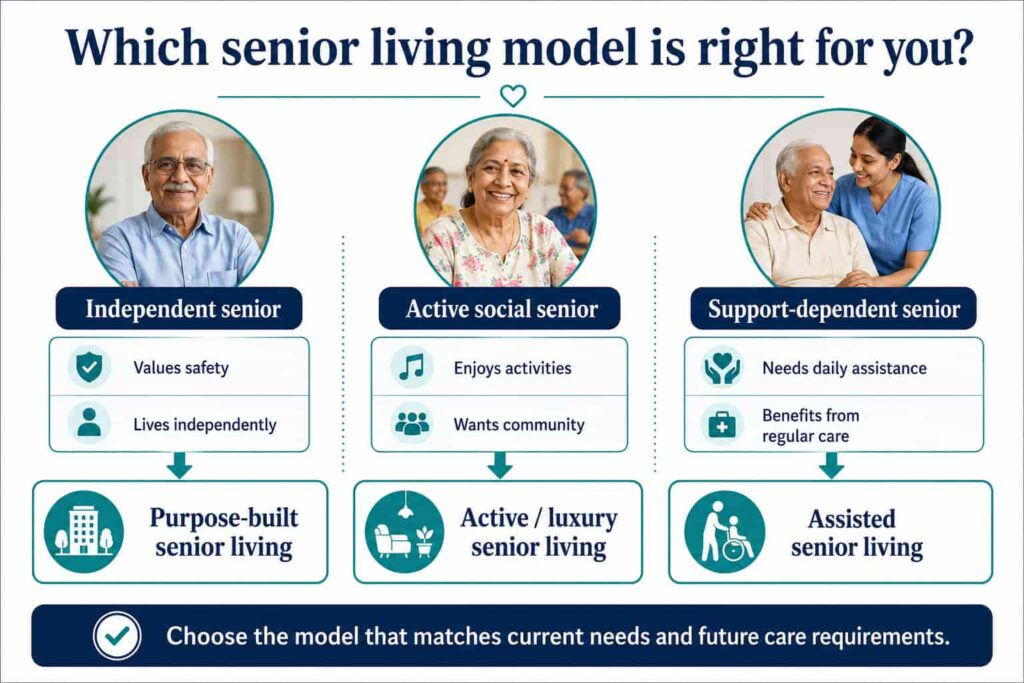
The decision should start with the senior, not the property.
Question one: How independent is the resident?
A fully independent senior may prefer purpose-built or active living.
A resident who needs help with medicines, mobility or personal care may require assisted living.
Question two: What lifestyle does the resident prefer?
Some seniors enjoy organised activities and community dining. Others prefer quiet routines and greater privacy.
A project that suits an outgoing resident may feel intrusive to someone who values solitude.
Question three: How quickly could care needs change?
Families should consider both the present and the next five to ten years.
A project that cannot provide additional support may require the senior to move again during a health crisis.
Question four: Is the senior willing to move?
A technically excellent project can still fail emotionally if the senior feels the decision has been imposed.
The senior should be involved in visits, conversations and final selection wherever possible.
A practical comparison of the three models
| Factor | Purpose-built senior living | Active or luxury senior living | Assisted senior living |
|---|---|---|---|
| Primary need | Safe independent housing | Lifestyle and community | Daily support and care |
| Typical resident | Independent senior | Independent or mildly supported senior | Senior requiring regular assistance |
| Architecture | Senior-friendly | Senior-friendly and premium | Senior-friendly and care-oriented |
| Activities | Limited or optional | Strongly organised | Adapted to health and mobility |
| Caregiver support | Usually limited | Available in selected projects | Core service |
| Nursing support | Emergency or on call | Project-dependent | Often available or coordinated |
| Common model | Purchase or rental | Purchase, lease or rental | Primarily rental or service package |
| Main family concern | Safety | Quality of life | Continuity of care |
| Main risk | Weak operations | Paying for cosmetic luxury | Inadequate staffing or clinical capability |
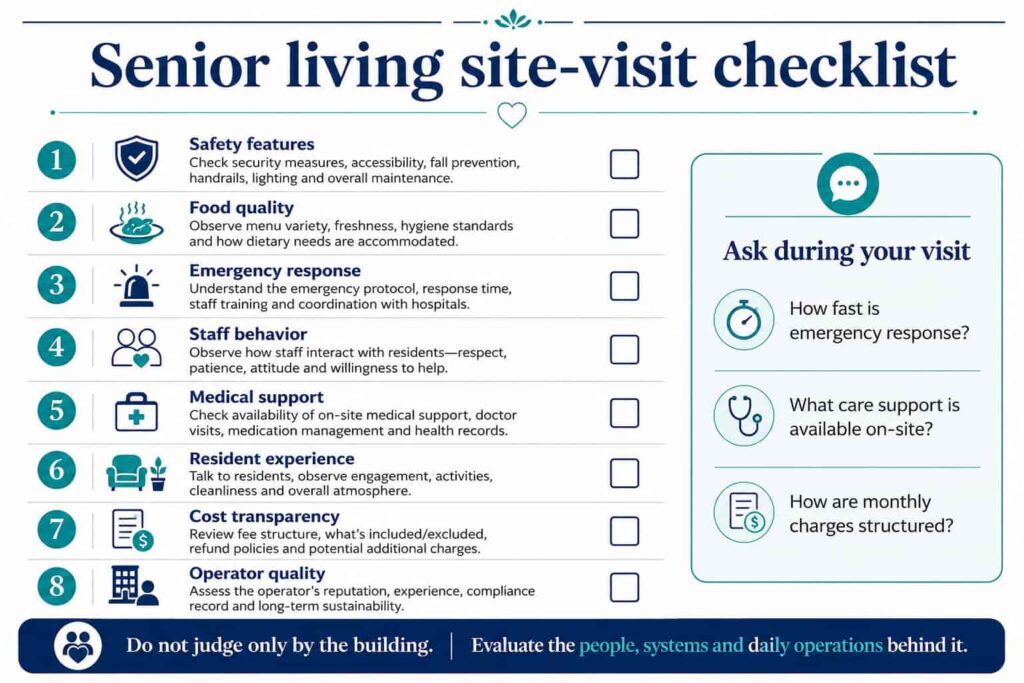
What should families inspect during a site visit?
A site visit should go beyond the model apartment.
Observe the residents
Do residents appear comfortable and engaged? Are common areas actually being used? Do staff members address residents respectfully?
Inspect the bathrooms and pathways
Check flooring, handrails, lighting, door width, emergency systems and wheelchair movement.
Eat the food
Food quality is one of the most important recurring aspects of daily life. Ask whether menus accommodate diabetes, hypertension, swallowing difficulty and cultural preferences.
Test emergency response
Ask what happens after an emergency button is pressed. Who receives the alert? What is the expected response time? Is staff available at night?
Understand medical capability
Is there a nurse on-site or only on call? How are doctor consultations arranged? Which hospital handles emergencies? Is an ambulance available?
Study staffing stability
Frequent caregiver changes can disturb the resident and weaken continuity. Ask about training, background checks, shifts and staff retention.
Review the activity calendar
Check whether activities are genuinely conducted or merely printed in the brochure.
Speak with existing residents and families
Independent conversations often reveal more than the sales presentation.
The operator matters more than the building
Traditional residential real estate is heavily influenced by location, construction and legal title.
Senior living depends on all three, but adds another critical variable: the operator.
The operator influences:
- care standards,
- food,
- staff culture,
- emergency response,
- activity quality,
- resident dignity,
- family communication,
- and long-term reputation.
A project can have excellent architecture and still fail because of poor operations.
This creates a distinctive risk for buyers and investors. The apartment may remain physically present even if the original service operator withdraws, but the core senior living value can deteriorate sharply.
Families should ask:
- Who is contractually responsible for operations?
- Can the operator be replaced?
- What happens if occupancy remains low?
- Are services dependent on a minimum number of residents?
- Is there an escalation mechanism for complaints?
- How are service charges revised?
- Are care packages clearly documented?
What should HNIs and NRIs examine more carefully?
HNIs and NRIs often focus on premium amenities and brand positioning. Their real concern, however, is usually reliability from a distance.
They should examine:
- frequency of family updates,
- emergency communication protocols,
- digital health records,
- consent and decision-making procedures,
- hospital coordination,
- financial transparency,
- authorised local contacts,
- and the process for increasing care support.
A polished mobile application cannot replace strong ground-level operations.
For an NRI family, the most valuable service may be the confidence that someone responsible will notice, respond and communicate when circumstances change.
Is senior living a good investment opportunity?
The sector has strong structural drivers:
- a rapidly increasing senior population,
- greater geographic separation between parents and children,
- rising retirement wealth in some urban households,
- improved acceptance of organised senior communities,
- and limited formal supply.
Industry reports project strong market expansion, but market-level growth does not guarantee project-level returns.
An investor must study:
- operator capability,
- unit absorption,
- recurring service charges,
- occupancy,
- resale restrictions,
- rental structure,
- maintenance obligations,
- target-customer depth,
- healthcare access,
- and the project’s ability to remain operationally sustainable.
Why senior living cannot be analysed like ordinary housing?
A normal apartment investor may depend mainly on capital appreciation and rental yield.
A senior living asset may have:
- a narrower buyer pool,
- operator-linked services,
- age-related occupancy conditions,
- specialised maintenance,
- resale approval requirements,
- and recurring care charges.
Some projects may perform very well because of strong trust and demand. Others may face resale difficulty if the operator’s reputation declines.
The investment case must therefore combine real-estate analysis with operating-business analysis.
Important risks investors should not ignore
Operator risk
If service quality falls, the entire project proposition weakens.
Resale liquidity
The buyer pool may be smaller than for a conventional apartment.
Service-charge escalation
Care, food and staffing costs may rise faster than ordinary maintenance.
Occupancy risk
Community quality and financial sustainability can suffer if too few residents move in.
Regulatory and clinical risk
Care-related services require appropriate staffing, processes and compliance.
Product mismatch
A luxury project in the wrong location or an assisted facility without sufficient healthcare access can struggle despite good construction.
Should people book senior living before they need it?
Early planning has clear advantages.
A family exploring senior living during a medical emergency often makes decisions under pressure. It may accept the first available option without adequately evaluating culture, care and cost.
Planning earlier allows the senior to:
- visit communities,
- compare operating models,
- understand future costs,
- select a preferred city,
- experience trial stays,
- and participate in the decision.
However, booking too early also carries risk if the project is still under construction, operations are untested or future service charges are unclear.
The best timing depends on the project’s maturity and the senior’s life plan.
What should define a 10/10 senior living project?
A truly strong senior living community should perform well across six dimensions.
Safe design
The residence should reduce avoidable physical risk.
Reliable operations
Services must work consistently, not only during sales visits.
Appropriate care
Support should match the resident’s actual needs and adapt over time.
Respectful community
The senior should retain dignity, privacy and personal choice.
Transparent cost
Families should understand both present charges and the basis for future increases.
Continuity
The project should remain dependable even when the resident’s health, staffing requirements or family circumstances change.
Final conclusion
Senior living in India should no longer be viewed as a last resort.
At its best, it is a deliberate choice that allows older adults to live with greater safety, independence, engagement and dignity.
The three main categories serve different needs:
Purpose-built senior living offers safer architecture for independent seniors.
Active or luxury senior living combines independent housing with community, hospitality and lifestyle services.
Assisted senior living provides structured support for residents who need help with daily activities and care.
The right option depends on the senior’s independence, personality, health, finances and likely future needs.
Families should not select a project only because it has a beautiful clubhouse or a recognised developer. They must evaluate the team that will operate the community every day.
Investors should not assume that demographic growth will make every senior living property successful. The sector’s potential is real, but performance will depend on operator quality, trust, occupancy, care standards and long-term financial sustainability.
The building is the product people initially see.
The daily experience is the product they actually live with.
That is the real difference between an ordinary retirement apartment and a successful senior living community.
Sources:-
- UNFPA India Ageing Report and population projections
- JLL–Association of Senior Living India market landscape report
- CBRE report on India’s senior care sector
- JLL research on the growth of India’s senior living housing market


Leave a Reply