

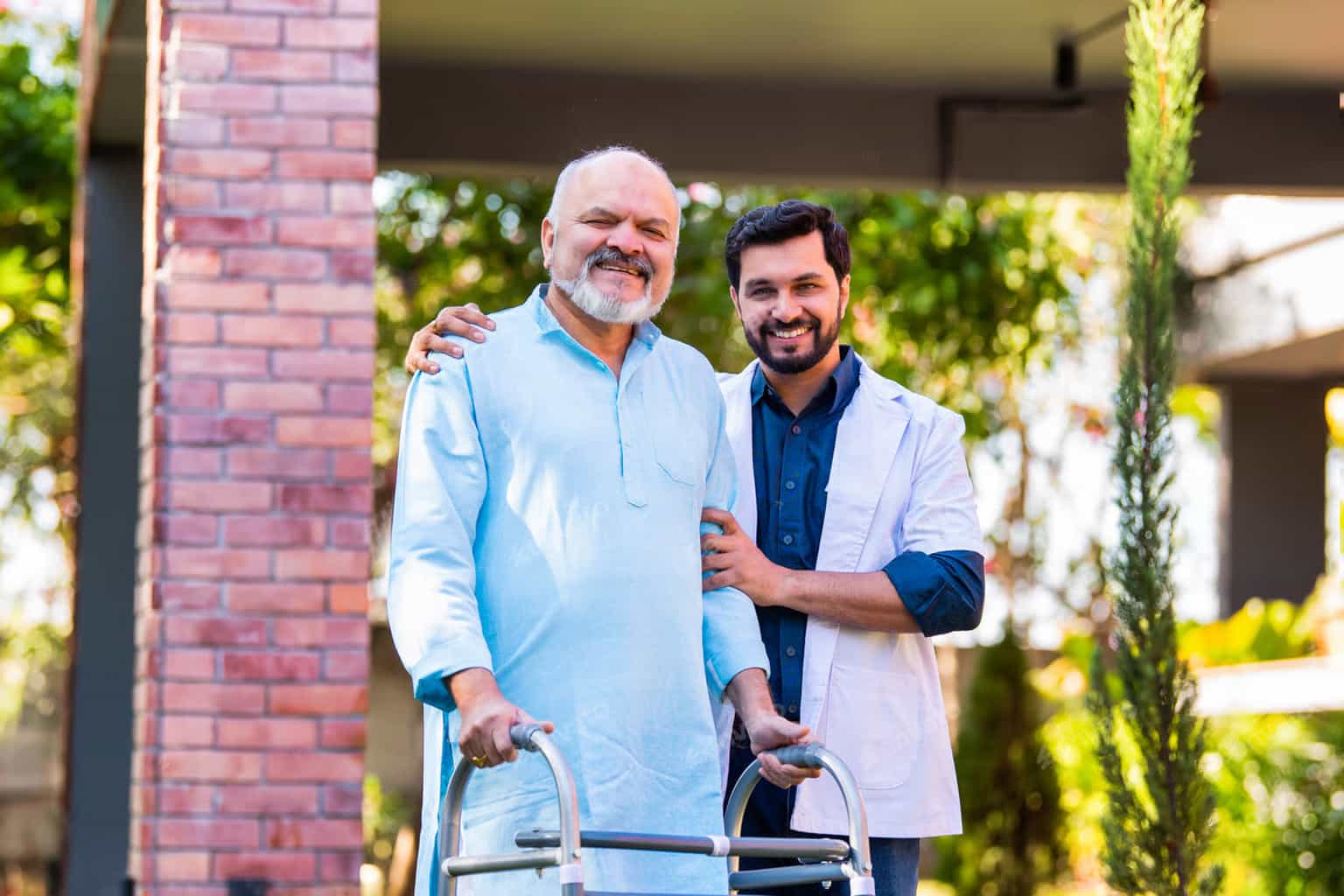
A parent may still be living independently, preparing meals, managing medicines and speaking confidently on the phone.
From a distance, everything appears normal.
Then a neighbour calls to say that your father fell in the bathroom. Your mother has begun forgetting whether she took her evening medicine. Unopened bills are collecting on a table. The refrigerator contains food, but most of it has expired.
Nothing may look like a major crisis on its own. Together, however, these small changes can signal that occasional family support is no longer enough.
This is the moment when many families begin searching for elder care in India.
The decision is rarely easy. Parents may feel that professional care will take away their independence. Children may carry guilt because work, marriage or geography prevents them from being available every day. Families may also struggle to understand whether they need a companion, caregiver, nurse, assisted-living community or specialised medical support.
The right answer is not the same for every senior.
Good elder care should not take control of a person’s life. It should protect the senior’s safety, dignity and ability to continue doing what matters to them. The World Health Organization describes healthy ageing in terms of maintaining the functional ability that enables well-being—not merely the absence of disease.
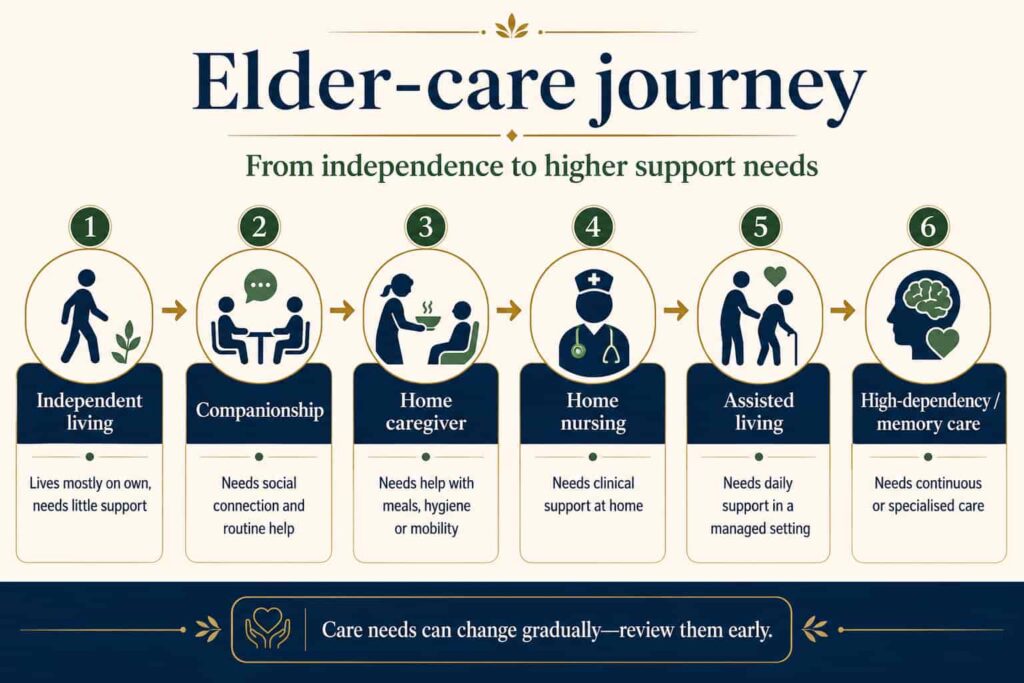
Why elder care is becoming an important family decision?
India is ageing alongside its young population.
According to UNFPA, India had approximately 153 million people aged 60 and above in 2022, and this number is expected to reach about 347 million by 2050. By then, older adults could represent nearly one-fifth of the country’s population.
This demographic change is occurring at the same time as Indian families are becoming more geographically dispersed.
Children move to another city or country for employment. Older couples remain in their family homes. Domestic workers provide selected services, but there may be no organised system for medicines, nutrition, mobility, emergency response or emotional support.
The issue is not always a lack of love.
It is often a lack of time, proximity and dependable care infrastructure.
A daughter living abroad may be able to arrange an online consultation, but she cannot personally assess why her mother has stopped eating properly. A son working in another city may pay for a full-time attendant, but he may not know who will replace that person during leave.
Professional elder care attempts to fill these operational gaps without replacing the family.
What does elder care actually include?
Elder care is broader than medical treatment.
Depending on the senior’s needs, it may include:
- companionship and emotional support,
- meal preparation and nutrition monitoring,
- bathing and dressing assistance,
- medicine reminders,
- mobility support,
- housekeeping,
- transportation,
- physiotherapy,
- nursing procedures,
- doctor coordination,
- emergency response,
- dementia support,
- and structured residential care.
The objective is not to make the senior unnecessarily dependent.
The objective is to provide enough support for the person to remain safe, involved and as independent as possible.
WHO’s integrated-care approach for older people also emphasises coordinated, person-centred care rather than fragmented services working separately.
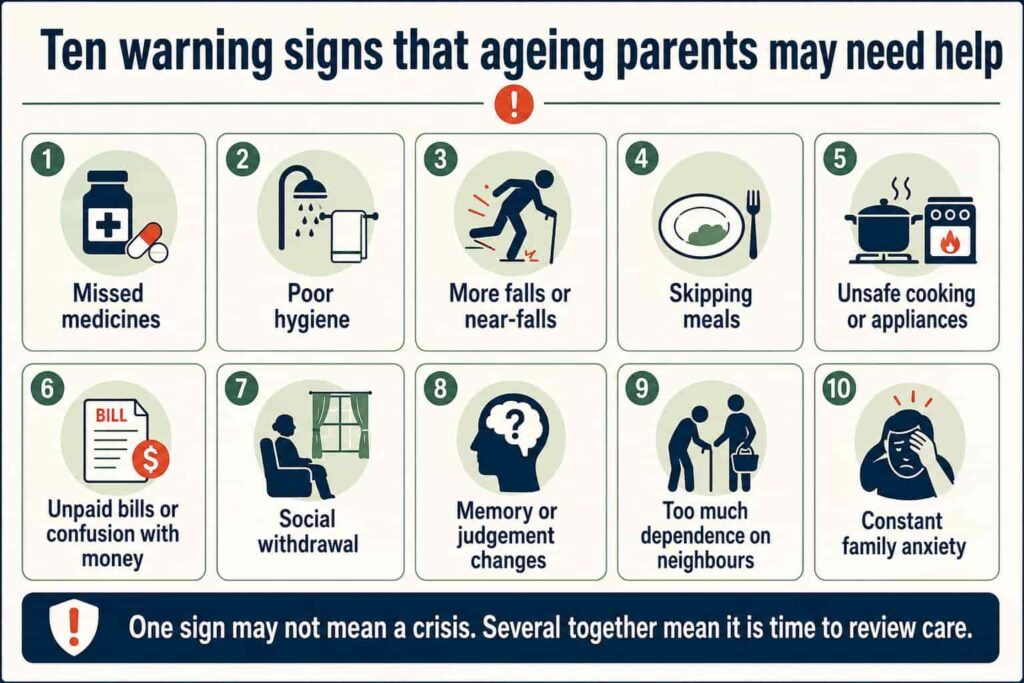
Ten warning signs that parents may need professional support
Age alone does not determine whether a senior needs care.
Some people remain highly independent well into their eighties, while others may need regular assistance much earlier because of illness, surgery, mobility limitations or cognitive changes.
Families should pay attention when several of the following signs begin appearing together.
Medicines are frequently missed or repeated
The parent cannot remember whether a dose was taken or begins mixing up medicines.
2. Personal hygiene is declining
Bathing, grooming, changing clothes or using the toilet becomes difficult.
3. Falls or near-falls are increasing
The senior begins holding walls or furniture while walking, avoids stairs or reports unexplained bruises.
4. Meals are being skipped
There may be weight loss, weakness, expired food or an increasing dependence on biscuits and tea.
5. Household tasks are becoming unsafe
Gas burners are left on, taps remain open or electrical appliances are used incorrectly.
6. Bills and financial tasks are being neglected
Payments are missed, documents are misplaced or unfamiliar transactions appear.
7. Social withdrawal is increasing
The senior stops meeting friends, avoids calls or loses interest in activities previously enjoyed.
8. Memory and judgement are changing
Repeated questions, confusion about dates, getting lost or suspicious behaviour may require professional assessment.
9. Neighbours are becoming the primary support system
Occasional neighbourly help is valuable, but it should not become the only emergency arrangement.
10. The family is constantly anxious
If children must repeatedly check cameras, call domestic workers or coordinate emergencies remotely, the current system may not be sustainable.
One warning sign does not automatically mean that a parent must move into assisted living. It means the family should begin a structured assessment rather than waiting for a major emergency.
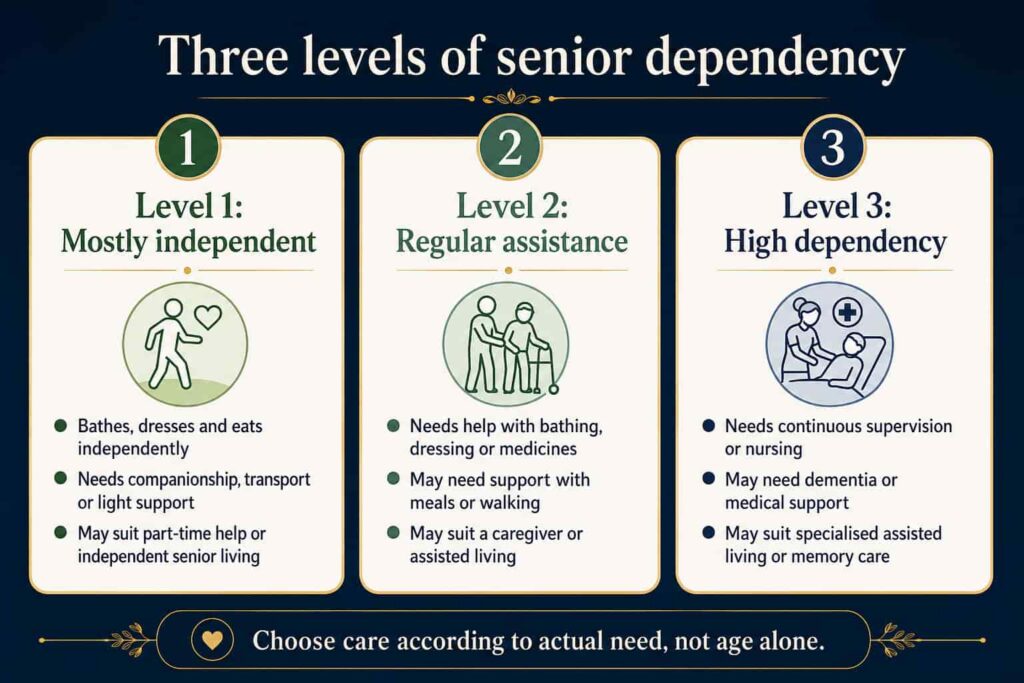
Three levels of elder-care dependency
A useful way to select care is to assess what the senior can still do independently.
Level 1: Mostly independent
The senior can bathe, dress, eat, use the toilet and move around without regular physical assistance.
Support may still be needed for:
- companionship,
- grocery shopping,
- transportation,
- housekeeping,
- medical appointments,
- or occasional monitoring.
Suitable options may include companionship services, part-time home support, senior day care or independent senior living.
Level 2: Regular daily assistance
The senior needs help with some routine activities, such as:
- bathing,
- dressing,
- medicines,
- preparing food,
- walking,
- or transferring from the bed to a chair.
A trained home caregiver or assisted-living facility may be more appropriate.
Level 3: High dependency or medical support
The senior may require:
- continuous supervision,
- nursing procedures,
- dementia care,
- feeding assistance,
- pressure-sore prevention,
- catheter or wound care,
- oxygen support,
- or help with most daily activities.
This level may require trained nursing, specialised assisted living, memory care, rehabilitation or a continuing-care facility.
WHO notes that some older adults experience physical or mental decline that prevents them from caring for themselves without support, making access to good-quality long-term care essential for dignity and functional ability.
Main elder-care options in India
The Indian elder-care market includes both home-based and residential services. The correct option depends on independence, health, family availability, emotional needs and budget.
Companionship care
Companionship care is suitable for a largely independent senior who primarily needs:
- conversation,
- accompaniment,
- help with hobbies,
- assistance during appointments,
- or regular social interaction.
It can reduce loneliness, but it is not a substitute for nursing or personal-care support.
Part-time home attendant
A part-time attendant may help with:
- bathing,
- dressing,
- meals,
- walking,
- housekeeping,
- and basic routine assistance.
This can work when the senior requires support for a limited number of hours and family members are available for the remaining period.
Twelve-hour or live-in caregiver
A longer-shift caregiver may support seniors who require regular assistance during the day or night.
The caregiver may help with:
- personal hygiene,
- mobility,
- meals,
- toileting,
- medicine reminders,
- and companionship.
However, one caregiver should not be treated as the entire care system. Families need a replacement plan, supervision and emergency backup.
Home nursing
Home nursing is appropriate when clinical tasks are required.
These may include:
- injections,
- wound dressing,
- catheter care,
- vital monitoring,
- post-operative care,
- feeding-tube support,
- and other prescribed procedures.
Nursing is generally more specialised than caregiving and should be delivered by an appropriately qualified professional.
Senior day-care centre
A senior day-care facility provides supervised daytime support while allowing the person to continue living at home.
It may include:
- meals,
- activities,
- basic health monitoring,
- rehabilitation,
- and social engagement.
The limitation is that support usually ends when the senior returns home.
Independent senior living
Independent senior living is suitable for active seniors who want:
- senior-friendly housing,
- community activities,
- housekeeping,
- dining,
- security,
- and access to emergency support.
It is primarily a lifestyle and convenience model rather than intensive care.
Assisted living
Assisted living combines accommodation with regular help for daily activities.
It may include:
- meals,
- medication support,
- housekeeping,
- nursing availability,
- mobility assistance,
- personal care,
- emergency response,
- and resident activities.
It is often appropriate when living alone has become risky or one home caregiver is no longer sufficient.
Memory care
Memory care is designed for people living with dementia or significant cognitive decline.
It requires:
- trained staff,
- secure layouts,
- structured routines,
- closer supervision,
- and specialised communication practices.
A general senior living facility should not be assumed to provide dementia care unless it has dedicated capabilities.
Caregiver versus nurse: Why the difference matters?
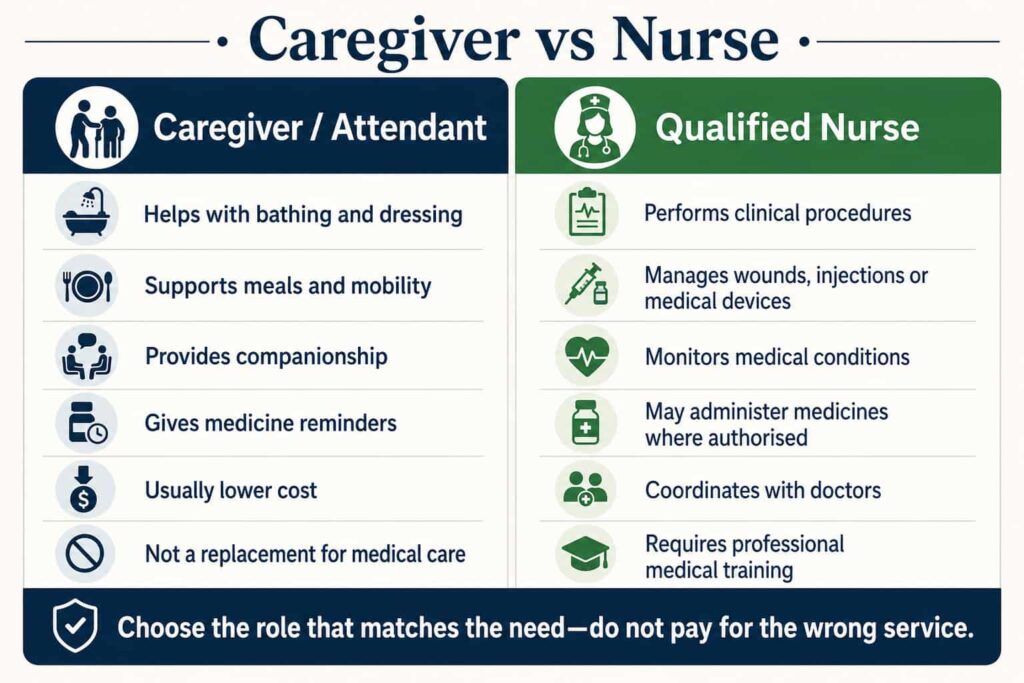
Families often use the words caregiver, attendant and nurse interchangeably. Their roles are different.
| Caregiver or attendant | Qualified nurse |
|---|---|
| Supports bathing and dressing | Performs clinical procedures |
| Helps with meals and mobility | Manages wounds, injections and medical devices |
| Provides companionship | Monitors medical conditions |
| Gives medicine reminders | Administers medicines where professionally authorised |
| Supports toileting and routine | Coordinates clinical care with doctors |
| Usually costs less | Generally costs more because of medical training |
A caregiver should not be asked to perform a nurse’s clinical responsibilities without proper training and authorisation.
Similarly, paying for a nurse may be unnecessary when the senior only needs companionship and basic routine support.
The care plan should match the actual requirement.
Home care versus assisted living
This is one of the most difficult decisions for families.
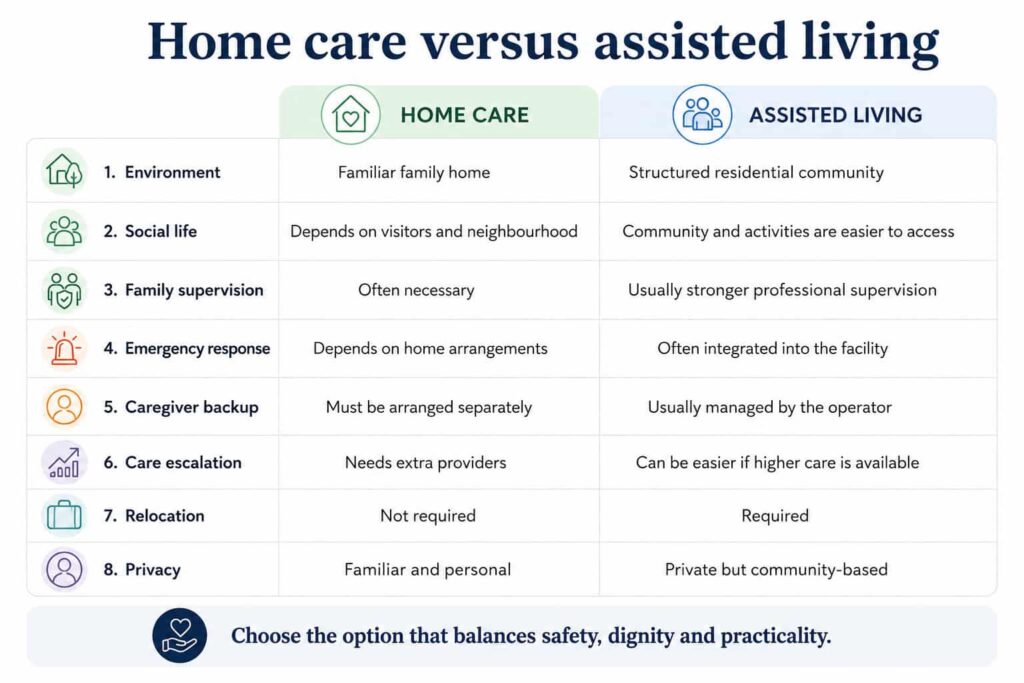
Neither option is automatically better. The correct choice depends on the senior’s condition and the reliability of the support system.
| Factor | Home care | Assisted living |
|---|---|---|
| Environment | Familiar family home | Structured residential community |
| Independence | Can remain high | Can remain high with support nearby |
| Family supervision | Often necessary | Professional supervision is usually stronger |
| Social engagement | Depends on visitors and neighbourhood | Community and activities are more accessible |
| Caregiver backup | Must be arranged separately | Usually managed by the operator |
| Emergency response | Depends on home arrangements | May be integrated into the facility |
| Care escalation | Requires additional providers | May be easier if higher care is available |
| Relocation | Not required | Required |
| Privacy | Familiar and personal | Private but community-based |
| Cost | Varies with staffing intensity | Usually packaged around accommodation and services |
Home care may be suitable when:
- the senior strongly prefers the existing home,
- the house can be made safe,
- care needs are moderate,
- a dependable family member lives nearby,
- and replacement caregivers can be arranged.
Assisted living may be more appropriate when:
- the senior lives alone,
- falls are becoming common,
- medicines are repeatedly missed,
- night-time supervision is needed,
- loneliness is affecting daily life,
- or multiple separate home services have become difficult to coordinate.
A familiar home has emotional value. But familiarity should not be confused with safety.
Assisted living offers systems and backup, but relocation should not be forced without involving the senior in the decision.
How much does elder care cost in India?
There is no single nationwide elder-care price.
The amount depends on:
- city,
- shift duration,
- caregiver experience,
- clinical requirements,
- room occupancy,
- equipment,
- meals,
- transportation,
- and level of dependency.
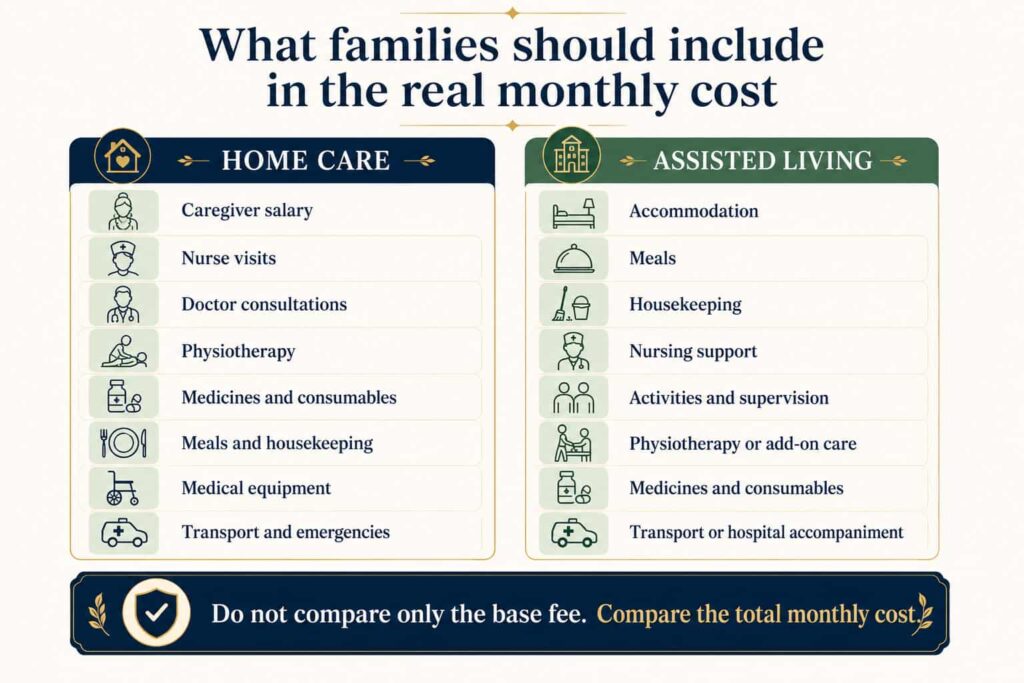
Instead of asking only, “What is the monthly price?”, families should calculate the complete cost.
Cost of home-based care
A home-care budget may include:
- caregiver salary,
- replacement or agency fee,
- nurse visits,
- doctor consultations,
- physiotherapy,
- medicines,
- adult diapers and consumables,
- medical equipment,
- meals,
- transportation,
- and emergency support.
The initial caregiver quotation may therefore represent only one part of the total monthly expense.
Cost of assisted living
An assisted-living package may include:
- accommodation,
- meals,
- housekeeping,
- nursing support,
- activities,
- maintenance,
- security,
- and emergency response.
Additional charges may apply for:
- dedicated caregivers,
- advanced nursing,
- physiotherapy,
- hospital accompaniment,
- special diets,
- equipment,
- medicines,
- and higher-dependency care.
Why package comparison can be misleading?
A home caregiver’s monthly fee should not be compared directly with an assisted-living package without including:
- rent or the cost of maintaining the home,
- food,
- domestic help,
- supervision,
- caregiver replacement,
- nursing,
- transport,
- and emergency arrangements.
The lower quoted price is not always the lower total cost.
A practical way to calculate the real monthly cost
Families can use the following method:
Step 1: Calculate accommodation cost
Include rent, maintenance, property upkeep or the assisted-living room charge.
Step 2: Add daily support
Include caregiver, attendant, housekeeping, laundry and food.
Step 3: Add healthcare
Include nursing, doctor visits, physiotherapy, medicines and equipment.
Step 4: Add emergency and transport costs
Include ambulance access, hospital visits and accompaniment.
Step 5: Add backup costs
Include caregiver replacement, family travel and temporary support during leave.
Step 6: Consider future dependency
Ask what the same arrangement would cost if care needs increased after one or two years.
This calculation gives a more honest picture than comparing advertisements.
What is best for parents living alone?
A senior living alone does not automatically need residential care.
The family should first examine:
- physical mobility,
- memory,
- medicine management,
- food habits,
- emergency access,
- neighbourhood support,
- and willingness to accept help.
A mostly independent senior may manage well with:
- a daily companion,
- housekeeping,
- meal delivery,
- transport support,
- and a medical-alert system.
However, home care becomes fragile when it depends entirely on one person.
A stronger arrangement should include:
- a primary caregiver,
- a documented replacement,
- emergency contacts,
- medical records,
- medicine tracking,
- regular family updates,
- and a nearby hospital plan.
Special concerns for NRI and intercity families
Distance makes care management more complex.
Families living abroad or in another city should ask for more than occasional phone updates.
A professional system should ideally provide:
- scheduled health reports,
- medicine records,
- emergency escalation,
- caregiver attendance tracking,
- hospital coordination,
- document management,
- appointment updates,
- and one accountable point of contact.
The family should also clarify:
- who can provide consent during an emergency,
- who will accompany the parent to the hospital,
- where medical records are stored,
- who manages payments,
- and how quickly relatives will be informed.
Technology can improve visibility, but cameras and applications cannot replace human judgement or trained response.
How to verify an elder-care provider?
Choosing a provider based only on online ratings or a polished brochure can be risky.
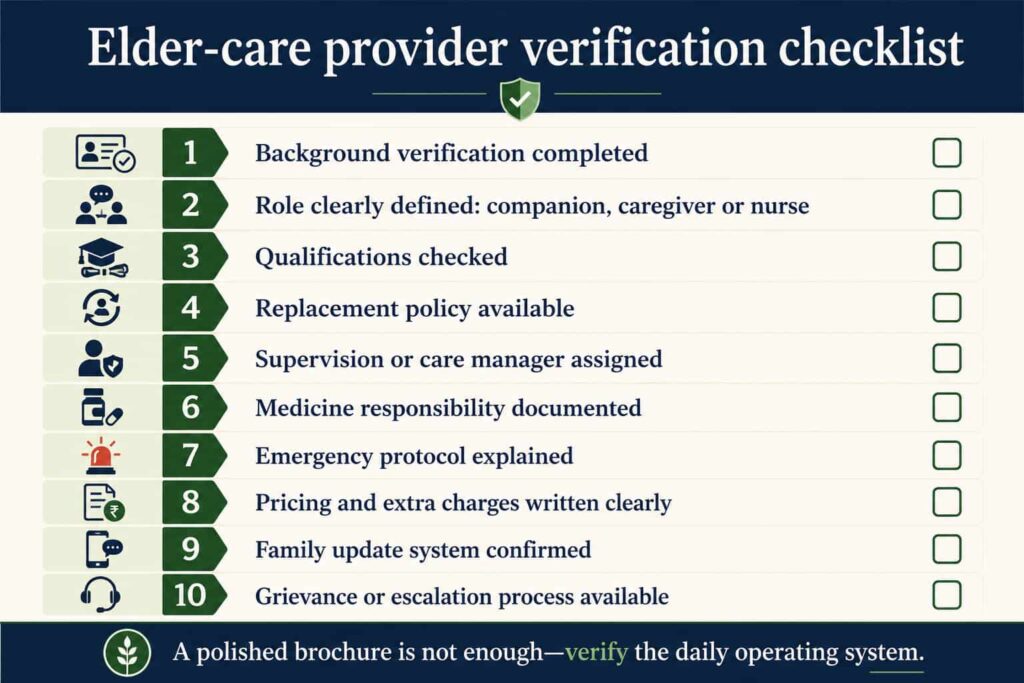
Families should complete a structured verification.
Check caregiver background verification
Ask whether identity, address, previous employment and police verification have been completed.
Confirm qualifications
Understand whether the assigned person is a companion, attendant, caregiver, nursing assistant or qualified nurse.
Ask about replacement policy
Who will provide care when the regular staff member is absent?
Verify supervision
Does a senior nurse or care manager regularly review the service?
Understand medicine responsibility
Are medicines merely reminded, or are they administered and documented?
Ask for the emergency protocol
Who is contacted first? Is ambulance support available? Which hospital is used?
Review the pricing contract
Check:
- deposits,
- cancellation charges,
- annual increases,
- overtime,
- replacement fees,
- and additional-care costs.
Examine family communication
Will the family receive daily, weekly or only emergency updates?
Check grievance escalation
There should be a clear mechanism for reporting poor care, absenteeism or misconduct.
Speak to existing clients or residents
A provider’s promises should be compared with actual family experience.
Common mistakes families make
Waiting for a serious emergency
Families often postpone the conversation until after a fall, hospitalisation or major medicine error.
Earlier planning allows the senior to participate in the decision.
Hiring the cheapest available attendant
A low quotation may come without backup, supervision or adequate training.
Treating one caregiver as a complete system
No individual can work continuously without leave, fatigue or personal emergencies.
Confusing nursing with personal care
The wrong professional may increase costs without solving the actual problem.
Ignoring loneliness
A senior may be physically safe but emotionally isolated.
Choosing assisted living only for its amenities
A swimming pool and attractive lobby do not prove the quality of nursing, food or emergency response.
Excluding the senior from the conversation
Care imposed without consent can create resistance, anger and emotional distress.
How to discuss elder care with parents?
The conversation should not begin with:
“You can no longer manage on your own.”
That framing can sound like a judgement.
A more respectful beginning may be:
“We want to make daily life easier and ensure that help is available whenever you need it.”
Focus on what the senior gains:
- safety,
- convenience,
- companionship,
- freedom from household stress,
- and fewer emergency worries.
Where possible:
- visit providers together,
- begin with limited assistance,
- consider a trial stay,
- allow time for adjustment,
- and preserve the senior’s choices.
The purpose of elder care is not to take over a person’s life. It is to make that life safer and more comfortable.
Government support and the larger elder-care system
India’s Atal Vayo Abhyuday Yojana aims to improve senior citizens’ quality of life by supporting shelter, food, medical care, entertainment opportunities and productive ageing through government and community institutions.
Government programmes remain important, particularly because premium private care is not affordable for every family.
India will need a wider elder-care ecosystem that includes:
- affordable home support,
- trained geriatric caregivers,
- senior citizen homes,
- day-care centres,
- assisted living,
- medical care,
- and community-based services.
The country’s ageing challenge cannot be addressed only through premium retirement housing.
Carpet Area view
Elder care in India should not be reduced to a debate between keeping parents at home and moving them into assisted living.
The real question is:
Which arrangement gives this senior the right balance of independence, safety, companionship and care?
For a largely independent parent, a few hours of organised home support may be enough.
For someone who needs medicines, mobility assistance and meal supervision every day, a trained caregiver may be necessary.
For a senior living alone with repeated falls, memory changes or night-time anxiety, assisted living may provide a more dependable system.
For dementia or complex medical needs, specialist care becomes essential.
Families should avoid decisions driven only by guilt, social pressure or price.
Love is the reason we care.
But reliable care also requires trained people, documented systems, backup and accountability.
Final decision guide
Before choosing any elder-care option, answer these seven questions:
- What can the senior do independently today?
- Which daily activities require assistance?
- Is the need social, personal, medical or a combination?
- Can the home be made safe?
- Is reliable backup available?
- What is the complete monthly cost?
- Can the care level increase in the future?
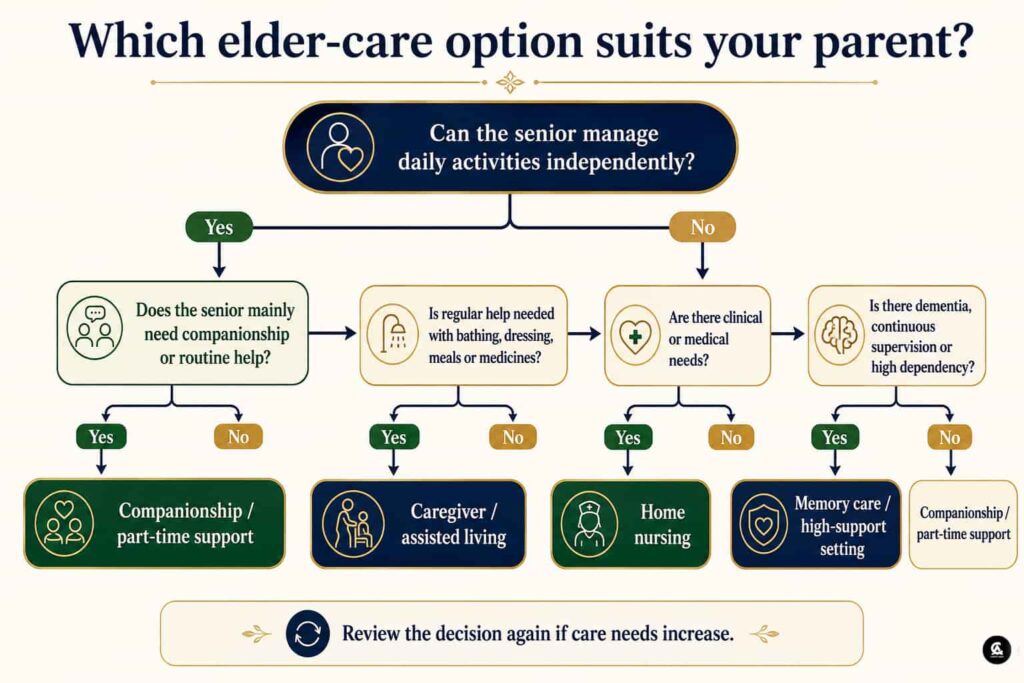
The best care arrangement is not necessarily the most expensive one.
It is the one that protects dignity, reduces avoidable risk and gives the senior enough support to continue living meaningfully.
Professional care does not have to replace family involvement.
At its best, it allows the family to stop functioning only as emergency managers—and return to being sons, daughters, spouses and companions.
Sources:-
- UNFPA – India Ageing Report 2023
https://india.unfpa.org/en/publications/caring-our-elders-institutional-responses-india-ageing-report-2023 - UNFPA – India’s ageing population: Why it matters more than ever
https://india.unfpa.org/en/news/indias-ageing-population-why-it-matters-more-ever - UNFPA – Elderly population may reach around 20% by 2050
https://india.unfpa.org/en/news/india-ageing-elderly-make-20-population-2050-unfpa-report - World Health Organization – Healthy ageing and functional ability
https://www.who.int/news-room/questions-and-answers/item/healthy-ageing-and-functional-ability - WHO – Integrated Care for Older People, ICOPE
https://www.who.int/teams/maternal-newborn-child-adolescent-health-and-ageing/ageing-and-health/integrated-care-for-older-people-icope - WHO – Integrated Care for Older People guidelines
https://www.who.int/publications/i/item/9789241550109 - WHO – UN Decade of Healthy Ageing
https://www.who.int/initiatives/decade-of-healthy-ageing - Government of India – Atal Vayo Abhyuday Yojana
https://socialjustice.gov.in/schemes/43 - Official AVYAY scheme document PDF





Leave a Reply