


A ₹30,000 caregiver can appear far more affordable than an assisted-living residence charging ₹70,000 or more per month.
This is also where many families make the wrong comparison.
The ₹30,000 figure usually represents the cost of one caregiver. It may not include accommodation, meals, domestic help, nursing, physiotherapy, home maintenance, emergency response, staff replacement or social engagement.
An assisted-living fee, on the other hand, may combine several of these services into one monthly package.
Therefore, the question is not simply:
How much does a caregiver cost?
The more useful question is:
What will it cost to create a safe, reliable and sustainable care arrangement for an ageing parent?
The answer depends not only on the senior’s health. It also depends on the house, the family’s availability, the quality of caregivers available locally and how the senior’s needs may change over time.
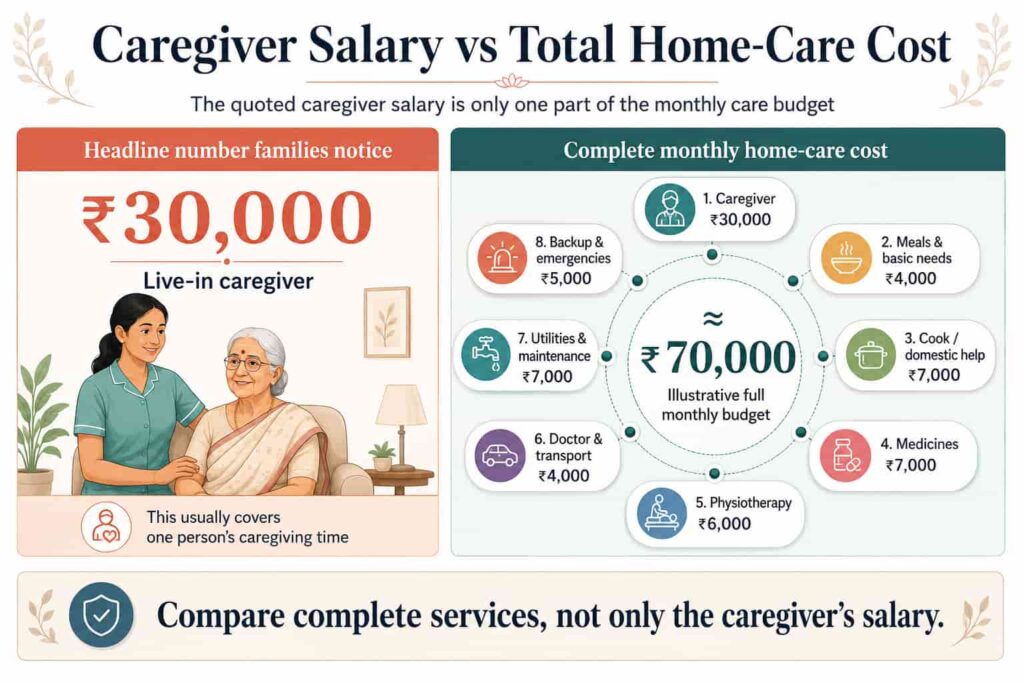
The caregiver’s salary tells only part of the story
Home care can be an excellent option for an elderly person who wants to remain in familiar surroundings.
Depending on the arrangement, a caregiver may assist with:
- Bathing and dressing
- Toileting
- Mobility
- Feeding
- Medication reminders
- Companionship
- Basic observation
- Support with daily activities
However, families should understand what the caregiver has actually been hired to do.
A general caregiver or attendant is not automatically:
- A qualified nurse
- A physiotherapist
- A doctor
- A trained dementia-care specialist
- A cook
- A housekeeper
- A 24-hour emergency-response system
A family may eventually need several of these services, especially when the senior becomes partially dependent, bedridden or medically fragile.
Published provider estimates show considerable variation in Indian home-care pricing. Costs change according to the city, shift duration, caregiver qualification, medical complexity and whether staff are hired independently or through an agency.
General market estimates commonly place live-in non-medical caregiver support in the range of approximately ₹25,000 to ₹40,000 or more per month. Nursing-led or medically intensive care can be substantially more expensive.
These figures should be treated as indicative—not as standard rates applicable to every family.
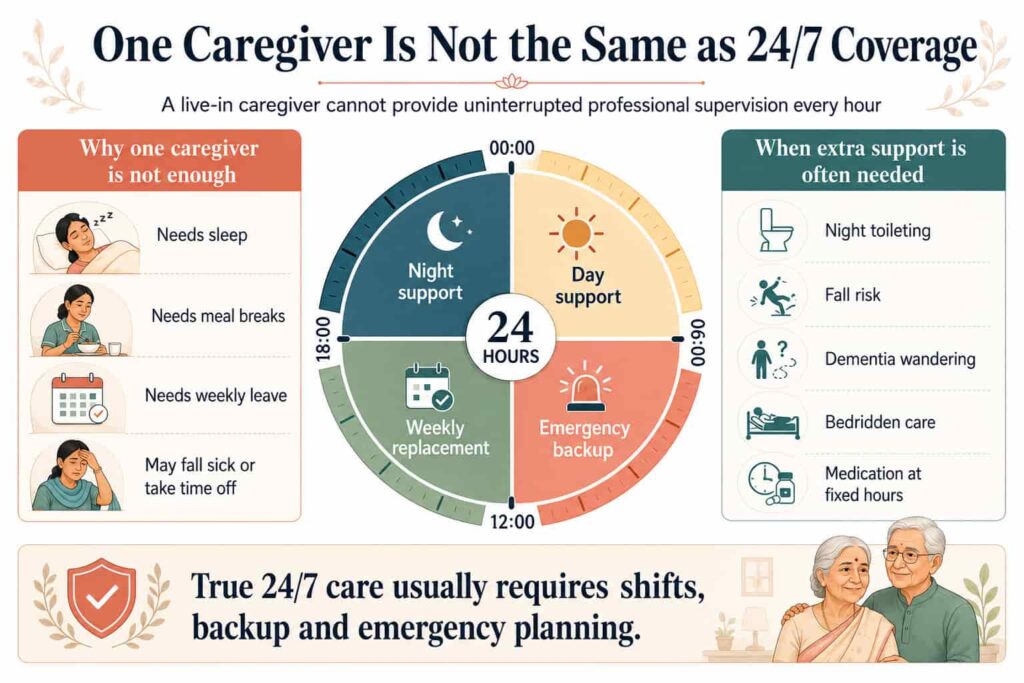
One live-in caregiver does not create a 24-hour care system
The expression “24-hour caregiver” can be misleading.
A person living inside the senior’s home cannot remain awake, attentive and professionally available throughout every hour of the day and night.
A live-in caregiver also needs:
- Sleep
- Meal breaks
- Personal time
- Weekly leave
- Sick leave
- Replacement during emergencies
One caregiver may be sufficient when a senior requires routine assistance during the day and generally sleeps through the night.
The arrangement becomes more difficult when the senior:
- Needs toileting several times at night
- Wanders because of dementia
- Has a risk of falling
- Requires repositioning in bed
- Needs oxygen or medical monitoring
- Experiences frequent confusion
- Requires medication at fixed night-time intervals
In such situations, the family may need separate day and night staff.
That means the relevant cost is no longer the salary of one caregiver. It may include two shifts, relief staff, nursing supervision and an agency-management fee.
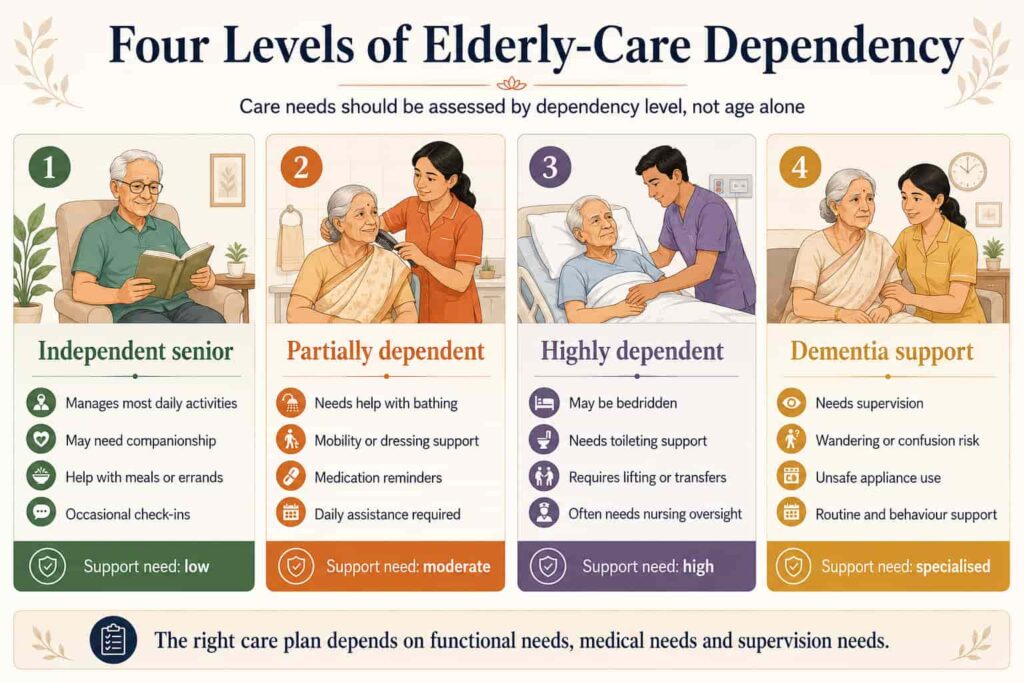
Start with the senior’s dependency level—not age alone
Two people of the same age may require entirely different care arrangements.
An active 80-year-old who manages personal hygiene, meals and medication may need only limited assistance.
Another person of the same age may require help with every daily activity.
Before comparing costs, families should place the senior in one of the following practical categories.
Independent senior
The senior can manage most daily activities but may require:
- Meal support
- Transportation
- Companionship
- Housekeeping
- Occasional health monitoring
- Assistance with outside appointments
A few hours of support or a daytime attendant may be sufficient.
Partially dependent senior
The senior may require help with:
- Bathing
- Dressing
- Toileting
- Walking
- Medication
- Meal preparation
- Doctor visits
This situation normally requires regular daily assistance and stronger family supervision.
Highly dependent senior
The senior may be:
- Bedridden
- Recovering after surgery
- Living with advanced Parkinson’s disease
- Experiencing severe mobility restrictions
- Requiring catheter, wound or feeding support
- At high risk of falling
Such a person may require trained nursing, medical equipment and night-time monitoring.
Senior living with dementia
Dementia care cannot be evaluated only through physical mobility.
A senior may be able to walk independently but still require constant supervision because of:
- Wandering
- Confusion
- Aggression
- Missed medication
- Sleep disruption
- Unsafe use of appliances
- Difficulty recognising people or places
Dementia care is often operationally demanding even when the senior appears physically active.
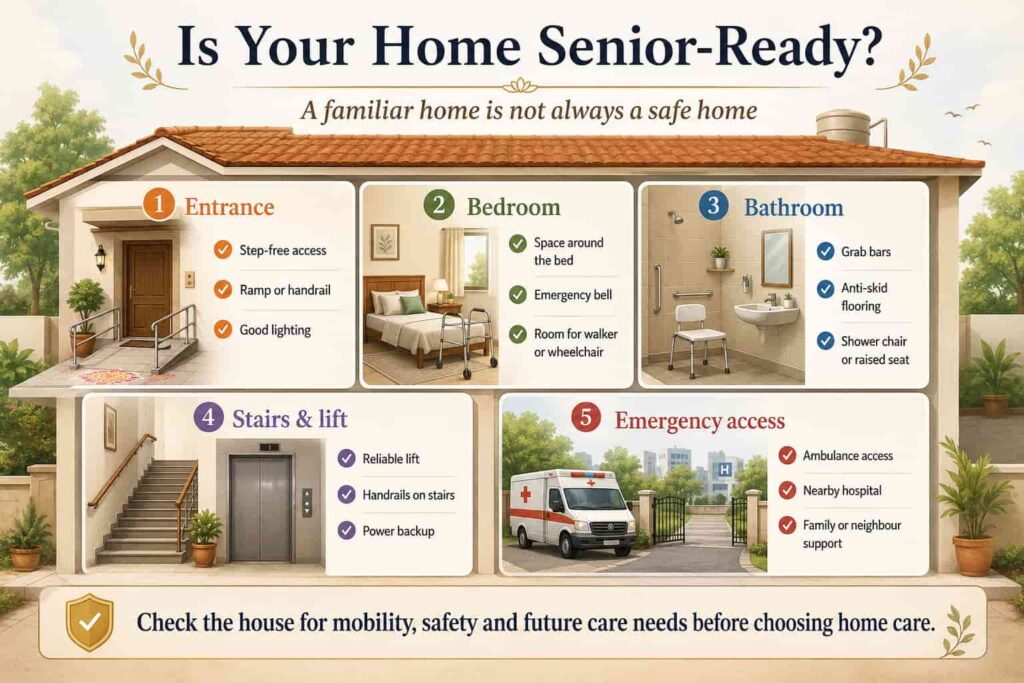
The house may be the biggest hidden cost
Most families ask whether their parents can remain at home.
A better question is:
Can the existing home continue to support them safely?
A house can be emotionally familiar but physically unsuitable for ageing.
A senior may have lived comfortably in a home for 25 years. However, reduced balance, weaker eyesight, arthritis, incontinence or wheelchair dependency can suddenly make ordinary features risky.
Entrance and building access
Check whether the property has:
- Step-free access
- A wheelchair-friendly ramp
- Handrails
- Adequate lighting
- Space for an ambulance to approach
- A reliable lift
- Power backup for the lift
- Security personnel who can respond during emergencies
A third-floor apartment without a reliable lift may become unmanageable after a fall, surgery or stroke.
Bedroom suitability
The senior’s bedroom should ideally have:
- Adequate space around the bed
- Direct or nearby bathroom access
- Space for a walker or wheelchair
- An emergency bell or calling system
- Proper night lighting
- Space for medical equipment
- A suitable sleeping arrangement for the caregiver
A small room may work for an independent senior but become difficult when a hospital bed, wheelchair and caregiver are added.
Bathroom safety
Bathrooms are among the highest-risk areas for elderly residents.
A senior-friendly bathroom may require:
- Grab bars
- Anti-skid flooring
- A shower chair
- A handheld shower
- A raised toilet seat
- Wider access
- Improved lighting
- Removal of unnecessary level differences
A decorative bathroom is not necessarily a safe bathroom.
Multi-level homes
Duplexes, villas and homes with internal staircases may become restrictive as mobility declines.
The family may have to:
- Move the senior’s bedroom to the ground floor
- Create a bathroom on the same level
- Install a stairlift
- Add railings
- Restrict access to unsafe areas
These modifications involve both money and disruption.
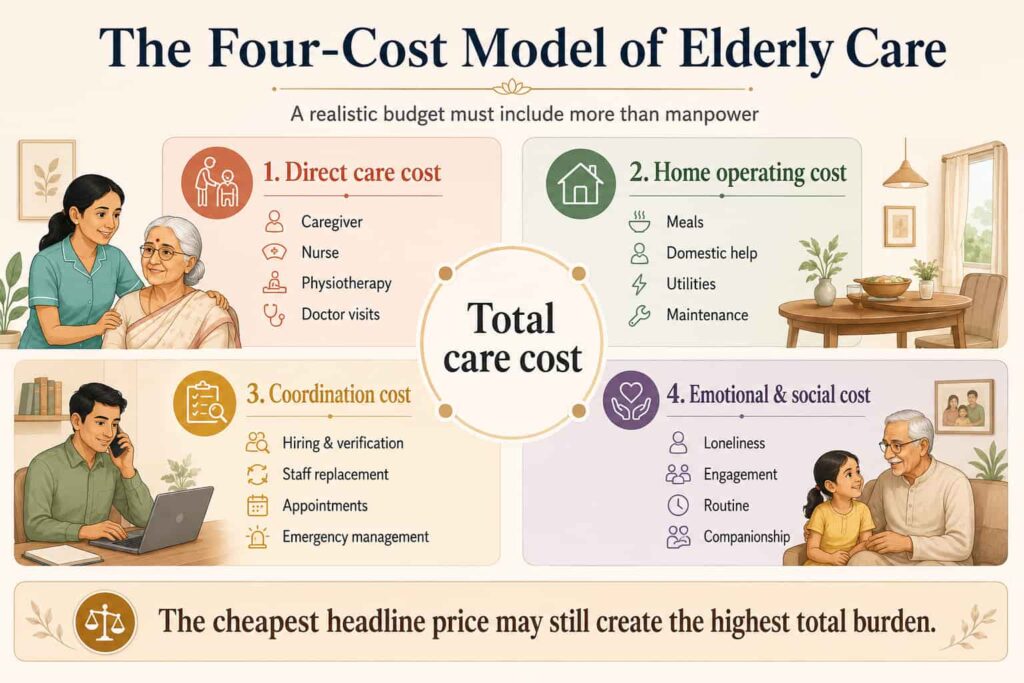
The four costs families should calculate
A useful home-care budget should contain four separate cost categories.
1. Direct care cost
This includes:
- Caregiver or attendant
- Qualified nurse
- Physiotherapist
- Doctor consultations
- Medical consumables
- Replacement staff
- Agency charges
This is the most visible part of the budget, but it may not be the largest in every case.
2. Home operating cost
This may include:
- Groceries
- Special meals
- Cook
- Domestic help
- Caregiver meals
- Electricity
- Air-conditioning
- Laundry
- Property maintenance
- Medical equipment rental
- Safety modifications
A larger home may also carry higher maintenance expenses even when only one senior occupies it.
3. Coordination cost
This is rarely included in financial calculations.
Someone still has to:
- Interview caregivers
- Verify their background
- Prepare duty instructions
- Monitor attendance
- Arrange replacements
- Order medicines
- Coordinate appointments
- Handle hospital visits
- Resolve disputes
- Respond to emergencies
When adult children live in another city or country, this becomes a major challenge.
Even when these tasks do not generate a monthly bill, they consume time and create operational risk.
4. Emotional and social cost
Hiring a caregiver does not automatically solve loneliness.
A senior may remain isolated even after receiving assistance with bathing, meals and medication.
Families must also consider:
- Meaningful conversation
- Social interaction
- Physical activity
- Purposeful routines
- Recreation
- Emotional confidence
- Contact with people of a similar age
A care plan that keeps a person medically safe but socially disconnected may still be incomplete.
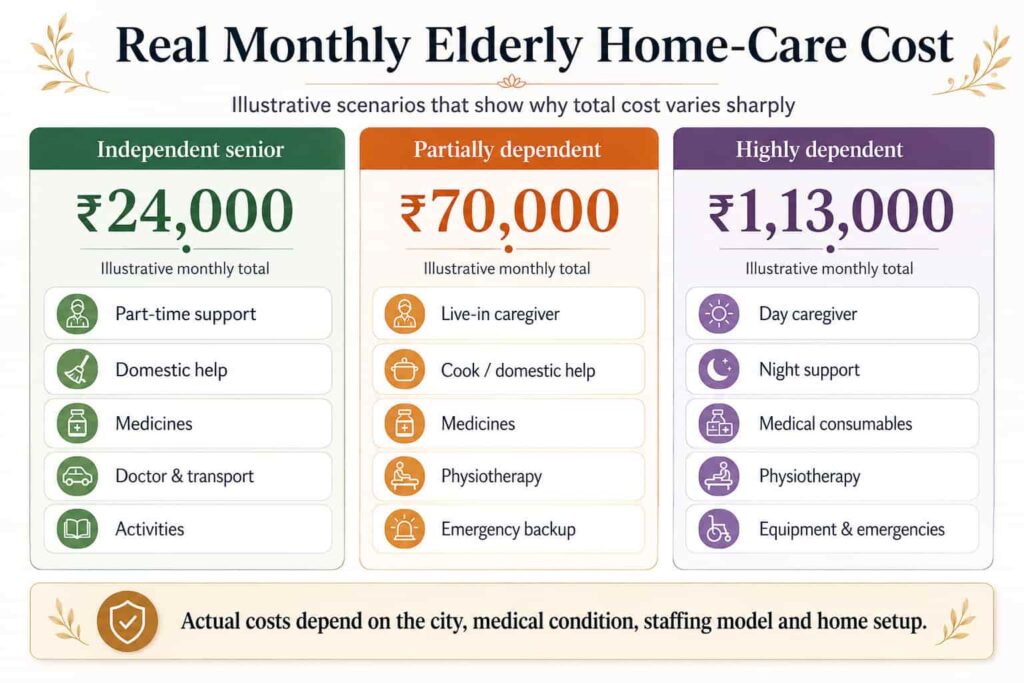
What could home care actually cost every month?
The following calculations are illustrative. Actual expenses will vary according to the city, provider, medical condition, accommodation and level of care.
They are intended to show how families should build a complete budget.
Scenario 1: Independent senior needing limited support
| Monthly requirement | Illustrative amount |
|---|---|
| Part-time assistance or companionship | ₹8,000 |
| Domestic help and meal support | ₹7,000 |
| Medicines and routine consumables | ₹4,000 |
| Doctor visits and local transportation | ₹2,500 |
| Activities and miscellaneous support | ₹2,500 |
| Illustrative monthly total | ₹24,000 |
In this situation, remaining at home may be both practical and financially manageable—particularly when family members live nearby.
Scenario 2: Partially dependent senior living alone
| Monthly requirement | Illustrative amount |
| Full-time or live-in caregiver | ₹30,000 |
| Caregiver meals and basic requirements | ₹4,000 |
| Cook or domestic support | ₹7,000 |
| Medicines and consumables | ₹7,000 |
| Physiotherapy | ₹6,000 |
| Doctor visits and transportation | ₹4,000 |
| Utilities and home maintenance | ₹7,000 |
| Replacement and emergency provision | ₹5,000 |
| Illustrative monthly total | ₹70,000 |
The caregiver’s salary is less than half of the complete illustrative budget.
Scenario 3: Highly dependent senior requiring night supervision
| Monthly requirement | Illustrative amount |
| Day caregiver | ₹30,000 |
| Night caregiver or nursing support | ₹35,000 |
| Meals and domestic help | ₹10,000 |
| Medicines and medical consumables | ₹12,000 |
| Physiotherapy and consultations | ₹10,000 |
| Equipment and emergency provision | ₹8,000 |
| Home operation and maintenance | ₹8,000 |
| Illustrative monthly total | ₹1,13,000 |
Where medically skilled nursing is required, the expense may rise further.
This is why a simple comparison between one caregiver’s salary and a complete assisted-living package is often inaccurate.
One-time home-modification expenses also matter
Monthly expenditure is only one part of the calculation.
Families may also need to spend on:
| Home modification | Purpose |
| Grab bars | Support in bathrooms and corridors |
| Anti-skid treatment | Reduce fall risk |
| Wheelchair ramp | Create step-free access |
| Wider doors | Allow wheelchair movement |
| Raised toilet seat | Improve bathroom accessibility |
| Shower chair | Support assisted bathing |
| Emergency alarm | Enable faster response |
| CCTV or monitoring system | Remote supervision |
| Hospital bed | Support high-dependency care |
| Stairlift | Provide access in multi-level homes |
| Power backup | Support lifts and medical devices |
The exact investment depends on the property.
A modern apartment with lift backup and accessible bathrooms may need limited changes. An older independent house with narrow passages, internal stairs and multiple level differences may require substantial work.
Property suitability should therefore be evaluated before the family commits to long-term home care.
Home care and assisted living are not identical products
A caregiver’s monthly salary is primarily a manpower expense.
An assisted-living fee may include several components, depending on the operator:
- Accommodation
- Meals
- Housekeeping
- Maintenance
- Security
- Emergency response
- Activities
- Community engagement
- Medication assistance
- Nursing availability
- Care coordination
Not every assisted-living residence includes all these services. Families must check the contract and obtain a written list of inclusions and exclusions.
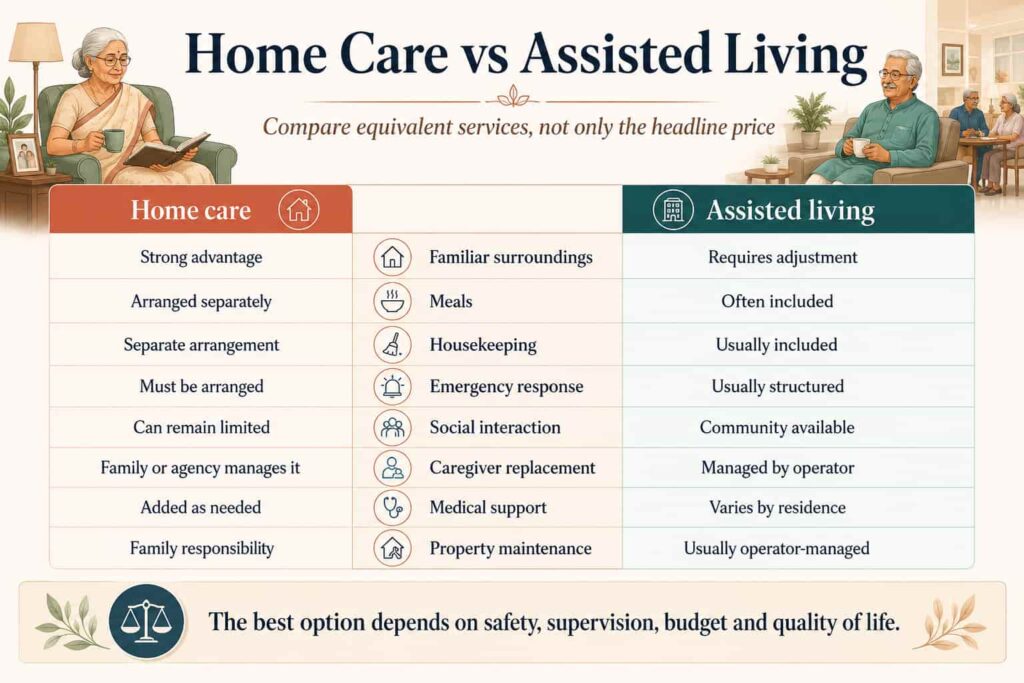
The correct comparison is between equivalent services.
| Decision factor | Home care | Assisted living |
| Familiar surroundings | Major advantage | Requires adjustment |
| Personalised attention | Can be strong | Depends on staffing model |
| Meals | Arranged separately | Commonly included |
| Housekeeping | Arranged separately | Commonly included |
| Property maintenance | Family responsibility | Usually operator-managed |
| Caregiver replacement | Family or agency responsibility | Managed internally |
| Emergency response | Must be arranged | Usually structured |
| Social interaction | May remain limited | Community is available |
| Medical support | Added according to need | Varies by residence |
| Family control | High | Shared with the operator |
| Continuity if dependency increases | Must be rebuilt | May be available within the community |
The presence of an infirmary, nurse or medical room should not be assumed. Families must ask what is available during the day, at night and during emergencies.
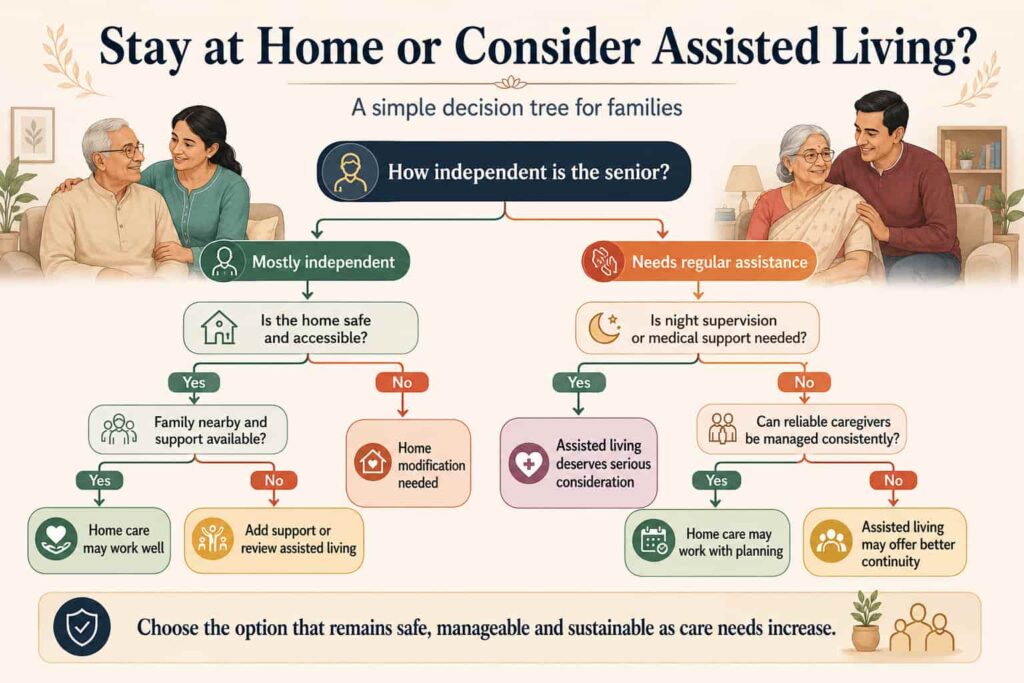
When staying at home can be the better decision
Home care may be suitable when:
- The senior is largely independent
- The home is safe and accessible
- Family members live nearby
- Medical requirements are limited
- Reliable caregivers are available
- The senior has an active social network
- Night supervision is not required
- The arrangement can be managed consistently
The emotional value of familiar surroundings should not be underestimated.
A senior may feel secure in a known neighbourhood, close to old friends, familiar doctors and established routines.
Home care should not be rejected merely because assisted living appears more organised.
When assisted living deserves serious consideration
Assisted living may offer stronger long-term value when:
- The senior lives alone
- Children live in another city or country
- Caregivers change frequently
- Medication errors are becoming common
- The senior has experienced repeated falls
- The home is not wheelchair-friendly
- Night-time assistance is required
- Loneliness is affecting emotional well-being
- Meals and housekeeping have become difficult
- Family members are struggling to coordinate care
- The senior requires a structured daily routine
Moving an elderly parent should never be treated only as a property decision.
It is a care, safety, lifestyle and emotional decision.
Caregiver verification cannot be optional
When a caregiver is hired inside the home, the person may gain access to:
- The senior’s medicines
- Personal documents
- Bank-related information
- Jewellery and valuables
- House keys
- Family routines
- Medical history
Families should verify:
- Government-issued identity documents
- Permanent and current address
- Police verification
- Previous-employer references
- Training certificates
- Relevant work experience
- Medical fitness
- Agency registration
- Replacement policy
- Emergency escalation process
The scope of work should also be recorded in writing.
This should clearly state whether the caregiver is responsible for:
- Bathing
- Toileting
- Diaper changing
- Cooking
- Cleaning
- Lifting
- Night duties
- Medication reminders
- Hospital accompaniment
Many disputes begin because the family and caregiver assume different responsibilities.
Do not make the decision using today’s health alone
Ageing is progressive.
A care arrangement that works today may not remain sufficient two years later.
Families should ask:
- What happens if the senior becomes wheelchair-dependent?
- Can a hospital bed fit inside the room?
- Who will provide night supervision?
- Is nursing available locally?
- Can the bathroom be modified?
- Will the building lift remain reliable?
- Can the monthly budget support two caregivers?
- Who will manage the arrangement if the primary family coordinator is unavailable?
A good care plan should work not only for the present condition, but also for a reasonably foreseeable increase in dependency.
A five-question test before choosing
Before selecting home care or assisted living, discuss these five questions as a family.
1. Is the existing home genuinely safe?
Do not evaluate the house emotionally. Evaluate it through mobility, bathroom safety, emergency access and future wheelchair use.
2. Who will manage the caregiver?
Hiring a caregiver is not the end of the responsibility. Someone must monitor performance, arrange replacements and handle emergencies.
3. Is the senior receiving care or only attendance?
A person may be physically present without providing meaningful care, engagement or observation.
4. What is the complete monthly cost?
Add manpower, food, domestic help, nursing, physiotherapy, medicines, utilities, equipment, maintenance and emergency provision.
5. Can the arrangement continue if dependency increases?
The lowest-cost arrangement today may become difficult or unsafe when medical and mobility needs change.
The final decision should not be based on the cheapest headline price
There is no universally correct answer.
For an independent senior living in a safe home with family nearby, home care may provide comfort, continuity and excellent value.
For a highly dependent senior living alone in an inaccessible property, creating a reliable home-care system may become expensive and difficult to manage.
The family should calculate three figures before making a decision:
- The complete monthly cost of home care
- The one-time cost of making the house senior-friendly
- The cost of reliable backup, night and emergency support
Only then should these numbers be compared with an assisted-living residence offering an equivalent level of service.
The right question is not whether home care or assisted living is cheaper.
The right question is:
Which arrangement can keep the senior safe, supported, socially connected and dignified without becoming unsustainable for the family?
That is the calculation that matters.
Important note
The prices and scenarios used in this article are illustrative estimates intended to explain the method of calculating elderly-care expenses. Actual prices differ by city, provider, caregiver qualification, medical condition, shift duration and service inclusions. Families should obtain written quotations and independently verify caregivers or care providers before making a decision.
References
- India Ageing Report 2023, United Nations Population Fund
- JLL–ASLI report on India’s senior-living market landscape
- Published Indian home-care provider price references





Leave a Reply