


Most families do not begin searching for elder care when everything is going smoothly.
The search usually begins after something changes.
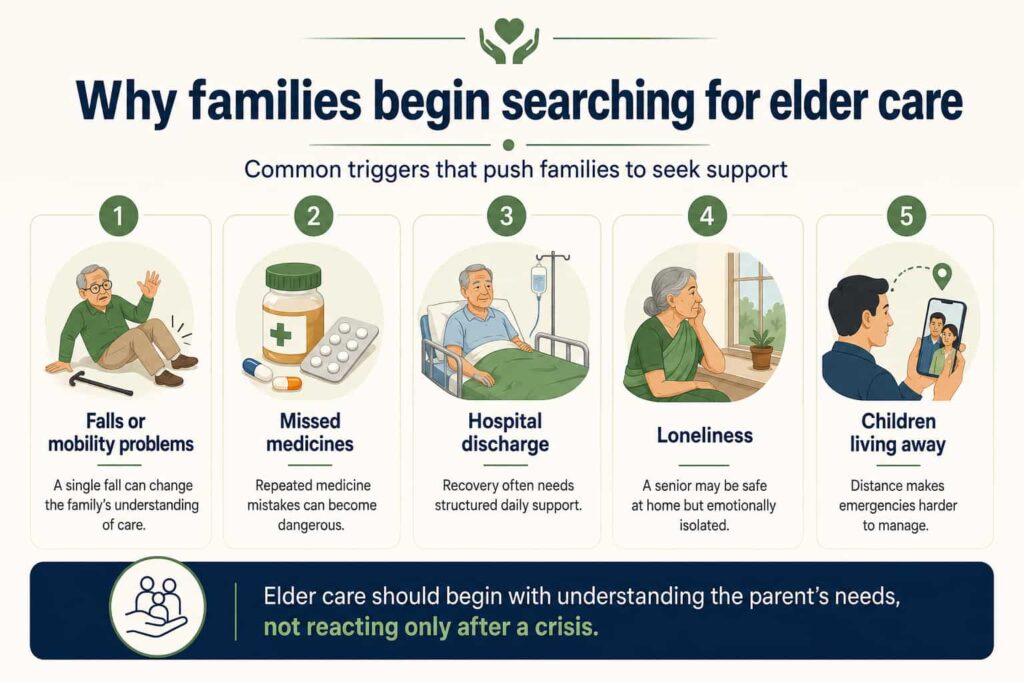
A parent falls in the bathroom. Medicines are missed. A hospital discharge requires daily support. A trusted domestic worker suddenly leaves. A son or daughter living in another city realises that regular phone calls are no longer enough.
At that point, families often make decisions under pressure.
They search for the nearest caregiver, compare a few prices and choose the provider that promises the fastest arrangement. But elder care is not simply about placing another person inside the home.
It is about trusting someone with a parent’s safety, privacy, health and dignity.
The best elder-care service is therefore not necessarily the cheapest, nearest or most advertised. It is the service that correctly understands the senior’s needs and has trained people, reliable backup and clear accountability.
Why choosing elder care is becoming an important family decision?
India had approximately 149 million people aged 60 and above in 2022. By 2050, this population is projected to reach nearly 347 million, representing approximately 20.8% of the country’s population.
This demographic change is taking place alongside changing family structures.
Children frequently work in other cities or countries. Older couples may continue living in the family home, while their daily needs gradually become more complex.
The family may still be emotionally present, but may not be physically available during:
- a late-night fall;
- a medicine error;
- a sudden hospital visit;
- a caregiver’s absence;
- or a period of loneliness and confusion.
Professional elder care should not replace the family. It should create a dependable support system around the senior.
Begin with the parent, not the provider
Families often begin by asking:
Which elder-care company is the best?
The better first question is:
What kind of support does my parent actually need?
A provider cannot be selected correctly until the senior’s physical, medical, emotional and social requirements are understood.
WHO’s integrated-care approach recommends person-centred and coordinated care that begins by identifying changes in mobility, cognition, nutrition, vision, hearing, emotional well-being and other areas affecting an older person’s functional ability.
Before contacting providers, observe whether the senior can independently:
- bathe and dress;
- prepare and eat meals;
- manage medicines;
- walk safely;
- use the toilet;
- handle money and bills;
- attend medical appointments;
- and respond appropriately during an emergency.
Also consider emotional needs.
A senior may be physically independent but deeply lonely. Another may have family companionship but require nursing after surgery. These situations need different solutions.
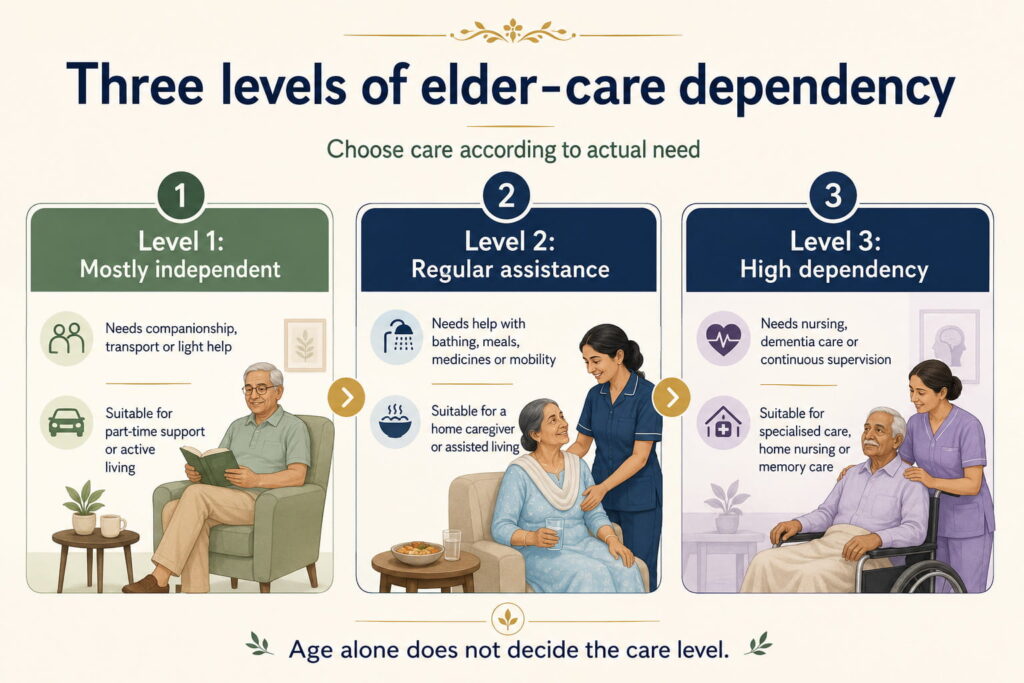
Three practical levels of care
Level 1: Mostly independent
The senior manages personal routines but may need help with:
- companionship;
- transport;
- shopping;
- housekeeping;
- appointment coordination;
- or occasional health monitoring.
Possible options include part-time companionship, day care, home-support services or independent senior living.
Level 2: Needs regular assistance
The senior requires help with activities such as:
- bathing;
- dressing;
- meals;
- medicines;
- walking;
- or using the toilet.
A trained home caregiver or assisted-living arrangement may be appropriate.
Level 3: High dependency or clinical needs
The senior may require:
- continuous supervision;
- nursing procedures;
- post-operative care;
- feeding support;
- dementia care;
- wound management;
- or assistance with most daily activities.
This may require qualified home nursing, specialised assisted living, rehabilitation or memory care.
Age alone should not determine the care level. Two people of the same age may have entirely different abilities and support requirements.
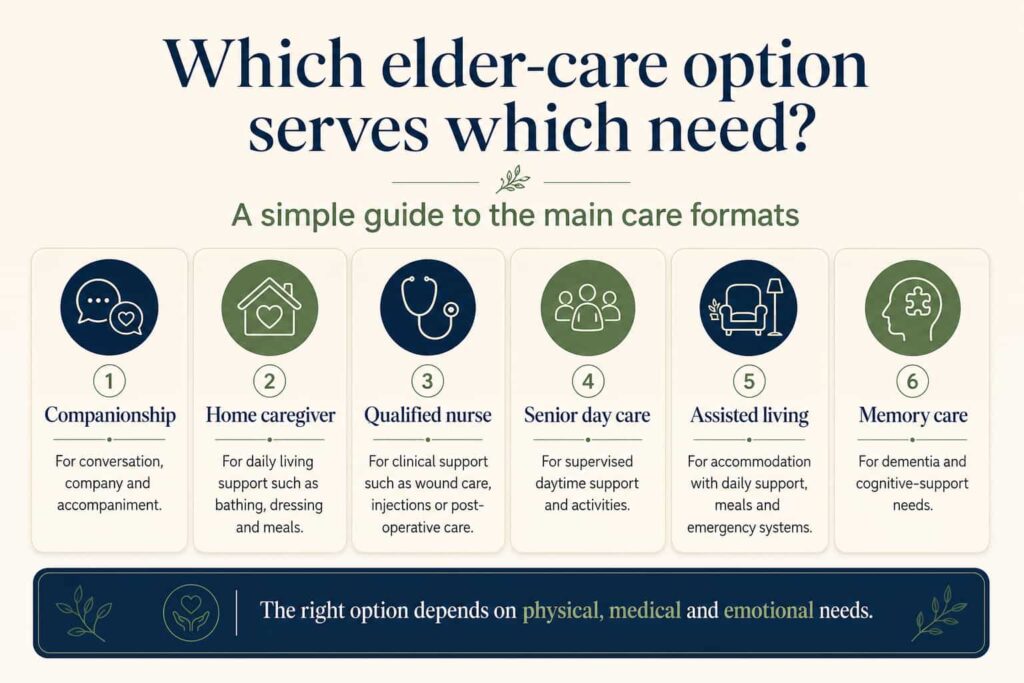
Understand the main elder-care options
The term “elder care” covers several different services. Families should not treat them as interchangeable.
Companionship support
Companionship is suitable for seniors who are mostly independent but need regular conversation, accompaniment or social interaction.
It may include:
- spending time together;
- accompanying the senior for walks;
- reading;
- helping with hobbies;
- and attending appointments.
Companionship does not replace personal care or nursing.
Home caregiver or attendant
A caregiver generally supports daily living activities such as:
- bathing;
- dressing;
- eating;
- mobility;
- toileting;
- medicine reminders;
- and companionship.
This arrangement may work well when the senior wants to remain at home and the family can supervise the care system.
Qualified home nurse
A nurse is required when the senior needs clinical support.
Depending on qualifications and medical instructions, nursing responsibilities may include:
- wound dressing;
- injections;
- catheter care;
- medical-device management;
- monitoring vital signs;
- and post-operative support.
A caregiver should not be asked to perform clinical procedures without the necessary training and authorisation.
Senior day care
Day-care centres offer supervised daytime support while allowing the senior to continue living at home.
Services may include:
- meals;
- social activities;
- rehabilitation;
- health monitoring;
- and companionship.
The family must still arrange care during evenings and nights.
Assisted living
Assisted living combines accommodation with daily support.
Depending on the community, this may include:
- meals;
- housekeeping;
- personal assistance;
- nursing availability;
- medicine management;
- emergency response;
- and social activities.
It can be suitable when the senior needs regular help or when living alone has become unsafe.
Memory care
Memory care is intended for people living with dementia or significant cognitive decline.
It requires specialist staff, closer supervision, secure spaces and structured routines.
A normal assisted-living facility should not be assumed to provide memory care unless its staff, systems and infrastructure are specifically designed for it.
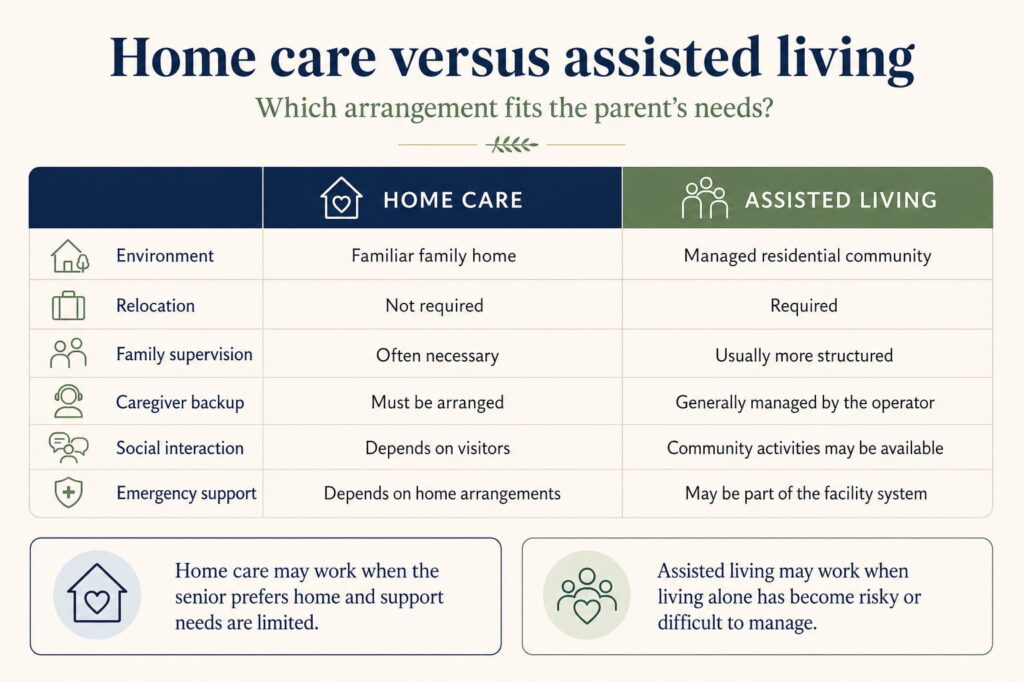
Home care versus assisted living
This is often the most difficult family decision.
Neither option is automatically better. The answer depends on the senior’s needs and the reliability of the surrounding support system.
| Factor | Home care | Assisted living |
|---|---|---|
| Environment | Familiar family home | Managed residential community |
| Relocation | Not required | Required |
| Family supervision | Often necessary | Usually more structured |
| Caregiver backup | Must be arranged | Generally managed by the operator |
| Social interaction | Depends on visitors | Community activities may be available |
| Emergency support | Depends on home arrangements | May be part of the facility system |
| Increasing care needs | Requires additional providers | May be easier if higher care is available |
| Privacy | Familiar and personal | Private but community-based |
Home care may be suitable when:
- the senior strongly prefers the existing home;
- care requirements are limited or moderate;
- the home can be made senior-friendly;
- a dependable family member lives nearby;
- and replacement staff can be arranged.
Assisted living may deserve consideration when:
- the senior lives alone;
- falls or medicine errors are becoming common;
- night-time support is required;
- several home services have become difficult to coordinate;
- or loneliness is affecting daily life.
Remaining at home can preserve familiarity. But a familiar home is not automatically a safe home.
Similarly, assisted living may provide better systems, but a senior should not be relocated without meaningful involvement in the decision.
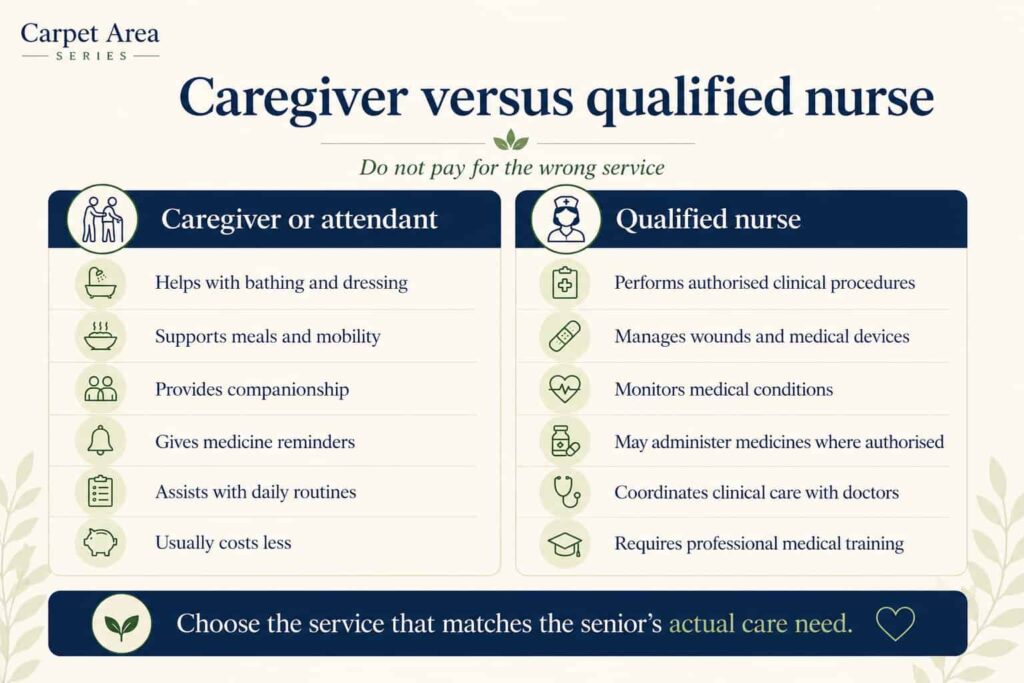
Caregiver versus nurse: Do not pay for the wrong service
Families frequently use the words caregiver, attendant and nurse as though they mean the same thing.
They do not.
| Caregiver or attendant | Qualified nurse |
|---|---|
| Helps with bathing and dressing | Performs authorised clinical procedures |
| Supports meals and mobility | Manages wounds and medical devices |
| Provides companionship | Monitors medical conditions |
| Gives medicine reminders | May administer medicines where authorised |
| Assists with daily routines | Coordinates clinical care with doctors |
| Usually costs less | Requires professional medical training |
A nurse may be unnecessary when a senior needs only companionship and bathing assistance.
A caregiver may be unsafe when wound management, injections or complex medical monitoring are required.
Before hiring anyone, ask the provider to define the role in writing.
How to verify an elder-care provider?
A polished website and compassionate sales conversation do not prove that a provider can deliver reliable care.
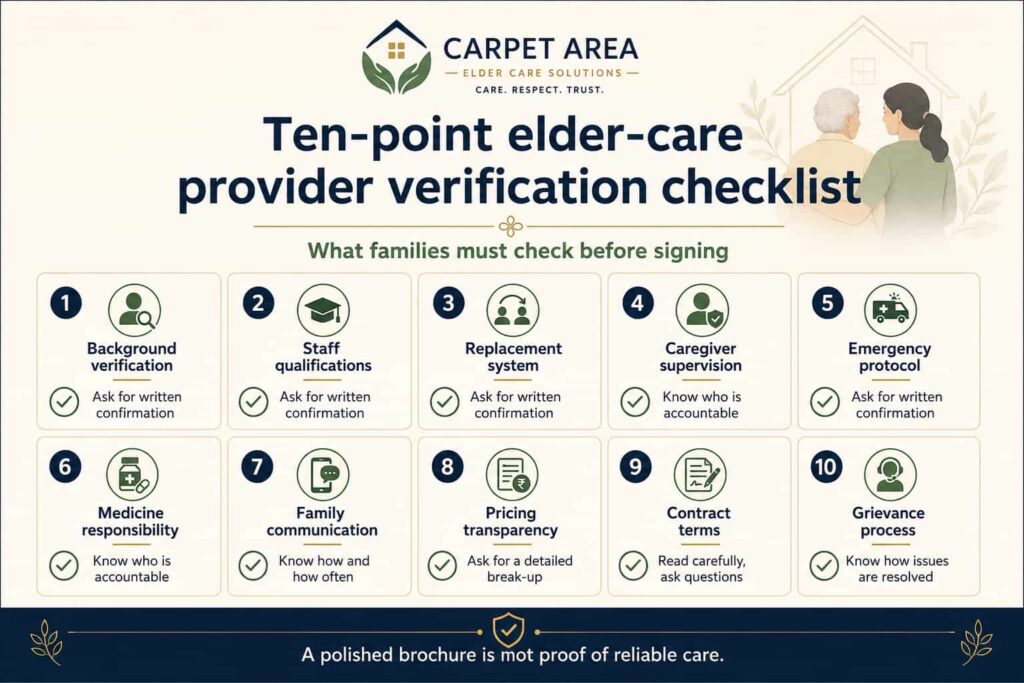
The following areas should be verified before signing an agreement.
Check staff identity and background
Ask whether the assigned staff member has undergone:
- identity verification;
- address verification;
- employment-reference checks;
- and police verification, where applicable.
Request written confirmation rather than relying only on verbal assurance.
Verify qualifications
Understand whether the person is being assigned as a:
- companion;
- attendant;
- caregiver;
- nursing assistant;
- physiotherapist;
- or qualified nurse.
Ask for relevant certificates when medical or nursing duties are involved.
Examine the replacement system
One person cannot be the entire care plan.
Ask:
- What happens when the regular caregiver is absent?
- How quickly will a replacement arrive?
- Will the replacement know the care routine?
- Is emergency replacement available at night?
A provider without dependable backup may leave the family unsupported at the most difficult moment.
Ask who supervises the caregiver
A professional system should have an accountable supervisor or care manager.
Clarify:
- who reviews the care plan;
- who checks attendance;
- who handles complaints;
- and who decides when the care level should change.
Understand the emergency protocol
The provider should be able to explain:
- whom the caregiver contacts first;
- whether ambulance assistance is available;
- which hospital is normally used;
- who accompanies the senior;
- and how the family is informed.
A vague answer such as “we will manage everything” is not an emergency plan.
Clarify medicine responsibility
Ask whether the staff member will:
- remind the senior;
- organise medicines;
- administer medicines;
- record each dose;
- or coordinate with a doctor.
These are different responsibilities and should not be left unclear.
Review family communication
Children living away should know how frequently they will receive updates.
Ask whether the provider maintains:
- daily notes;
- medicine records;
- incident reports;
- health summaries;
- and emergency updates.
Read the agreement carefully
The contract should clearly explain:
- included services;
- working hours;
- weekly leave;
- replacement charges;
- overtime;
- cancellation conditions;
- deposits;
- annual price increases;
- and notice periods.
Red flags families should not ignore
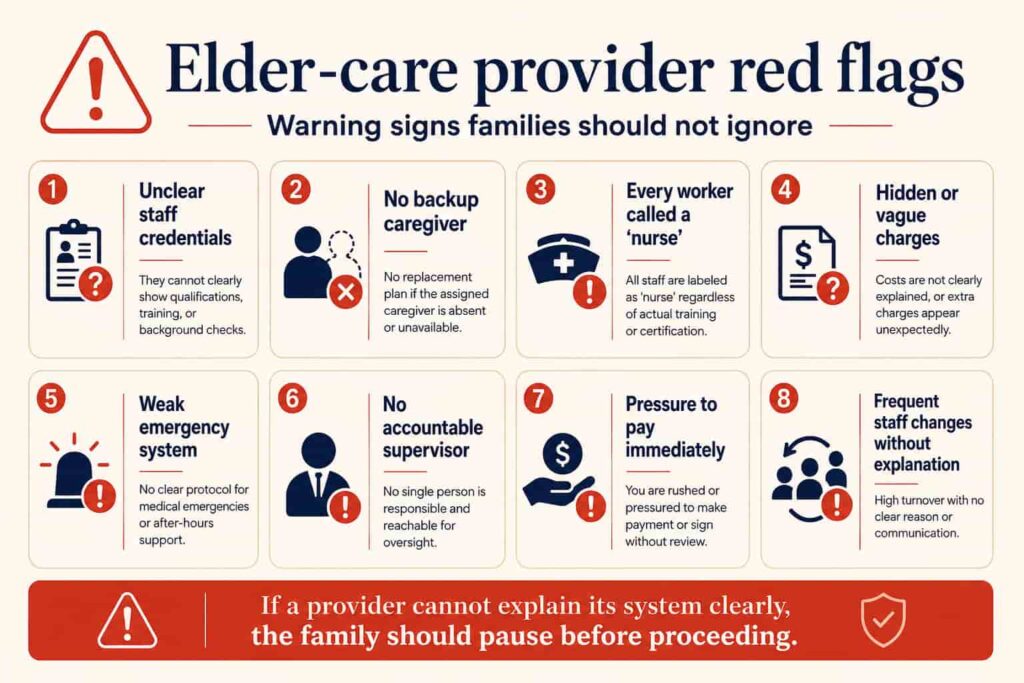
A provider deserves additional scrutiny when it:
- refuses to share staff credentials;
- calls every employee a “nurse”;
- promises one caregiver without any leave or replacement;
- avoids giving charges in writing;
- cannot explain the emergency procedure;
- provides no accountable supervisor;
- guarantees medical recovery;
- discourages communication with the assigned staff;
- pressures the family to pay immediately;
- or dismisses the senior’s preferences.
Another warning sign is frequent staff rotation without explanation.
Some change is unavoidable, but constant replacement can disturb the senior’s routine and weaken trust.
How to inspect an assisted-living facility?
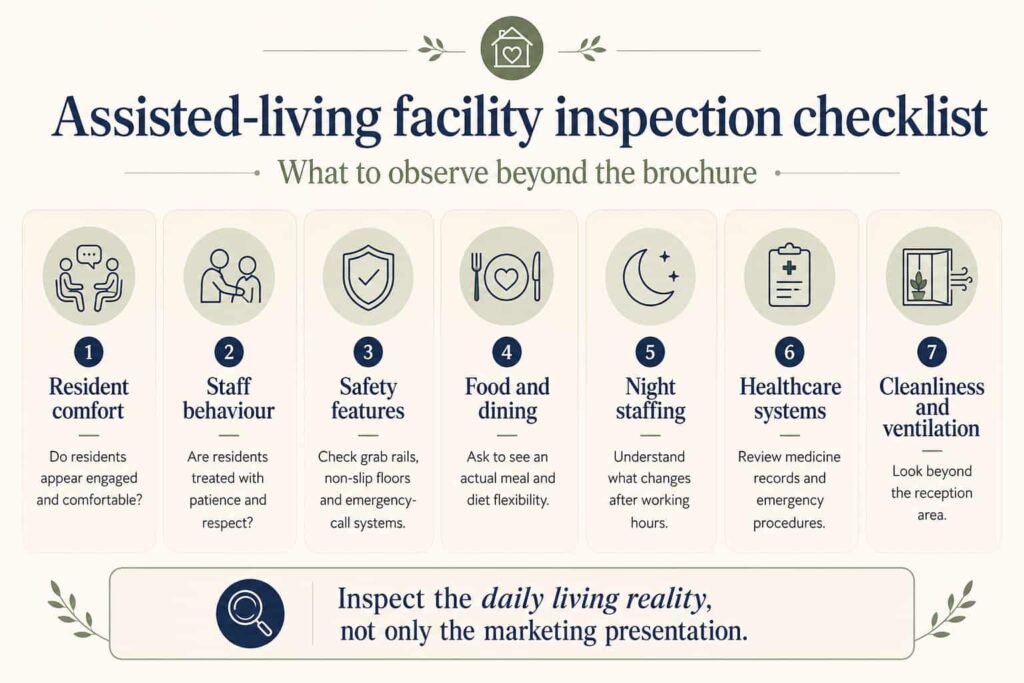
Do not evaluate a residential care facility only from its reception area, sample room or brochure.
Visit the spaces residents use daily.
Observe the residents
Notice whether residents appear:
- engaged;
- comfortable;
- appropriately dressed;
- and familiar with the staff.
One moment cannot prove the full quality of care, but it can raise useful questions.
Watch staff interactions
Pay attention to whether staff members:
- address residents respectfully;
- listen patiently;
- protect privacy;
- and assist without appearing rushed or irritated.
Inspect safety features
Check for:
- grab rails;
- non-slip floors;
- accessible bathrooms;
- emergency-call buttons;
- wheelchair-friendly passages;
- adequate lighting;
- and clear evacuation routes.
Examine food and dining
Ask to see an actual meal rather than only the menu.
Clarify whether the facility can support:
- diabetic diets;
- low-salt diets;
- texture-modified food;
- and individual nutritional requirements.
Ask about night staffing
A facility may appear fully staffed during the day but operate differently at night.
Ask:
- how many staff members remain overnight;
- whether a nurse is present;
- and how emergencies are handled after working hours.
Review healthcare systems
Check whether the facility maintains:
- medicine records;
- care plans;
- incident reports;
- doctor-visit documentation;
- and emergency contacts.
WHO emphasises that long-term care should combine health services, caregiving and social support through a person-centred continuum rather than disconnected interventions.
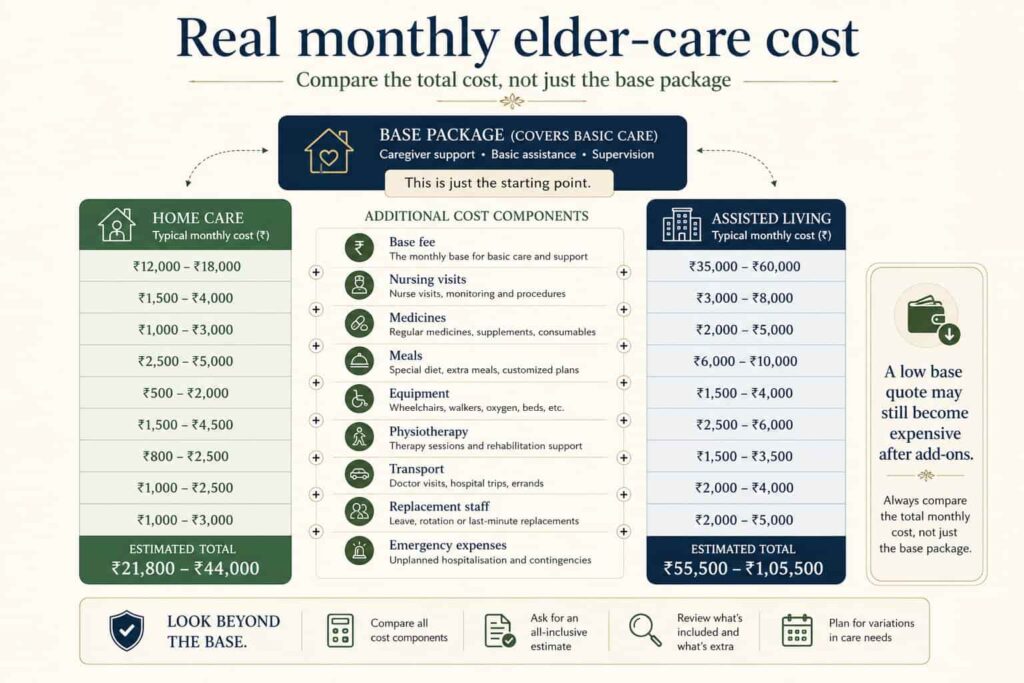
Compare the total cost, not the base package
The lowest quotation may not be the least expensive arrangement.
A home-care budget may include:
- caregiver fees;
- agency charges;
- replacement costs;
- nurse visits;
- doctor consultations;
- physiotherapy;
- food;
- medicines;
- adult diapers;
- equipment;
- transport;
- and ambulance expenses.
An assisted-living package may include accommodation, meals, housekeeping and selected nursing support, but charge separately for:
- personal caregivers;
- advanced nursing;
- special diets;
- physiotherapy;
- hospital accompaniment;
- equipment;
- and high-dependency care.
Ask every provider for a written list showing:
- What is included?
- What is excluded?
- Which services are billed by use?
- How often can charges increase?
- What will the package cost if care needs rise?
A base fee is meaningful only when the family understands the complete monthly cost.
Additional checks for NRI and intercity families
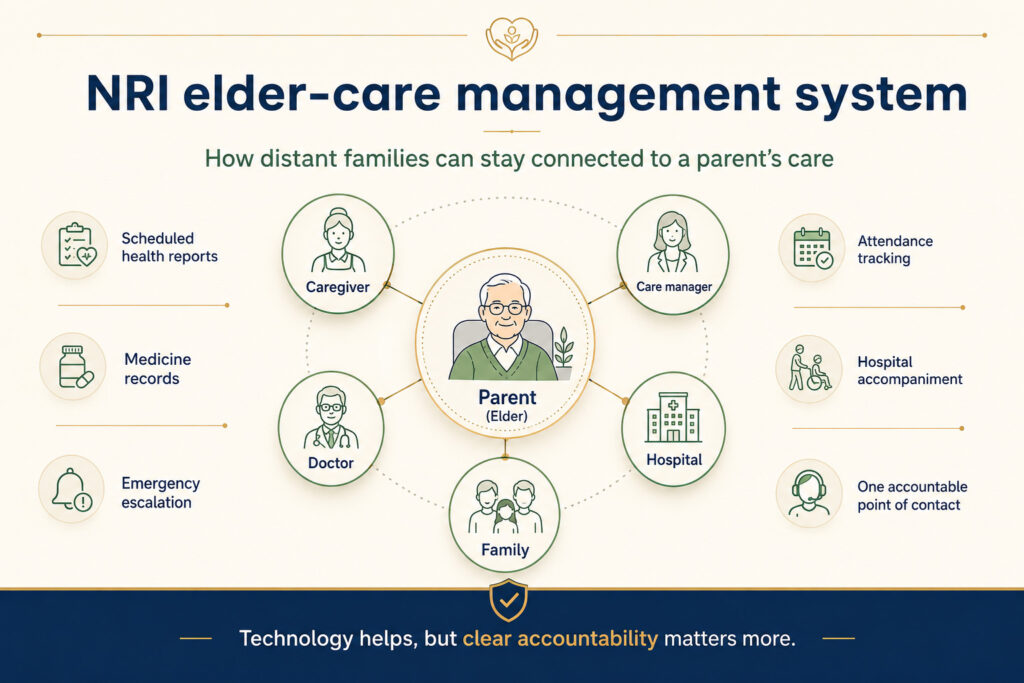
Distance creates an additional layer of risk.
A family living abroad or in another city should ask for:
- one accountable care coordinator;
- scheduled health reports;
- medicine records;
- caregiver attendance tracking;
- hospital accompaniment;
- emergency escalation;
- document management;
- and regular financial statements.
The family should also decide:
- who can provide consent during an emergency;
- who holds medical documents;
- who manages hospital payments;
- which local relative or friend can assist;
- and how quickly the provider must report an incident.
Cameras and mobile applications can improve visibility, but they cannot replace trained judgement and human supervision.
Involve parents without making them feel powerless
The elder-care conversation should not begin with:
You cannot manage on your own anymore.
That statement can sound like a loss of respect and control.
A better approach may be:
We want to make daily life easier and ensure help is available whenever you need it.
Where possible:
- discuss different options;
- visit facilities together;
- introduce limited support gradually;
- consider a trial arrangement;
- and preserve the senior’s preferences.
Care should increase safety without unnecessarily removing independence.
The goal is not to take over the parent’s life. It is to protect the parts of life they can still manage and support them where help is genuinely required.
Common mistakes families make
Waiting for a crisis
Planning after a serious fall or hospitalisation limits the family’s options and increases pressure.
Choosing only by price
The cheapest service may not provide trained staff, supervision or replacement support.
Relying on one caregiver
Every care plan needs backup.
Ignoring loneliness
Physical safety does not automatically mean emotional well-being.
Assuming a nearby hospital is a formal tie-up
Ask what agreement exists and what support is actually guaranteed.
Excluding the senior
A technically correct care plan can still fail when the senior feels ignored or forced.
Carpet Area view
Choosing elder care should not begin with a provider’s brochure.
It should begin with a careful understanding of the parent.
The family must identify:
- what the senior can manage independently;
- where support is required;
- whether the need is social, personal or medical;
- and how the requirement may change over time.
After that, evaluate the provider’s people and systems.
A dependable elder-care arrangement should have:
The right care level, trained staff, reliable backup, transparent pricing and one accountable person.
Compassion matters, but compassion without process is not enough.
A kind caregiver without supervision can become unavailable. A premium facility without a strong night team can become unsafe. A low-cost package with hidden charges can become financially difficult.
The best care service is the one that remains dependable after the sales conversation has ended.
Final family checklist
Before selecting any elder-care service, answer these questions:
- What can the senior manage independently?
- Is the need companionship, personal assistance, nursing or residential care?
- Are staff credentials and background checks available?
- Who supervises the care?
- What happens when the assigned caregiver is absent?
- What is the emergency protocol?
- How are medicines recorded?
- How will the family receive updates?
- What is the complete monthly cost?
- Can the care plan increase as needs change?
- What are the cancellation and refund conditions?
- Is the senior comfortable with the arrangement?
Choosing care for a parent is rarely only a practical transaction.
It is an emotional decision built around trust.
The right provider should not make the family feel that it is handing over responsibility. It should help the family remain involved while ensuring that the senior is safe, respected and supported every day.
Sources:-
- UNFPA India, India Ageing Report 2023.
- World Health Organization, Integrated care for older people.
- World Health Organization, Providing access to long-term care for older people.
Disclaimer: This article provides general information and is not a medical assessment. Care requirements should be evaluated with qualified healthcare and elder-care professionals. Service availability, qualifications, pricing and contractual conditions vary by provider and location.





Leave a Reply