

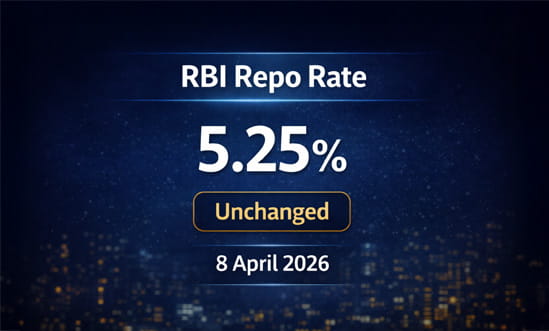
At a time when buyers are watching EMIs closely, developers are tracking demand, and investors are trying to understand the next move in real estate, the Reserve Bank of India’s latest policy decision has brought one important thing back into focus: stability. In its April 8, 2026 monetary policy decision, the RBI kept the repo rate unchanged at 5.25% and retained its neutral stance. That may sound like a technical banking update, but for the property market, it carries a much bigger message.

The biggest relief is for homebuyers. When the repo rate stays unchanged, the immediate fear of rising home-loan costs also stays under control. For many families, the real question is simple: will my EMI rise, or will it stay manageable? A stable repo rate does not automatically make homes cheaper, but it helps keep borrowing conditions predictable. That matters because predictability gives buyers more confidence to plan purchases, especially in a market where affordability is already under pressure.
This is particularly important right now because India’s housing market has entered a more selective phase. Recent market data shows that residential sales across the top eight cities fell 4 percent year-on-year in Q1 2026 to 84,827 units. In other words, demand has not disappeared, but buyers have become more careful. In such an environment, any sharp increase in loan rates could have weakened sentiment further. By keeping the repo rate unchanged, the RBI has at least avoided adding extra pressure to an already cautious market.
For developers, this decision is helpful for a different reason. Real estate thrives not only on demand, but also on confidence. When interest rates remain stable, developers get a clearer picture of how buyers may behave in the coming months. It becomes easier to plan launches, pricing, marketing, and inventory movement. Stable rates also support project financing sentiment and reduce the uncertainty that often affects large real-estate decisions. That is why many industry voices have interpreted the RBI’s move as a supportive signal rather than a passive one.
There is also a wider economic angle behind this decision. Business Standard’s recent real-estate coverage noted that a steady repo rate can keep EMIs predictable while helping sustain purchasing power and business expansion if inflation moderates later in the year. That combination matters because real estate does not move in isolation. Housing demand improves when consumers feel more financially secure, and commercial real estate gains strength when companies expand, hire, and lease more space.
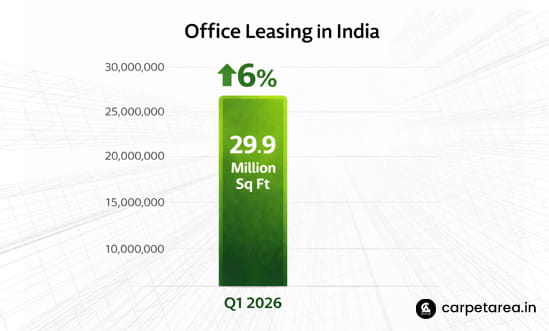
That brings us to the office market, where the signal is even more positive. India’s office leasing touched a record 29.9 million square feet in Q1 2026, rising 6 percent year-on-year. This strength is being driven by business expansion and strong demand from Global Capability Centres, which accounted for nearly half of office leasing during the quarter. In this context, a stable repo rate works like an added layer of support. It does not create office demand on its own, but it helps maintain a more stable financial environment for businesses making long-term leasing decisions.
For investors, the decision also sends a measured message. The RBI has not moved toward aggressive rate cuts, but it has also not tightened conditions further. That middle path suggests the central bank is trying to balance growth with inflation risks, especially in a global environment still affected by geopolitical tensions and energy-price uncertainty. For the real-estate market, this means the current cycle is likely to be driven by stability and selective growth rather than sudden policy-led excitement.
Of course, stability alone cannot solve every problem in the property market. Home prices in many cities have risen, affordability remains a concern for a large section of buyers, and inventory dynamics still vary widely across markets. A steady repo rate helps sentiment, but it does not replace the need for sensible pricing, strong project execution, and genuine end-user demand. Buyers will still compare location, value, trust, and long-term livability before making decisions.
Still, timing matters in real estate, and this decision has come at a useful moment. The housing segment needed reassurance more than excitement. The office segment needed continuity more than disruption. By holding the repo rate at 5.25 percent, the RBI has given both sides of the market something valuable: a stable base on which decisions can be made. That may not create dramatic headlines overnight, but it often matters more in the long run.

In the end, this is why the repo-rate pause matters. For homebuyers, it means less fear of immediate EMI shock. For developers, it means a more stable demand environment. For the office market, it helps preserve momentum at a time when commercial leasing is already strong. And for the broader real-estate sector, it offers something the market always values highly: clarity.
So while the RBI may not have announced a dramatic cut, its decision still carries real meaning for property markets across India. In a year where caution and confidence are competing side by side, a stable repo rate could be exactly the support real estate needed.





Leave a Reply