


For many NRIs, Indian real estate is more than an investment. It is an emotional connection, a future retirement option, a family asset and sometimes a way to stay financially linked with India.
But the question is not simply, “Should NRIs invest in Indian property?”
The real question is: where should NRIs invest, and what type of property makes sense in 2026?
India’s real estate market is active, but it is not the same everywhere. A flat in a strong rental market, a plot in an approved layout, a Grade-A commercial asset, a REIT or a second home in a lifestyle location can all look attractive. But each option has different risk, management effort, liquidity and return potential.
For NRIs, the best property is not always the one with the biggest promise. It is the one that is legally safe, easy to manage, located in a real-demand market and aligned with the investor’s purpose.
Why are NRIs looking at Indian real estate again?
NRI interest in Indian real estate has become stronger because India’s housing market is moving towards premium and better-managed projects.
CBRE’s India Residential Market Outlook 2026 says affordability dynamics may stabilise over the medium term, with household income growth expected to outpace property price increases. It also says branded residences are expected to remain an important growth theme because buyers are looking for professionally managed formats and better service benchmarks. For NRIs, this matters because management quality and trust are often as important as price appreciation.
The premium housing trend is also visible in broader market reporting, where high-value homes and premium real estate are increasingly being seen as part of wealth preservation and portfolio diversification, especially among HNIs.
But this also creates a caution. Premium supply is rising, so NRIs should not assume every expensive project is a good investment. The project must justify its price through location, builder credibility, rental demand, construction quality and resale potential.
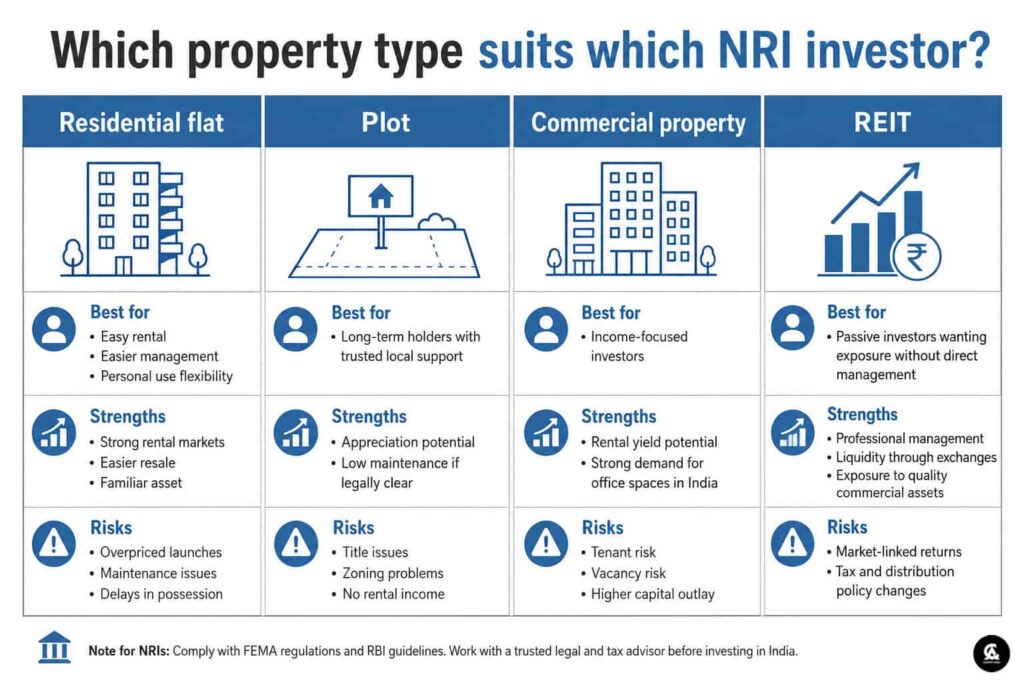
Which property type suits which NRI investor?
For NRIs, the investment decision should not start with a project name. It should start with the investor’s purpose.
If the goal is rental income and easier management, a residential apartment in a strong city may be better.
If the goal is long-term appreciation and the NRI has trusted local support, an approved plot may work.
If the goal is income from business districts, Grade-A commercial property or REIT exposure may be considered.
If the goal is lifestyle use, a second home may make sense only when property management and rental potential are clear.
Should NRIs invest in residential flats?
For most NRIs, residential flats remain the easiest real estate investment to understand and manage.
A well-located apartment in a strong city can offer rental income, future resale value and personal-use flexibility. It can also be easier to maintain compared with independent houses or plots.
But the location must be chosen carefully. NRIs should prefer cities and micro-markets with jobs, metro connectivity, airports, IT parks, business districts, schools, hospitals and rental demand.
Recent reporting has highlighted how metro corridors are driving residential growth in areas linked to the Noida-Greater Noida Aqua Line, Pune Metro Line 3, Mumbai Metro Line 4, Navi Mumbai Metro, Bengaluru’s Whitefield-KR Puram and North Bengaluru links, Hyderabad’s Miyapur-LB Nagar corridor and Chennai Metro Corridor 3.
For NRI investors, this means infrastructure-linked locations can be attractive, but only if the project is legally clear and the price is still reasonable.
Better for: NRIs who want a safe, familiar and easier-to-rent asset.
Be careful about: Overpriced launches, weak rental markets, delayed projects and poor maintenance.
Are plots a good investment for NRIs?
Plots can give strong long-term appreciation, but they also carry higher risk.
For NRIs, plot investment is tempting because land feels simple and permanent. But land is also where legal issues can become serious. Title disputes, unclear zoning, illegal layouts, encroachments, weak road access and fake promises are common risks.
A plot can be considered only if it is in an approved authority layout or a clearly regulated plotted development. NRIs should check title, zoning, encumbrance certificate, layout approval, road access, possession status and development authority approval.
Plots are better for long holding periods. They usually do not give monthly rental income unless developed or leased. They are also harder to monitor from abroad.
Better for: NRIs with trusted local support and long-term holding capacity.
Be careful about: Unapproved colonies, agricultural land sold as future residential land and far-away “future city” promises.
Is commercial real estate better for NRIs?
Commercial real estate can be attractive because of rental income, but direct commercial property is not simple.
India’s office market is showing strong demand. JLL reported that India’s office market recorded 21.5 million sq ft of gross leasing in Q1 2026, which was its best-ever first quarter. This supports the office real estate story, especially for Grade-A office assets in major business cities.
But NRIs should not buy any random office unit or shop just because a broker promises rental income. Commercial investment depends on tenant quality, lease tenure, location, vacancy risk, maintenance, exit liquidity and building grade.
For many NRIs, REITs or professionally managed commercial exposure may be easier than directly managing a shop or office unit.
Better for: NRIs looking for income-focused investment and willing to understand commercial risk.
Be careful about: Assured return schemes, weak tenants, poor locations and empty commercial units.
Should NRIs look at REITs?
REITs can be useful for NRIs who want exposure to Indian commercial real estate without buying and managing a full property.
REITs allow investors to participate in income-generating office or retail assets through a regulated market instrument. They may offer easier entry, better liquidity than physical property and professional management.
CBRE’s India Real Estate Investment Market Outlook 2026 says India’s real estate sector is expected to maintain investment momentum in 2026, supported by continued investor interest and a flight to quality in major real estate assets.
But REITs are market-linked. Their price can move up or down, and returns are not guaranteed.
Better for: NRIs who want real estate exposure without direct property management.
Be careful about: Market risk, taxation, distribution changes and interest-rate impact.
What about warehousing and logistics?
Warehousing and logistics are becoming strong long-term themes because of e-commerce, manufacturing, GST-led supply-chain changes and demand for Grade-A storage spaces.
However, warehousing is not an easy direct investment for ordinary NRI buyers. It needs knowledge of zoning, highway access, lease structure, tenant quality, truck movement and compliance.
For most NRIs, warehousing should be considered only through professional platforms, funds, REIT-like structures or expert-managed opportunities.
Better for: High-budget NRIs or experienced investors.
Be careful about: Land-use rules, tenant risk, poor access and unverified yield promises.
Are Tier-II cities good for NRI investors?
Tier-II cities can be attractive because prices may be lower than top metros and infrastructure is improving.
Recent reporting has listed cities such as Indore, Lucknow, Jaipur, Coimbatore, Nagpur, Bhubaneswar, Surat and Visakhapatnam as emerging real estate investment hubs due to infrastructure, employment growth, affordability and urbanisation.
For NRIs, Tier-II cities can work well if there is a personal connection, family use, retirement plan or long holding period.
But the risk is liquidity. It may take longer to rent or resell compared with top metro markets. A good city name does not automatically make every project good.
Better for: Long-term NRIs, retirement planners and investors with family support in that city.
Be careful about: Weak resale demand, low rental depth and projects sold only on future hype.
Should NRIs buy second homes in India?
Second homes are becoming popular among wealthy buyers, especially in lifestyle destinations such as Goa, Alibaug, Lonavala, Rishikesh and coastal or hill locations.
For NRIs, second homes can make sense if the location has tourism demand, good access, property management support and clear legal documents.
But second homes can become expensive to maintain if they are rarely used and do not generate rental income.
Better for: NRIs who want lifestyle use plus potential rental income.
Be careful about: Maintenance cost, local permissions, seasonal demand and property management.
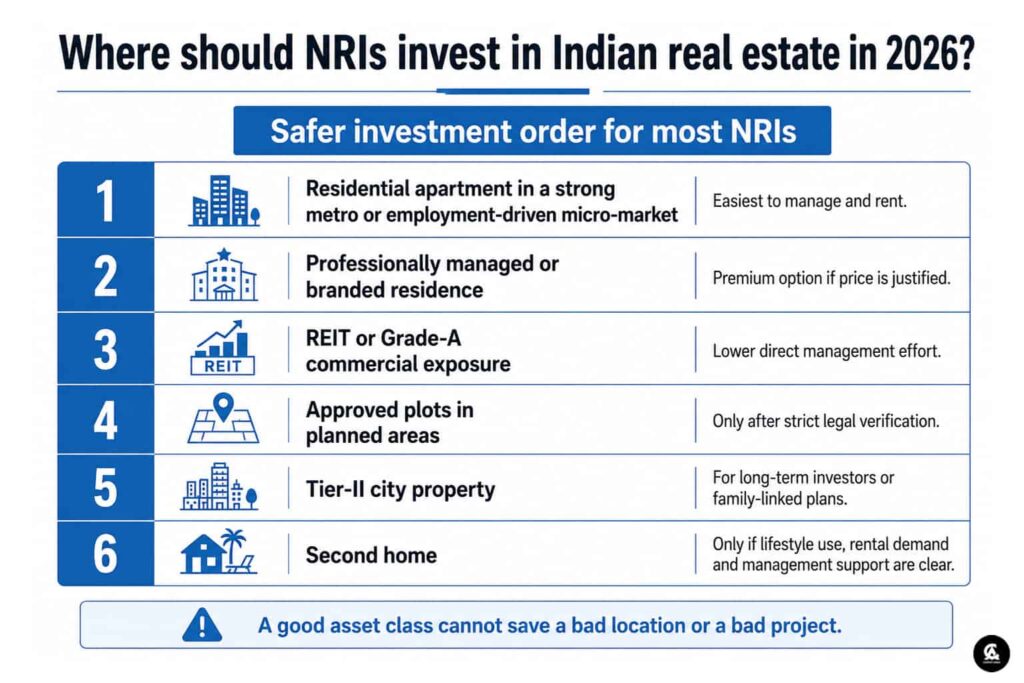
What is the safer investment order for NRIs?
For most NRI investors, the safer order can be:
First, a residential apartment in a strong metro or employment-driven micro-market.
Second, a professionally managed or branded residence, if the price is justified.
Third, REITs or Grade-A commercial exposure for those who want income and lower management effort.
Fourth, approved plots in planned areas, only after legal verification.
Fifth, Tier-II city property if there is a long-term plan or family connection.
Sixth, second homes only if there is lifestyle value, rental demand and strong management support.
This order may change depending on budget, risk appetite and purpose, but the principle remains the same: buy what you can verify and manage.
What should NRIs avoid?
NRIs should avoid buying only because a relative, broker or local contact says prices will double.
They should be extra careful with unapproved plots, agricultural land sold as future residential land, projects without clear RERA details, assured return schemes, properties with unclear title, far-away projects with no current demand, under-construction projects from unknown builders, commercial shops with unrealistic rental promises and second homes with no management support.
For NRIs, the biggest risk is not only losing money. It is getting stuck in a property that is difficult to manage, rent, sell or legally defend from abroad.
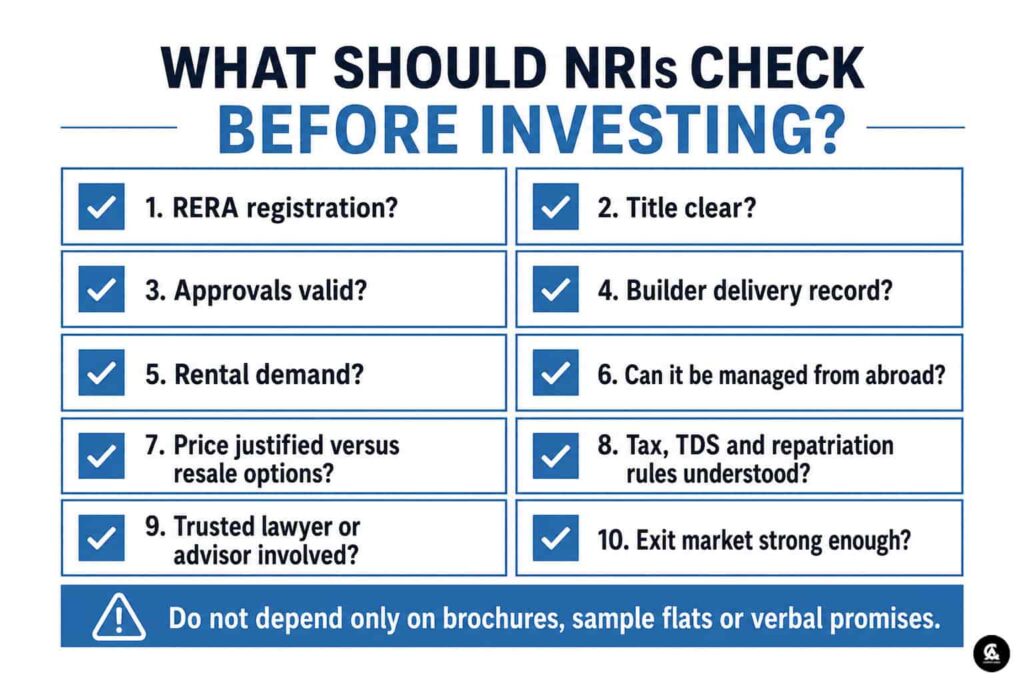
What should NRIs check before investing?
Before buying any property in India, NRIs should check these points:
Is the property RERA registered?
Is the title clear?
Are approvals and layout plans valid?
Is the builder’s delivery record reliable?
Is there rental demand in the location?
Can the property be managed from abroad?
Is the price justified compared with nearby resale and ready-to-move options?
Are tax, TDS and repatriation rules understood?
Is there a trusted lawyer or professional advisor involved?
Is the exit market strong enough if the property has to be sold later?
NRIs should never depend only on brochures, WhatsApp videos, sample flats or verbal promises.
Final view
Indian real estate can be a strong long-term investment for NRIs, but only when the decision is practical.
A good NRI property investment should be legally safe, easy to manage, located in a real-demand market and suitable for the investor’s purpose.
Residential flats in strong micro-markets remain the easiest option for most NRIs. Commercial and REIT exposure can work for income-focused investors. Plots and Tier-II cities can work for long-term investors, but only with strict legal checks. Second homes should be bought only when lifestyle, rental demand and management support are clear.
For NRI investors, the smartest rule is simple.
Do not invest in India only because the story sounds exciting.
Invest where the property can be verified, managed, rented and resold with confidence.

Sources:-
CBRE India Residential Market Outlook 2026:
https://www.cbre.co.in/insights/reports/india-residential-market-outlook-2026
CBRE India Real Estate Investment Market Outlook 2026:
https://www.cbre.co.in/insights/reports/india-real-estate-investment-market-outlook-2026
JLL India office market Q1 2026:
https://www.jll.com/en-in/newsroom/india-s-office-market-defies-global-headwinds-with-record-breaking
Times of India metro corridors report:
https://timesofindia.indiatimes.com/real-estate/news/8-metro-corridors-driving-residential-growth-and-transforming-indias-urban-housing-landscape/photostory/131480285.cms
Times of India Tier-II cities report:
https://timesofindia.indiatimes.com/real-estate/news/8-tier-ii-cities-emerging-as-real-estate-investment-powerhouses/photostory/131414140.cms





Leave a Reply