


Buying a flat, house, plot or commercial property from an NRI seller has traditionally involved more tax compliance than purchasing the same property from a resident seller.
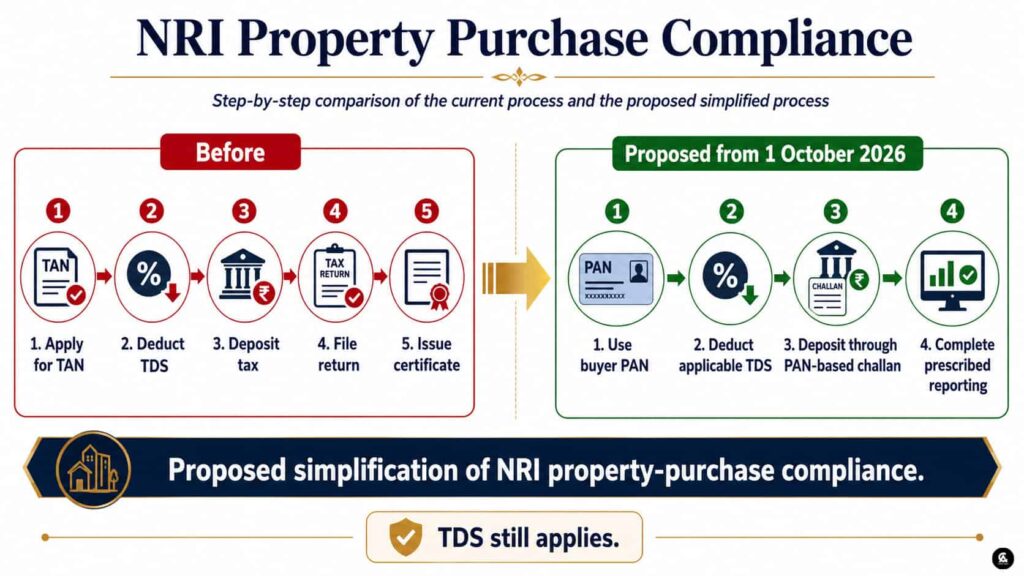
One of the biggest procedural difficulties is the requirement for the resident buyer to obtain a Tax Deduction and Collection Account Number, or TAN, even when the buyer is completing only one property transaction.
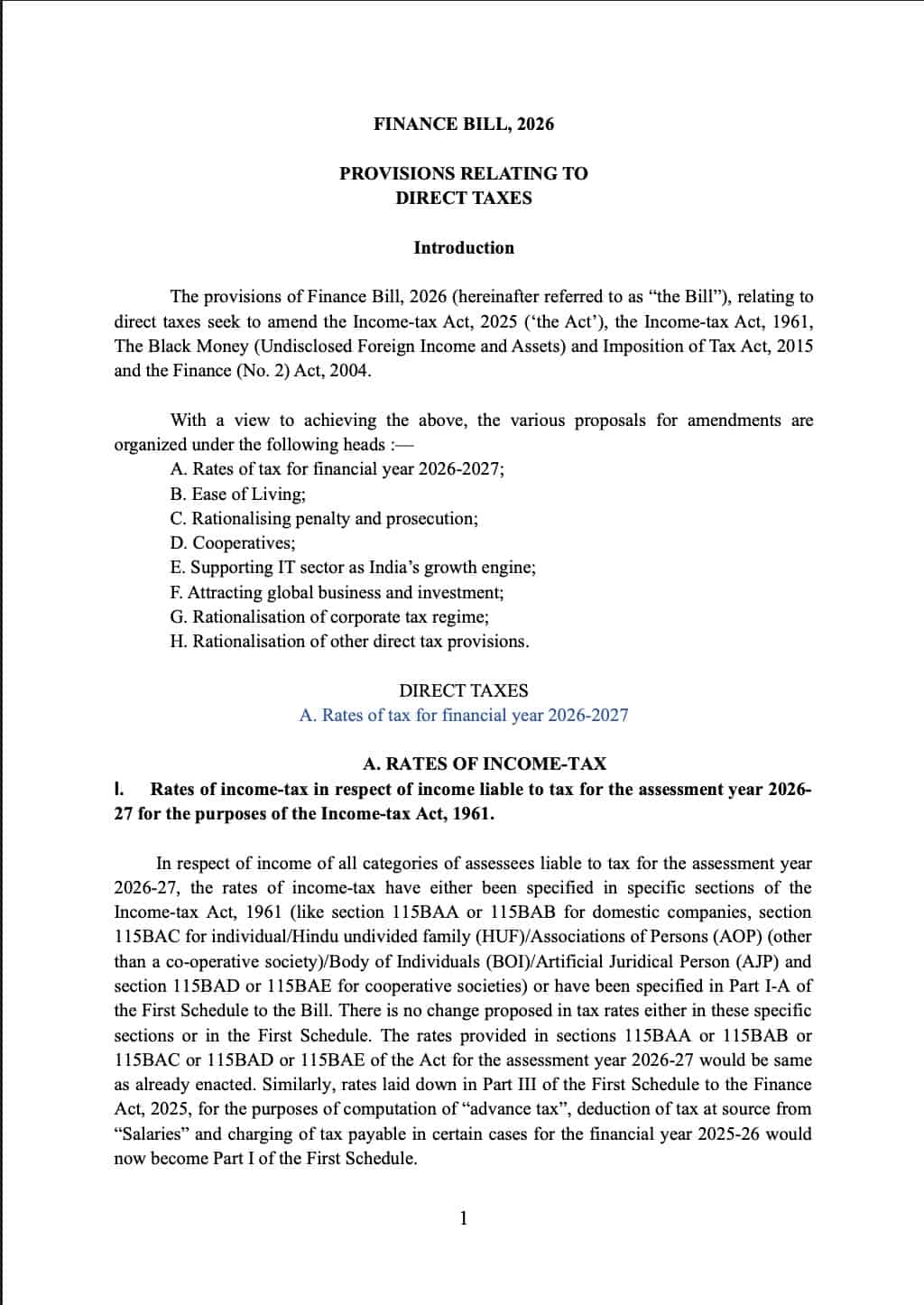
The Finance Bill 2026 proposes to simplify this process.
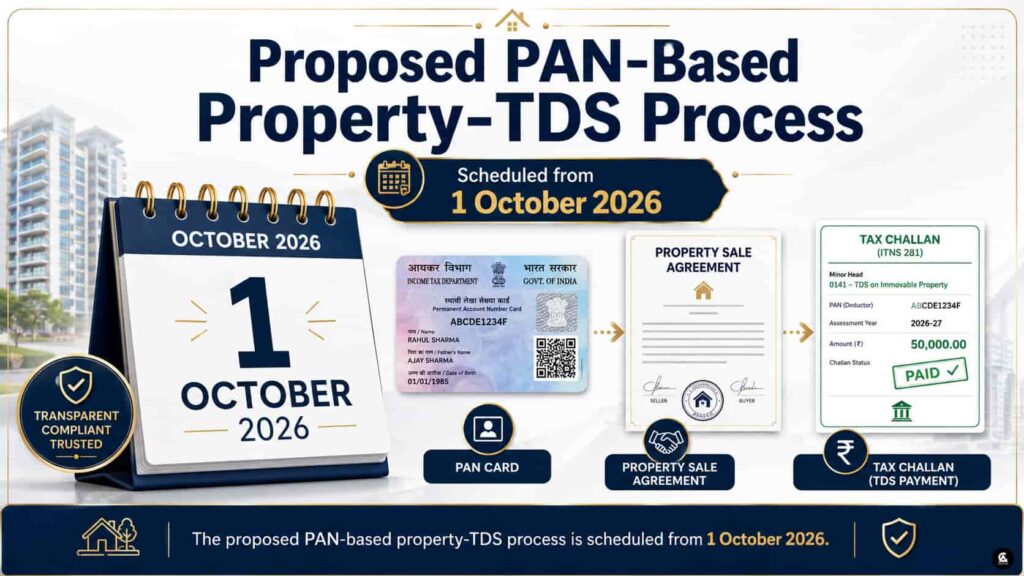
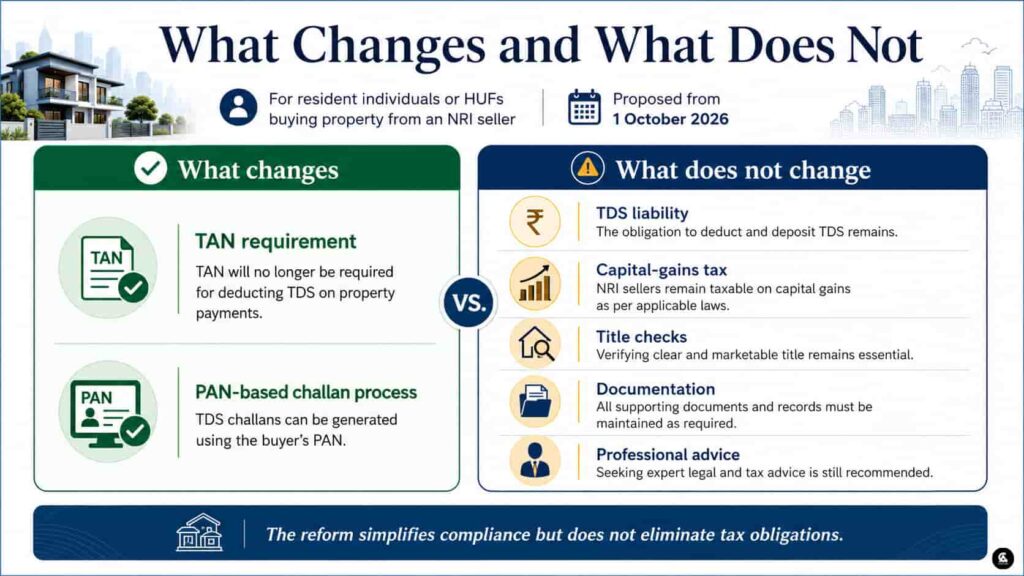
From 1 October 2026, a resident individual or Hindu Undivided Family purchasing immovable property from a non-resident seller is proposed to be exempted from obtaining TAN for that transaction.
Instead, the deducted tax is proposed to be deposited through a PAN-based challan mechanism.
The Union Budget documents describe this as a property-compliance simplification for transactions involving non-resident sellers.

What is the new NRI property proposal?
Under the present compliance framework, a person responsible for deducting tax at source generally needs a TAN unless a specific exemption applies.
A resident buyer purchasing property from a resident seller already uses a simplified property-TDS mechanism without obtaining TAN.
However, when the seller is a non-resident, the transaction is governed by the tax-deduction provisions applicable to payments made to non-residents. This generally creates a more complicated process for an ordinary individual buyer.
The Finance Bill 2026 proposes that a resident individual or HUF will not be required to obtain TAN when purchasing immovable property from a non-resident seller.
The government’s Budget summary explains the proposed change as replacing TAN with the resident buyer’s PAN for depositing the property-related TDS.
Proposed effective date
The official explanatory memorandum states that the amendment is proposed to take effect from:
1 October 2026
Until the new process becomes operational and the final portal procedure is available, buyers should continue following the compliance requirements applicable on the actual payment or deduction date.
This means the proposal should not be treated as an exemption that is already available before 1 October 2026.
Who will benefit from this change?
The proposal is specifically relevant where:
- the property buyer is a resident individual or HUF;
- the property seller is a non-resident;
- the transaction involves immovable property in India;
- the buyer is responsible for deducting tax from payment made to the non-resident seller.
The immediate compliance benefit goes to the resident buyer, because the buyer may no longer need to obtain TAN solely for one property transaction.
The proposal may also indirectly help NRI property owners because some resident buyers currently hesitate to purchase NRI-owned resale properties after learning about the additional TDS and TAN requirements.
That possible improvement in buyer confidence is a market inference, not a benefit guaranteed in the official Budget documents.
Who is not directly covered?
The proposal should not automatically be extended to:
- company buyers;
- partnership firms;
- trusts;
- resident property sellers;
- transactions where both buyer and seller are non-residents;
- payments unrelated to an immovable-property purchase.
The official provision is framed specifically around a resident individual or HUF buying property from a non-resident seller.
What is TAN and why was it a problem?
TAN stands for Tax Deduction and Collection Account Number.
It is generally required by persons responsible for deducting or collecting tax at source. The Income Tax Department describes TAN as the identification number used for TDS and TCS compliance.
For a normal family buying one property from an NRI, obtaining TAN can involve:
- applying for a separate tax-deduction number;
- registering as a tax deductor;
- depositing the deducted tax under the correct provision;
- filing the prescribed TDS statement;
- issuing the required TDS certificate;
- correcting mismatches if the tax is reported incorrectly.
The buyer may never use the TAN again after completing the transaction.
The proposed change attempts to remove this one-time administrative burden.
Does the new rule remove TDS on an NRI property sale?
No.
The proposal removes the requirement to obtain TAN for the specified buyer. It does not remove the buyer’s responsibility to deduct tax where TDS is applicable.
The Income Tax Department’s property-TDS guidance clearly distinguishes between resident and non-resident sellers:
- where the seller is resident, the property-TDS provision applicable to resident sellers is used;
- where the seller is non-resident, tax is deducted under the provision applicable to payments made to non-residents.
The official guidance identifies Section 195 under the existing Income-tax Act framework for a non-resident seller.
Therefore:
TAN relief does not mean TDS relief.
Can the buyer deduct only 1% TDS?
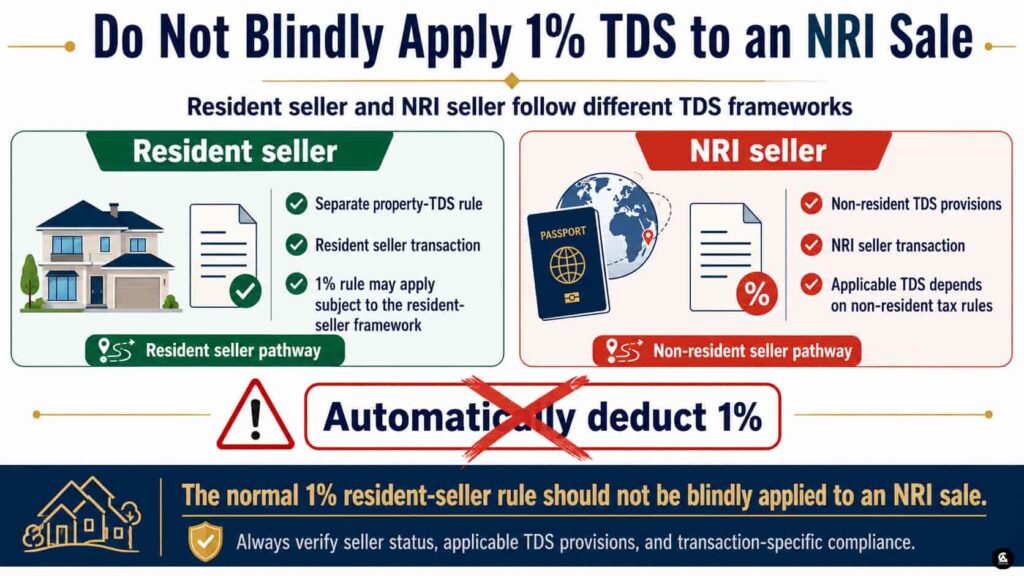
A buyer should not automatically deduct only 1% merely because the transaction involves immovable property.
The commonly discussed 1% property TDS applies to qualifying purchases from a resident seller, subject to the applicable value threshold.
The Income Tax Department states that where the seller is non-resident, tax is deducted under the provisions applicable to non-residents rather than the normal resident-seller property provision.
The correct amount in an NRI transaction can depend on:
- the seller’s residential status for tax purposes;
- the nature of the capital gain;
- the period for which the property was held;
- the amount chargeable to tax;
- applicable surcharge and cess;
- a lower or nil-deduction certificate, where obtained;
- the tax law in force on the payment date.
The buyer should obtain transaction-specific advice from a chartered accountant before releasing payment.
Why does the seller’s residential status matter?
The seller’s citizenship and residential status are not always the same thing.
An Indian citizen living overseas may be treated as non-resident for tax purposes depending on the applicable legal tests.
The buyer should not rely merely on:
- an Indian passport;
- an Aadhaar card;
- an Indian correspondence address;
- an Indian bank account;
- a statement made by the broker.
The sale agreement should clearly record the seller’s residential status, and the buyer should obtain appropriate documentary confirmation.
If the buyer applies the resident-seller process to a transaction where the seller is actually non-resident, the buyer may face:
- short deduction of tax;
- interest liability;
- penalty exposure;
- difficulties in completing TDS reporting;
- problems obtaining or registering the property;
- disputes with the seller over the balance payment.
What should an NRI seller prepare?
An NRI planning to sell property in India should ordinarily organise:
- PAN;
- passport and overseas-address proof;
- purchase deed;
- sale agreement;
- payment history;
- improvement-cost records;
- inheritance or gift documents, where relevant;
- property-tax receipts;
- loan closure documents;
- capital-gain computation;
- lower-deduction certificate, where applicable;
- Indian bank-account details appropriate for receiving sale proceeds.
The exact requirements depend on the property, transaction structure and applicable tax law.
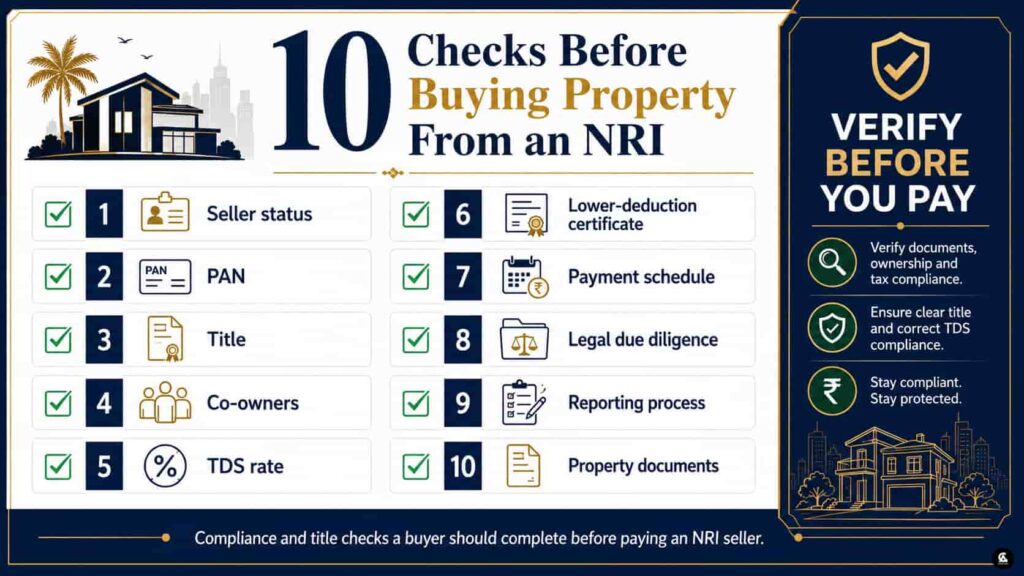
What should the resident buyer verify?
Before paying token money or signing the final agreement, the resident buyer should verify:
- Whether the seller is resident or non-resident for tax purposes.
- Whether all owners are correctly named in the title documents.
- Whether any co-owner is non-resident.
- The PAN details of every seller.
- The applicable TDS provision and deduction rate.
- Whether the seller has obtained a lower-deduction certificate.
- The payment schedule in the agreement.
- Whether TDS must be deducted from every instalment.
- How the tax will be deposited and reported.
- Whether the property has any loan, charge, dispute or title defect.
What happens when there are multiple buyers or sellers?
NRI property transactions can become more complicated when:
- two or more people are buying the property;
- the property has multiple sellers;
- only one seller is non-resident;
- ownership percentages differ;
- payments are made in instalments;
- consideration is paid from different bank accounts.
The TDS responsibility may need to be allocated buyer-wise, seller-wise and payment-wise.
The proposed removal of TAN may simplify identification and payment, but it does not eliminate the need to correctly report:
- each buyer;
- each seller;
- ownership share;
- payment amount;
- date of deduction;
- tax amount.
Will the proposal make NRI resale property easier to sell?
Potentially, yes—but the impact should not be overstated.
Removing the TAN requirement may reduce one source of hesitation among resident buyers.
It may be particularly useful in resale markets with a high concentration of overseas owners, including properties held by NRIs in:
- Delhi-NCR;
- Mumbai and Pune;
- Bengaluru;
- Hyderabad;
- Chennai;
- Kerala;
- Punjab;
- Gujarat;
- Goa.
However, buyer decisions will still depend on:
- title clarity;
- property price;
- physical possession;
- power-of-attorney arrangements;
- tax-deduction amount;
- repatriation documentation;
- condition of the property;
- society and authority records.
The proposal simplifies one part of the transaction. It does not remove the remaining legal, banking and tax checks.
What is the difference between TAN relief and tax relief?
| Issue | Proposed effect |
|---|---|
| Buyer’s need to obtain TAN | Proposed to be removed for specified resident individual/HUF buyers |
| Buyer’s PAN | Proposed to be used for challan-based compliance |
| Requirement to deduct applicable TDS | Continues |
| NRI seller’s capital-gains tax | Continues |
| Title verification | Continues |
| Sale-agreement documentation | Continues |
| Lower-deduction certificate option | May remain relevant, subject to applicable law |
| Effective date | Proposed from 1 October 2026 |
Illustrative example
Suppose a resident couple agrees to purchase an apartment in Bengaluru from an NRI owner.
The property price is ₹1.20 crore.
The sale will be completed in instalments.
Under the present process, the buyers may need to obtain TAN and complete the applicable non-resident TDS compliance.
Under the proposed rule from 1 October 2026, eligible resident individual buyers may be allowed to use their PAN through the prescribed challan-based mechanism instead of obtaining TAN.
However, the buyers must still determine:
- the correct amount of TDS;
- when TDS must be deducted;
- whether deduction applies to each instalment;
- whether the NRI seller has a lower-deduction certificate;
- how the transaction will be reported.
The proposal simplifies the identification and payment process. It does not convert a complex tax calculation into a flat 1% deduction.
Should buyers wait until 1 October 2026?
A buyer should not delay or accelerate a property transaction solely because of this proposal without considering:
- agreed price;
- property availability;
- registration timeline;
- home-loan approval;
- seller’s urgency;
- tax impact;
- legal due diligence;
- final notified procedure.
The relevant compliance can depend on the date of payment, credit, deduction and registration.
Professional advice is especially important where payments begin before 1 October 2026 but the sale deed is registered afterward.
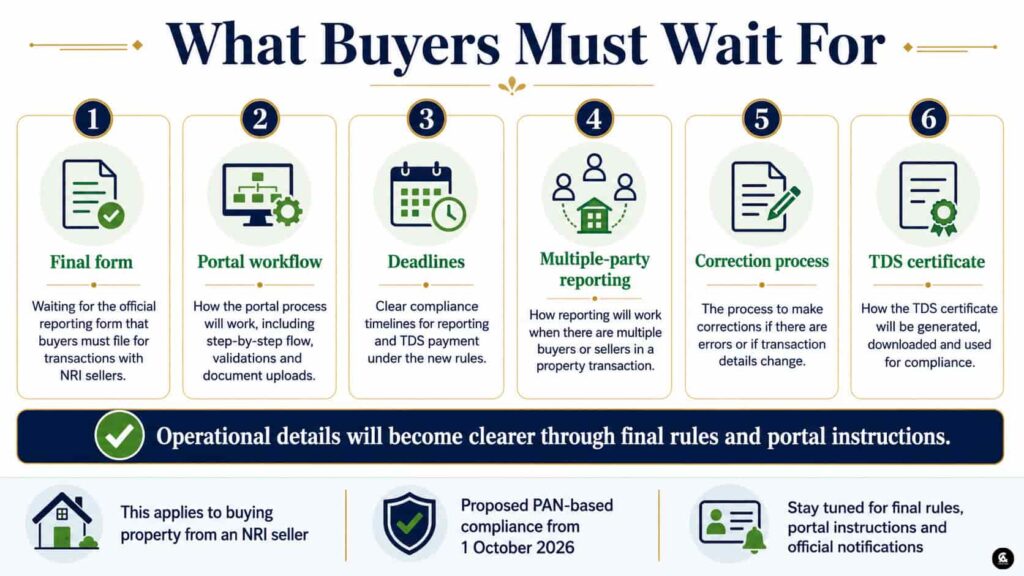
What information is still awaited?
Before the proposed process becomes fully practical, buyers will need clarity on:
- the final challan or reporting form;
- the e-filing portal workflow;
- procedure for multiple buyers and sellers;
- payment and reporting deadlines;
- correction mechanism;
- generation of the TDS certificate;
- treatment of instalments spanning the effective date;
- interaction with the new income-tax framework.
Official portal instructions and final rules should be checked once they are released.
Common mistakes buyers must avoid
Mistake 1: Treating an NRI seller as resident
The buyer should independently verify the seller’s tax residential status.
Mistake 2: Automatically deducting 1%
The normal resident-seller property rule should not be blindly applied to a non-resident seller.
Mistake 3: Paying the full amount before checking TDS
Once the entire consideration has been transferred, recovering the tax amount from the seller can become difficult.
Mistake 4: Believing TAN relief means no compliance
The proposal changes the identification mechanism. It does not remove deduction and reporting duties.
Mistake 5: Depending entirely on the broker
A property broker can coordinate the transaction but should not replace legal and tax advice.
Mistake 6: Ignoring non-resident co-owners
If one of several sellers is non-resident, the payment attributable to that seller requires separate examination.
Mistake 7: Checking tax only at registration
TDS obligations may arise when payment is credited or made, not merely when the final sale deed is registered.
What should NRI investors understand?
The proposal is relevant not only to NRI homeowners but also to overseas investors who may eventually sell Indian real estate.
A simpler buyer-side process may improve transaction convenience, but NRI investors must still plan for:
- capital-gains taxation;
- documentation of acquisition cost;
- improvement expenses;
- tax deduction at source;
- repatriation of sale proceeds;
- banking documentation;
- inherited-property records;
- power-of-attorney compliance;
- applicable FEMA conditions.
A well-documented property is usually easier to sell than one where purchase records, succession documents or payment evidence are incomplete.
Carpet Area verdict
The proposed removal of the TAN requirement is a meaningful compliance reform for resident individuals and HUFs buying property from an NRI seller.
It addresses a genuine problem: an ordinary buyer currently may have to obtain and manage a separate tax-deduction number for a single property transaction.
From 1 October 2026, the government proposes to replace this TAN-based burden with a PAN-based challan process.
However, buyers must understand the limitation of the reform:
TAN may go, but TDS does not.
The buyer must still:
- identify the seller’s correct residential status;
- calculate the applicable deduction;
- deposit the tax on time;
- complete the prescribed reporting;
- verify the title and transaction documents.
For NRI sellers, the proposal may reduce buyer hesitation and make resale transactions smoother.
For resident buyers, it may remove one procedural hurdle.
But neither party should treat the change as permission to complete the transaction without professional tax and legal verification.
Frequently asked questions
Will TAN be completely removed for every NRI transaction?
No. The proposal is specifically framed for a resident individual or HUF purchasing immovable property from a non-resident seller.
Will the rule apply before 1 October 2026?
The official memorandum proposes an effective date of 1 October 2026. Transactions and payments before that date should follow the applicable process in force at that time.
Does the proposal remove TDS?
No. It proposes to remove the TAN requirement for the specified buyer. The obligation to deduct applicable tax continues.
Can the buyer deduct 1% from an NRI seller?
The buyer should not automatically apply the normal resident-seller rate. The applicable non-resident tax provisions and transaction facts must be examined.
Will the NRI seller still pay capital-gains tax?
Yes, where capital gains are taxable. Buyer-side TDS is not necessarily the seller’s final tax liability.
Can an NRI obtain a lower-deduction certificate?
A lower-deduction mechanism may be relevant depending on the applicable law and facts. The seller should consult a qualified tax professional well before the sale.
Does the ₹50 lakh resident-property threshold automatically apply?
The buyer should not assume that the resident-seller threshold and process govern a non-resident seller transaction. Non-resident payments are dealt with separately.
Should the sale agreement mention the seller’s NRI status?
Yes. Residential status, tax deduction, payment allocation and cooperation in completing compliance should be clearly recorded.
Important disclaimer
This article is for general educational purposes and does not constitute tax, legal, investment or property advice.
Tax rates, residential status, deduction requirements and filing procedures depend on the facts of each transaction and the law applicable on the payment date.
The Finance Bill 2026 materials describe the TAN relaxation as a proposed change from 1 October 2026. Buyers and sellers should confirm the enacted provisions, final rules and Income Tax portal procedure before acting.
Consult a chartered accountant and property lawyer before purchasing or selling property involving a non-resident party.






Leave a Reply