

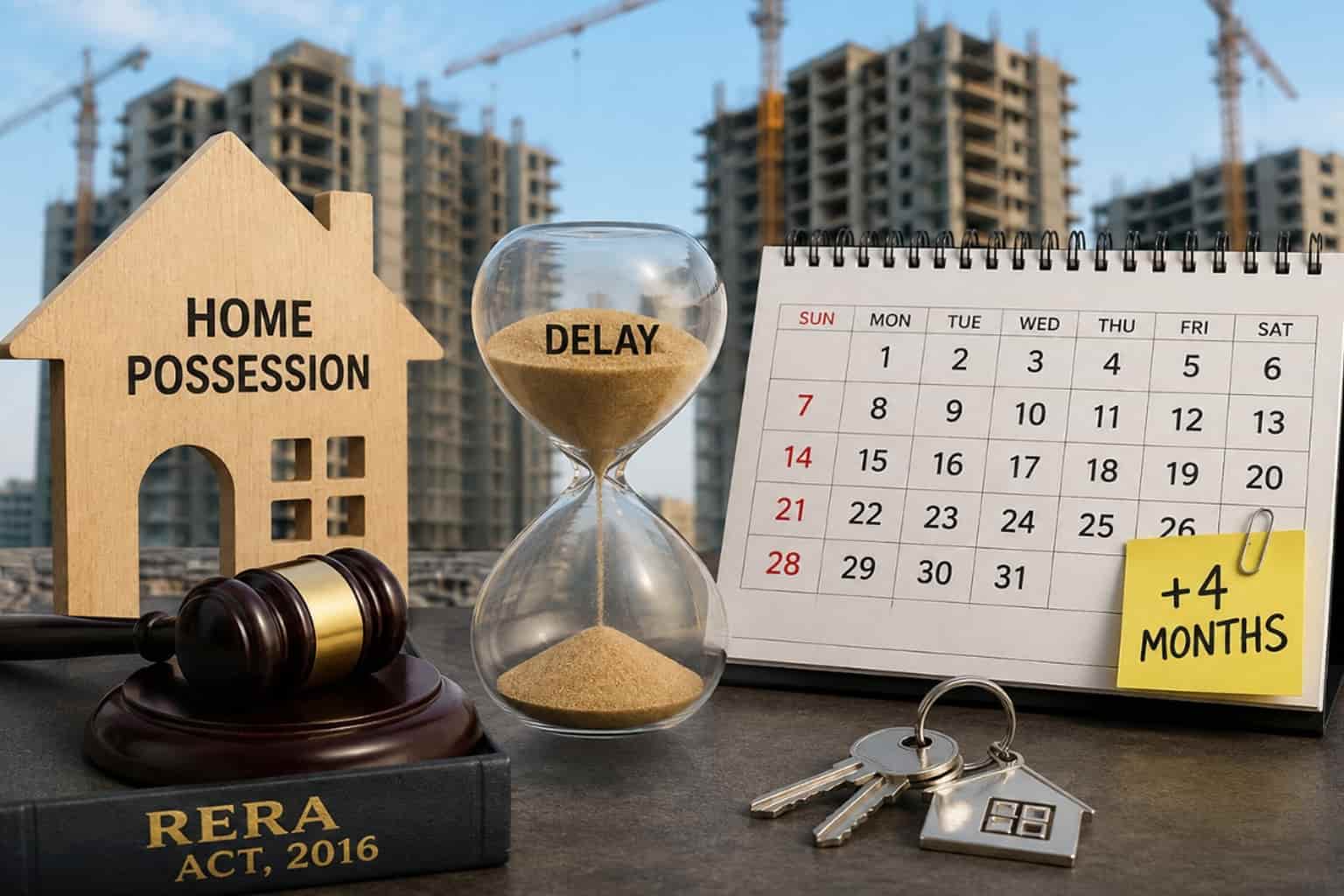
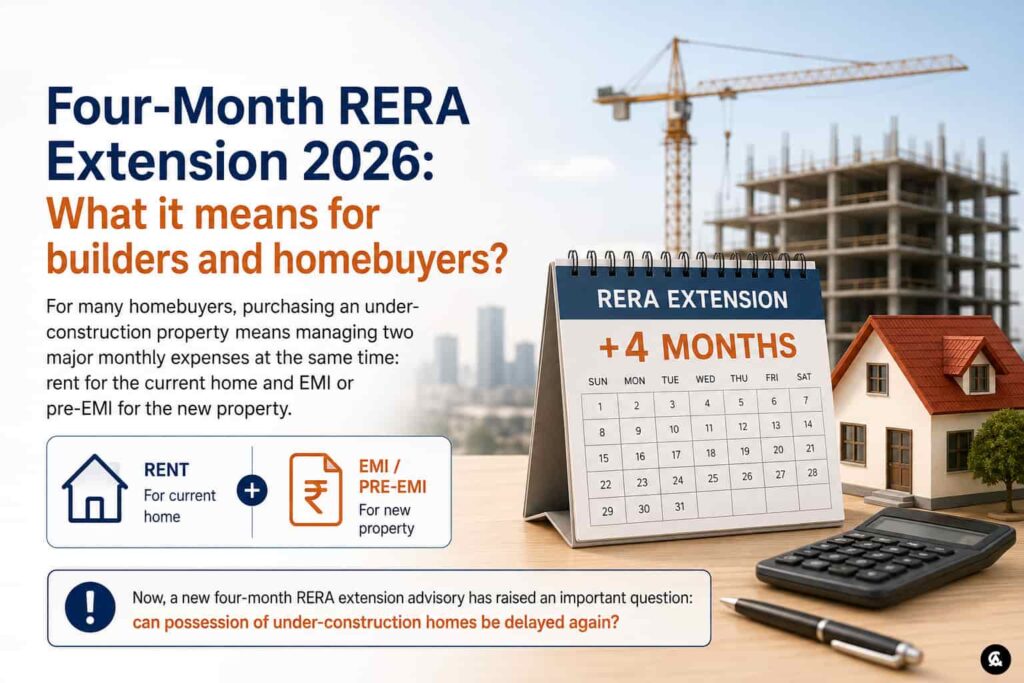
Buying an under-construction property can place a heavy financial burden on a family. Many homebuyers continue paying rent for their present accommodation while also paying EMI or pre-EMI on the property they are waiting to receive.
Against this background, the Union Government’s four-month RERA extension advisory has created a major concern among homebuyers:
Can builders now delay possession by another four months?
The Ministry of Housing and Urban Affairs has advised State Real Estate Regulatory Authorities to provide additional time to eligible real-estate projects affected by supply-chain disruptions linked to the West Asia crisis.
However, the advisory does not mean that every builder or every housing project in India has automatically received four additional months.
The benefit will depend on:
- the concerned State RERA issuing or adopting an appropriate order;
- the project satisfying the eligibility conditions;
- and the delay being genuinely connected with the identified disruption.
What has the government proposed?
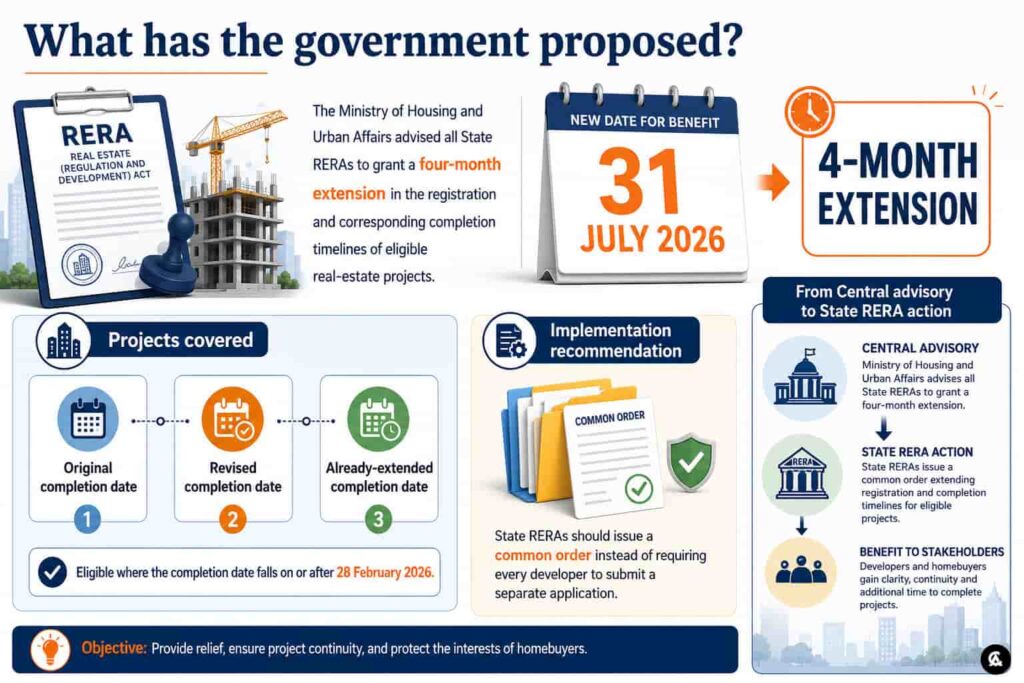
On 31 July 2026, the Ministry of Housing and Urban Affairs advised all State RERAs to grant a four-month extension in the registration and corresponding completion timelines of eligible real-estate projects.
The advisory broadly covers projects whose:
- original completion date;
- revised completion date; or
- already-extended completion date
falls on or after 28 February 2026.
The ministry has also recommended that State RERAs issue a common order instead of requiring every developer to submit an individual application.
The objective appears to be faster and more uniform implementation across eligible projects.
Why has the four-month extension been proposed?
The government has linked the proposed relief to continuing instability in West Asia and its impact on international supply chains.
According to the advisory, the disruption has affected the availability and timely delivery of certain construction materials, components and specialised equipment.
Where a project depends on imported or internationally sourced materials, delays in transportation, manufacturing or delivery can affect the entire construction schedule.
Developer organisations such as CREDAI and NAREDCO have supported the move. They have argued that shortages, higher input costs and logistics-related disruptions have affected the progress of some ongoing projects.
However, support from developer bodies does not by itself establish that every project has been affected.
Each project must still be examined according to the order issued by the concerned State RERA.
What is the connection with the Finance Ministry memorandum?
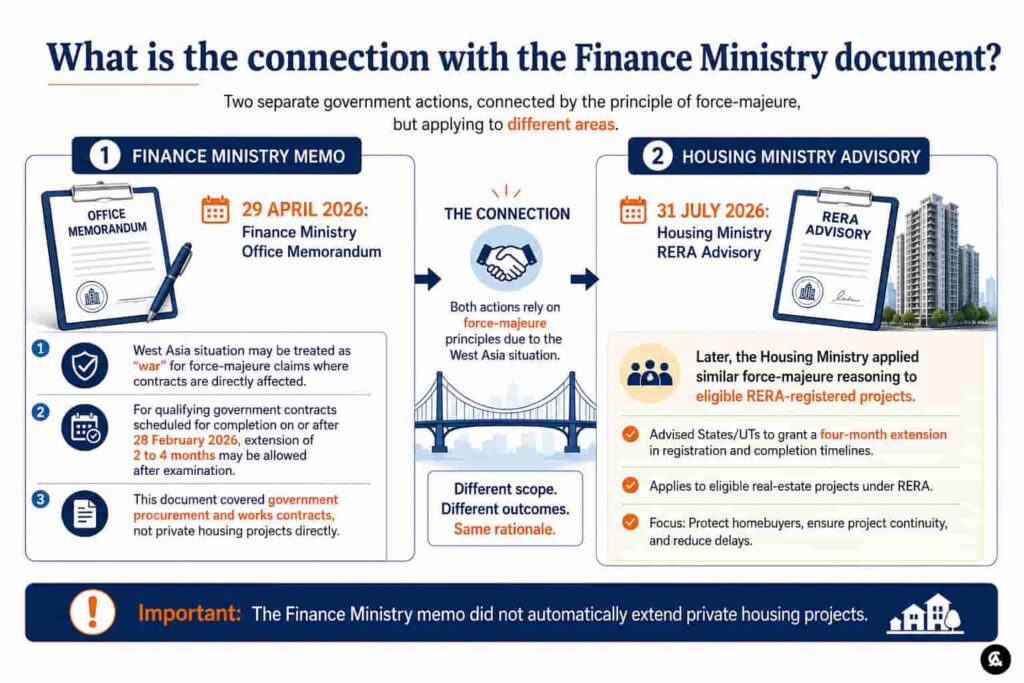
The Ministry of Finance issued an Office Memorandum dated 29 April 2026 dealing with force majeure in government procurement and works contracts.
The memorandum stated that the prevailing West Asia situation may be treated as “war” while considering force-majeure claims where contractual obligations have been directly affected.
For qualifying government contracts scheduled for completion on or after 28 February 2026, the memorandum permits an extension ranging from two to four months after examination of the circumstances.
However, this distinction is important:
The Finance Ministry memorandum related to goods, services, consultancy and construction contracts involving government agencies.
It did not directly extend the timelines of private housing projects.
The Ministry of Housing and Urban Affairs later applied similar force-majeure reasoning to eligible real-estate projects registered under RERA.
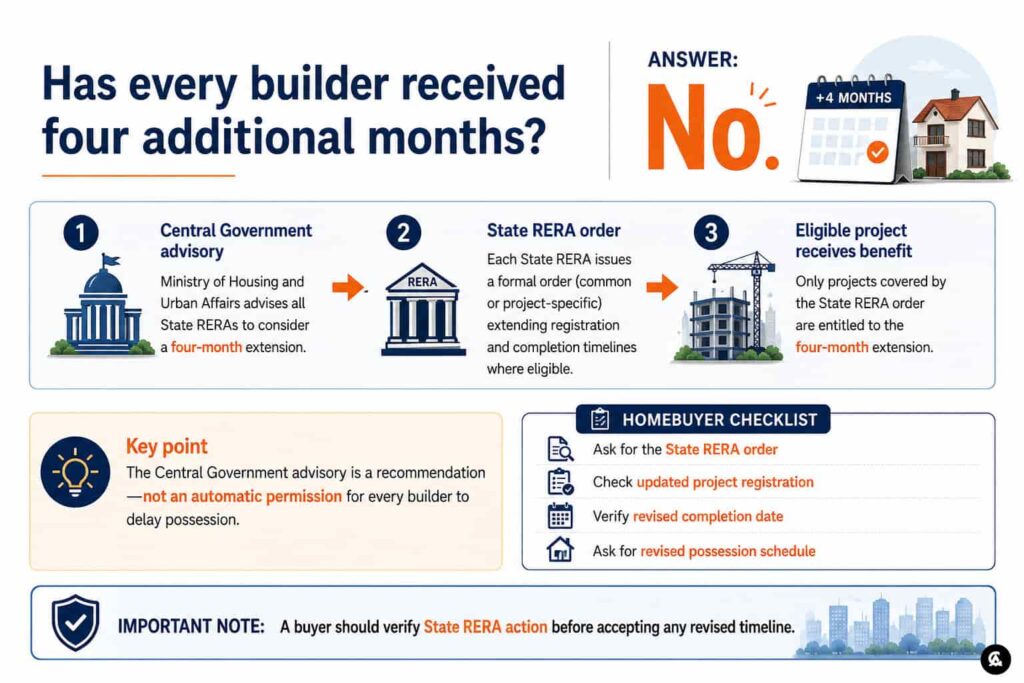
Has every builder received four additional months?
No.
This is the most important clarification for homebuyers.
The Central Government has issued an advisory to State RERA authorities. The advisory alone should not be treated by a builder as automatic permission to postpone possession.
The process can be understood in three stages:
- The Central Government issues an advisory.
- The concerned State RERA issues, adopts or publishes an order.
- Eligible projects receive the benefit according to that State RERA order.
Therefore, a builder merely referring to the Central Government advisory is not sufficient.
The buyer should ask for:
- the applicable State RERA order;
- the revised registration certificate;
- the updated project-completion date;
- and the revised possession schedule.
Which projects may qualify for the extension?
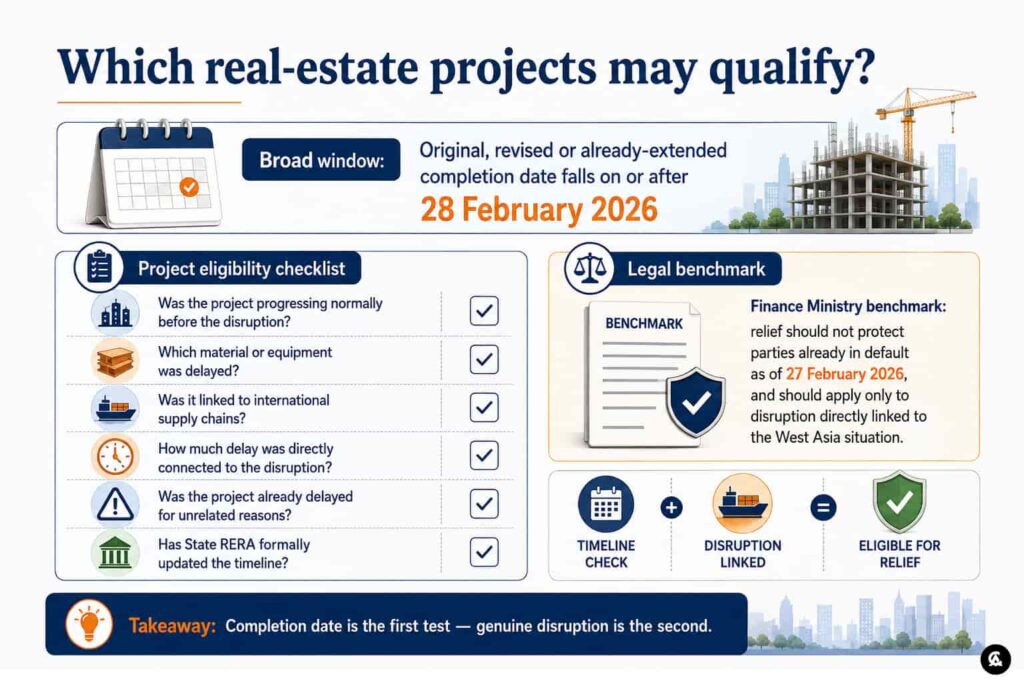
The first test is the project’s registered completion date.
A project may fall within the broad eligibility window where its original, revised or already-extended completion date is on or after 28 February 2026.
However, the completion date should not be the only test.
State RERA authorities should also examine whether the project was genuinely affected by the West Asia crisis.
Important questions may include:
- Was the project progressing normally before the disruption?
- Which construction material, equipment or component was delayed?
- Was the affected item dependent on an international supply chain?
- When was the purchase order placed?
- What was the expected delivery date?
- How much delay was directly caused by the disruption?
- Was the project already delayed for financial, approval-related or operational reasons?
- Has the State RERA formally updated the completion timeline?
The Finance Ministry memorandum also provides an important benchmark.
It states that force-majeure protection should not benefit parties that were already in default as of 27 February 2026.
It further indicates that relief should apply only to non-performance directly attributable to the identified disruption.
Although those safeguards were drafted for government contracts, State RERAs may consider similar principles while dealing with housing projects.
What does force majeure mean under RERA?
Force majeure refers to an extraordinary event beyond the reasonable control of the concerned parties which affects their ability to perform contractual obligations.
Section 6 of the Real Estate (Regulation and Development) Act, 2016 permits a RERA authority to extend the registration of a project due to force majeure.
The explanation under the Act includes events such as:
- war;
- flood;
- drought;
- fire;
- cyclone;
- earthquake;
- and certain other calamities caused by nature.
The law also allows the authority to grant an extension in reasonable circumstances where the promoter is not responsible for the delay, subject to examination of the facts and reasons being recorded in writing.
This means RERA already contains a legal mechanism for extending project registration in exceptional situations.
The present advisory seeks to use that mechanism for projects affected by disruptions connected with the West Asia conflict.
Can possession be delayed by four months?
Possibly, but not automatically in every project.
The advisory deals primarily with the project’s RERA registration and corresponding completion timeline.
Where a State RERA grants the extension, the developer may revise the construction schedule and expected delivery timeline.
However, the RERA completion date and the possession date mentioned in the agreement for sale may not always be identical.
The impact on an individual buyer may depend on:
- the wording of the State RERA order;
- the project’s revised registration details;
- the possession date in the agreement for sale;
- the force-majeure clause in the agreement;
- the project’s actual construction status;
- and the genuine reason for delay.
Therefore, a regulatory extension should not automatically be treated as permission to rewrite every contractual obligation.
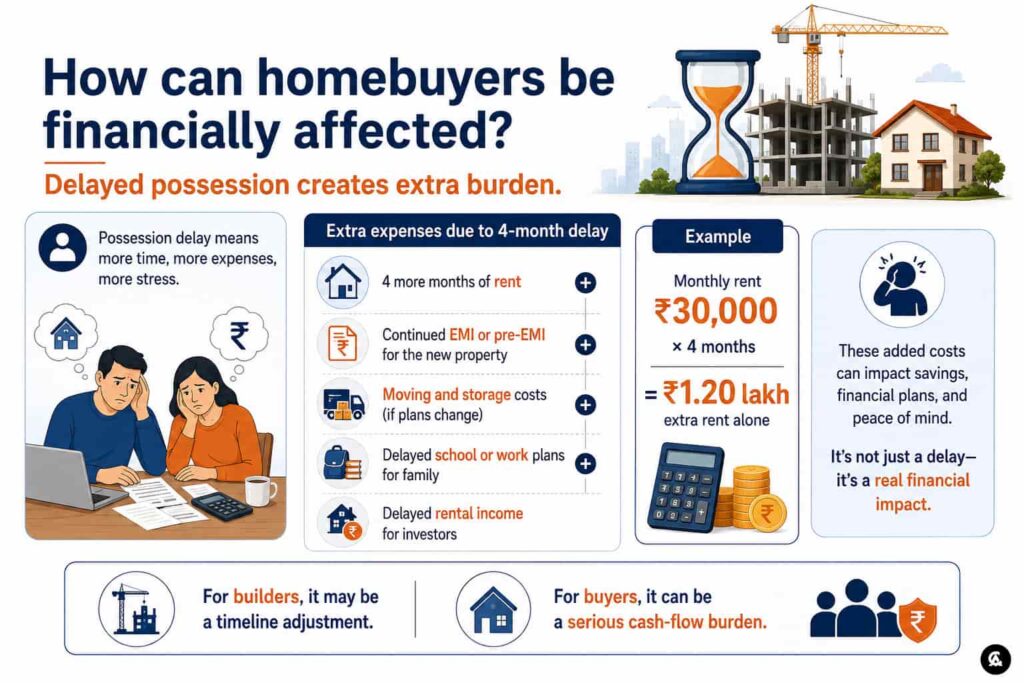
How can homebuyers be financially affected?
For a developer, four months may look like a regulatory adjustment.
For a family waiting to shift into its new home, it may create a serious additional burden.
A four-month delay can result in:
- four additional months of rent;
- continued home-loan EMI or pre-EMI;
- higher interest outgo;
- postponed shifting arrangements;
- delayed school admissions or employment relocation;
- extended storage expenses;
- temporary accommodation costs;
- and delayed rental income for investors.
For example, consider a homebuyer paying monthly rent of ₹30,000 while also paying a home-loan EMI.
An additional four-month delay would create an extra rent burden of:
₹30,000 × 4 months = ₹1.20 lakh
This amount excludes loan interest, moving expenses, storage costs and other incidental losses.
Do homebuyers lose their refund and compensation rights?
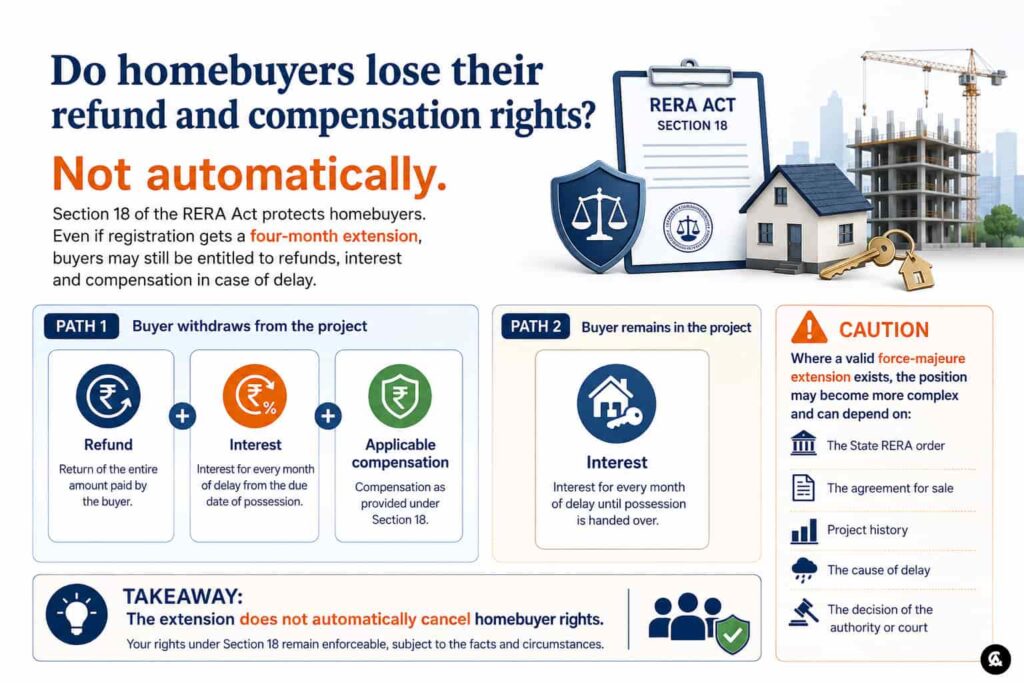
Not automatically.
Section 18 of the RERA Act provides remedies where a promoter fails to complete a project or is unable to provide possession according to the terms and date specified in the agreement for sale.
Where a homebuyer wishes to withdraw from the project, Section 18 allows the buyer to seek:
- refund of the amount paid;
- prescribed interest;
- and applicable compensation.
Where the buyer decides to remain in the project, the provision allows interest for every month of delay until possession is handed over.
However, matters may become more complicated where a project receives a valid force-majeure extension.
Whether interest or compensation remains payable for the extended four-month period may depend on:
- the exact wording of the State RERA order;
- the buyer-builder agreement;
- the project’s earlier construction record;
- the actual reason for delay;
- and the decision of the concerned RERA authority, tribunal or court.
Therefore, it would be incorrect to claim that the advisory has completely removed homebuyer rights.
Why are homebuyers concerned?
The main concern is not that genuinely affected projects may receive limited relief.
The concern is that builders whose projects were already delayed for unrelated reasons may also attempt to use the advisory.
Homebuyer representatives have questioned why developers may receive collective regulatory relief while individual buyers often need to file separate complaints for refund, interest or compensation.
Their major concerns include:
- blanket extensions without project-specific evidence;
- benefit being given to projects already in default;
- further delay in possession;
- continued rent and EMI pressure;
- uncertainty regarding compensation;
- inadequate disclosure of the claimed supply-chain impact;
- and misuse of force majeure as a general excuse.
The credibility of the extension will therefore depend on how carefully State RERAs identify eligible projects.
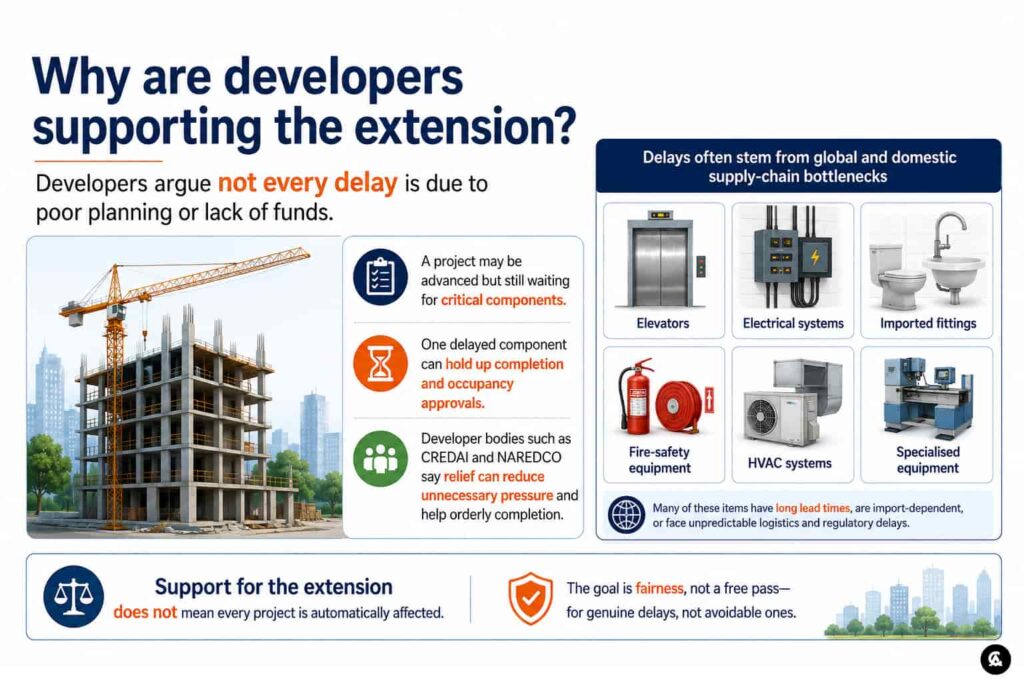
Why are developers supporting the extension?
Developers argue that every delay is not caused by poor planning, shortage of funds or negligence.
A project may be close to completion but still depend on essential components such as:
- elevators;
- electrical systems;
- fire-safety equipment;
- imported fittings;
- specialised machinery;
- façade components;
- HVAC systems;
- or other technical installations.
A delay in one critical component may prevent the developer from completing the project or obtaining completion and occupancy approvals.
CREDAI and NAREDCO have argued that temporary relief can reduce unnecessary regulatory pressure and help eligible projects complete construction in an orderly manner.
They have also sought quick and consistent implementation by State RERAs.
Is a common extension order fair?
The Housing Ministry has recommended that State RERAs issue a common order instead of requiring every developer to submit a separate application.
The purpose is to reduce procedural delay and ensure uniformity.
However, Section 6 of the RERA Act refers to an application by the promoter and examination of the circumstances surrounding the project.
This creates an important legal and regulatory question:
Can a common order provide relief without allowing ineligible or already-delayed projects to receive an unfair benefit?
A balanced State RERA order should ideally clarify:
- which categories of projects are covered;
- the applicable cut-off date;
- the treatment of projects previously in default;
- the evidence developers must maintain;
- the disclosure required on the RERA portal;
- the revised registration and completion dates;
- the impact on possession commitments;
- and the treatment of homebuyer interest and compensation claims.
A common order may reduce paperwork, but project-level accountability should still remain.
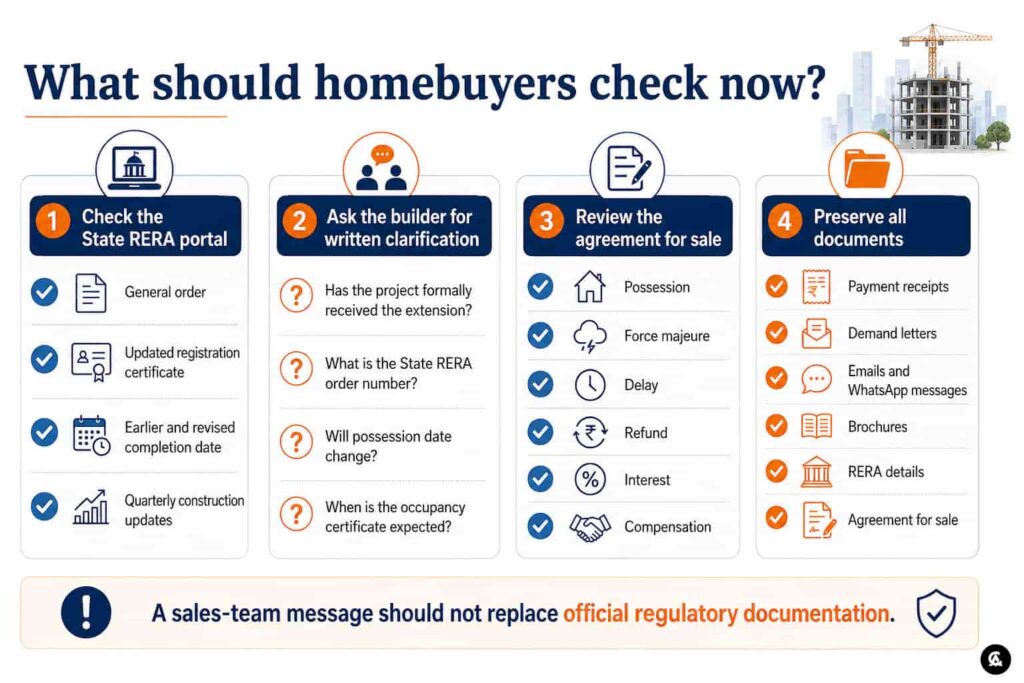
What should homebuyers check now?
Homebuyers do not need to panic merely because the Central Government has issued an advisory.
The first step is to verify whether the specific project has actually received the extension.
Check the State RERA portal
Search for:
- a general order implementing the extension;
- an updated project-registration certificate;
- the earlier completion date;
- the revised completion date;
- quarterly construction-progress reports;
- photographs uploaded by the promoter;
- revised disclosures;
- and notices issued by the developer.
Ask the builder for written clarification
Homebuyers should ask:
- Has the project formally received the extension?
- What is the State RERA order number?
- What was the earlier completion date?
- What is the revised completion date?
- Which material or equipment was delayed?
- When was it ordered?
- What was the construction status before the disruption?
- Will the possession date change?
- Will the payment schedule also change?
- What is the builder’s position on delay interest?
- When is the occupancy certificate expected?
- Will buyers receive a revised possession letter?
Review the agreement for sale
Pay special attention to clauses dealing with:
- possession;
- force majeure;
- grace period;
- construction delay;
- cancellation;
- refund;
- interest;
- compensation;
- and dispute resolution.
Preserve all documents
Keep copies of:
- payment receipts;
- allotment letters;
- builder demand notices;
- emails;
- WhatsApp communication;
- brochures;
- advertisements;
- construction updates;
- RERA project details;
- the agreement for sale;
- and any revised possession communication.
Can a builder extend possession through email or WhatsApp?
A builder may communicate a proposed revised timeline through email, WhatsApp or another message.
However, such communication alone does not prove that the project has received a valid RERA extension.
The buyer should request:
- the applicable State RERA order;
- the updated project-registration certificate;
- the revised completion date;
- the revised construction schedule;
- and a written explanation of how the extension affects the agreement for sale.
A message sent by a sales representative or customer-care executive should not replace official regulatory documentation.
What if the project was already delayed before February 2026?
This may become one of the most disputed issues.
A project that was already delayed because of:
- financial problems;
- approval-related issues;
- contractor disputes;
- slow construction;
- diversion of funds;
- poor project management;
- or earlier non-compliance
should not automatically receive the same treatment as a project that was progressing normally but was later affected by a new international disruption.
The Finance Ministry memorandum specifically states that parties should not have been in default as of 27 February 2026.
It also indicates that protection should apply only to non-performance directly linked with the West Asia disruption.
State RERA authorities may need to adopt similar safeguards to prevent the extension from becoming a blanket protection for old delays.
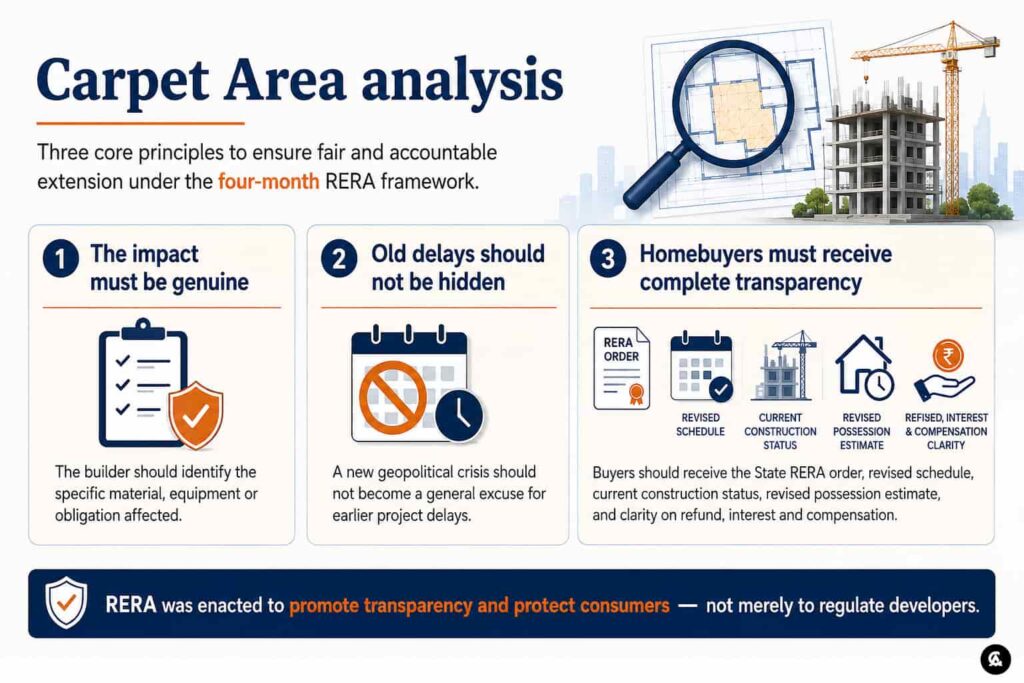
Carpet Area analysis
A limited extension may be justified where a promoter proves that an extraordinary international event directly disrupted project execution.
However, the relief should satisfy three basic conditions.
1. The impact must be genuine
The developer should identify the exact material, equipment, system or obligation affected by the disruption.
A general statement about international conditions should not be enough.
2. Previous delays must not be hidden
A new geopolitical crisis should not be used to cover financial problems, approval delays or poor construction progress that existed much earlier.
3. Buyers must receive complete transparency
Where a builder receives additional time, homebuyers should receive:
- the official State RERA order;
- the project’s revised registration details;
- the current construction status;
- the revised completion schedule;
- the expected possession date;
- the status of approvals;
- and clarity regarding refund, interest and compensation.
RERA was enacted not only to regulate developers but also to improve transparency and protect consumers in the real-estate sector.
Final conclusion
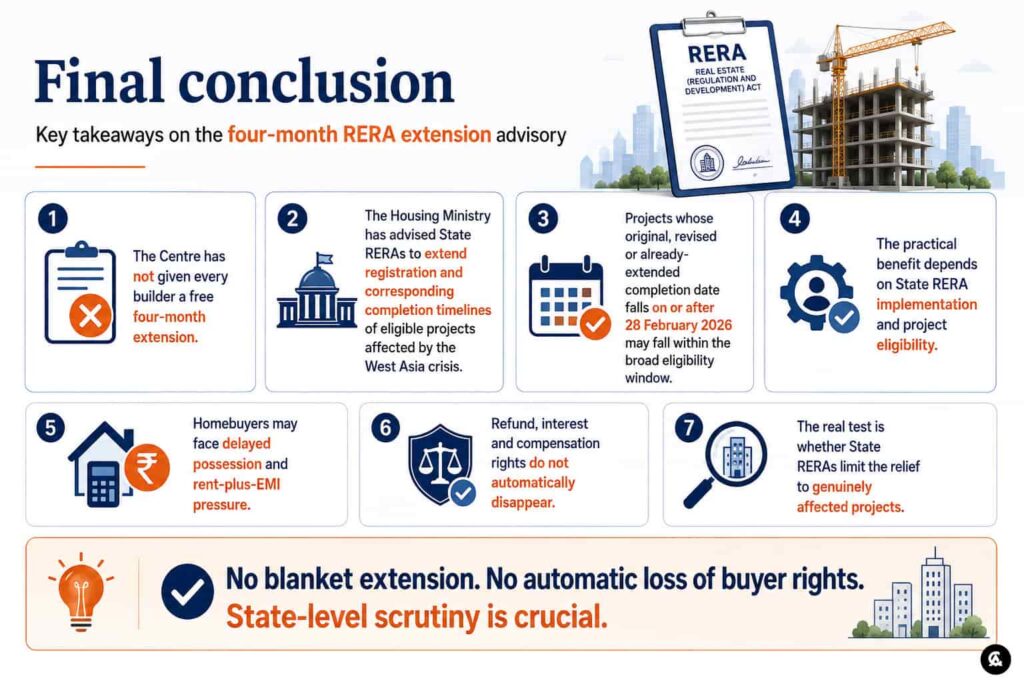
The Central Government has not given every builder in India a free four-month extension.
The Ministry of Housing and Urban Affairs has advised State RERAs to extend the registration and corresponding completion timelines of eligible projects affected by the West Asia crisis.
Projects whose original, revised or already-extended completion date falls on or after 28 February 2026 may come within the broad eligibility window.
However, the practical benefit to any particular project will depend on:
- implementation by the concerned State RERA;
- the project’s completion date;
- the project’s earlier construction record;
- and evidence that the disruption genuinely affected execution.
For homebuyers, the extension may result in delayed possession and additional rent-and-EMI pressure.
At the same time, refund, interest and compensation rights do not automatically disappear merely because a Central Government advisory has been issued.
The real test will be whether State RERAs restrict the relief to genuinely affected projects or allow previously delayed projects to receive additional time without proper scrutiny.
Frequently asked questions
Has every builder received a four-month RERA extension?
No. The Central Government has issued an advisory to State RERAs. Buyers should verify the applicable State RERA order and the updated registration details of their project.
Which projects may receive the extension?
Registered projects whose original, revised or already-extended completion date falls on or after 28 February 2026 may be covered, subject to State RERA implementation and eligibility conditions.
Will possession automatically be delayed by four months?
Not necessarily. The advisory relates to project-registration and completion timelines. Its impact on possession will depend on the State RERA order, project schedule and agreement for sale.
Can buyers still demand delay interest?
Section 18 of the RERA Act provides for interest for every month of delay where the buyer remains in the project. Its application during a valid force-majeure extension may depend on the order, agreement and facts of the project.
Can a builder simply blame the West Asia crisis?
A genuine force-majeure claim should establish a direct connection between the disruption and the project delay. A broad statement without supporting evidence should not be treated as sufficient.
Can a builder revise possession only through WhatsApp or email?
A message may communicate the proposed timeline, but it does not replace the State RERA order, revised registration details or official documentation.
What should a homebuyer do first?
Check the project page on the concerned State RERA portal and ask the builder for the official order, updated registration certificate and revised construction schedule.
What if the project was already delayed earlier?
State RERA should examine whether the project was already in default before the qualifying date. Earlier delays should not automatically receive protection under a new force-majeure claim.
Do refund and compensation rights disappear?
No. These rights do not automatically disappear. Their application may depend on the agreement, State RERA order, actual cause of delay and the decision of the competent authority.
Sources:-
- Ministry of Finance—Force Majeure Office Memorandum, 29 April 2026 (official PDF)
This is the government document that treats the prevailing West Asia situation as “war” for examining eligible force-majeure claims in government contracts.
PDF: https://doe.gov.in/files/whats_new_documents/OM132026_29042026.pdf - Department of Expenditure—official document page
Government webpage hosting the above Force Majeure Clause memorandum.
Link: https://doe.gov.in/force-majeure-clause-fmc-3 - DD India—Government advises State RERAs to grant four-month extension
This report reproduces the key terms of the Housing Ministry advisory: 31 July 2026 date, four-month extension, 28 February 2026 eligibility cut-off and recommendation for a common State RERA order.
Link: https://ddindia.co.in/2026/07/govt-advises-state-reras-to-grant-4-month-extension-for-real-estate-projects-hit-by-west-asia-crisis/ - Economic Times—Housing Ministry advisory and industry response
Covers the proposed extension, eligible project dates, common-order recommendation and statements from CREDAI and NAREDCO.
Link: https://economictimes.indiatimes.com/industry/services/property-/-cstruction/housing-ministry-issues-advisory-to-state-reras-to-give-project-extension-due-to-west-asia-crisis/articleshow/132764685.cms - Hindustan Times—Detailed report on eligibility and implementation
Explains that the advisory applies to registered projects whose original, revised or extended completion date falls on or after 28 February 2026.
Link: https://www.hindustantimes.com/real-estate/west-asia-crisis-centre-advises-state-reras-to-extend-project-deadlines-by-4-months-credai-naredco-welcome-move-101785495714744.html - Moneycontrol—Impact on homebuyers and developers
Useful for explaining possible possession delays, the need to check revised timelines and why buyers should continue monitoring their State RERA portal.
Link: https://www.moneycontrol.com/news/business/personal-finance/what-rera-s-4-month-extension-for-real-estate-projects-means-for-homebuyers-and-developers-13992019.html - Times of India—Homebuyer implications
Discusses the extension from the buyer’s perspective, including possible possession delays and force-majeure implications.
Link: https://timesofindia.indiatimes.com/real-estate/news/centres-rera-extension-amid-middle-east-conflict-what-it-means-for-homebuyers/articleshow/132785121.cms - Times of India—CREDAI and NAREDCO reaction
Covers why developer organisations welcomed the proposal and sought its quick implementation.
Link: https://timesofindia.indiatimes.com/real-estate/news/realtors-hail-centres-4-month-project-deadline-relief-amid-middle-east-supply-disruptions/articleshow/132795069.cms




Leave a Reply