


Bengaluru is known for high-paying technology jobs, global companies and rapidly growing residential neighbourhoods.
Yet a new question is troubling many salaried professionals:
If incomes are rising, why does buying a home still feel increasingly difficult?
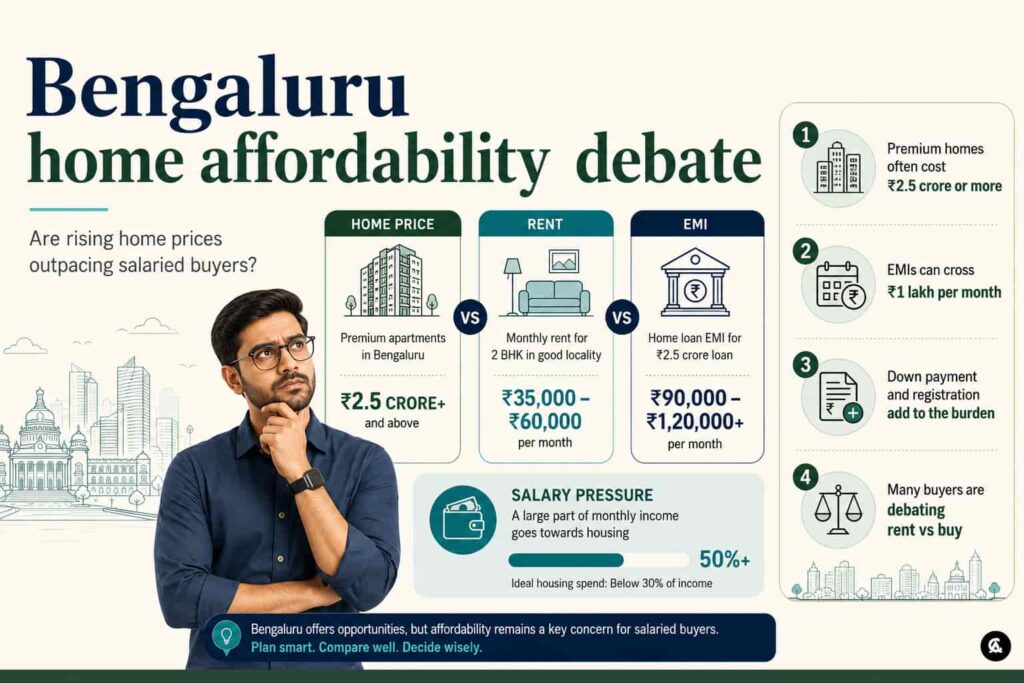
Recent social-media discussions have highlighted apartments priced between approximately ₹2.5 crore and ₹6 crore in premium Bengaluru locations. Buyers have also shared examples where monthly home-loan EMIs may range from ₹80,000 to more than ₹1 lakh.
These examples have triggered a wider debate about housing affordability, job security, long-term debt and whether renting may sometimes be financially safer than buying.
However, the viral numbers should not be treated as the average price of every home in Bengaluru. They mainly reflect premium projects, high-demand locations and individual buyer situations.
The real issue is the growing gap between household income and the complete cost of owning a home.
Why has Bengaluru housing affordability become a viral topic?
The discussion became popular because Bengaluru is generally associated with strong salaries, especially in technology, finance and startup-related jobs.
If well-paid professionals are also finding it difficult to buy homes, the problem appears much larger than an ordinary luxury-property discussion.
Many potential buyers are asking:
- Who is purchasing homes priced above ₹2 crore?
- Are salaries really high enough to support these EMIs?
- Are buyers depending on family wealth or the sale of an older property?
- Are couples using two incomes to qualify for large loans?
- Is it financially sensible to take a 20- or 25-year loan?
- What happens if one income stops because of layoffs or career changes?
The topic is relatable because a house may appear affordable based on the EMI alone, while the total purchase cost can be substantially higher.
A ₹2.5 crore home costs more than ₹2.5 crore
The advertised price of a property is not necessarily the final amount paid by the buyer.
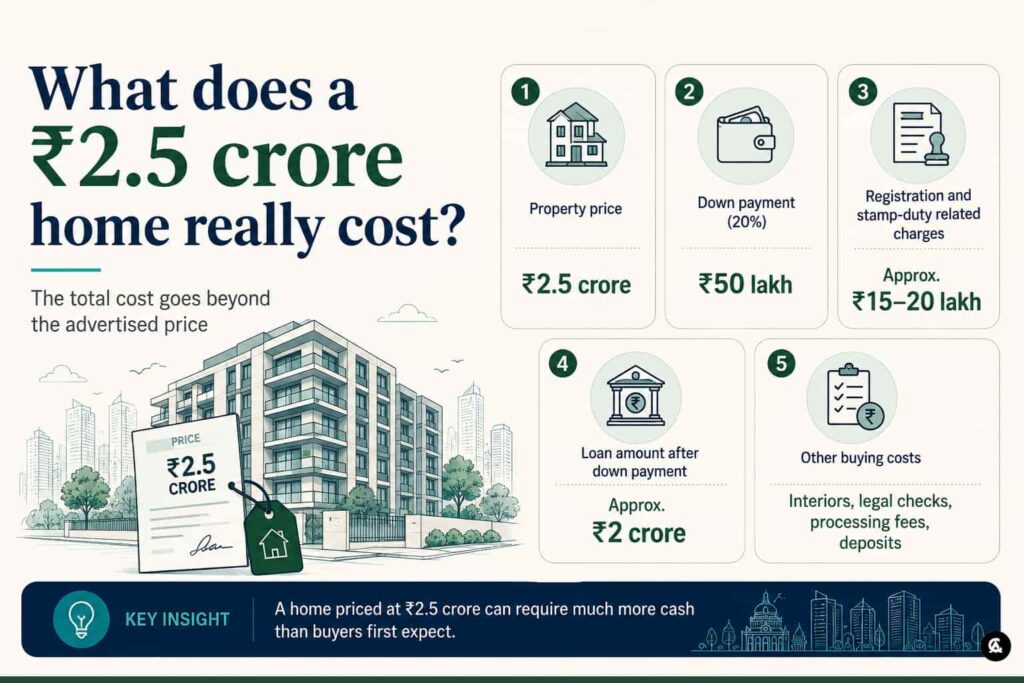
Apart from the basic property price, a buyer may need to account for:
- down payment;
- stamp duty;
- registration charges;
- GST where applicable;
- parking charges;
- clubhouse or amenity charges;
- maintenance deposit;
- legal verification;
- loan-processing charges;
- interiors and furnishing;
- and moving expenses.
For example, a buyer considering a ₹2.5 crore home may need a substantial amount from personal savings even before the bank releases the loan.
This is why affordability should never be judged only by asking whether the monthly EMI can be paid.
What could the EMI look like?
Consider a simplified illustration.
Suppose a property costs ₹2.5 crore and the buyer arranges a 20% down payment.
- Property price: ₹2.5 crore
- Approximate down payment: ₹50 lakh
- Approximate loan requirement: ₹2 crore
Depending on the interest rate and loan tenure, the monthly EMI on a ₹2 crore loan can be extremely high.
The exact EMI will vary according to:
- the lender;
- interest rate;
- credit profile;
- loan tenure;
- and whether the loan carries a floating or fixed rate.
A longer tenure can reduce the monthly EMI, but it can significantly increase the total interest paid over the life of the loan.
This is the part many buyers underestimate.
A home may cost ₹2.5 crore today, but the total amount paid through down payment, interest and associated expenses can be much higher.
How much salary is needed to buy safely?
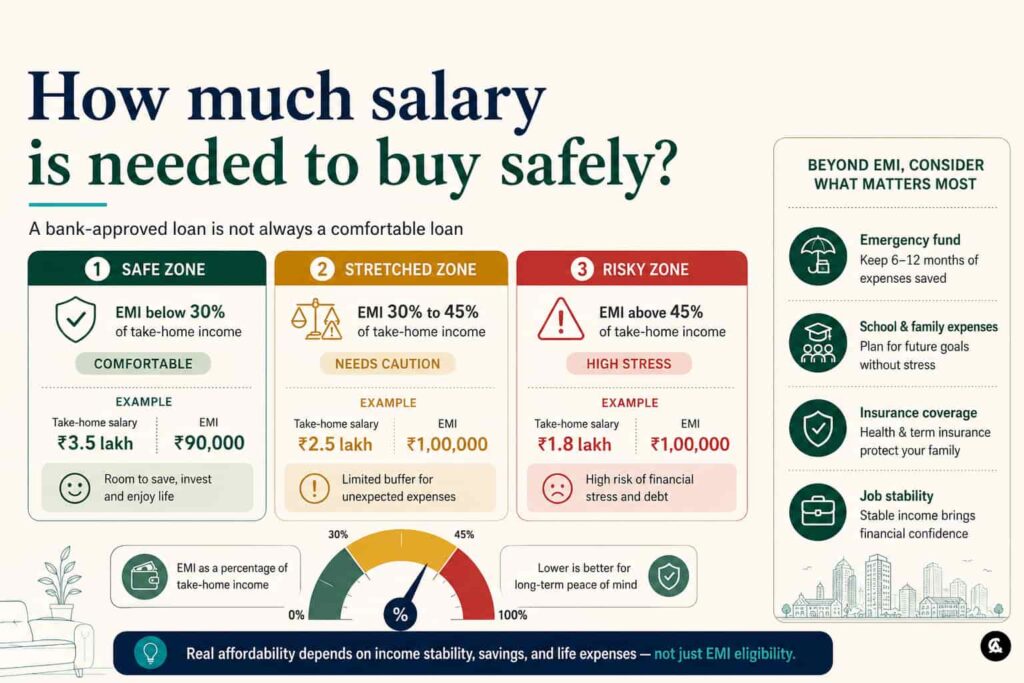
The bank’s willingness to approve a loan does not automatically mean the loan is financially comfortable for the borrower.
A buyer should examine how much of the monthly take-home income will go towards the EMI.
For example, if a family takes home ₹2.5 lakh per month and pays an EMI of ₹1 lakh, around 40% of its monthly income is already committed to the home loan.
The remaining income must cover:
- food and household expenses;
- school and childcare costs;
- healthcare;
- transport;
- insurance;
- existing loans;
- family responsibilities;
- savings;
- and emergencies.
A financially safe purchase generally requires more than just a large salary. It also requires:
- stable employment;
- limited existing debt;
- sufficient emergency savings;
- adequate insurance;
- and a realistic long-term household budget.
A buyer should also calculate affordability using take-home income, not only annual cost-to-company or headline salary.
₹44,000 rent versus ₹65,000 EMI: which is better?
This is one of the most common comparisons in the current debate.
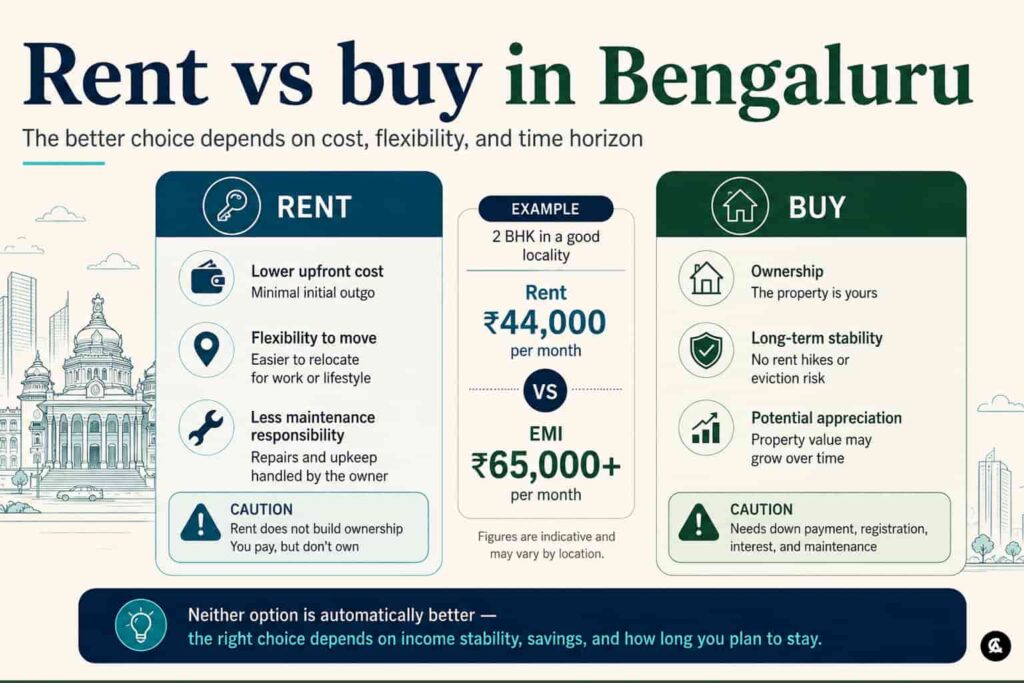
At first glance, an EMI of ₹65,000 may appear more attractive than paying ₹44,000 as rent because the EMI helps create ownership in an asset.
However, the comparison is incomplete unless the buyer also considers:
- the down payment used to purchase the home;
- registration and transaction costs;
- maintenance charges;
- property tax;
- loan interest;
- repairs and interiors;
- flexibility to change location;
- and the return that the down-payment money could have earned elsewhere.
Renting provides flexibility and usually requires less upfront capital.
Buying offers stability, ownership and possible long-term appreciation.
Neither option is automatically better for everyone.
The correct decision depends on how long the buyer plans to remain in the city, income stability, family needs and the specific property being considered.
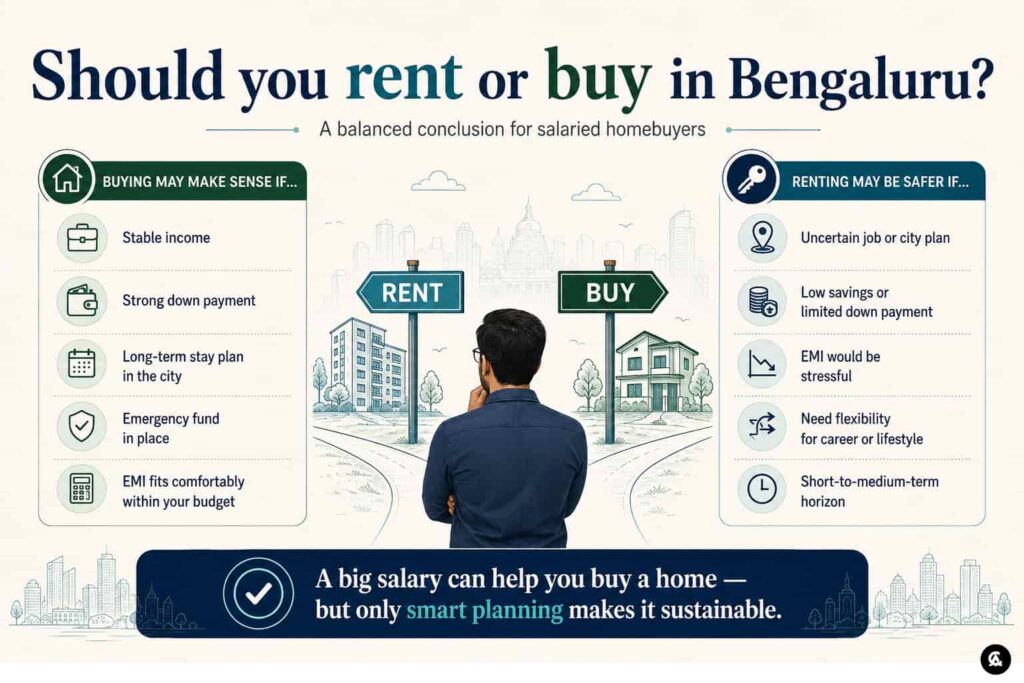
When buying may make sense
Buying may be suitable where the buyer:
- plans to live in the same location for many years;
- has a stable household income;
- can arrange the down payment without exhausting all savings;
- has an emergency fund after completing the purchase;
- is comfortable with the EMI even if interest rates rise;
- and has completed legal and technical verification of the property.
Buying may also make sense for families seeking long-term stability, school continuity and freedom to modify their home.
When renting may be the safer option?
Renting may be more suitable where the person:
- may change jobs or cities;
- is uncertain about long-term location plans;
- does not have sufficient down-payment savings;
- would need to spend most of the monthly income on EMI;
- has an unstable or highly variable income;
- or is considering a property mainly because of social pressure.
Renting should not automatically be treated as wasted money.
It is a payment for flexibility, location access and freedom from large long-term debt.
Why have prices increased in Bengaluru?
Bengaluru’s housing market is influenced by several factors.
Strong employment demand
Technology parks, global capability centres, startups and corporate offices continue to attract professionals from across India.
Limited supply in preferred areas
Demand remains concentrated in locations with better offices, schools, hospitals, roads and social infrastructure.
Rising land and construction costs
Land prices, labour, construction materials and compliance-related costs can increase project pricing.
Premium project launches
A growing share of new developments may target affluent buyers, dual-income households, senior executives, NRIs and investors.
Infrastructure expectations
Metro expansion, road projects and new business corridors can increase buyer interest and land values even before infrastructure is fully operational.
Investor and NRI participation
Some projects attract buyers who are not dependent only on salary income. This can make the market appear unaffordable when compared only with the earnings of an average salaried professional.
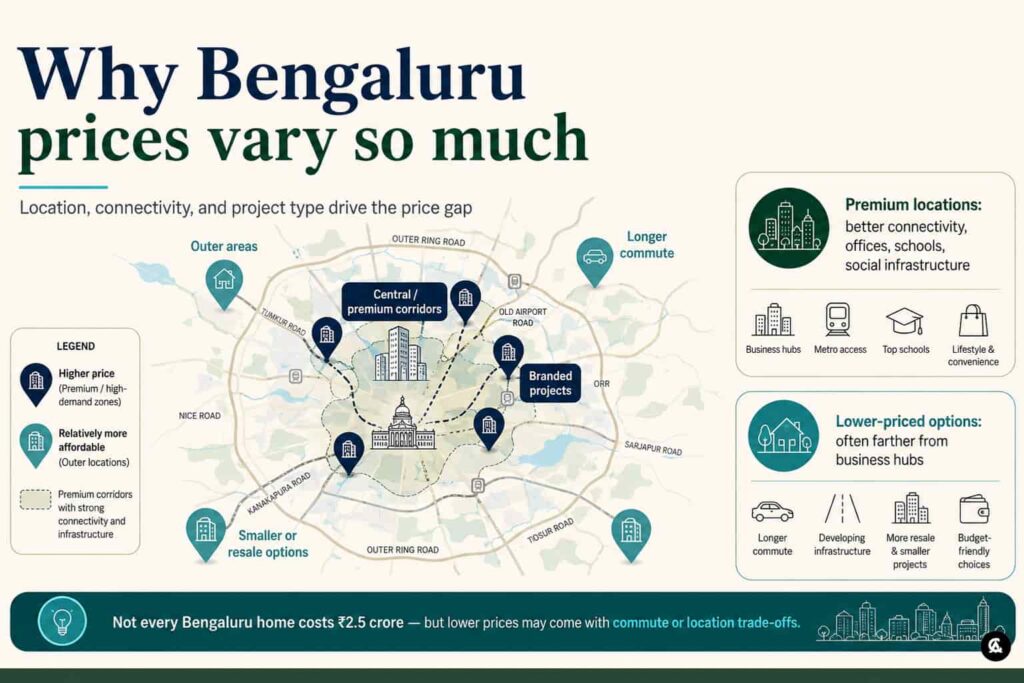
Does every Bengaluru home cost ₹2.5 crore or more?
No.
This is an important fact-check.
Bengaluru is a large and diverse property market. Prices vary according to:
- location;
- builder;
- project stage;
- apartment size;
- land value;
- infrastructure;
- and distance from employment hubs.
The viral range of ₹2.5 crore to ₹6 crore mainly reflects premium developments and high-demand locations.
More affordable homes may still be available in outer locations, resale markets and smaller projects.
However, buyers may have to compromise on:
- commute time;
- apartment size;
- project amenities;
- builder brand;
- or proximity to major business districts.
Therefore, the real affordability problem is not that every home is extremely expensive. It is that reasonably priced homes in desirable and well-connected locations are becoming harder to find.
The risks buyers often ignore
A high salary can create confidence, but a long-term home loan carries several risks.
Job loss or income disruption
Technology-sector salaries may be strong, but employment conditions can change. A large EMI becomes difficult if one household income stops.
Floating interest-rate risk
If lending rates rise, the EMI may increase or the loan tenure may become longer.
Delayed possession
An under-construction project may require the buyer to pay rent and EMI or pre-EMI together.
Maintenance expenses
Premium projects may carry high monthly maintenance charges after possession.
Poor resale liquidity
An expensive home may not always be easy to sell quickly at the expected price.
Location risk
A cheaper apartment far from work may result in high commuting expenses and a reduced quality of life.
Concentration of wealth
Putting most household savings into one property can leave the family with limited liquidity for emergencies or other investments.
How should buyers calculate real affordability?
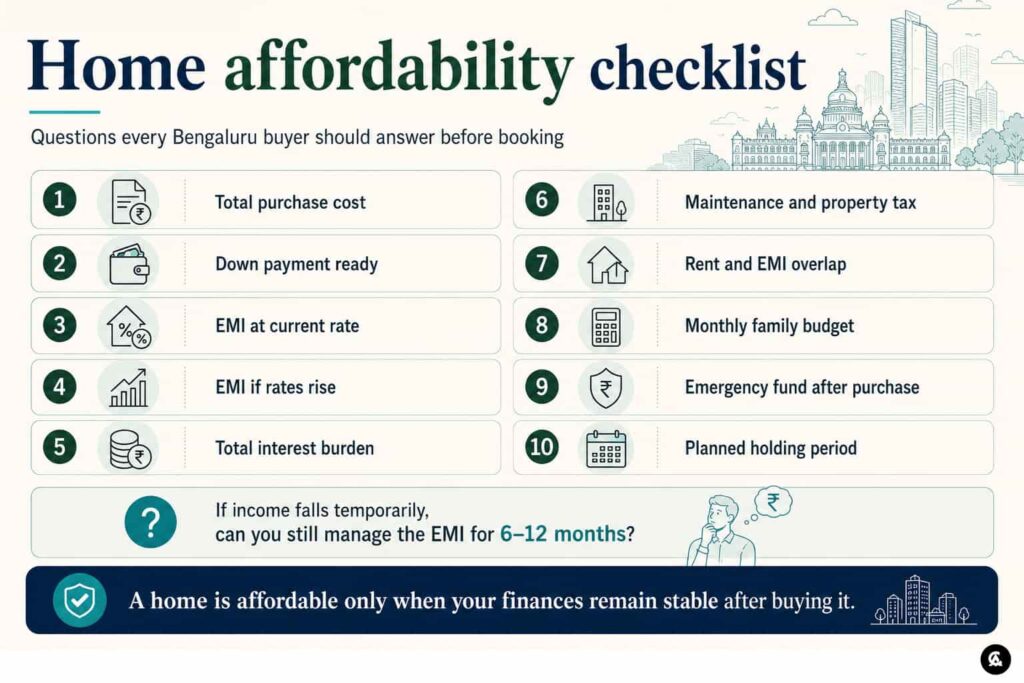
Before purchasing, calculate the following:
- Total purchase cost, not only the advertised price.
- Down payment without using emergency savings.
- EMI under the current interest rate.
- EMI if the interest rate increases.
- Total interest over the complete tenure.
- Monthly maintenance and property tax.
- Rent and EMI overlap during construction.
- Household expenses after paying the EMI.
- Emergency fund available after purchase.
- Expected period of ownership.
The buyer should also ask one difficult but important question:
Could I continue paying this EMI for at least six to twelve months if my income temporarily falls?
If the answer is no, the purchase may be too financially aggressive.
What should buyers verify before booking?
A high-value property decision requires financial, legal and technical checks.
Buyers should verify:
- project registration on Karnataka RERA;
- sanctioned plans;
- title documents;
- approvals;
- builder’s delivery history;
- construction progress;
- possession timeline;
- cancellation and refund clauses;
- maintenance estimates;
- water and power arrangements;
- traffic and commute conditions;
- and resale demand in the location.
For ready-to-move properties, buyers should also check:
- Occupancy Certificate;
- Completion Certificate where applicable;
- fire and lift approvals;
- structural condition;
- pending maintenance dues;
- and society or association records.
Independent legal verification and technical inspection can reduce the risk of an expensive mistake.
Can property appreciation justify a large EMI?
Property appreciation should not be assumed.
A home’s future value depends on:
- location development;
- infrastructure completion;
- supply of competing projects;
- employment growth;
- project quality;
- maintenance;
- and overall economic conditions.
A buyer should not take an uncomfortable loan only because someone claims that prices will double.
The first objective of a self-use home should be financial stability and suitability for the family.
Future appreciation should be treated as a possibility, not a guarantee.
Carpet Area analysis
The Bengaluru affordability debate is not simply about expensive apartments.
It reflects a deeper shift in the housing market.
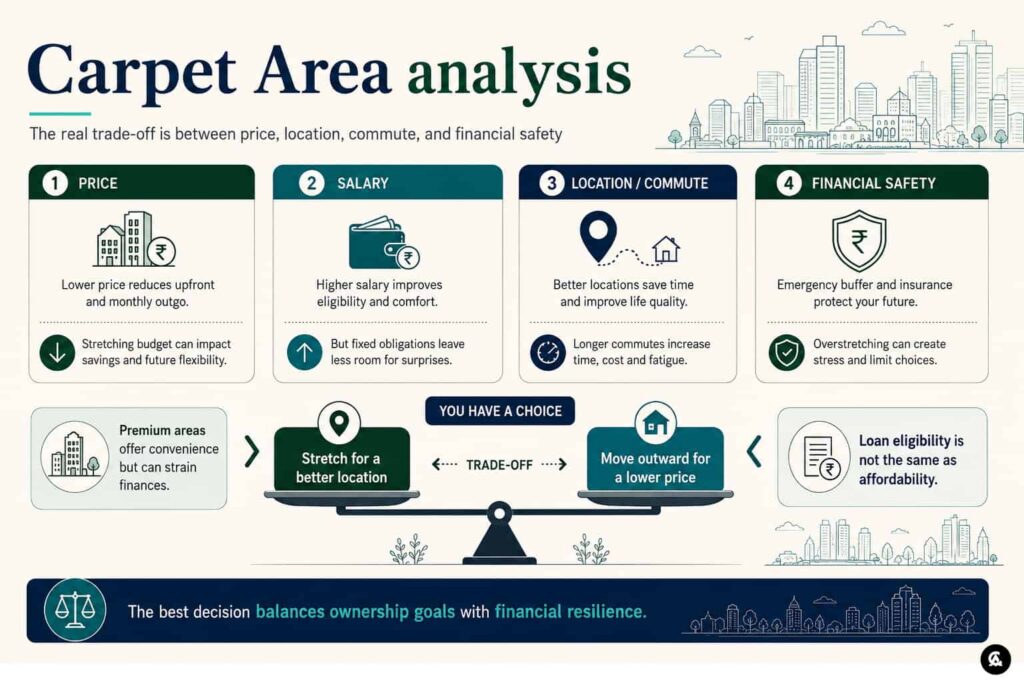
Many salaried buyers can technically qualify for a large home loan, but qualification is not the same as affordability.
The real affordability test should include:
- total ownership cost;
- income stability;
- long-term interest;
- opportunity cost of the down payment;
- location suitability;
- and financial resilience after purchase.
Bengaluru still offers housing across multiple price segments. However, affordable homes in preferred, well-connected locations are becoming limited.
This creates a difficult choice:
Buyers can either stretch their finances for location and convenience, or move farther away to find a lower-priced property.
Neither decision is wrong, but both involve trade-offs.
Final conclusion
The viral Bengaluru housing debate has raised a genuine question:
Are homes becoming unaffordable even for well-paid professionals?
In premium locations and branded projects, the answer may increasingly be yes.
But the viral figures do not represent the entire city. Bengaluru still has different price segments, although lower-priced options may involve longer commutes, fewer amenities or compromises on location.
The right decision is not based only on whether the bank approves the loan.
A buyer should purchase only when:
- the down payment is manageable;
- the EMI does not damage monthly financial stability;
- emergency savings remain available;
- the family plans to stay for the long term;
- and the property passes legal and technical checks.
A large salary can help someone buy an expensive home, but only careful financial planning can make that purchase sustainable.
Frequently asked questions
Are all Bengaluru flats priced above ₹2 crore?
No. Prices vary significantly by location, size, builder and project category. The viral examples mainly involve premium developments.
Is paying EMI always better than paying rent?
No. EMI creates ownership, but buying also requires a down payment, interest, registration, maintenance and long-term commitment.
How much income should go towards a home-loan EMI?
There is no single rule for everyone. Buyers should ensure that the EMI leaves enough money for household expenses, savings, insurance and emergencies.
Is a 25-year home loan safe?
A longer tenure reduces the monthly EMI but increases the total interest paid. The borrower should also consider job and income stability over such a long period.
Should buyers use all their savings for the down payment?
No. Buyers should retain an emergency fund and avoid becoming completely cash-strapped after the purchase.
Is Bengaluru real estate overpriced?
Some premium locations may appear expensive compared with salaried incomes. However, prices differ widely across the city, and every project should be evaluated separately.
What is the biggest mistake buyers make?
The biggest mistake is calculating affordability only from the EMI while ignoring down payment, interest, maintenance, registration and emergency savings.


Leave a Reply