

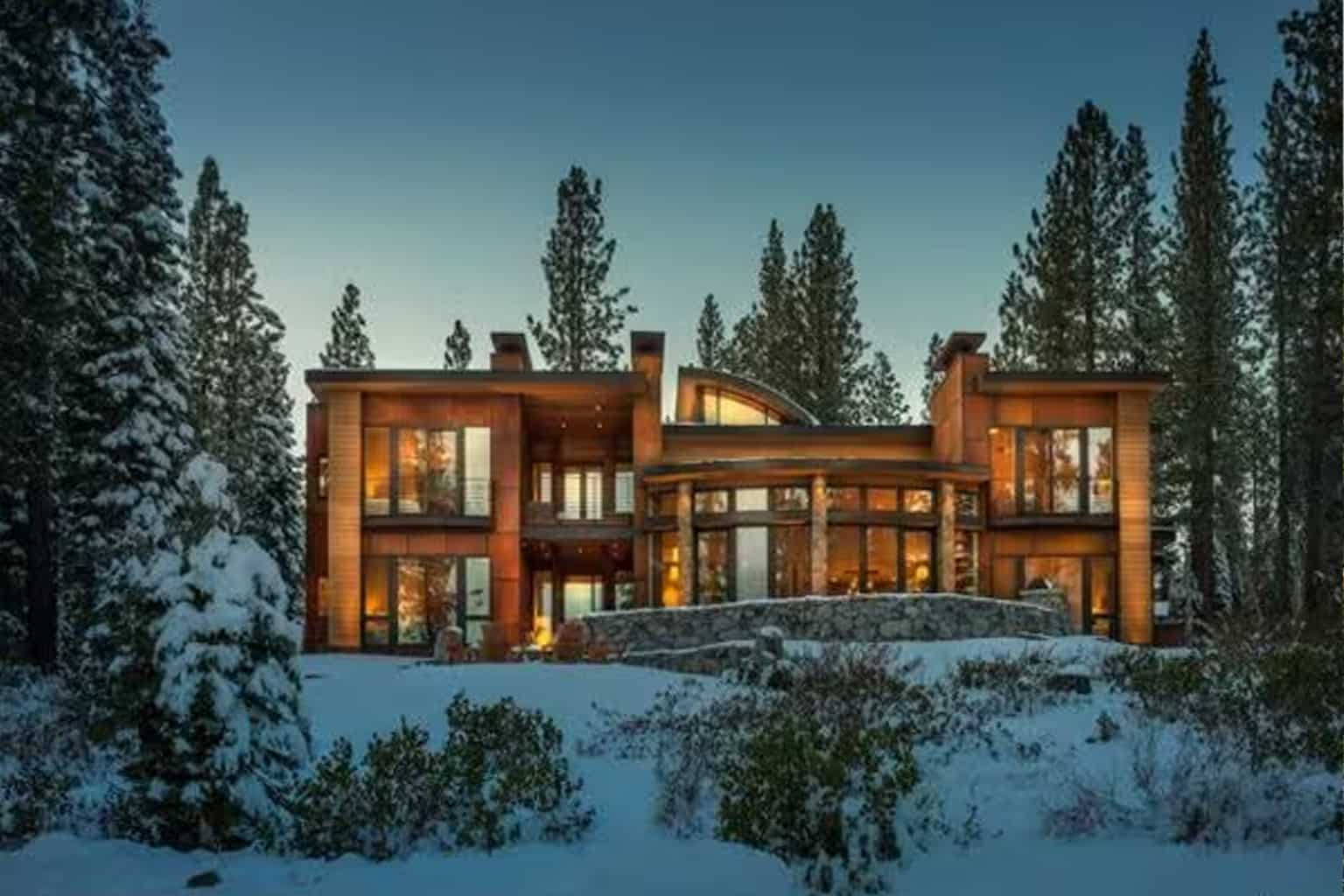
India’s luxury second-home market is changing. Wealthy buyers looking at Himachal Pradesh, Uttarakhand and other leisure destinations are increasingly moving beyond isolated holiday villas and towards gated, professionally developed and managed luxury communities.
The Economic Times report says transactions in hill destinations such as Himachal Pradesh and Uttarakhand are now crossing ₹20 crore, while professional management, hospitality services and amenities are becoming increasingly important in purchase decisions.
The change is significant because buyers are no longer purchasing only a house with a mountain view. At the premium end, the product is increasingly becoming:
Second home + managed community + hospitality + wellness + professional property management.
What is changing in India’s luxury second-home market?
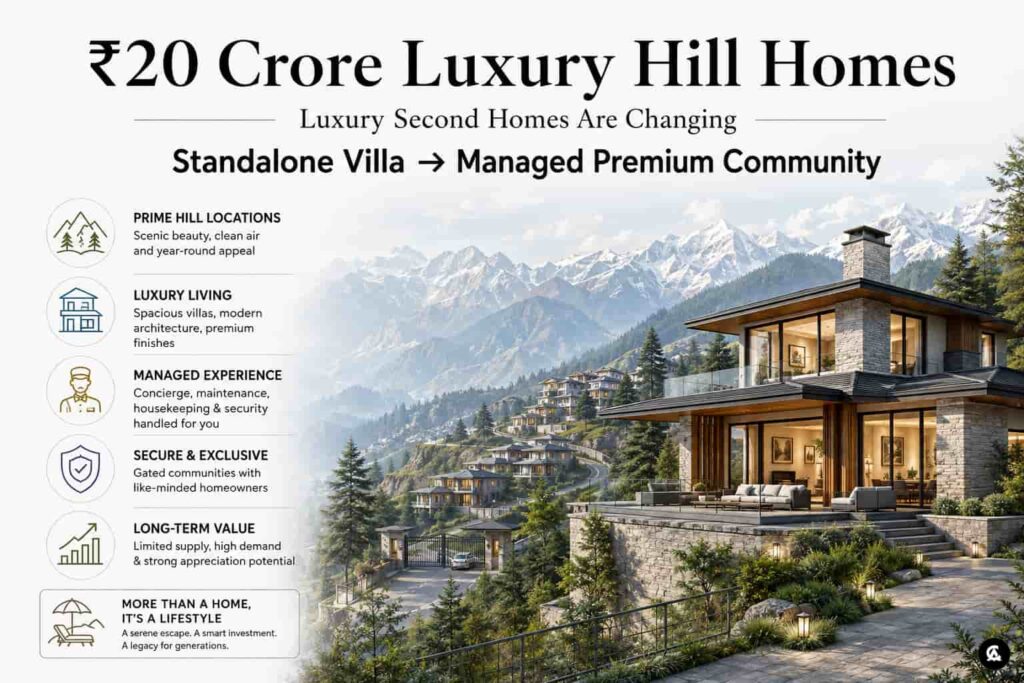
Traditionally, buying a second home in the hills meant purchasing an independent villa, using it for holidays and leaving it locked for much of the year.
The emerging luxury model is different.
Premium buyers are increasingly looking for professionally maintained homes inside planned communities, where security, housekeeping, food and beverage services, wellness facilities and curated experiences may be available through an organised operator.
Savills India told ET that the traditional “lock-and-leave” second home is evolving into a more lifestyle-led and yield-oriented residential product supported by professional management.
This means the value proposition is moving from:
Land + Villa
to:
Villa + Community + Management + Services + Experience
How expensive are luxury hill homes becoming?
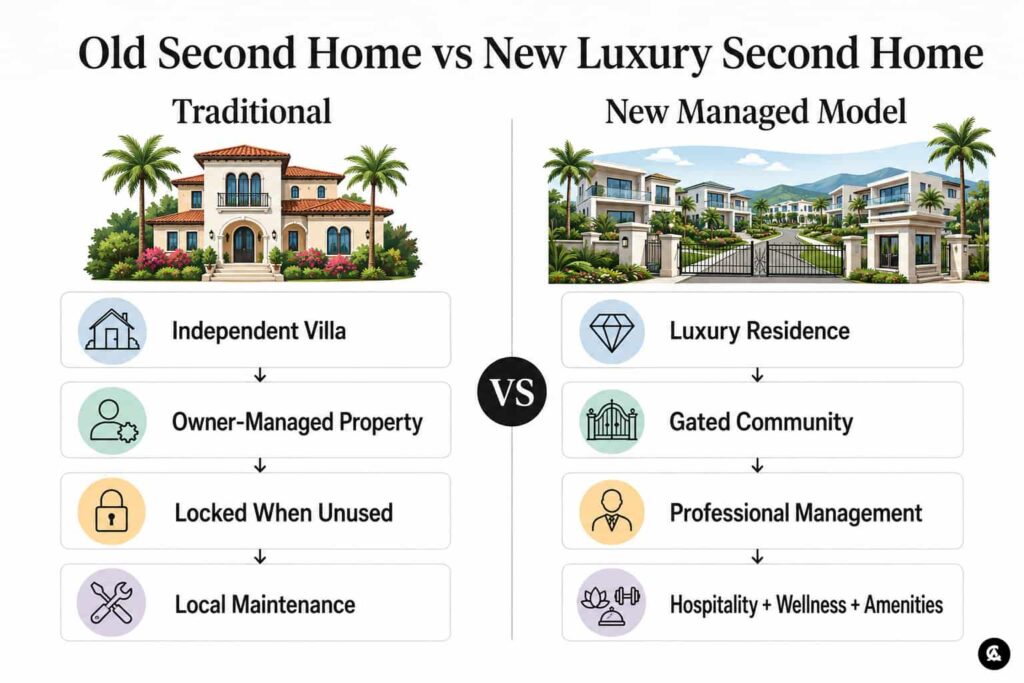
The upper end of the market is no longer limited to ₹2–3 crore weekend homes.
The latest ET report says property transactions in parts of Himachal Pradesh and Uttarakhand are crossing ₹20 crore, while some premium villas are being positioned at around ₹28 crore.
A real example of this premiumisation can be seen at Terra Grande Sirmaur near the Kasauli Hills. Phase I consists of 39 luxury villas across approximately 16 acres, priced around ₹8 crore to ₹10 crore, and the developer says the phase has sold out.
Terra Grande is now planning three more luxury second-home projects around Kalth in Solan, near Rishikesh and Sirmaur, alongside its existing developments. Together, the five projects are planned across approximately 61.5 acres with more than 100 residences.
This suggests that organised developers see luxury second homes as a distinct residential category rather than a niche holiday-home product.
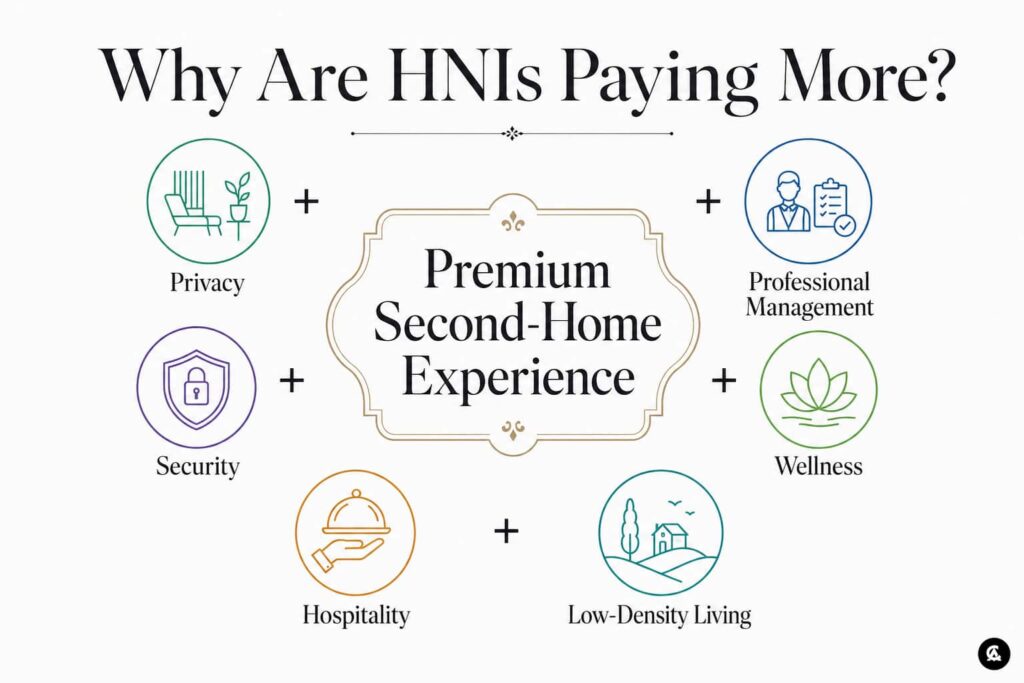
Why are HNIs willing to pay more for managed communities?
The answer is not simply “luxury”.
A second home located hundreds of kilometres away from the owner’s primary residence creates practical problems:
Who maintains the house?
Who checks plumbing and electrical systems?
Who manages landscaping?
Who provides security when the house is empty?
Who prepares the property before the owner arrives?
A managed community attempts to solve these problems through an organised service ecosystem.
At the high end, buyers are increasingly paying for:
Privacy
Low-density development and larger residences.
Professional maintenance
Property upkeep without depending entirely on local vendors.
Security
Controlled access and organised security.
Amenities
Wellness, fitness, recreation and social spaces.
Hospitality-style services
Housekeeping, food and beverage and curated experiences where offered.
Community planning
Roads, landscaping and common infrastructure designed as part of one development.
What does “professionally managed” actually mean?
This term should not be accepted purely as marketing language.
Before buying, a purchaser should determine exactly what the management contract includes.
Possible services can include:
- housekeeping
- security
- landscaping
- preventive maintenance
- plumbing and electrical support
- concierge assistance
- food and beverage services
- common-area management
- rental management
Terra Grande’s official Sirmaur project information, for example, positions the development around low-density mountain living, recreational amenities and community experiences. Its project is registered under Himachal Pradesh RERA No. HPRERASIR2023060/P.
Tata Housing’s Myst near Kasauli is another established example of organised luxury hill living, offering apartments and 3-, 4- and 5-bedroom villas alongside facilities such as a spa and yoga zone.
The important point for buyers is:
Managed does not automatically mean every service is included in the purchase price.
Annual maintenance and service costs must be checked separately.

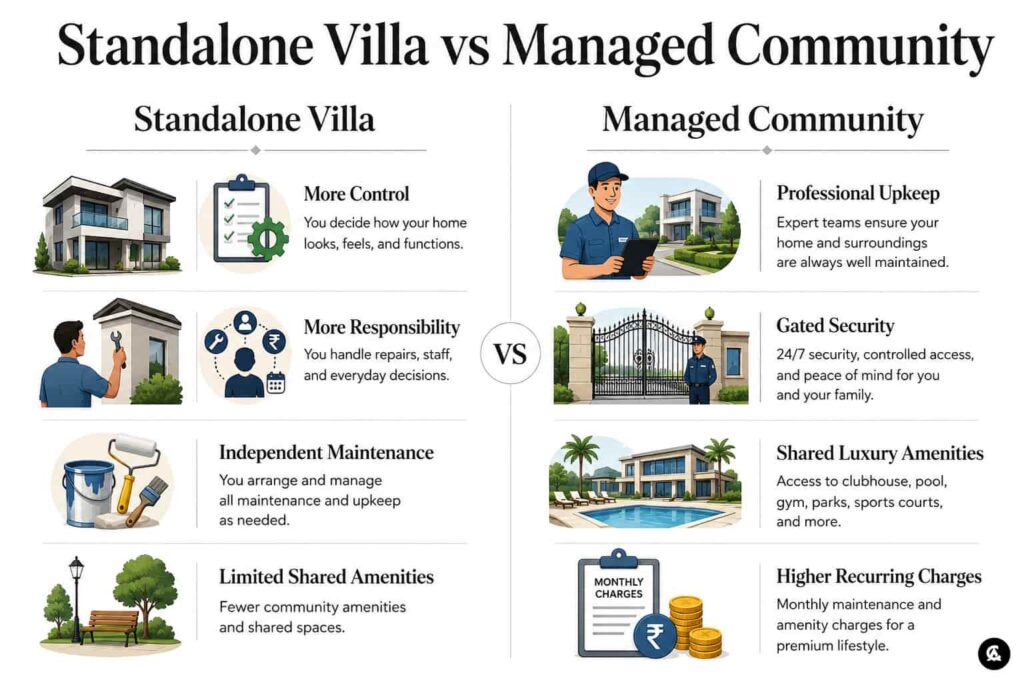
Standalone villa vs managed community: which is better?
Neither option is automatically superior.
| Standalone hill villa | Managed luxury community |
|---|---|
| Greater independence | Organised community |
| Owner controls maintenance | Professional maintenance |
| Owner arranges security | Gated security |
| Fewer common charges | Recurring management charges |
| Rental management can be difficult | Rental support may be available |
| Limited shared amenities | Club/wellness facilities may be available |
| More responsibility | More convenience |
A standalone villa may suit someone who wants maximum control and spends significant time at the property.
A managed second home may make more sense for a buyer who wants a low-maintenance holiday residence that can remain professionally looked after when unused.
Can a luxury hill home generate rental income?
This is where buyers need to be particularly careful.
A professionally managed second home can make short-term or holiday rentals easier if the project permits them and a rental programme exists, but a scenic location does not automatically guarantee strong rental returns.
Before buying for rental income, ask:
Who manages the property?
Developer, third-party operator or the owner?
How is revenue shared?
What management fee is deducted?
Is renting optional or mandatory?
Can the owner use the residence during peak holiday periods?
How seasonal is demand?
Who pays for repairs, housekeeping and utilities?
A projected rental yield should therefore be evaluated after operating and management expenses, not simply against advertised nightly rental rates.
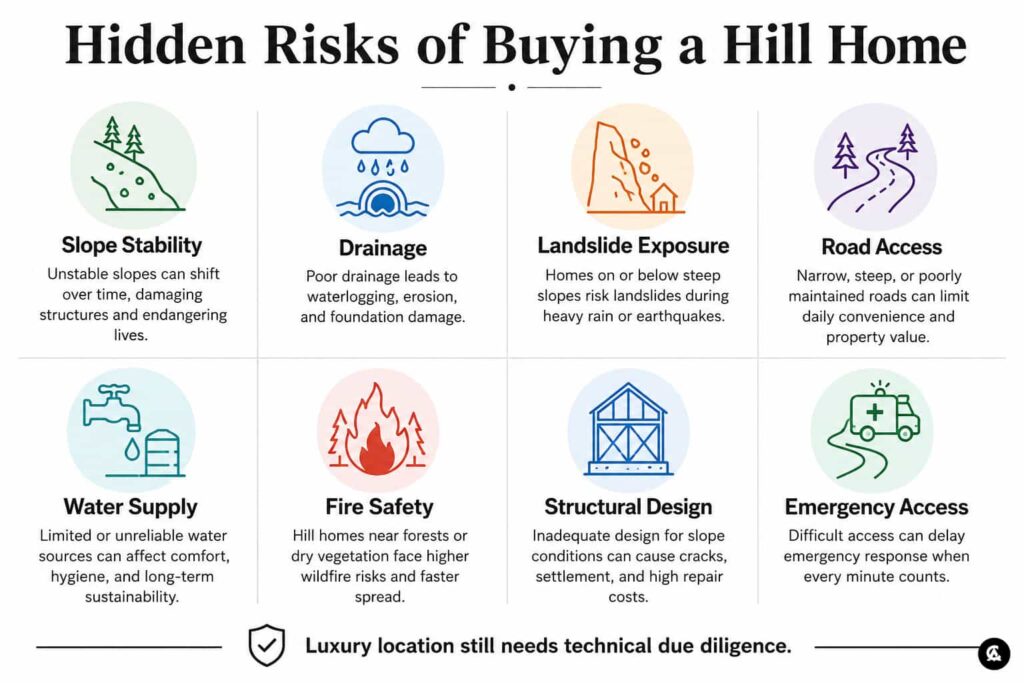
Hill properties carry risks that city apartments may not
This is one of the most important differences between buying a ₹10 crore apartment in Delhi NCR and a ₹10 crore villa in the mountains.
Buyers should investigate the physical characteristics of the site, including:
Slope stability
Drainage and water movement
Retaining structures
Road accessibility
Water availability
Fire safety
Emergency access
Heavy-rain or landslide exposure
Structural design appropriate for the location
Mountain geography can make a spectacular property more complicated to develop and maintain than a comparable urban residence.
A panoramic view should therefore never replace technical due diligence.
Check the legal structure before buying
Property laws and development regulations can differ between hill states.
A buyer considering property in Himachal Pradesh or Uttarakhand should therefore verify the rules applicable to the specific property and buyer category instead of assuming that normal metro-city purchase rules apply.
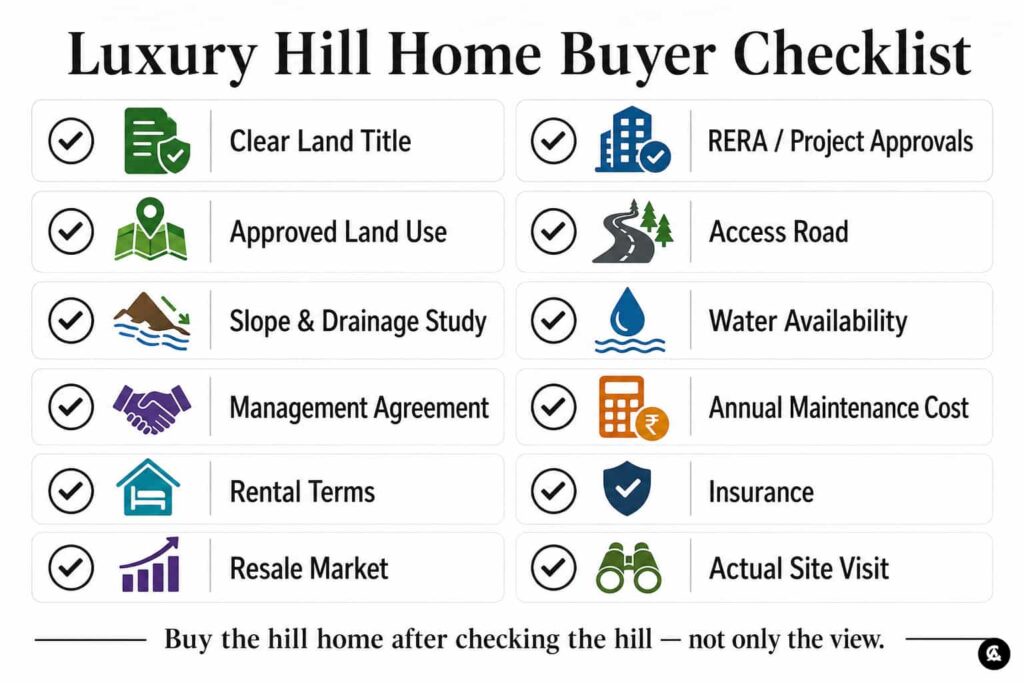
At a minimum, examine:
Land title
Permitted land use
Sanctioned plans
Applicable RERA registration
Development approvals
Access rights
Local ownership or transfer restrictions, where applicable
Encumbrances
These checks become even more important when the transaction involves large land parcels or villa developments.
The hidden cost of a ₹10–20 crore second home
The purchase price is only the entry cost.
Luxury second-home ownership can also involve:
Maintenance charges
Property-management fees
Housekeeping
Landscaping
Club charges
Utilities
Insurance
Repairs
Property tax
Rental-management commission
A professionally managed community may reduce the owner’s workload, but that convenience comes at a recurring cost.
The relevant financial calculation is therefore:
Purchase Price + Transaction Costs + Annual Ownership Costs
—not purchase price alone.
Lifestyle purchase or investment?
This distinction matters.
A lifestyle buyer may value:
privacy, views, climate, family use, wellness and convenience.
An investment buyer needs to examine:
rental demand, seasonality, operating costs, resale liquidity and the depth of the buyer market.
This becomes particularly important at ₹10 crore, ₹20 crore or higher ticket sizes.
A property may be rare and luxurious, but the potential resale audience for a ₹20 crore hill residence can also be much smaller than the audience for a mainstream city apartment.
Luxury and liquidity are not the same thing.
Why organised developers are entering this market?
The current shift is visible in actual development pipelines.
Terra Grande by Eldeco plans more than 100 luxury residences across five projects spanning roughly 61.5 acres in Himachal Pradesh and Uttarakhand.
The latest industry report also notes that established developers such as Tata Realty and DLF have previously developed organised projects in hill markets, while the current wave is increasingly centred on branded and professionally managed communities.
At Tata Housing’s Myst near Kasauli, current official marketing lists luxury villas starting around ₹5.26 crore, with 4-bedroom villas from approximately ₹6.12 crore, illustrating how established developers are positioning organised hill residences firmly within the luxury segment.
The direction of travel is clear:
Holiday Home → Luxury Second Home → Managed Community → Hospitality-Led Residence
What should you check before buying a luxury second home?
Are managed luxury second homes worth the premium?
For the right buyer, they can solve one of the biggest problems associated with owning a distant holiday property: management.
A professionally run community can offer security, maintenance and lifestyle facilities that are difficult to organise independently.
But the premium makes sense only when the buyer can clearly identify what they are receiving in return.
The comparison should be:
Independent Villa Price
versus
Managed Community Price + Services + Annual Cost
If the additional amount is largely justified by professional upkeep, superior infrastructure, scarcity, privacy and services the buyer actually values, the premium may be reasonable.
If it is based mainly on marketing and location imagery, buyers should be much more cautious.
India’s premium second-home market is moving beyond the traditional isolated holiday villa. A fresh industry report shows ₹20 crore-plus transactions in Himachal Pradesh and Uttarakhand, while professionally managed communities with hospitality, wellness and organised services are increasingly appealing to affluent buyers.
Developments such as Terra Grande’s expanding Himachal-Uttarakhand portfolio and Tata Housing’s Myst also show how organised real-estate players are building products around this demand.
For buyers, however, the real question is not:
“How beautiful is the villa?”
It is:
“What am I paying for, who will manage it, what will it cost every year, and how easy will it be to exit later?”
That is the difference between buying a luxury holiday home and making an informed luxury real-estate decision.
Sources:-
- Economic Times — Hill homes turn premium as buyers seek managed second-home communities
Read the Economic Times report - Economic Times — Terra Grande plans three new luxury second-home projects
Read the Economic Times report - Terra Grande — Official Sirmaur luxury hill-home project page
Terra Grande Sirmaur — Official Project Information - Tata Housing — Official Myst Kasauli project page
Tata Myst Kasauli — Official Project Information - Tata Housing — Myst luxury villas and current pricing page
Tata Myst Luxury Villas — Official Campaign Page





Leave a Reply