


A home loan makes buying a house possible, but the interest paid over 15 or 20 years can significantly increase its actual cost. For example, if you borrow ₹50 lakh at an annual interest rate of 8% for 20 years, your total repayment will exceed ₹1 crore.
However, you do not necessarily have to wait 20 years to become debt-free. A slightly higher EMI, one extra payment every year and occasional prepayments can help reduce the outstanding loan faster.
We analysed six repayment strategies for a ₹50 lakh home loan. The results show that combining these methods could reduce the repayment period to 10 years and 1 month, saving approximately ₹25.57 lakh in interest compared with the standard 20-year repayment schedule.
Let us understand how this works through the example of two friends, Mr. Chaudhary and Mr. Mishra.
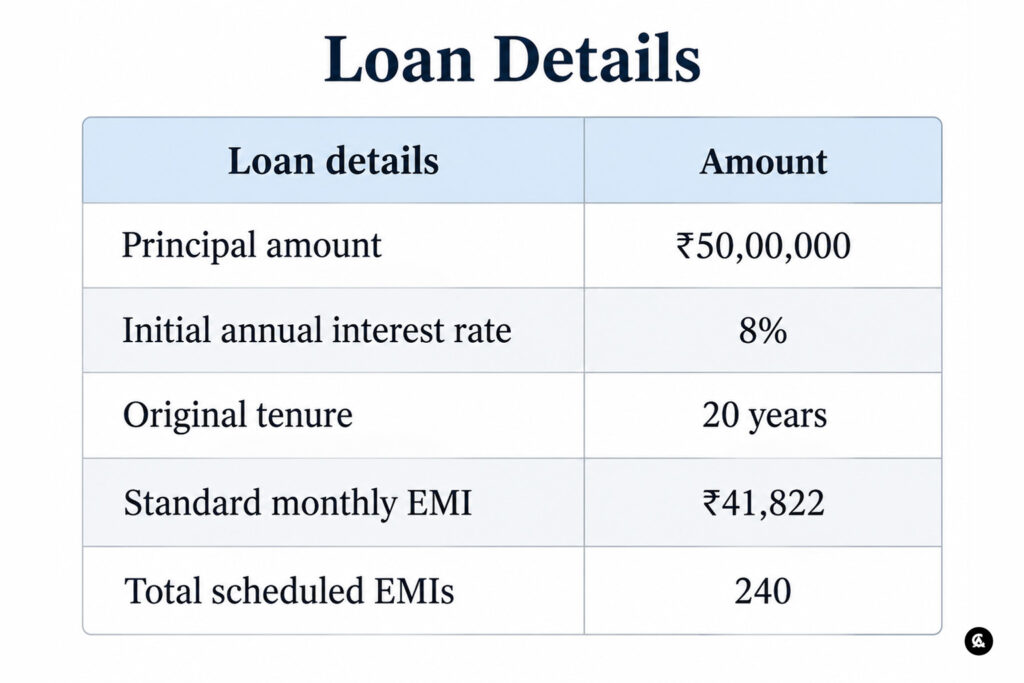
Mr. Chaudhary chooses to pay the standard EMI throughout the loan tenure. Mr. Mishra explores different ways to repay the principal earlier.
For this comparison, we assume the interest rate remains at 8% unless a balance transfer is specifically introduced. The calculations use monthly reducing-balance interest.
Situation 1: What happens when you pay the normal EMI?
Mr. Chaudhary pays approximately ₹41,822 every month for 20 years.
By the time his loan closes, he has paid:
Original principal: ₹50 lakh
Total interest: ₹50.37 lakh
Total repayment: ₹1.004 crore
In other words, he pays slightly more in interest than the amount he originally borrowed.
Why does this happen?
During the initial years, a large portion of each EMI goes towards interest. In the first month itself, approximately ₹33,333 of his ₹41,822 EMI is interest, while only ₹8,489 reduces the outstanding principal.
As the loan balance decreases, the interest component gradually falls. This is also why paying additional principal early in the loan can make a significant difference.
Situation 2: Increase the monthly EMI to ₹43,000
Mr. Mishra begins with a simple change. Instead of paying ₹41,822, he chooses a fixed EMI of ₹43,000.
That is an additional payment of approximately ₹1,178 every month.
Without making any other changes, his loan closes in 18 years and 9 months, and his total interest falls to ₹46.59 lakh.
This small increase saves approximately ₹3.78 lakh in interest and reduces the tenure by 15 months.
The lesson is straightforward: even a modest additional monthly payment can reduce the long-term cost of borrowing.
Situation 3: Pay one extra EMI every year
Next, Mr. Mishra keeps his regular EMI at ₹43,000 but decides to pay one additional EMI at the end of every full year.
Instead of paying 12 EMIs annually, he effectively pays 13.
His annual repayment becomes:
₹43,000 × 13 = ₹5,59,000
This additional payment reduces the outstanding principal, which subsequently lowers the interest charged by the bank.
As a result, his loan closes in 16 years, with total interest of ₹38.64 lakh.
Compared with the standard 20-year home loan, he saves approximately ₹11.74 lakh in interest.
A borrower could use part of an annual bonus, salary arrears or accumulated surplus to make this additional payment, provided adequate emergency savings are maintained.
Situation 4: Increase EMI by 5% every year and pay one extra EMI
Mr. Mishra now combines two repayment methods.
He increases his monthly EMI by 5% at the beginning of every new loan year and continues paying one additional EMI annually.
His starting EMI remains ₹43,000, but the payment gradually rises.
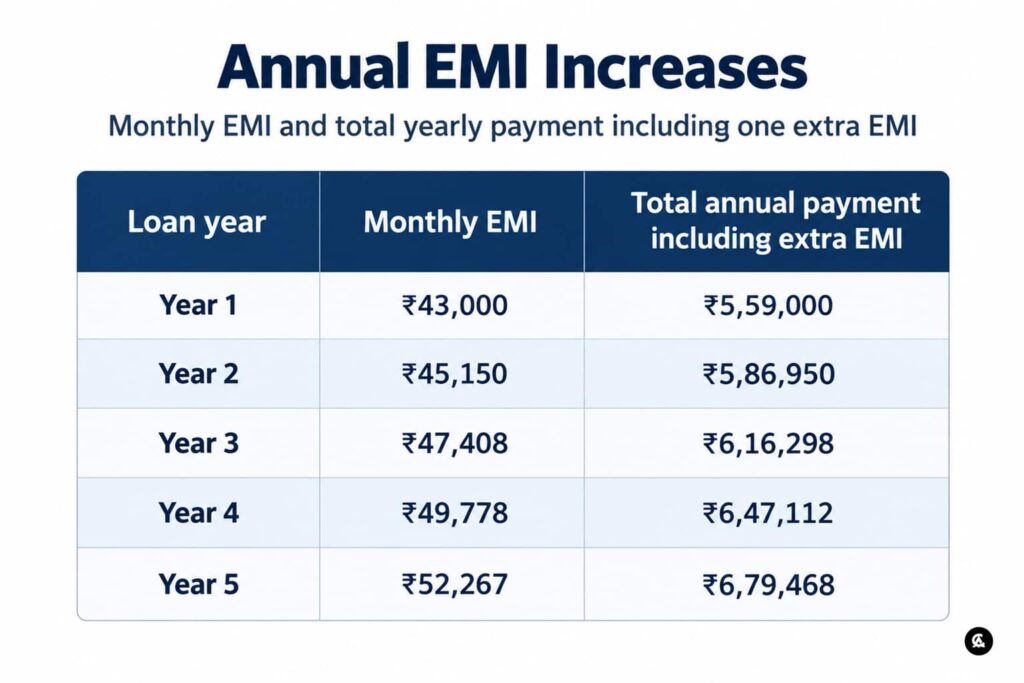
By Year 5, the regular monthly EMI reaches approximately ₹52,267.
Although this requires a larger repayment budget, the impact is substantial.
The home loan closes in 11 years, and total interest falls to ₹28.06 lakh.
This represents a saving of approximately ₹22.31 lakh against the standard repayment schedule.
The reason is that the increasing EMI reduces the principal more aggressively. With a smaller outstanding balance, less interest accumulates in subsequent months.
For salaried borrowers, using part of their annual salary increments towards higher EMIs may be an effective approach. However, the increase should depend on actual affordability rather than assuming that income will always rise.
Situation 5: Transfer the home loan to a lower interest rate
After completing 36 months, Mr. Mishra explores a balance transfer to another bank.
At this stage, his outstanding principal is approximately ₹43.78 lakh.
He transfers the loan from an annual interest rate of 8% to 7.75%, while maintaining his annual EMI increases and extra payments.
This reduces his total interest to ₹27.29 lakh and brings the loan closure forward to 10 years and 10 months.
The balance transfer saves approximately ₹77,478 in additional interest and shortens the tenure by two months compared with Situation 4.
This result highlights an important point: a small reduction in interest rate can help, but consistently making higher repayments has a greater effect in this particular calculation.
Before transferring a loan, borrowers should compare interest savings with processing fees, legal expenses, valuation charges and other applicable costs.
Situation 6: Make two additional prepayments of ₹2 lakh
Finally, Mr. Mishra adds two lump-sum prepayments to the previous strategy.
He makes the first payment of ₹2 lakh after 42 months and another ₹2 lakh after 60 months.
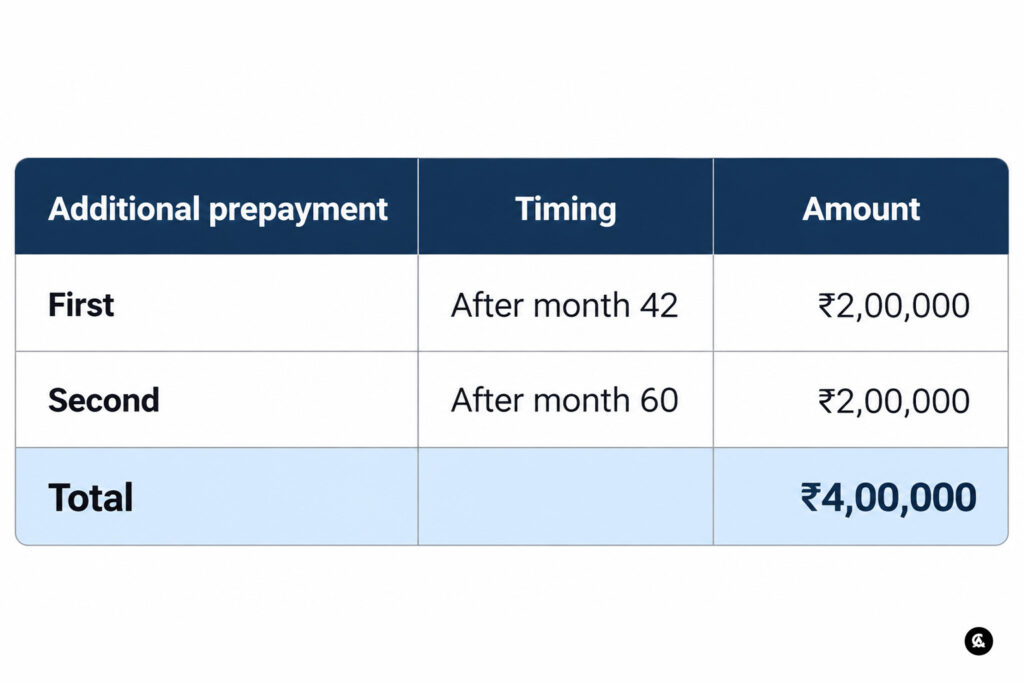
He continues increasing the EMI by 5% annually, paying one extra EMI each year and benefiting from the lower 7.75% interest rate after the balance transfer.
With these combined actions, the ₹50 lakh home loan closes in 10 years and 1 month.
The total interest paid is approximately ₹24.80 lakh, and the overall repayment is ₹74.80 lakh, including the lump-sum prepayments.
This strategy saves approximately ₹25.57 lakh in interest compared with the original standard EMI plan.
The savings do not come from the ₹4 lakh prepayments alone. They result from the combined effect of earlier principal repayments, increasing EMIs and the lower interest rate.
Complete comparison of all six home loan strategies
Here is the financial outcome of each repayment approach.
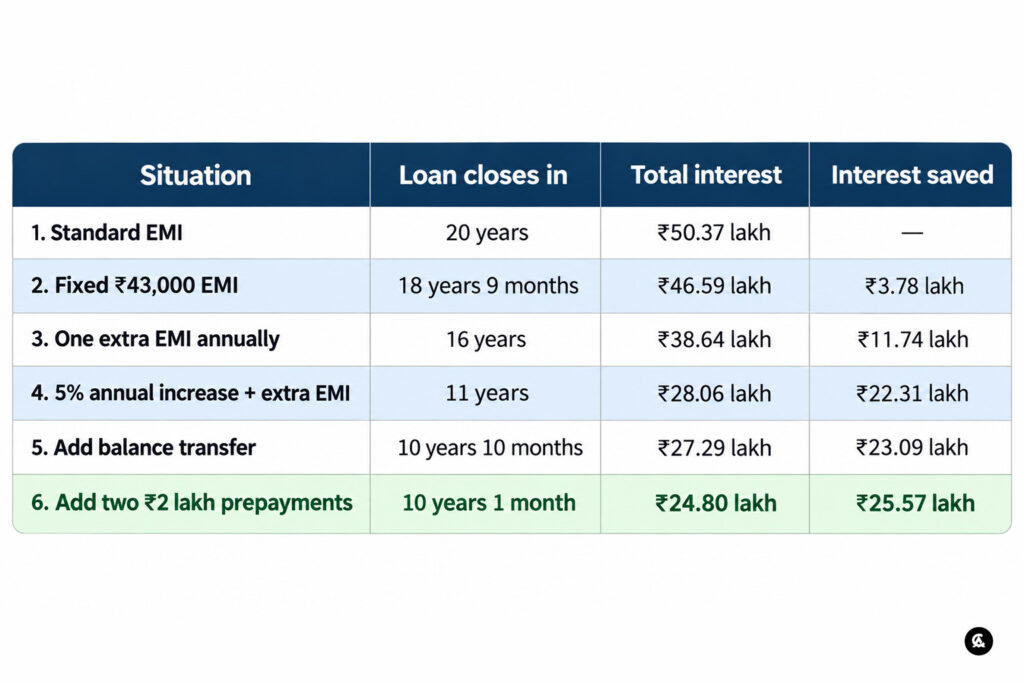
All interest savings are measured against Situation 1, the standard 20-year repayment schedule.
The largest improvement occurs when the borrower starts increasing the EMI annually while maintaining the additional yearly payment.
Mr. Chaudhary vs Mr. Mishra: The final result
Both friends started with exactly the same ₹50 lakh loan.
Mr. Chaudhary continued with his standard repayment schedule. Mr. Mishra progressively adopted the combined repayment strategy.
Their difference was not the amount borrowed, but how quickly they repaid the principal.
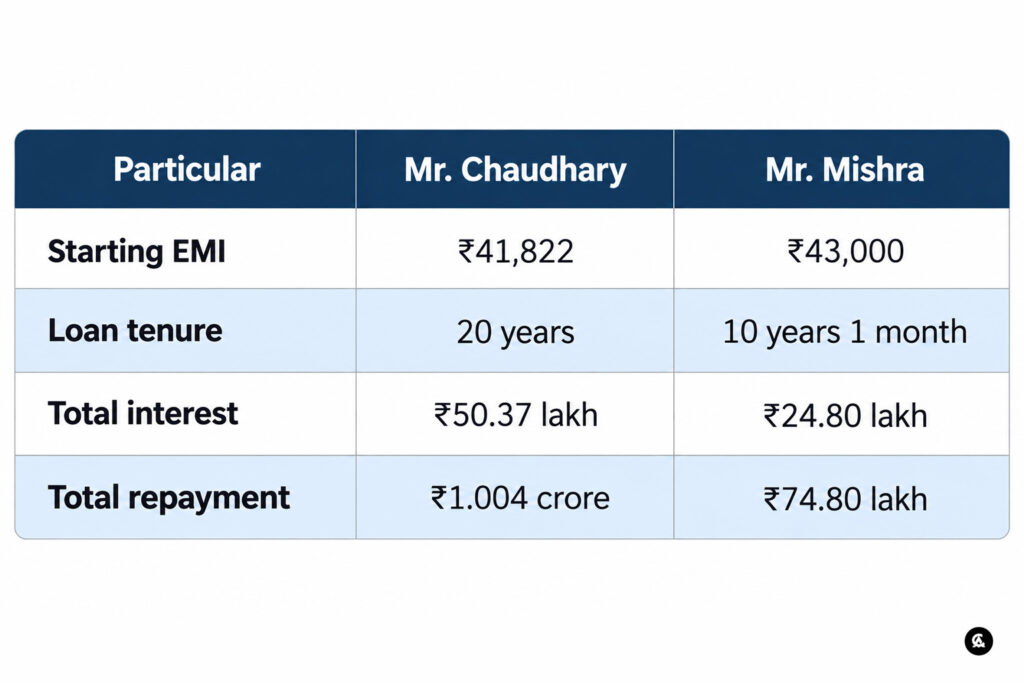
Mr. Mishra becomes debt-free 9 years and 11 months earlier.
However, he also commits considerably more money to repayment during the initial years. The ₹25.57 lakh benefit represents interest avoided through faster repayment, not an amount paid to him by the bank.
Is this Home Loan repayment Ssrategy suitable for everyone?
Not necessarily. The fastest loan repayment strategy is not always the most practical choice.
A family with stable earnings, regular salary increments and sufficient surplus savings may be able to increase its EMI consistently.
However, borrowers with variable income, education expenses, elderly dependants or other financial obligations may require a more flexible approach.
Before making additional payments, consider these factors:
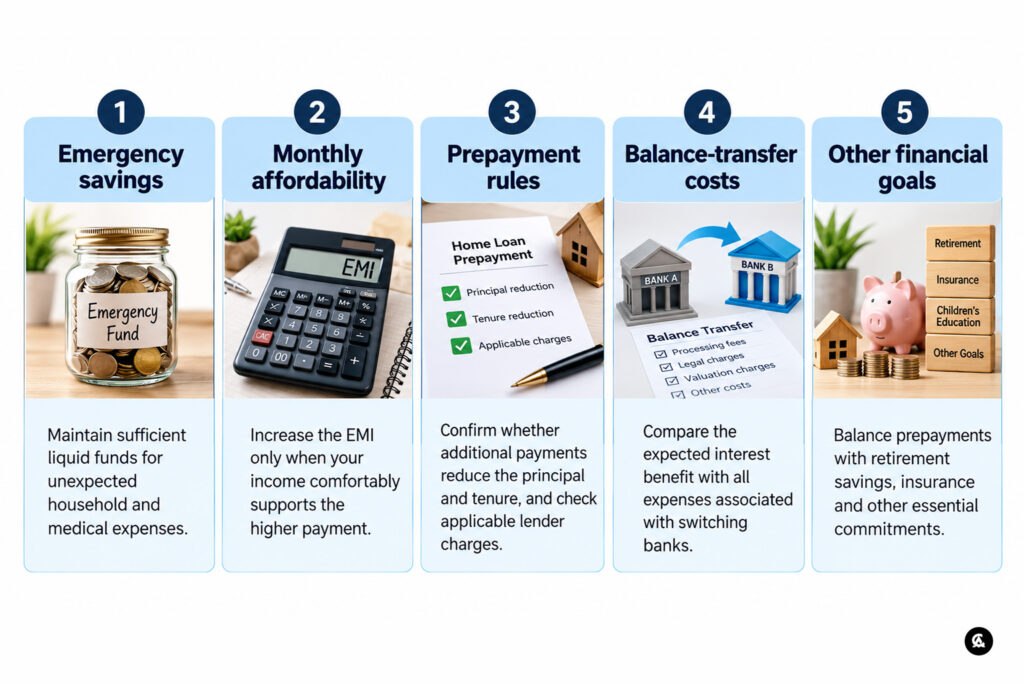
The calculation also assumes that the stated repayment increases and prepayments continue. If the borrower misses planned additional payments or interest rates change, the final tenure and savings will differ.
Frequently Asked Questions
Can I prepay a home loan without increasing my regular EMI?
Yes. Borrowers can generally make eligible part-prepayments while retaining their regular EMI, subject to the loan agreement and applicable lender rules. Ask the bank to explain how the payment will affect the outstanding principal and tenure.
Should I reduce EMI or tenure after a home loan prepayment?
If your objective is to minimise total interest and you can comfortably continue paying the existing EMI, reducing the tenure will generally save more interest. Reducing the EMI may be preferable when you need lower monthly commitments.
Is paying off a home loan early always the best financial decision?
Not always. The decision depends on the loan interest rate, available savings, other financial obligations, tax considerations and alternative uses of the money. Repayment should not compromise essential financial security.
Conclusion
A home loan may be sanctioned for 20 years, but disciplined repayment can shorten that period considerably.
The analysis shows that paying slightly more each month is a useful starting point. Annual extra payments and gradual EMI increases create much larger savings, while a balance transfer and occasional prepayments can reduce the loan tenure further.
The important principle is simple: the sooner you reduce your outstanding principal, the less interest you may pay over the remaining loan period.
Choose a repayment strategy that helps you become debt-free sooner without placing unnecessary pressure on your family’s finances.

Leave a Reply