


Mindspace REIT’s latest Chennai acquisition is more than a large commercial real estate deal. It is a strong signal about where institutional capital believes the next layer of office-market opportunity lies. The REIT has agreed to acquire Commerzone Pallikaranai, a 2.6 million sq ft Grade A office campus in Chennai, for about ₹2,541 crore. In a market where capital is becoming more selective, that kind of commitment is rarely just about adding square footage. It is usually about backing a city, a corridor, and a demand story that investors believe still has room to run.
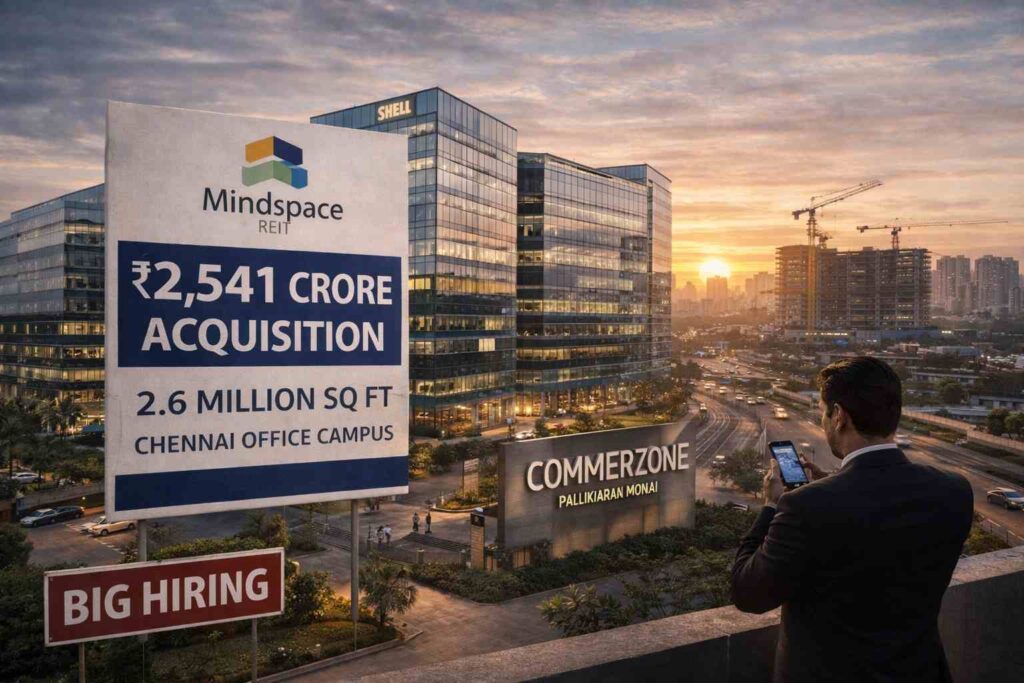
What makes the transaction especially interesting is the kind of asset being acquired. Commerzone Pallikaranai sits on Chennai’s Pallavaram-Thoraipakkam Road, a key office corridor, and spans 12.4 acres. Of the total 2.6 million sq ft, about 1.4 million sq ft is already completed, while another 1.2 million sq ft is under construction and is expected to be completed by March 2027. That means this is not just a purchase of current income. It is also a bet on embedded future growth.
The tenant profile matters too. Shell is the anchor occupier and accounts for roughly 55% of the leased space, according to reported details of the transaction. For institutional investors, that changes the quality of the story. A large, established tenant base with long lease visibility makes an asset more than a development play. It turns it into a blend of stability and upside, which is exactly the kind of profile smart capital tends to prefer when it enters or expands in a market.
There is also a bigger portfolio logic behind this move. Mindspace said the acquisition would meaningfully strengthen its presence in Chennai, a market it described as one of India’s more resilient and high-growth office cities, with low vacancy and a strong multinational tenant base. That is important because large REIT-led acquisitions often reveal how institutional investors are reading city-level office demand. They do not just ask where rents are today. They ask where occupier confidence is likely to hold, where vacancy is manageable, and where future leasing can still compound value.
Seen from that lens, this deal tells us something important about Chennai. The city may not always dominate public real estate conversation the way Bengaluru, Mumbai, or Gurugram do, but institutional money clearly sees it as a serious office market with durable demand characteristics. The fact that this acquisition is happening through a REIT structure makes that signal even stronger. REIT capital is usually more disciplined, more yield-aware, and more focused on quality than speculative money. So when a REIT puts ₹2,541 crore into a single office-campus platform, it is effectively making a public statement on where it sees long-term value. This interpretation is an inference drawn from the nature and scale of the transaction.
The deal structure adds another layer. Mindspace announced that the acquisition includes buying 100% equity in Sycamore Properties and Content Properties, and it also proposed a preferential unit issue of up to about ₹675 crore, subject to approvals. Reported details further said the acquisition price was at a 3.4% discount to the average of two independent valuations. That matters because it shows the transaction is not just large, but also structured with valuation discipline and capital-planning intent.
For the wider office market, the message is straightforward. This is not merely a Chennai story. It is a signal that high-quality, income-producing, institutionally owned office assets are still attracting serious money in India. At a time when many people continue to ask whether office demand can stay strong in the hybrid-work era, transactions like this suggest that the answer depends less on office as a category and more on asset quality, tenant quality, and city quality. The best assets in the right markets are still commanding conviction. This is an analytical reading based on the profile of the deal and the sponsor-backed acquisition rationale.
For real estate watchers, the biggest takeaway may be this: smart office money is not moving randomly. It is moving toward cities and assets where leasing resilience, multinational demand, infrastructure quality, and future expansion potential come together in one place. Mindspace REIT’s Chennai move fits that pattern almost perfectly. And that is why this acquisition deserves to be read not just as a transaction, but as a market signal.



Leave a Reply