

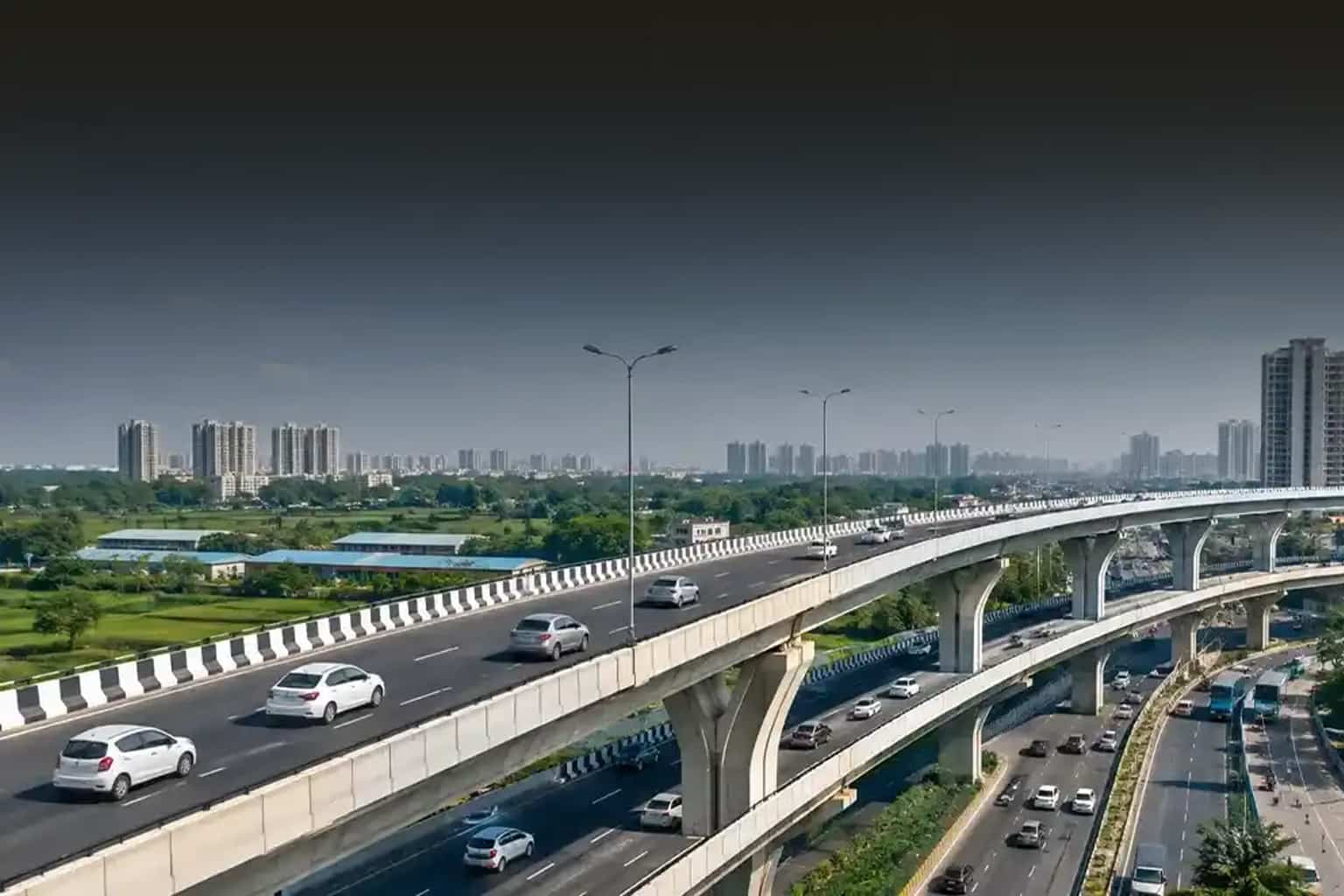
A long-discussed connectivity project between Greater Noida West and NH-9/Delhi–Meerut Expressway has moved into a much stronger approval stage.
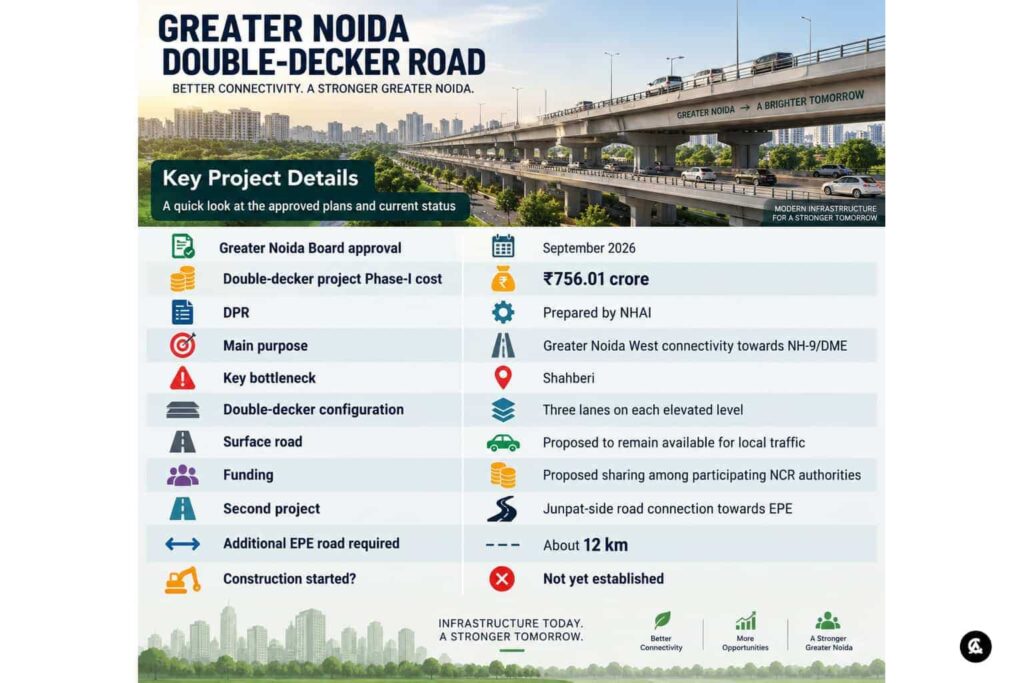
At its 144th Board Meeting in September 2026, the Greater Noida Industrial Development Authority approved ₹756.01 crore for the first phase of an elevated corridor designed to tackle the Shahberi bottleneck and improve connectivity towards Crossings Republik, NH-9 and the Delhi–Meerut Expressway.
The board also approved a separate road project connecting Greater Noida’s 105-metre-wide arterial road towards the Eastern Peripheral Expressway (EPE).
These are two different projects serving two different parts of Greater Noida, and understanding that distinction is important for property buyers.
The project originally looked very different
The present double-decker design evolved from an earlier plan.
In March 2025, Greater Noida Authority approved an approximately 4-km elevated road from Ek Murti Chowk towards NH-9 through Shahberi and Crossings Republik. The estimated cost at the time was around ₹400 crore.
That proposal envisaged a conventional elevated road, while NHAI was expected to work on the DPR and execution.
The current ₹756.01-crore project should therefore not be described simply as the same ₹400-crore road becoming ₹356 crore more expensive.
The engineering solution itself changed.
Why was the road redesigned as a double-decker structure?
Shahberi has a fundamental constraint: limited available width.
Greater Noida project officials said a conventional elevated structure would require around 15 metres of space, while only about 14 metres was available at critical locations.
The double-decker solution allows the authorities to create six elevated traffic lanes within a smaller structural footprint.
Under the proposed arrangement:
- one elevated level carries three lanes in one direction;
- the second carries three lanes in the opposite direction;
- the existing surface road remains available for local movement.
Officials have also indicated the use of U-shaped piers for the proposed structure.
This is the real reason the double-decker design matters. It is not being proposed simply as a landmark structure; it is an engineering response to Shahberi’s narrow and heavily constrained corridor.
Where will the corridor connect?
The project is strategically important because it links into Greater Noida’s 130-metre-wide arterial road, which runs through Greater Noida and Greater Noida West.
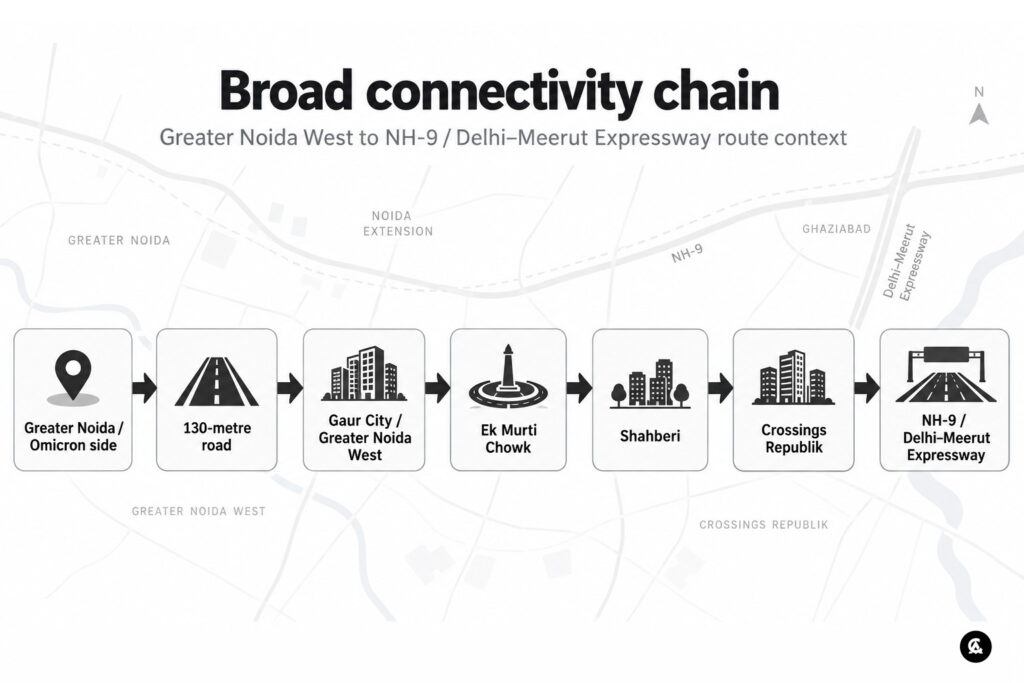
Greater Noida Authority officials have said that once this connection is completed, the 130-metre road can provide a stronger link towards the Delhi–Meerut Expressway.
Why are 2.5 km, 5–6 km and 7 km figures appearing in reports?
This is the most important factual clarification in the story.
Different reports are describing different portions of the overall connectivity plan.
Detailed reporting before the September board meeting described the core double-decker section around Shahberi as approximately 2.5 km.
Hindustan Times subsequently reported that the approved ₹756.01-crore Phase I is part of a phased connection between Ek Murti and the DME side, while the remaining stretch is intended to follow in another phase.
Times of India has described the wider proposed alignment as around 7 km.
Therefore, the safest description is:
The ₹756.01-crore approval relates to Phase I of a broader Greater Noida West–DME elevated connectivity project. The core double-decker component is only part of the larger alignment.
Calling the entire corridor a “7-km double-decker flyover” without explaining the phasing can give readers the wrong impression.
What is Phase I and what happens later?
NHAI studied alternative configurations for the Shahberi corridor.
According to the Greater Noida Authority CEO quoted by Hindustan Times, the project committee decided to take up the DME–Ek Murti connectivity in the first phase, with ₹756.01 crore approved for that stage, while the remaining portion would follow in the second phase.
For buyers, this means one thing:
approval of Phase I should not be interpreted as simultaneous construction and completion of every proposed section of the wider corridor.
Who will fund and construct the project?
NHAI has prepared the DPR and is expected to play the principal construction role.
Greater Noida Authority has said the cost is proposed to be shared equally among:
- Greater Noida Authority
- Noida Authority
- Yamuna Expressway Industrial Development Authority
- Ghaziabad Development Authority
However, Times of India reported after the board meeting that approvals from Noida Authority and YEIDA were still required as participating authorities.
That is an important execution point.
Greater Noida Authority’s board approval is a major milestone, but it is not the final physical-construction milestone.
The second project: around 12 km of new road towards EPE
The double-decker corridor is only one part of the September infrastructure decision.
Greater Noida Authority also approved a proposal to extend its existing 105-metre-wide road towards the Eastern Peripheral Expressway.
The authority says approximately 12 km of additional road is required for the EPE connection, while NHAI has agreed to construct the road and Greater Noida Authority will arrange the required land.
Times of India describes the Junpat–EPE section as a proposed 10-lane corridor. The route would cross a railway line and the Eastern Dedicated Freight Corridor before reaching EPE
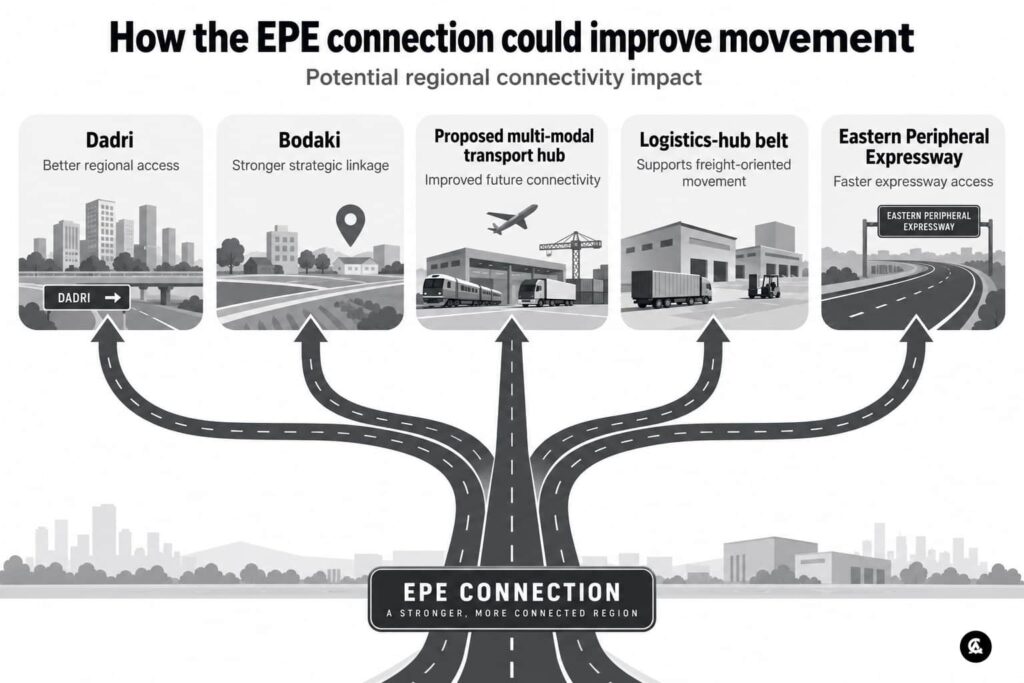
This makes the EPE project especially relevant to the eastern Greater Noida–Dadri development belt, whereas the Shahberi project is primarily a Greater Noida West–Ghaziabad connectivity story.
Why these projects matter for Greater Noida property
The potential real-estate benefit is straightforward: better regional access.
For Greater Noida West, the proposed elevated corridor addresses one of the area’s weakest links—the congested route towards Shahberi, Crossings Republik and NH-9.
If completed as proposed, properties that currently depend on this corridor could benefit from:
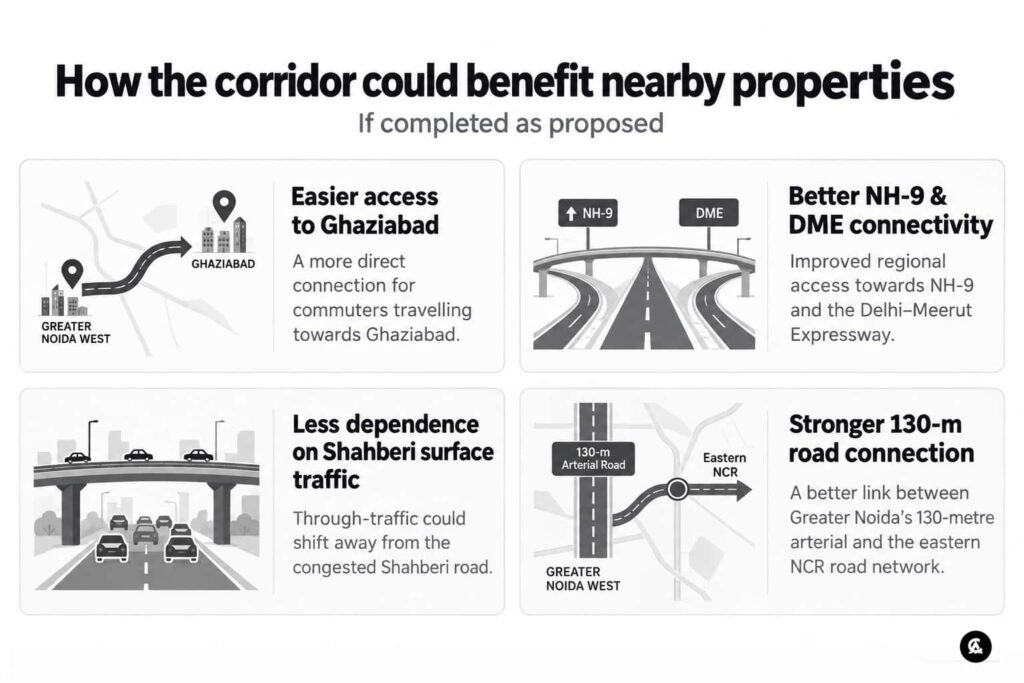
For the Dadri and Bodaki side, the proposed EPE connection could improve access to regional freight, transport and expressway infrastructure.
However, connectivity benefit and property-price appreciation are not the same thing.
A road can improve a location’s accessibility, but the investment quality of an individual property will still depend on its price, legal status, registry, RERA compliance, builder quality, occupancy, maintenance and last-mile access.
What happens next?
The project should now be tracked through execution milestones rather than announcements.
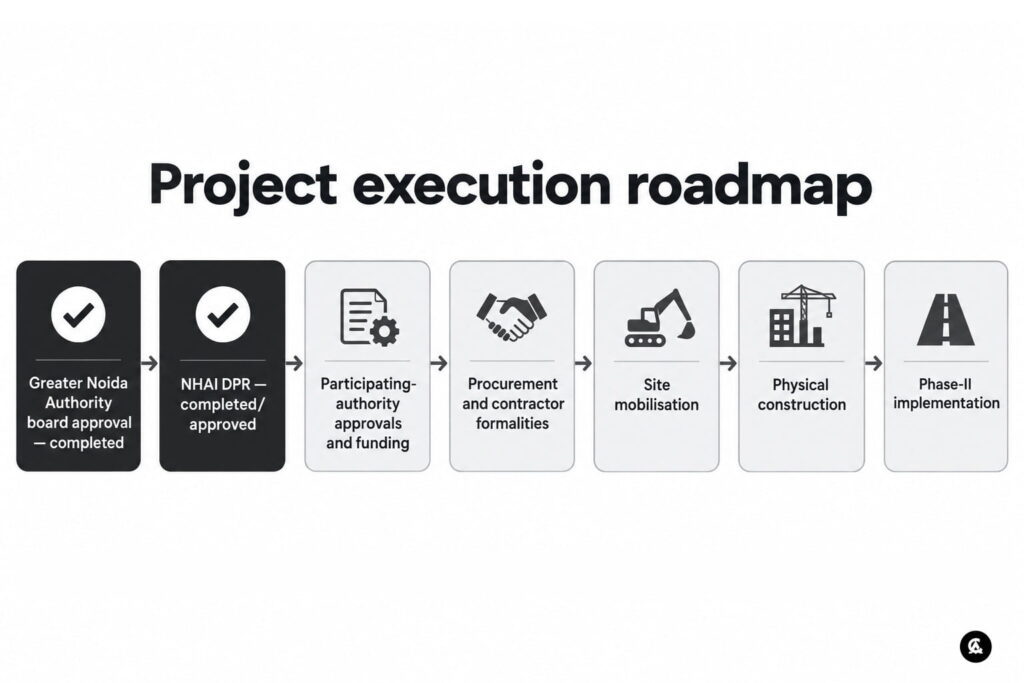
For the EPE road, land availability and acquisition will be another critical milestone.
Neither a firm construction-start date nor a definitive completion deadline should be assumed until those stages are formally established.
What should property buyers take away from this development?
The September 2026 approval is significant because it moves the Shahberi connectivity project well beyond its earlier ₹400-crore conventional-road concept.
The engineering approach has changed, the DPR has advanced, and ₹756.01 crore has now been approved for Phase I.
At the same time, the separate Junpat–EPE road project expands the significance of the board meeting beyond Greater Noida West.
For buyers, the two most relevant infrastructure directions are now:
Greater Noida West → Shahberi → NH-9/DME
and
Greater Noida → Junpat → EPE
Both could strengthen Greater Noida’s regional connectivity if executed as planned.
The point at which this should influence a property decision more strongly is not merely board approval—it is when funding, contracting and visible construction begin translating the plans into usable infrastructure.
Sources
Hindustan Times — Greater Noida board clears ₹756 crore double-decker road corridor
Read Hindustan Times report
Times of India — Greater Noida board approves DME flyover alignment and Junpat–EPE road
Read Times of India report
Times of India — Earlier ₹400-crore elevated-road proposal
Read the 2025 project report
Hindustan — Technical design of the Shahberi double-decker road
Read the double-decker design report
Hindustan — March 2025 approval of the earlier Shahberi elevated-road plan
Read the earlier Shahberi road report


Leave a Reply