


India’s real-estate market is gradually expanding beyond conventional apartments, offices and shopping centres. One segment now attracting greater attention is student housing, particularly Purpose-Built Student Accommodation (PBSA).
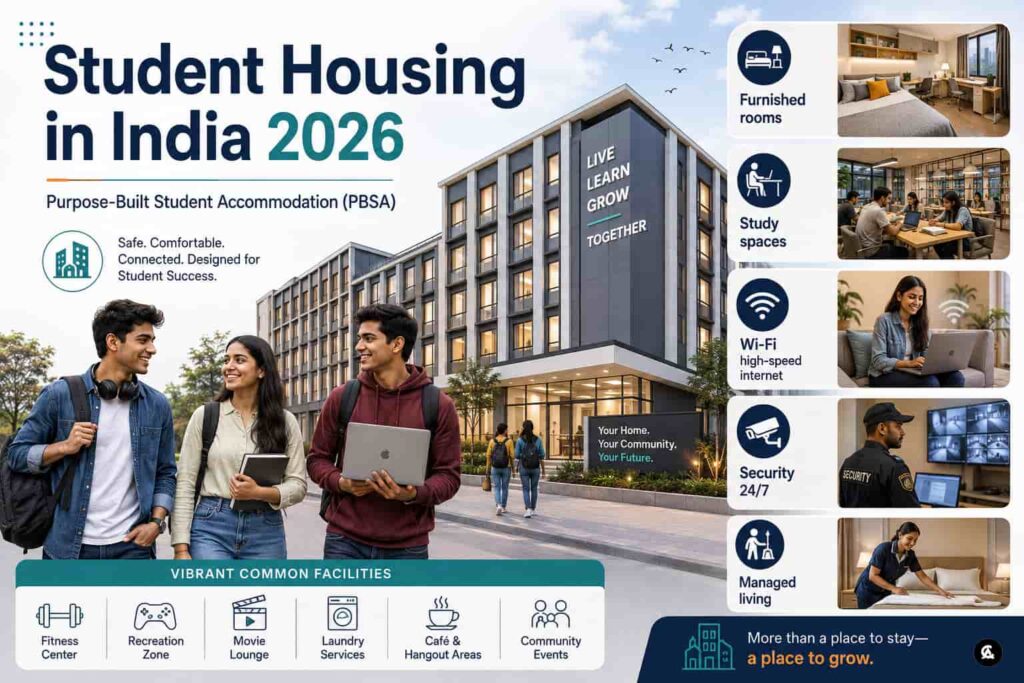
Unlike an ordinary hostel or paying guest accommodation, PBSA is designed and professionally operated specifically for students. It may combine furnished rooms with security, Wi-Fi, housekeeping, meals, study areas and common spaces within one managed property.
Recent industry outlooks also indicate that institutionalised rental housing—including student housing, co-living and senior living—is gaining traction in India.
The question is:
Can student housing become India’s next organised real-estate asset class?
What exactly is PBSA?
PBSA stands for Purpose-Built Student Accommodation.
It refers to accommodation created primarily around the requirements of students rather than ordinary residential tenants.
A typical professionally managed student-housing property may offer:
- furnished rooms;
- single or shared accommodation;
- high-speed internet;
- security and controlled access;
- housekeeping;
- meals or dining facilities;
- laundry;
- common lounges;
- study areas;
- and property management.
The fundamental difference is that the building and its operations are structured around the student’s living cycle.
How is PBSA different from a hostel or PG?
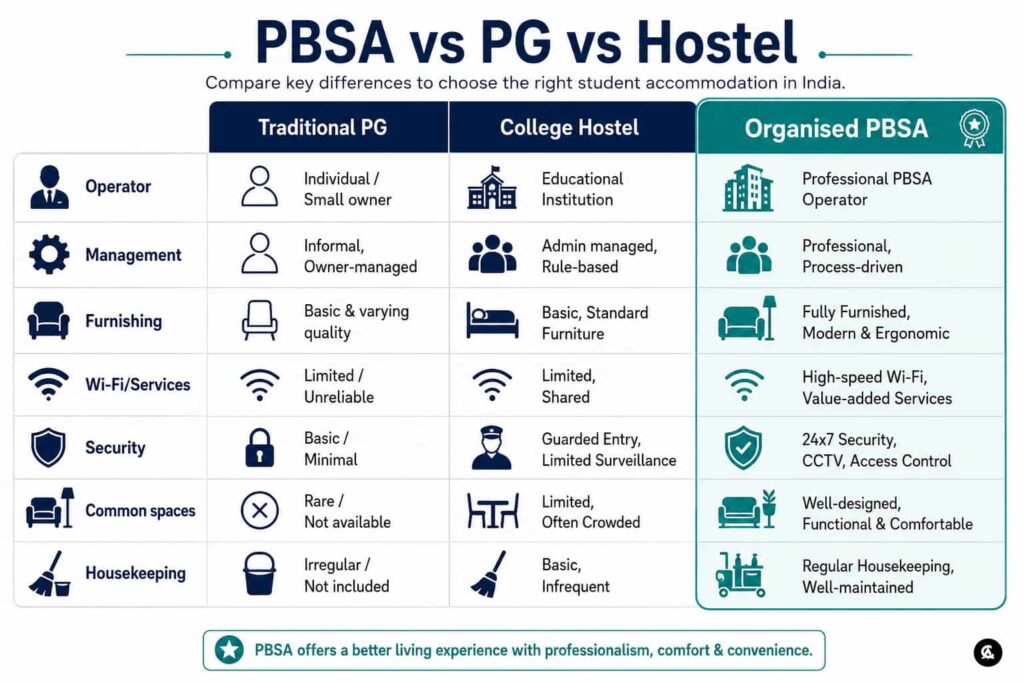
The terms may appear similar, but the operating models can be very different.
| Factor | Traditional PG | College hostel | Organised PBSA |
|---|---|---|---|
| Operator | Individual/local operator | Educational institution | Professional operator |
| Management | Varies considerably | Institution managed | Standardised |
| Furnishing | Basic to moderate | Usually basic | Typically furnished |
| Wi-Fi/services | Varies | Usually available | Usually integrated |
| Security | Varies | Institution controlled | Professionally managed |
| Common spaces | Limited | Usually available | Designed for student use |
| Housekeeping | Varies | Limited/varies | Often included |
| Student experience | Accommodation-focused | Campus-focused | Accommodation + services |
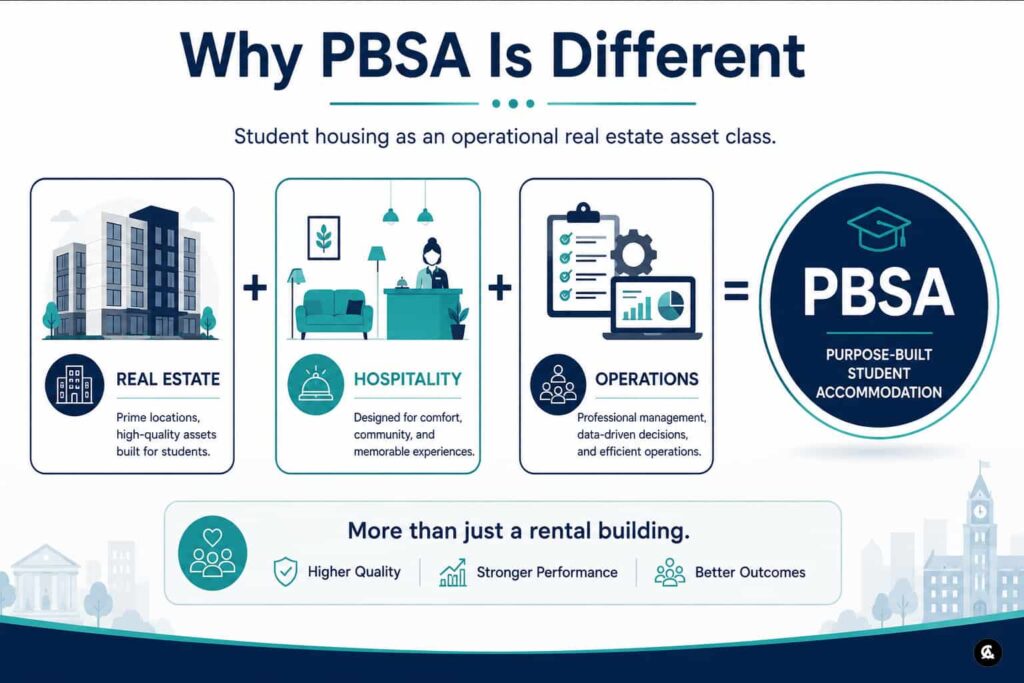
PBSA therefore sits somewhere between real estate, hospitality and managed living.
Why is student housing becoming important in India?
The demand story is relatively straightforward.
Millions of students move away from their hometowns to attend universities, professional colleges, coaching centres and other educational institutions.
But the supply surrounding many campuses continues to depend heavily on:
- individual landlords;
- small PG operators;
- converted residential houses;
- and limited university hostel capacity.
This creates an opportunity for professionally managed accommodation where parents and students are willing to pay for better safety, reliability, cleanliness and convenience.
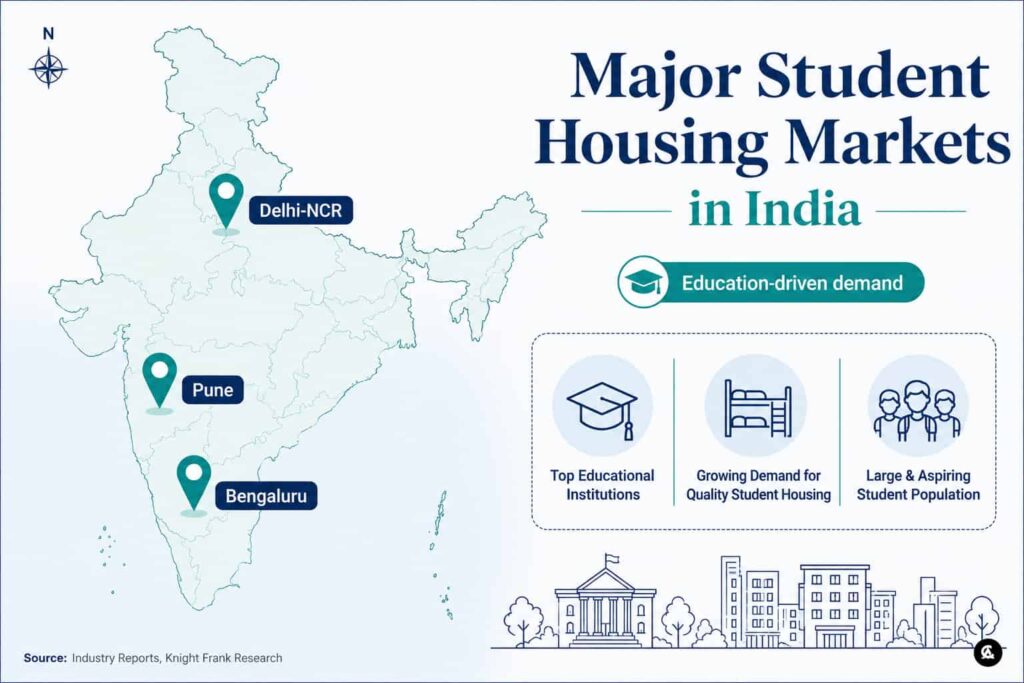
A recent report highlighted Pune, Bengaluru and Delhi-NCR among prominent education markets seeing demand for professionally managed student accommodation.
How large could the student accommodation market become?
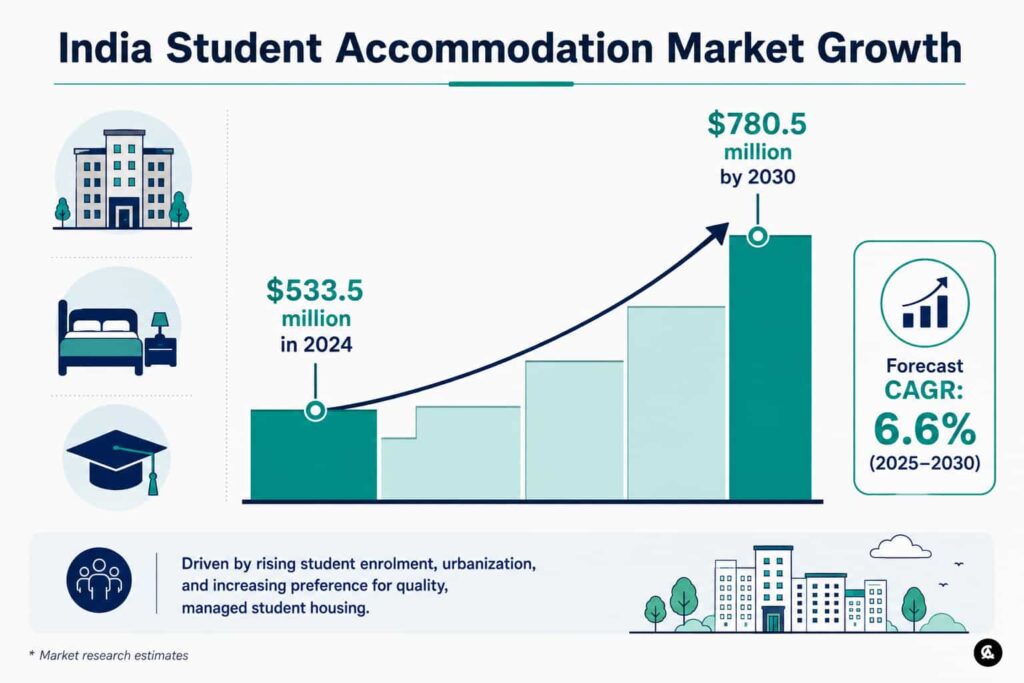
One market estimate valued India’s student accommodation market at approximately US$533.5 million in 2024 and projects it to reach around US$780.5 million by 2030, representing a forecast CAGR of about 6.6% between 2025 and 2030.
The same research identified PBSA as the largest accommodation-type segment by revenue in 2024.
These are market-research estimates rather than government statistics, so they should be read as indicators of the direction of the sector rather than guaranteed outcomes.
Which cities could have stronger student housing demand?
PBSA does not work equally well in every city.
The strongest locations are generally those that combine:
- a large student population;
- multiple universities or colleges;
- students arriving from outside the city;
- limited quality hostel capacity;
- and sustainable rental demand.
Potential markets therefore include major education hubs such as:
Pune: Large higher-education ecosystem with students arriving from across India.
Bengaluru: Universities, technology institutions and a large young migrant population.
Delhi-NCR: Delhi University, Noida and Greater Noida education clusters.
Other education-heavy locations may also present opportunities, but the viability of each project should be analysed at the micro-market and institution level, rather than simply assuming that every university town requires PBSA.
Why are developers and investors looking at this segment?
Traditional residential real estate normally depends on selling homes.
Student housing operates differently.
The asset can generate recurring rental income by accommodating successive batches of students.
For an operator or investor, the attraction can include:
- recurring occupancy;
- predictable academic cycles;
- demand concentrated around education hubs;
- professionally managed rental income;
- and the potential to operate multiple properties under one brand.
This fits a broader shift in Indian real estate towards professionally managed formats.
CBRE’s India Residential Market Outlook 2026 expects increasing institutionalisation of rental housing across segments including student housing, co-living and senior living, although fragmented inventory and compliance issues remain challenges.
Colliers also expects organised managed-living inventory to expand, with PBSA and partnerships with educational institutions supporting future growth.
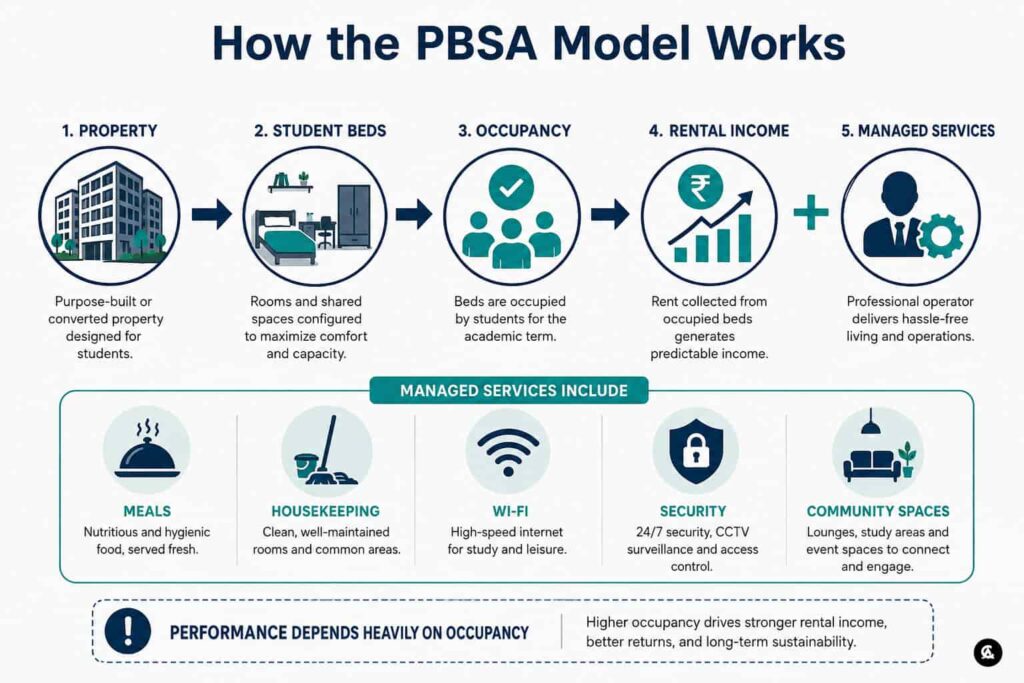
How does a student housing business make money?
The basic model is rental income.
A property may generate revenue through:
- room rent;
- single or double occupancy;
- food plans;
- laundry;
- housekeeping;
- additional services;
- and institutional arrangements with colleges.
The economics depend heavily on occupancy.
For example, a building may look attractive on paper because of high per-bed rents, but poor occupancy can quickly reduce profitability.
That is why operators track revenue per bed, not merely the price of the building.
What makes a good PBSA location?
For student housing, location works differently from conventional residential property.
A premium neighbourhood is not always necessary.
More important factors can include:
- distance from the institution;
- walking or easy commuting access;
- public transport;
- student safety;
- food and daily-use facilities;
- reasonable rent;
- and concentration of colleges or universities.
A property located close to a large education cluster may therefore be more suitable for student housing than a significantly more expensive property located farther away.
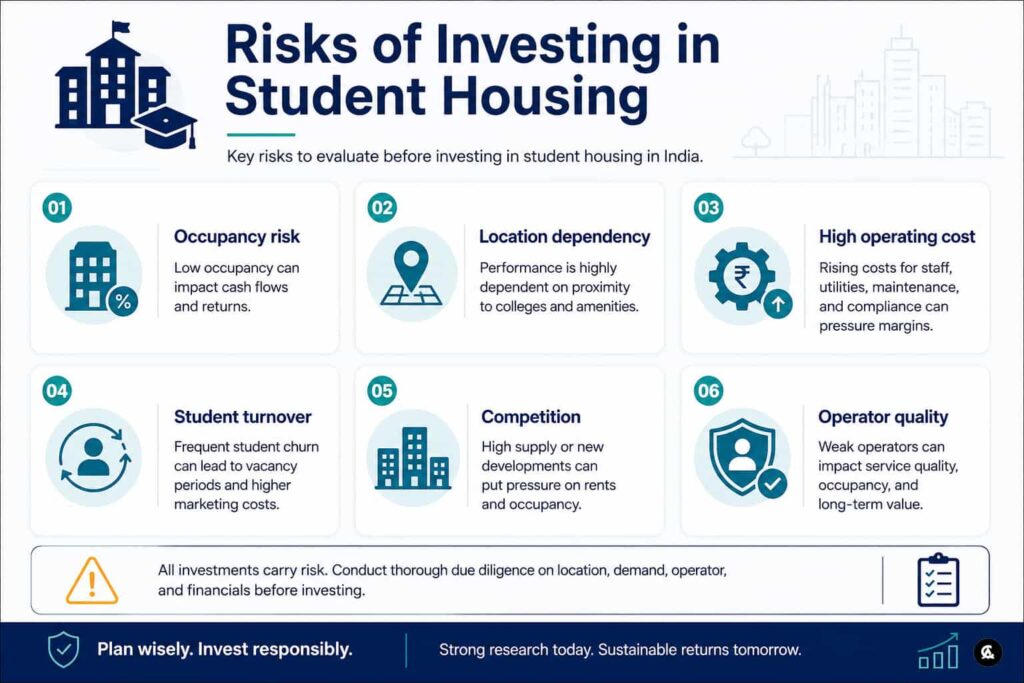
What are the biggest risks?
Student housing is not automatically a high-return investment.
There are several important risks.
Occupancy risk:
If admission numbers decline or students choose another area, vacant beds directly affect revenue.
Single-institution dependency:
A property dependent heavily on one university may face problems if that institution changes hostel capacity or admission levels.
High operating cost:
Security, housekeeping, staffing, food, repairs and utilities create ongoing expenses.
Student turnover:
Students regularly enter and leave, requiring continuous leasing and room maintenance.
Competition:
New PGs, hostels, rental apartments and other PBSA operators can put pressure on pricing.
Operator risk:
A good building can still perform poorly if the management company delivers weak service.
Regulatory and compliance risk:
Fire safety, local building norms, licences and operational requirements need to be properly addressed.
PBSA vs normal residential investment: what changes?
A normal apartment investment is generally judged by:
- purchase price;
- appreciation;
- monthly rent;
- and resale potential.
PBSA requires a different approach.
An investor needs to analyse:
- number of beds;
- rent per bed;
- average occupancy;
- operating expenses;
- student intake;
- university proximity;
- operator fees;
- and seasonal vacancy.
Therefore, a PBSA property should be evaluated partly like a residential asset and partly like an operating business.
Can individual investors participate in student housing?
Possibly, but investors need to understand what exactly they are buying.
There is a significant difference between:
Buying an apartment near a university and renting it to students
and
Investing in a professionally managed PBSA project.
Before investing in any managed student-housing project, investors should verify:
- property title;
- approvals;
- RERA applicability where relevant;
- operator agreement;
- guaranteed-return claims;
- revenue-sharing structure;
- maintenance responsibility;
- exit conditions;
- occupancy assumptions;
- and who owns the underlying real estate.
Any promised or projected rental return should be treated as an assumption until supported by contractual terms and actual operating performance.
Could student housing follow the senior-living model?
There is an interesting similarity.
A senior-living project is not simply a residential building; its value depends heavily on operations, services and the resident experience.
Student housing works on a similar principle.
The physical building matters, but so do:
- management;
- food;
- security;
- community;
- housekeeping;
- technology;
- maintenance;
- and resident experience.
This means PBSA developers cannot simply construct small rooms and call the project student housing.
The operating model is equally important.
Carpet Area analysis
Student housing has a genuine demand base in India because educational migration is already significant.
The bigger opportunity is not simply creating more beds. It is converting an extremely fragmented accommodation market into a professionally managed housing segment.
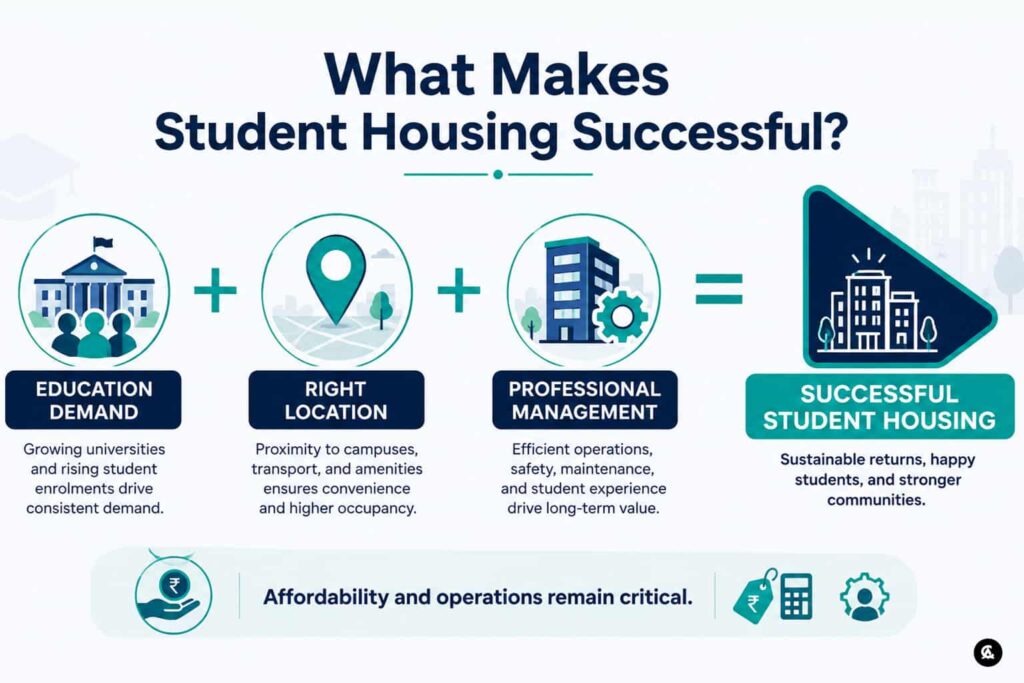
For PBSA to scale successfully, three factors will matter most:
Location: Students must genuinely want to live there.
Affordability: Premium services cannot push rent beyond what students and parents can reasonably pay.
Operations: Consistent management will determine occupancy and reputation.
Investors should therefore avoid evaluating student housing purely on property appreciation or advertised rental yield.
The strongest projects are likely to be those where education demand, location and professional operations work together.
Final conclusion
Student housing is emerging as an interesting alternative segment within Indian real estate.
Demand from students moving between cities already exists. What is changing is the way that demand is being served.
Instead of relying only on hostels, PGs and individual landlords, professionally managed student accommodation is beginning to create a more organised market.
But PBSA should not be viewed as an automatic high-return investment.
Its success depends on:
- the right educational catchment;
- sustainable rents;
- high occupancy;
- good management;
- sensible acquisition or construction costs;
- and strong regulatory compliance.
If these fundamentals improve, Purpose-Built Student Accommodation could become an important part of India’s organised rental-housing market over the coming years.
Sources
CBRE India – India Residential Market Outlook 2026: Institutionalisation of rental housing across student housing, co-living and other managed-living formats. CBRE India Residential Market Outlook 2026
Colliers India – India Real Estate 2026 Outlook: Expansion of organised managed living, PBSA and education-institution partnerships. Colliers India Real Estate 2026 Outlook
Grand View Research – India Student Accommodation Market: Market-size and 2030 projection. India Student Accommodation Market Outlook
Times of India – Student Housing Emerging as a Real Estate Segment: Recent reporting on demand and major education hubs. Student Housing in India report




Leave a Reply