


Tamil Nadu is preparing for a major change in the way certain new-property transactions are registered.
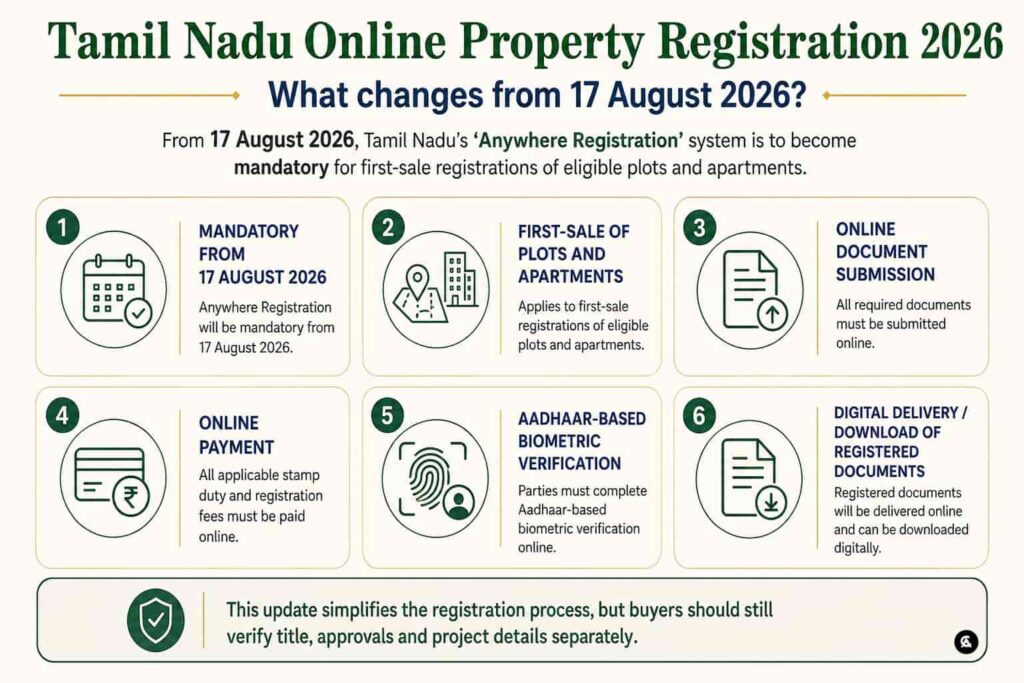
From 17 August 2026, the state’s Anywhere Registration system will become compulsory for specified first-sale transactions involving plots and apartments, allowing builders and developers to submit and complete eligible registrations digitally instead of requiring the traditional physical visit to the Sub-Registrar Office.
The reform is significant, but homebuyers should understand one thing clearly: online property registration does not mean every property transaction in Tamil Nadu can now be completed from home, nor does it replace legal due diligence before buying a property.
What changes from 17 August 2026?
Tamil Nadu’s Commercial Taxes and Registration Minister announced that the Anywhere Registration system will become compulsory for the first sale of plots and apartments from 17 August 2026.
Under the first phase, the government has identified transactions including:
- first sale of plots by developers;
- first sale of apartments by builders;
- associated title-deed deposit documents in applicable plot transactions;
- and linked mortgage documents in applicable apartment transactions.
Builders and land developers will need their own login credentials on the Registration Department’s online system and will submit eligible sale documents electronically.
This is therefore primarily a change to the developer-to-first-buyer registration process, rather than a blanket replacement of every property registration procedure in Tamil Nadu.
Does the new rule cover resale properties?
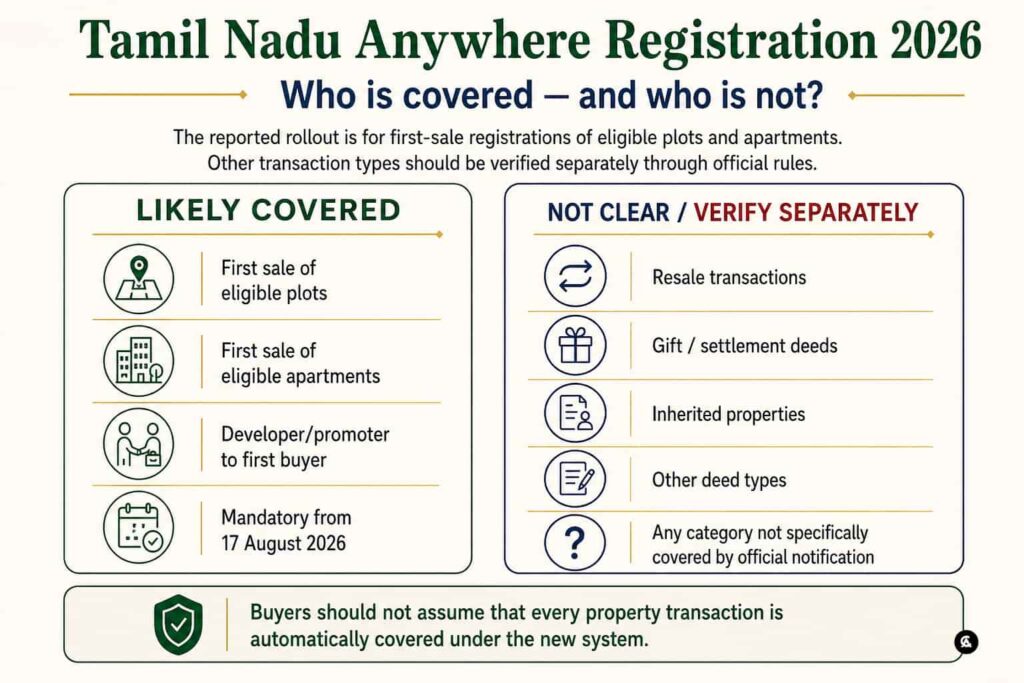
The confirmed August rollout specifically focuses on first-sale transactions.
That normally means the first transfer of a newly developed plot or apartment from the developer/promoter to its first purchaser.
There is currently not enough publicly available information from the rollout announcement to say that ordinary resale transactions, inheritance transfers, gift deeds or every Power of Attorney transaction will automatically fall under the same mandatory first-phase process.
Buyers dealing with these types of transactions should check the applicable Registration Department procedure rather than assuming that the new rule applies.
Old property registration vs Anywhere Registration
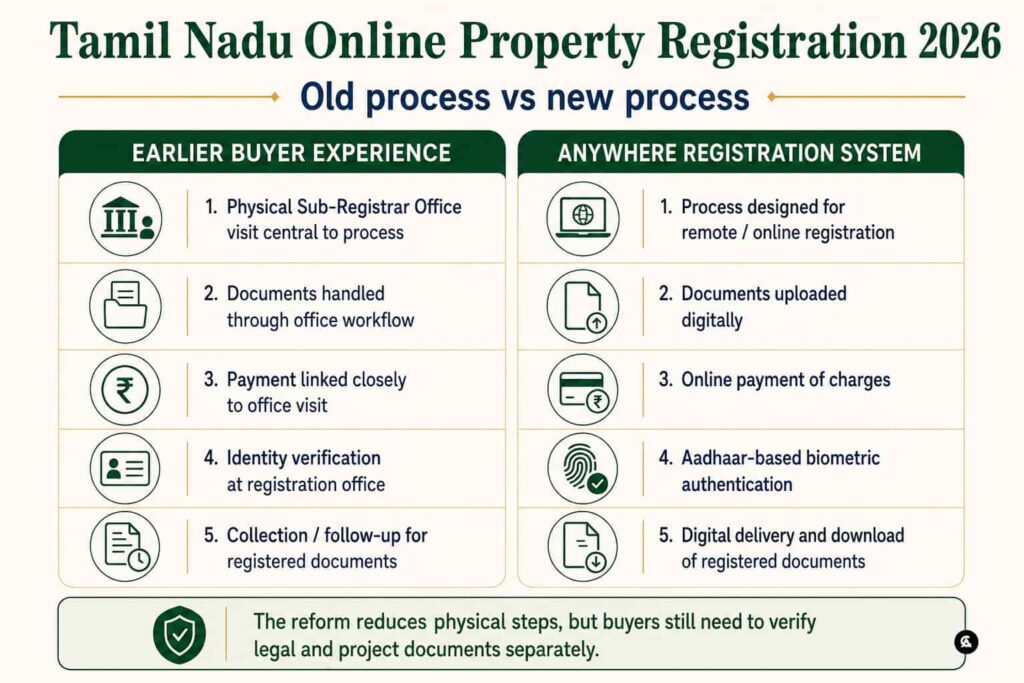
The key change is the removal of much of the physical interface involved in eligible registrations.
| Conventional process | Anywhere Registration |
|---|---|
| Physical interaction with Sub-Registrar Office central to final registration | Eligible documents can be digitally submitted |
| Registration papers move through office-based workflow | Documents uploaded online |
| Parties physically complete identity verification | Aadhaar-based biometric authentication is used |
| Payments linked with registration process | Charges can be paid online |
| Registered document collected/followed up physically | Digitally signed document issued electronically |
According to the Registration Minister, the objective is to improve transparency, reduce waiting time and reduce overcrowding at Sub-Registrar Offices.
Can property really be registered without visiting the Sub-Registrar Office?
For the eligible categories covered under the presence-less system, that is the purpose of the reform.
The reported process requires applicants to:
- create the required online account;
- upload transaction documents;
- submit Aadhaar information of the relevant parties and witnesses;
- upload photographs;
- complete biometric authentication;
- pay the applicable charges online; and
- digitally submit the document for examination by the registering authority.
If the Sub-Registrar requires additional information, the applicant can respond electronically.
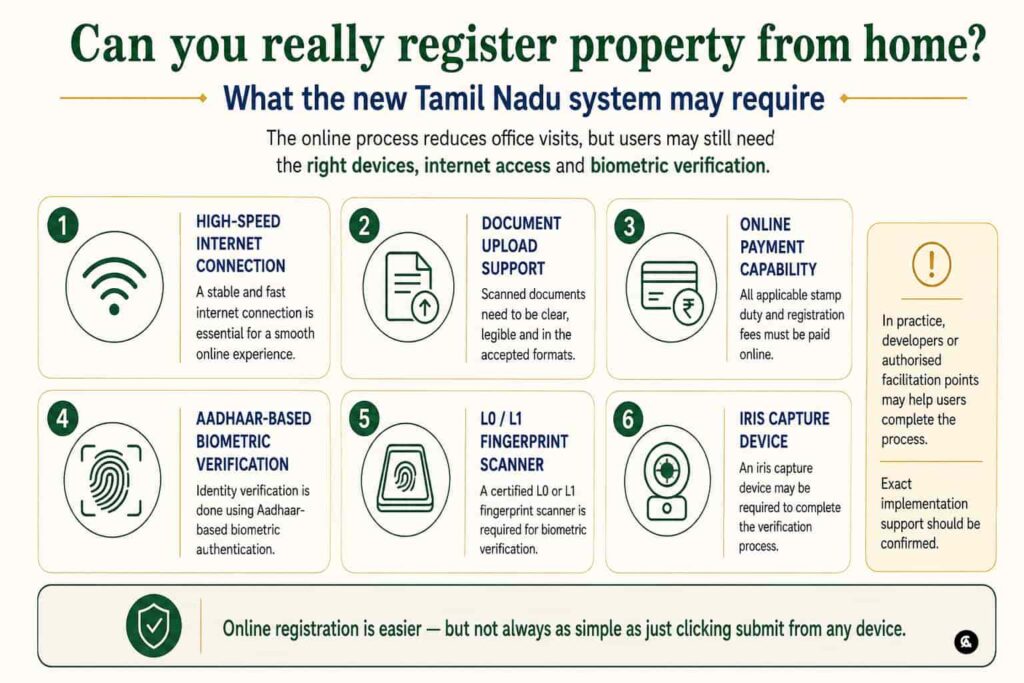
However, “online” does not simply mean that any buyer can complete the entire process with only a mobile phone.
Reports on the rollout state that the setup can require internet connectivity, UIDAI-approved biometric equipment and a webcam. Earlier rollout reporting also referred to facilities such as e-Seva assistance as an alternative route for users.
How will Aadhaar and biometric verification work?
Identity verification is an important part of the new system.
Aadhaar details of parties involved in the eligible transaction—including executants, claimants and witnesses—are to be provided, with identity authenticated using biometric verification such as fingerprint or iris scanning.
This allows identity verification to take place digitally before the registering authority processes the document.
The move does not remove the Sub-Registrar’s role.
The registering officer will still examine the documents for statutory compliance before allowing registration.
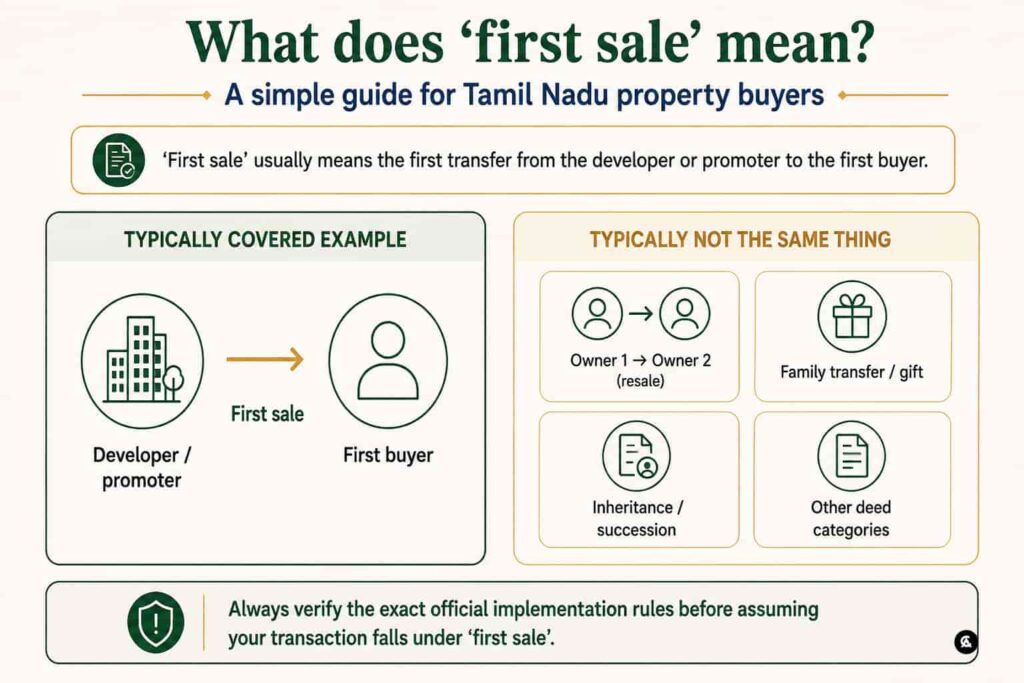
What exactly is a ‘first sale’?
For a typical new residential project, a first sale can be understood as:
Developer / promoter → First property buyer
For example, if a builder develops an apartment and transfers it to the original purchaser, that is the type of transaction targeted by this rollout.
It should not automatically be treated as the same as:
- Buyer A reselling a flat to Buyer B;
- family gift transfers;
- inheritance;
- succession;
- or another category of deed.
The exact treatment of a transaction should always be checked against the applicable registration rules.
What happens after the document is submitted online?
The registration process does not become an automatic approval system.
The concerned Sub-Registrar continues to scrutinise the transaction.
According to the rollout details:
- additional information can be sought online;
- applicants can respond electronically;
- the registered document will carry the Sub-Registrar’s digital signature;
- the document and fee receipts are expected to be issued on the same day or by the next working day under the stated process;
- and registered documents can reportedly be downloaded for a limited period after registration.
Tamil Nadu has also stated that its existing same-day registration and document-return commitment will apply to the presence-less system.
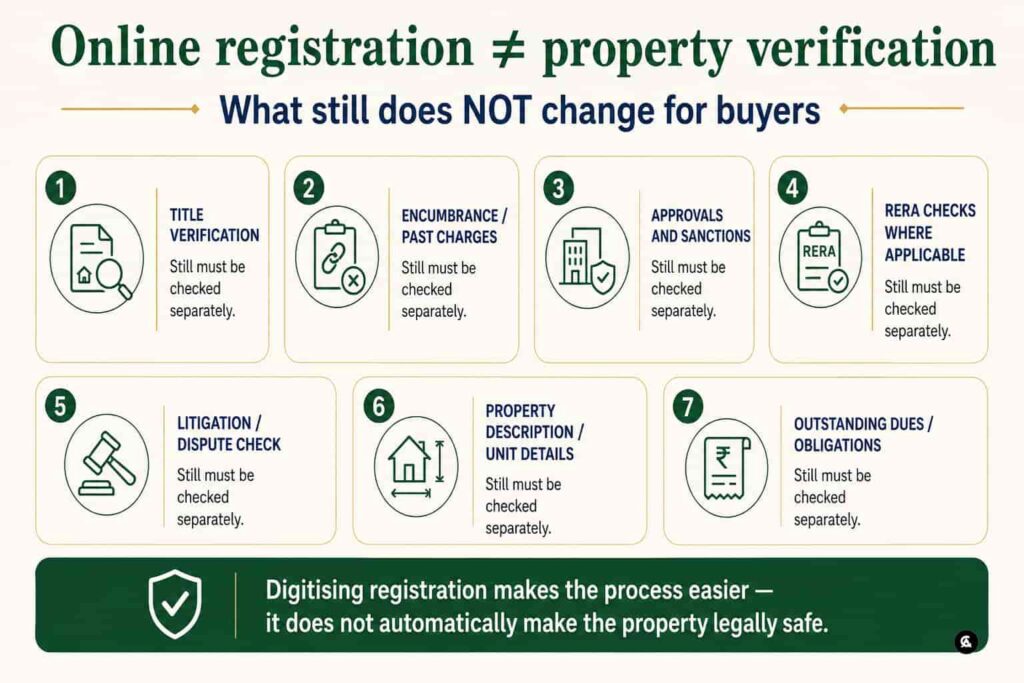
Does online registration guarantee that a property is legally safe?
No. This is probably the most important point for a homebuyer.
Online registration changes how the sale document is registered.
It does not automatically certify that:
- the developer has perfect title;
- there is no litigation;
- the land is free from encumbrances;
- all planning permissions are valid;
- the project is compliant with RERA where applicable;
- there are no unpaid dues;
- or the flat/plot description in the agreement is correct.
A buyer should still independently verify the property before registration.
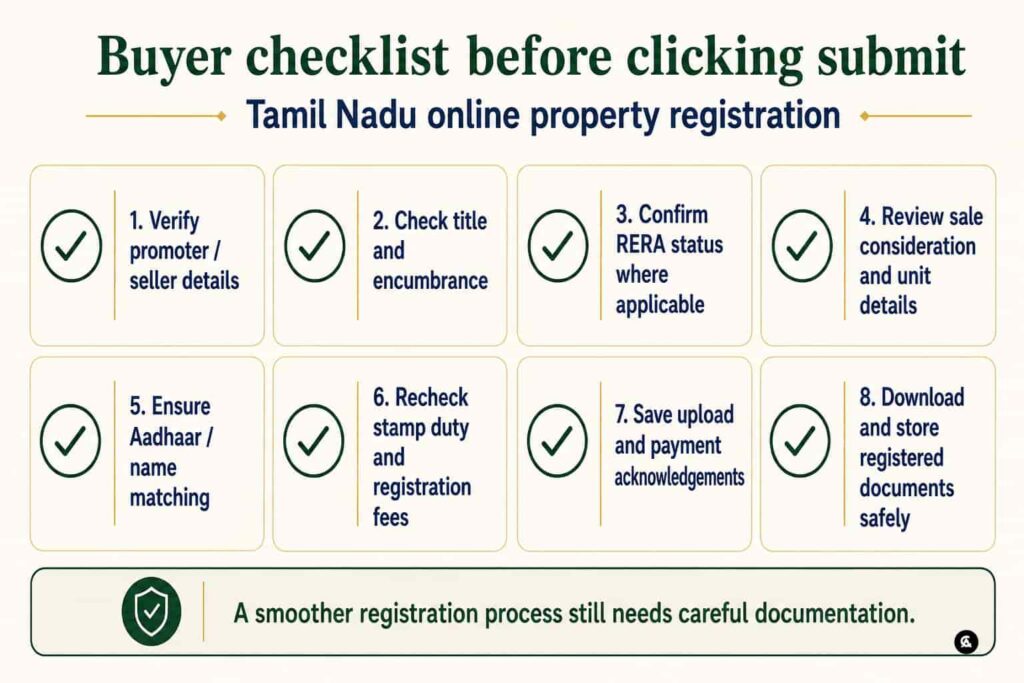
What should a buyer verify before completing online registration?
A buyer should ideally check:
- seller/developer identity;
- title documents;
- Encumbrance Certificate;
- approved plan and relevant permissions;
- RERA registration where applicable;
- exact survey number, plot number or apartment number;
- area mentioned in the agreement;
- sale consideration;
- applicable stamp duty and registration charges;
- Aadhaar/name consistency across documents;
- pending dues or charges;
- and any known litigation affecting the property.
Once the registration is complete, the buyer should securely retain the digitally signed registered document and payment acknowledgements.
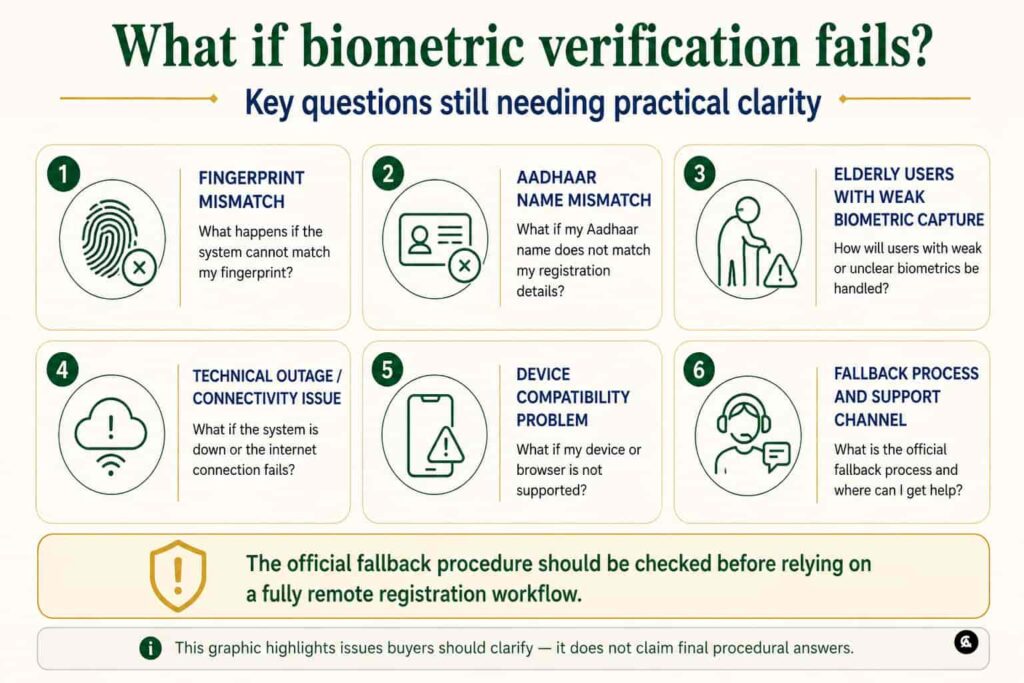
What if fingerprint or biometric authentication fails?
This is an important practical issue, particularly for elderly buyers or people whose fingerprints may not scan easily.
The available rollout reports explain the use of fingerprint and iris authentication, but the detailed public material we reviewed does not provide enough clarity on every fallback scenario, such as:
- repeated biometric failure;
- Aadhaar mismatch;
- unsupported devices;
- prolonged system outage;
- elderly users with poor biometric capture.
Buyers facing such cases should follow the official help or fallback mechanism provided by the Registration Department once the system becomes operational.
It would be misleading to assume a workaround until the department formally specifies it.
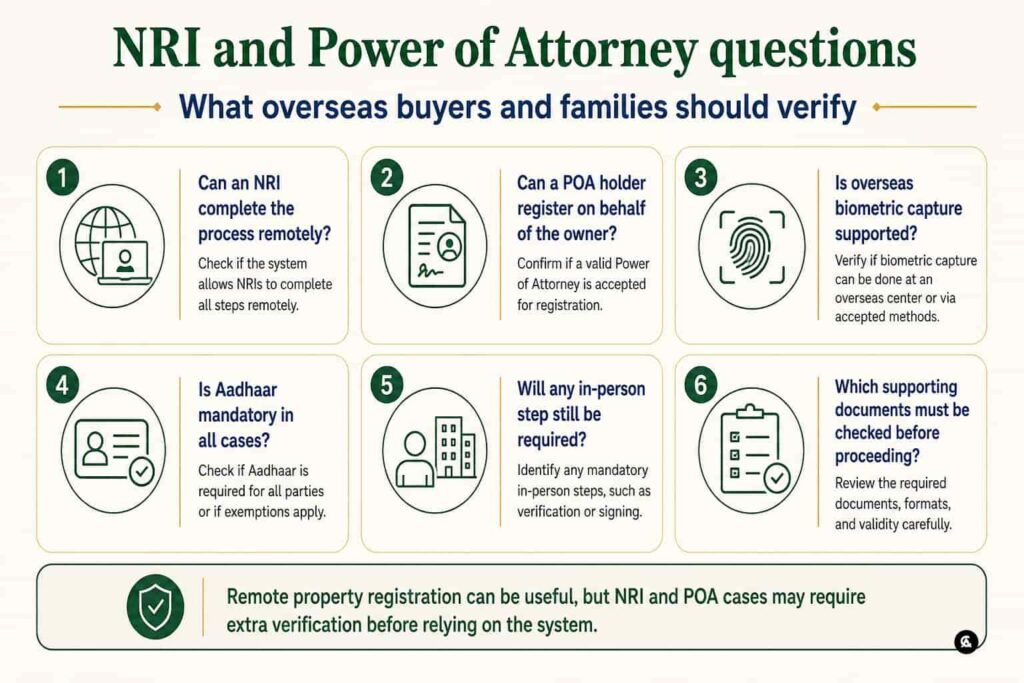
What about NRIs and Power of Attorney transactions?
The online system could potentially reduce physical inconvenience, but NRIs should not assume that the August rollout automatically enables an entire property transaction to be completed from overseas.
Questions still requiring transaction-specific confirmation include:
- whether Aadhaar authentication is mandatory for every relevant party;
- how biometric authentication would be completed from outside India;
- whether an attorney acting under a Power of Attorney can complete the relevant process;
- whether any physical verification is required;
- and whether a particular POA/deed category falls within the first phase.
Until these are clarified through the applicable official procedure, NRI and POA transactions should be treated separately from the straightforward developer-to-first-buyer case.
Why is Tamil Nadu introducing Anywhere Registration?
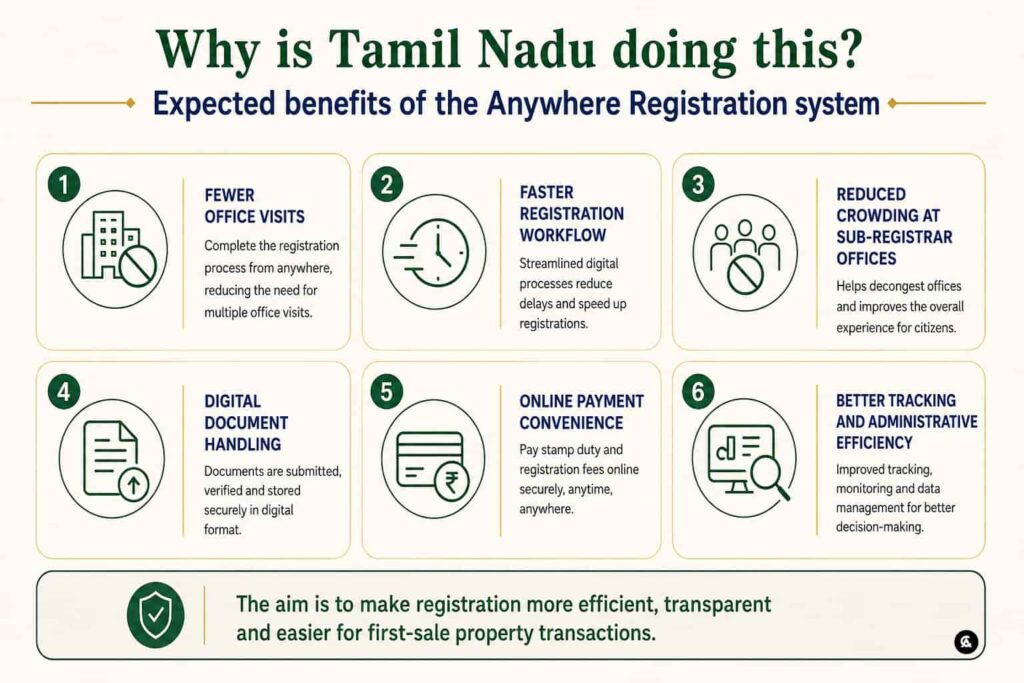
The state says the reform is intended to make property registration:
- more transparent;
- more accessible;
- faster;
- less dependent on physical interaction;
- and less congested at Sub-Registrar Offices.
The government expects the first phase itself to reduce a substantial portion of physical footfall at registration offices.
It is also part of Tamil Nadu’s wider move from earlier STAR and STAR 2.0 systems towards the STAR 3.0 digital registration ecosystem.
Is there an official legal document behind online registration?
Yes.
The legal groundwork for electronic presentation of registration documents was created earlier.
An official Tamil Nadu Government Gazette Extraordinary dated 12 September 2022 brought the Registration (Tamil Nadu Amendment) Act, 2021 into force.
The same Gazette contains G.O. Ms. No.132, Commercial Taxes and Registration (J2), dated 12 September 2022, concerning presentation of specified documents through electronic means for online registration under the Registration Act, 1908.
The July 2026 rollout is a further expansion of this digital-registration framework.
The New Indian Express reported that the Tamil Nadu government issued a fresh Government Order in July 2026 setting out the first phase of presence-less registration for the specified first-sale transactions.
Important transparency note: while the issue of that fresh G.O. is reported and the 2022 Gazette is publicly available on the Tamil Nadu Government’s official Gazette website, I have not found a publicly accessible official copy of the July 2026 G.O. itself during this review. Therefore, buyers should rely on the Registration Department’s final operational notification and portal instructions once published.
What should homebuyers take from this change?
For buyers purchasing a new plot or new apartment directly from a builder or developer in Tamil Nadu, the registration experience could become significantly more digital from 17 August 2026.
But the reform should be understood correctly:
It digitises registration. It does not digitise away buyer responsibility.
Before transferring large amounts of money or registering a property, buyers still need to verify the title, approvals, encumbrances, RERA details and the exact property being purchased.
That distinction matters far more than whether the sale deed is registered at a counter or through a computer.
Sources:-
Official Tamil Nadu Government Gazette:
Tamil Nadu Government Gazette PDF – 12 September 2022
The New Indian Express — 8 July 2026:
Read The New Indian Express report
Times of India — 7 July 2026:
Read Times of India report
The New Indian Express — 8 June 2026:
Read the June rollout report





Leave a Reply