


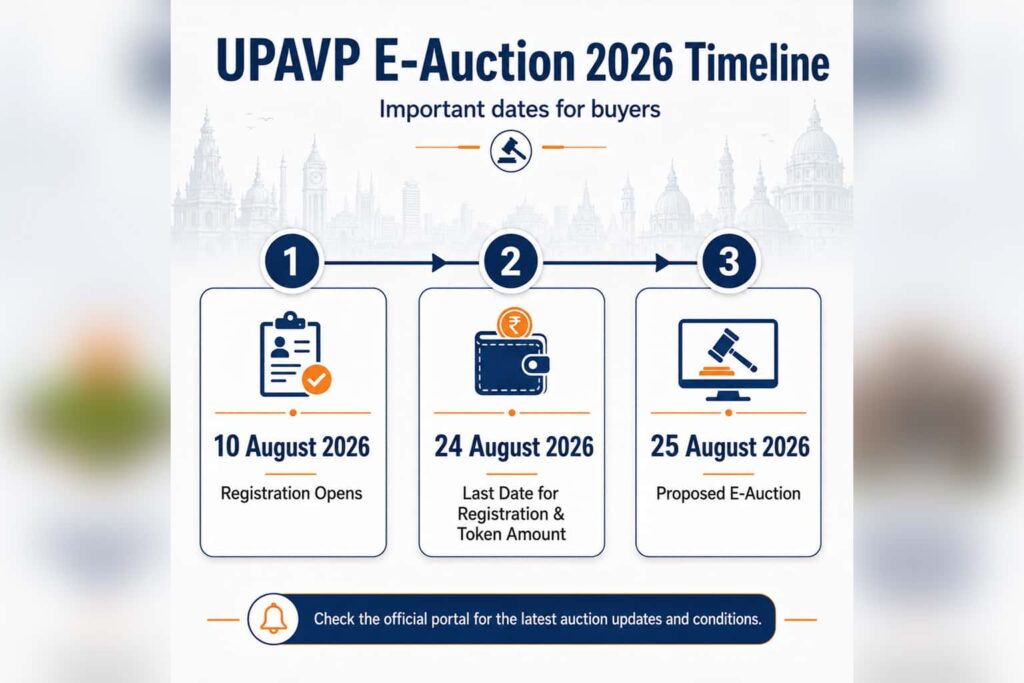
The Uttar Pradesh Awas Evam Vikas Parishad (UPAVP) has scheduled a fresh e-auction of residential, commercial, educational and other non-residential properties across multiple zones in Uttar Pradesh. Registration and deposit of the applicable token amount are scheduled from 10 August to 24 August 2026, while the proposed e-auction is to be held on 25 August 2026. Search-indexed copies of the auction notice also show the same 10–24 August registration window and 25 August auction date.

This is not a single housing scheme or a private-builder launch. The inventory spans different UPAVP schemes and property categories, meaning a buyer looking for a house or residential plot and an investor looking for a shop, commercial plot or institutional property may find very different options within the same auction programme.

UPAVP e-auction 2026: Key dates
The immediate schedule buyers need to know is straightforward:
| Event | Date |
|---|---|
| Online registration begins | 10 August 2026 |
| Token amount deposit period | 10–24 August 2026 |
| Last date for registration/token payment | 24 August 2026 |
| Proposed e-auction | 25 August 2026 |
Registration and bidding are conducted online. UPAVP also operates a dedicated e-auction portal for participation in its property auctions.
What types of properties are being auctioned?
One of the important aspects of this auction is the variety of properties.
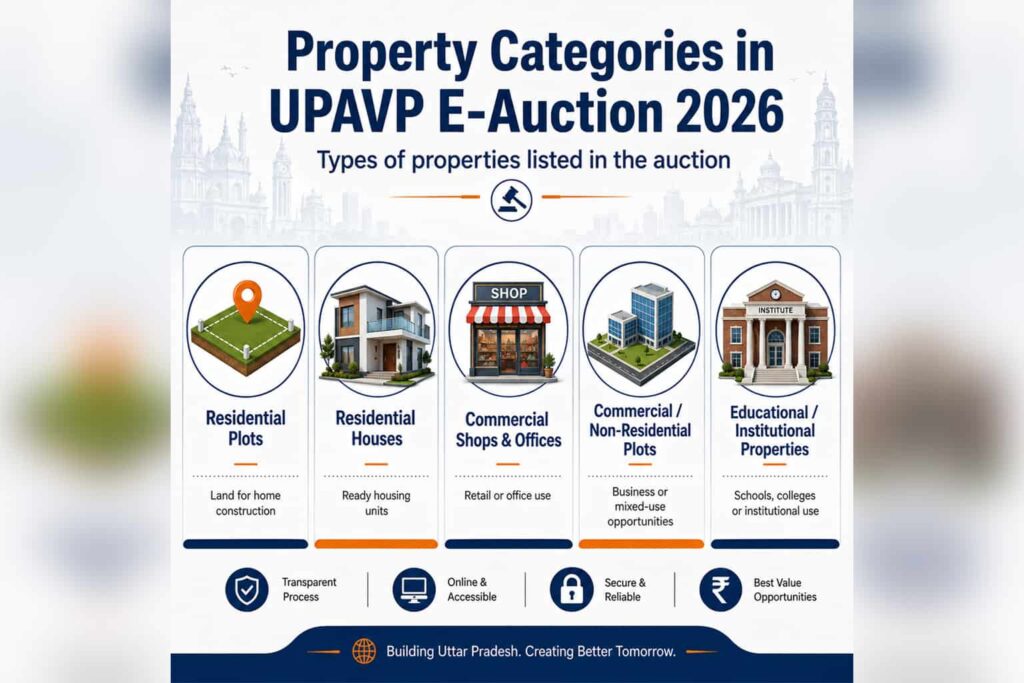
The official listing covers different residential and non-residential categories, including properties described as:
- Residential plots
- Residential houses
- LIG houses
- EWS houses
- Commercial shops
- Commercial plots
- Group-housing plots
- Educational properties
- Institutional plots
- Other non-residential properties
This distinction matters because the eligibility conditions, permitted use, reservation status, payment terms and applicable auction rules may differ from one property category to another.
A commercial plot should therefore not be evaluated using the same criteria as an LIG house or an educational plot.
Where are the properties located?
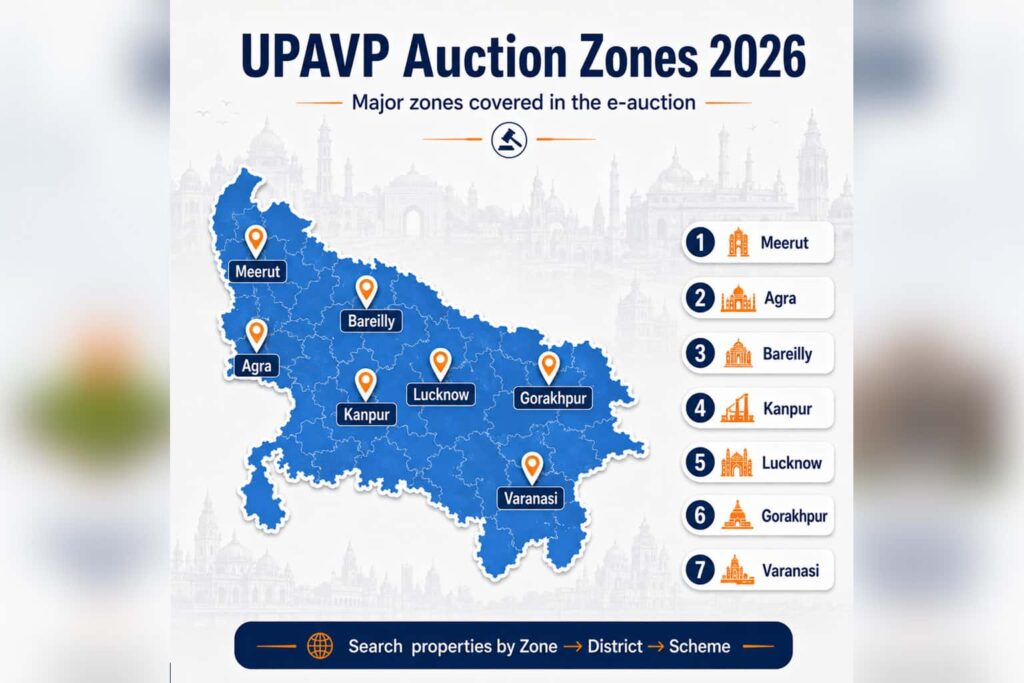
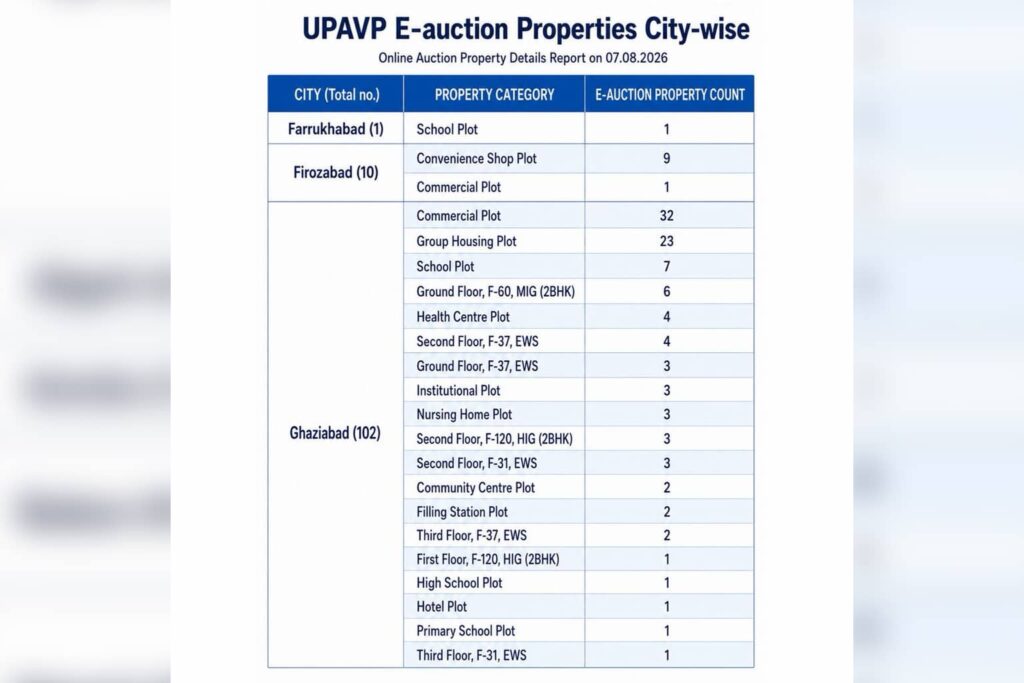
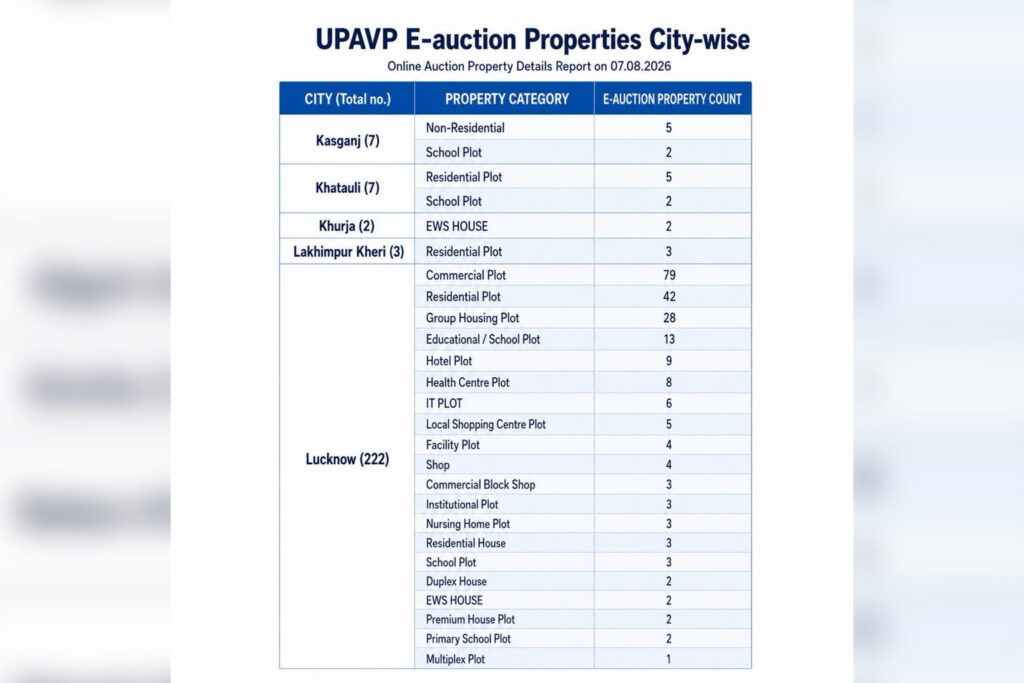
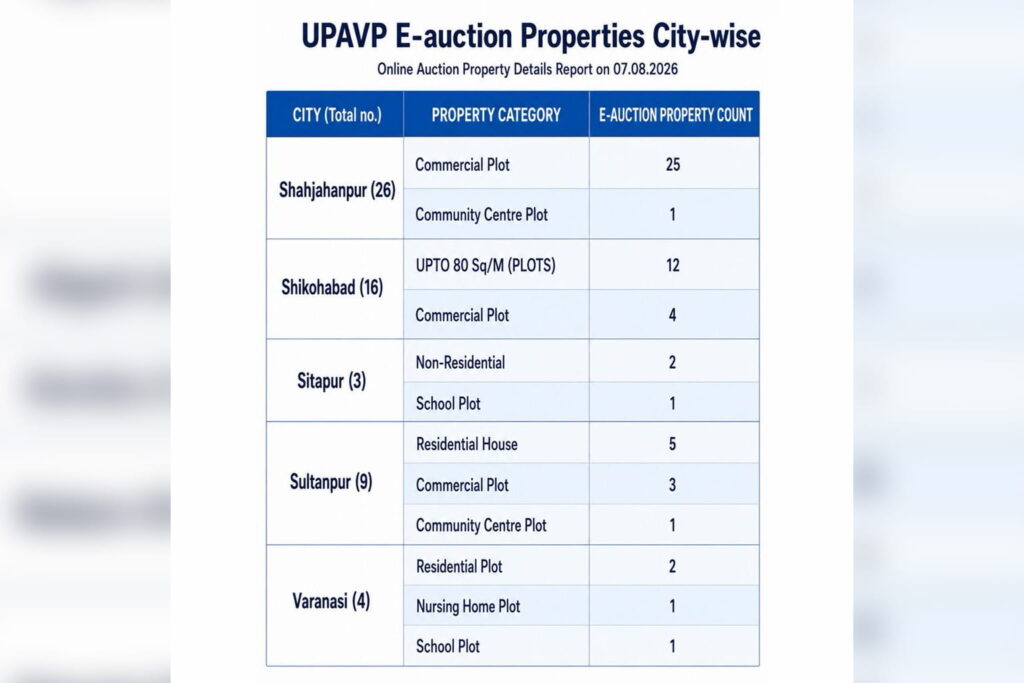
The auction inventory is organised through major UPAVP zones including:
Agra, Bareilly, Gorakhpur, Kanpur, Lucknow, Meerut and Varanasi.
A crucial point for buyers is that zone and district are not necessarily the same thing.
For example, properties displayed under a particular UPAVP zone may be situated in other districts administered through that zone. The listing referred to districts and locations such as Aligarh, Firozabad, Bijnor, Moradabad, Shahjahanpur, Gonda, Etawah, Barabanki, Hardoi, Lakhimpur Kheri, Sitapur and Sultanpur, among others.
Therefore, a buyer should not search only by the seven zone names.
The correct approach is:
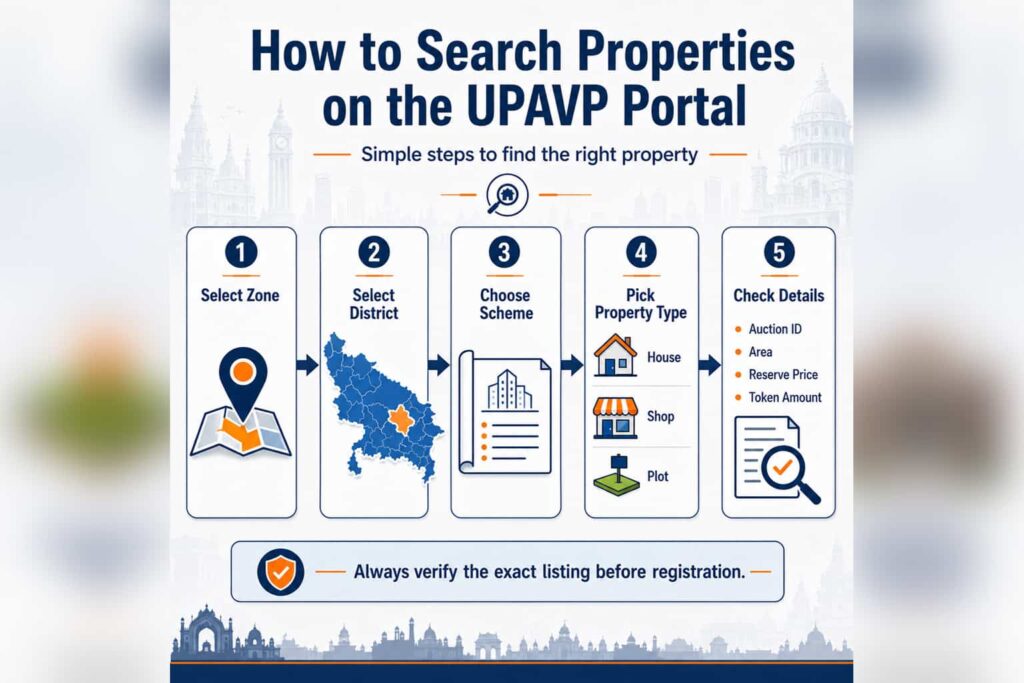
Zone → District → Scheme → Property → Property Category
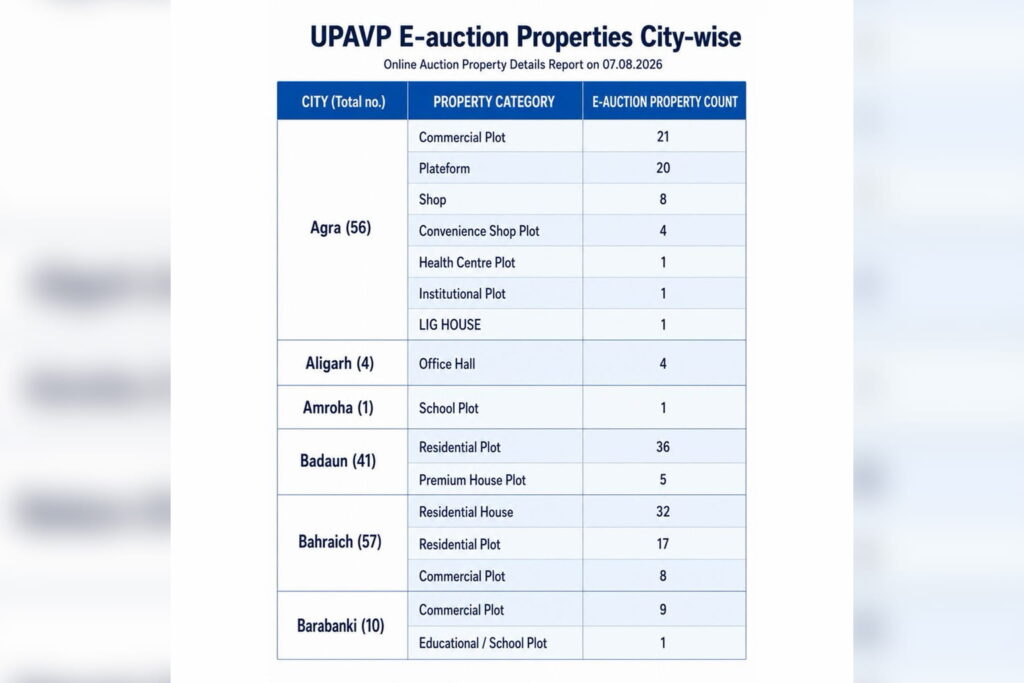
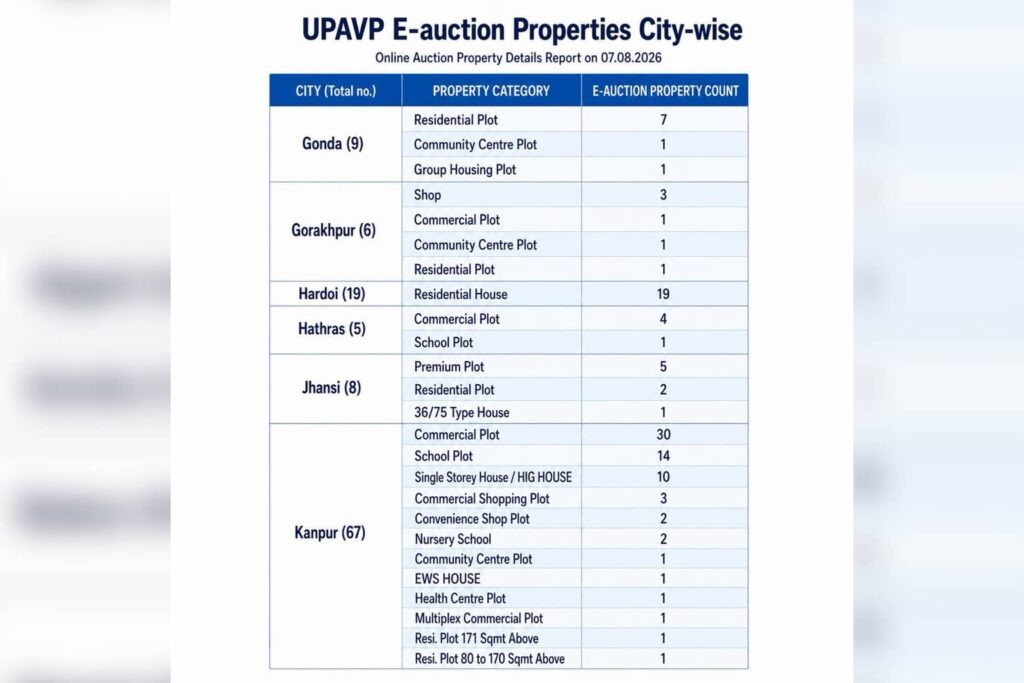
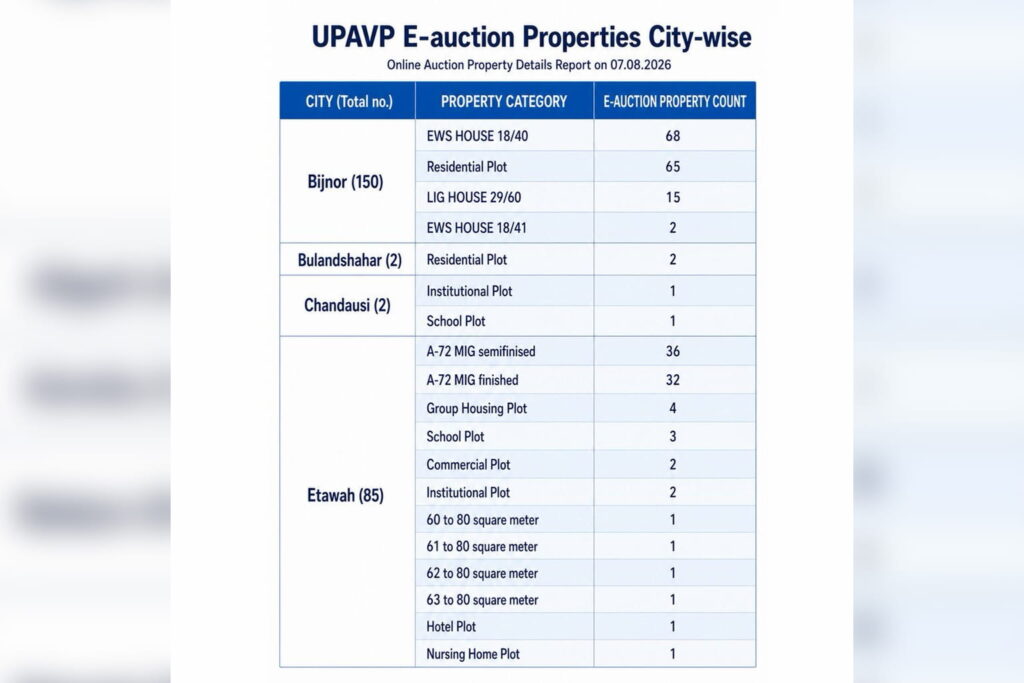
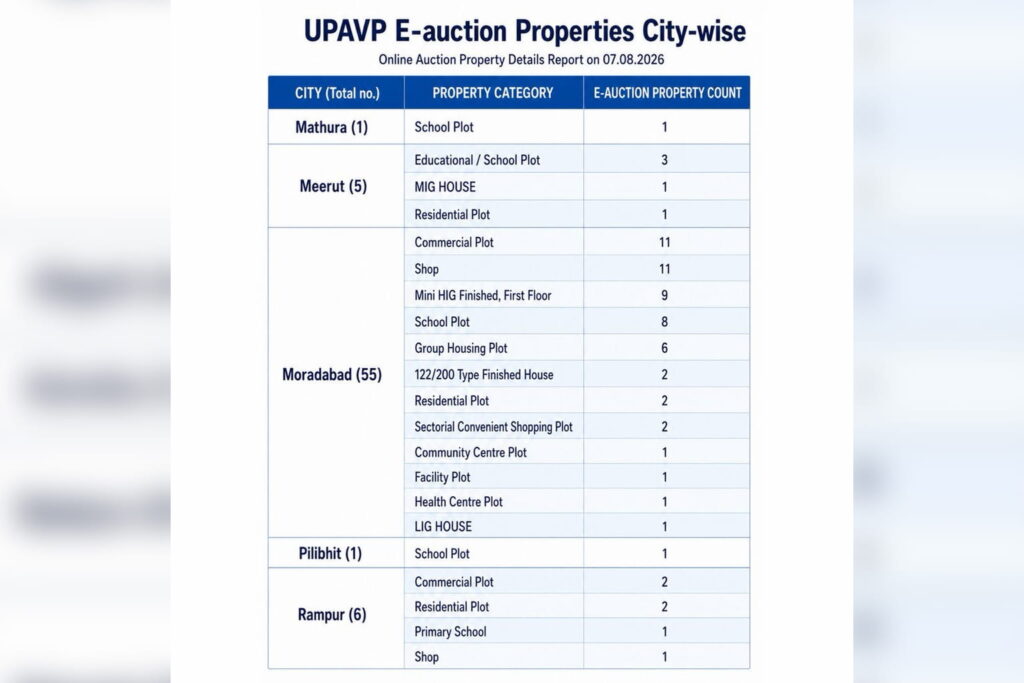
How to find a suitable property on the UPAVP portal?
The UPAVP property database allows buyers to narrow down the available inventory instead of manually searching through a long list.
A buyer should first identify the preferred:
Zone → District → Scheme → Property Type → Property Category
The individual listing can then provide relevant information such as:
- Property or unit number
- Auction ID
- Scheme
- Property type
- Property category
- Area
- Reserve price
- Token amount
- Reservation/category status
This is a much better way to shortlist properties than choosing solely on the basis of a city name or an advertised reserve price.
Reserve price and token amount are not the same thing
Two figures need particular attention when comparing auction properties.
Reserve price is the price benchmark attached to a particular property for the auction. It should not automatically be treated as the amount at which the property will finally be acquired because competitive bidding can take the final bid above the reserve level.
The token amount is the amount required under the auction conditions for participation in the selected property.
The applicable amount can vary from property to property, so buyers should use the figure shown against the specific Auction ID, rather than assuming a common token amount across the auction.
This is particularly important where several properties in the same scheme have different sizes, categories or reservation conditions.
Do not rely on a single headline property count
Buyers may come across different property counts while viewing exports, filtered results or the live auction database.
For that reason, the safest reference is the current property list against the 25 August 2026 auction on the official portal, rather than an isolated Excel export or a number repeated in an advertisement.
The auction database is searchable, and the final property chosen by the bidder should be verified through its Auction ID and property details before any payment is made. The official e-auction portal is the appropriate reference point for live auction participation.
This approach also avoids confusion where one portal screen displays all available records while an exported or filtered list contains only a subset.
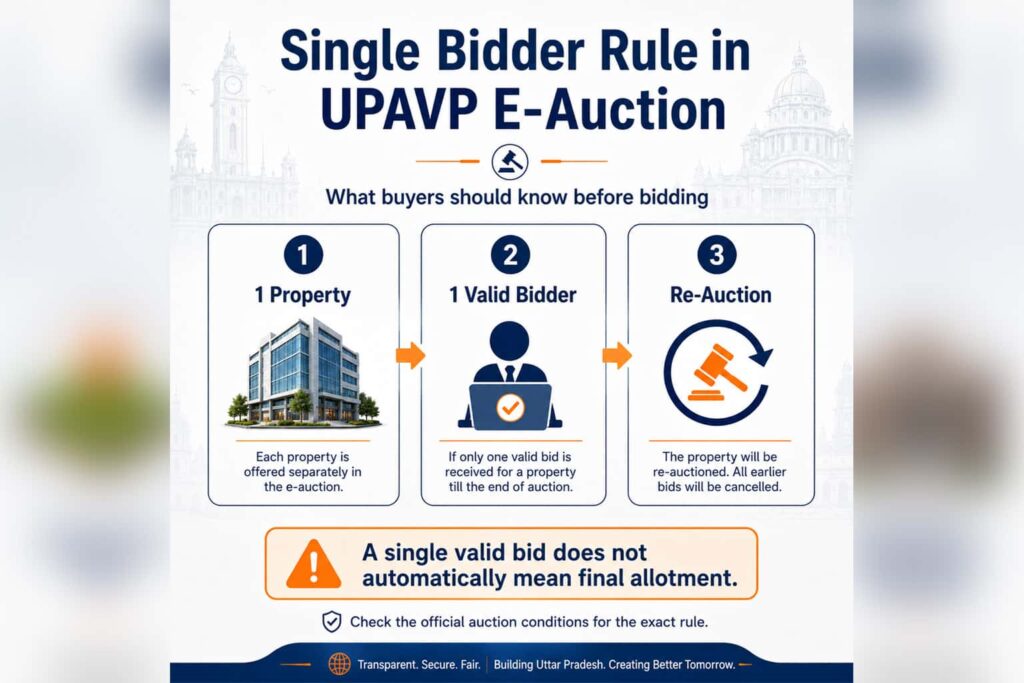
What happens if only one bidder participates?
This is one of the most important auction conditions for prospective buyers.
According to the auction information, where only a single bid is received for a property in the proposed e-auction, the property can be taken up for re-auction rather than being automatically allotted merely because only one bidder participated.
In practical terms:
Being the only bidder should not be interpreted as a guarantee that the property will be allotted at the reserve price.
Are all properties open to every applicant?
Not necessarily.
The property listing contains fields relating to reservation/category status, and some entries may be unreserved while others may carry specific category conditions.
A bidder should therefore verify the reservation field of the exact property before paying the token amount.
Do not assume that another property in the same scheme has identical eligibility.
Different properties have different auction rules
UPAVP provides separate rules and conditions for different categories of property.
The available documentation referred to separate rules for:
Residential/Staff Quarter properties
Non-residential properties
Educational properties
This is important because payment conditions, eligibility, property use, documentation and other obligations can differ substantially.
A buyer interested in a shop should therefore study the non-residential terms, while a person bidding for a residential property should read the applicable residential rules.
How to participate in the UPAVP e-auction?
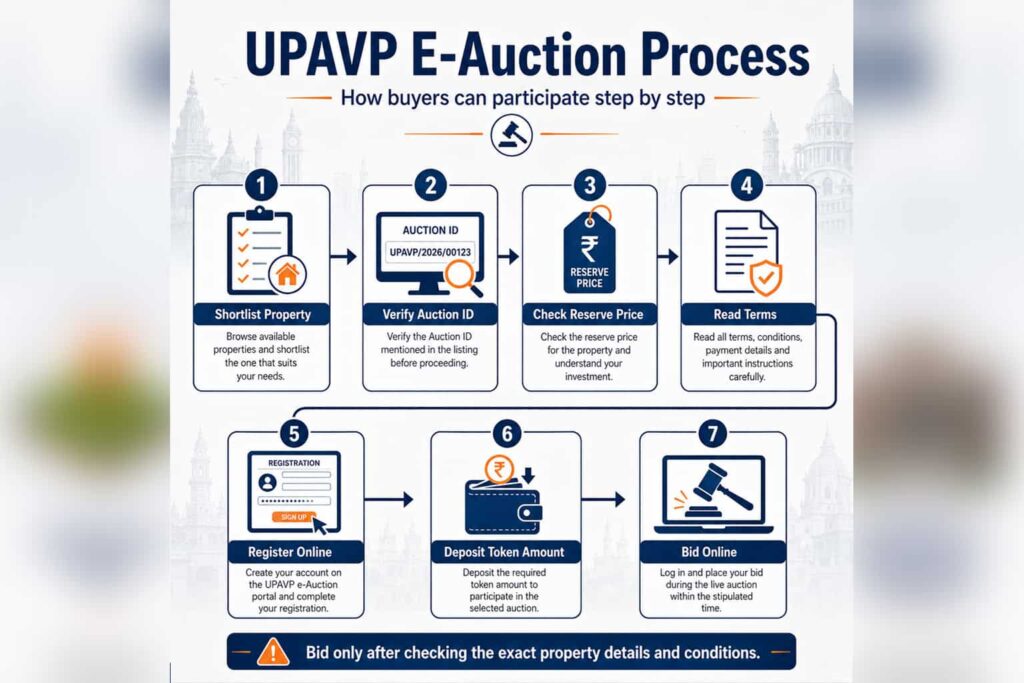
The process should be approached in the following order:
1. Shortlist the property
Search the official auction database using zone, district, scheme and property category.
2. Note the Auction ID
Do not identify the property merely by its locality. Record its property number and Auction ID.
3. Check area and permitted use
Confirm whether the asset is a residential plot, house, shop, commercial plot, educational plot or another category.
4. Check the reserve price
Evaluate the starting price against the property’s location, size, permitted use and surrounding market.
5. Check the token amount and eligibility
Confirm the exact token amount and whether any reservation/category condition applies.
6. Read the applicable Terms & Conditions
Study the official rules for that property category before making payment.
7. Register and deposit the required token amount
For the current round, the stated registration and token-deposit window is 10–24 August 2026.
8. Participate in the e-auction
The proposed auction date is 25 August 2026.
What should buyers verify before bidding?
A government authority conducting an auction does not remove the need for property-level due diligence.
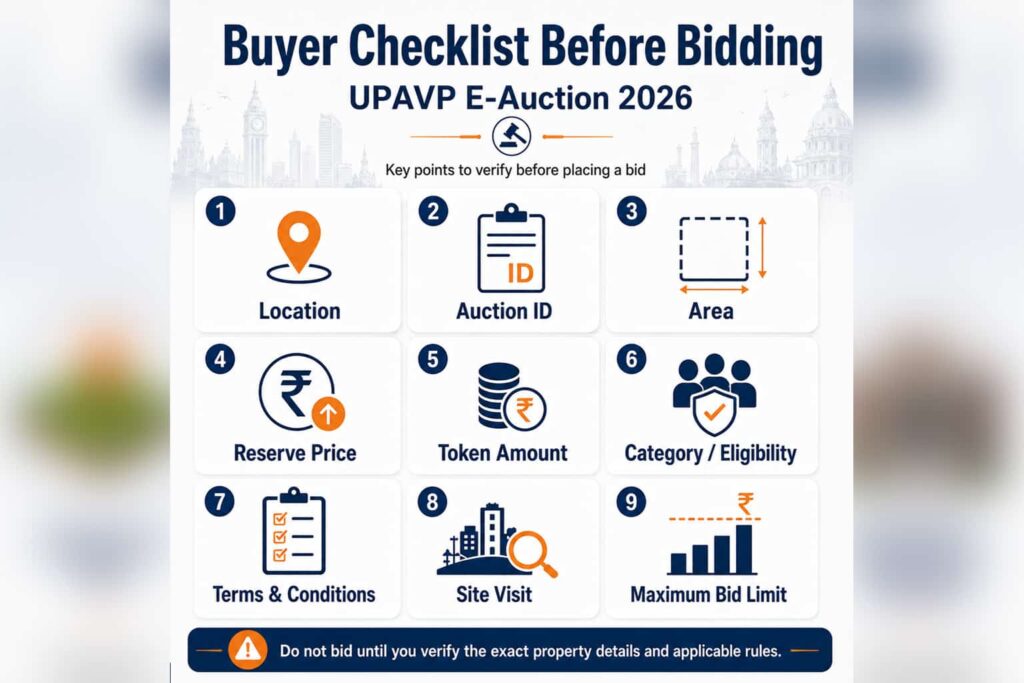
Before placing a bid, check:
Property identification: Match the scheme, property number and Auction ID.
Exact location: Visit the site where practical and check approach road, surroundings and existing development.
Area: Verify the area stated in the official listing and relevant documents.
Permitted use: Residential, commercial, educational and institutional uses are not interchangeable.
Reserve price: Compare the reserve price with comparable properties rather than assuming an auction property is automatically cheap.
Token amount: Confirm the amount specifically applicable to that property.
Reservation status: Ensure that you are eligible to participate against that entry.
Payment conditions: Check how much becomes payable after a successful bid and within what period.
Additional charges: Review the applicable rules for charges beyond the winning bid, if any.
Possession and property status: Understand the actual physical condition and possession terms before bidding.
Applicable rules: Read the complete UPAVP terms for the selected property category.
Bid limit: Decide the maximum amount you are prepared to pay before the live auction starts.
Is a UPAVP auction property automatically a good deal?
No.
An e-auction creates a mechanism for acquiring the property; it does not guarantee that every listed asset is undervalued or suitable for investment.
A residential plot may make sense for someone planning to construct a house but may offer little immediate rental income.
A commercial property may offer business or rental potential but only if its location has sufficient demand.
A large institutional or group-housing plot can require substantial capital and may be relevant primarily to developers or institutions rather than ordinary homebuyers.
The right comparison is therefore not:
Government property vs private property
but:
Final acquisition cost + location + permitted use + development status + future usability
against realistic alternatives available in that market.
Who should consider this auction?
The auction can be relevant to different types of buyers:
| Buyer | Properties worth examining |
|---|---|
| End-user/homebuyer | Residential houses, LIG/EWS units, residential plots |
| Individual investor | Selected residential or commercial properties |
| Business owner | Shops and commercial properties |
| Developer | Larger commercial or group-housing plots |
| Educational organisation | Educational/institutional sites |
| Long-term land buyer | Selected plots where location and permitted use support the objective |
The final decision should depend on the individual property, not merely the fact that it is being auctioned by UPAVP.
Carpet Area assessment
The UP Awas Vikas e-auction scheduled for 25 August 2026 is significant because it brings several property categories and multiple UPAVP zones into a common online auction process. Buyers can examine residential assets as well as commercial, educational and other non-residential properties instead of being restricted to one housing product.
The most important advantage for a serious buyer is the availability of property-level information such as scheme, area, reserve price, token amount, category and Auction ID.
But the auction should not be approached as a rush to bid.
The sensible strategy is:
shortlist first → verify the exact property → read the relevant rules → inspect the location → calculate your maximum acceptable price → only then participate in the auction.
With registration scheduled until 24 August 2026 and the proposed e-auction on 25 August 2026, prospective bidders should use the official UPAVP portal for the latest property list and any revision to the auction schedule or conditions.
Sources:-
- Uttar Pradesh Awas Evam Vikas Parishad — Official E-Auction Page
View Official UPAVP E-Auction Page
This is the main UPAVP page where auction advertisements, property details, rules for residential/non-residential/educational properties and registration instructions are published. - UPAVP — Official E-Auction Portal
Open UPAVP E-Auction Portal
Buyers can use this portal to search properties and access the online e-auction system. - UPAVP — Residential Property Auction Rules & Regulations
Open Official E-Auction Page and select Residential Rules
UPAVP publishes separate rules for allotment/e-auction of residential and staff-quarter properties on this page. - UPAVP — Non-Residential Property Auction Rules & Regulations
Open Official E-Auction Page and select Non-Residential Rules
Relevant for commercial plots, shops and other non-residential properties. - UPAVP — Educational Property Auction Rules & Regulations
Open Official E-Auction Page and select Educational Property Rules
UPAVP separately publishes the applicable rules for educational properties. - UPAVP — Registration & Payment Instructions
Open Official E-Auction Page
The same official page provides the document titled “Important steps/instructions for registration & making payment.”



Leave a Reply