

Amit had been waiting for years to buy a residential plot.
Then one morning, he saw an advertisement from a government development authority.
The location looked promising.
The price appeared attractive.
Several plot sizes were available.
But one sentence caught his attention:
“Allotment will be made through e-lottery.”
Amit understood the word “lottery”, but this was not a lottery ticket bought from a shop. He would have to submit documents, deposit registration money and compete with thousands of other applicants for a limited number of properties.
His questions started immediately.
What exactly is an e-lottery?
When did property e-lotteries start in India?
Does submitting an application automatically put his name in the draw?
Does applying on Day 1 improve his chances?
Why might someone applying for a 120 sq m plot have different odds from a person applying for a 200 sq m plot?
Why does GDA use an e-lottery while YEIDA still conducts some residential plot allotments through a physical/manual draw?
Which system is more transparent?
And perhaps the most uncomfortable question:
Which system has a greater risk of manipulation or scam?
Amit is fictional, but these questions are real.
This guide follows Amit from application to allotment while using actual examples from the GDA Madhuban Bapudham 2026 e-lottery and YEIDA RPS10/2026 physical draw to explain how property lotteries really work.
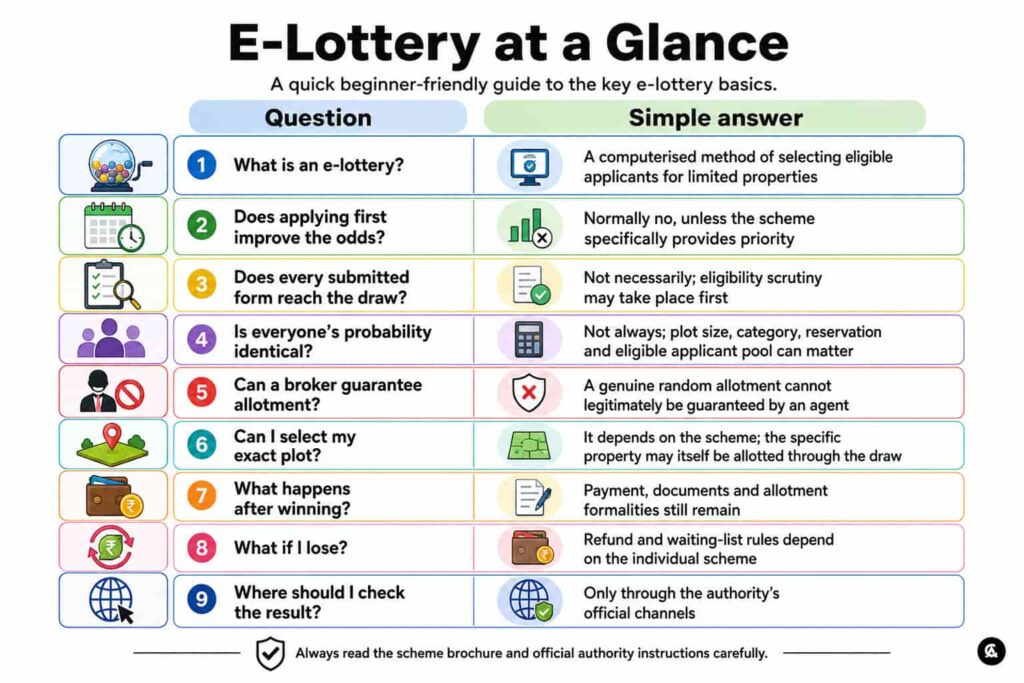
E-lottery at a glance
| Question | Simple answer |
|---|---|
| What is an e-lottery? | A computerised method of selecting eligible applicants for limited properties |
| When did it start in India? | There is no single nationwide start date; computerised housing draws can be documented from the early 1980s |
| Does applying first improve the odds? | Normally no, unless the scheme specifically provides priority |
| Does every submitted application reach the draw? | Not necessarily; eligibility scrutiny can happen first |
| Is everyone’s probability identical? | Not always; plot size, reservation, category and eligible applicant pool can change the odds |
| Is physical draw still used? | Yes. YEIDA has continued to prescribe manual draws in recent residential plot schemes |
| Is e-lottery used today? | Yes. GDA, DDA and other authorities use computerised draws |
| Which system do applicants prefer? | No reliable nationwide survey establishes one clear preference |
| Which is safer from scams? | Neither is automatically safer; the risks are different |
| Can a broker guarantee allotment? | A genuine random allotment cannot legitimately be guaranteed by an agent |
| What happens after winning? | Payment, documents and legal allotment formalities still remain |
| Where should the result be checked? | Through the concerned authority’s official channels |
Amit finds the scheme — but what exactly is an e-lottery?
Imagine an authority offering 500 residential plots.
If only 400 eligible people apply, the authority may have enough inventory for all qualifying applicants.
But suppose 20,000 people apply for those 500 plots.
There simply are not enough properties for everyone.
An authority could use an auction.
It could use First Come First Serve.
Or it could conduct a draw.
An e-lottery, in the property-allotment context, is a computerised selection mechanism used to allot limited properties among eligible applicants according to the notified scheme rules.
DDA’s official housing FAQ, for example, says flats are allotted through a computerised draw after applications are scrutinised according to eligibility criteria and scheme terms.
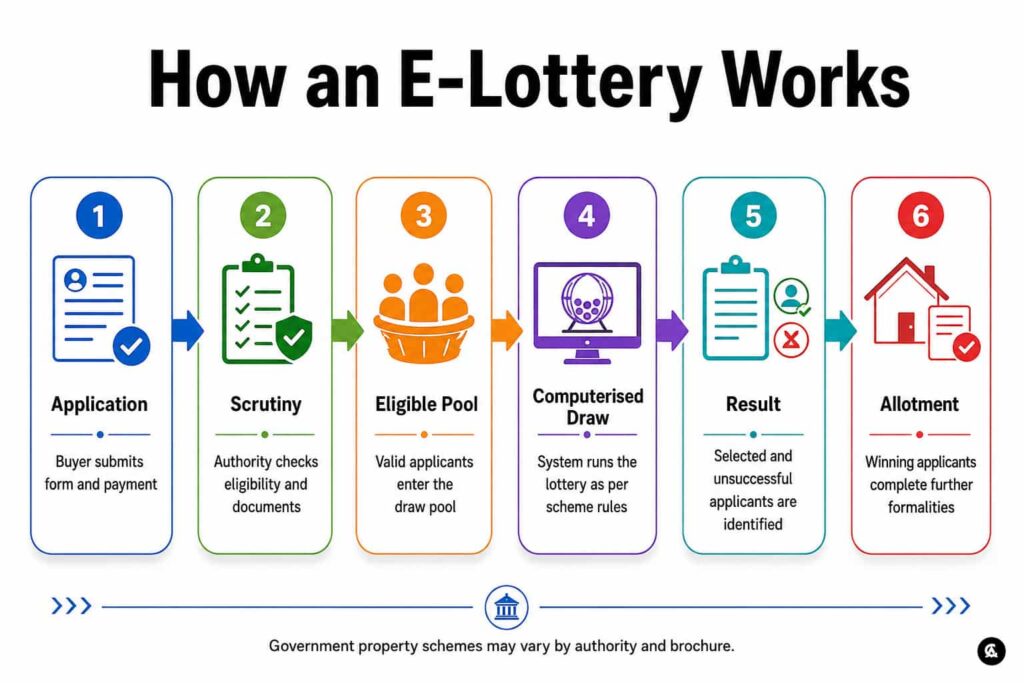
The broad process can therefore look like this:
Scheme announced
↓
Applications submitted
↓
Applications scrutinised
↓
Eligible applicant pool prepared
↓
Applicable category/property pools created
↓
Computerised draw
↓
Successful applicants identified
↓
Property allotment and payment formalities
The first lesson for Amit is therefore simple:
Submitting an application is not the same as winning—and depending on the scheme, it may not even guarantee entry into the final eligible draw pool.
When did e-lottery start in India?
Amit now becomes curious about something more fundamental.
Is e-lottery a recent invention?
Not really.
But the answer needs an important distinction.
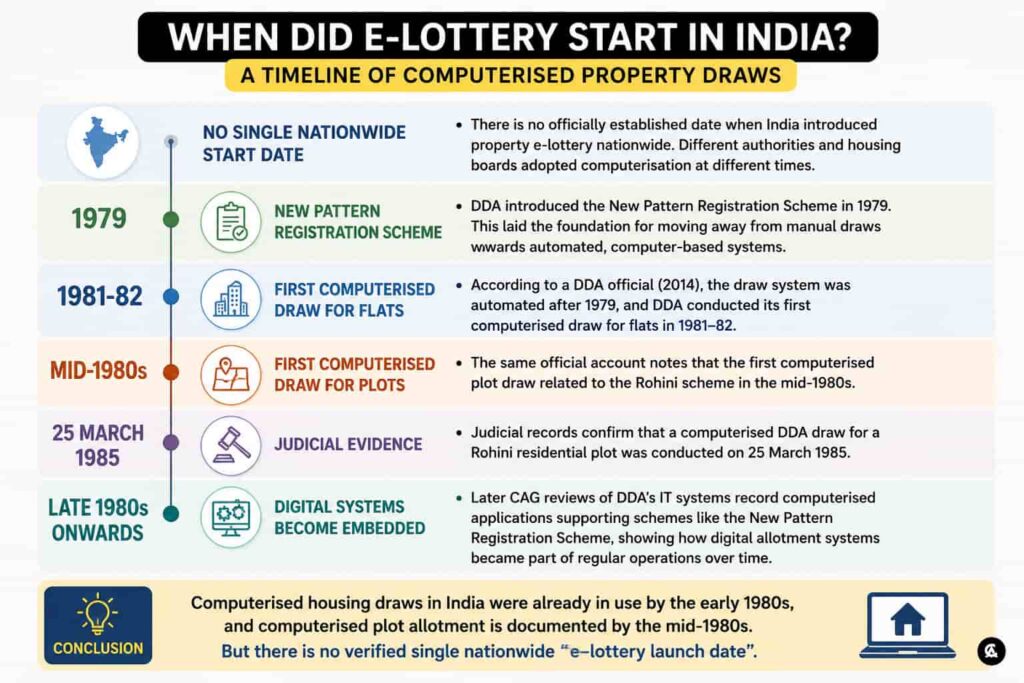
There is no single officially established date on which India introduced property e-lottery nationwide. Development authorities and housing boards adopted computerisation independently over different periods.
The modern expression “e-lottery” is also newer than the underlying concept of a computerised draw of lots.
Historical evidence shows that DDA’s move away from purely manual draws began decades ago.
A DDA official quoted in 2014 stated that after the New Pattern Registration Scheme of 1979, the draw system was automated and DDA conducted its first computerised draw for flats in 1981–82. The same account described the first computerised plot draw as relating to Rohini in the mid-1980s.
There is also judicial evidence showing that a computerised DDA draw for a Rohini residential plot was conducted on 25 March 1985.
The safest conclusion is therefore:
Computerised housing draws were already being used in India by the early 1980s, and computerised plot allotment is documented by the mid-1980s. But there is no verified single nationwide “e-lottery launch date”.
A later CAG review of DDA’s IT systems also records computerised applications supporting schemes such as the New Pattern Registration Scheme, showing how digital allotment systems became embedded in authority operations over time.
So an article claiming:
“E-lottery started in India in exactly XXXX”
without specifying the authority and the type of draw is oversimplifying the history.
Then Amit discovers something surprising — not every authority uses e-lottery
Amit assumes that if computers have been used for decades, every authority must now conduct allotments electronically.
That is not true.
Even in 2026, major development authorities can use very different draw mechanisms.
The clearest NCR example is:
YEIDA — Physical/manual draw
versus
GDA — Computerised e-lottery
This makes an excellent real-world comparison.
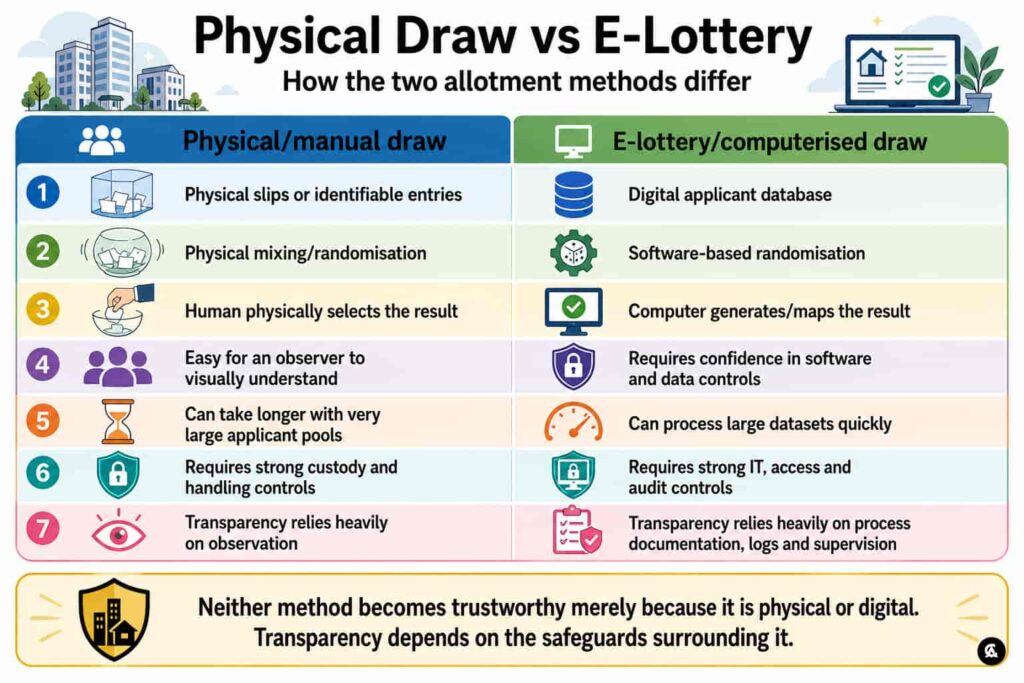
Physical draw vs e-lottery — what is actually different?
A physical draw uses a tangible random-selection process.
Names, application numbers or corresponding slips may be placed inside drums or containers and physically selected under the announced procedure.
An e-lottery replaces this final physical selection with a computerised randomisation/allotment system.
The principle behind both methods is similar:
Eligible applicants > Available properties → Random selection required
But the mechanism used to produce the winner is different.
| Physical/manual draw | E-lottery/computerised draw |
| Physical slips or identifiable entries | Digital applicant database |
| Physical mixing/randomisation | Software-based randomisation |
| Human physically selects the result | Computer generates/maps the result |
| Easy for an observer to visually understand | Requires confidence in software and data controls |
| Can take longer with very large applicant pools | Can process large datasets quickly |
| Requires strong custody and handling controls | Requires strong IT, access and audit controls |
| Transparency relies heavily on observation | Transparency relies heavily on process documentation, logs and supervision |
Neither method becomes trustworthy merely because it is physical or digital.
Transparency depends on the safeguards surrounding it.
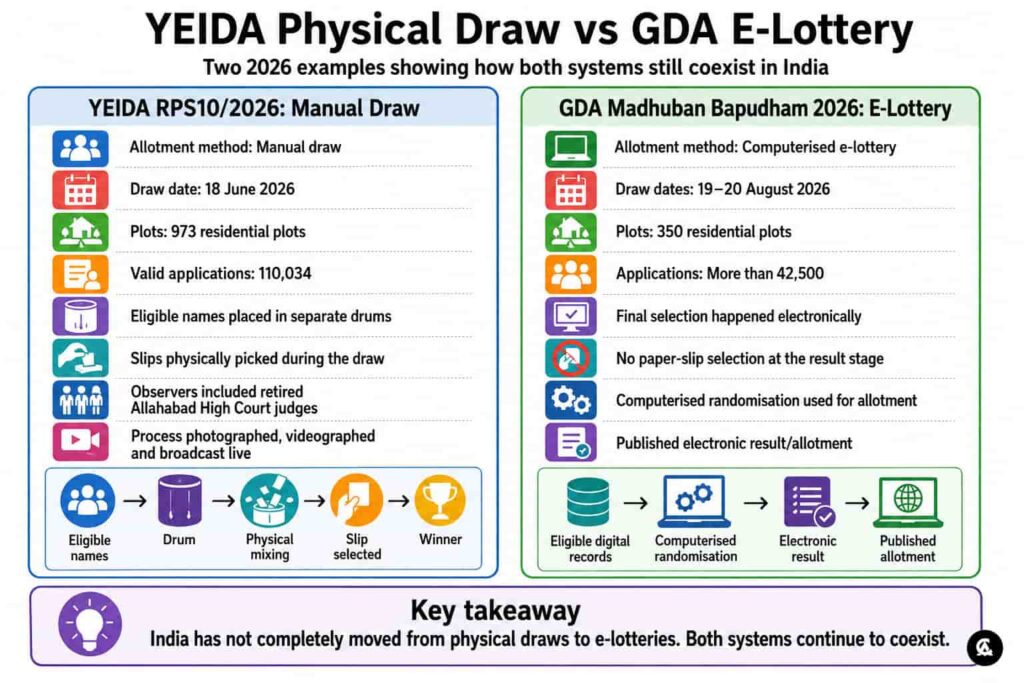
YEIDA physical draw vs GDA e-lottery — two 2026 examples
This comparison makes the difference much easier to understand.
YEIDA RPS10/2026: a manual draw
YEIDA’s official RPS10/2026 residential plot brochure prescribed allotment by manual draw.
The draw was held on 18 June 2026 for 973 residential plots.
According to reporting based on YEIDA officials, the scheme had 110,034 valid applications. Eligible applicants in each category had their names placed in separate drums, and slips were physically picked during the draw. The process was conducted in the presence of the allotment committee and observers including retired Allahabad High Court judges, while the event was photographed, videographed and broadcast live.
So here, the applicant could understand the final selection visually:
Eligible names → Drum → Physical mixing → Slip selected → Winner
GDA Madhuban Bapudham 2026: an e-lottery
GDA took a different route.
For the 350 residential plots under the Madhuban Bapudham scheme, allotment on 19 and 20 August 2026 was conducted through a computerised e-lottery. More than 42,500 applications were reported for the scheme.
Here, the final selection occurred electronically rather than through paper slips.
So the process becomes:
Eligible digital records → Computerised randomisation → Electronic result → Published allotment
Both methods were being used for major NCR authority schemes within a gap of only around two months.
That proves an important point:
India has not completely moved from physical draws to e-lotteries. Both systems continue to coexist.
How many physical draws and e-lotteries have happened in India?
Amit now asks what sounds like a straightforward question:
“Which method has been used more often?”
The problem is that India does not have a central public database counting every housing and plot draw conducted by every development authority, housing board and government agency.
Therefore, an exact statement such as:
“India has conducted 1,200 physical draws and 3,000 e-lotteries”
would not be credible without a comprehensive national dataset.
What can be documented are authority-specific examples.
YEIDA’s official brochures explicitly prescribed manual draws for residential plot schemes with draw dates in:
- September 2024;
- December 2024;
- July 2025;
- June 2026.
So we can directly document at least four recent YEIDA residential plot schemes where the brochure prescribed a manual draw.
On the other side, DDA’s official result archive shows repeated use of computerised draws, including multiple computerised mini draws in 2026 alone.
GDA’s August 2026 Madhuban Bapudham allotment adds another current e-lottery example.
A CAG audit of GDA records also found that the authority conducted seven lottery draws during 2018–22, although those audit records do not classify every one of those seven draws as physical or electronic.
Therefore, the accurate answer is:
Both methods have been used many times, but there is no verified India-wide count that allows us to say exactly how many physical draws versus e-lotteries have taken place.
Which do applicants prefer — physical draw or e-lottery?
This question is often answered too casually.
You may hear:
“People trust physical draws more.”
or
“Everyone now prefers e-lottery.”
But there is no reliable nationwide applicant survey establishing either conclusion.
In most authority schemes, the applicant does not even choose the allotment method.
The authority chooses it in the scheme conditions.
Still, the two systems create different perceptions.
A physical draw can feel more understandable because an applicant can see:
the slips
the drums
the mixing
the person picking the result
For someone worried about software, that visible process may provide psychological comfort.
An e-lottery offers a different advantage.
It can handle tens of thousands of applicants quickly, systematically map categories and reservations, produce digital records and publish results rapidly.
For digitally comfortable applicants, that may feel cleaner and more efficient.
But those are characteristics of the systems, not evidence that one type of person universally prefers one method.
The better question is therefore:
“Which method gives an applicant more confidence in a particular scheme?”
The answer depends less on physical versus digital and more on how transparent the authority makes the process.
Amit applies on Day 1 — has he increased his chances?
Now Amit returns to his own application.
The portal opens at 10 AM.
He completes his form by 10:15 AM.
His friend congratulates him:
“You applied first. Your chance will be better.”
That may matter in First Come First Serve allotment.
It does not normally create extra lottery weight in a random draw unless the scheme explicitly provides some form of priority.
So Amit should remember:
Lottery: Eligible applications compete through the prescribed draw.
FCFS: Timing/order can directly matter.
Submitting early is still useful because it gives the applicant more time to resolve:
- payment failures;
- document errors;
- portal issues;
- incorrect details.
But:
Early application ≠ automatically higher e-lottery probability.
Amit receives an application number — is he definitely inside the draw?
Not necessarily.
Amit sees:
Application successfully submitted
and assumes:
“Now I am in the lottery.”
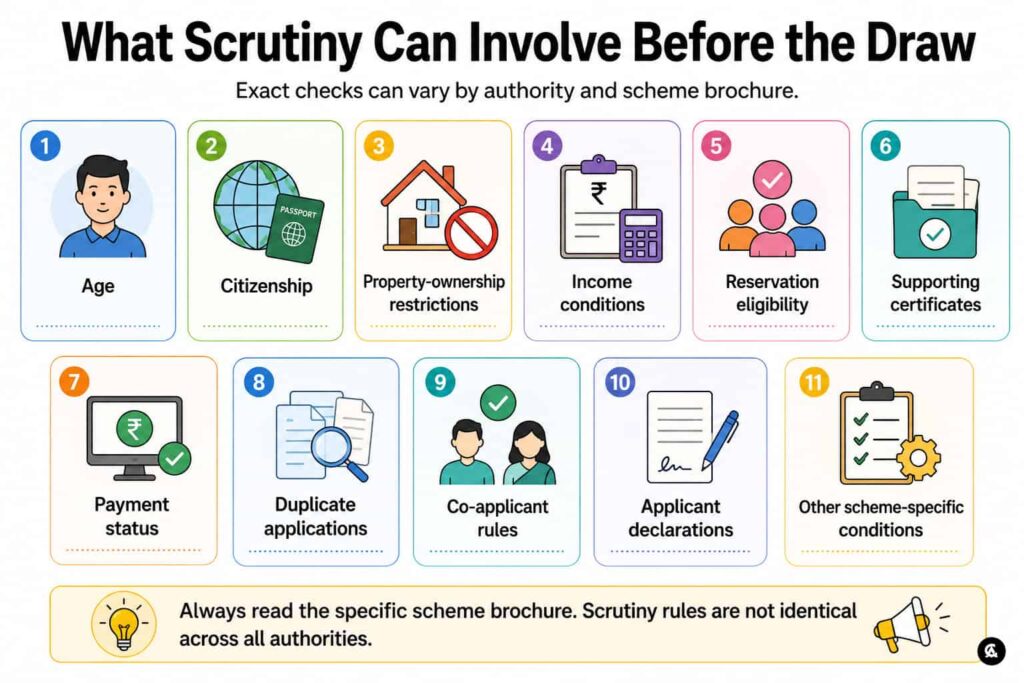
But authorities may first determine whether the application satisfies the scheme conditions.
Depending on the brochure, scrutiny can involve:
- age;
- citizenship;
- property-ownership restrictions;
- income conditions;
- reservation eligibility;
- supporting certificates;
- payment status;
- duplicate applications;
- co-applicant conditions;
- applicant declarations;
- other scheme-specific requirements.
DDA’s official FAQ explicitly connects computerised allotment with scrutiny against eligibility criteria and terms and conditions.
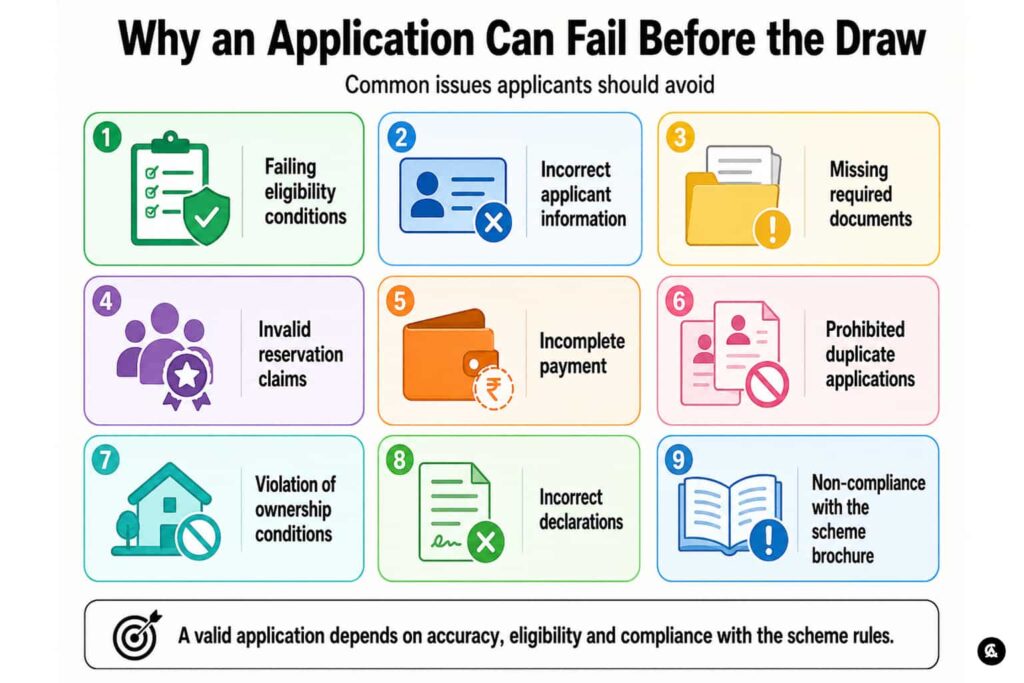
What are the common reasons an application can fail before the draw?
There is no single rejection list applicable to every authority.
GDA can have different conditions from DDA.
DDA can differ from YEIDA.
YEIDA can differ from MHADA.
But potential problems can include:
- failing eligibility conditions;
- entering incorrect applicant information;
- missing required documents;
- invalid reservation claims;
- incomplete payment;
- prohibited duplicate applications;
- violation of ownership conditions;
- incorrect declarations;
- non-compliance with the scheme brochure.
A CAG audit of MHADA’s computerised lottery system provides an important historical warning.
The audit found weaknesses including under-age applicants entering lottery data, duplicate applications and applicants appearing under more than one income group. In the 2005 lottery data, the audit found 112 cases of duplicate applications, while further duplicate cases were identified in 2006.
This illustrates a fundamental principle:
A random draw can only be as reliable as the applicant pool supplied to it.
Amit cannot control the random number.
He can control whether his own application is valid.
This creates an important distinction:
Applications received
versus
Eligible applications actually entering the draw.
The GDA Madhuban Bapudham 2026 draw gives us a real example.
For the four categories drawn on 19 August 2026, 16,478 applications were reported as received, while 16,436 applicants were found eligible.
That means 42 applications did not form part of that eligible draw pool.
The number is small compared with the whole pool.
The lesson is not.
Your probability should normally be considered against the eligible competing pool, not simply every submitted application.
What are the common reasons an application can fail before the draw?
There is no single rejection list applicable to every authority.
GDA can have different conditions from DDA.
DDA can differ from YEIDA.
YEIDA can differ from MHADA.
But potential problems can include:
- failing eligibility conditions;
- entering incorrect applicant information;
- missing required documents;
- invalid reservation claims;
- incomplete payment;
- prohibited duplicate applications;
- violation of ownership conditions;
- incorrect declarations;
- non-compliance with the scheme brochure.
A CAG audit of MHADA’s computerised lottery system provides an important historical warning.
The audit found weaknesses including under-age applicants entering lottery data, duplicate applications and applicants appearing under more than one income group. In the 2005 lottery data, the audit found 112 cases of duplicate applications, while further duplicate cases were identified in 2006.
This illustrates a fundamental principle:
A random draw can only be as reliable as the applicant pool supplied to it.
Amit cannot control the random number.
He can control whether his own application is valid.
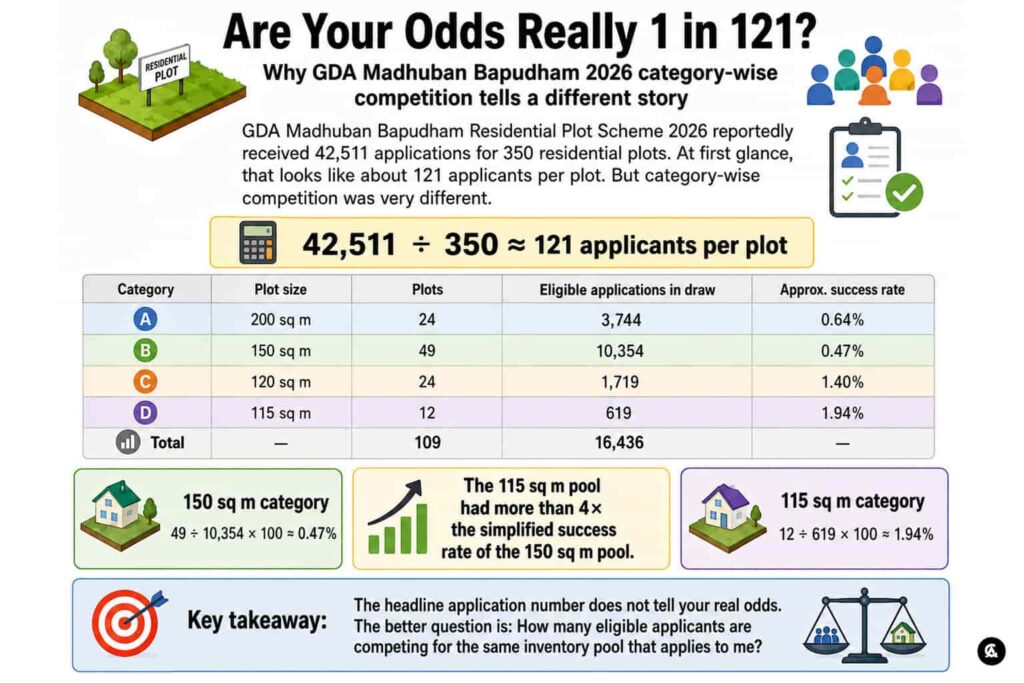
Amit sees 42,511 applications for 350 plots — is his chance really 1 in 121?
Now comes one of the most misunderstood parts of the process.
The GDA Madhuban Bapudham Residential Plot Scheme 2026 reportedly received 42,511 applications for 350 residential plots.
At first glance:
42,511 ÷ 350 ≈ 121 applicants per plot
That sounds as if every applicant faced approximately the same odds.
But the first-day draw shows why that assumption is misleading.
On 19 August 2026, the first four categories covered 109 plots.
| Category | Plot size | Plots | Eligible applications in draw | Approx. success rate |
| A | 200 sq m | 24 | 3,744 | 0.64% |
| B | 150 sq m | 49 | 10,354 | 0.47% |
| C | 120 sq m | 24 | 1,719 | 1.40% |
| D | 115 sq m | 12 | 619 | 1.94% |
| Total | — | 109 | 16,436 | — |
The reported category data shows that the 150 sq m pool was dramatically more competitive than the 115 sq m pool.
For the 150 sq m plots:
49 ÷ 10,354 × 100 ≈ 0.47%
For the 115 sq m plots:
12 ÷ 619 × 100 ≈ 1.94%
That is more than four times the simplified success rate.
Same authority.
Same scheme.
Same lottery period.
Different plot category.
Different odds.
This leads to one of the most valuable questions an applicant can ask:
“How many eligible applicants are competing
How should Amit calculate his actual chances?
Suppose another fictional scheme has:
20,000 eligible applicants
for
500 properties.
Overall simplified success probability:
500 ÷ 20,000 = 2.5%
But Amit applies only for Category X.
Category X has:
150 properties
and
7,500 eligible applicants.
Category-level simplified probability:
150 ÷ 7,500 = 2%
Another category has:
50 properties
and
1,000 eligible applicants.
Its simplified probability is:
5%.
Even these numbers may not represent the final effective probability because allocation can also depend on:
- reservations;
- locality preferences;
- plot-size categories;
- subcategories;
- special quotas;
- inventory-transfer rules;
- scheme-specific allocation procedures.
So the headline application number gives context.
The relevant applicant pool gives insight.
Should Amit choose a less popular plot size just to improve the odds?
Not automatically.
There are two separate decisions:
Probability
and
Property suitability.
A larger or less popular property may attract fewer applicants.
But it may also:
- cost substantially more;
- require a larger down payment;
- create a bigger loan burden;
- be larger than the buyer needs;
- have a different location;
- carry different premiums or charges.
Also, an applicant normally does not know the final category-level competition with certainty while applications are still open.
The better order is:
Affordability first → Suitability second → Probability third
Never buy the wrong property simply because its lottery pool looks less crowded.
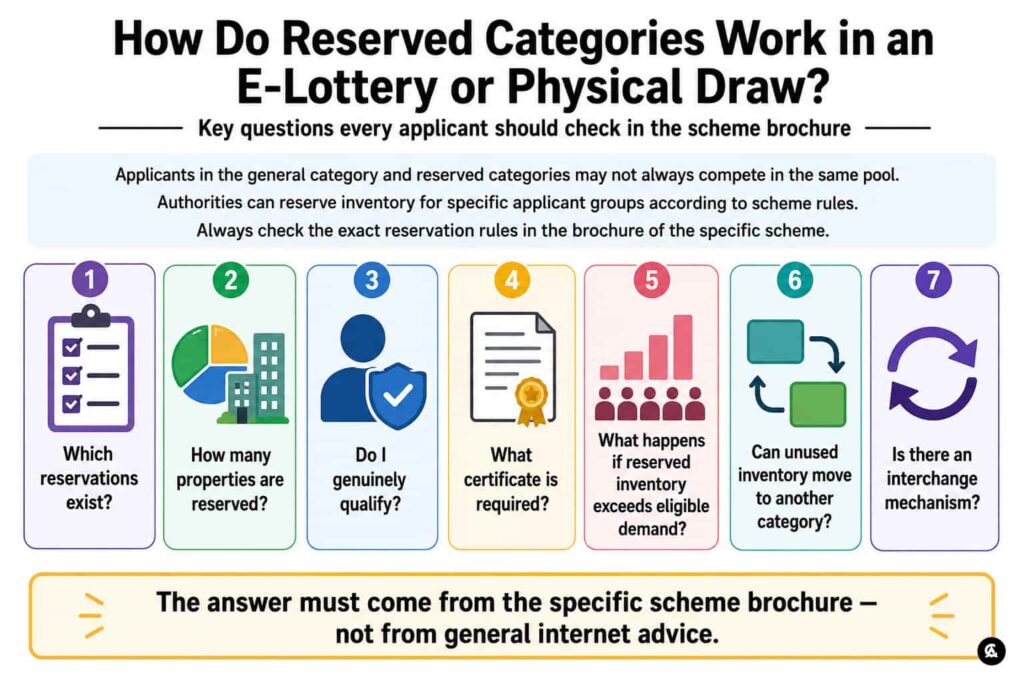
How do reserved categories work in an e-lottery or physical draw?
Suppose Amit applies under the general category.
Another applicant qualifies under a reserved category.
They may not necessarily compete inside an identical pool.
Authorities can reserve inventory for specified categories according to the scheme.
DDA’s documented draw procedure, for example, explains how reservations and locality choices can be factored into computerised property mapping.
But an applicant must not take DDA’s reservation system and assume it applies to GDA or YEIDA.
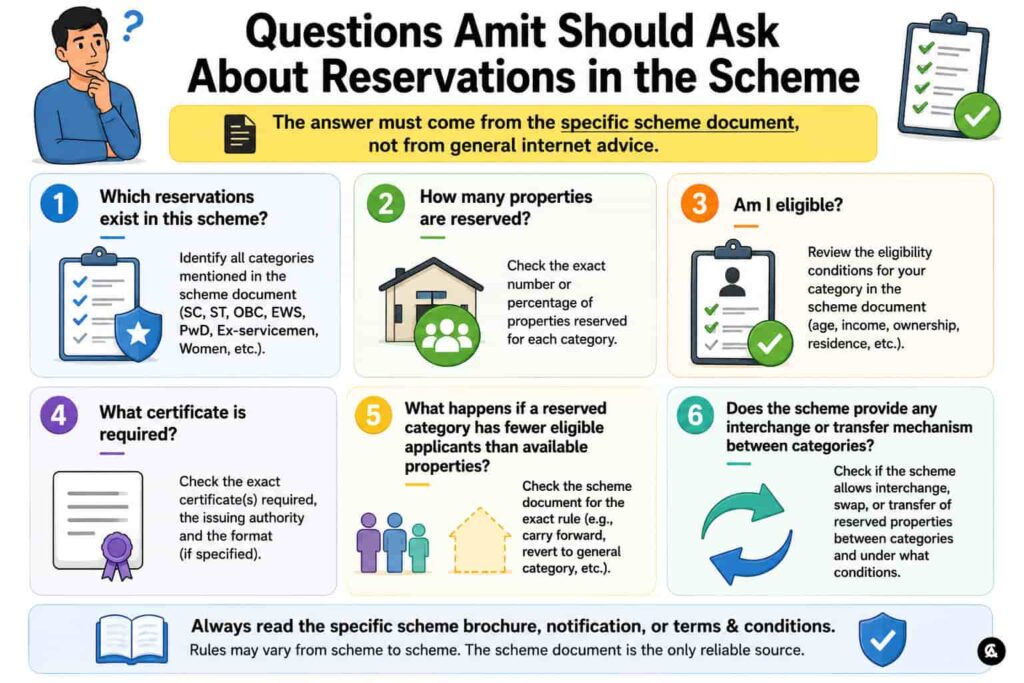
For every new scheme, ask:
- Which reservations exist?
- How many properties are reserved?
- Do I genuinely qualify?
- What certificate is required?
- What happens if reserved inventory exceeds eligible demand?
- Can unused inventory move to another category?
- Is there an interchange mechanism?
The answer must come from the specific scheme brochure.
Can husband and wife both apply? Can one applicant submit multiple forms?
There is no universal India-wide rule.
One useful example comes from the DDA Special Housing Scheme 2021.
Its conditions permitted husband and wife to apply separately subject to the scheme’s eligibility rules, while providing that if both became successful, only one flat would ultimately be allotted and the other spouse’s application money would be refunded.
The brochure also restricted one individual to one application under its applicable conditions.
That example demonstrates why Amit should never assume:
“My spouse can definitely apply separately.”
or
“I’ll submit three applications to triple my chance.”
The scheme brochure decides.
A prohibited duplicate application can actually reduce your chances by creating an eligibility problem.
A broker tells Amit — “₹50,000 दे दो, नाम निकलवा देंगे”
Two days before the draw, Amit receives a call.
The caller says:
“हमारा authority में contact है. Guaranteed allotment करा देंगे.”
This should immediately trigger caution.
A legitimate random allotment cannot be guaranteed by an outside broker simply because money is paid.
Watch for claims such as:
- “100% guaranteed allotment”;
- “inside quota” absent from the brochure;
- “special authority connection”;
- requests for payment to personal bank or UPI accounts;
- claims that the result is known before the draw;
- unofficial winner PDFs;
- demands to pay money to “activate” a selected plot.
If someone claims to have a special route to allotment, ask:
“Show me the exact clause in the official brochure.”
If it does not exist there, the buyer should not treat it as an official advantage.
Which has a greater chance of scam — physical draw or e-lottery?
This is the question Amit really wanted answered.
Unfortunately, there is no credible India-wide dataset proving:
Physical draw = more scams
or
E-lottery = more scams.
The risks are different.
Possible risks in a physical draw
A poorly controlled manual process could theoretically face:
- slip substitution;
- selective handling;
- inadequate mixing;
- custody problems;
- counting or recording mistakes;
- human interference.
That is why safeguards such as:
independent observers + sealed/controlled drums + videography + livestreaming + public result publication
matter.
YEIDA’s 2026 draw illustrates this model: manual selection was combined with an allotment committee, observers, videography and live broadcast.
Possible risks in an e-lottery
A digital system removes much of the physical handling.
But new risks arise:
- incorrect applicant data;
- duplicate entries;
- weak validation rules;
- unauthorised system access;
- flawed randomisation implementation;
- inadequate logs;
- poor software controls;
- result-file manipulation outside the actual draw system.
The CAG’s MHADA IT audit is important here because it found weaknesses in applicant validation, including duplicate applications and other data-quality failures entering the lottery database.
This leads to an important conclusion:
Many risks occur before the actual draw begins.
If the eligible database itself is wrong, neither a perfectly mixed physical drum nor a mathematically perfect random-number generator can automatically correct that problem.
There are also scams completely outside the draw:
- fake brokers;
- fake websites;
- fake result PDFs;
- phishing links;
- fake payment demands;
- false allotment letters.
Those can target applicants in both physical-draw and e-lottery schemes.
So which is safer?
The better answer is:
The safer system is the one with stronger controls.
That means:
verified applicant data
clear published rules
independent supervision
secure randomisation
audit trail
public result
effective grievance mechanism
Physical is not automatically safer.
Digital is not automatically more transparent.
Process quality matters more than format.
Is an e-lottery completely random, or can the result be influenced?
The purpose of an e-lottery is to reduce discretionary human selection and use a defined computerised randomisation process.
But there is an important difference between:
“The randomisation step is fair.”
and
“Every stage of the entire system is automatically flawless.”
A credible e-lottery depends on:
Correct applicant database
↓
Correct eligibility scrutiny
↓
Correct category mapping
↓
Randomisation
↓
Software/process controls
↓
Supervision
↓
Audit trail
↓
Official result publication
↓
Grievance mechanism
DDA has published details of its computerised draw process, including randomisation of applicants and flats, selection of starting numbers and mapping of applicants to properties.
But DDA’s process should not be assumed to be identical to every other authority’s software architecture.
The correct conclusion is:
E-lottery is designed to make selection random and rule-based, but transparency depends on the complete system surrounding the randomisation.
Who conducts and supervises an e-lottery?
There is no single national organisation conducting every property lottery in India.
The concerned development authority or housing body conducts the allotment under its notified scheme.
Depending on the authority, supervision may involve:
- senior authority officers;
- allotment committees;
- technical teams;
- observers;
- judges;
- IT professionals;
- videography;
- live/public viewing.
For Amit, the useful question is not:
“Who supervises e-lotteries in India?”
It is:
“Who has been appointed to supervise this particular scheme’s draw?”
Check:
- brochure;
- draw notice;
- official press release;
- authority website;
- livestream information;
- result document.
What happens if the computer or livestream fails during the draw?
Imagine:
The screen freezes.
The livestream stops.
The system throws an error.
That does not automatically prove manipulation.
Nor does it automatically mean the draw remains valid.
The authority may need to:
- pause;
- resume;
- investigate;
- issue a clarification;
- reschedule a part of the draw;
- conduct a fresh draw if the notified procedure requires it.
Applicants should wait for an official communication rather than relying on WhatsApp claims such as:
“Draw cancelled.”
or
“Re-draw confirmed.”
A technical interruption and an invalid allotment are not automatically the same thing.
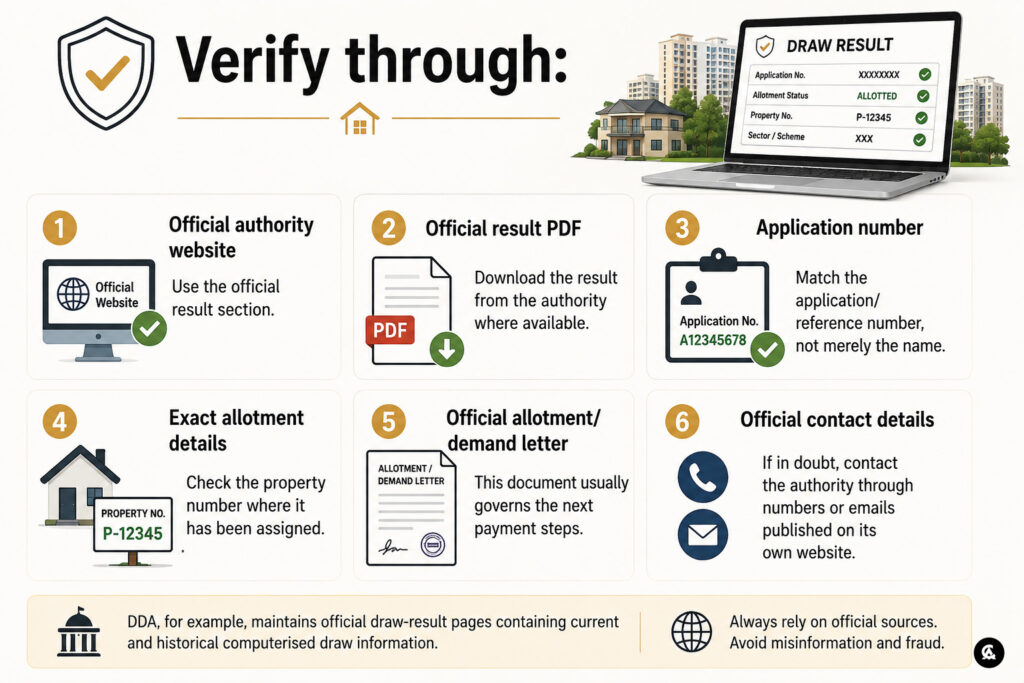
Draw day arrives — how should Amit verify the result?
Amit receives a WhatsApp image:
“Congratulations! Your plot has been allotted.”
He should not transfer money based on that screenshot.
Verify through:
1. Official authority website
Use the official result section.
2. Official result PDF
Download the result from the authority where available.
3. Application number
Match the application/reference number, not merely the name.
4. Exact allotment details
Check the property number where it has been assigned.
5. Official allotment/demand letter
This document usually governs the next payment steps.
6. Official contact details
If in doubt, contact the authority through numbers or emails published on its own website.
DDA, for example, maintains official draw-result pages containing current and historical computerised draw information.
Amit wins — can he choose whichever plot he wants?
Not necessarily.
Amit imagines:
“Now I’ll take the corner plot facing the park.”
But an applicant may only be selecting:
- a size;
- locality;
- sector;
- category;
- preference.
The exact property can then be allotted according to the draw mechanism.
DDA’s FAQ, for example, explains that although locality choice may be offered in some schemes, applicants cannot necessarily select the exact floor, sector or pocket because the specific flat is allotted through computerised draw.
So before applying, Amit should ask:
“Am I selecting the exact property—or merely the category from which a property will later be allotted?”
Amit has won — but is he now the legal owner?
Not necessarily.
Winning normally means:
You have been selected for allotment subject to the scheme conditions.
The next stages can include:
Successful result
↓
Allotment/Demand letter
↓
Balance payment
↓
Required documents
↓
Compliance with conditions
↓
Lease/Conveyance/Registry process
↓
Possession
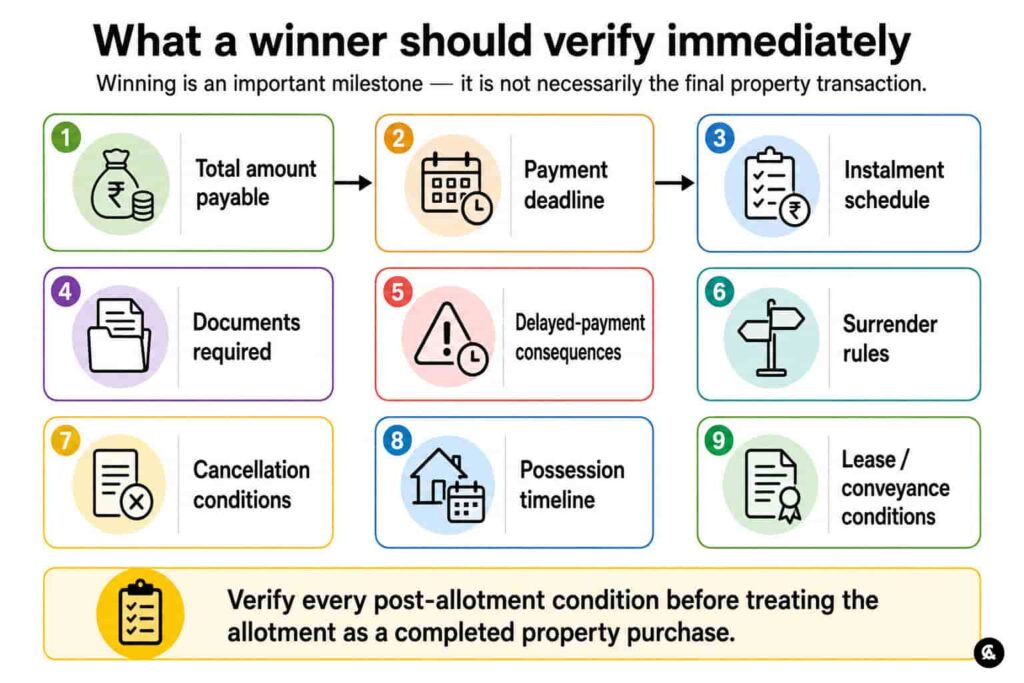
A winner should immediately verify:
- total amount payable;
- payment deadline;
- instalment schedule;
- documents required;
- delayed-payment consequences;
- surrender rules;
- cancellation conditions;
- possession timeline;
- lease/conveyance conditions.
Winning is an important milestone.
It is not necessarily the final property transaction.
What additional costs can appear after winning?
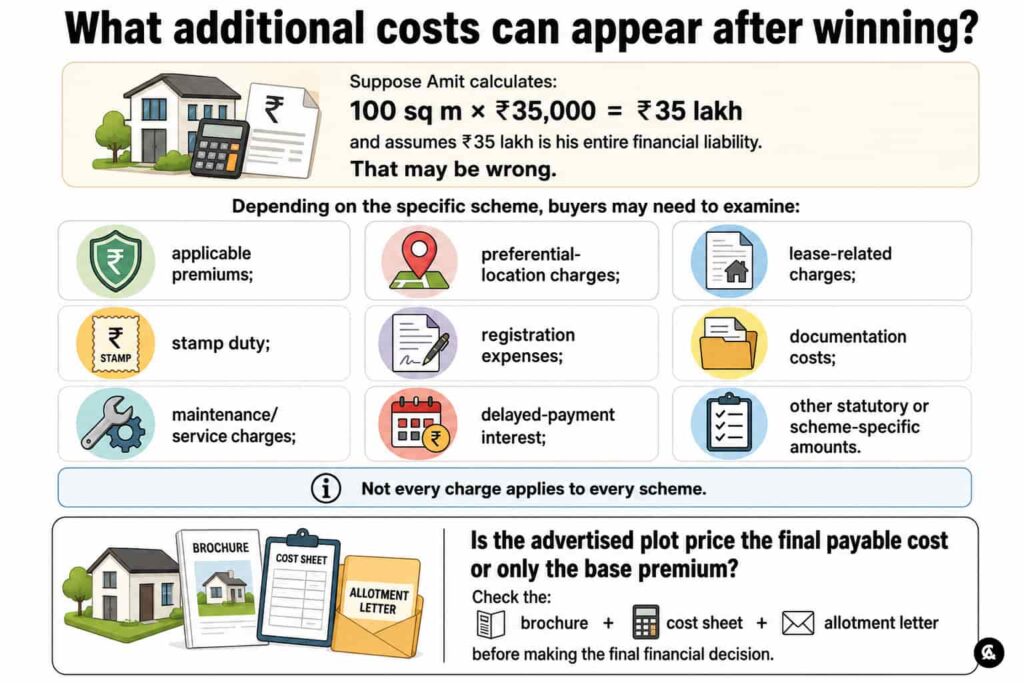
Suppose Amit calculates:
100 sq m × ₹35,000 = ₹35 lakh
and assumes ₹35 lakh is his entire financial liability.
That may be wrong.
Depending on the specific scheme, buyers may need to examine:
- applicable premiums;
- preferential-location charges;
- lease-related charges;
- stamp duty;
- registration expenses;
- documentation costs;
- maintenance/service charges;
- delayed-payment interest;
- other statutory or scheme-specific amounts.
Not every charge applies to every scheme.
The correct question is:
“Is the advertised plot price the final payable cost or only the base premium?”
Check the:
brochure + cost sheet + allotment letter
before making the final financial decision.
What if Amit wins but cannot arrange the money?
Winning can quickly become a liability if Amit applied for a plot that he cannot finance.
Schemes normally prescribe payment deadlines.
Depending on the scheme, failure to pay could lead to:
- delayed-payment interest;
- cancellation;
- deductions or forfeiture;
- surrender;
- re-allotment.
So Amit should calculate affordability before applying.
He should know:
- available savings;
- required down payment;
- loan eligibility;
- expected EMI;
- payment deadline after allotment;
- backup funding.
Never approach a lottery as:
“First I’ll win, then I’ll figure out how to pay.”
Amit loses — what happens to the registration money?
There is no universal refund period applicable to every authority.
The brochure may specify:
- refundable amount;
- non-refundable processing fee;
- refund method;
- refund timeline;
- deductions;
- bank-account requirements.
YEIDA’s official grievance portal, for example, recorded multiple RPS10/2026 queries from unsuccessful applicants seeking registration-money refunds after the June draw, demonstrating why applicants need to understand the scheme’s refund process rather than rely on assumptions.
Look for brochure clauses titled:
Refund
Registration Money
Earnest Money
or
Unsuccessful Applicants
Is there a waiting list if Amit does not win?
Some schemes create a waiting list.
Others do not.
A waiting list can become relevant if selected applicants:
- withdraw;
- become ineligible;
- fail to pay;
- surrender;
- have allotment cancelled.
But the applicant cannot assume:
“I am next after the winner, so the property automatically becomes mine.”
A waiting-list mechanism must actually exist in the scheme rules.
Amit believes the result is wrong — can he challenge the draw?
There is a major difference between:
“I lost.”
and
“The authority appears to have processed my application incorrectly.”
Losing a random draw does not prove wrongdoing.
A genuine grievance could involve:
- eligible application omitted;
- payment incorrectly shown as unpaid;
- wrong reservation category;
- incorrect applicant details;
- discrepancy in result records;
- failure to follow the announced draw process.
Amit should preserve:
- application;
- acknowledgement;
- payment receipt;
- eligibility documents;
- category certificate;
- eligible applicant list;
- scheme brochure;
- draw notice;
- result;
- allotment communication;
- relevant correspondence.
The best grievance is a specific documented grievance, not merely dissatisfaction with the outcome.
E-lottery vs e-auction vs First Come First Serve — what is the difference?
Amit has now encountered several terms that sound similar but work very differently.
| Method | How it broadly works | Main deciding factor |
| E-Lottery | Eligible applicants enter a computerised draw | Random allotment process |
| Physical Draw | Eligible applicants are selected through manual draw of lots | Random physical selection |
| E-Auction | Eligible participants bid electronically | Successful bid |
| FCFS | Property is booked according to notified sequence | Timing/order plus availability |
The easiest way to remember them:
E-lottery:
Who gets selected?
→ Computerised draw decides
Physical draw:
Who gets selected?
→ Manual draw decides
E-auction:
Who gets the property?
→ Competitive bidding decides
FCFS:
Who gets the property first?
→ Sequence can decide
These systems require completely different applicant strategies.
Applying at 10:00 AM may matter in FCFS.
It should not normally give extra lottery weight in a random draw.
Offering more money may matter in an auction.
It should not improve the probability in a fixed-price lottery.
Myth vs fact — what Amit hears about property lotteries
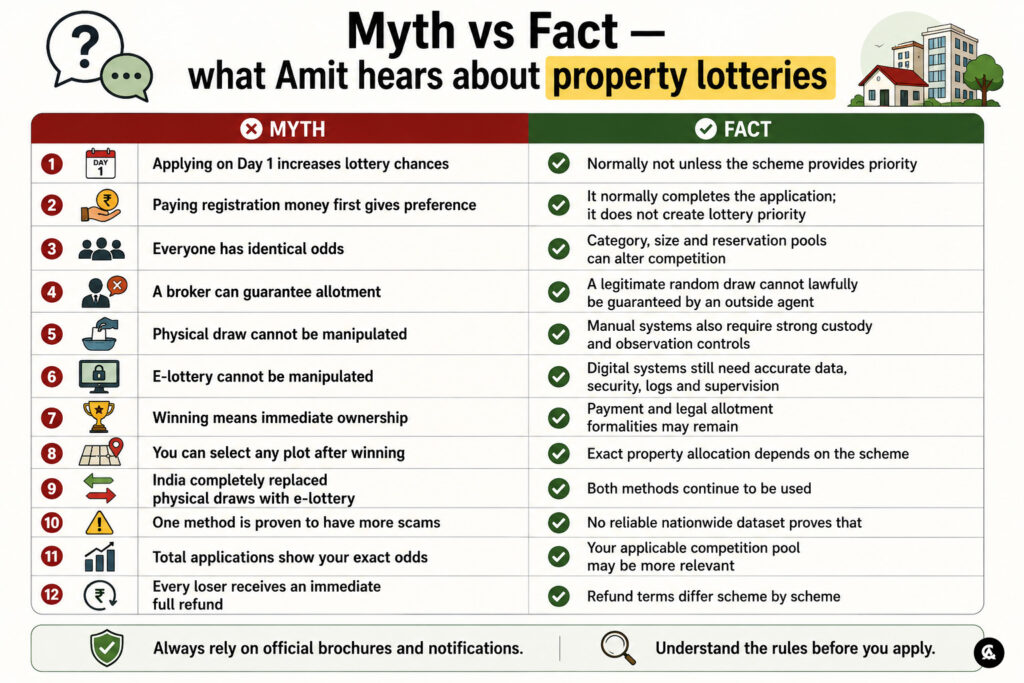
| Myth | Fact |
| Applying on Day 1 increases lottery chances | Normally not unless the scheme provides priority |
| Paying registration money first gives preference | It normally completes the application; it does not create lottery priority |
| Everyone has identical odds | Category, size and reservation pools can alter competition |
| A broker can guarantee allotment | A legitimate random draw cannot lawfully be guaranteed by an outside agent |
| Physical draw cannot be manipulated | Manual systems also require strong custody and observation controls |
| E-lottery cannot be manipulated | Digital systems still need accurate data, security, logs and supervision |
| Winning means immediate ownership | Payment and legal allotment formalities may remain |
| You can select any plot after winning | Exact property allocation depends on the scheme |
| India completely replaced physical draws with e-lottery | Both methods continue to be used |
| One method is proven to have more scams | No reliable nationwide dataset proves that |
| Total applications show your exact odds | Your applicable competition pool may be more relevant |
| Every loser receives an immediate full refund | Refund terms differ scheme by scheme |
So what can Amit actually do to improve his chances?
If the draw is genuinely random, Amit cannot lawfully force the selection mechanism to favour him.
But he can reduce avoidable risks.
Check eligibility carefully.
Do not discover after paying that you never qualified.
Understand the property pool.
Know the size, locality and category for which you are competing.
Read reservation conditions.
Claim a reserved category only when you genuinely qualify.
Avoid prohibited multiple applications.
Check spouse, family and co-applicant rules.
Make payment correctly.
Keep proof.
Calculate the post-allotment requirement.
Know how much you will need if selected.
Compare category competition where reliable information exists.
But never choose an unsuitable property merely to chase better odds.
Verify everything through the authority.
The brochure matters more than a broker’s promise.
These precautions will not turn a 1% probability into 10%.
But they can stop Amit from losing because of an error he could have prevented.
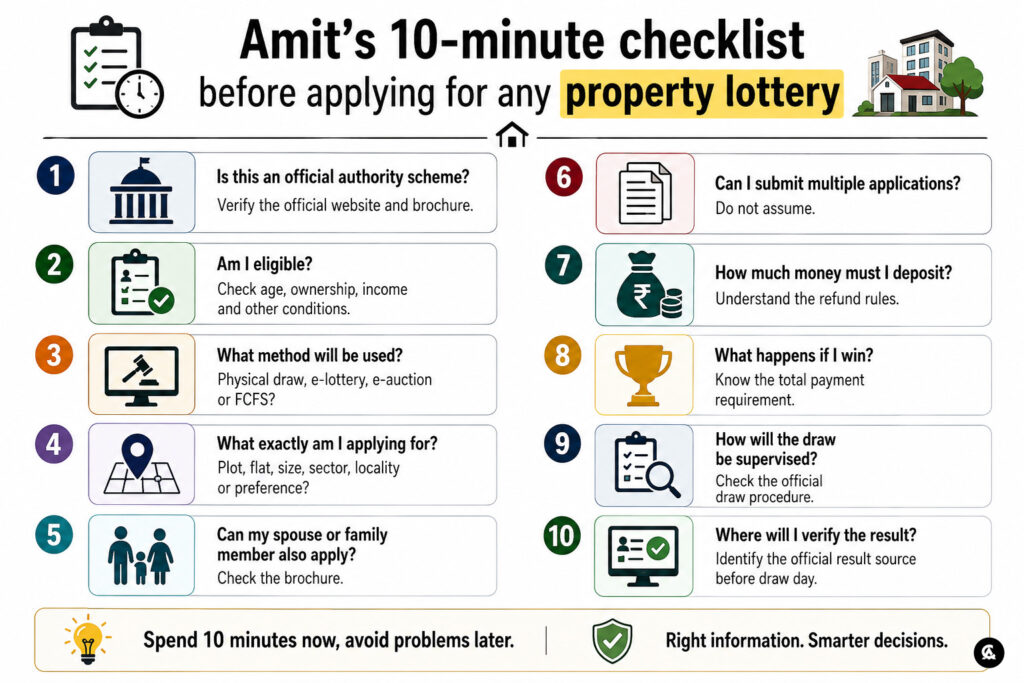
Amit’s 10-minute checklist before applying for any property lottery
1. Is this an official authority scheme?
Verify the official website and brochure.
2. Am I eligible?
Check age, ownership, income and other conditions.
3. What method will be used?
Physical draw, e-lottery, e-auction or FCFS?
4. What exactly am I applying for?
Plot, flat, size, sector, locality or preference?
5. Can my spouse or family member also apply?
Check the brochure.
6. Can I submit multiple applications?
Do not assume.
7. How much money must I deposit?
Understand the refund rules.
8. What happens if I win?
Know the total payment requirement.
9. How will the draw be supervised?
Check the official draw procedure.
10. Where will I verify the result?
Identify the official result source before draw day.
Amit finally understands what the draw can—and cannot—decide
When Amit first read:
“Allotment through e-lottery”
he thought the entire process depended on luck.
Now he understands something different.
Luck may decide the final random selection.
But almost everything surrounding that moment depends on preparation.
Amit controls whether he reads the brochure.
He controls whether his application is correct.
He controls whether he understands the reservation rules.
He controls whether the property is affordable.
He controls whether he understands his actual competition pool.
He controls whether he falls for a fake broker.
He controls whether he verifies the result.
And if he wins, he controls whether he is prepared to complete the payment and legal formalities.
He also understands that the debate is not simply:
Physical draw good, e-lottery bad
or
E-lottery modern, physical draw outdated.
YEIDA’s 2026 manual draw and GDA’s 2026 e-lottery show that both methods can still be used for highly oversubscribed government plot schemes.
The real question is:
How strong are the controls around the draw?
The result can be random.
Preparation and transparency should not be.
Conclusion — the smartest applicant does not try to beat the lottery
An e-lottery is fundamentally a computerised property-allotment mechanism for selecting from an eligible applicant pool when available properties are limited.
But the history and current examples show that it is only one way of conducting a draw.
Computerised housing draws in India can be traced back to the early 1980s, while manual draws continue to be used decades later. There is no single nationwide date on which India “started e-lottery”, and there is no central database that gives a reliable total of every physical draw and e-lottery ever conducted.
The YEIDA RPS10/2026 manual draw and GDA Madhuban Bapudham 2026 e-lottery demonstrate that two major NCR authorities can use different random-allotment mechanisms in the same year.
Neither system should be trusted merely because one uses paper and the other uses software.
A strong physical draw needs:
controlled applicant lists + secure slips + proper mixing + observers + videography + official results.
A strong e-lottery needs:
validated applicant data + secure software + proper randomisation + access controls + audit logs + supervision + official results.
And both need an effective grievance mechanism.
The GDA example also demonstrates why applicants should look beyond headline numbers. More than 42,500 applications were received for 350 plots, yet the first-day simplified category success rates ranged from approximately 0.47% to 1.94%.
So the smartest buyer does not ask:
“Which trick will make me win?”
The smarter questions are:
Am I eligible?
Which applicant pool am I actually competing in?
Is this a physical draw or e-lottery?
How is the process supervised?
Can I afford the property if selected?
How will I verify the result?
What happens after allotment?
Once those questions are answered, a government property lottery stops being a mysterious game of luck.
It becomes what it should be:
a rule-based allotment process in which random selection may decide the winner, but transparency, preparation and informed decision-making protect the buyer.
Sources
Delhi Development Authority — Housing FAQs
Official information on eligibility scrutiny and computerised allotment. DDA Housing FAQs
Delhi Development Authority — Draw Results
Official archive showing repeated use of computerised draws. DDA Draw Results
Delhi Development Authority — historical computerisation
A DDA official’s account of the move from manual to computerised housing draws in the early 1980s. Economic Times report on DDA draw history
Delhi High Court — Rohini computerised plot draw
Judgment recording a computerised DDA plot draw held on 25 March 1985. Delhi High Court case record
YEIDA — RPS10/2026 Residential Plot Scheme
Official scheme source for the 2026 residential plot draw. YEIDA RPS10/2026 Brochure
YEIDA — Residential Plot Scheme 2024
Official brochure explicitly prescribing manual draw. YEIDA 2024 Residential Plot Brochure
YEIDA — Residential Plot Scheme 2025
Official brochure explicitly prescribing manual draw. YEIDA 2025 Residential Plot Brochure
YEIDA RPS10/2026 draw reporting
Details of 973 plots, 110,034 valid applications, manual drums, observers, videography and livestreaming. Hindustan Times — YEIDA 973-plot draw
CAG — MHADA Lottery and Flat Allotment IT Audit
Official audit evidence concerning applicant validation, duplicate applications and computerised lottery controls. CAG MHADA IT Audit
CAG — Ghaziabad Development Authority Property Allotment Audit
Official audit showing seven GDA lottery draws during 2018–22, without classifying every draw as manual or electronic. CAG GDA Performance Audit
GDA Madhuban Bapudham 2026 — First-Day E-Lottery
Reported 16,478 applications, 16,436 eligible applicants and allotment of 109 plots through computerised e-lottery. GDA Madhuban Bapudham first-day draw report
GDA Madhuban Bapudham 2026 — Category Competition
Category-wise applicant and plot figures from the 19 August draw. GDA Madhuban Bapudham category-wise result report


Leave a Reply