


An e-lottery is a computerised allotment process used by housing and development authorities to distribute limited flats or plots among eligible applicants. Instead of deciding allotment through competitive bidding or simply rewarding the earliest applicant, the authority first checks eligibility, creates the relevant applicant pool and conducts a computerised draw according to the scheme rules.
India does not have one officially declared date on which property e-lottery began nationwide. Computerised housing lotteries were already documented among major authorities by the mid-2000s. The GDA Madhuban Bapudham e-lottery held on 19 August 2026, where 109 plots were allotted among 16,436 applicants in the first four categories, provides a recent real-world example of how such draws work.
What is an e-lottery?
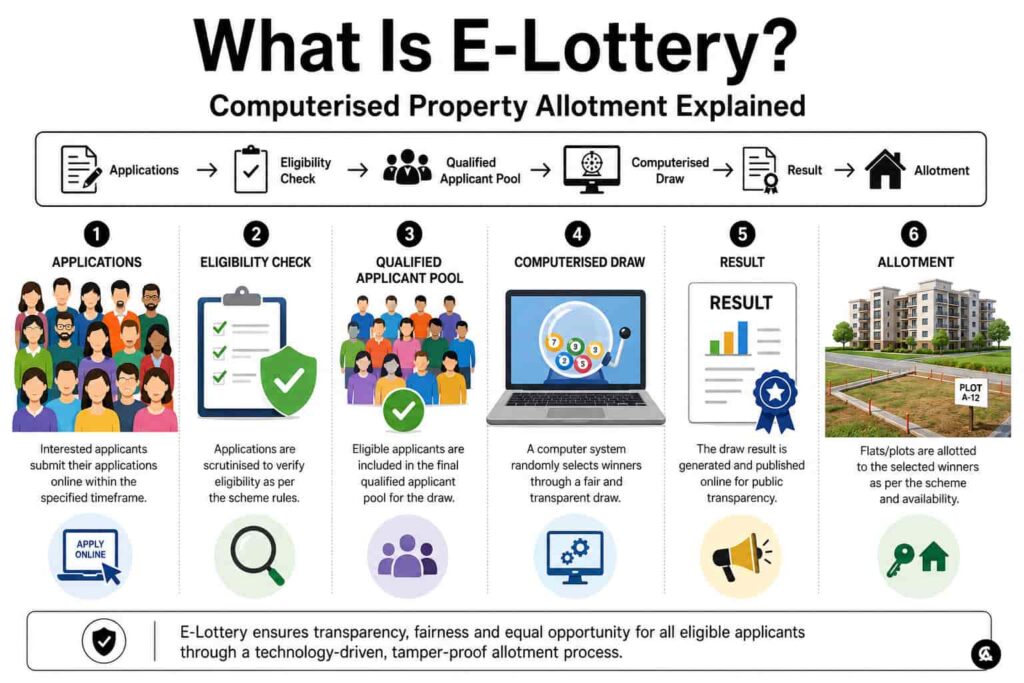
An e-lottery, or electronic lottery, is a computer-based draw used to select successful applicants when the number of eligible applicants exceeds the properties available under a scheme.
The basic concept is:
Applications → Eligibility Check → Qualified Applicant Pool → Computerised Draw → Result → Allotment
The Delhi Development Authority’s housing guidance provides a useful official example. DDA states that applications are first scrutinised according to eligibility criteria and scheme terms, after which flats are allotted through a computerised draw.
This means submitting an application does not automatically mean that the applicant will enter the final draw. The application must first satisfy the conditions of the particular scheme.
E-lottery is not First Come, First Serve
Under a normal e-lottery, being the first person to submit an application does not automatically give an applicant the property.
E-lottery is also not an e-auction
An applicant does not normally win an e-lottery by offering a higher price. The property is allotted through the notified draw mechanism.
When did e-lottery start in India?
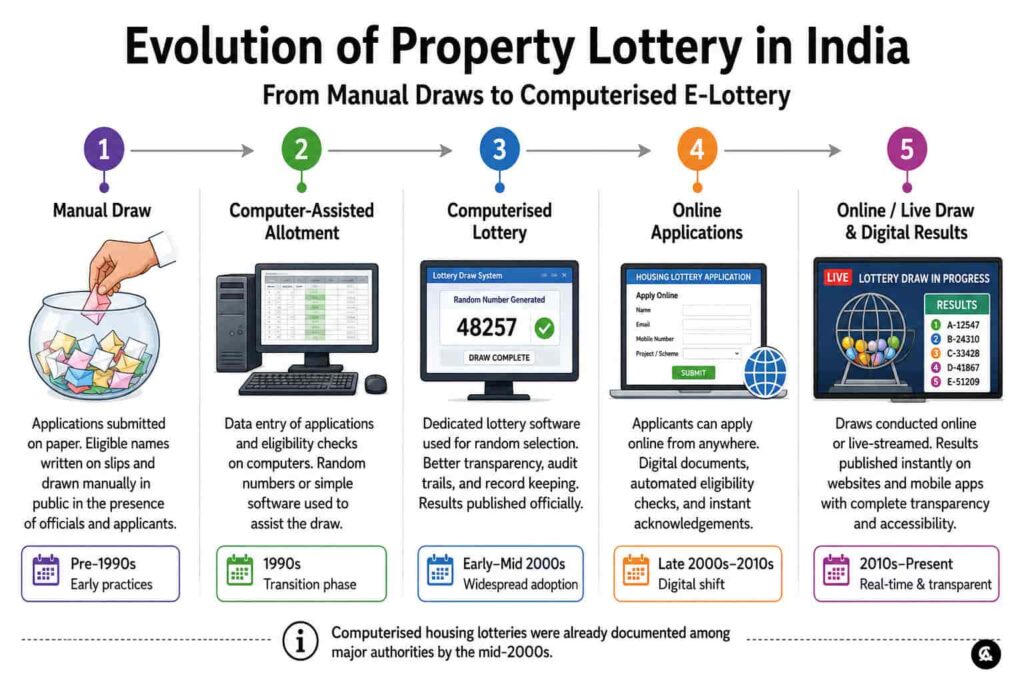
There is no single verified national date that can accurately be described as “the day e-lottery started in India.”
Housing authorities adopted computerised allotment systems at different times.
One of the strongest documented historical examples comes from a Comptroller and Auditor General of India audit of the Mumbai Housing and Area Development Board under MHADA.
The CAG audit examined lotteries conducted on:
- 14 June 2005
- 11 July 2006
The audit also records that a new Lottery Management System with enhanced functionality and security features was developed in June 2006.
Therefore, the accurate way to understand the history is:
Computerised property lotteries were already in use among major Indian housing authorities by the mid-2000s, but different authorities adopted such systems on different timelines.
It would be incorrect to state that e-lottery universally “started in India in 2006.”
Why did housing authorities start using e-lottery?
The main practical problem is simple:
Properties are limited, but eligible applicants can number in the thousands.
Authorities therefore need a mechanism capable of handling large applicant pools while applying:
- Eligibility conditions
- Different property categories
- Reservation quotas
- Applicant preferences where applicable
- Randomisation
- Property-to-applicant mapping
- Result generation
Computerisation makes such large-scale allotments easier to process and document.
DDA’s published draw process, for example, describes randomisation of applicants and flats, generation of cross-reference lists, selection of starting or “lucky” numbers and computerised mapping of applicants to available properties while taking reservation and locality rules into account.
Computerisation can also provide better records and audit trails. But it is important not to oversimplify this.
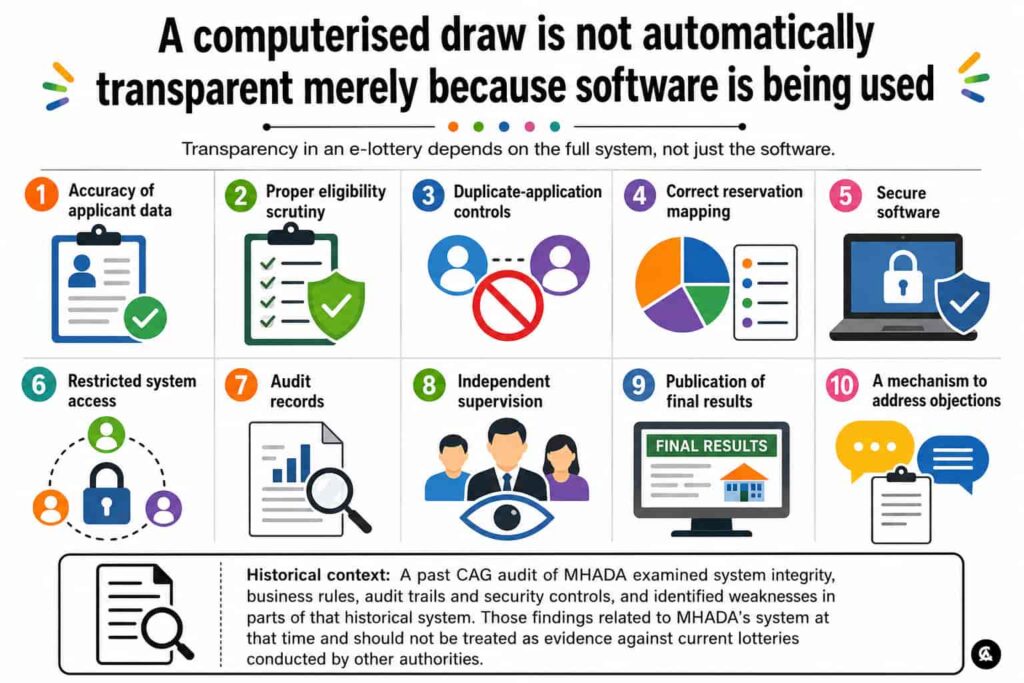
A computerised draw is not automatically transparent merely because software is being used.
Transparency also depends on:
- Accuracy of applicant data
- Proper eligibility scrutiny
- Duplicate-application controls
- Correct reservation mapping
- Secure software
- Restricted system access
- Audit records
- Independent supervision
- Publication of final results
- A mechanism to address objections
The historical CAG audit of MHADA specifically examined system integrity, business rules, audit trails and security controls, and identified weaknesses in parts of that historical system. Those findings relate to MHADA’s system at that time and should not be interpreted as evidence against current lotteries conducted by other authorities.
What happens in an e-lottery?
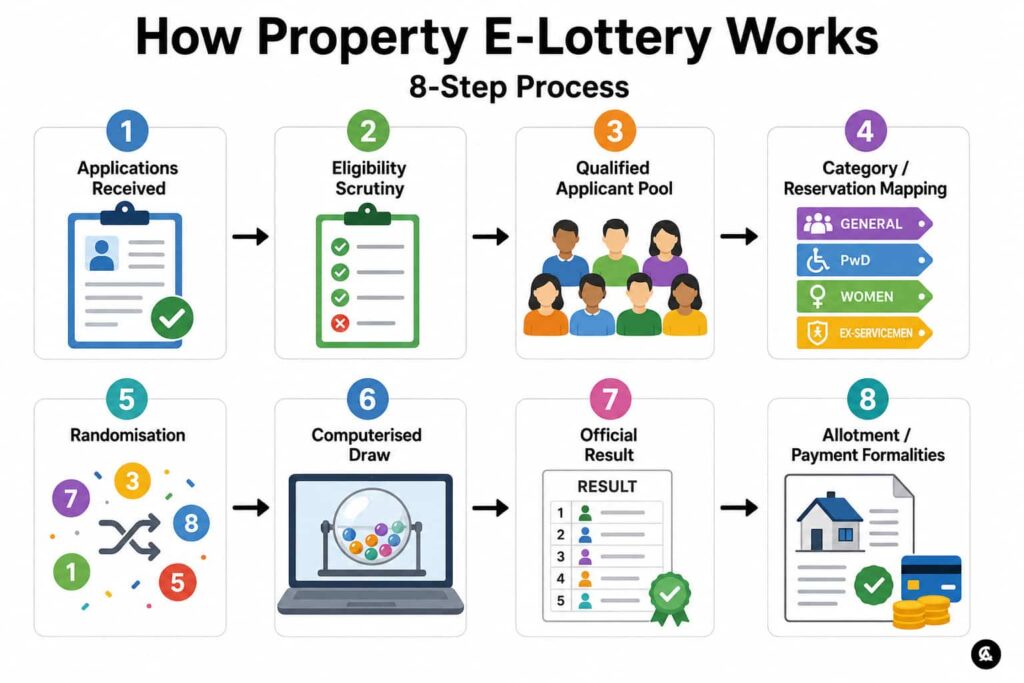
The exact procedure can vary from one authority to another, but a property e-lottery can broadly be understood through eight stages.
1. Applications are received
The authority launches a housing or plot scheme and applicants register for the eligible property category.
The application normally contains information such as:
- Applicant identity
- Property/category selected
- Reservation category, where applicable
- Supporting documents
- Application or registration amount
2. Eligibility is scrutinised
The authority checks whether applicants satisfy the scheme rules.
DDA specifically states that its computerised allotment takes place after scrutiny of applications according to eligibility criteria and the terms and conditions of the scheme.
Therefore:
Applications received ≠ final eligible draw pool
This distinction is important whenever a scheme receives very high application numbers.
3. Qualified applicant pool is prepared
Applications that clear scrutiny become part of the applicable draw pool.
An applicant rejected on eligibility or document grounds may not participate even though an application was originally submitted.
4. Applicants are mapped into categories and reservations
A scheme may contain separate pools based on:
- Flat or plot size
- General category
- SC
- ST
- Persons with Disabilities
- Ex-servicemen
- War widows
- Other reservations specifically provided by the authority
DDA’s published draw process explains that reservations can be applied category-wise while applicants and flats are mapped during allotment.
5. Applicants and properties may be randomised
Depending on the authority’s system, applicant records and available properties can be shuffled or assigned random references before final allotment.
DDA’s process describes randomisation of both applicants and flats before mapping begins.
6. Computerised draw is conducted
The software executes the allotment according to the configured scheme rules.
The precise software and procedure can differ by authority, so there is no single universal e-lottery algorithm used throughout India.
7. Official result is generated
Successful applicants are identified and the authority publishes the result through its official channels.
Depending on the scheme, the result may include:
- Successful applicant
- Application number
- Allotted property
- Waiting-list position
- Reservation category
- Further allotment instructions
8. Successful applicants complete allotment formalities
Winning the e-lottery does not automatically mean immediate possession.
A successful applicant may still have to:
- Verify original documents
- Deposit the required amount
- Meet payment deadlines
- Pay applicable additional charges
- Receive the formal allotment letter
- Complete lease/freehold or agreement formalities
- Wait for possession according to scheme conditions
Does every applicant have the same chance in an e-lottery?
Not necessarily.
Consider a housing authority offering several property sizes.
Applicants seeking a 200 sq m plot may be placed in a different draw pool from applicants seeking a 40 sq m plot.
Competition can also vary because of:
- Number of properties in that category
- Number of eligible applicants
- Reservation rules
- Applicant category
- Scheme-specific conditions
Therefore, a headline such as:
“40,000 applications for 400 properties”
does not automatically mean that every applicant has exactly a 1-in-100 probability.
The correct comparison is usually:
Eligible applicants in your relevant draw pool ÷ properties available in that pool
The GDA Madhuban Bapudham draw provides a good example of how dramatically those numbers can differ.
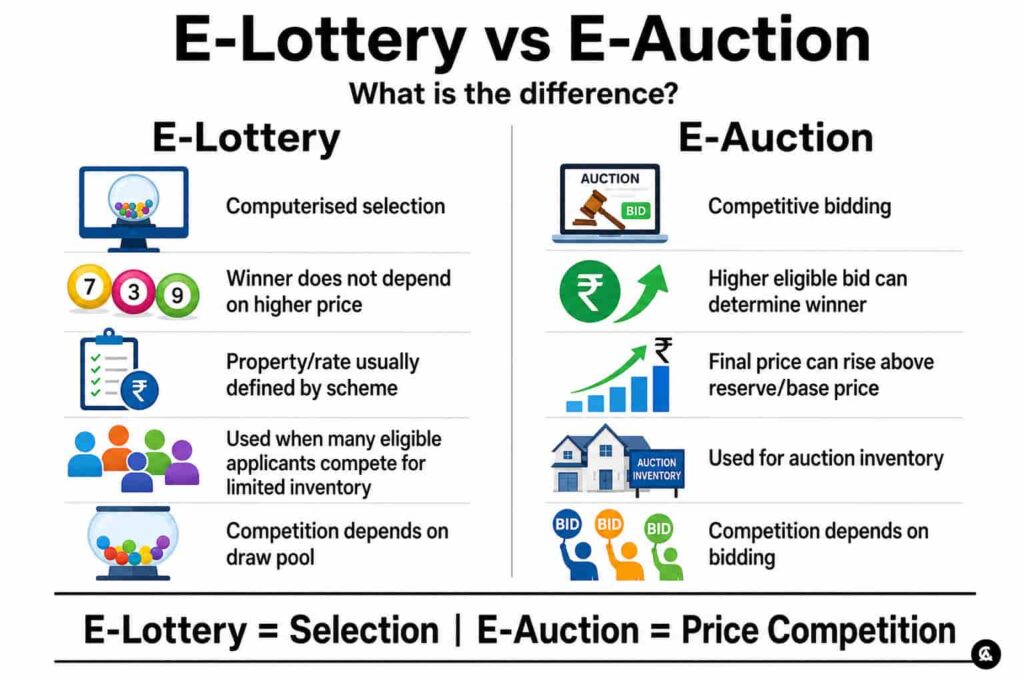
E-lottery vs e-auction: What is the difference?
E-lottery and e-auction are two completely different property-allotment mechanisms.
| E-Lottery | E-Auction |
|---|---|
| Selection through a computerised draw | Selection through competitive bidding |
| Applicant normally does not win by offering a higher price | Higher eligible bid can determine the winner |
| Property price/rate is generally governed by scheme conditions | Final price can rise above the reserve/base price |
| Used when eligible demand exceeds limited inventory | Used where authority sells property through bidding |
| Competition depends on eligible draw pool | Competition depends on bidding behaviour |
| Result identifies selected allottee | Auction identifies successful bidder |
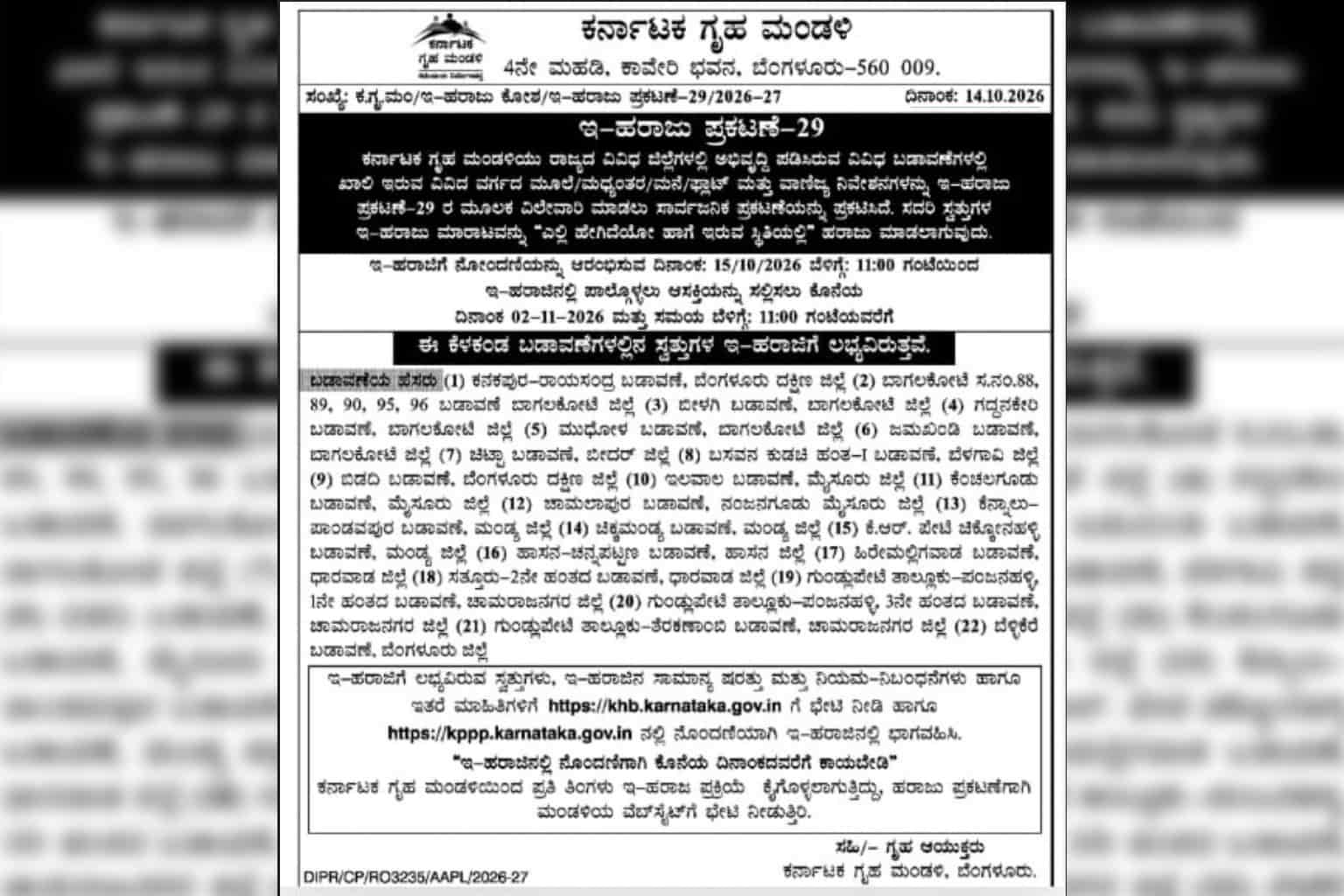
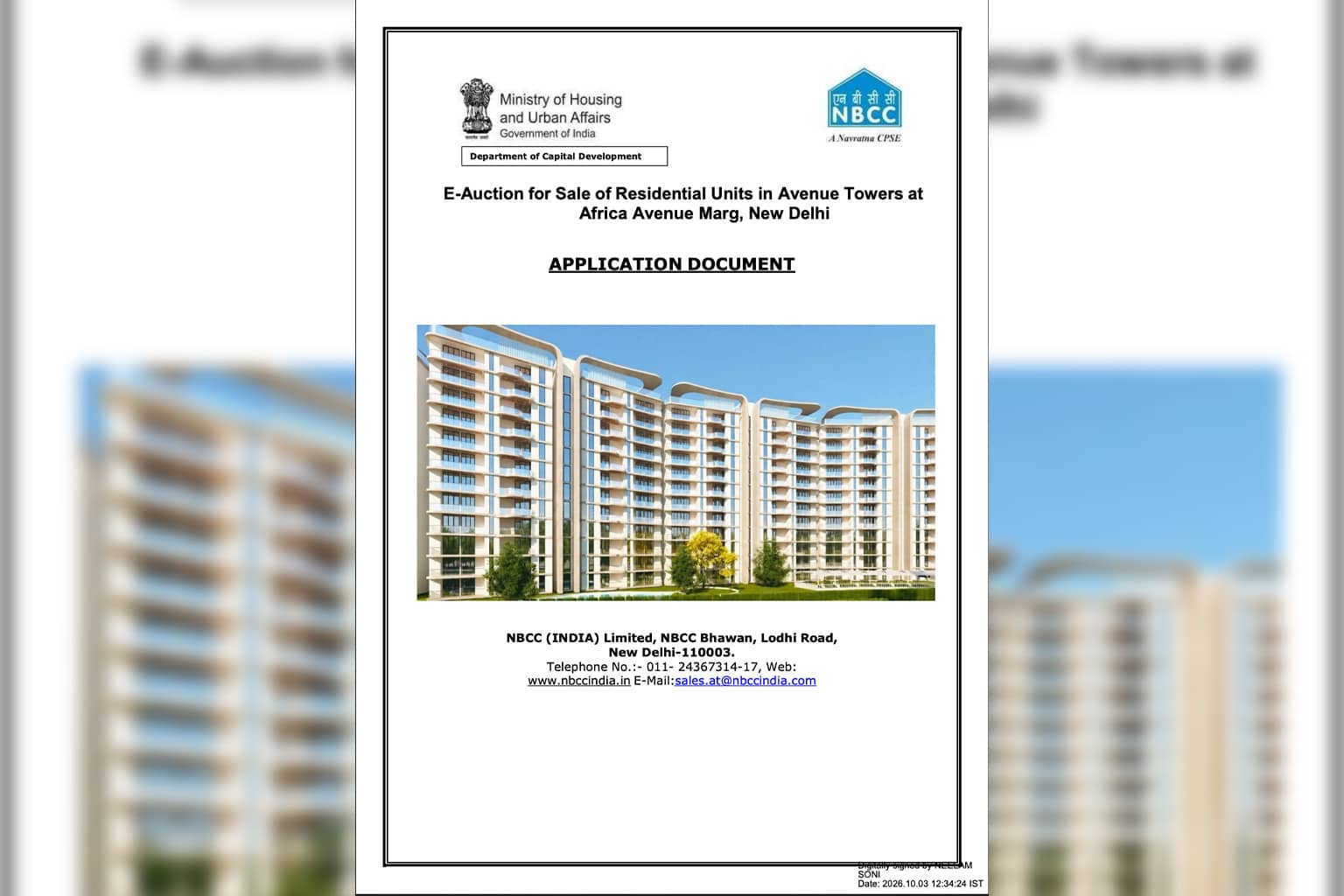
DDA currently uses both approaches. Its housing circulars include schemes offered on a computerised draw basis as well as separate e-auction housing schemes.
The simplest distinction is:
E-Lottery = Who gets the property?
E-Auction = Who offers the winning bid?
What happened in GDA Madhuban Bapudham e-lottery on 19 August 2026?
The Ghaziabad Development Authority’s Madhuban Bapudham Residential Plot Scheme 2026 provides a current example of an oversubscribed authority plot scheme using a computerised lottery.
GDA received 42,511 applications for 350 residential plots. The plots ranged from around 40 sq m to 200 sq m, with a reported base rate of ₹35,000 per sq m.
Because of the size of the applicant pool, the draw was divided across 19 and 20 August 2026 at Hindi Bhawan, Lohia Nagar, Ghaziabad.
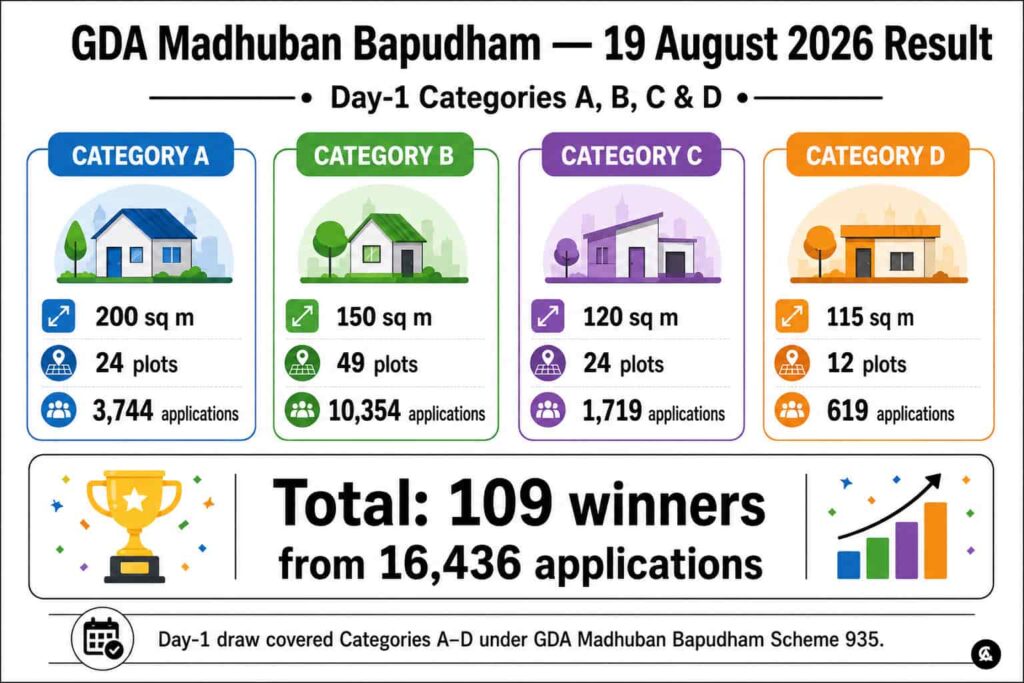
The first day, 19 August, covered Categories A, B, C and D, representing the 200 sq m, 150 sq m, 120 sq m and 115 sq m plot categories.
GDA 19 August e-lottery result
| Category | Plot size | Plots / Winners | Applications | Unsuccessful |
|---|---|---|---|---|
| A | 200 sq m | 24 | 3,744 | 3,720 |
| B | 150 sq m | 49 | 10,354 | 10,305 |
| C | 120 sq m | 24 | 1,719 | 1,695 |
| D | 115 sq m | 12 | 619 | 607 |
| Total | — | 109 | 16,436 | 16,327 |
The Day-1 draw therefore selected:
109 successful applicants from a pool of 16,436 applications
while 16,327 applicants were unsuccessful.
Which GDA category was the most competitive?
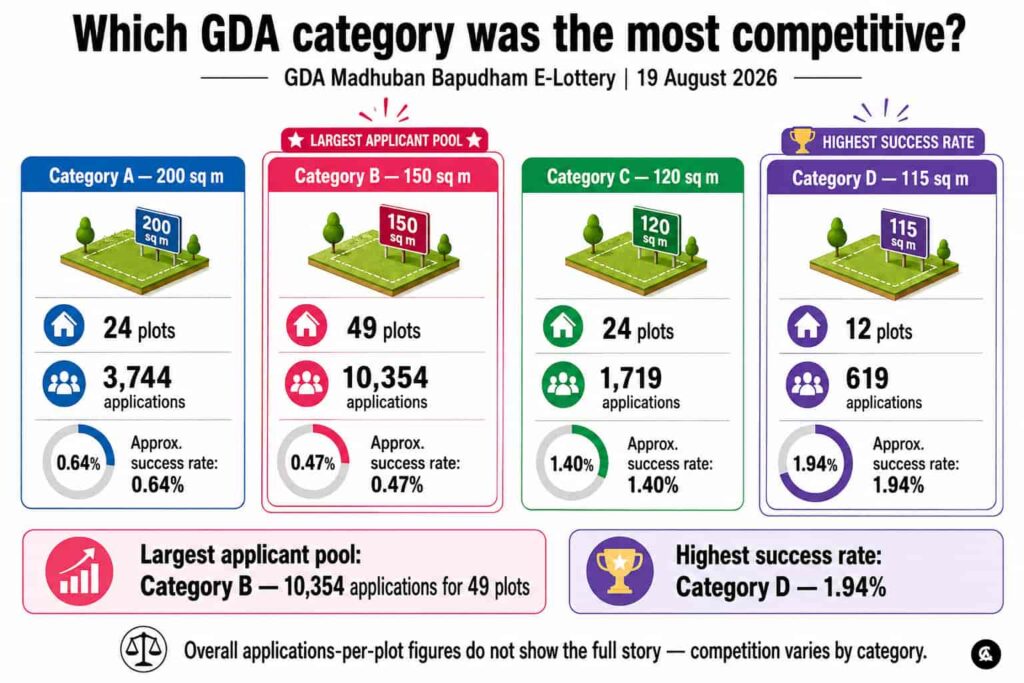
The 19 August result also demonstrates why an overall “applications per plot” figure does not tell the whole story.
Category A — 200 sq m
24 plots for 3,744 applications
Approximate success rate:
0.64%
Category B — 150 sq m
49 plots for 10,354 applications
Approximate success rate:
0.47%
Category C — 120 sq m
24 plots for 1,719 applications
Approximate success rate:
1.40%
Category D — 115 sq m
12 plots for 619 applications
Approximate success rate:
1.94%
Category B attracted the largest Day-1 applicant pool with 10,354 applications for 49 plots. Category D had the highest approximate success rate among these four categories, even though it had only 12 plots.
This is exactly why applicants should analyse their specific category, not simply divide the overall number of applications by total inventory.
Why was the GDA draw live-streamed?
GDA arranged live viewing of the draw, allowing applicants to follow proceedings remotely instead of requiring tens of thousands of people to be physically present.
According to reporting after the first draw, GDA also retained the recording of the proceedings. Applicants with doubts or objections about the draw process were reportedly told that the recording could be reviewed for clarification.
Live streaming can improve public visibility, but it should be understood correctly:
Watching a draw live is an additional transparency measure; it does not replace the official result document.
Applicants should always verify their final status using the authority’s published result or allotment communication.
What should applicants check after an e-lottery?
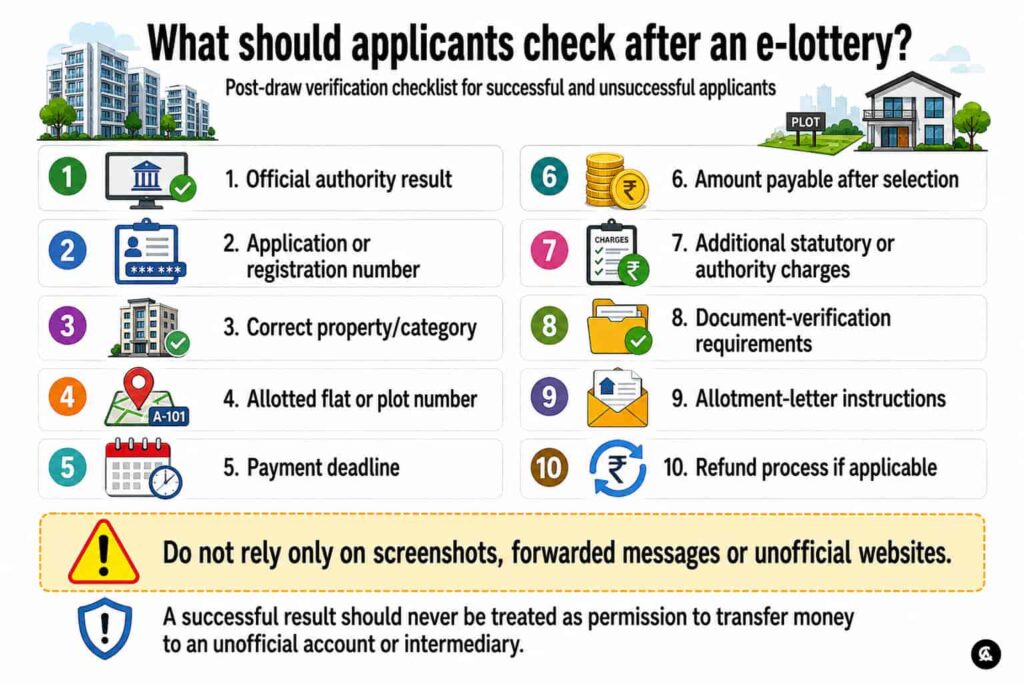
After any authority property draw, successful and unsuccessful applicants should avoid relying solely on screenshots, forwarded messages or unofficial websites.
Check:
- Official authority result
- Application or registration number
- Correct property/category
- Allotted flat or plot number
- Payment deadline
- Amount payable after selection
- Additional statutory or authority charges
- Document-verification requirements
- Allotment-letter instructions
- Refund process if applicable
A successful result should never be treated as permission to transfer money to an unofficial account or intermediary.
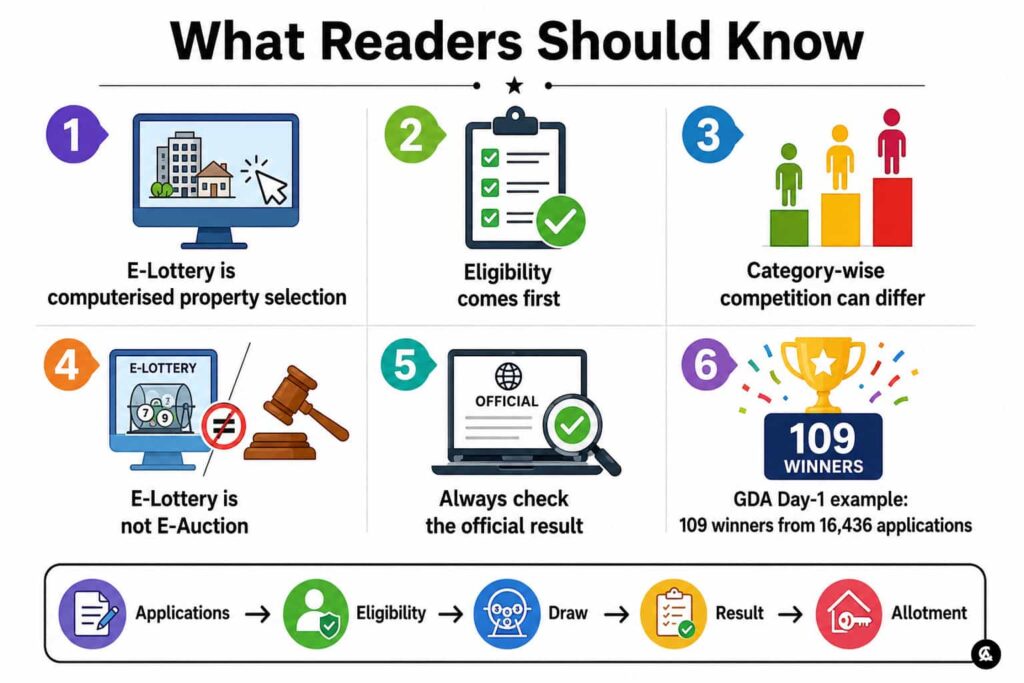
What readers should know?
An e-lottery is not simply an online lucky draw. It is an allotment process built around eligibility, defined applicant categories, available property inventory and computerised selection.
The main points are:
- There is no single verified nationwide date when property e-lottery started in India.
- Computerised housing lotteries were already documented among major authorities by the mid-2000s.
- Applicants are normally scrutinised before entering the final draw.
- Applications received and eligible draw participants are not necessarily the same number.
- Separate property and reservation categories can have very different levels of competition.
- E-lottery and e-auction are fundamentally different.
- E-lottery selects among eligible applicants; e-auction selects through bidding.
- A computerised system still requires proper data, controls, audit trails and supervision.
- A winning result is followed by payment, verification and formal allotment procedures.
- In GDA Madhuban Bapudham on 19 August 2026, 109 plots were allotted among 16,436 applications in Categories A–D, showing how competition can vary significantly between categories.
Sources:-
Delhi Development Authority — Housing FAQs: Computerised allotment after eligibility scrutiny.
Open DDA Housing FAQs
Delhi Development Authority — Official Process of Draw document explaining randomisation, lucky-number selection and mapping of applicants and flats.
Open DDA Process of Draw PDF
Delhi Development Authority — Housing Policies and Guidelines, including Process of Draw.
Open DDA Housing Guidelines
Comptroller and Auditor General of India — IT Audit of MHADA Lottery and Tenements Allotment System, covering lotteries held in 2005 and 2006 and the Lottery Management System developed in June 2006.
Open CAG MHADA Audit PDF
Navbharat Times — GDA Madhuban Bapudham first draw result, 19 August 2026: 109 successful applicants from 16,436 applications across the first four categories.

Leave a Reply