


For most homebuyers, the sale agreement feels like the final step before confidence begins. The flat has been selected, the payment plan has been discussed, the booking amount has been paid and the builder’s office finally shares a long legal document for signature.
Many buyers do not read every clause. Even fewer compare that agreement with the draft agreement uploaded by the developer on the RERA portal.
A recent Telangana Real Estate Appellate Tribunal ruling shows why that small step can become extremely important.
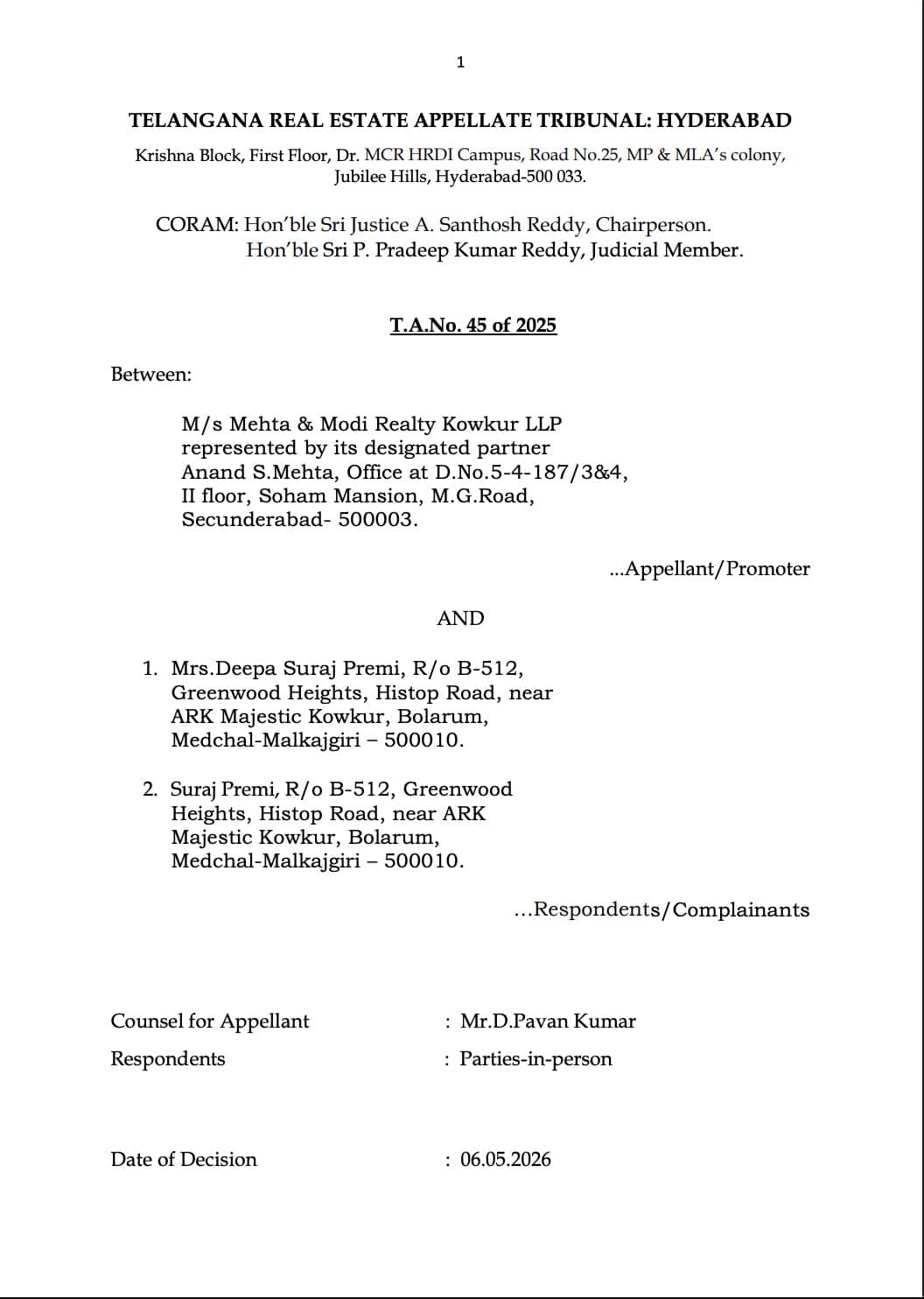
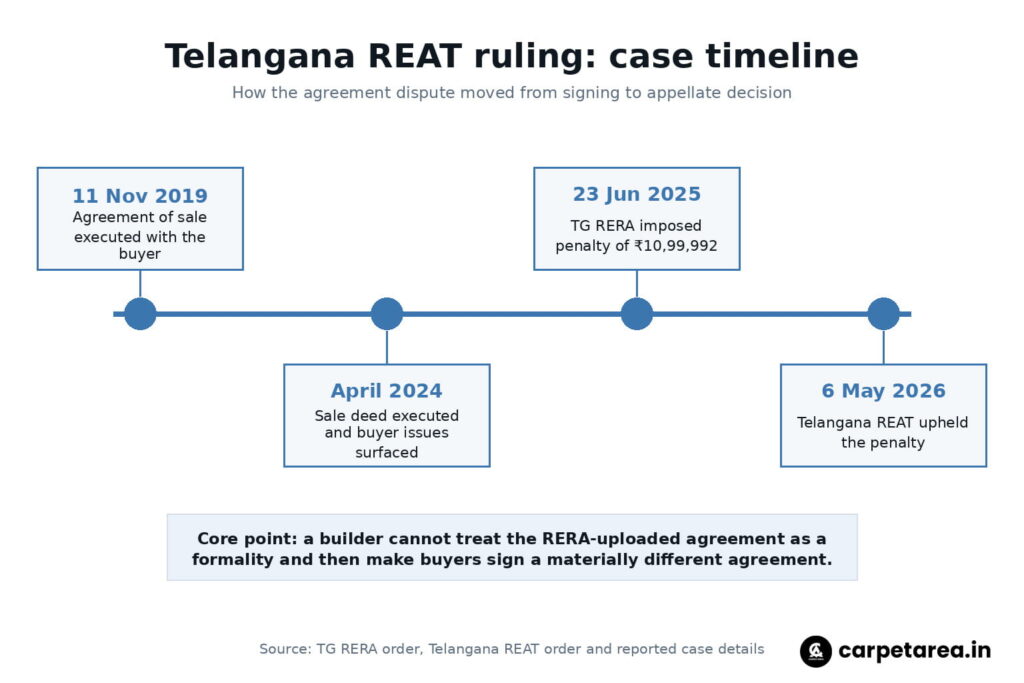
The Telangana Real Estate Appellate Tribunal, in T.A. No. 45 of 2025, decided on 6 May 2026, upheld action against M/s Mehta & Modi Realty Kowkur LLP in a dispute involving buyers of the Greenwood Heights project in Kowkur, Medchal-Malkajgiri. The tribunal upheld a penalty of ₹10,99,992 because the developer had executed an agreement of sale different from the one uploaded on the Telangana RERA website.
This is not just a Telangana story. This is a warning for every Indian homebuyer who signs a builder-buyer agreement without checking whether the document matches the RERA-uploaded format.
The issue was not only delay or maintenance
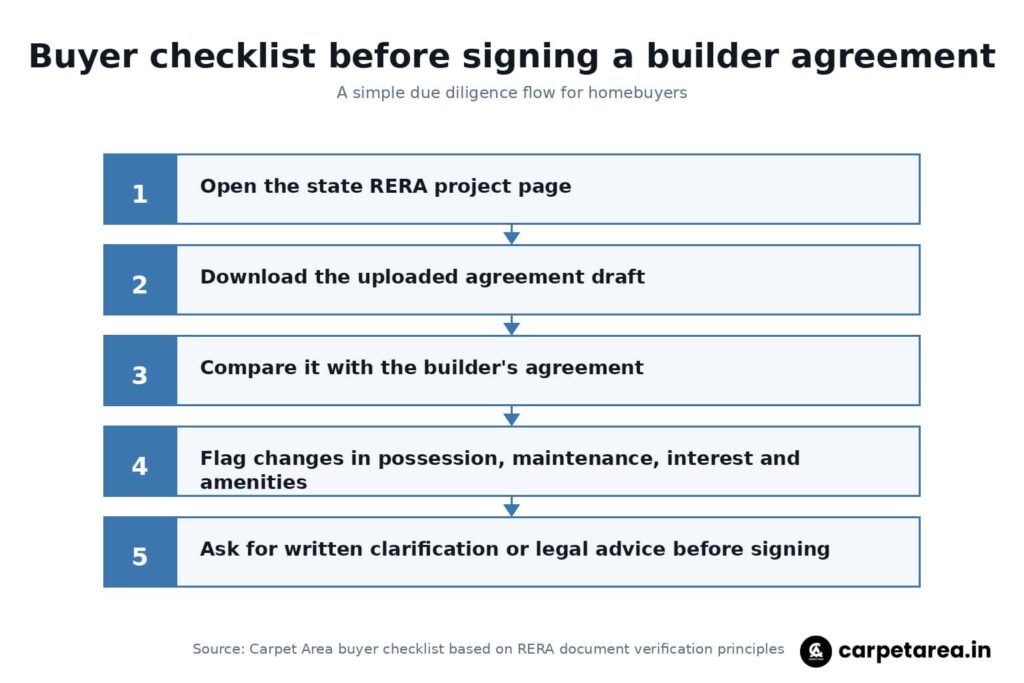
At first glance, the case looks like a typical builder-buyer dispute. The buyers had concerns regarding possession, maintenance charges, pending works, water charges, interest calculation and project completion. The original Telangana RERA order records that the complainants had purchased Flat No. B-512 in Greenwood Heights and raised several issues after the sale deed was executed in April 2024.
But the deeper issue was the agreement itself.
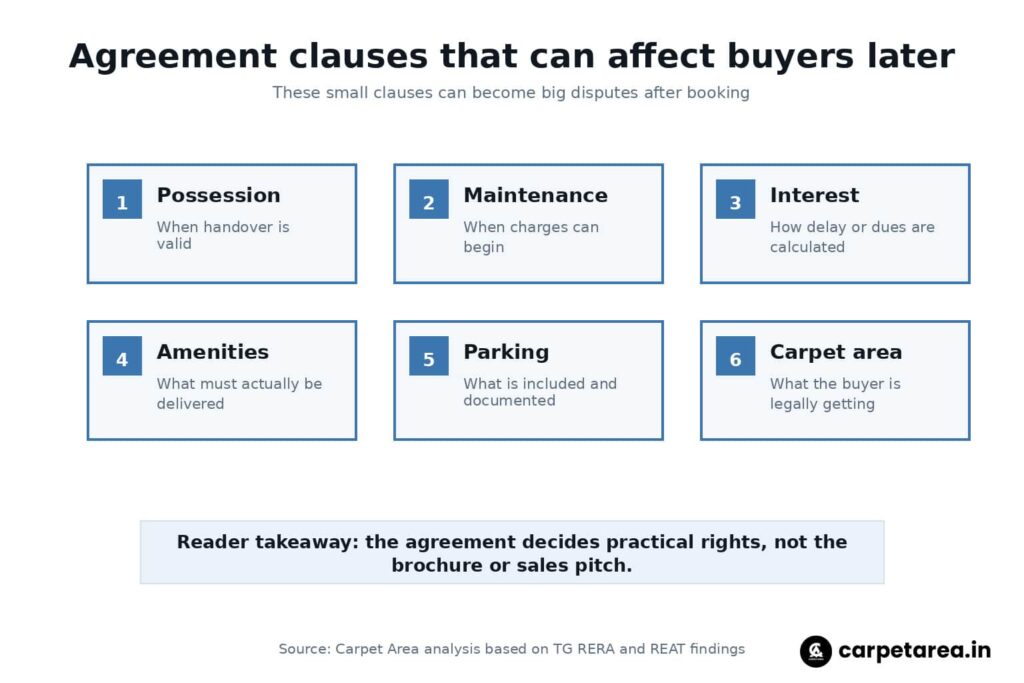
The buyers argued that the agreement submitted to RERA at the time of project registration and the agreement actually executed with them were different. The original Telangana RERA order recorded that the executed agreement contained many clauses that were not part of the format submitted to the Authority and that the agreement was alleged to be lopsided in favour of the developer.
That is where the case became bigger than one flat.
Why the RERA-uploaded agreement matters?
When a project is registered under RERA, the promoter provides project details and documents to the authority. One of the important documents is the agreement for sale format. In Telangana, Rule 38 of the Telangana State Real Estate Rules says that the agreement for sale between the promoter and the allottee should be in the prescribed annexure format.
This is important because the agreement is not a casual document. It decides what the buyer is entitled to, when possession can be offered, when maintenance can be charged, how obligations are defined and how the developer’s promises are recorded.
If the developer uploads one format to RERA but makes buyers sign a materially different agreement, the buyer may not even realise that important protections have changed. The buyer may only discover the difference when a dispute begins.
That is exactly why this ruling matters.
What Telangana RERA found?
The original Telangana RERA order dated 23 June 2025 found that the draft agreement uploaded by the respondent on the project website was entirely different from the agreement executed with the buyer on 11 November 2019. The Authority held that the promoter had uploaded the same draft agreement as the annexure to Rule 38 but executed a completely different agreement with the buyer, which it described as impermissible.
The Authority also held that this conduct amounted to misrepresentation, furnishing false information and deliberate suppression of material facts. It imposed a penalty of ₹10,99,992 under Section 60 of the RERA Act.
Section 60 of the Real Estate Regulation and Development Act, 2016 provides that if a promoter gives false information or contravenes Section 4, the promoter can face a penalty up to five percent of the estimated project cost as determined by the authority.
What the appellate tribunal said?
The developer challenged the Telangana RERA order before the Telangana Real Estate Appellate Tribunal. The tribunal examined the issue and upheld the core finding.
The tribunal observed that the developer had uploaded the draft agreement on the website as per the Annexure to Rule 38, but executed a completely different agreement of sale dated 11 November 2019 in favour of the complainants. The tribunal held that changing the format and executing a completely different agreement, even if some terms were similar, was impermissible.
The appellate tribunal also held that this conduct not only violated Rule 38 but also amounted to furnishing false information and deliberate suppression of material facts. It found that the regulatory authority was right in imposing the penalty under Section 60 of the Act.
This is the key message for buyers: the builder cannot treat the RERA-uploaded agreement as a formality and then use another agreement with the buyer.
Why this matters to normal homebuyers?
Most buyers look at a flat from the outside. They check location, price, floor plan, amenities, payment schedule and possession timeline. But the agreement is where many future problems are hidden.
A clause can decide when maintenance starts. Another clause can decide whether the buyer has accepted possession. Another clause can affect claims related to pending works, amenities or delayed payment interest.
In the Greenwood Heights case, maintenance charges were one of the issues. The appellate tribunal discussed Clause 7.2 of the draft agreement under Rule 38, which connects possession procedure with occupancy certificate and physical handover. The tribunal noted that the developer could not override the statutory mandate through a contractual clause in an invalidly executed agreement that differed from the uploaded draft.
For a buyer, this is a practical lesson. A builder may say that the agreement is standard. But the buyer should still ask: standard according to whom? Standard as per the builder’s office or standard as per the RERA-uploaded format?
The real buyer checklist from this ruling
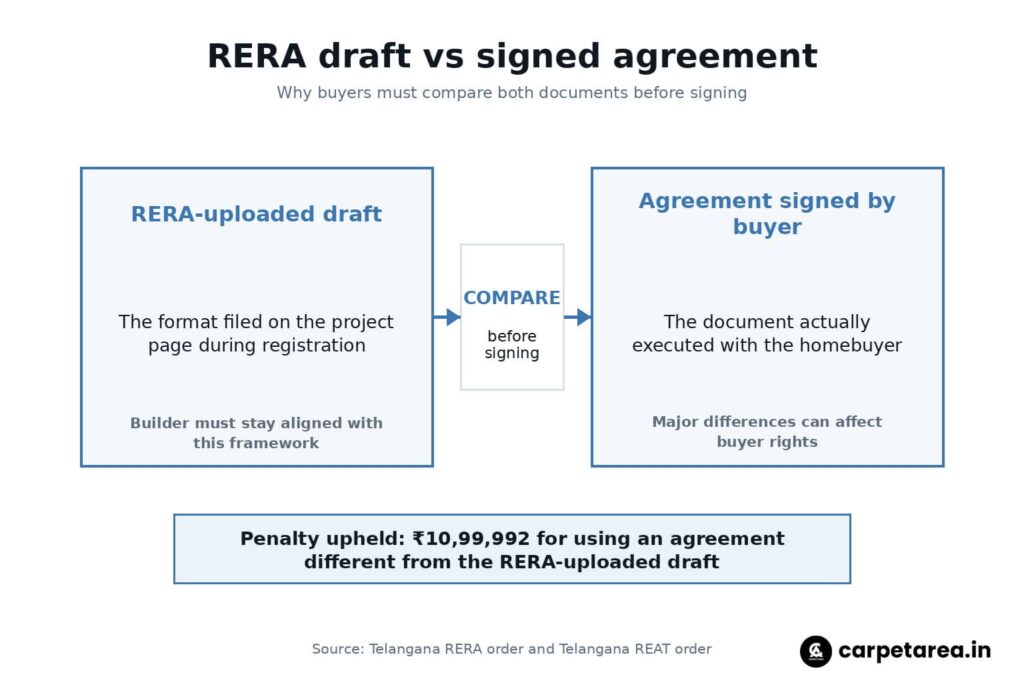
Before signing any builder-buyer agreement, a homebuyer should take a few basic steps.
First, open the project page on the concerned state RERA website and download the uploaded agreement for sale or draft agreement. Second, compare the builder’s physical agreement or PDF with that uploaded draft. Third, check whether important clauses related to possession, maintenance, interest, parking, amenities, carpet area, defect liability and association formation are aligned. Fourth, do not sign possession confirmation, inspection satisfaction, no-objection or maintenance documents casually before actual handover and proper inspection.
This does not mean every difference is automatically illegal. But if the executed agreement materially changes buyer rights, it can become a serious issue.
For buyers who are paying lakhs or crores for a home, comparing two documents is not extra work. It is basic safety.
Why builders should also take this seriously?
This ruling is also a message for developers.
A project’s RERA registration is not only a compliance checkbox. The documents submitted to RERA create a framework of trust. If the builder uploads one document and uses another document with buyers, the regulator may treat it seriously.
The Hindustan Times report on the ruling notes that the tribunal held that modifying the approved agreement format or executing materially different sale agreements violates rules, and it upheld the penalty imposed by Telangana RERA.
For good developers, this is also an opportunity. A builder who uses the same transparent RERA-aligned agreement for all buyers can build more trust. In a market where buyers are increasingly cautious, clean documentation can become a selling point.
Why this story has national importance?
The project is in Telangana, and the ruling comes from the Telangana Real Estate Appellate Tribunal. But the concern is national.
Across India, many buyers sign long agreements without knowing what was uploaded on the RERA portal. Many depend only on the builder’s sales team, broker or relationship manager. Some assume that if a project is RERA-registered, every document must automatically be safe.
This ruling reminds buyers that RERA registration is not the end of due diligence. It is the starting point.
The RERA portal can help buyers verify the project registration number, sanctioned plans, completion timeline, promoter details and uploaded documents. But the buyer has to use that information before signing.
The Carpet Area view
This ruling matters because it brings the focus back to paperwork, not just property price.
A homebuyer may negotiate the rate, floor, view or payment plan. But if the agreement is not checked properly, the buyer may later struggle with possession, maintenance, interest, amenities or completion-related disputes.
The safest approach is simple: before signing, compare the builder’s agreement with the RERA-uploaded draft. If there is a major difference, ask questions in writing and take professional advice before moving ahead.
For homebuyers, this case is a reminder that the most important part of a property purchase may not be the brochure, sample flat or discount offer. It may be the document that quietly defines your rights.



Leave a Reply