


A social-media clip from Noida has triggered a wider debate about housing affordability after a local property creator described a compact apartment costing around ₹80 lakh as a “kabutar khana”—literally, a pigeon-sized home.
The frustration expressed in the viral clip is easy to understand. Many buyers feel that apartment prices are rising faster than salaries, while usable living spaces are becoming smaller.
However, the available news report does not identify the project, sector, builder, apartment configuration or exact carpet area. It is also unclear whether ₹80 lakh represents the base price or the complete purchase cost.
Therefore, this should not be treated as proof that every small Noida flat costs ₹80 lakh.
The more useful question is:
What does an ₹80 lakh buyer actually receive in terms of carpet area, layout, location and long-term affordability?
What is confirmed and what remains unknown?
Confirmed through the reported viral story
- A Noida-based real-estate creator criticised rising prices.
- He referred to a compact apartment costing approximately ₹80 lakh.
- He argued that a buyer may need a substantial down payment and a monthly salary exceeding ₹1 lakh.
- The clip generated discussion around shrinking homes and deteriorating affordability.
Still not confirmed
- Exact project
- Noida sector
- Apartment configuration
- RERA carpet area
- Super built-up area
- Builder
- Ready-to-move or under-construction status
- Base price or all-inclusive price
- Parking and club charges
- Maintenance amount
Without these details, nobody can responsibly conclude whether the apartment is overpriced.
₹80 lakh is not enough information
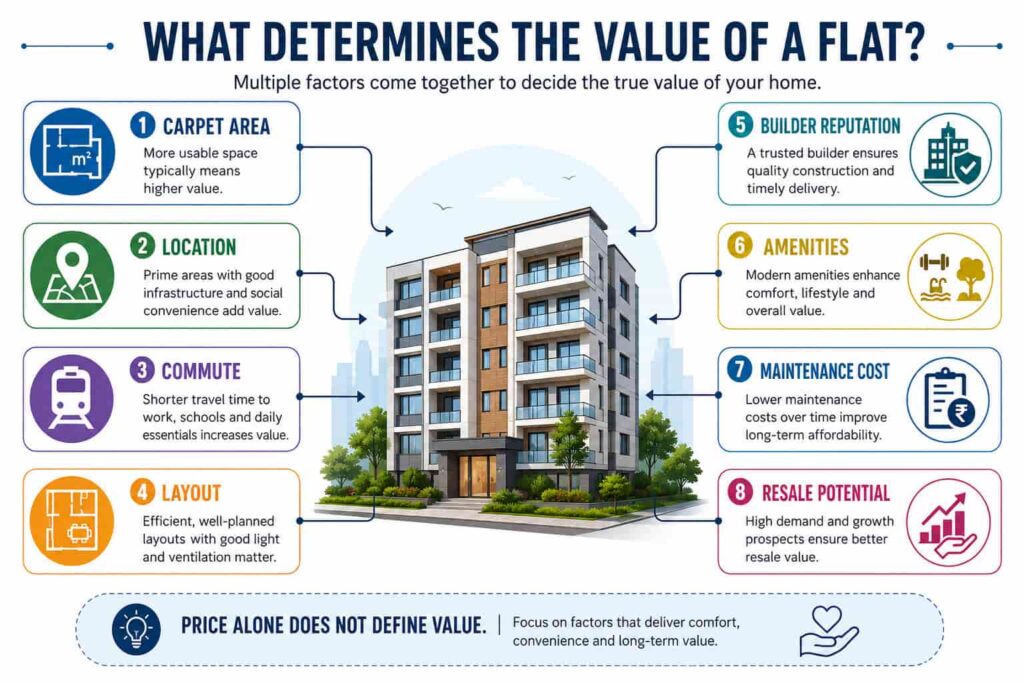
A property’s value depends on several factors working together:
- RERA carpet area
- Layout efficiency
- Location
- Metro and office connectivity
- Construction quality
- Builder record
- Project age
- Amenities
- Maintenance
- Possession status
- Future resale demand
A 600 sq ft carpet-area apartment near a major employment hub may be more expensive than an 850 sq ft home located far from offices and public transport.
The buyer is not purchasing area alone. The buyer is also paying for location, infrastructure and saved travel time.
Carpet area is the most important number
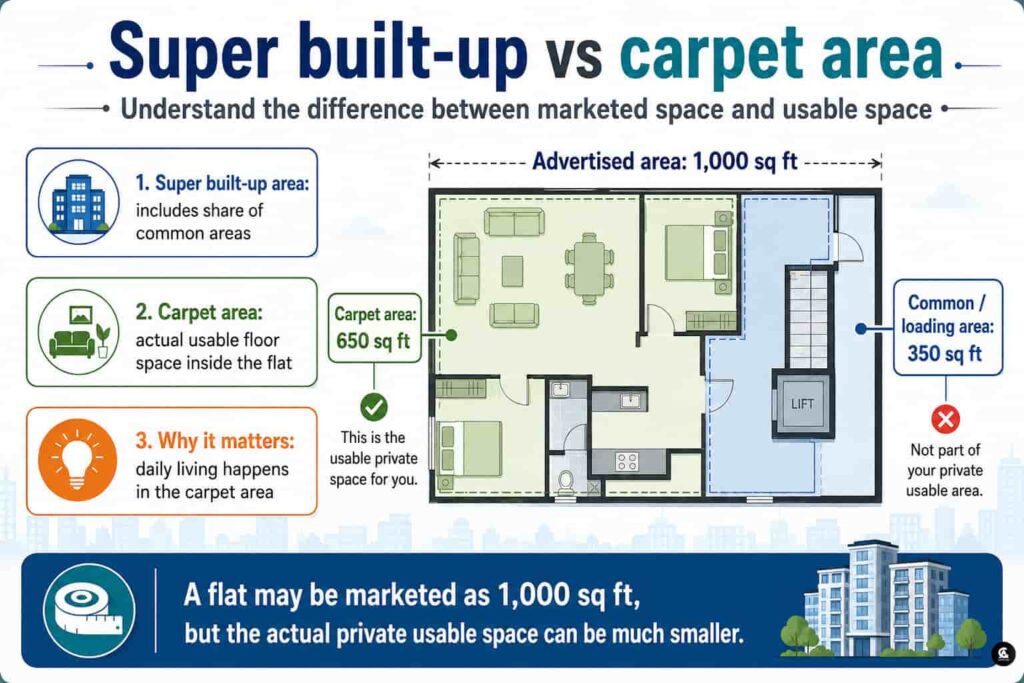
Under RERA, carpet area refers to the net usable floor area of the apartment. It excludes external walls, service shafts, balconies, verandahs and open terraces, while including internal partition walls.
UP RERA has recently advised buyers to verify the carpet area on its official portal and not make a purchase decision only on the basis of super built-up or super area.
This distinction matters because a flat advertised as 1,000 sq ft may provide substantially less private usable space.
Illustrative example
| Area description | Size |
|---|---|
| Advertised super built-up area | 1,000 sq ft |
| Illustrative carpet efficiency | 65% |
| Approximate usable carpet area | 650 sq ft |
| Common/loading component | 350 sq ft |
The actual efficiency varies by project and layout.
A buyer may pay according to the project’s marketed area structure, but everyday life happens inside the carpet area.
How much does ₹80 lakh cost per carpet square foot?
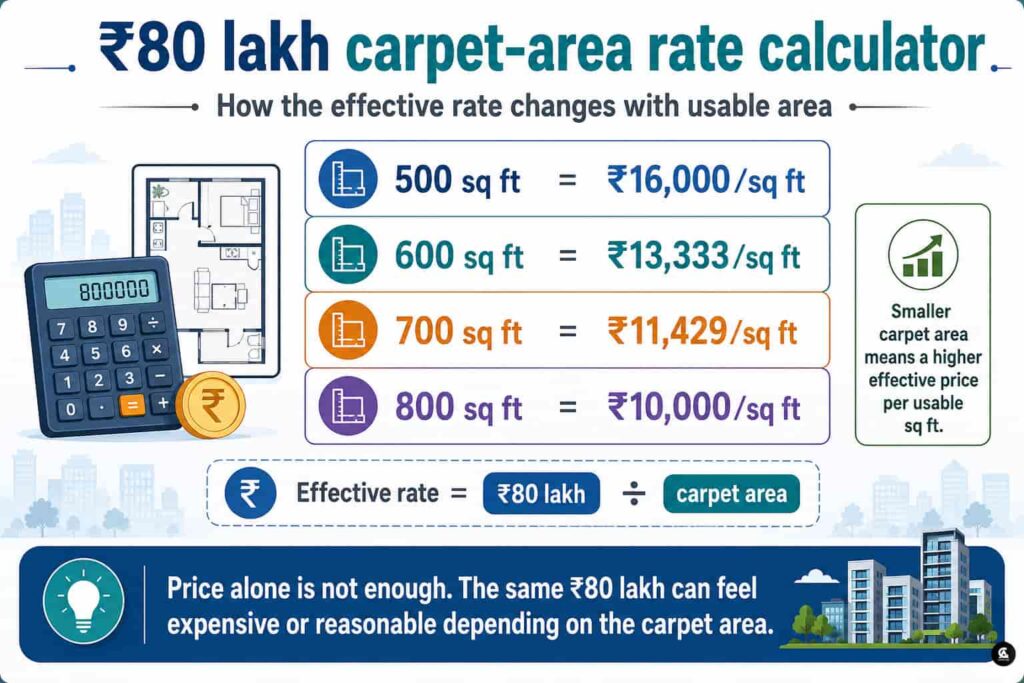
The effective carpet-area rate changes dramatically depending on the usable area.
| RERA carpet area | Effective price at ₹80 lakh |
|---|---|
| 500 sq ft | ₹16,000 per sq ft |
| 600 sq ft | ₹13,333 per sq ft |
| 700 sq ft | ₹11,429 per sq ft |
| 800 sq ft | ₹10,000 per sq ft |
These figures use only the ₹80 lakh purchase price.
They do not include:
- Stamp duty
- Registration
- Brokerage
- Parking
- Club charges
- Interiors
- Maintenance deposit
This is why the project’s RERA carpet area must be obtained before calling the flat cheap or expensive.
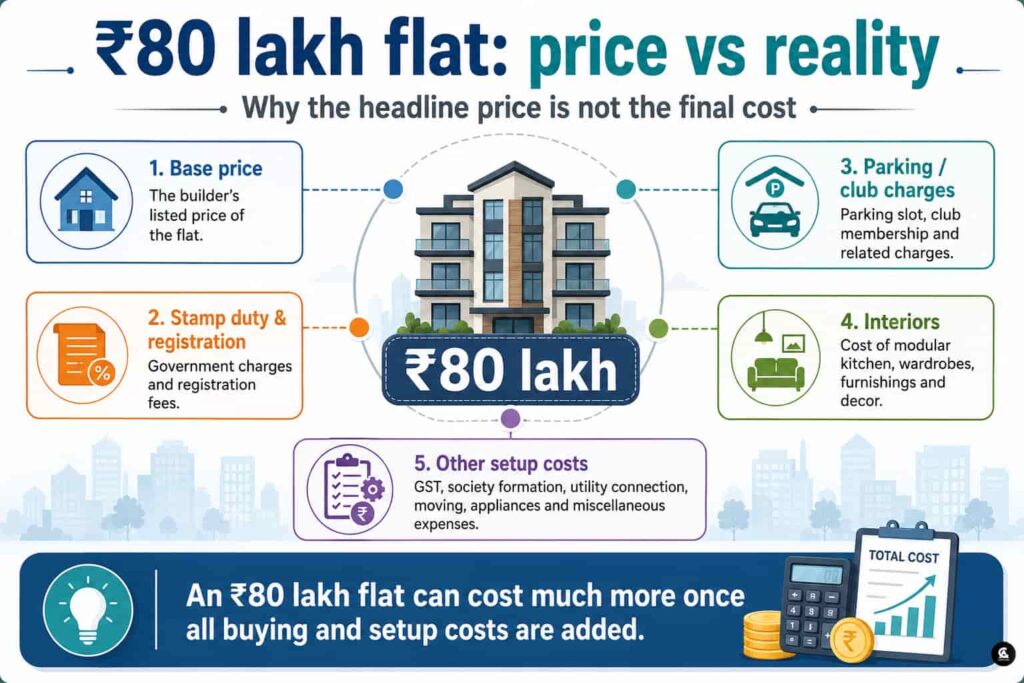
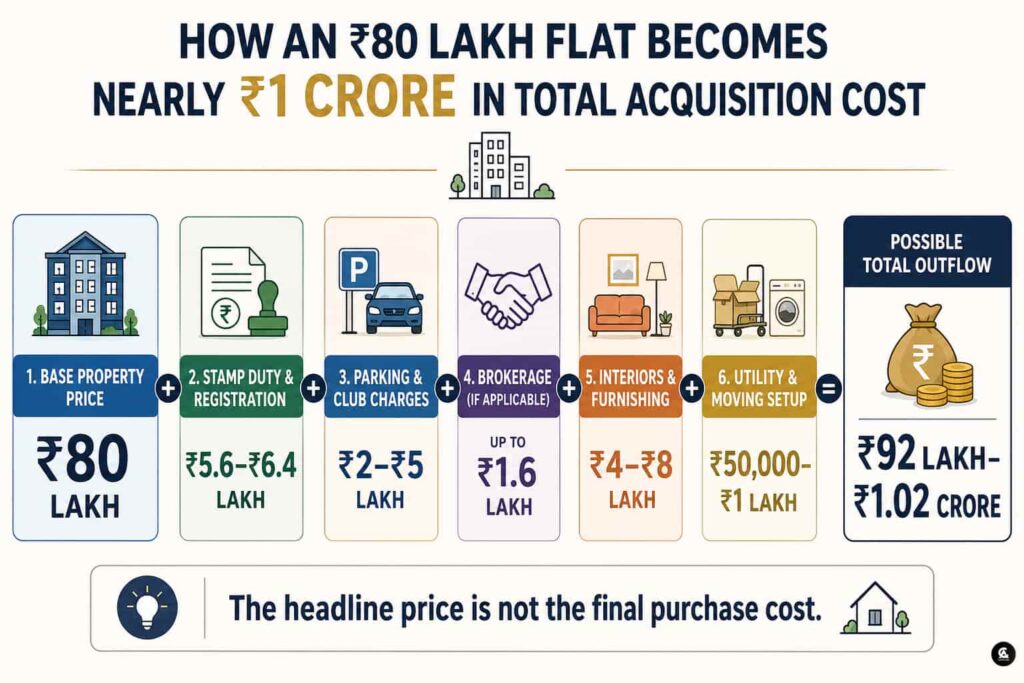
An ₹80 lakh flat may cost much more than ₹80 lakh
The headline price may be only one part of the transaction.
An illustrative buyer budget could look like this:
| Cost component | Illustrative amount |
|---|---|
| Property price | ₹80 lakh |
| Stamp duty and registration | ₹5.6–₹6.4 lakh |
| Parking and club charges | ₹2–₹5 lakh |
| Brokerage, where applicable | Up to ₹1.6 lakh |
| Interiors and furnishing | ₹4–₹8 lakh |
| Utility and moving setup | ₹50,000–₹1 lakh |
| Possible total outflow | About ₹92 lakh–₹1.02 crore |
Recent consumer references place Uttar Pradesh stamp duty broadly between 6% and 7%, depending on ownership category, with registration generally charged separately at around 1%. Buyers should verify the current amount on the official state registration portal before purchase.
The example above is not a quotation for the viral apartment. It only demonstrates why an ₹80 lakh property can require a significantly larger total budget.
Ask for an all-inclusive price sheet
The written quotation should separately disclose:
- Base price
- Floor-rise charge
- Preferential-location charge
- Parking
- Club membership
- Power backup
- Maintenance deposit
- Corpus or sinking fund
- GST, where applicable
- Stamp duty and registration
- Brokerage
Do not make a booking decision on a “starting from ₹80 lakh” headline.
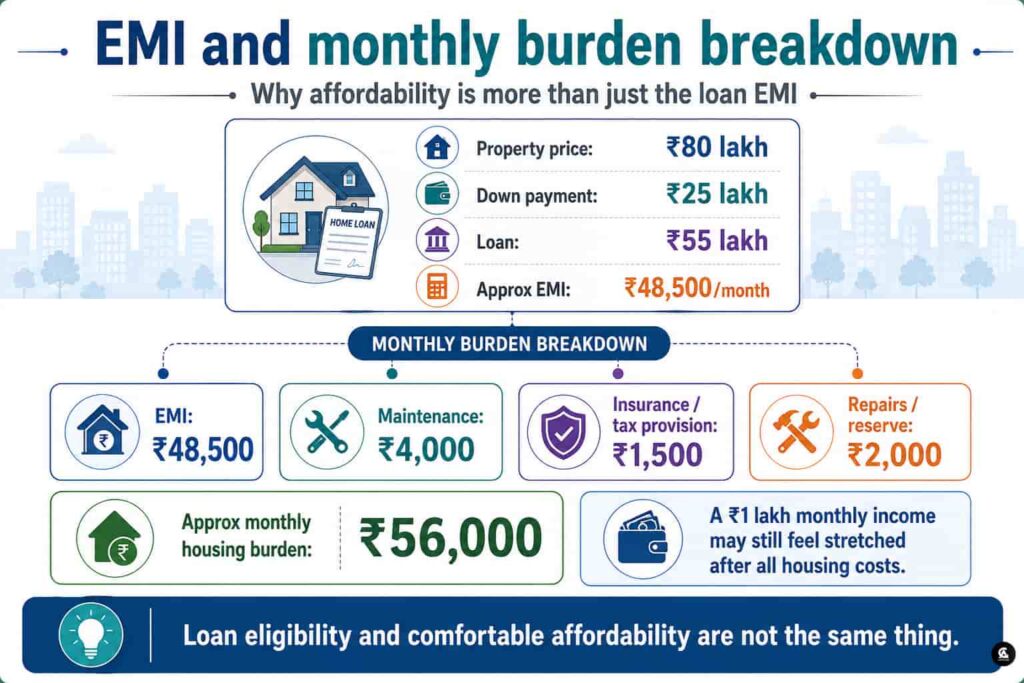
What could the home-loan EMI look like?
Consider a purely illustrative scenario:
- Flat price: ₹80 lakh
- Down payment: ₹25 lakh
- Loan amount: ₹55 lakh
- Loan tenure: 20 years
- Assumed interest rate: 8.5%–9%
The EMI could be approximately ₹47,700–₹49,500 per month.
But EMI is not the complete monthly housing burden.
| Monthly expense | Illustrative amount |
|---|---|
| Home-loan EMI | ₹48,500 |
| Society maintenance | ₹4,000 |
| Insurance and property-tax provision | ₹1,500 |
| Repairs and replacement reserve | ₹2,000 |
| Total housing burden | Around ₹56,000 per month |
Actual loan rates and project expenses will vary.
Can a person earning ₹1 lakh afford it?
Loan eligibility and comfortable affordability are different.
A bank may approve a loan based on:
- Income
- Credit score
- Existing debt
- Employment history
- Age
- Loan tenure
But the buyer must also pay for:
- Food
- Transport
- Insurance
- Children’s expenses
- Retirement savings
- Medical needs
- Emergency fund
- Existing loans
If housing absorbs more than half of take-home income, even a sanctioned loan may create long-term financial stress.
A dual-income household may manage the same EMI more comfortably, but it also needs to plan for job loss, parental care, childbirth and other future expenses.
Prime Noida or a larger flat farther away?
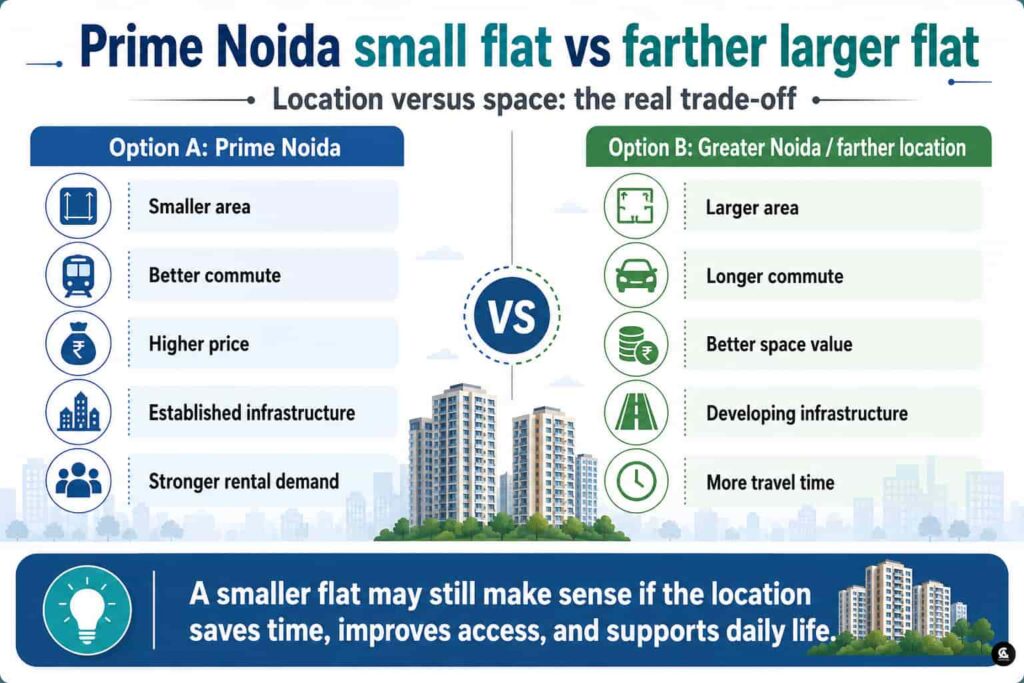
This is the real decision many NCR buyers face.
Option A: Smaller flat in a better-connected Noida location
Possible advantages:
- Shorter office commute
- Metro access
- Established schools and hospitals
- Stronger rental demand
- Mature neighbourhood
Possible compromises:
- Smaller carpet area
- Higher effective price
- Less storage
- Limited future space
Option B: Larger home in Greater Noida, Greater Noida West or another peripheral market
Possible advantages:
- More carpet area
- Additional bedroom
- Lower effective per-square-foot cost
- Better future usability
Possible compromises:
- Longer commute
- Private-vehicle dependence
- Developing social infrastructure
- Higher daily travel cost
- More time spent on the road
A smaller home is not automatically a poor purchase if it saves two or three hours of weekly commuting and provides better access to work and essential services.
Conversely, a prestigious address may not justify years of cramped living for a growing family.
A compact flat can still be well designed
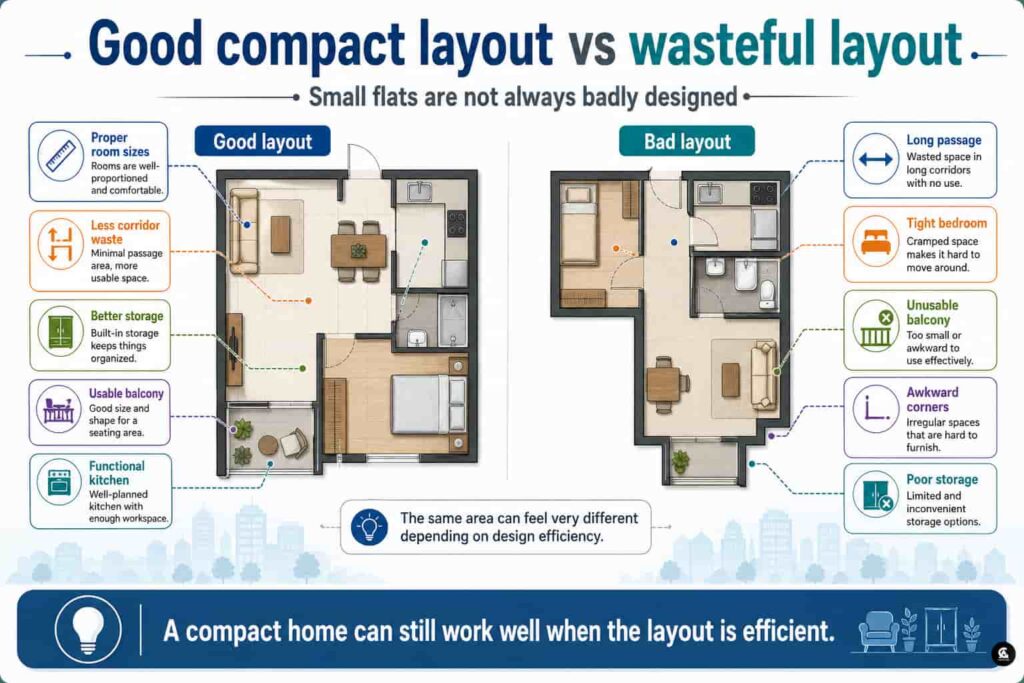
Size alone does not determine usability.
A well-designed compact flat may offer
- Minimal corridor wastage
- Rectangular rooms
- Useful wall space
- Proper ventilation
- Natural light
- Functional kitchen
- Practical storage
- Usable balcony
A poorly designed flat may have
- Long internal passage
- Narrow bedrooms
- Awkward columns
- Oversized foyer
- Poor furniture placement
- Dark kitchen
- Unusable balcony
- Excessive common-area loading
Two flats with the same carpet area can feel very different.
Buyers should place furniture dimensions over the floor plan before paying a token amount.
Are premium amenities reducing private space?
Modern projects often offer:
- Clubhouse
- Swimming pool
- Gym
- Landscaped spaces
- Multiple lifts
- Security systems
- Basement parking
- Power backup
These amenities may add value, but they also influence:
- Project price
- Common-area loading
- Monthly maintenance
- Long-term repair costs
The buyer should ask:
- Will the family actually use the amenities?
- Is the clubhouse already operational?
- What is the projected maintenance charge?
- Does the project have enough occupied homes to support operations?
- Will maintenance rise sharply after handover?
A premium amenity is not free. The buyer pays for it both during purchase and throughout ownership.
Ready-to-move and under-construction flats require different checks
Ready-to-move property
Advantages:
- Exact unit can be inspected
- Actual light and ventilation are visible
- Existing maintenance can be checked
- Residents can be consulted
- Occupancy can be observed
Verify:
- Occupancy certificate
- Society dues
- Seepage
- Lift condition
- Fire safety
- Actual carpet dimensions
Under-construction property
Possible advantage:
- Lower initial payment
- Choice of floor or unit
Risks:
- Delay
- Rent plus pre-EMI
- Final layout variation
- Unfinished amenities
- Maintenance estimate uncertainty
The report about the viral Noida flat does not clearly establish which category it belongs to.
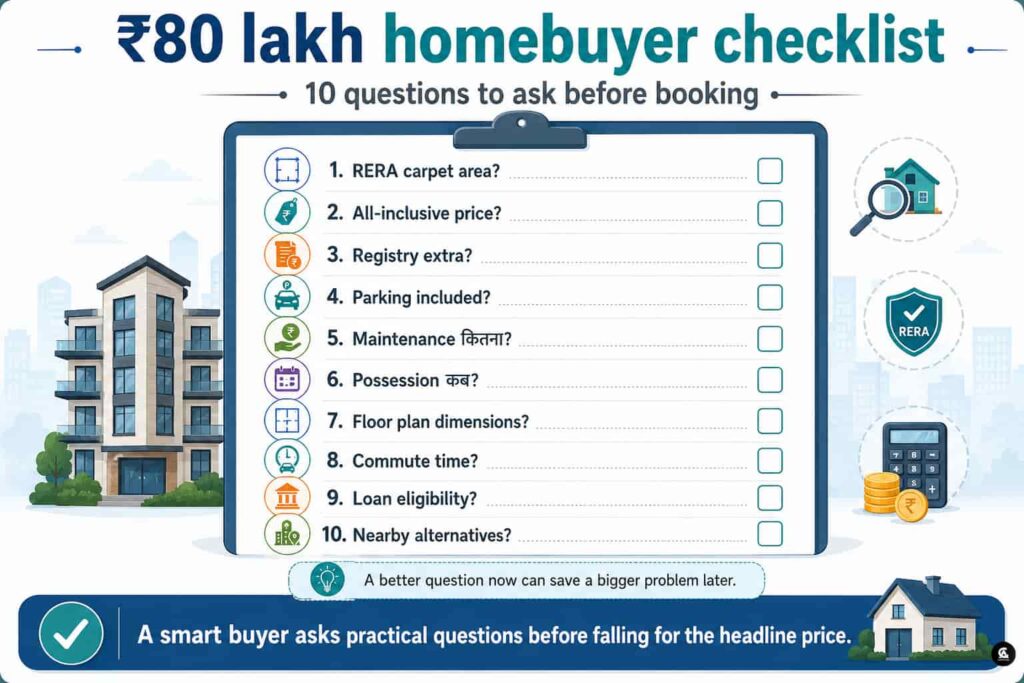
Red flags before paying the booking amount
Stop and verify when:
- Carpet area is not disclosed clearly
- Sales staff focuses only on super area
- Price is repeatedly described as “starting from”
- Parking appears later in the cost sheet
- Floor-rise or location charges are unclear
- Maintenance estimate is vague
- Sample flat dimensions differ from the booked unit
- Balcony is presented as part of usable indoor space
- The builder avoids giving a signed cost breakup
- Project details cannot be verified on UP RERA
UP RERA provides an official portal for checking registered project disclosures.
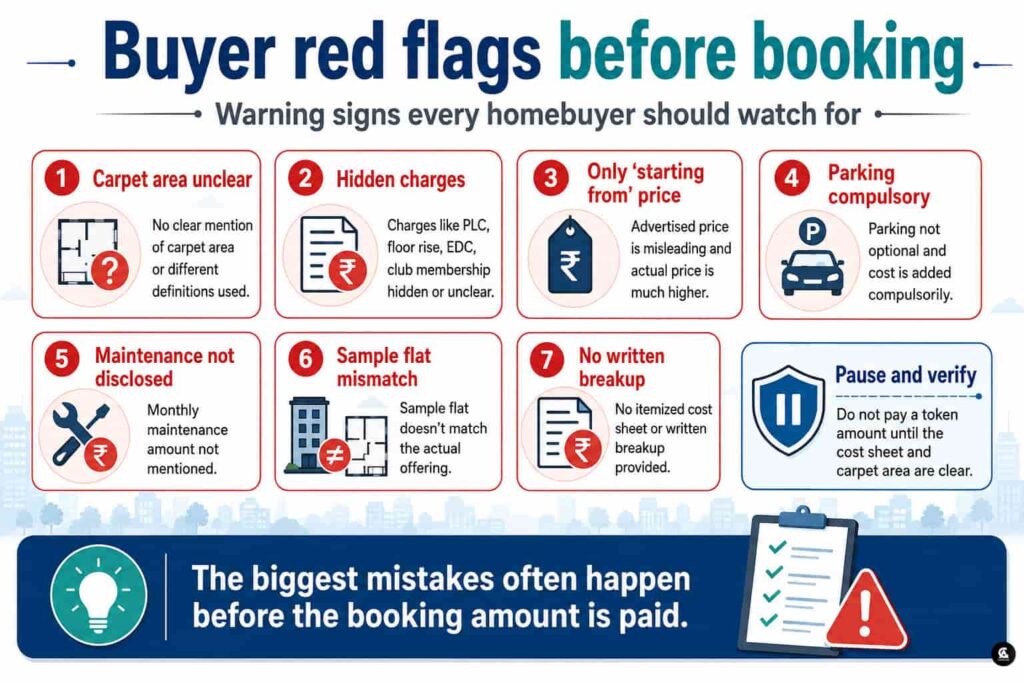
Ten questions every ₹80 lakh buyer should ask
- What is the exact RERA carpet area?
- What is the final all-inclusive purchase cost?
- Are parking and club charges included?
- How much will stamp duty and registration cost?
- What are the actual bedroom dimensions?
- What is the expected monthly maintenance?
- Is the project registered with UP RERA?
- Is the flat ready to move or under construction?
- What is the peak-hour travel time to work?
- What larger alternatives are available within the same total budget?
Carpet Area verdict
The viral “₹80 lakh kabutar khana” comment reflects a genuine affordability concern, but the news report does not provide enough property-level information to determine whether the apartment is actually overpriced.
The decision cannot be made from price alone.
A buyer should compare:
- RERA carpet area
- Effective rate per usable square foot
- Layout efficiency
- Complete acquisition cost
- EMI and maintenance burden
- Location and commute
- Project quality
- Future family needs
An ₹80 lakh apartment may represent poor value when it combines limited usable space, high loading, hidden charges and weak connectivity.
The same price may be defensible when it offers an efficient layout, established location, strong transport access, reliable construction and sustainable resale or rental demand.
The final question should not be:
Is the flat small?
It should be:
Does the usable space, location and long-term financial burden justify the complete amount the buyer will pay?
That is the calculation every Noida homebuyer should complete before signing a booking form.
Important disclaimer
This article analyses a viral market discussion and uses illustrative calculations. The original report does not disclose the specific project, sector, builder, carpet area or complete cost. Loan rates, taxes, registration charges and project expenses can change. Buyers should verify all figures through the builder, lender, UP RERA and relevant government portals before making a financial commitment.
Sources:-
Economic Times report on the viral ₹80 lakh Noida flat
₹80 lakh for a “kabutar khana”: Noida viral apartment discussion
2. UP RERA official portal
Uttar Pradesh Real Estate Regulatory Authority — Official Portal
3. RERA carpet-area explanation
Carpet area, built-up area and super built-up area explained
4. Official legal definition under the RERA Act
Real Estate (Regulation and Development) Act and Rules — Ministry of Housing and Urban Affairs PDF
5. UP RERA advisory: buy on carpet area, not super area
Verify carpet area on UP RERA portal—do not purchase only on super-area claims
6. Earlier UP RERA direction on selling apartments by carpet area
UP RERA directs developers to sell apartments according to carpet area



Leave a Reply