

At first, the changes in Neha’s parents appeared small.
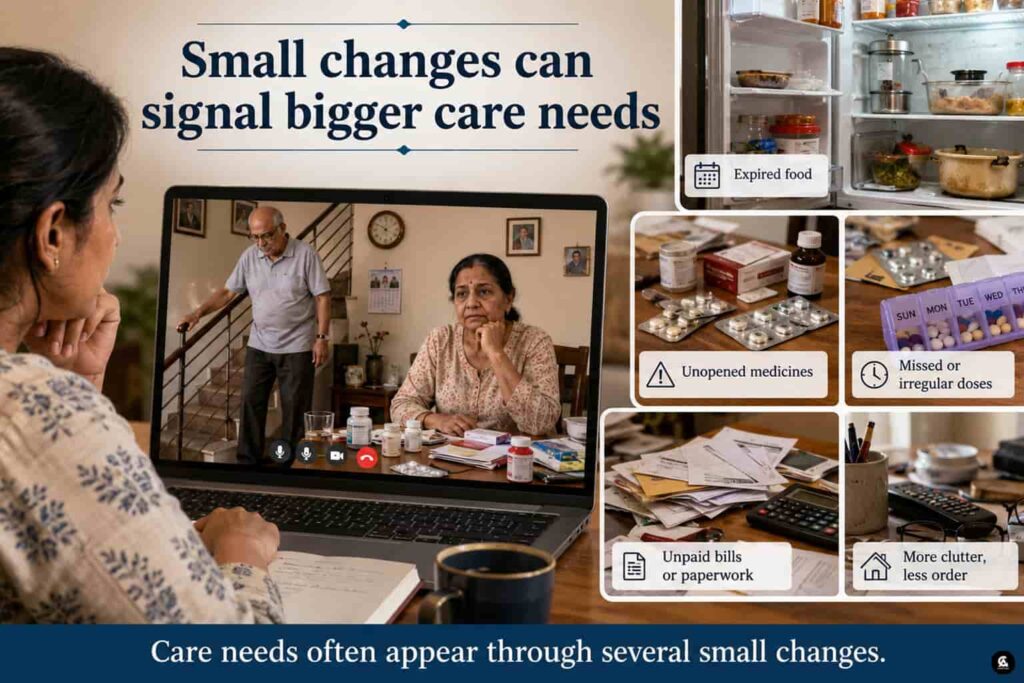
Her father had stopped driving after sunset. Her mother occasionally forgot whether she had taken her blood-pressure medicine. The refrigerator contained expired food, and both parents had started avoiding the staircase leading to the bedrooms.
Neha lived outside India and spoke to them every day. During each call, they assured her that everything was fine.
No single incident looked like a crisis.
Together, however, the changes suggested that her parents’ home, routine and existing support system were no longer protecting the same level of independence.
This is how elderly-care needs often emerge. Families do not always receive one clear warning. They notice a series of missed meals, medicine mistakes, falls, unpaid bills, withdrawn behaviour or neglected household work.
The difficult question is not only:
Do my parents need help?
The more useful questions are:
- What level of help do they require?
- Can that care be provided safely at home?
- Is the present house suitable for ageing?
- Would structured assisted living offer better safety?
- Can the family sustain the present arrangement?
12 common signals involving daily self-care, household management, medication, falls, memory, hygiene, isolation, home safety, driving, medical complexity, financial mistakes and caregiver burnout. This Carpet Area guide converts those signals into a practical housing-and-care decision framework.
Not every warning sign means assisted living
One missed medicine or one untidy room does not automatically mean that a parent must move into assisted living.
The correct response depends on four factors:
- Frequency: Is the problem occasional or recurring?
- Severity: Is it inconvenient or immediately dangerous?
- Progression: Is the difficulty becoming worse?
- Support: Can the family or a professional service manage it safely?
A parent who occasionally needs help shopping may remain independent with limited home support.
A parent who repeatedly misses medicines, falls, wanders or requires help with bathing may need daily supervision or a more structured care environment.
The aim should not be to move a parent unnecessarily.
The aim should be to prevent a manageable problem from becoming a medical or family crisis.
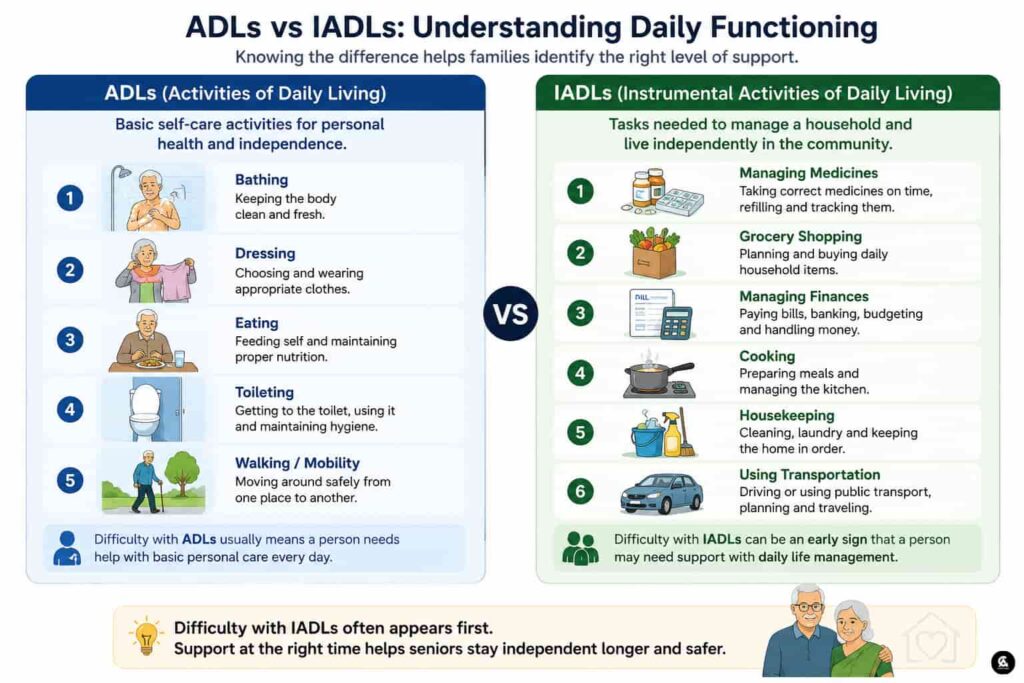
Understand ADLs and IADLs first
Senior-care assessments often divide daily functioning into two broad groups.
Activities of Daily Living, or ADLs, are basic personal-care activities such as:
- bathing,
- dressing,
- toileting,
- eating,
- walking,
- transferring from a bed or chair.
Instrumental Activities of Daily Living, or IADLs, are the tasks required to manage an independent household, including:
- buying groceries,
- cooking,
- managing medicines,
- paying bills,
- using transport,
- cleaning the home,
- attending appointments.
Difficulty with IADLs may be an early sign that support is needed.
Difficulty with multiple ADLs generally indicates a higher level of daily dependency.
Early signs that limited home support may be enough
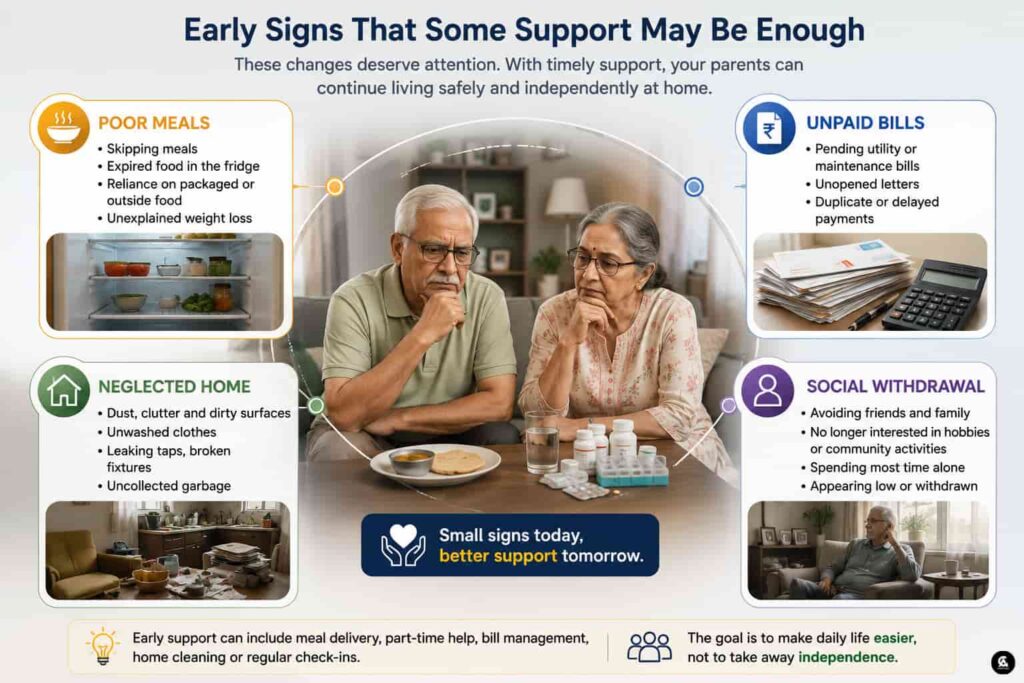
These signs deserve attention, but they may not immediately require assisted living.
1. Meals are being skipped or food is expiring
Look for:
- an almost empty refrigerator,
- expired or spoiled food,
- frequent dependence on packaged snacks,
- reduced cooking,
- unexplained weight loss,
- repeatedly saying, “I was not hungry.”
The cause may involve poor mobility, difficulty shopping, dental problems, depression, memory changes or reduced energy.
A reasonable first response may include:
- meal delivery,
- grocery support,
- a cook,
- nutritional assessment,
- scheduled family monitoring.
Persistent weight loss or sudden appetite changes should be medically assessed rather than treated only as a household-management issue.
2. Bills, banking or household tasks are becoming difficult
Signs may include:
- unpaid electricity or maintenance bills,
- duplicate payments,
- unusual withdrawals,
- unopened letters,
- difficulty using digital banking,
- falling for suspicious calls.
Financial mistakes may reflect poor vision, unfamiliarity with technology, memory decline or vulnerability to fraud.
Families can consider:
- automatic payments,
- account alerts,
- a trusted family contact,
- limited transaction controls,
- professional legal advice for authority arrangements.
Do not remove financial independence without discussion. Introduce safeguards proportionate to the actual risk.
3. The house is becoming increasingly neglected
Notice:
- dust and clutter,
- broken lights or appliances,
- unwashed clothes,
- leaking taps,
- uncollected waste,
- spoiled food,
- unfinished repairs.
The issue may be physical weakness, poor vision, reduced motivation or an inability to coordinate household workers.
Part-time housekeeping and maintenance support may be sufficient when the parent remains otherwise independent.
If the home continues becoming unsafe despite support, the family should reassess whether ageing in place remains sustainable.
4. Social interaction is reducing
Warning signs include:
- stopping regular walks,
- avoiding friends,
- not attending religious or community events,
- declining family calls,
- spending most of the day watching television,
- appearing unusually withdrawn.
The World Health Organization recognises social isolation and loneliness as important public-health concerns that can affect physical health, mental wellbeing and quality of life.
Possible responses include:
- neighbourhood groups,
- adult-day programmes,
- hobby classes,
- regular family visits,
- community transport,
- companion care.
Assisted living may become relevant when isolation is persistent and the present location provides almost no realistic social network.
Signs that daily care may now be necessary
These difficulties often indicate that occasional family visits are no longer enough.
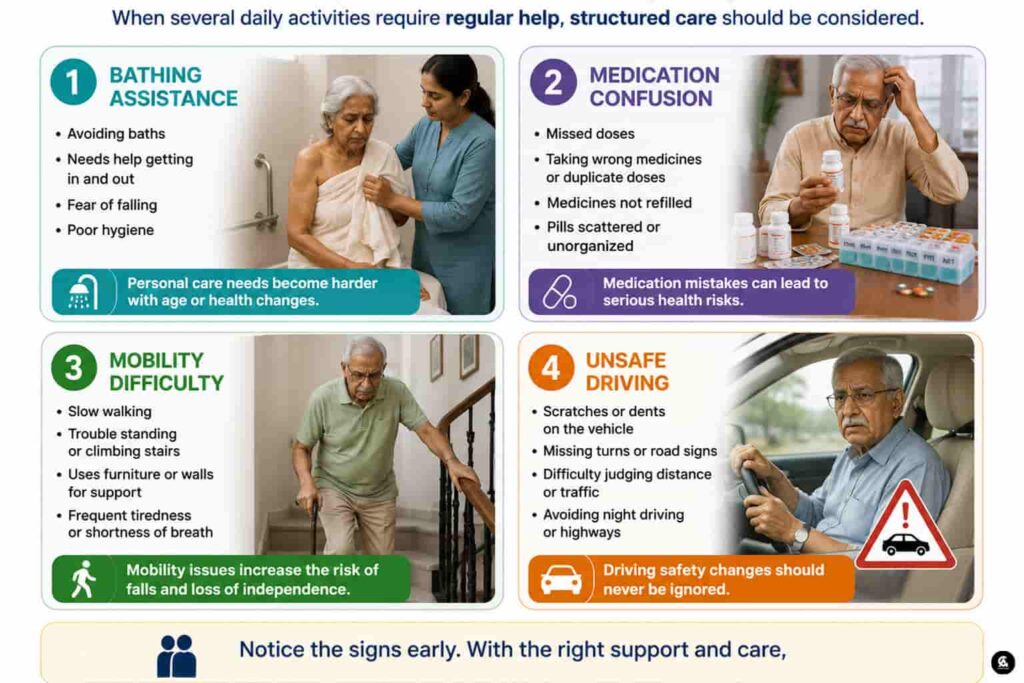
5. Bathing, dressing or toileting requires help
A parent may:
- avoid bathing,
- wear the same clothes repeatedly,
- struggle with buttons or footwear,
- need support getting on or off the toilet,
- take unusually long to dress,
- appear embarrassed about asking for help.
Difficulty with personal care affects health, dignity and fall risk.
Potential responses include:
- trained morning or evening assistance,
- bathroom modifications,
- occupational-therapy assessment,
- daily caregiver support,
- assisted living.
The choice depends on how often help is needed and whether it can be delivered safely and respectfully at home.
6. Medication mistakes are recurring
Look for:
- missed tablets,
- duplicate doses,
- medicines taken at the wrong time,
- half-used strips scattered around the house,
- confusion between similar packages,
- prescriptions not being refilled.
A pill organiser, reminder application or pharmacy-packed dose system may help in mild cases.
However, repeated medicine errors—especially with insulin, blood thinners, heart medicines or multiple prescriptions—require professional review.
Medication supervision may be provided through home nursing or an assisted-living setting, depending on the complexity of care.
7. Mobility is declining
Notice:
- difficulty rising from a chair,
- holding walls while walking,
- avoiding stairs,
- reduced walking speed,
- unexplained bruises,
- fear of entering the bathroom,
- dependence on furniture for balance.
Falls are not an inevitable part of ageing. Home hazards, mobility limitations, medication effects and poor balance can all increase risk. WHO notes that older people face the greatest risk of serious injury from falls, while CDC and NIA guidance recommends correcting hazards such as poor lighting, loose rugs, unsafe steps and unsuitable bathrooms.
A fall assessment should consider both the person and the house.
8. Driving is no longer safe
Possible signs include:
- new dents or scratches,
- missed turns on familiar roads,
- difficulty judging traffic,
- avoiding night driving,
- confusion at signals,
- unexplained traffic penalties.
Stopping driving can feel like losing independence.
Before removing access completely, explore:
- family transport,
- hired drivers,
- community shuttles,
- app-based taxis with supervision,
- pharmacy and grocery delivery.
If the entire household depends on one parent driving, the suitability of the location should also be reviewed.
Urgent signs requiring professional assessment
Some signs should not be managed only through informal household support.
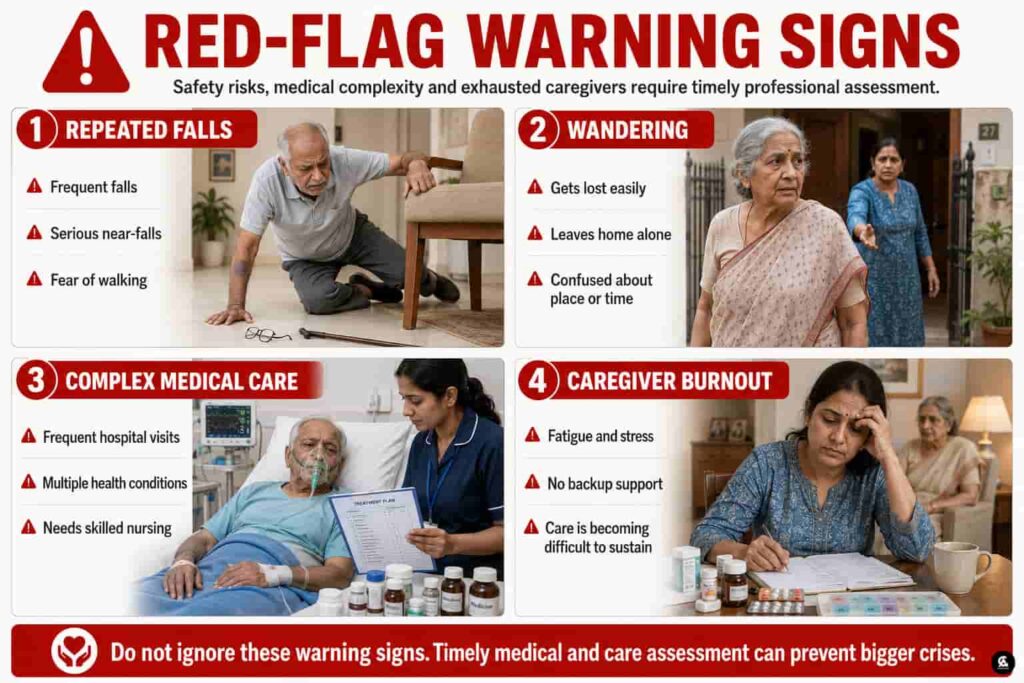
9. Repeated falls or serious near-falls
One fall should trigger a review.
Repeated falls require medical and home-safety assessment.
Check:
- medication side effects,
- blood-pressure changes,
- vision,
- footwear,
- muscle weakness,
- balance,
- bathroom flooring,
- staircase lighting,
- loose rugs,
- absence of handrails.
A parent who has fallen may also begin restricting movement because of fear, which can further reduce strength and independence.
10. Memory loss is affecting safety
Occasionally forgetting a name is different from:
- becoming lost on a familiar route,
- leaving gas or appliances on,
- repeatedly asking the same question,
- missing medicines,
- forgetting recent meals,
- becoming confused about time or place,
- wandering outside the home.
Dementia refers to changes in memory, reasoning or other thinking abilities that become severe enough to interfere with daily life. Wandering and getting lost are recognised safety risks for people living with dementia.
These signs require a medical and cognitive evaluation.
Mild difficulties may be managed with structured home support. Progressive confusion, wandering or unsafe behaviour may require supervised memory care.
11. Medical needs have become complex
Watch for:
- repeated hospital admissions,
- oxygen support,
- wound care,
- injections,
- uncontrolled diabetes,
- frequent blood-pressure emergencies,
- multiple specialist appointments,
- swallowing difficulty,
- catheter or feeding support.
A general attendant may not be qualified to manage complex clinical care.
The family should distinguish among:
- companion,
- personal caregiver,
- trained nursing assistant,
- qualified nurse,
- physiotherapist,
- doctor.
“Someone is present at home” does not necessarily mean that appropriate medical care is available.
12. The main family caregiver is exhausted
Caregiver burnout is not a secondary issue.
Warning signs include:
- constant fatigue,
- missed work,
- irritability,
- sleep problems,
- declining personal health,
- guilt,
- resentment,
- no backup caregiver,
- feeling unable to leave the parent alone.
A care arrangement is not sustainable when it protects one person by seriously harming another.
Possible responses include:
- respite care,
- rotating family responsibility,
- trained home-care support,
- short-term assisted-living stay,
- permanent assisted living.
Professional support is not a replacement for family concern. It can make family care safer and more sustainable.
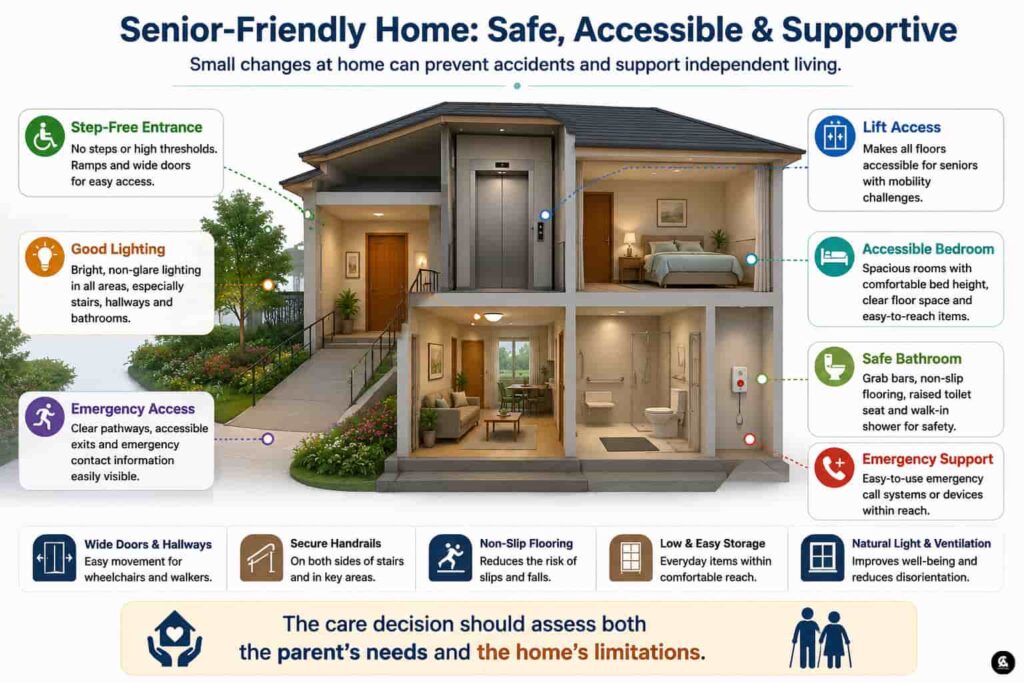
Can the current home support ageing safely?
Many families focus only on the parent’s health.
They overlook the role of the property.
A person with moderate mobility limitations may remain independent in a well-designed apartment but struggle in a large duplex with stairs, narrow bathrooms and distant healthcare.
The National Institute on Aging recommends reviewing the home room by room and correcting immediate hazards such as poor lighting, unsafe railings and fall risks.
Entrance and building
Check:
- Can the entrance become step-free?
- Is a ramp feasible?
- Is the lift reliable?
- Is power backup available?
- Can an ambulance reach the entrance?
- Are corridors adequately lit?
- Are fire exits usable?
Bedroom
Check:
- Is a bedroom available on the entrance level?
- Is there a clear route to the bathroom?
- Can the bed be reached from both sides?
- Is there room for a walker or caregiver?
Bathroom
Check:
- Can grab bars be installed?
- Is the floor anti-skid?
- Can a shower chair fit?
- Is the doorway wide enough?
- Is there space for assistance?
- Does the door open outward in an emergency?
Location
Check:
- How far is the hospital?
- Is a pharmacy nearby?
- Is domestic help available?
- Are groceries and diagnostics accessible?
- Can the parent function without driving?
- Are trusted neighbours nearby?
A home can be emotionally important while still becoming physically unsuitable.
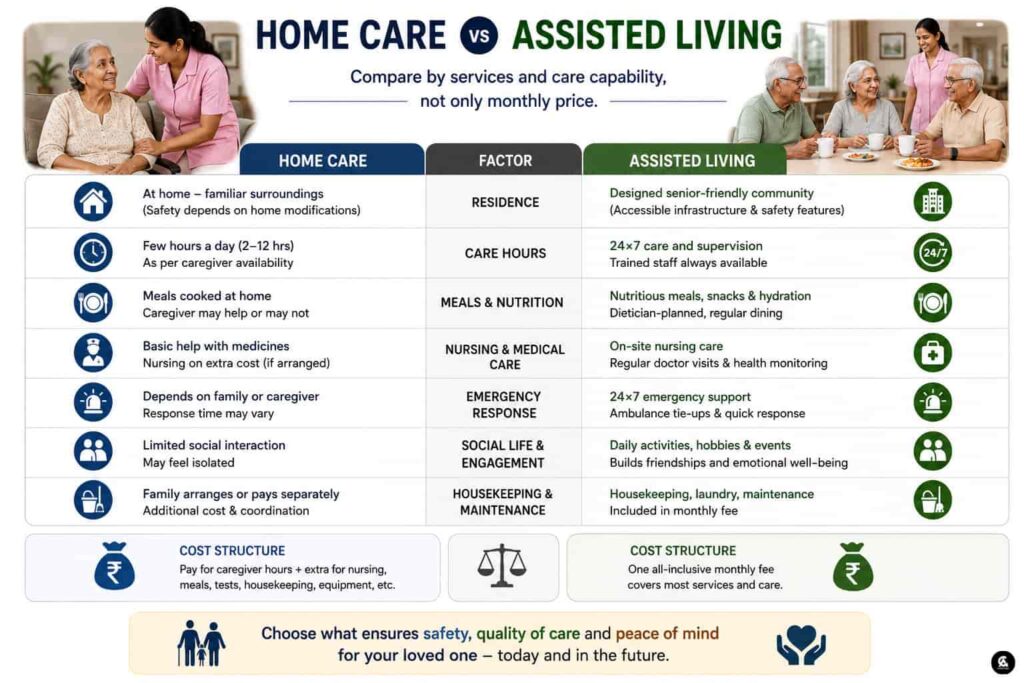
Home care versus assisted living
The correct option depends on the frequency, complexity and predictability of support.
| Factor | Home care | Assisted living |
|---|---|---|
| Residence | Parent remains in the existing home | Parent moves to a managed community |
| Care timing | Scheduled, part-time or live-in | Structured daily support |
| Meals | Family or separate vendor | Commonly included |
| Housekeeping | Separate arrangement | Commonly included |
| Medication support | Depends on caregiver or nurse | Usually structured, but verify scope |
| Nursing | Usually separately arranged | Facility-specific |
| Emergency response | Must be organised | Usually available on site; verify details |
| Social engagement | Must be arranged | Community activities are usually available |
| Maintenance | Family remains responsible | Managed by the operator |
| Best suited for | Mild or manageable needs in a suitable home | Recurring support needs or unsafe living conditions |
Home care may work when
- the parent remains largely independent,
- care is needed for predictable hours,
- the house can be modified,
- family monitoring is available,
- medical needs are manageable,
- the parent strongly prefers to remain at home.
Assisted living may work when
- help is required throughout the day,
- medicine management is becoming difficult,
- living alone is unsafe,
- meals and housekeeping are inconsistent,
- loneliness is severe,
- adult children live elsewhere,
- the home is difficult to modify,
- care requirements are increasing.
Specialised care may be necessary when
- dementia causes wandering or unsafe behaviour,
- continuous nursing is required,
- the person is bed-bound,
- feeding, oxygen or wound care is complex,
- frequent medical monitoring is necessary.
General assisted living and skilled nursing are not the same service.
Families must verify the actual care capability of the provider.
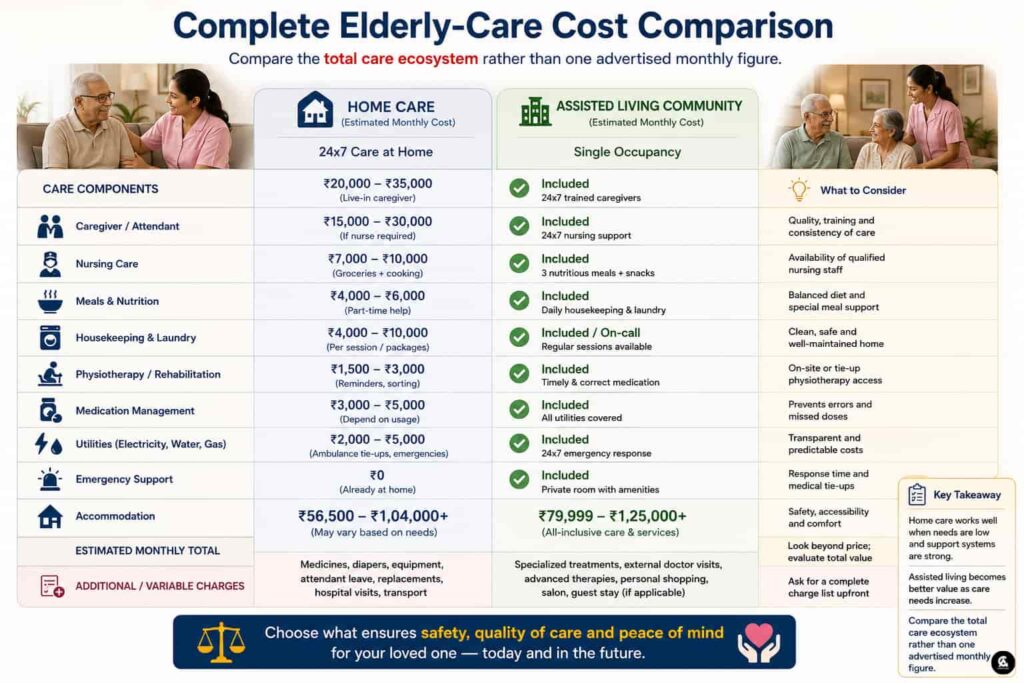
How much does elderly care actually cost?
The caregiver’s salary is not the complete cost of home care.
The assisted-living fee is also not always the complete cost of residential care.
Possible home-care costs
- attendant or caregiver,
- nursing visits,
- physiotherapy,
- doctor consultation,
- meals,
- housekeeping,
- medicines,
- diapers and consumables,
- ambulance,
- agency charges,
- caregiver replacement,
- utility and property-maintenance expenses.
Possible assisted-living costs
- monthly accommodation fee,
- meals,
- housekeeping,
- basic assistance,
- care-level charges,
- nursing,
- physiotherapy,
- medicines,
- diapers and medical consumables,
- ambulance,
- security deposit,
- GST where applicable,
- hospital-attendant charges.
A ₹30,000 caregiver and a ₹70,000 assisted-living fee are not directly comparable unless both service packages are broken down.
Ask what is included, what is additional and how charges increase when care needs change.
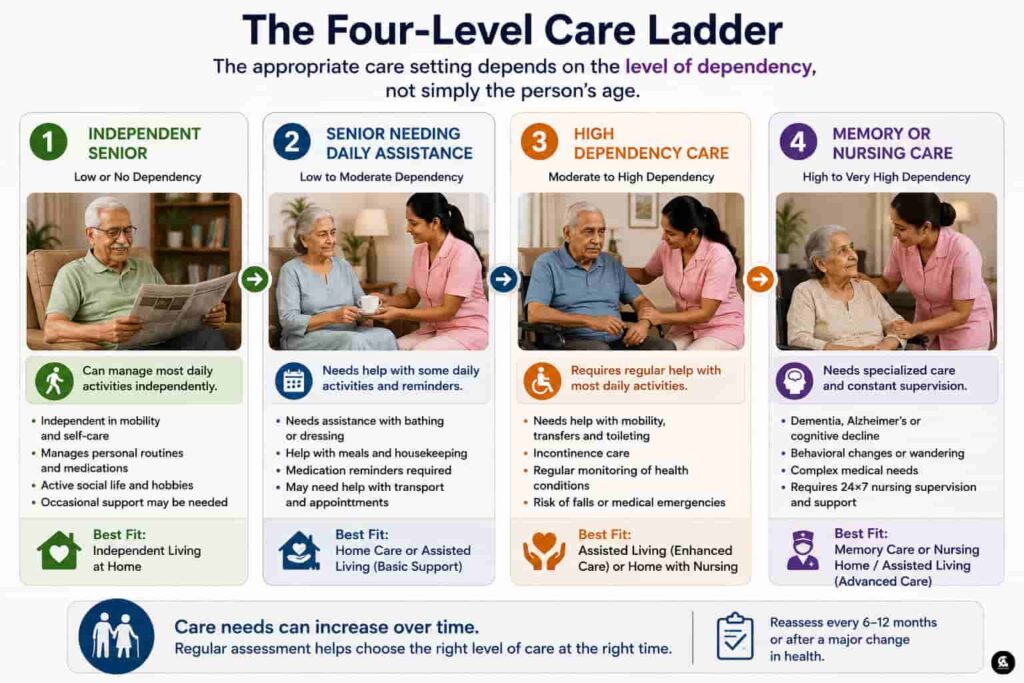
A practical care-level ladder
Level 1: Mostly independent
Typical signs:
- occasional help with groceries,
- minor household difficulty,
- limited transport support,
- manageable social isolation.
Possible response:
Home modification, monitoring and limited assistance.
Level 2: Regular daily support
Typical signs:
- repeated medicine reminders,
- help with meals,
- assistance bathing or dressing,
- mobility support,
- poor household management.
Possible response:
Structured home care or assisted-living assessment.
Level 3: High dependency
Typical signs:
- assistance with most personal activities,
- repeated falls,
- inability to remain alone,
- frequent night support,
- multiple medical appointments.
Possible response:
High-dependency assisted living or continuous home-care team.
Level 4: Dementia or complex nursing
Typical signs:
- wandering,
- unsafe behaviour,
- severe cognitive decline,
- oxygen or wound care,
- bed-bound condition,
- continuous clinical monitoring.
Possible response:
Memory care, skilled nursing or medically supported residential care.
What should NRI children arrange for parents in India?
Distance makes informal care difficult to verify.
An NRI child should know:
- who can reach the parents within 30 minutes,
- who holds medical records,
- who manages hospital admission,
- which doctor knows the complete history,
- whether the caregiver is supervised,
- who replaces the caregiver during leave,
- whether medicines are independently checked,
- whether the home has emergency alerts,
- whether neighbours have emergency contacts,
- who can make decisions when the family cannot immediately travel.
Technology can support care through:
- video doorbells,
- emergency buttons,
- medication reminders,
- location tracking where appropriate,
- digital health records,
- remote cameras in common areas with consent.
Technology cannot replace a reliable person on the ground.
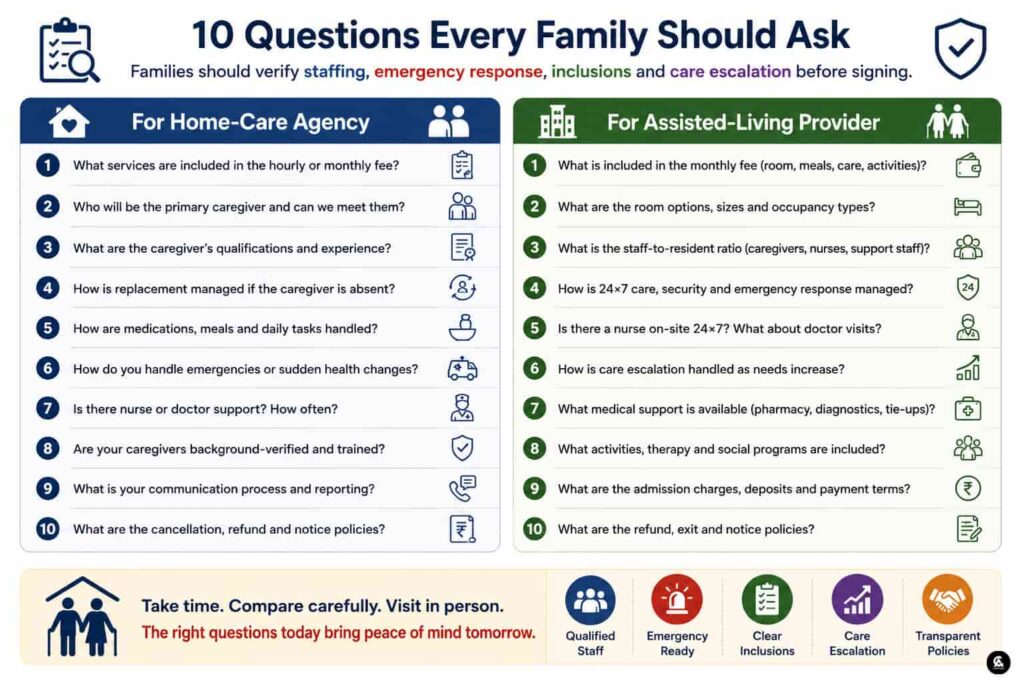
Questions to ask a home-care agency
- Is the caregiver background-verified?
- What training has the caregiver received?
- Who provides supervision?
- What happens during leave or absence?
- Is medication management included?
- Is night care available?
- Can nursing be arranged?
- Is there a written care plan?
- How are complaints handled?
- What is the emergency protocol?
Questions to ask an assisted-living provider
- What is included in the monthly fee?
- What services are charged separately?
- Is a qualified nurse available at night?
- Is the doctor on site or on call?
- What happens when care needs increase?
- Is dementia care available?
- How are medicines managed?
- What is the hospital-transfer process?
- What are the staff-to-resident ratios?
- What is the deposit, exit and refund policy?
Do not choose a provider only on the basis of interiors, brochures or recreational amenities.
Care capability, staffing, emergency systems and transparency matter more.
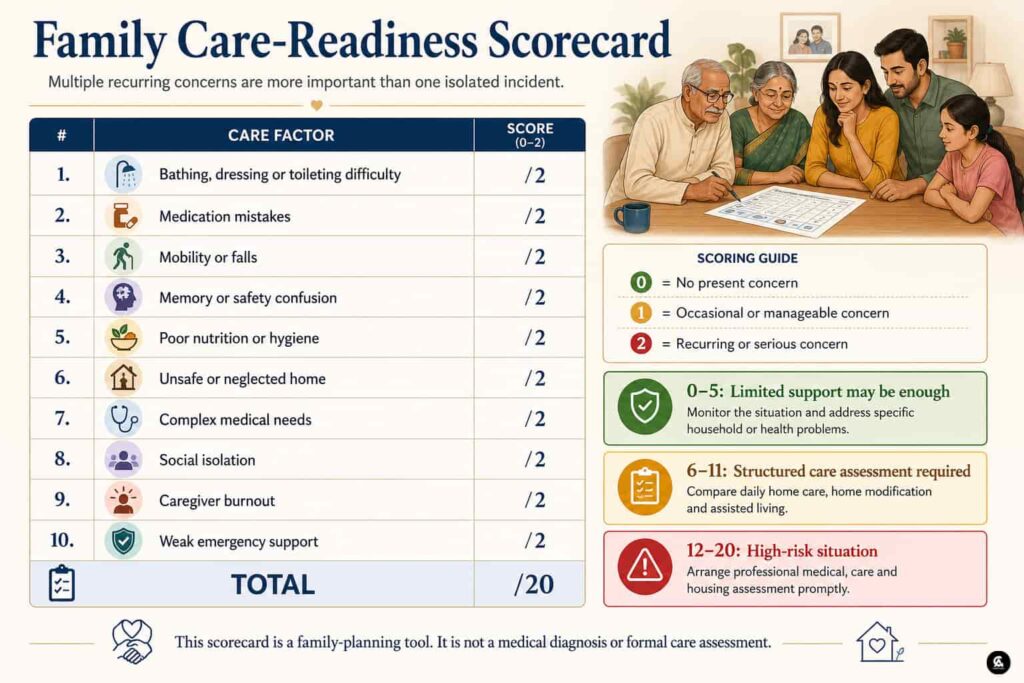
Use this 20-point family care-readiness scorecard
Give each category:
- 0: No present concern
- 1: Occasional or manageable concern
- 2: Recurring or serious concern
| Care factor | Score |
| Bathing, dressing or toileting difficulty | /2 |
| Medication mistakes | /2 |
| Mobility or falls | /2 |
| Memory or safety confusion | /2 |
| Poor nutrition or hygiene | /2 |
| Unsafe or neglected home | /2 |
| Complex medical needs | /2 |
| Social isolation | /2 |
| Caregiver burnout | /2 |
| Weak emergency support | /2 |
| Total | /20 |
Score interpretation
0–5: Limited support may be enough
Monitor the situation and address specific household or health problems.
6–11: Structured care assessment required
Compare daily home care, home modification and assisted living.
12–20: High-risk situation
Arrange professional medical, care and housing assessment promptly.
This scorecard is a family-planning tool. It is not a medical diagnosis or formal care assessment.
Frequently asked questions
Does one fall mean my parent needs assisted living?
Not necessarily.
One fall should trigger medical and home-safety review. Repeated falls, poor mobility or inability to remain alone may justify structured daily care or assisted living.
Can dementia be managed through home care?
Some people with mild cognitive impairment or early dementia may remain at home with structured support.
Wandering, unsafe appliance use, night confusion or inability to remain alone may require specialised supervision or memory care.
What is the difference between a caregiver and a nurse?
A caregiver generally helps with daily activities and companionship.
A qualified nurse performs clinical tasks within their training and professional scope.
Families should not expect an unqualified attendant to manage complex medical care.
Is assisted living the same as an old-age home?
Not necessarily.
Assisted living generally combines accommodation with support for daily activities. Services, staffing and care standards differ widely between operators.
Can the existing home be modified instead of selling it?
Often yes.
Feasibility depends on the entrance, lift, bathroom size, bedroom location, building rules and hospital connectivity.
When does caregiver burnout become a warning sign?
When the caregiver’s health, employment, sleep or relationships begin deteriorating, the care arrangement needs additional professional support.
Carpet Area verdict
The decision between home care and assisted living should not begin with guilt.
It should begin with evidence.
Look at:
- daily functioning,
- medicine safety,
- mobility,
- memory,
- nutrition,
- medical complexity,
- the suitability of the house,
- the availability of family support,
- the sustainability of caregiving.
Home care can preserve familiarity and independence when needs are predictable and the property is suitable.
Assisted living can provide structured support when daily tasks, safety, loneliness or household management are becoming difficult.
Specialised memory or nursing care may become necessary when cognitive decline or medical complexity exceeds what ordinary home support can manage.
The correct decision is not the option that looks most loving from the outside.
It is the arrangement that protects the parent’s safety, dignity, health and meaningful independence for the longest possible time.
Important disclaimer
This article provides general educational guidance and does not replace medical, psychological, legal, financial, architectural or professional care advice.
Sudden confusion, a serious fall, breathing difficulty, chest pain, stroke symptoms, loss of consciousness or other medical emergencies require immediate professional attention.
Care requirements differ by individual. Families should consult qualified doctors, geriatric professionals, care specialists and accessibility experts before making significant decisions.
Sources:-
- National Institute on Aging — Aging in Place: Growing Older at Home
https://www.nia.nih.gov/health/aging-place/aging-place-growing-older-home - National Institute on Aging — Home Safety Tips for Older Adults
https://www.nia.nih.gov/health/aging-place/home-safety-tips-older-adults - National Institute on Aging — Preventing Falls at Home: Room by Room
https://www.nia.nih.gov/health/falls-and-falls-prevention/preventing-falls-home-room-room - World Health Organization — Falls
https://www.who.int/news-room/fact-sheets/detail/falls - World Health Organization — Age-friendly Environments
https://www.who.int/teams/social-determinants-of-health/demographic-change-and-healthy-ageing/age-friendly-environments - World Health Organization — Reducing Social Isolation and Loneliness Among Older People
https://www.who.int/health-topics/ageing/reducing-social-isolation-and-loneliness-among-older-people - CDC — About Older Adult Fall Prevention
https://www.cdc.gov/falls/about/index.html - CDC — STEADI Older Adult Fall Prevention
https://www.cdc.gov/steadi/index.html - Alzheimer’s Association — Wandering
https://www.alz.org/help-support/caregiving/stages-behaviors/wandering - Alzheimer’s Association — Alzheimer’s and Dementia Home Safety Tips
https://www.alz.org/help-support/caregiving/safety/home-safety





Leave a Reply