

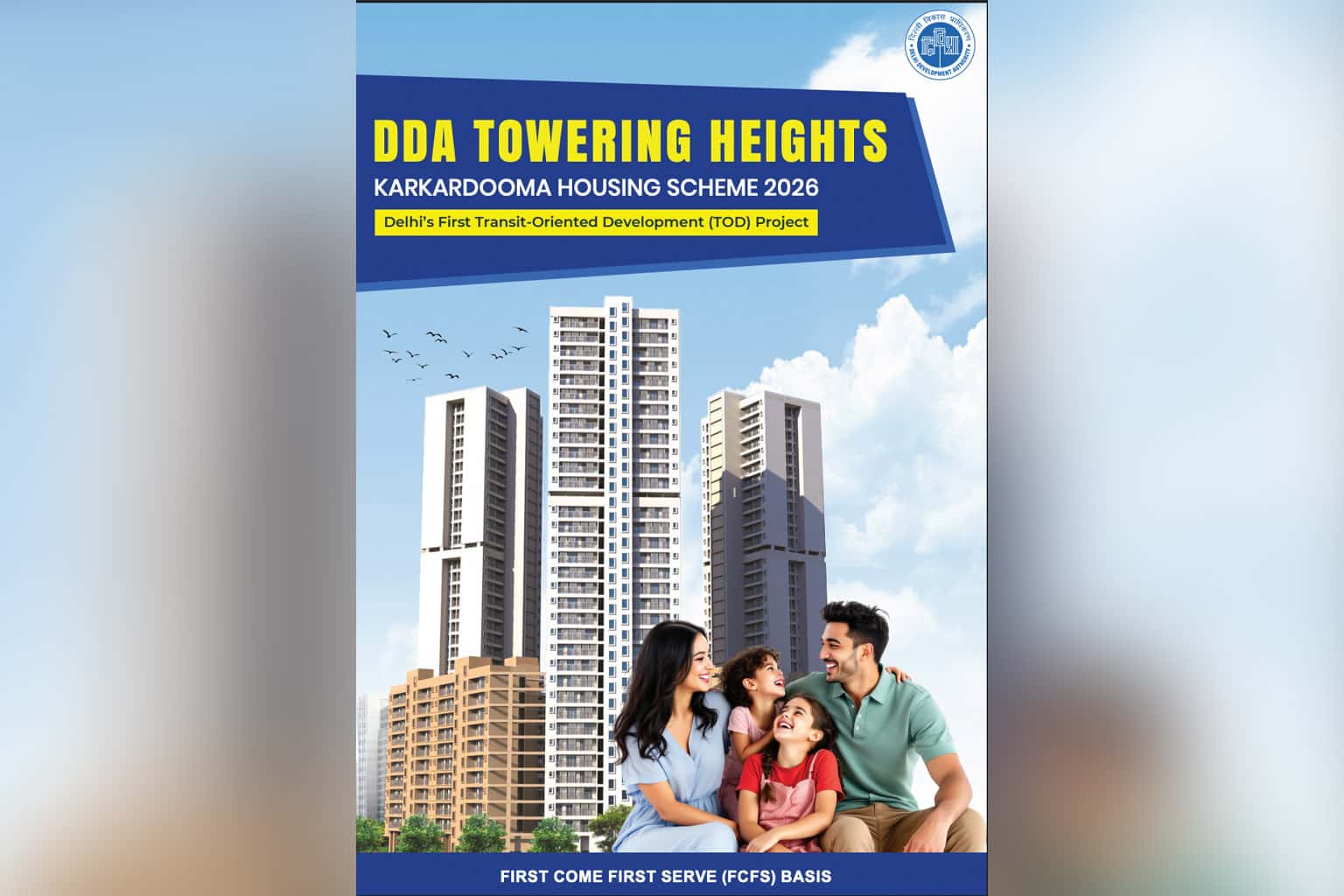
For many Delhi homebuyers, a DDA flat still carries a different kind of trust. It feels more official, more structured and less risky than many private real estate options. That is why the DDA Towering Heights Karkardooma Housing Scheme 2026 deserves attention, especially for buyers looking at East Delhi and Karkardooma as a serious residential location.
But this scheme should not be seen only as a “DDA flat opportunity.” It should be understood carefully because the booking amount is high, the booking is on First Come First Serve basis, the payment schedule is strict and the final cost will be higher than the headline price table.
In simple words, this is an official DDA opportunity, but not a casual booking decision.
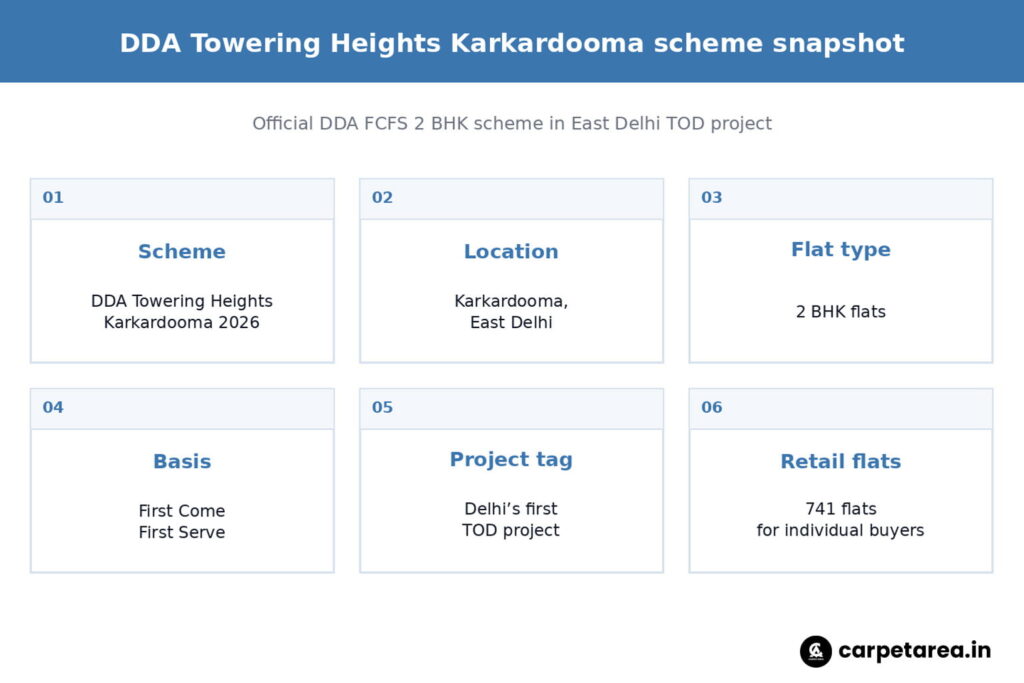
Why this scheme is important for Delhi buyers?
DDA Towering Heights at Karkardooma is positioned as Delhi’s first Transit-Oriented Development, TOD project. That makes it different from a normal standalone housing scheme. A TOD project is generally planned around better connectivity, public transport access and mixed urban development.
For buyers, the location story is important. Karkardooma is in East Delhi, and the project is connected with the larger East Delhi Hub idea. For families who want to stay within Delhi and still look for a newly built authority-backed 2 BHK option, this scheme can look attractive.
But the buyer must ask one practical question: does this flat fit my budget, my payment capacity and my long-term use?
That is where the brochure needs to be read carefully.
What the official brochure says?
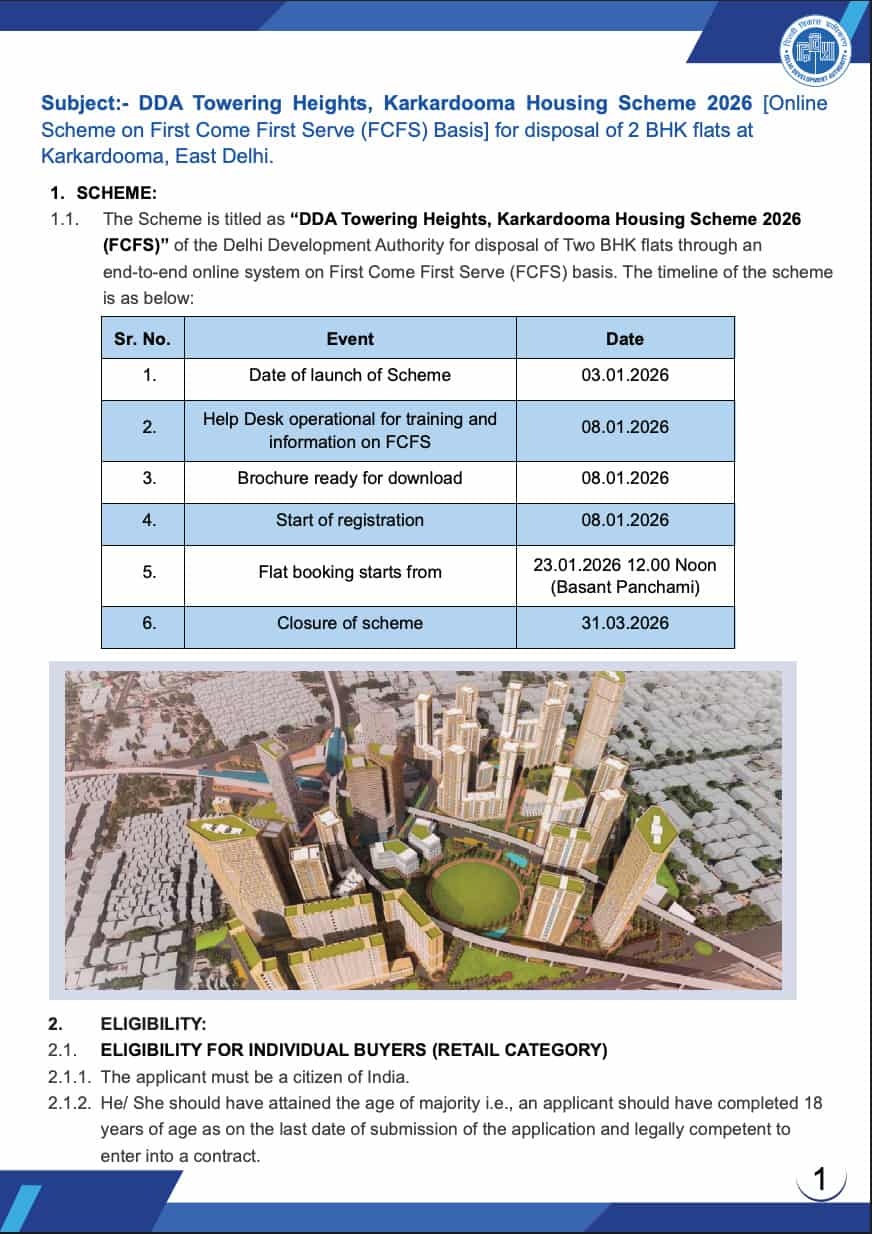
The DDA brochure says the scheme is titled DDA Towering Heights, Karkardooma Housing Scheme 2026 (FCFS). It is for disposal of 2 BHK flats through an end-to-end online system on First Come First Serve basis.
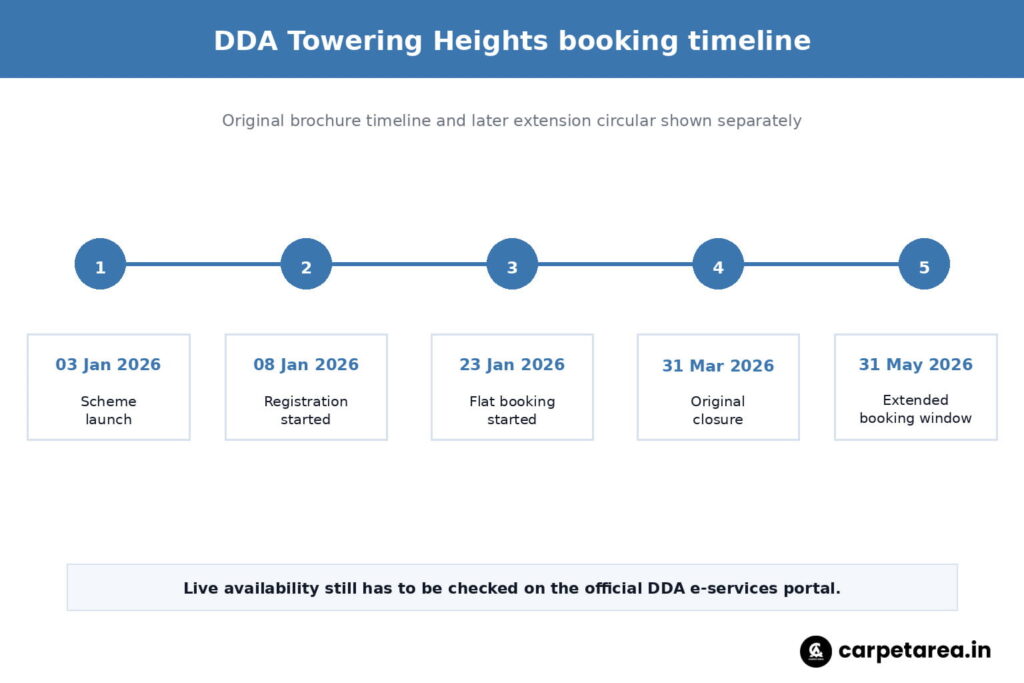
The brochure states that the scheme was launched on 3 January 2026. Registration started on 8 January 2026, and flat booking started on 23 January 2026 at 12 noon. The original closure date mentioned in the brochure was 31 March 2026.
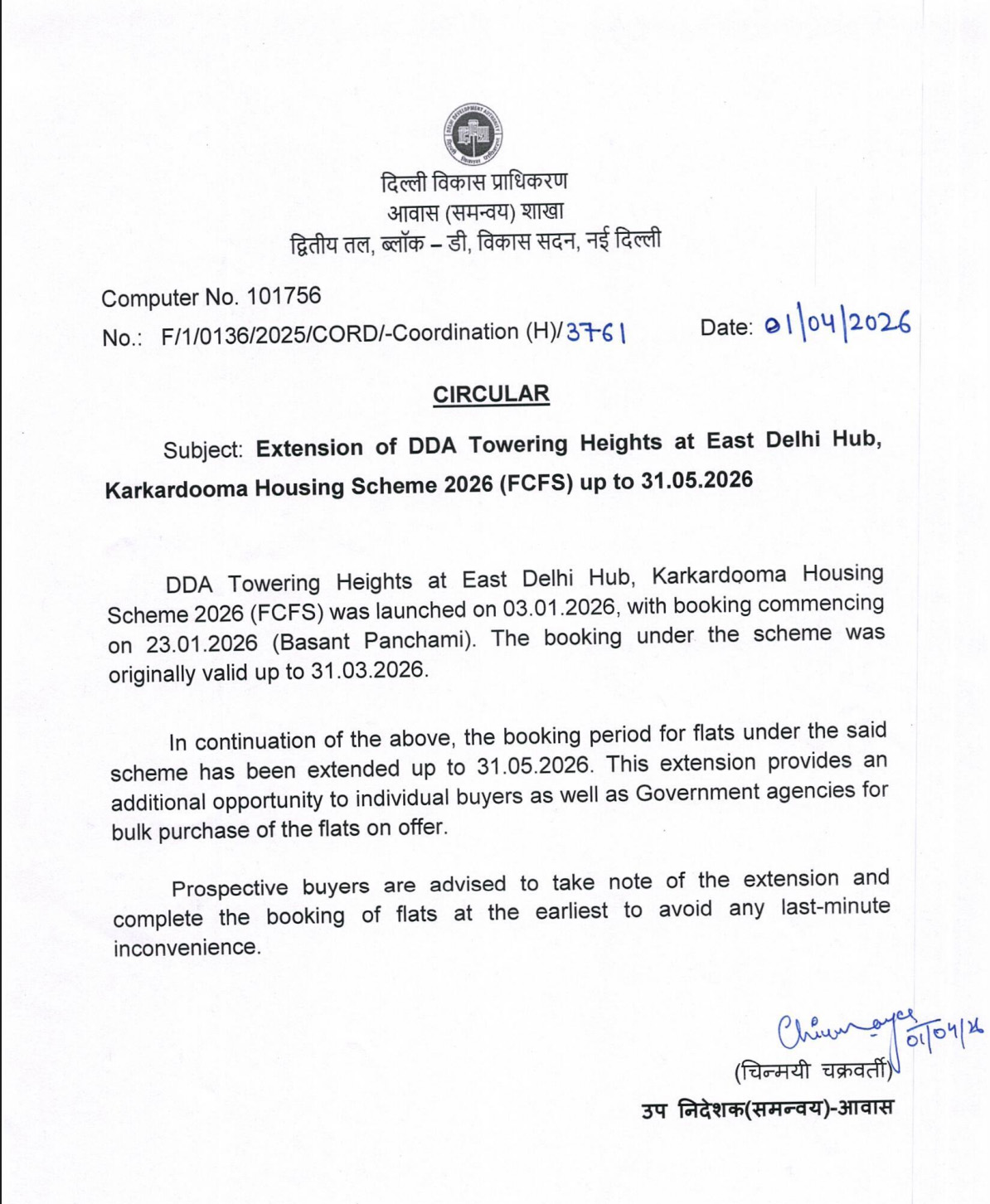
However, the DDA circular shared separately confirms that the booking period was extended up to 31 May 2026. So the correct way to write this is: the brochure originally showed 31 March 2026 as the closing date, but a DDA circular dated 1 April 2026 extended the booking period up to 31 May 2026.
Since this is an FCFS scheme, buyers should still verify current live availability on the official DDA e-services portal before making any decision.
Eligibility for DDA Towering Heights Karkardooma Housing Scheme
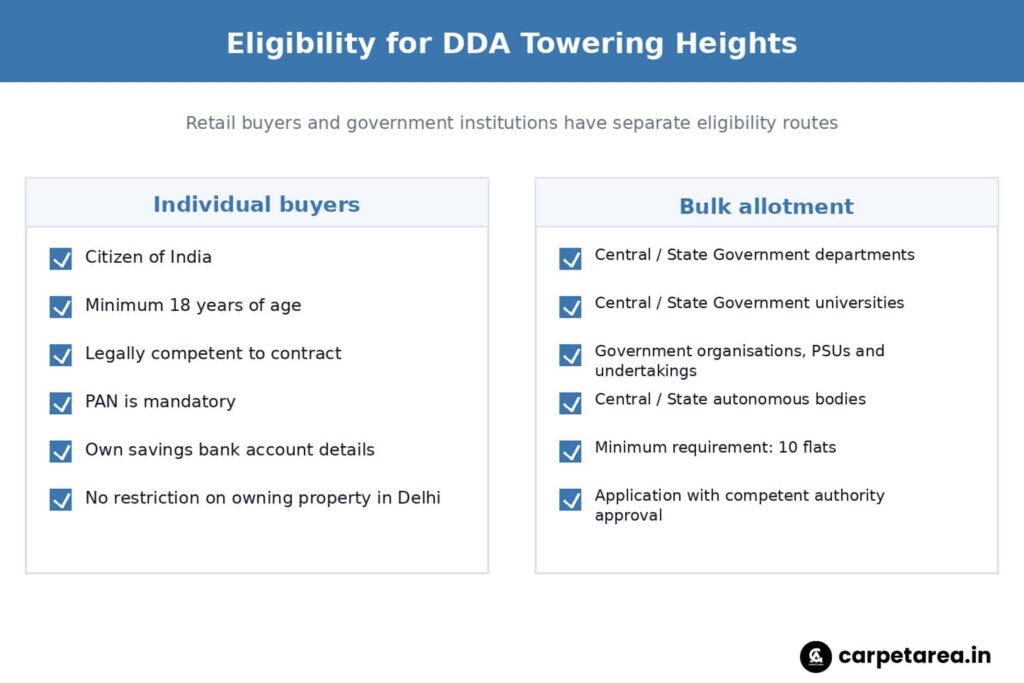
As per the DDA brochure, individual buyers applying under the retail category must be citizens of India and should have completed 18 years of age as on the last date of submission of the application. The applicant must also be legally competent to enter into a contract.
One important point is that the brochure clearly says there is no restriction regarding owning any land or built-up property in Delhi. This means an existing property owner in Delhi is not automatically disqualified under this scheme.
Applicants must provide details of their own savings bank account in the application form, and PAN is mandatory. In case of a joint application under the Persons with Disabilities, Divyangjan category, the applicant himself or herself should fall within the reserved category, and the joint applicant or co-applicant should be from within the family.
The brochure also has a separate eligibility provision for bulk allotment to government institutions. Eligible Central or State Government departments, universities, PSUs, undertakings and autonomous bodies can apply, with a minimum requirement of 10 flats.
Buyers should read the eligibility conditions carefully before applying because DDA says eligibility may not be fully verified at the time of accepting the application. If a buyer is later found ineligible or has given false information, the allotment can be cancelled and the amount deposited may be forfeited.
How the FCFS booking process works?
This is not a lottery scheme. It is a First Come First Serve scheme.
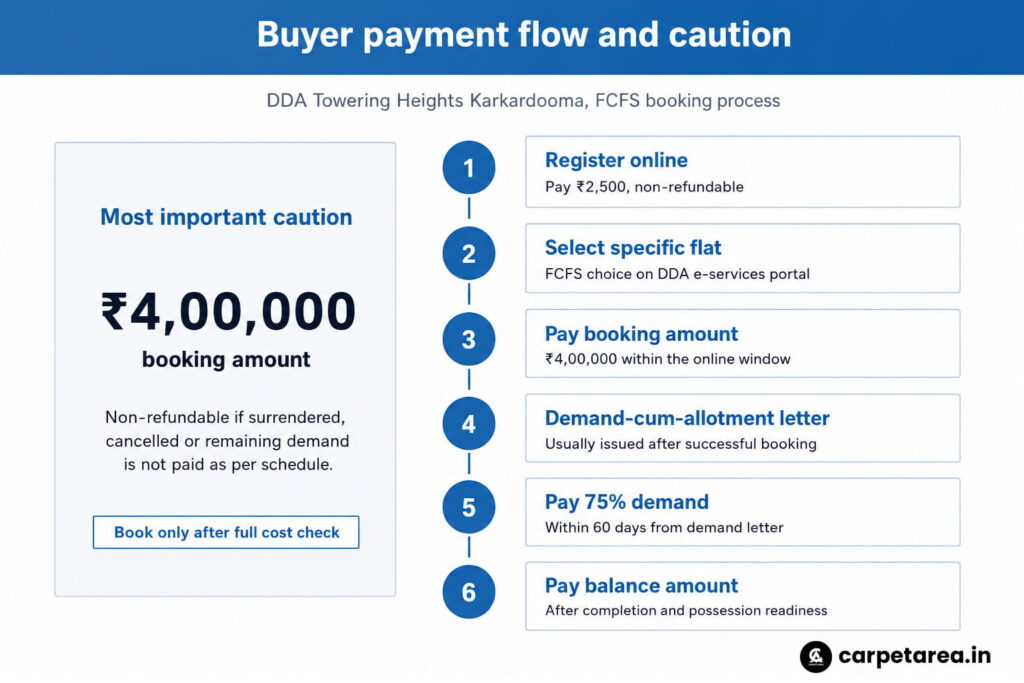
A buyer has to visit the official DDA website or DDA e-services portal, create login credentials using PAN and other details, and register for the scheme by paying ₹2,500. This registration amount is non-refundable.
After registration, buyers can view tower-wise and flat-wise details online. These details include plinth area, tentative disposal price and parking details.
The important part starts when the buyer selects a specific flat. Once a flat is selected online, the buyer gets a 15-minute window to pay the booking amount through online mode in a single transaction. During that 15-minute window, the selected flat is not available to others.
This means the buyer must be ready before clicking. Bank transaction limits, internet banking, debit card or credit card limits and fund availability should be checked in advance.
The ₹4 lakh booking amount is the biggest caution
The booking amount for the scheme is ₹4,00,000.
This amount is non-refundable. If the booking is successful, it will be adjusted against the price of the flat. But if the buyer surrenders the flat, cancels the booking or fails to pay the remaining demand as per schedule, the booking amount can be forfeited.
This is the most important buyer warning in the entire scheme.
A buyer should not treat the booking button like a casual expression of interest. Once the booking amount is paid, the financial risk becomes real.
Before booking, a buyer should be clear about three things: the chosen flat, total payable cost and ability to meet the payment timeline.
Payment schedule: Why buyers must be financially ready?
The brochure says the flat price has to be deposited within 60 days from the date of issue of the demand-cum-allotment letter.
Since the flats are stated to be more than 90% complete, DDA says only 75% of the total disposal cost is payable initially. The demand letter for the remaining 25% will be issued once construction is completed and flats are ready for possession, expected in July 2026.
This sounds helpful because buyers are not being asked to pay the full amount immediately. But it still requires strong financial readiness. These flats are priced in the premium range, so the 75% demand itself can be a major amount.
If payment is delayed, interest and penal interest provisions may apply. If the demanded amount is not paid within the prescribed time, the allotment can be cancelled and the booking amount can be forfeited.
So, the scheme may be official, but payment discipline is critical.
How many flats are on offer?
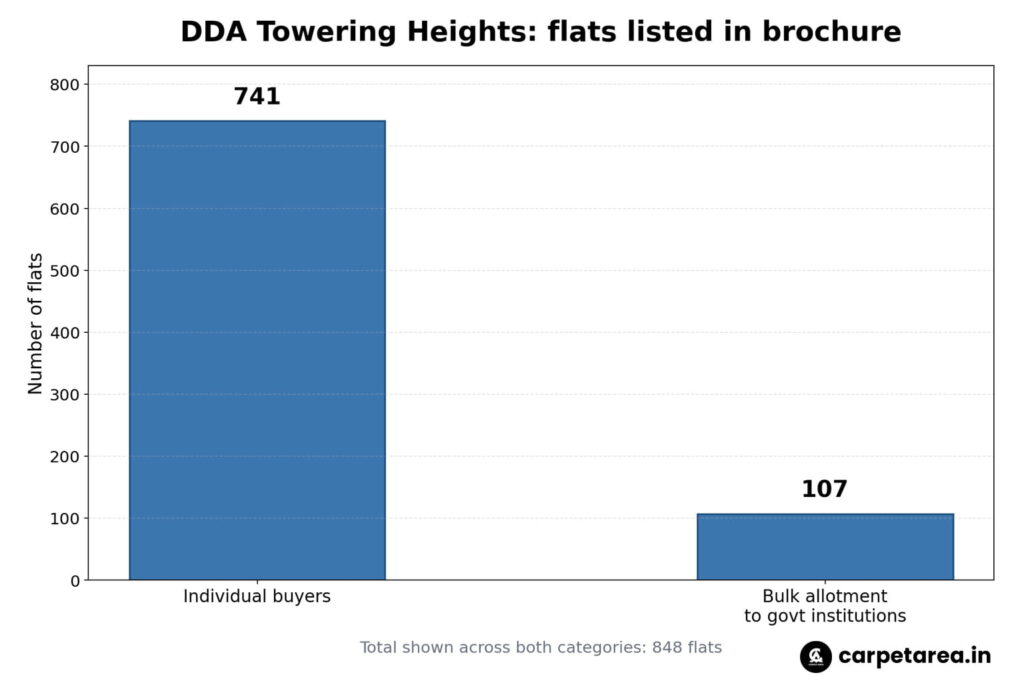
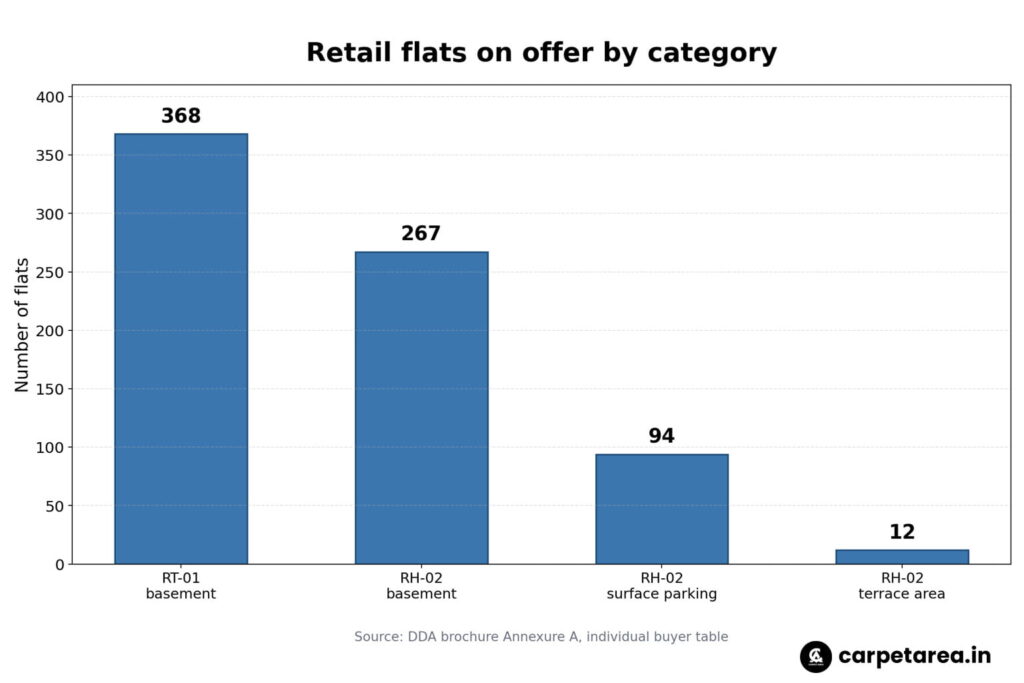
The brochure lists 741 flats for individual buyers.
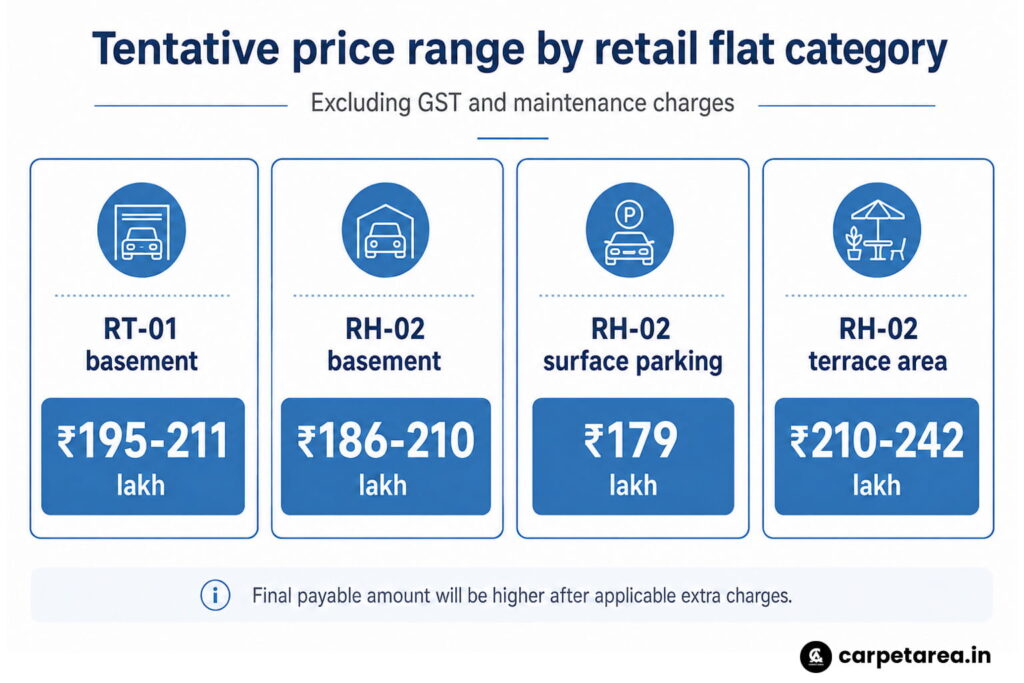
The biggest block is RT-01 with basement parking, where 368 flats are listed. The plinth area range is approximately 158.58 sq m to 171.91 sq m, and the tentative price range is around ₹195 lakh to ₹211 lakh.
Other RH-02 categories include flats with basement parking, surface parking with solar panel roof and basement parking with additional terrace area. The broad tentative price range runs from around ₹179 lakh to ₹242 lakh, excluding GST and maintenance charges.
There are also 107 flats listed separately for bulk allotment to government institutions.
So, this is not a small scheme. But because it is FCFS, actual availability can change quickly.
The price table is not the final cost
This is another major point for buyers.
The tentative disposal price mentioned in the brochure does not include GST, maintenance charges, conversion charges for freehold property and water connectivity charges.
The brochure also mentions an upfront maintenance corpus of ₹2,50,000 plus GST, if applicable. Apart from this, day-to-day maintenance is charged at ₹2.50 per sq ft per month plus applicable GST, and this is collected upfront for two years.
That means the actual payable amount will be higher than the price shown in the flat table.
Buyers should calculate the full cost before booking. The real cost should include tentative disposal price, GST if applicable, maintenance corpus, recurring maintenance, conversion charges, water connection charge, stamp duty, registration cost, loan processing and other related expenses.
A flat that looks affordable on the table may become difficult if the full cost is not calculated properly.
Site inspection should not be skipped
The brochure itself advises applicants to visit the site and inspect the flats before applying.
This is important because buyers should not depend only on brochure images, online details or location branding. A site visit helps the buyer understand access roads, actual surroundings, construction status, sample flat quality, tower location, parking arrangement and practical livability.
For a premium scheme where the flat price is in crores and booking amount is non-refundable, site inspection should be treated as a must, not an option.
Buyers should inspect the flat, compare the tower location, understand the approach road, check nearby facilities and evaluate whether the project suits their family’s daily life.
Possession and completion status
The brochure says the flats are in the final stages of construction and expected to be handed over by July 2026.
This is a positive point compared with early-stage under-construction projects. But buyers should still verify present status before booking because possession depends on completion, payment, documentation and DDA formalities.
The buyer should also remember that possession is not automatic after booking. All dues must be paid, required documents must be uploaded, and all formalities must be completed before the possession letter and physical possession process.
Documents required after allotment
The brochure lists several documents required after allotment and before possession.
These include affidavit, undertaking, identity proof, address proof, PAN card, loan sanction letter if applicable, bank statement for margin money if applicable, PwBD certificate if applying under Divyangjan category, TDS certificate if applicable and other documents mentioned on the online portal.
This means buyers should keep documents ready in advance. A delay in documents can create problems in possession or formalities.
Divyangjan benefit
The brochure gives specific provisions for Persons with Benchmark Disabilities, Divyangjan.
Eligible Divyangjan allottees can choose between cash down payment and hire purchase. Under hire purchase, the initial payment is 25%, and the remaining amount can be paid in monthly instalments over up to 15 years with simple interest at 10% per annum on monthly reducing balance.
The brochure also mentions a 5% rebate in price, subject to a maximum of ₹1 lakh, for eligible allottees under this quota.
But this benefit applies only if the applicant applies under the PwBD or Divyangjan category. If the flat is allotted under the general category, the benefit cannot be claimed later.
What buyers must check before booking?
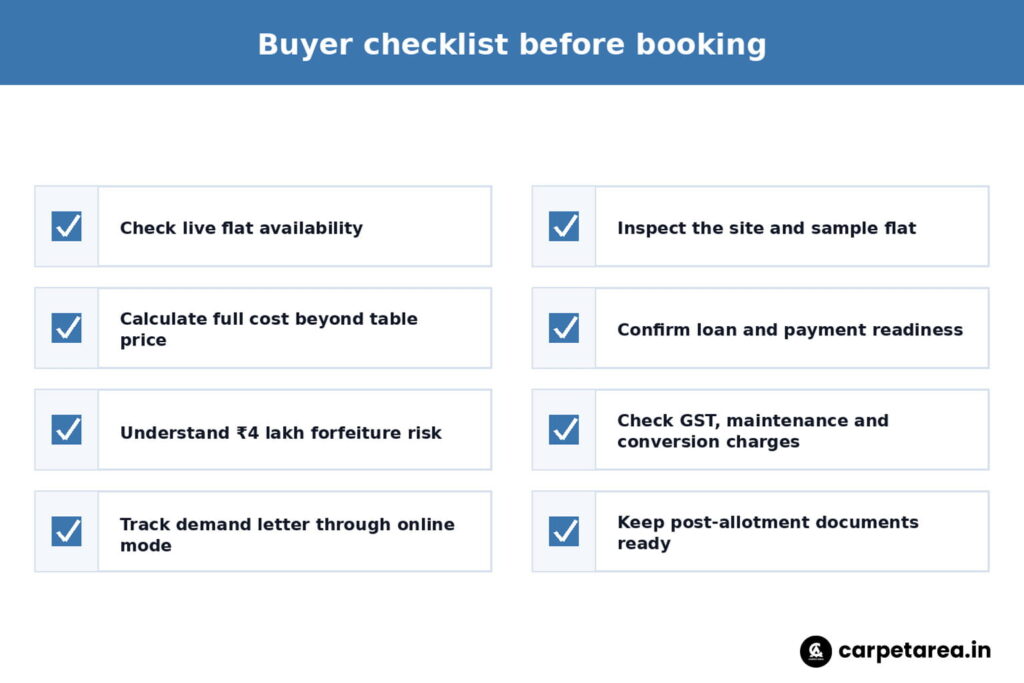
Before booking a flat under DDA Towering Heights Karkardooma, buyers should check live availability on the DDA e-services portal, exact flat number and tower, plinth area and parking details, actual tentative disposal price, GST and extra charges, maintenance corpus and recurring maintenance, payment timeline, loan eligibility and bank readiness, site condition and sample flat, possession timeline, documents required after allotment and cancellation or forfeiture conditions.
This is not a scheme where buyers should act only because the name is DDA. It is an official scheme, but every buyer must still verify affordability and suitability.
Final view
DDA Towering Heights Karkardooma Housing Scheme 2026 is a strong official housing opportunity for buyers looking at 2 BHK flats in East Delhi’s TOD-linked location. The project has the advantage of DDA backing, FCFS booking, near-completion status and Karkardooma’s connectivity story.
But this is not a low-cost housing scheme. The tentative prices are in the premium range, and the final payable amount will be higher after taxes, maintenance, conversion and other charges.
The biggest caution is the ₹4 lakh non-refundable booking amount. Once a buyer selects a flat and pays the booking amount, the decision becomes financially serious.
For Carpet Area readers, the simple message is this: DDA Towering Heights Karkardooma can be a good official option for the right buyer, but only after checking live availability, inspecting the site, calculating total cost and understanding the payment risk.
Do not book only because it is a DDA scheme. Book only if the flat, price, payment schedule and location make sense for your family or investment plan.
Sources:-
DDA official housing schemes page:-
https://dda.gov.in/housing/housing-scheme
DDA Towering Heights 2026 official e-services portal:-
https://eservices.dda.org.in/DDAToweringHeightsScheme2026
DDA official e-services login page:-
https://eservices.dda.org.in/user
Official brochure PDF link path found from DDA housing page:-
https://dda.gov.in/sites/default/files/Housing_Department/updated_brochure_kkd_tod_fcfs_2026.pdf
Supporting update: Hindustan Times report on DDA payment deadline extension to 30 June 2026:-
https://www.hindustantimes.com/real-estate/dda-gives-more-time-to-towering-heights-allottees-in-karkardooma-payment-deadline-extended-to-june-30-101777887402481.html
Supporting update: Economic Times report on DDA payment deadline extension:-
https://m.economictimes.com/wealth/real-estate/dda-extends-payment-deadline-to-june-30-2026-for-flats-allotted-under-towering-heights-project-in-karkardooma/articleshow/130818487.cms

Leave a Reply