


A parent may sound completely fine during a five-minute phone call.
What the family may not see is the untouched lunch in the kitchen, the medicine taken twice, the electricity bill lying unpaid or the bruise from a fall that was never mentioned.
Ageing parents do not always ask for help. Sometimes the need appears first through small changes in their daily routine.
One difficult day does not mean that a parent has lost independence. But repeated changes in mobility, memory, nutrition, hygiene, mood or home safety should not be dismissed as “normal ageing.”
India had approximately 153 million people aged 60 and above in 2022, and this population is expected to reach around 347 million by 2050. As families become geographically dispersed, identifying care needs early will become increasingly important.
The objective is not to take control away from parents. It is to provide enough support to help them remain safe, respected and independent for as long as possible.
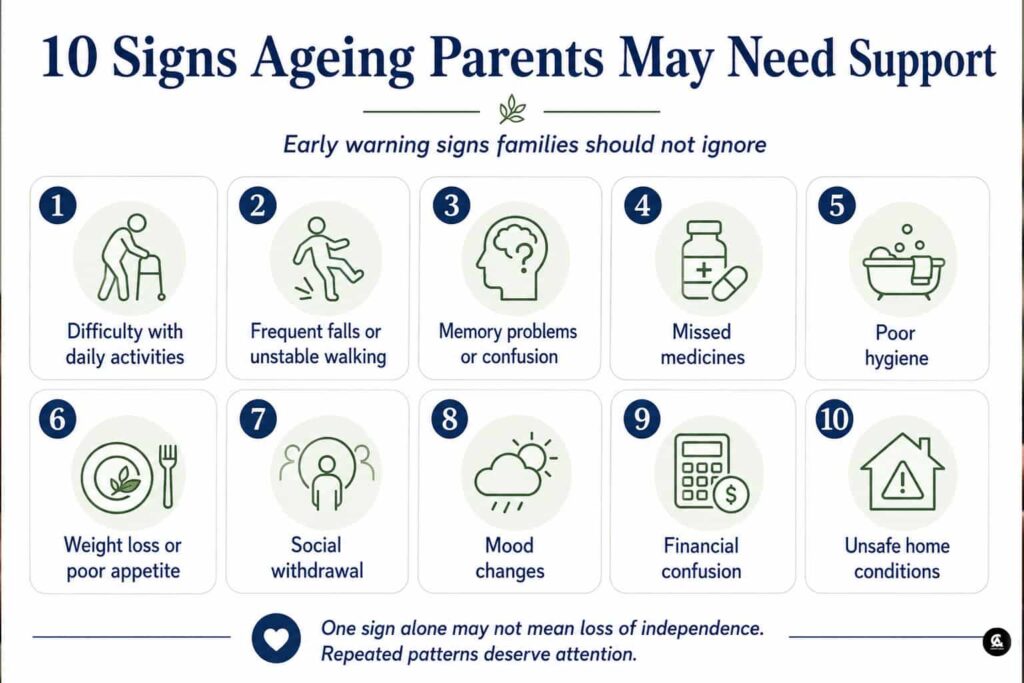
Ten warning signs ageing parents may need support
Families should look for patterns rather than judging a parent on one isolated incident.
1. Daily activities are becoming difficult
The senior may struggle with:
- bathing;
- dressing;
- preparing meals;
- using the toilet;
- cleaning the home;
- or getting in and out of bed.
A parent may avoid discussing these difficulties because asking for help can feel like losing independence.
2. Falls or unstable walking are increasing
Look for:
- unexplained bruises;
- holding walls or furniture while walking;
- difficulty getting up from a chair;
- avoiding stairs;
- or fear of walking alone.
Even when a fall does not cause a major injury, it may indicate poor balance, weakness, unsafe flooring, vision problems or medication-related dizziness.
3. Memory or judgement is changing
Occasional forgetfulness can happen at any age.
More concerning patterns may include:
- asking the same question repeatedly;
- becoming confused in familiar places;
- leaving appliances on;
- forgetting important appointments;
- or making decisions that appear unusually unsafe.
These signs should lead to a professional assessment, not an assumption that the person has dementia.
4. Medicines are being missed or repeated
Watch for:
- tablets remaining unused;
- doses being taken twice;
- medicines being mixed together;
- expired prescriptions;
- or confusion about timing.
A medicine organiser may help in mild cases, but repeated errors require closer supervision and medical review.
5. Personal hygiene is declining
Changes may include:
- wearing the same clothes repeatedly;
- avoiding bathing;
- poor oral hygiene;
- strong body odour;
- or an increasingly unclean home.
Before concluding that the senior is unwilling to maintain hygiene, check whether pain, weakness, fear of falling or an inaccessible bathroom is making the task difficult.
6. Appetite is reducing or weight is falling
The refrigerator may contain expired food, meals may be skipped or the parent may increasingly survive on tea and snacks.
Possible reasons include:
- difficulty shopping or cooking;
- dental problems;
- trouble swallowing;
- reduced appetite;
- medicine side effects;
- loneliness;
- or an underlying illness.
Unexplained weight loss should be discussed with a qualified medical professional.
7. Social withdrawal is increasing
A previously social parent may stop:
- meeting friends;
- attending religious or community activities;
- answering calls;
- pursuing hobbies;
- or leaving the home.
The reason may be loneliness, hearing loss, pain, reduced mobility, embarrassment about health problems or emotional distress.
8. Mood or behaviour has changed
Noticeable irritability, anxiety, fearfulness, apathy or unusual suspicion deserves attention.
Sudden behavioural changes may be connected with pain, infection, medicine effects or another health issue. They should not automatically be treated as personality changes.
9. Bills and money are becoming difficult to manage
Warning signs may include:
- repeated unpaid bills;
- services being disconnected;
- unusual bank transactions;
- misplaced cash;
- duplicate payments;
- or responding to suspicious financial requests.
The senior may need support with bill payments and protection from fraud without being unnecessarily excluded from all financial decisions.
10. The home is becoming unsafe
Look for:
- loose rugs;
- poor lighting;
- cluttered passages;
- unlocked doors;
- gas burners left on;
- spoiled food;
- unsafe electrical appliances;
- or bathrooms without support rails.
Some risks can be reduced through simple home modifications before full-time care becomes necessary.
Normal ageing or a genuine warning sign?
Not every change means that professional care is immediately required.
Families should consider five factors:
Frequency
Did the problem occur once, or is it happening repeatedly?
Severity
Was it a small inconvenience, or did it place the parent in danger?
Suddenness
Did the change develop slowly, or did it appear suddenly?
Effect on daily life
Is the senior still able to eat, bathe, walk, communicate and manage medicines safely?
Combination of signs
One missed appointment may not be alarming. Missed medicines, weight loss, repeated falls and financial confusion appearing together require closer attention.
WHO describes healthy ageing in terms of maintaining the functional ability that enables well-being. The aim should therefore be to understand what the senior can still do independently and where additional support is required.
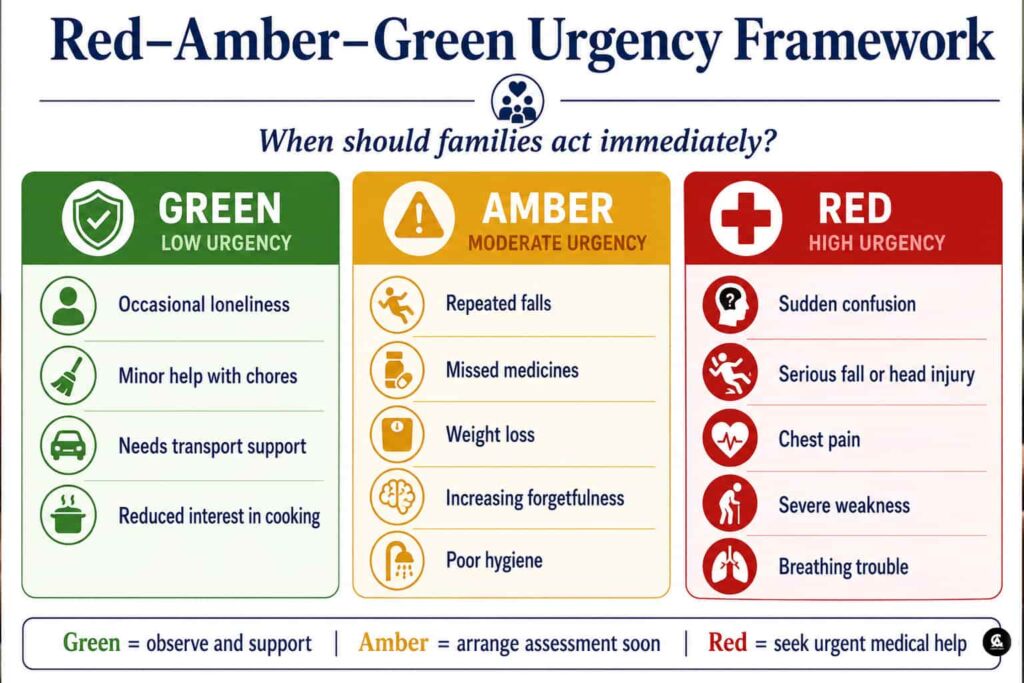
Red, amber and green: How urgently should the family act?
Not all warning signs should be handled in the same way.
Red: Seek urgent medical help
Urgent assistance may be required when there is:
- sudden confusion;
- severe difficulty breathing;
- chest pain;
- loss of consciousness;
- sudden severe weakness;
- a serious fall;
- or a head injury.
Sudden confusion, severe breathing difficulty and chest symptoms may require immediate emergency assessment. Families should contact their local emergency medical service rather than attempting to diagnose the condition at home.
Amber: Arrange an assessment soon
Professional evaluation should be arranged when there are:
- repeated falls;
- frequent medicine mistakes;
- unexplained weight loss;
- increasing forgetfulness;
- noticeable mood changes;
- declining hygiene;
- or difficulty managing basic routines.
These situations may not be immediate emergencies, but waiting for a crisis can reduce the family’s choices.
Green: Observe and provide light support
Limited support may be enough when the senior mainly needs:
- companionship;
- transport;
- grocery assistance;
- housekeeping;
- meal preparation;
- or occasional monitoring.
The arrangement should be reviewed if the senior’s needs increase.
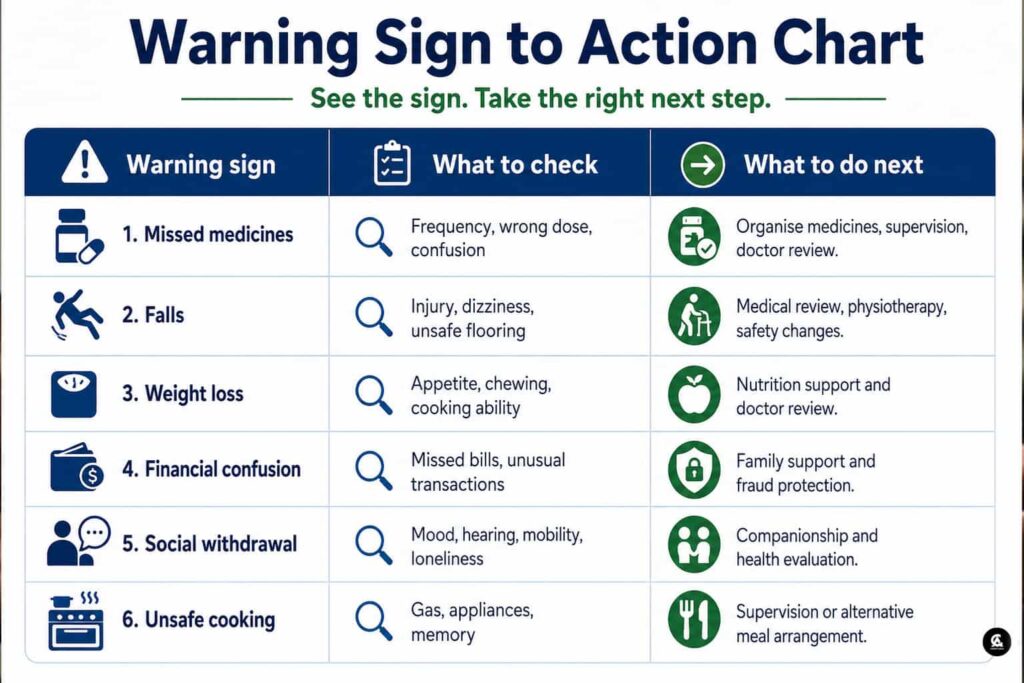
What should the family do after noticing a warning sign?
The next step should depend on the problem.
Missed medicines
Check:
- how frequently it happens;
- whether the wrong dose was taken;
- and whether the parent understands the prescription.
Possible next steps include a pill organiser, written medicine chart, supervised doses and a doctor or pharmacist review.
Repeated falls
Check:
- whether an injury occurred;
- whether the parent felt dizzy;
- whether footwear is safe;
- and whether the floor, bathroom or staircase presents hazards.
Possible next steps include medical assessment, physiotherapy, walking support and home-safety changes.
Weight loss
Check:
- appetite;
- food availability;
- chewing or swallowing problems;
- ability to cook;
- and changes in mood.
Arrange medical and nutritional assessment rather than assuming that reduced appetite is simply part of ageing.
Financial confusion
Check:
- unpaid bills;
- unusual withdrawals;
- duplicate payments;
- and suspicious calls or messages.
Introduce oversight gradually and respectfully. The objective should be to protect the parent, not remove all control without discussion.
Social withdrawal
Check:
- hearing;
- mobility;
- pain;
- mood;
- transport limitations;
- and loneliness.
Companionship, hearing assessment, transport support or medical evaluation may help.
Unsafe cooking
Check:
- gas and electrical appliances;
- memory changes;
- hand strength;
- vision;
- and balance.
Possible solutions include supervised cooking, prepared meals, appliance modifications or alternative meal arrangements.
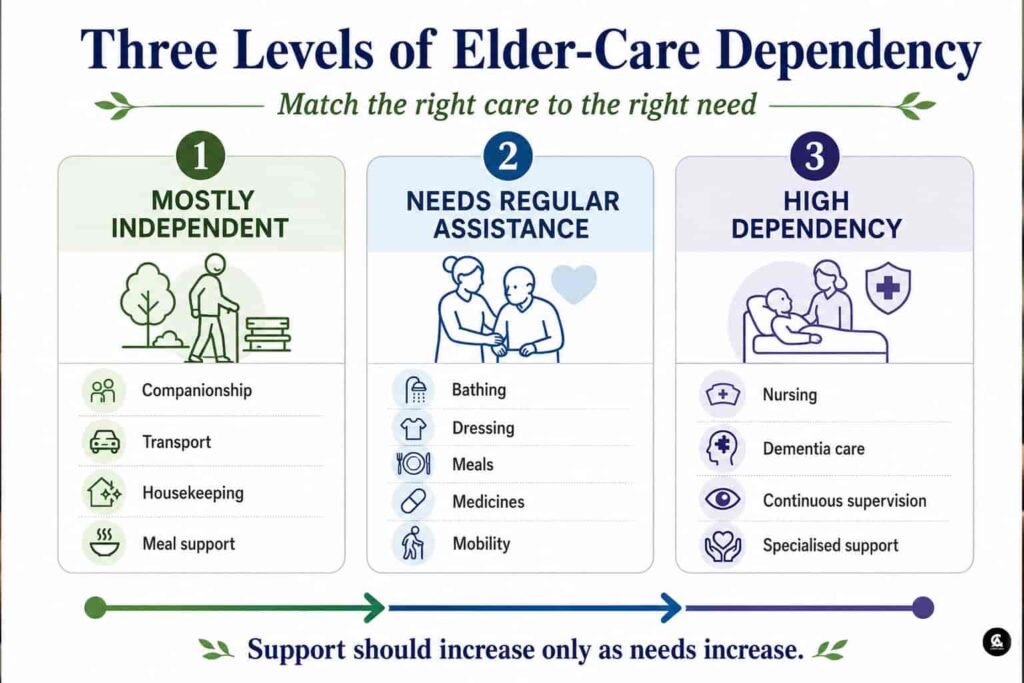
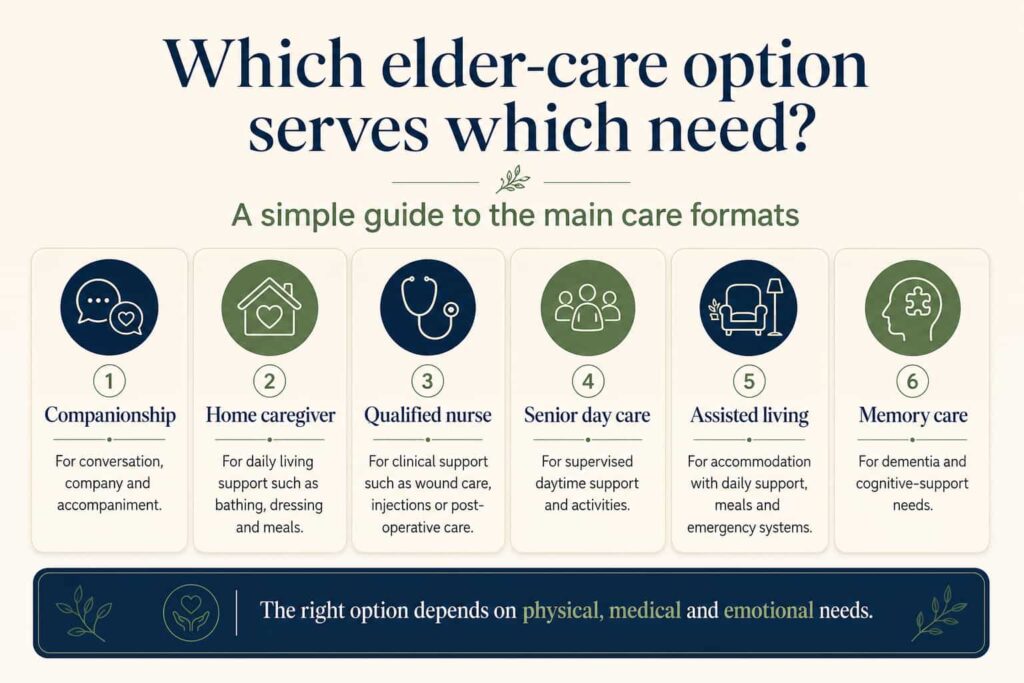
Three levels of elder-care dependency
Care should be based on ability and need—not age alone.
Level 1: Mostly independent
The senior can generally:
- bathe and dress independently;
- eat without assistance;
- walk safely;
- use the toilet;
- and manage basic decisions.
Support may still be helpful for:
- companionship;
- transport;
- shopping;
- housekeeping;
- meal preparation;
- and appointments.
Suitable options may include part-time companionship, domestic support, senior day care or active senior living.
Level 2: Needs regular assistance
The senior may require help with:
- bathing;
- dressing;
- medicines;
- meals;
- walking;
- transfers;
- or toileting.
Possible options include a trained home caregiver or assisted living.
Level 3: High dependency
The senior may require:
- nursing;
- dementia support;
- feeding assistance;
- continuous supervision;
- medical-device management;
- or help with most daily activities.
This may require qualified home nursing, memory care, rehabilitation or specialised residential care.
WHO’s Integrated Care for Older People approach supports person-centred assessment and coordinated care based on physical, mental and social needs rather than fragmented services.
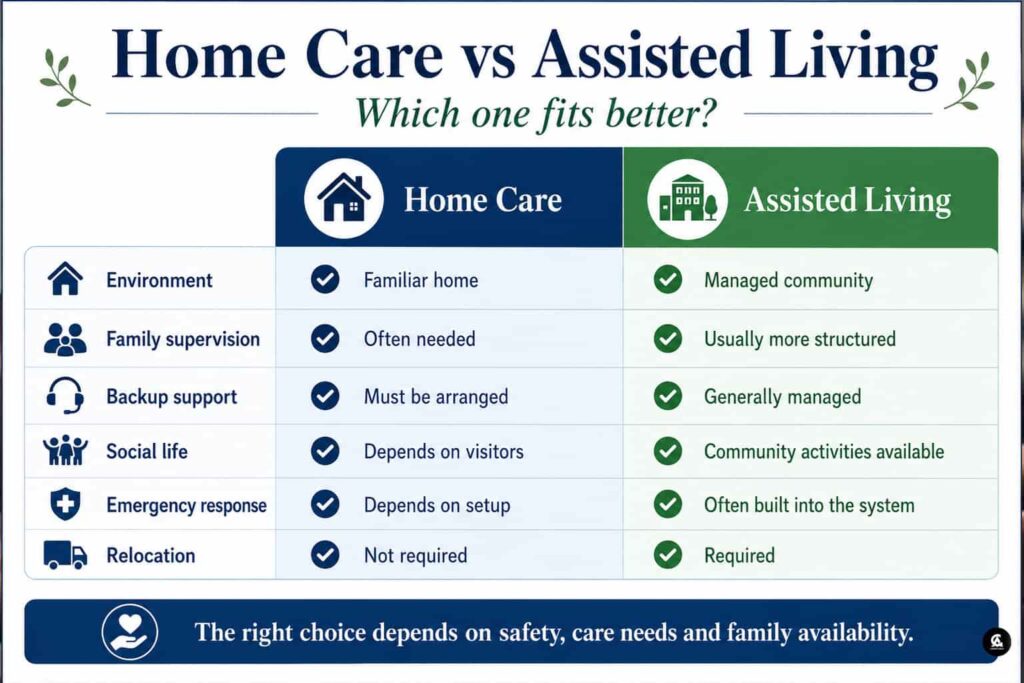
When may home care be enough?
Home care may be suitable when:
- the parent strongly prefers the existing home;
- care needs are limited or moderate;
- the home can be made safer;
- family supervision is available;
- and replacement staff can be arranged.
The family may begin with:
- a few hours of companionship;
- meal support;
- medicine supervision;
- physiotherapy;
- bathroom modifications;
- or a daytime caregiver.
Remaining at home can preserve routine and familiarity. However, a care arrangement based entirely on one unmonitored caregiver can become fragile.
A proper home-care system should include:
- documented duties;
- a replacement plan;
- emergency contacts;
- medicine records;
- supervision;
- and regular family updates.
When may assisted living deserve consideration?
Assisted living may be appropriate when:
- living alone has become unsafe;
- falls are becoming frequent;
- medicines cannot be managed reliably;
- night-time assistance is required;
- loneliness is affecting well-being;
- or several separate home services have become difficult to coordinate.
Assisted living may provide:
- accommodation;
- meals;
- housekeeping;
- organised activities;
- emergency support;
- and daily assistance.
However, families should not assume that every facility provides nursing, dementia support or high-dependency care. These capabilities must be verified separately.
The senior should be involved in the decision wherever possible. Relocation imposed without consultation can create resistance and emotional distress.
Caregiver or qualified nurse?
Families often use the words caregiver, attendant and nurse interchangeably.
Their responsibilities are different.
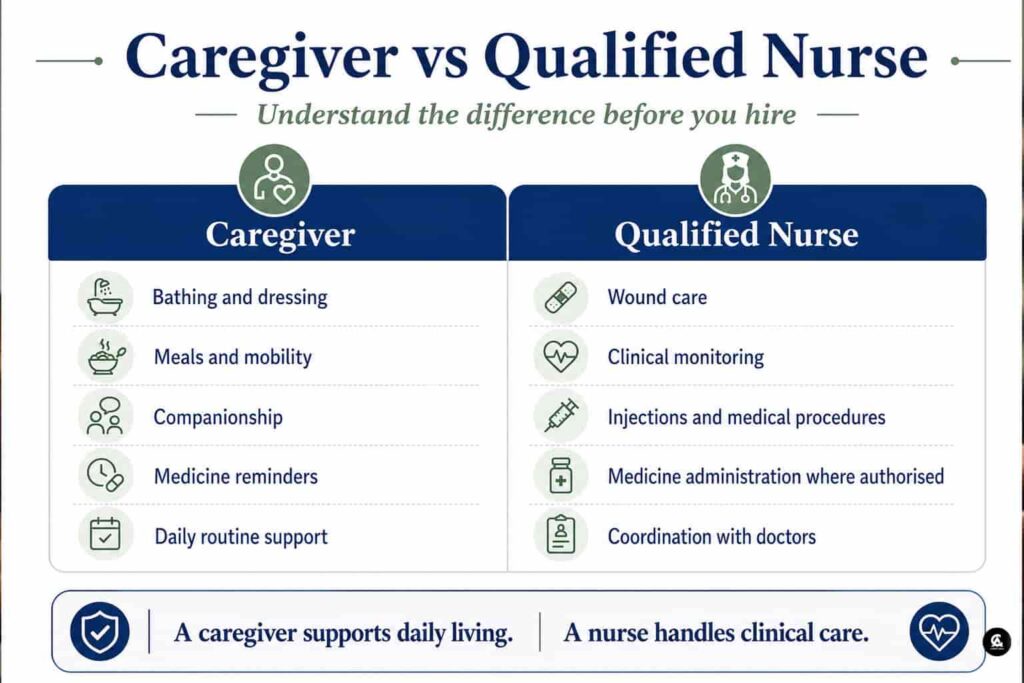
A caregiver generally supports daily living
A caregiver may help with:
- bathing and dressing;
- meals;
- mobility;
- toileting;
- companionship;
- medicine reminders;
- and household routines.
A qualified nurse handles clinical care
A nurse may be required for:
- wound care;
- clinical monitoring;
- injections;
- catheter care;
- medical-device management;
- post-operative care;
- and medicine administration where professionally authorised.
Hiring a nurse for basic companionship may create unnecessary expense.
Hiring an unqualified caregiver for clinical procedures may create serious risk.
Ask the provider to define the role, qualifications and permitted responsibilities in writing.
How to verify an elder-care provider?
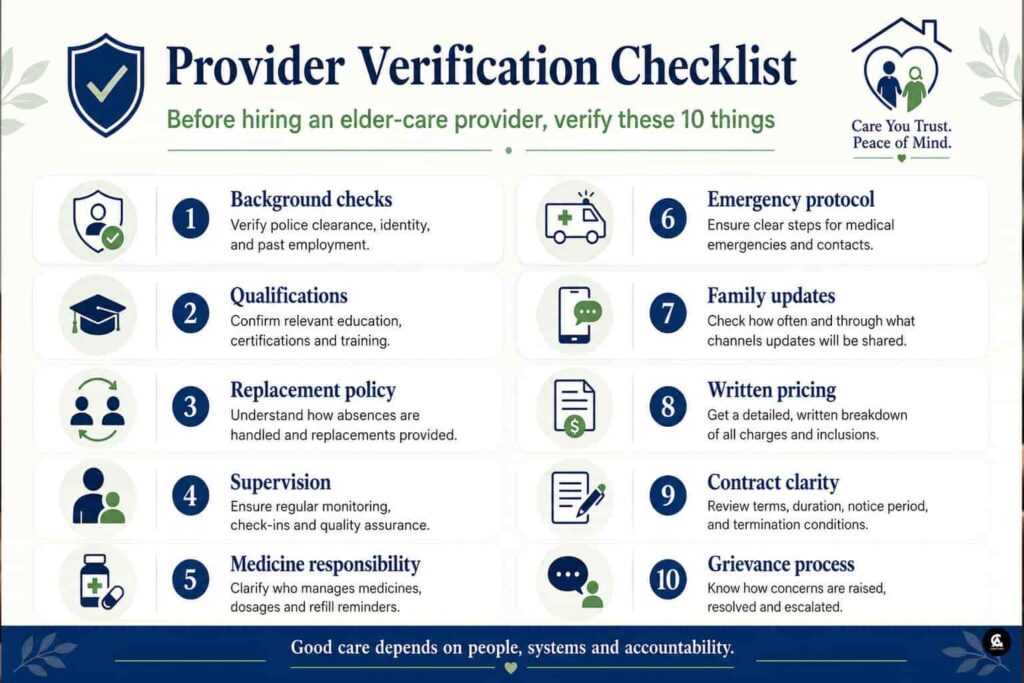
A compassionate sales conversation does not prove that a provider can deliver dependable care.
Before hiring, verify the following.
1. Background checks
Ask for confirmation of identity, address, previous employment and police verification where applicable.
2. Qualifications
Understand whether the assigned person is a companion, caregiver, nursing assistant or qualified nurse.
3. Replacement policy
Ask what happens when the regular caregiver is on leave, ill or unavailable.
4. Supervision
Identify the care manager or senior professional responsible for monitoring the service.
5. Medicine responsibility
Clarify whether staff members will remind, organise, administer or document medicines.
6. Emergency protocol
Ask:
- whom the caregiver contacts;
- how an ambulance is arranged;
- which hospital is used;
- who accompanies the senior;
- and how the family is informed.
7. Family updates
Confirm whether updates will be daily, weekly or limited to emergencies.
8. Written pricing
Ask for a detailed breakdown of included services, exclusions and additional charges.
9. Contract clarity
Review:
- duty hours;
- weekly leave;
- deposits;
- replacement charges;
- notice period;
- cancellation;
- and refund conditions.
10. Grievance process
There should be one accountable person and a clear escalation system for complaints or poor performance.
Compare the complete monthly cost
The lowest base quotation may not be the lowest total cost.
A home-care budget may include:
- caregiver fees;
- nursing visits;
- meals;
- medicines;
- equipment;
- physiotherapy;
- transport;
- emergency support;
- agency charges;
- and replacement staff.
An assisted-living package may include:
- accommodation;
- meals;
- housekeeping;
- basic assistance;
- security;
- and selected activities.
Additional charges may apply for:
- personal caregivers;
- advanced nursing;
- physiotherapy;
- medical equipment;
- special diets;
- hospital accompaniment;
- medicines;
- and higher-dependency care.
Before comparing providers, ask each one to provide:
- The base fee
- Included services
- Excluded services
- Usage-based charges
- Annual escalation
- Higher-care costs
- Deposit and refund conditions
The family should also estimate what the arrangement may cost if the senior’s dependency increases after one or two years.
How to speak with ageing parents respectfully?
The conversation should not begin with:
“You can no longer manage on your own.”
That statement can sound like a judgement.
A more respectful approach may be:
“We have noticed that a few daily tasks are becoming tiring. Let us find a way to make things easier while protecting your independence.”
Focus on what the parent may gain:
- greater safety;
- fewer household burdens;
- dependable help;
- companionship;
- and faster emergency support.
Where possible:
- discuss several options;
- start with limited support;
- visit providers together;
- consider a trial arrangement;
- and review the decision after a defined period.
Care should support independence rather than remove it unnecessarily.
Common family mistakes
Dismissing every change as normal ageing
A repeated pattern deserves assessment.
Waiting for a major crisis
Early planning gives the senior more time and choice.
Choosing only by price
Low fees may come without training, backup or supervision.
Depending on one caregiver
Every arrangement needs a replacement plan.
Treating a caregiver as a nurse
Clinical procedures require appropriate qualifications.
Ignoring loneliness
A senior may be physically safe but emotionally isolated.
Believing technology is enough
Cameras and mobile applications can improve visibility, but they cannot replace trained judgement, companionship and emergency response.
Excluding the parent
A technically sound plan may still fail when the senior feels powerless or unheard.
Carpet Area view
One missed medicine, one unpaid bill or one difficult day does not automatically mean that a parent can no longer live independently.
But repeated changes in safety, nutrition, mobility, memory and daily routines should not be ignored.
Families should follow a clear sequence:
Notice the change → assess the urgency → speak with the parent → obtain medical advice where needed → determine the care level → verify the provider.
The goal of elder care is not maximum intervention.
It is the right intervention at the right time.
Sometimes that may mean adding a grab rail and arranging meal support. In another case, it may mean hiring a daytime caregiver. For a senior with complex medical or cognitive needs, specialised care may become necessary.
The best arrangement is the one that protects dignity while reducing avoidable risk.
Final family checklist
Before finalising a care plan, answer these questions:
- What can the parent still manage independently?
- Which changes are repeated rather than isolated?
- Does any sign require urgent medical attention?
- Is the need social, personal, medical or combined?
- Can the home be made safer?
- Is family supervision realistically available?
- Does the parent need a caregiver or a nurse?
- Is backup available when staff are absent?
- What is the complete monthly cost?
- Can the arrangement increase as care needs change?
- Has the provider been properly verified?
- Is the parent comfortable with the decision?
Recognising that a parent needs help can be emotionally difficult.
But arranging support is not an admission that the family has failed.
Done correctly, it allows parents to remain safer and more independent—and allows children to return from being constant emergency managers to being sons and daughters again.
Sources:-
- UNFPA India, population ageing in India.
- World Health Organization, healthy ageing and functional ability.
- World Health Organization, Integrated Care for Older People.
- NHS, guidance on symptoms requiring urgent or emergency assessment.




Leave a Reply