

Retirement is usually planned as a financial event.
People calculate their pension, savings, insurance, monthly expenses and expected investment income. Yet when the last working day arrives, another transition begins—one that cannot be managed through money alone.
Work may have provided:
- A fixed daily schedule
- Social interaction
- Recognition
- Responsibility
- A professional identity
- A reason to leave the house
- A feeling of being needed
When these disappear together, even a financially secure retiree may feel unsettled.
The first year after retirement should therefore not be treated as an extended holiday. It is a period for redesigning daily life, relationships, responsibilities and the home.
WHO describes healthy ageing in terms of maintaining the ability to do what a person values. This ability is influenced not only by health but also by the physical and social environment in which the person lives.
Why can retirement feel uncomfortable at first?
The discomfort is not always caused by financial insecurity.
A retiree may have sufficient income, a supportive family and good health but still feel that something important is missing.
This can happen because work previously organised several parts of life at once.
| What work provided | What may be lost after retirement |
|---|---|
| Fixed timings | Structure in the day |
| Meetings and deadlines | Sense of urgency |
| Colleagues | Regular social contact |
| Designation | Professional identity |
| Responsibility | Feeling of usefulness |
| Salary | Financial certainty |
| Workplace recognition | External appreciation |
The objective after retirement is not to recreate office life.
It is to understand which functions work previously performed and replace them with healthier, more flexible alternatives.
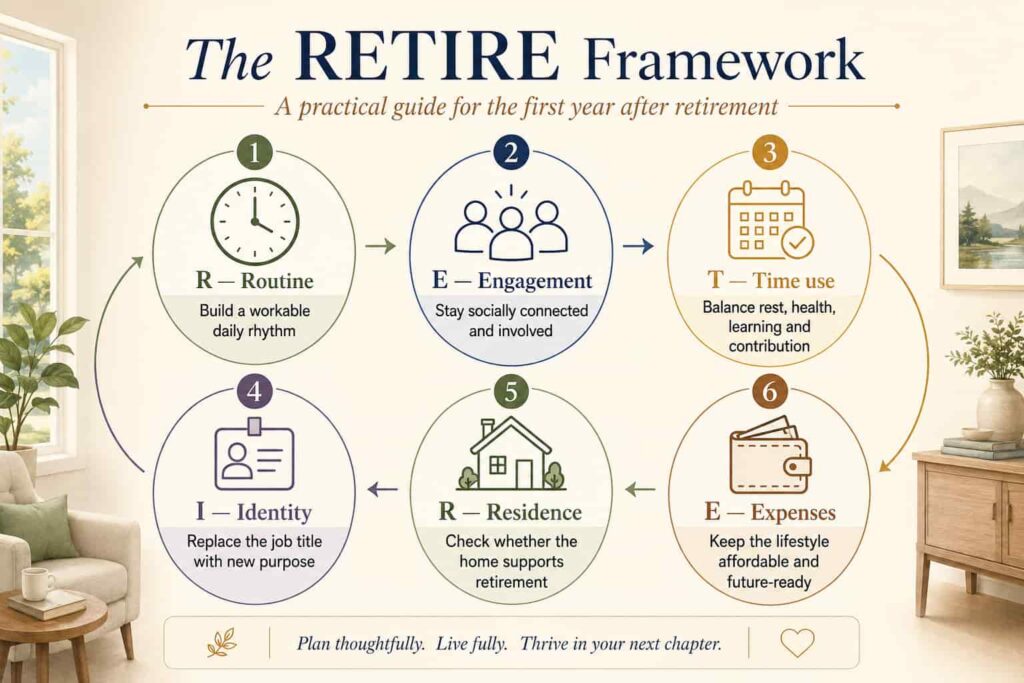
Use the RETIRE framework
A practical retirement plan should cover six areas.
R — Routine
What will give shape to mornings, afternoons and evenings?
E — Engagement
Who will the retiree meet, call, help or work with regularly?
T — Time use
How will time be divided between rest, health, family, learning and contribution?
I — Identity
Which roles will replace the professional title?
R — Residence
Does the current home support present comfort and future ageing needs?
E — Expenses and evolution
Is the lifestyle affordable, and can it adapt as health and support requirements change?
Financial planning remains important, but it is only one part of this framework.
A practical first-year retirement timeline
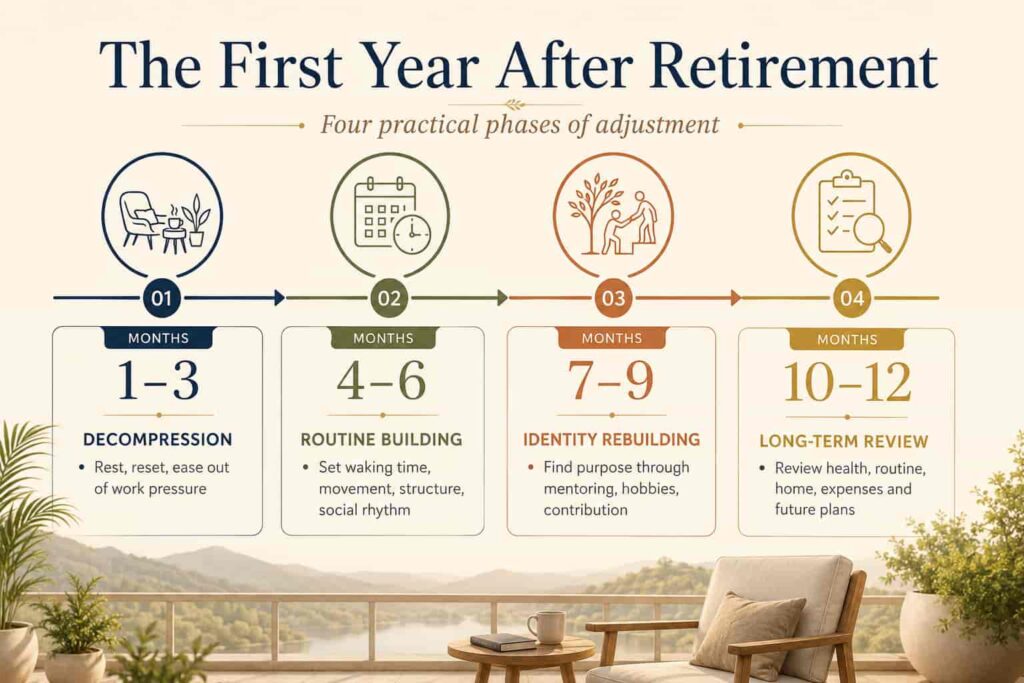
Every retiree adjusts differently. The following timeline is a planning framework, not a fixed psychological or medical rule.
Months 1–3: Decompression
The initial period may feel relaxing.
A retiree may enjoy:
- Sleeping without an alarm
- Travelling
- Spending time with family
- Completing pending household work
- Taking a break from professional pressure
There is no need to fill every free hour immediately.
However, sleep, meals, movement and social contact should not become completely irregular.
Months 4–6: Build a workable routine
Once the novelty reduces, unplanned days can start feeling repetitive.
This is the time to introduce:
- A fixed waking time
- Daily physical activity
- Household responsibilities
- Regular social interaction
- A hobby or learning goal
- A weekly family or community commitment
The schedule should provide direction without making retirement feel like another job.
Months 7–9: Rebuild identity and purpose
By this stage, the retiree may have a clearer idea of what is missing.
Possible roles include:
- Consultant
- Mentor
- Volunteer
- Teacher
- Association member
- Community organiser
- Family historian
- Traveller
- Caregiver
- Small-business owner
Purpose does not have to come from paid employment.
It can come from contribution, learning, relationships or responsibility.
Months 10–12: Review the new lifestyle
At the end of the first year, examine:
- Physical health
- Emotional well-being
- Social interaction
- Daily routine
- Family relationships
- Monthly expenses
- Use of the home
- Long-term housing needs
The goal is not to judge whether retirement was successful. It is to understand what requires adjustment.
Retirement planning should include the spouse
Retirement changes the household, not just the retiree.
A spouse may suddenly experience:
- Less personal space
- A change in household routine
- Greater expectations of companionship
- New disagreements about money
- Additional household involvement
- Pressure to travel or relocate
- Reduced freedom during the day
Couples should discuss:
- Personal time
- Shared time
- Household responsibilities
- Social activities
- Financial boundaries
- Travel plans
- Support for adult children
- Long-term housing decisions
A retiree’s freedom should not unintentionally reduce the spouse’s independence.
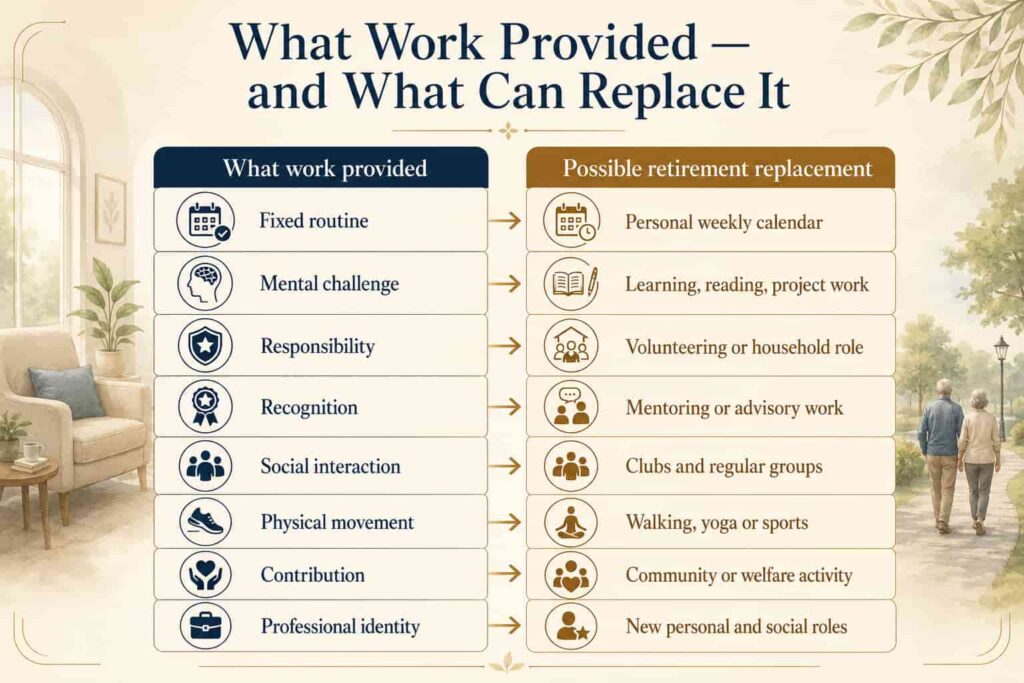
Replace the function, not the job
A person who misses work may not necessarily miss the office itself.
They may miss what the job provided.
| What may be missing | Possible replacement |
| Fixed routine | Personal weekly calendar |
| Mental challenge | Courses, reading or project work |
| Responsibility | Volunteering or household role |
| Recognition | Mentoring or advisory work |
| Social interaction | Clubs and regular groups |
| Physical movement | Walking, yoga or sports |
| Contribution | Community or welfare activity |
| Professional identity | New personal and social roles |
A retirement plan should include both enjoyment and responsibility.
Only leisure can eventually feel empty. Only responsibility can make retirement stressful.
A balance is healthier.
Social connection should be planned deliberately
Workplace interaction often disappears quietly after retirement.
Colleagues may initially call regularly, but contact can reduce as routines separate.
The retiree should therefore build relationships that do not depend entirely on the former workplace or immediate family.
Useful options include:
- Resident-welfare groups
- Veteran associations
- Religious or cultural groups
- Walking communities
- Sports clubs
- Volunteering
- Teaching or mentoring
- Hobby circles
- Community libraries
- Regular neighbourhood meetings
WHO identifies social isolation and loneliness as important health and well-being concerns among older people. NIA also notes associations between loneliness or isolation and higher risks of depression, cognitive decline and other health problems.
The aim is not to remain surrounded by people throughout the day.
The aim is to have meaningful and dependable relationships.
Use a social-connectivity check
Ask whether the retiree has:
- Someone to speak with most days
- At least one activity outside the house each week
- Friends beyond the immediate family
- People who notice an unexplained absence
- An opportunity to contribute
- Access to safe community spaces
- Reliable transport for social activities
A clubhouse in a residential project is useful only when residents actually use it and relationships develop naturally.
Is the current house still suitable after retirement?
A property selected during employment may not remain suitable during retirement.
Earlier, the owner may have spent most weekdays outside the house. After retirement, the home becomes the centre of daily life.
This changes the importance of:
- Natural light
- Ventilation
- Lift access
- Noise
- Neighbour interaction
- Walking areas
- Healthcare access
- Daily shopping
- Maintenance
- Public transport
- Safety
A large house may provide space but require constant maintenance.
A premium apartment may offer amenities but feel socially disconnected.
A peaceful villa may become inconvenient if hospitals, markets and family members are far away.
The decision should be based on daily usability, not only property value.
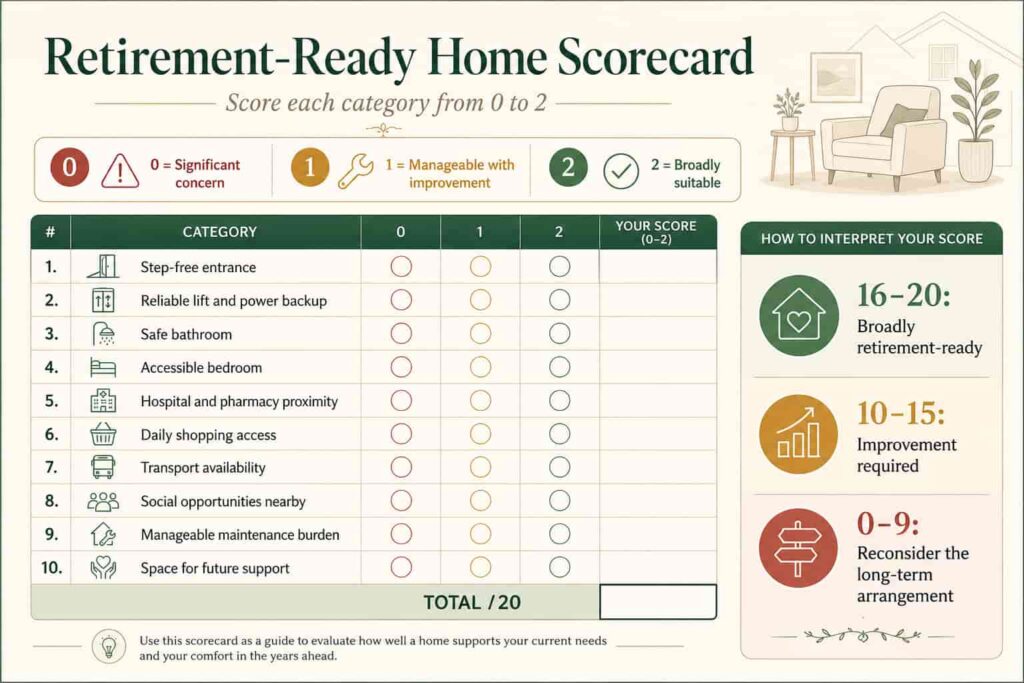
Retirement-ready home scorecard
Score each category:
- 0: Significant concern
- 1: Manageable with improvement
- 2: Broadly suitable
| Area assessed | Score |
| Step-free entrance | /2 |
| Reliable lift and power backup | /2 |
| Safe bathroom | /2 |
| Accessible bedroom | /2 |
| Hospital and pharmacy proximity | /2 |
| Daily shopping access | /2 |
| Transport availability | /2 |
| Social opportunities nearby | /2 |
| Manageable maintenance burden | /2 |
| Space for future support | /2 |
| Total | /20 |
How to interpret the score
16–20: Broadly retirement-ready
The home may remain suitable with regular maintenance and minor improvements.
10–15: Improvement required
Home modification, better services or stronger local support may be needed.
0–9: Reconsider the long-term arrangement
Downsizing, relocation or a more supportive residential environment should be evaluated.
This scorecard is a planning tool, not a professional accessibility assessment.
NIA advises that ageing at home requires advance planning around safety, mobility, daily activities and available support.
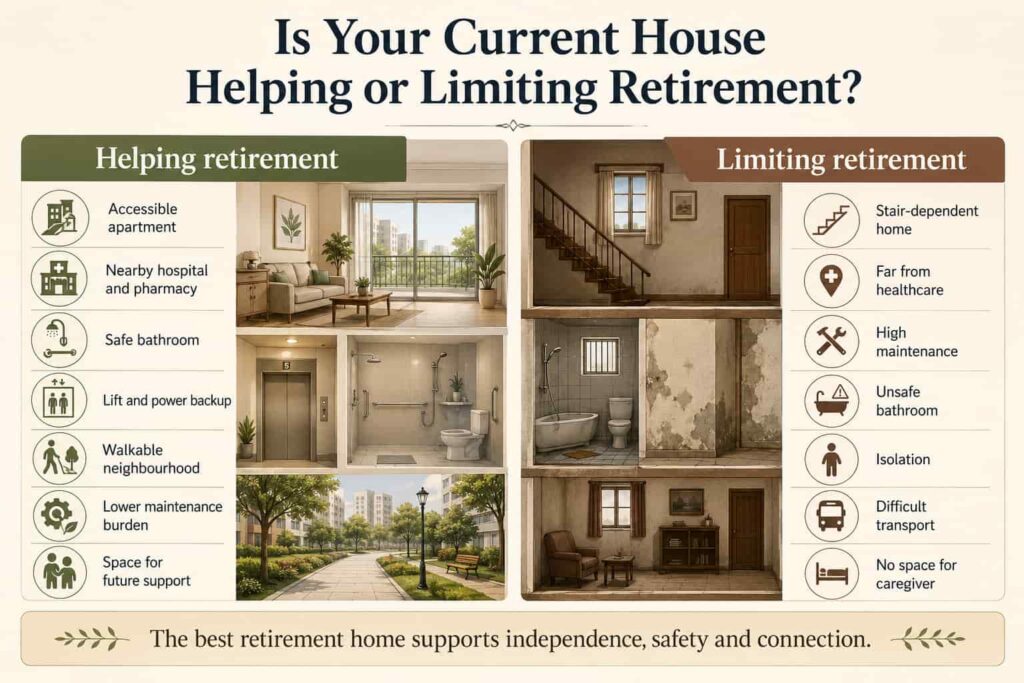
Five signs that the home may be limiting retirement
1. The retiree rarely leaves the house
The cause may not be lack of interest.
It may be:
- Difficult stairs
- No lift
- Poor transport
- Unsafe roads
- Lack of nearby destinations
- Dependence on another person for every trip
2. Property maintenance consumes time and money
A large independent house may require:
- Security
- Repairs
- Gardening
- Housekeeping
- Utility management
- Structural maintenance
These costs should be compared with the emotional and practical value of retaining the property.
3. Healthcare is too far away
Hospital distance matters more when:
- Driving becomes difficult
- One spouse has a chronic condition
- Children live elsewhere
- Emergency transport is unreliable
4. The neighbourhood provides little social interaction
A beautiful home can still create isolation when there are no safe, accessible and active community spaces nearby.
5. The house cannot support future care
Check whether the property has:
- A ground-floor bedroom
- A safe bathroom
- Space for a caregiver
- Wheelchair movement
- Ambulance access
- Lift power backup
- Emergency communication
The right time to assess these features is before a crisis.
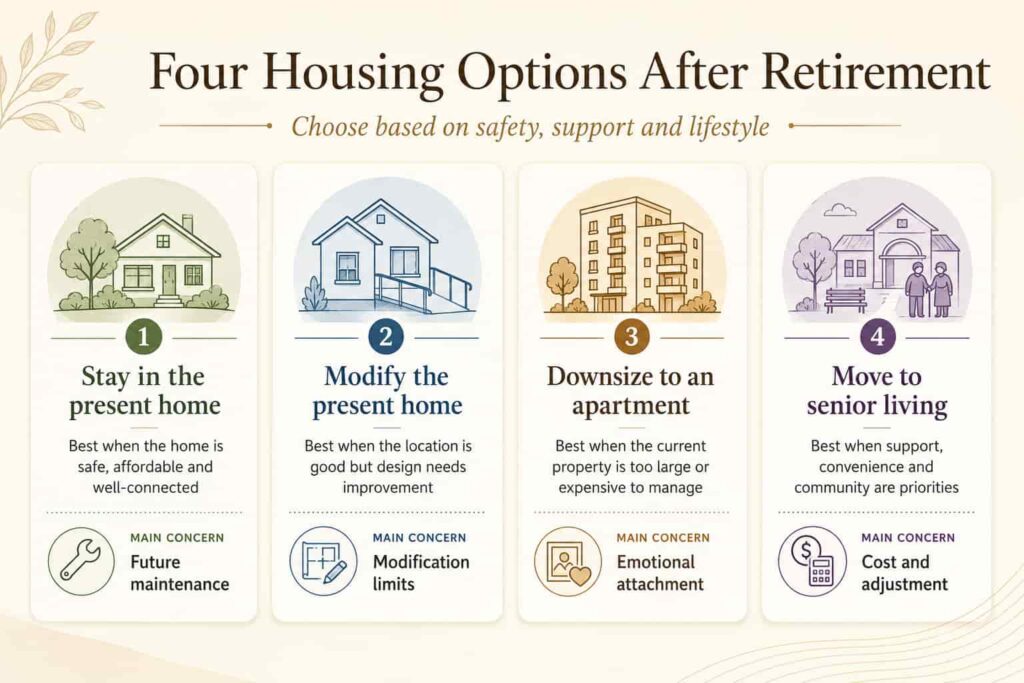
Four housing choices after retirement
| Housing option | Suitable when | Main concern |
| Continue in the present home | It is safe, affordable and well-connected | Future maintenance |
| Modify the present home | Location is good but design needs improvement | Modification limits |
| Downsize to an apartment | The existing property is large or expensive to manage | Emotional attachment |
| Move to senior living | Support, convenience and community are priorities | Cost and adjustment |
There is no universal answer.
The right choice depends on health, finances, family location, property design and personal preference.
Do not relocate only because retirement feels boring
Retirement and relocation are both major transitions.
Combining them immediately may create unnecessary stress.
Before moving, ask:
- Is the discomfort temporary?
- Can a routine be rebuilt in the current location?
- Can the house be modified?
- Does the spouse want to move?
- Will the new location improve healthcare access?
- Will social interaction actually improve?
- How close will the family be?
- What will happen to the existing property?
- Is the financial impact sustainable?
A short trial stay can be more informative than a sales presentation.
Spend time in the proposed neighbourhood during:
- Morning hours
- Evenings
- Weekends
- Different seasons
Check actual travel time to hospitals, shops and family—not only distances shown in the brochure.
When can senior living become relevant?
Senior living may deserve consideration when the retiree wants:
- Reduced property maintenance
- Organised activities
- A peer community
- Better emergency support
- Regular meals and housekeeping
- Easier access to assistance
- A more accessible home
- Continuity if care needs increase
But senior living should not be selected only because a project has attractive landscaping or luxury amenities.
Families should evaluate:
- Ownership or lease structure
- Monthly charges
- Care services
- Nursing availability
- Emergency response
- Hospital access
- Exit conditions
- Resale restrictions
- Resident profile
- Long-term affordability
The objective is not merely to purchase another property.
It is to select a living environment that supports independence and dignity.
Five Indian retirement profiles
Government pensioner in a large family home
Income may be stable, but the property may require extensive upkeep.
Possible options:
- Use one accessible floor
- Rent unused space
- Modify bathrooms
- Retain the house while health permits
- Downsize later
Private-sector retiree with limited monthly income
The person may own a valuable property but have restricted cash flow.
Possible options:
- Reduce maintenance costs
- Review property taxes and society charges
- Create rental income
- Downsize carefully
- Maintain a healthcare reserve
Armed Forces veteran
Retirement may involve the loss of rank, structure, unit identity and camaraderie.
Useful alternatives may include:
- Veteran organisations
- Welfare work
- Mentoring
- Fitness routines
- Community leadership
- Part-time advisory roles
Couple whose children live abroad
The property may be comfortable, but local emergency support may be weak.
Possible steps include:
- Trusted local contacts
- Emergency alert technology
- Verified service providers
- Healthcare coordination
- Trial stays in managed senior communities
Retiree who wants to continue working
Retirement does not require complete withdrawal from professional life.
Options may include:
- Consulting
- Teaching
- Mentoring
- Advisory work
- Entrepreneurship
- Part-time employment
- Social-sector participation
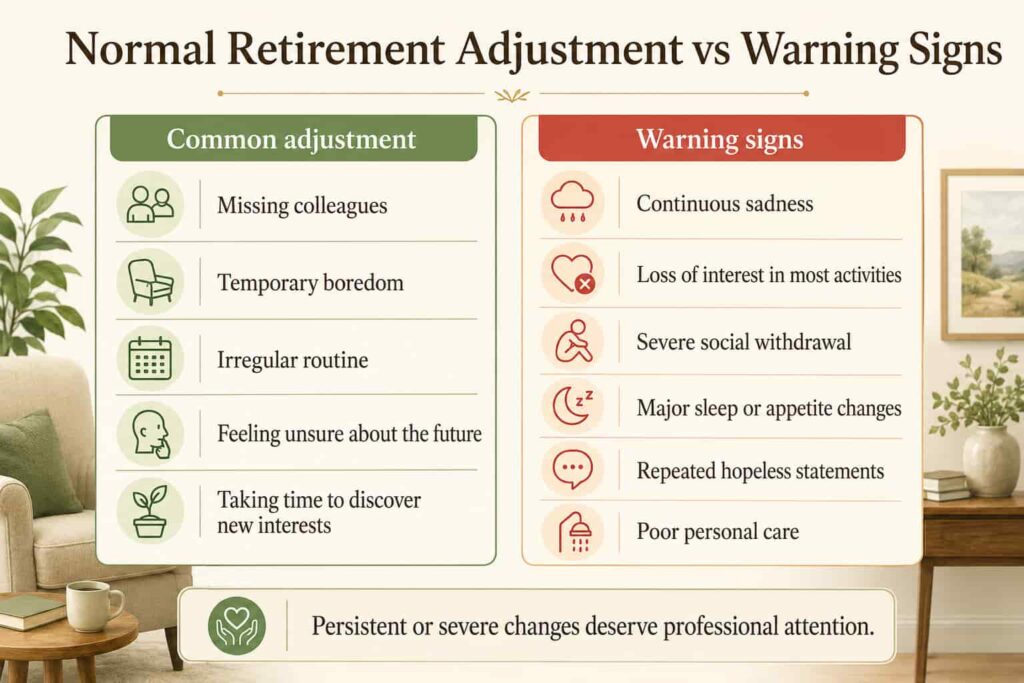
Normal adjustment or a warning sign?
Not every quiet or unproductive day is a mental-health problem.
Some temporary experiences may include:
- Missing colleagues
- Feeling unsure about the future
- Irregular routine
- Temporary boredom
- Taking time to identify new interests
- Feeling less important than before
However, families should pay attention when changes become severe or persistent.
Possible warning signs include:
- Continuous sadness
- Loss of interest in most activities
- Severe withdrawal
- Major sleep or appetite changes
- Poor personal care
- Increased alcohol use
- Repeated hopeless statements
- Inability to manage normal daily life
- Thoughts of self-harm
Social connection and meaningful activity can support mental well-being, but serious or persistent symptoms require qualified medical or mental-health assessment.
Family members should listen without dismissing the retiree’s feelings as laziness or overthinking.
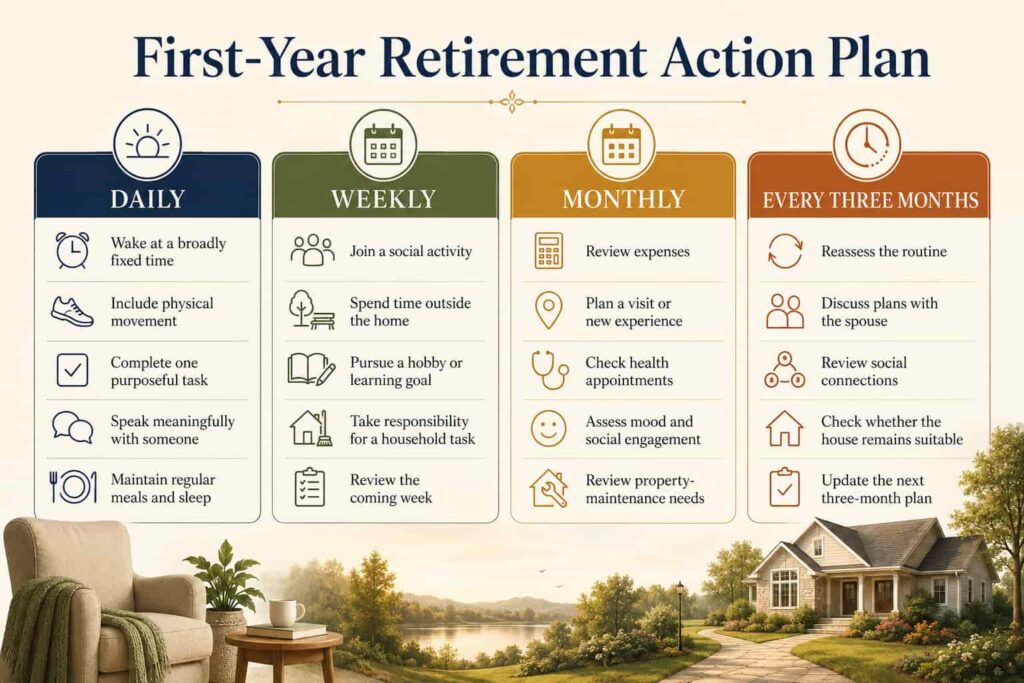
A simple first-year retirement action plan
Daily
- Wake at a broadly fixed time
- Include physical movement
- Complete one purposeful task
- Speak meaningfully with someone
- Maintain regular meals and sleep
Weekly
- Participate in a social activity
- Spend time outside the home
- Pursue a hobby or learning goal
- Take responsibility for a household task
- Review the coming week
Monthly
- Review expenses
- Plan a visit or new experience
- Check health appointments
- Assess mood and social engagement
- Review property-maintenance needs
Every three months
- Reassess the routine
- Discuss plans with the spouse
- Review social connections
- Check whether the house remains suitable
- Update the next three-month plan
Retirement is a redesign—not a withdrawal
A successful retirement does not require a person to remain constantly busy.
It requires a life that has:
- A manageable routine
- Meaningful relationships
- Personal choice
- Physical movement
- Financial stability
- A useful role
- A supportive home
- A plan for future needs
The most expensive house may not be the best retirement home.
The best retirement home is one that allows the resident to remain active, connected, independent and safe for as long as possible.
Before making a major property decision, retirees and families should answer four questions:
- Does the present home support everyday independence?
- Does the neighbourhood provide meaningful connection?
- Is the property financially and physically manageable?
- Can the living arrangement adapt if support needs increase?
The first year after retirement is therefore not just about learning how to stop working.
It is about deciding how the next phase of life should work.
Important note
This article provides general retirement, housing and lifestyle-planning information. It does not replace personalised medical, psychological, legal or financial advice.
Sources:-
- WHO — Healthy Ageing and Functional Ability
- WHO — Ageing and Health
- WHO — Reducing Social Isolation and Loneliness Among Older People
- WHO — Social Isolation and Loneliness Among Older People: Advocacy Brief
- WHO — Mental Health of Older Adults






Leave a Reply