


Senior living is often discussed only after a fall, hospital admission or serious family emergency.
In reality, the need for additional support usually appears much earlier.
A parent may begin avoiding stairs, missing medicines, cooking less often or withdrawing from friends. Household maintenance may become difficult, while children living in another city or country struggle to arrange dependable help.
These changes do not automatically mean that the parent must leave the family home.
They indicate that the family should assess whether the present combination of health, housing, care, social connection and emergency support remains safe and sustainable.
The correct question is not:
Is my parent too old to live independently?
The better question is:
Can the present home and support system continue protecting their safety, dignity and independence?
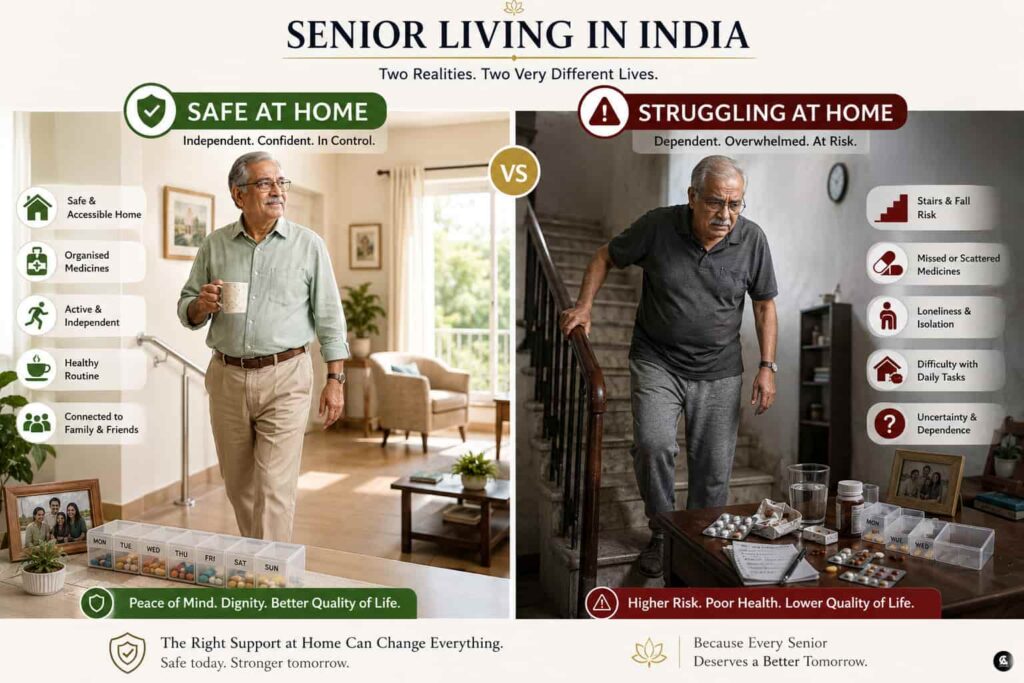
Age alone does not determine the need for senior living
A healthy, active and socially connected 78-year-old may continue living independently.
A 67-year-old experiencing repeated falls, medicine confusion, mobility difficulties and isolation may require structured support.
The decision should be based on:
- personal-care independence;
- mobility and fall risk;
- medication safety;
- memory and judgement;
- medical complexity;
- suitability of the home;
- social connection;
- emergency response;
- availability of family or professional care;
- affordability and long-term sustainability.
Senior living should therefore be evaluated according to dependency and risk, not simply age.
When staying at home may still work
Staying at home may remain practical when the senior can:
- bathe, dress and use the toilet independently;
- prepare meals or receive reliable meal support;
- manage medicines correctly;
- move safely inside and outside the house;
- contact help during an emergency;
- maintain regular social interaction;
- manage household tasks with limited assistance;
- access doctors, pharmacies and transport;
- rely on consistent family or professional support.
Limited assistance can often extend independent living.
This may include:
- part-time caregiving;
- meal delivery;
- housekeeping;
- medicine reminders;
- physiotherapy;
- transportation;
- emergency-alert systems;
- bathroom and entrance modifications.
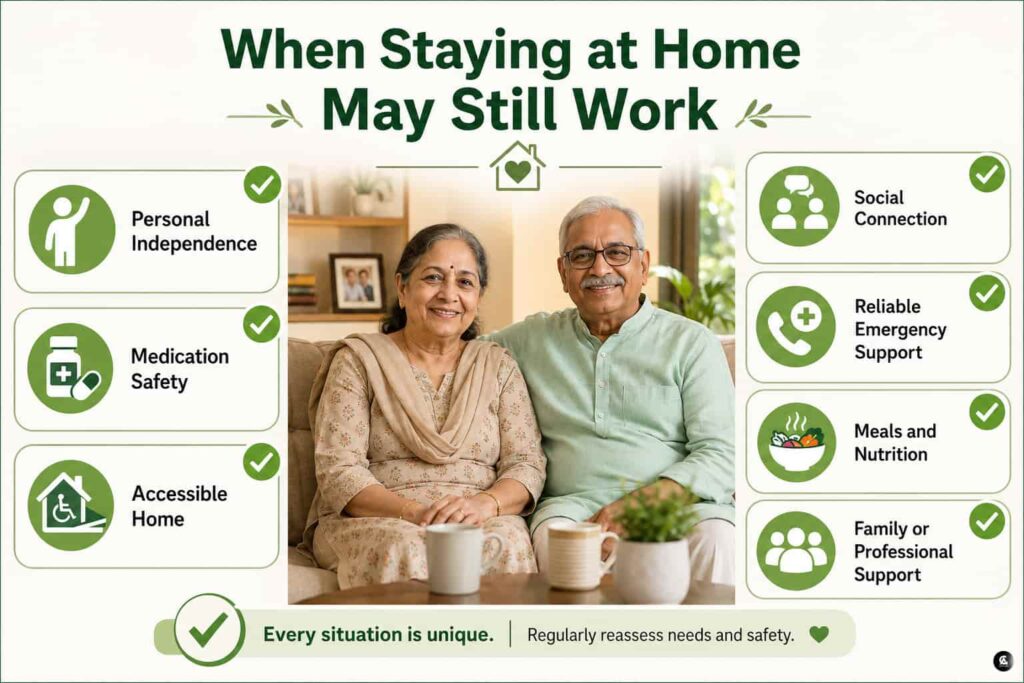
A senior should not be moved merely because some assistance is required.
The relevant question is whether that support can be provided safely, consistently and affordably.
Seven warning signs that senior living should be evaluated
Senior living should be assessed when several problems are recurring rather than isolated.
1. Daily-care activities increasingly require help
Warning signs include difficulty with:
- bathing;
- dressing;
- toileting;
- eating;
- walking;
- transferring from a bed or chair.
When assistance is required every day, occasional family visits may no longer be sufficient.
2. Medication management is becoming unsafe
Look for:
- missed doses;
- duplicate doses;
- confusion between medicines;
- medicines taken at the wrong time;
- prescriptions not being refilled.
A pill organiser or reminder may help in mild cases. Repeated mistakes require structured supervision.
3. Falls or near-falls are recurring
Common risk factors include:
- unsafe stairs;
- poor lighting;
- loose rugs;
- slippery bathroom flooring;
- weak balance;
- medication side effects;
- unsuitable footwear.
One fall should trigger a review. Repeated falls require both medical and home-safety assessment.
4. Memory changes are affecting safety
Concern becomes more serious when a parent:
- gets lost on a familiar route;
- leaves gas or appliances on;
- repeatedly forgets recent events;
- becomes confused about time or place;
- wanders outside;
- cannot safely remain alone.
These signs require medical evaluation and may indicate the need for supervised care.
5. Medical needs are becoming complex
The existing arrangement should be reviewed when the senior requires:
- frequent nursing;
- wound care;
- oxygen support;
- regular injections;
- repeated hospital visits;
- multiple specialist appointments;
- night monitoring.
A general attendant may not be qualified to provide clinical care.
6. Social isolation is increasing
Warning signs may include:
- fewer conversations;
- loss of interest in hobbies;
- avoiding friends;
- eating alone;
- sleeping excessively;
- spending most days without meaningful interaction.
A senior may be physically safe at home but emotionally isolated.
7. The main caregiver is exhausted
The care arrangement may no longer be sustainable when the family caregiver experiences:
- constant fatigue;
- poor sleep;
- declining health;
- missed work;
- irritability;
- no backup support;
- inability to leave the senior alone.
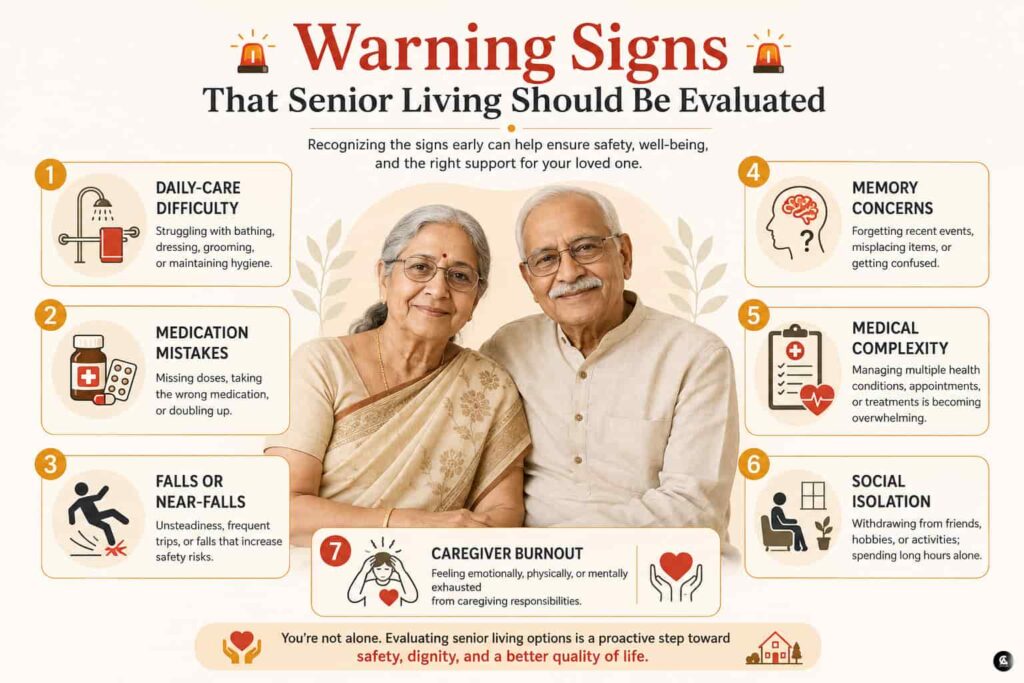
Professional care can protect both the senior and the family member providing support.
Understand the four senior-living models
Senior living is not one standard service.
Different models serve different levels of independence and care.
| Care model | Best suited for | Typical support |
|---|---|---|
| Independent senior living | Active seniors seeking community and low-maintenance housing | Meals, housekeeping, activities and emergency coordination |
| Assisted living | Seniors requiring regular help with daily activities | Personal care, meals, medication support and supervision |
| Memory care | Seniors with dementia, wandering or cognitive decline | Secure environment and specialised supervision |
| Nursing care | Seniors with complex or continuous medical needs | Skilled nursing and clinical monitoring |
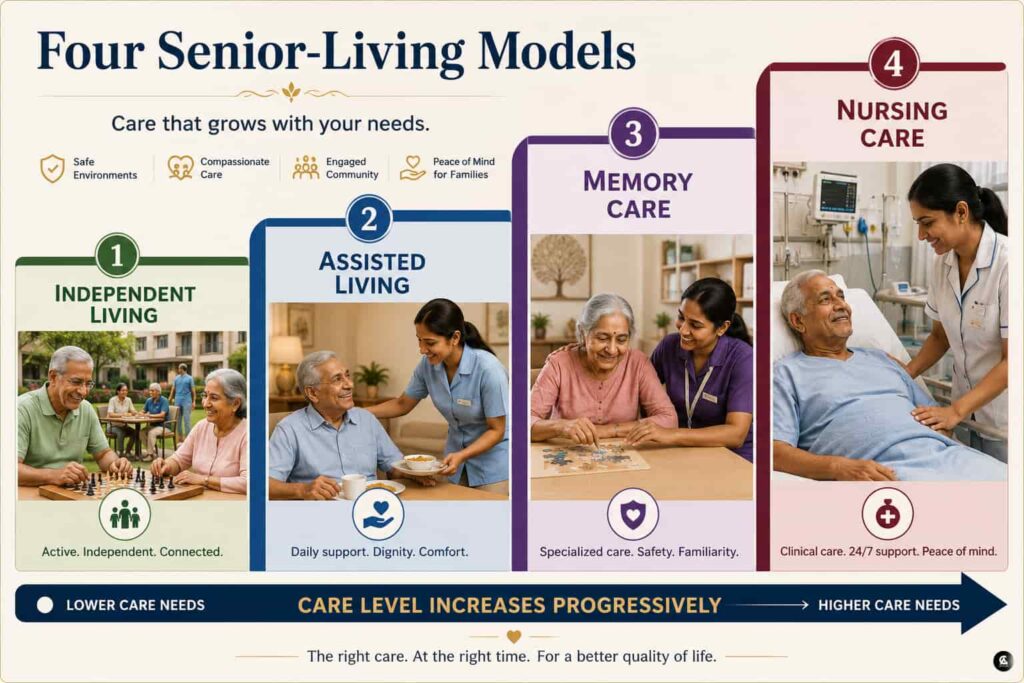
A premium-looking project may provide only independent living.
Similarly, a facility advertising “24×7 care” may mean security or attendant availability rather than continuous qualified nursing.
Families must verify the exact care capability.
Can the existing home support safe ageing?
The property itself can either support independence or make ordinary health difficulties more serious.
A senior with moderate mobility limitations may remain independent in a well-designed apartment but struggle in a duplex with stairs, narrow bathrooms and distant healthcare.
Entrance and building audit
Check:
- Is there a step-free entrance?
- Can a ramp be installed?
- Is the lift reliable?
- Is power backup available?
- Can an ambulance reach the entrance?
- Are corridors and stairs well lit?
Bedroom audit
Check:
- Is a bedroom available without climbing stairs?
- Is the bathroom nearby?
- Is there space for a walker?
- Can a caregiver approach the bed safely?
- Are switches and storage within easy reach?
Bathroom audit
Check:
- Can grab bars be installed?
- Is the flooring non-slip?
- Can a shower chair fit?
- Is the doorway wide enough?
- Is there room for assisted bathing?
- Can the door be opened during an emergency?
Location audit
Check:
- How far is the nearest hospital?
- Is a pharmacy nearby?
- Is domestic help available?
- Can the senior manage without driving?
- Are trusted neighbours or relatives nearby?
- Are home-care services available locally?

A home can be emotionally important while still becoming physically unsuitable.
Staying at home versus senior living
| Factor | Staying at home | Senior living |
|---|---|---|
| Familiarity | Existing home and neighbourhood | Adjustment to a new community |
| Care availability | Arranged separately | Structured according to care level |
| Meals | Family, cook or delivery service | Commonly included |
| Housekeeping | Separately managed | Usually included |
| Nursing | Additional arrangement | Provider-specific |
| Emergency response | Depends on family and local support | Usually organised on site |
| Social interaction | Must be arranged | Community activities available |
| Maintenance | Family responsibility | Managed by operator |
| Privacy | Usually higher | Depends on room and facility |
| Cost | Multiple variable expenses | Package plus additional charges |
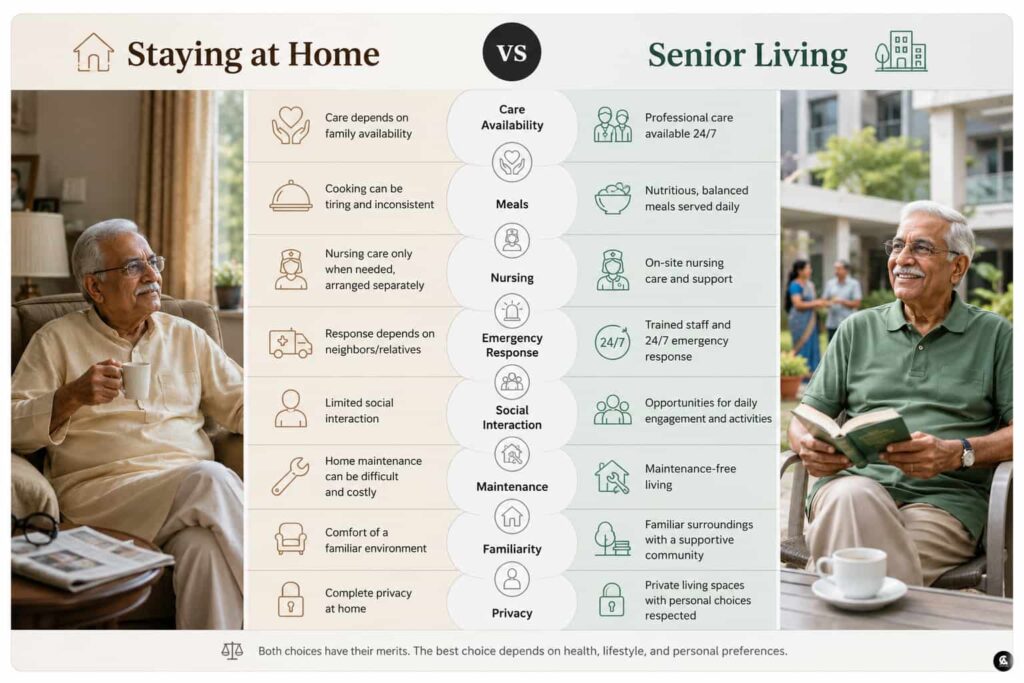
Home care is not automatically inferior to senior living.
A well-managed home-care arrangement can include:
- attendants;
- qualified nurses;
- physiotherapy;
- doctor coordination;
- medicine management;
- emergency alerts.
Senior living is also not automatically comprehensive. Services differ significantly between operators.
Calculate the complete cost of staying at home
Families often compare only the caregiver’s salary with the senior-living fee.
That comparison is incomplete.
The full cost of home care may include:
- caregiver or attendant;
- qualified nurse;
- physiotherapy;
- cook or meal delivery;
- housekeeping;
- medicines;
- medical consumables;
- ambulance;
- caregiver replacement;
- utilities;
- society maintenance;
- home repairs;
- accessibility modifications.
Calculate the complete senior-living cost
The total residential-care cost may include:
- accommodation;
- meals;
- housekeeping;
- basic assistance;
- care-level charges;
- nursing;
- physiotherapy;
- medicines;
- diapers and consumables;
- ambulance;
- security deposit;
- GST, where applicable;
- hospital-attendant charges;
- charges for increasing dependency.
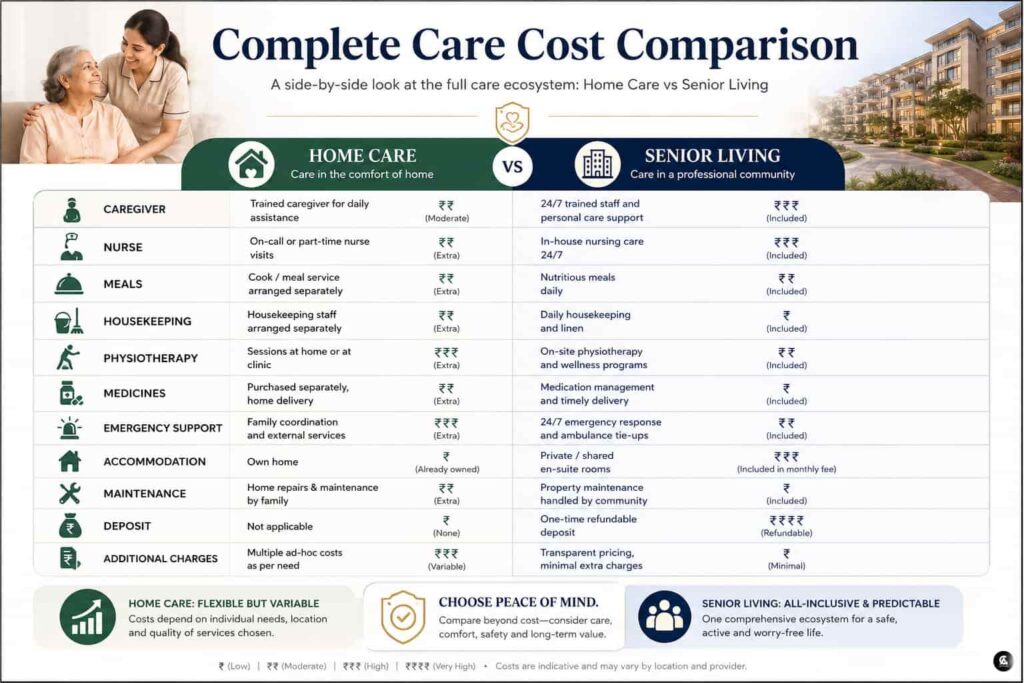
Ask the provider for a written cost statement showing:
- what is included;
- which services cost extra;
- annual fee escalation;
- deposit and refund terms;
- charges when care needs increase;
- hospitalisation-related expenses.
Test whether the family can sustain the present arrangement
A care plan may work today but fail when needs increase.
Ask:
- Is one family member managing everything?
- Is the caregiver’s health deteriorating?
- Is employment being affected?
- Is there backup support?
- Who handles night emergencies?
- Can the arrangement continue for three years?
- What happens when the caregiver takes leave?
- Can the family manage a prolonged medical disruption?
A sustainable care plan must protect the senior without exhausting the family.
Special considerations for NRI children
For children living outside India, remote supervision has clear limits.
The family should identify:
- a local emergency contact;
- a hospital coordinator;
- a trusted person with house access;
- someone holding medical and insurance documents;
- a backup caregiver;
- a doctor familiar with the complete medical history;
- a clear emergency decision-making process.
Technology may support care through:
- medicine reminders;
- video doorbells;
- emergency buttons;
- location-sharing tools;
- digital medical records.
However, technology cannot replace a reliable person on the ground.
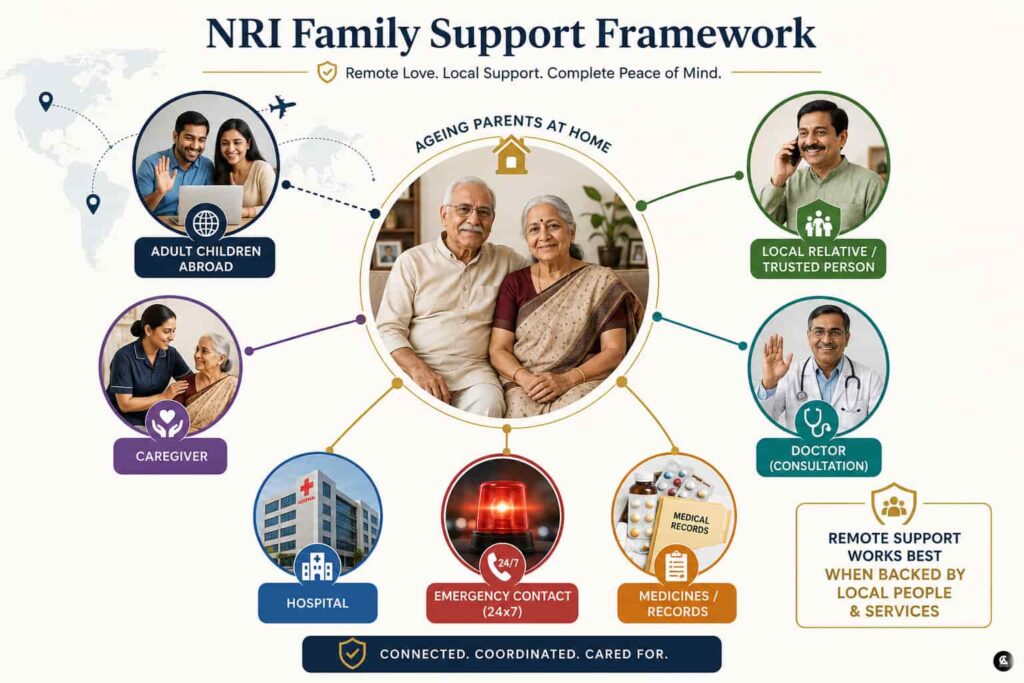
Use this senior-living decision scorecard
Score every factor:
- 0: No present concern
- 1: Occasional or manageable concern
- 2: Recurring or serious concern
| Decision factor | Score |
|---|---|
| Difficulty with personal care | /2 |
| Medication mistakes | /2 |
| Mobility or falls | /2 |
| Memory or judgement concerns | /2 |
| Complex medical needs | /2 |
| Unsuitable home design | /2 |
| Weak emergency response | /2 |
| Social isolation | /2 |
| Caregiver exhaustion | /2 |
| Financial unsustainability | /2 |
| Total | /20 |
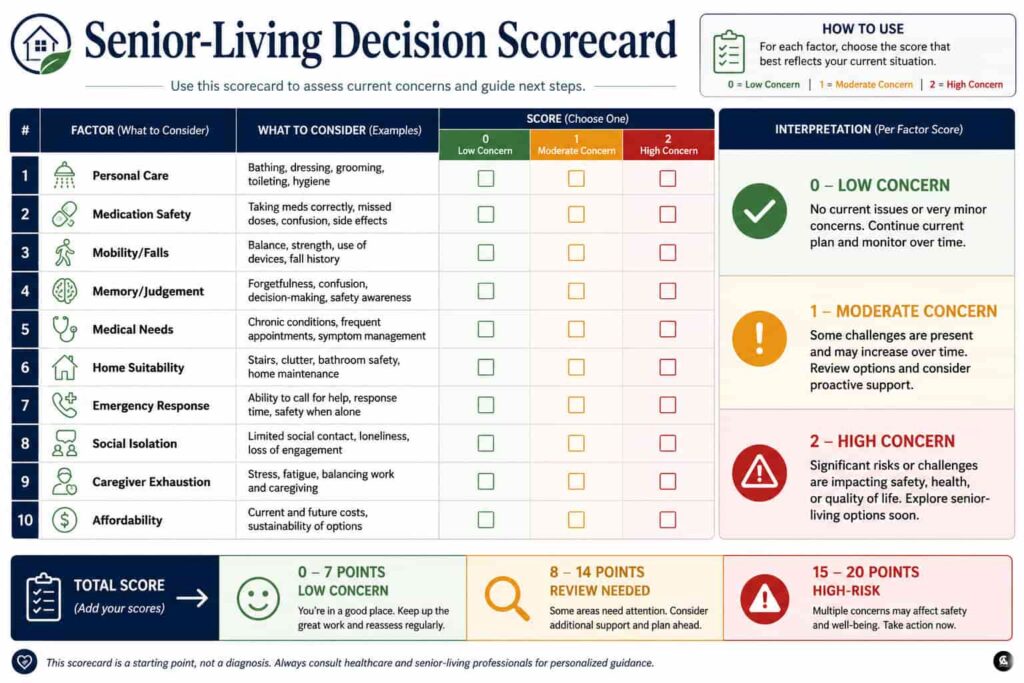
Score interpretation
0–5: Staying at home may remain workable
Address specific risks and review the arrangement regularly.
6–12: Compare structured home care and senior living
Arrange a professional care and home-safety assessment.
13–20: Higher-risk situation
Evaluate assisted living, memory care or nursing support promptly.
This scorecard is a family-planning tool and not a medical diagnosis.
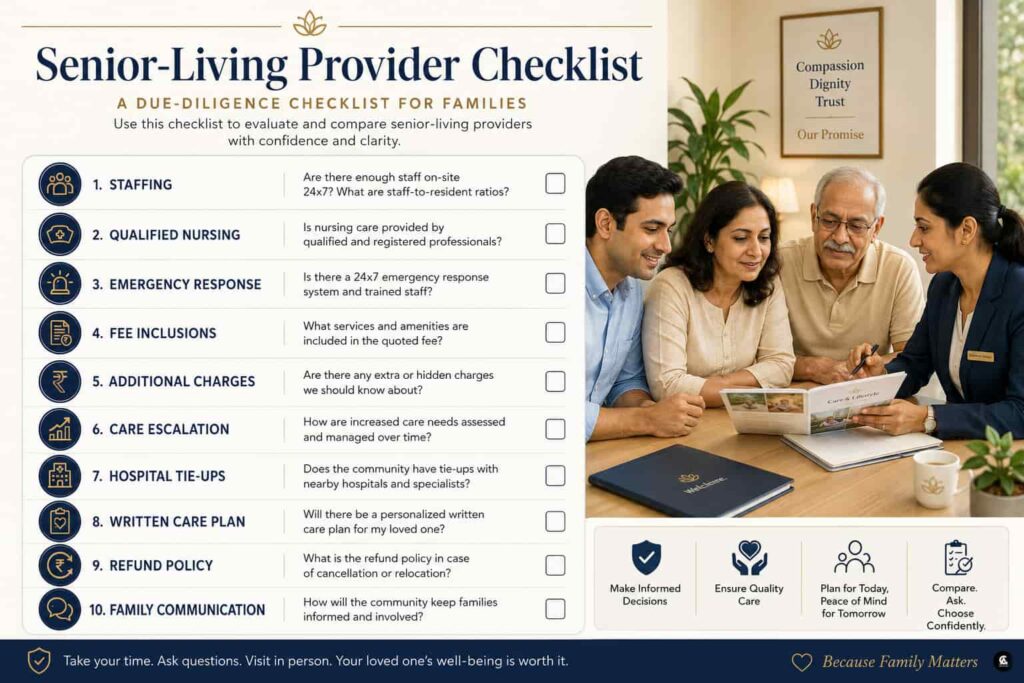
Questions to ask a senior-living provider
Before paying a deposit, ask:
- What is included in the monthly fee?
- Which services cost extra?
- Is a qualified nurse available at night?
- Is the doctor on site or on call?
- What is the staff-to-resident ratio?
- How are emergencies handled?
- Which hospital tie-ups are operational?
- What happens when dependency increases?
- Is memory care available?
- How are medicines managed?
- What are the deposit and refund rules?
- Can the family review the written care plan?
Visit the facility more than once.
Inspect it during an ordinary working day, not only during a planned sales presentation.
Where permitted, speak with existing residents and their families.
Frequently asked questions
Does every senior living alone need senior living?
No.
A senior may continue living safely at home when independent, medically stable, socially connected and supported by a reliable emergency system.
Is senior living the same as an old-age home?
Not necessarily.
Modern senior living may include independent living, assisted living, memory care and nursing care. Services and standards vary between operators.
Can home modifications delay the need to move?
In some cases, yes.
Better lighting, grab bars, non-slip flooring, ramps, accessible bathrooms and a suitable bedroom can improve safety.
The senior’s medical and cognitive needs must still be considered.
Is 24×7 care the same as 24×7 nursing?
No.
“24×7 care” may refer to security, attendants or emergency coordination. Families should separately verify qualified nursing and doctor availability.
Should families wait for a fall before evaluating senior living?
No.
Options should be explored while the senior can participate meaningfully in the decision.
Can a trial stay help?
A trial or respite stay may help the senior and family assess:
- adjustment;
- food;
- staff responsiveness;
- activities;
- sleep;
- medical coordination;
- overall comfort.
Commercial terms and refund policies should be reviewed before booking.
Carpet Area verdict
Senior living is not determined by age.
It becomes relevant when the existing combination of home, health, support, social life and emergency response can no longer protect safe and dignified independence.
Staying at home may remain the right choice when the property is suitable and professional support can be arranged reliably.
Senior living may become the stronger option when:
- daily assistance is recurring;
- the home is unsafe;
- loneliness is severe;
- emergencies cannot be managed quickly;
- medical needs are increasing;
- family care is no longer sustainable.
The best decision is neither the option that appears cheapest nor the one that attracts the least criticism.
It is the arrangement that can realistically protect the senior’s:
- safety;
- dignity;
- health;
- social connection;
- independence;
- continuity of care.
Important disclaimer
This article provides general educational information and does not replace medical, financial, legal, architectural or professional care advice.
Sudden confusion, serious falls, chest pain, breathing difficulty, stroke symptoms, loss of consciousness or other emergencies require immediate medical attention.
Families should consult qualified doctors, geriatric-care professionals, accessibility specialists and financial advisers before making major care or housing decisions.






Leave a Reply