

For most homebuyers, a property is the biggest financial asset of their life. And when a home loan is taken, the original property documents usually remain with the bank until the loan is repaid.
But what happens if those original documents are lost while they are in the bank’s custody?
This is not just a theoretical question. A major consumer dispute involving Manoj Madhusudan vs ICICI Bank brought this issue into public discussion. The case raised serious questions about bank responsibility, borrower rights, compensation, and the importance of original title papers.
The matter became even more important after the Reserve Bank of India (RBI) issued directions in September 2023 on the return of original property documents and compensation for delay.
This blog explains the issue in simple language, tells you what happened in the case, and shows what every borrower should do if a bank loses the original property papers.
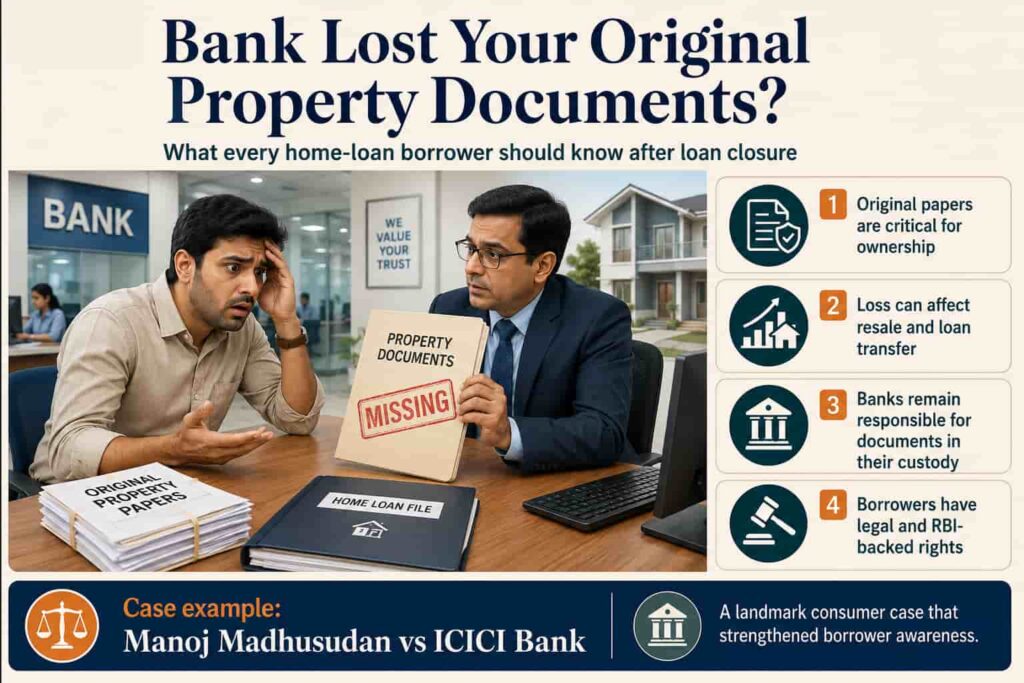
Why original property documents matter so much?
When you buy a property with a home loan, the bank usually keeps the original title documents as security. These papers are not ordinary documents. They are critical because they help establish ownership and legal title.
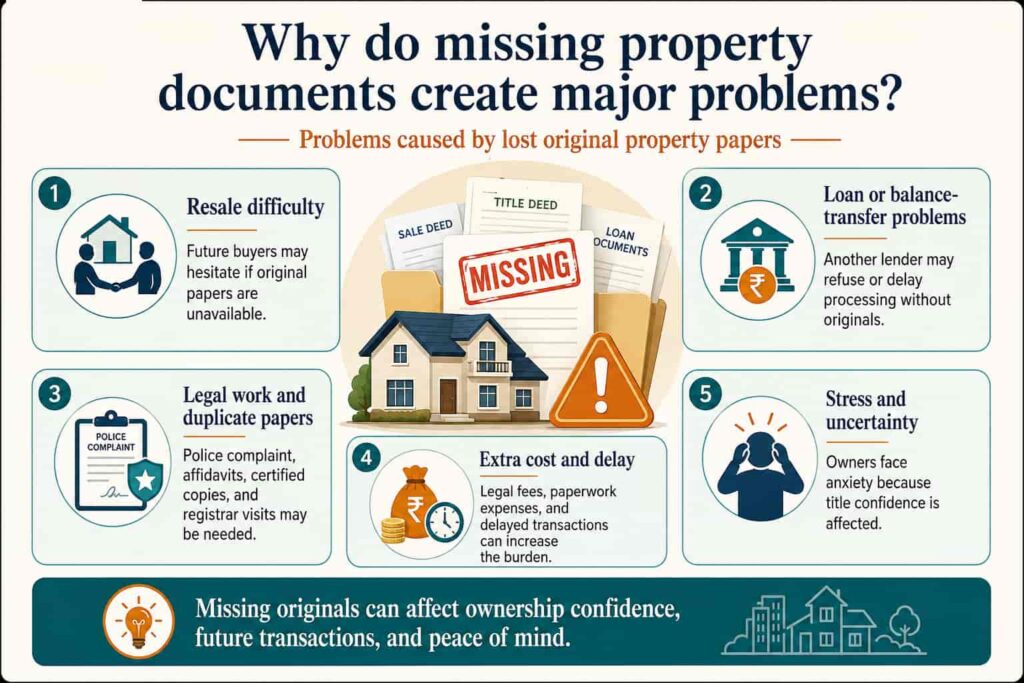
If the original papers are lost, the borrower may face several problems:
- resale of the property may become difficult;
- balance transfer to another bank may be affected;
- title verification for future buyers can become complicated;
- duplicate certified copies may require time, money and legal effort;
- the market value and marketability of the property may suffer;
- and the owner may have to make repeated visits to different authorities.
In short, losing original property papers is not a small inconvenience. It can create a long-term legal and financial burden.
What happened in the ICICI Bank case?
According to the case details discussed in public reporting and legal summaries, Manoj Madhusudan had taken a home loan of around ₹2.5 crore from ICICI Bank in 2016.
As is standard practice, the bank kept the original property documents in its custody. Later, when the borrower decided to close the loan and asked for the original documents back, it was discovered that the papers had been lost during transit while being moved by or through the bank’s arrangement.
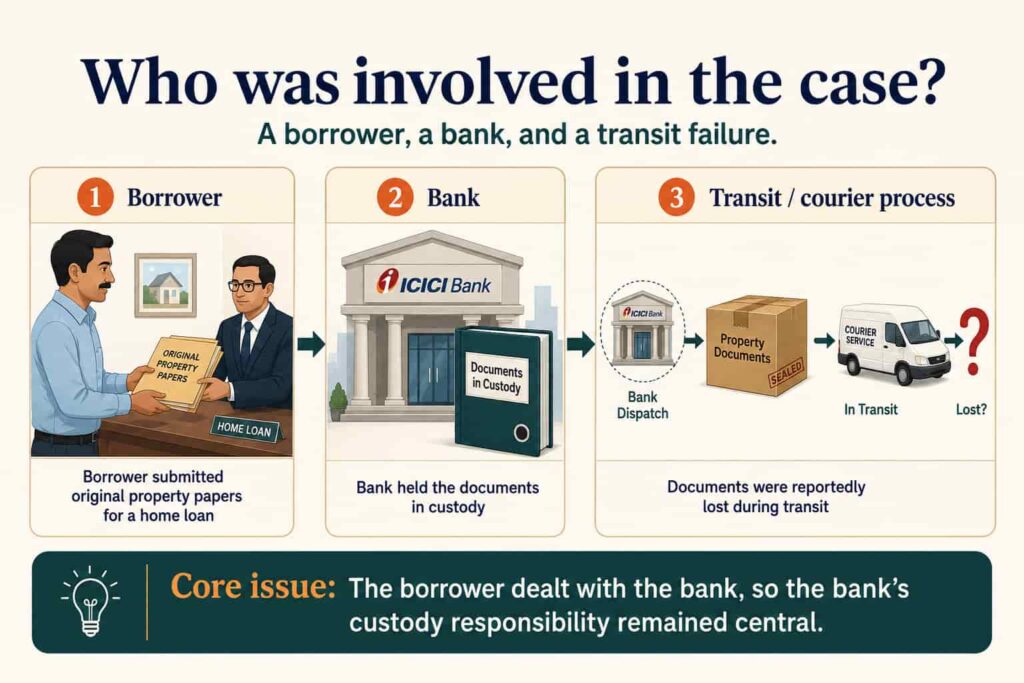
The case involved three broad participants:
- the borrower;
- ICICI Bank;
- and the delivery/courier arrangement used for moving the documents.
The borrower first approached the RBI Ombudsman, where a limited compensation amount was awarded. However, considering the seriousness of the issue and the value of the property, he was not satisfied and moved the National Consumer Disputes Redressal Commission (NCDRC).
The consumer dispute then became a major example of how courts may look at the loss of property documents by a bank.
Simple chronology of the dispute
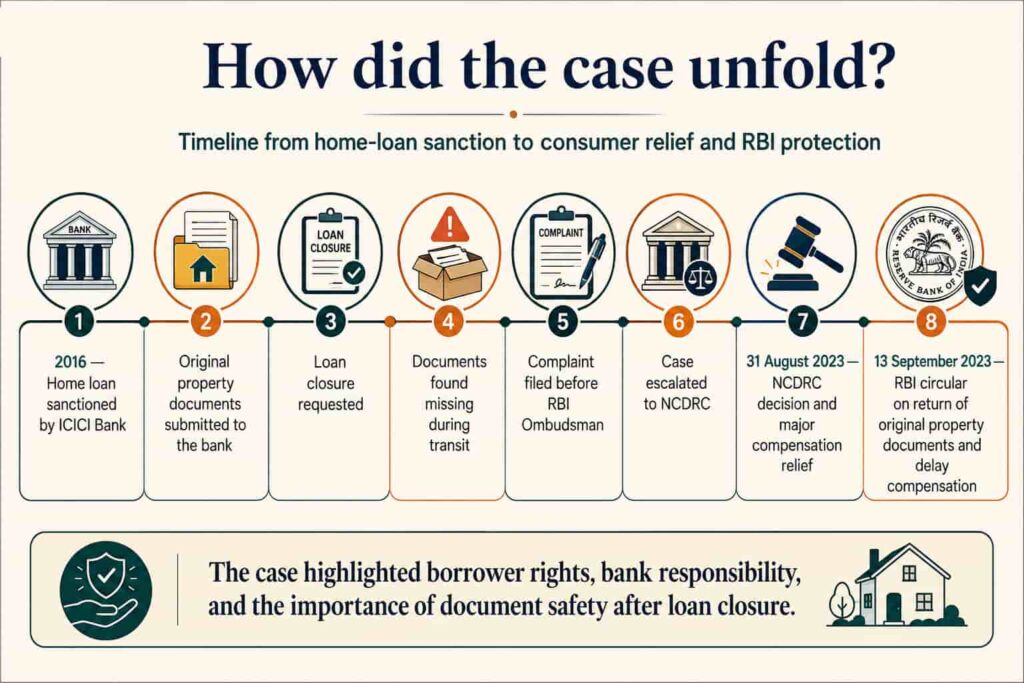
A high-value blog becomes stronger when the story is easy to follow. Here is the dispute in simple sequence:
2016
The borrower took a home loan from ICICI Bank. The original property papers were submitted to the bank as part of the loan security process.
Loan closure stage
After some time, the borrower moved to close the loan and asked the bank to return the original documents.
Documents found missing
It was then discovered that the original papers had reportedly been lost during transit while being handled under the bank’s process.
Complaint before RBI Ombudsman
The borrower escalated the issue and approached the RBI Ombudsman.
Further escalation to NCDRC
Not satisfied with the limited relief, the borrower approached the National Consumer Disputes Redressal Commission.
31 August 2023
The NCDRC passed its decision, holding the bank responsible and awarding significant compensation.
13 September 2023
The RBI issued directions regarding the return of original movable/immovable property documents and compensation for delay.
This sequence is important because it shows that the case is not only about negligence, but also about what remedies a borrower can realistically seek.
Why was the bank held responsible?
One of the most important legal points in this issue is responsibility.
A borrower hands over original documents to the bank, not to an unknown third party. If the bank uses a courier, storage vendor or internal transit process, the borrower generally has no control over that arrangement.
That is why the core principle is simple:
The bank cannot easily escape responsibility by saying that the papers were lost by someone else during transit.
In the case discussed, the consumer forum reportedly took the view that the borrower had done nothing wrong. The documents were handed to the lender in the normal course of a home loan transaction. Once those documents were in the bank’s custody, the responsibility to protect, store and return them safely rested on the bank.
This is the biggest takeaway for borrowers. If original documents are misplaced, damaged or lost while in the bank’s custody, the matter is not merely an “internal issue” of the lender.
What did the NCDRC reportedly order?
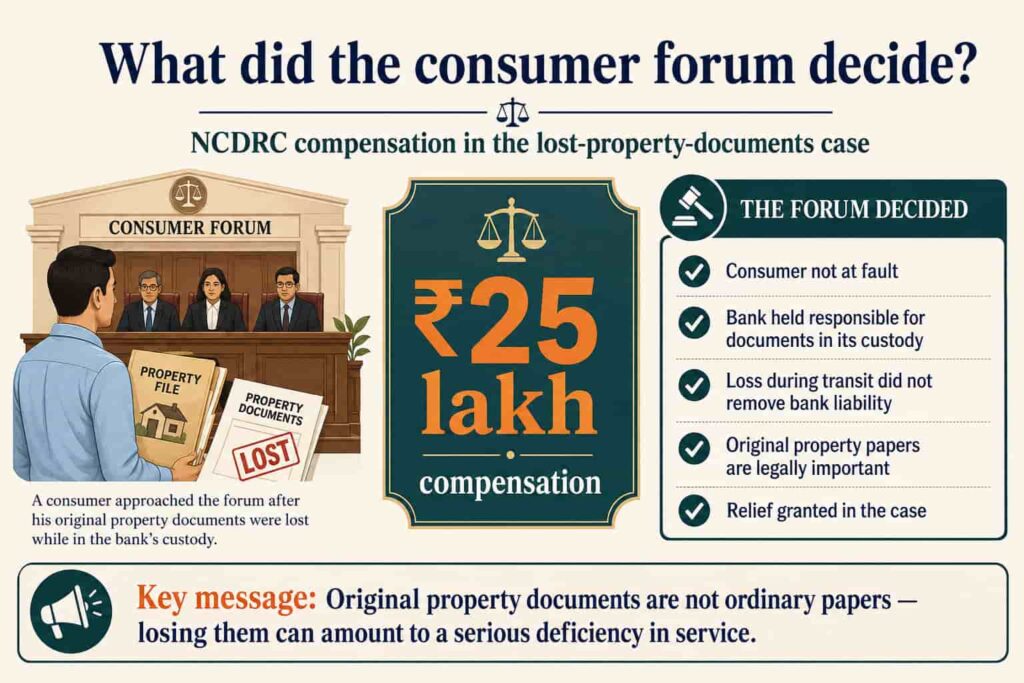
As per the case narration and widely discussed summaries, the NCDRC held that the consumer was not at fault and that the responsibility lay with the bank.
The decision reportedly granted relief that included:
- ₹25 lakh compensation to the borrower;
- direction connected with returning or arranging the document-related remedy;
- and recognition of the seriousness of the loss of original property papers.
Why is this significant?
Because consumer forums do not treat original property documents as ordinary paperwork. These papers are linked to ownership, title confidence, future transactions and the overall legal usability of the asset.
However, one important note must be kept in mind:
₹25 lakh is not an automatic compensation amount for every case.
The compensation in any dispute depends on facts, negligence, loss, inconvenience, mental harassment, and the findings of the competent authority.
What does the RBI’s September 2023 rule say?
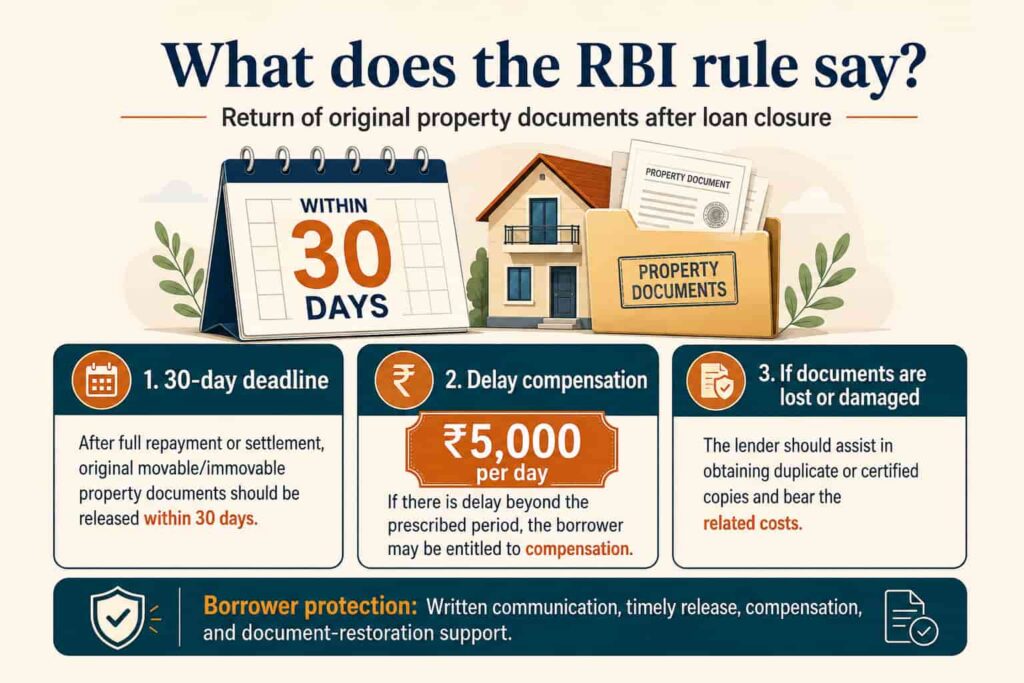
The RBI later issued an important circular on 13 September 2023 regarding the release of original movable/immovable property documents after full repayment or settlement of a loan.
This is a major relief for borrowers.
The RBI direction broadly requires regulated entities to:
- release all original property documents within 30 days after full repayment or settlement of the loan account;
- communicate clearly if there is any delay;
- and pay compensation in case of delay.
The circular also states that if there is a delay beyond the prescribed period, the regulated entity shall compensate the borrower at the rate of ₹5,000 per day for the delay.
Even more importantly, where the original documents are lost or damaged, the regulated entity is expected to assist the borrower in obtaining duplicate or certified copies and also bear the associated costs, in addition to paying compensation for delay as applicable.
This RBI framework has strengthened borrower protection significantly.
Does the RBI circular mean every borrower automatically gets ₹5,000 per day?
Not every situation is identical, so this point must be understood carefully.
The RBI circular lays down a borrower-protection mechanism. It does not mean that every complaint will play out exactly the same way without considering the facts.
A borrower should still check:
- whether the lender is covered under the RBI direction;
- the exact date of loan closure or settlement;
- whether the documents were actually withheld, delayed, lost or damaged;
- what written communication was given by the lender;
- and whether the matter needs escalation.
In practice, clear documentation is critical. Borrowers should keep loan-closure proof, correspondence and document-hand-over records safely.
What real problems arise when original papers are lost?
Many people think a bank losing documents is just a clerical problem. In reality, it can affect the borrower in several serious ways.
1. Sale of the property becomes harder
A future buyer may hesitate to purchase a property if original papers are not available.
2. Loan transfer becomes difficult
If you want to transfer your home loan to another bank, missing original papers can create a major obstacle.
3. Duplicate-document process is time-consuming
You may need:
- police complaint or NCR;
- affidavit or indemnity bond;
- newspaper publication;
- certified copies from the registrar or authority;
- and legal verification.
4. Financial loss increases
The borrower may incur:
- legal fees;
- travel expenses;
- documentation charges;
- delay-related costs;
- and possible loss of a buyer or investor.
5. Mental stress and uncertainty grow
Property is an emotional as well as financial asset. Losing the title papers creates a serious sense of insecurity.
What should a borrower do if a bank loses the original property documents?
If this happens, do not rely only on verbal assurances. Follow a documented process.
Step 1: Ask for a written acknowledgement
Demand a formal written communication from the bank stating that the original documents are missing, delayed or lost.
Step 2: Request a complete document list
Ask the bank to provide the exact list of documents submitted at the time of the loan.
Step 3: Preserve all proof
Keep copies of:
- loan sanction letter;
- document deposit receipt;
- loan closure letter;
- NOC or no-dues certificate;
- email communication;
- branch-level complaint;
- and any tracking/transit communication.
Step 4: File a formal complaint with the bank
Raise the issue with the branch and escalate it to the grievance redressal mechanism of the bank.
Step 5: Ask for duplicate-document support
If the documents are actually lost, ask the bank to:
- arrange or help obtain certified/duplicate copies;
- bear the cost of the process;
- provide indemnity support where required;
- and confirm the timeline in writing.
Step 6: Approach the RBI Ombudsman if needed
If the bank does not resolve the issue satisfactorily, file a complaint under the RBI’s grievance mechanism.
Step 7: Consider consumer forum or legal remedy
In serious cases involving negligence, harassment or loss, the borrower may approach the appropriate consumer forum or court.
How can borrowers protect themselves even before a problem happens?
Prevention is always better than dispute.
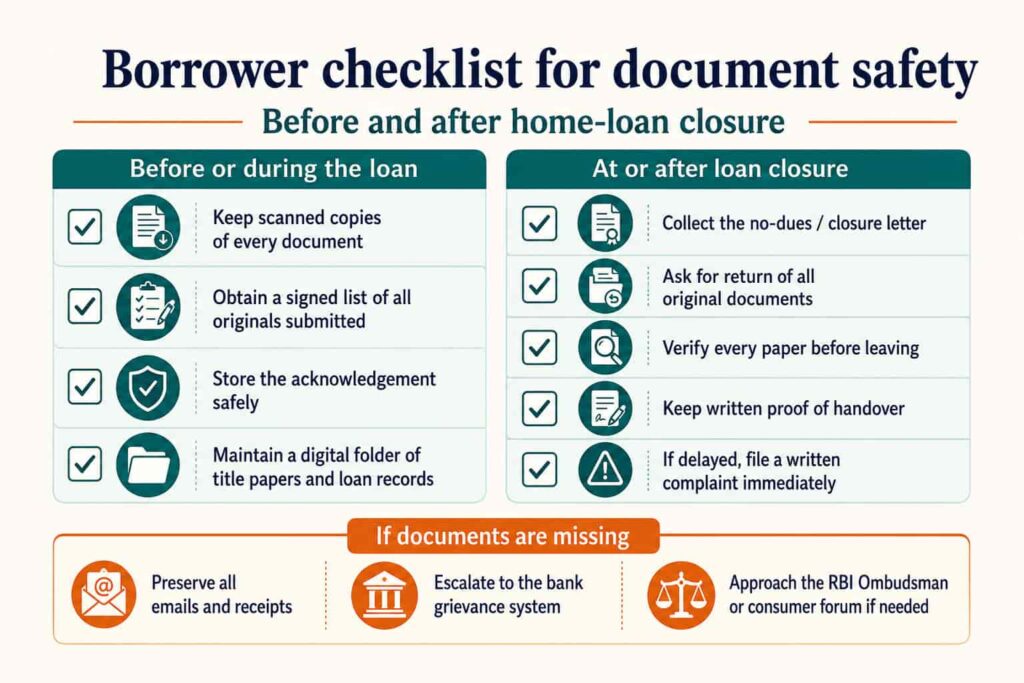
Before and during the loan process, borrowers should:
- take a photocopy or scanned set of every original document submitted;
- get a proper acknowledgement from the bank listing the documents one by one;
- keep the acknowledgement safely;
- maintain a digital folder of title papers and loan documents;
- insist on a closure letter when the loan is repaid;
- and verify the return of all papers at the time of loan closure.
When collecting documents back, do not leave the branch without checking the full set.
What does this case teach every homebuyer?
This case offers some very practical lessons:
A bank’s custody is a serious legal responsibility
Once original documents are handed over, the lender has a duty to preserve and return them safely.
Borrowers should not accept casual explanations
A statement like “documents are in transit” or “courier issue happened” is not the final answer.
Compensation rights do exist
Depending on facts and applicable rules, a borrower may be entitled to compensation and document-restoration assistance.
RBI’s rule is a major borrower-protection step
The 30-day timeline and ₹5,000 per day delay compensation have strengthened consumer confidence.
Documentation is everything
A borrower who keeps records is always in a stronger position during a dispute.
Carpet Area analysis
From a homebuyer’s point of view, this issue is bigger than one case. It exposes a serious operational risk in the home-loan ecosystem.
Banks do not merely finance houses. They also become custodians of highly sensitive property papers. That is why document management should be treated as a core responsibility, not a routine back-office function.
The most important principle is this:
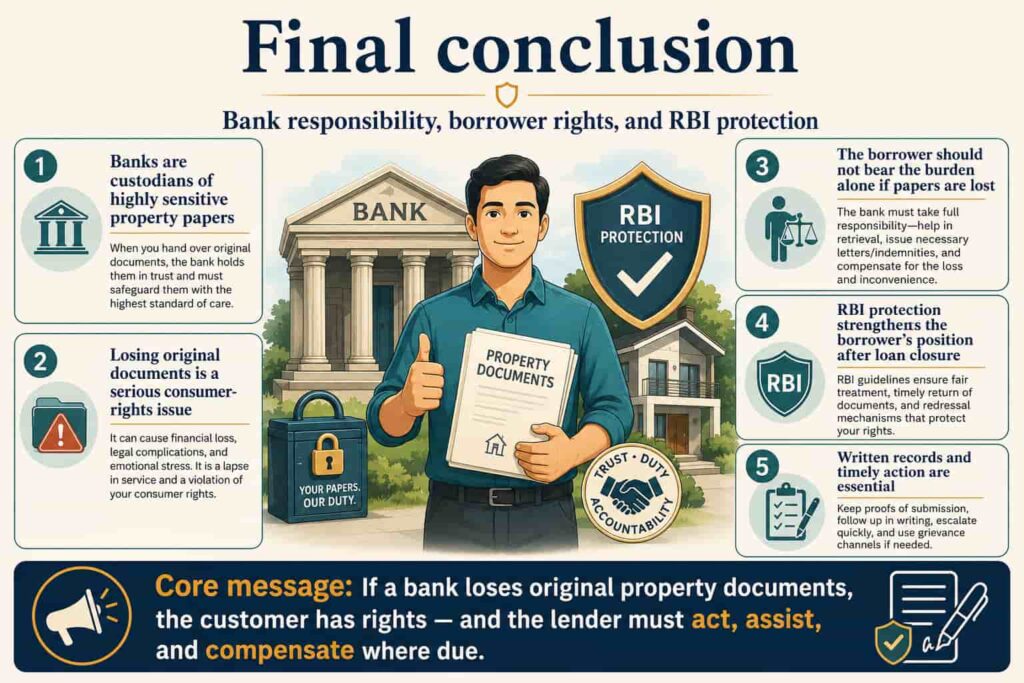
If a bank loses original property papers, the burden should not fall on the customer alone.
Where a borrower has fully complied with the loan process, the lender must take full responsibility for:
- immediate disclosure;
- timely resolution;
- duplicate-document support;
- expense bearing;
- and compensation where due.
This is where the ICICI Bank case and RBI’s later directions become highly relevant for every borrower in India.
Final conclusion
If a bank loses your original property documents, it is not a minor issue and should never be treated casually.
The ICICI Bank-related consumer dispute shows that the loss of original title papers can amount to a serious deficiency in service. It also shows that borrowers can pursue remedies through formal channels, including the RBI grievance process and consumer forums.
The RBI’s September 2023 directions have added an important layer of protection by requiring lenders to return original documents within 30 days after full repayment and by providing for ₹5,000 per day compensation for delay, along with support in cases where documents are lost or damaged.
For every home-loan borrower, the message is clear:
- keep records of all submitted documents;
- insist on written communication from the bank;
- verify every paper at the time of closure;
- and take prompt action if any document is delayed, damaged or missing.
A home loan may end with repayment, but the safety of your original property documents remains just as important.
Frequently Asked Questions
Can a bank lose original property documents?
Yes, it can happen, especially during storage, handling or transit. But if it happens, the lender may still remain responsible toward the borrower.
What should I do first if my property papers are missing?
Ask the bank for a written acknowledgement, preserve all documents and raise a formal complaint immediately.
What is the RBI rule for return of original property documents?
The RBI has said that original property documents should generally be returned within 30 days after full repayment or settlement of the loan.
What is the ₹5,000 per day rule?
If there is a delay in releasing the original documents beyond the prescribed period, the regulated entity may be required to compensate the borrower at ₹5,000 per day, subject to the applicable RBI framework and facts of the case.
What if the bank says the courier lost the papers?
That does not automatically end the matter. The borrower’s relationship is with the bank, and the bank may still be responsible.
Can I get compensation if the original documents are lost?
Yes, compensation may be possible depending on the facts, the lender’s conduct, the inconvenience caused and the decision of the competent authority.
Will the bank have to arrange duplicate documents?
Under RBI’s framework, where original documents are lost or damaged, the lender is expected to assist the borrower in obtaining duplicate or certified copies and bear the related costs.
Can missing original papers affect resale?
Yes. Future buyers and lenders may treat missing originals as a title-risk issue, making the property harder to sell or finance.
Sources:-
- RBI Circular dated 13 September 2023
Release of Movable/Immovable Property Documents on Repayment/Settlement of Personal Loans
https://www.rbi.org.in/Scripts/NotificationUser.aspx?Id=12535&Mode=0
इसमें 30 दिन की समय-सीमा, ₹5,000 प्रतिदिन compensation और lost/damaged documents के लिए duplicate copies उपलब्ध कराने में सहायता का नियम दिया गया है। - NCDRC judgment — Manoj Madhusudhanan vs ICICI Bank Ltd. & Anr., 31 August 2023
https://indiankanoon.org/doc/33935532/
यह Consumer Case No. 129 of 2017 का पूरा judgment text है। इसमें ICICI Bank और Blue Dart Express पक्षकार हैं। - NCDRC judgment PDF copy
https://lawbeat.in/sites/default/files/2023-09/Manoj%20Madhusudhanan%20v.%20ICICI%20Bank%20Ltd.%20and%20Ors..pdf
कोर्ट के आदेश की PDF प्रति। - Supreme Court case record — ICICI Bank appeal
https://api.sci.gov.in/officereport/2023/47521/47521_2023_2023-12-11_1283.html
इससे पता चलता है कि ICICI Bank ने NCDRC आदेश के खिलाफ Supreme Court में अपील की थी। - Supreme Court order dated 29 August 2025
https://api.sci.gov.in/supremecourt/2023/47521/47521_2023_5_27_63744_Order_29-Aug-2025.pdf
यह Civil Appeal Nos. 8132–8133 of 2023 का बाद का official proceeding record है।




Leave a Reply