


Buying a property worth ₹50 lakh, ₹1 crore or more involves more than arranging a home loan and paying stamp duty. In many property transactions, the buyer also has a legal responsibility to deduct and deposit TDS before paying the seller.
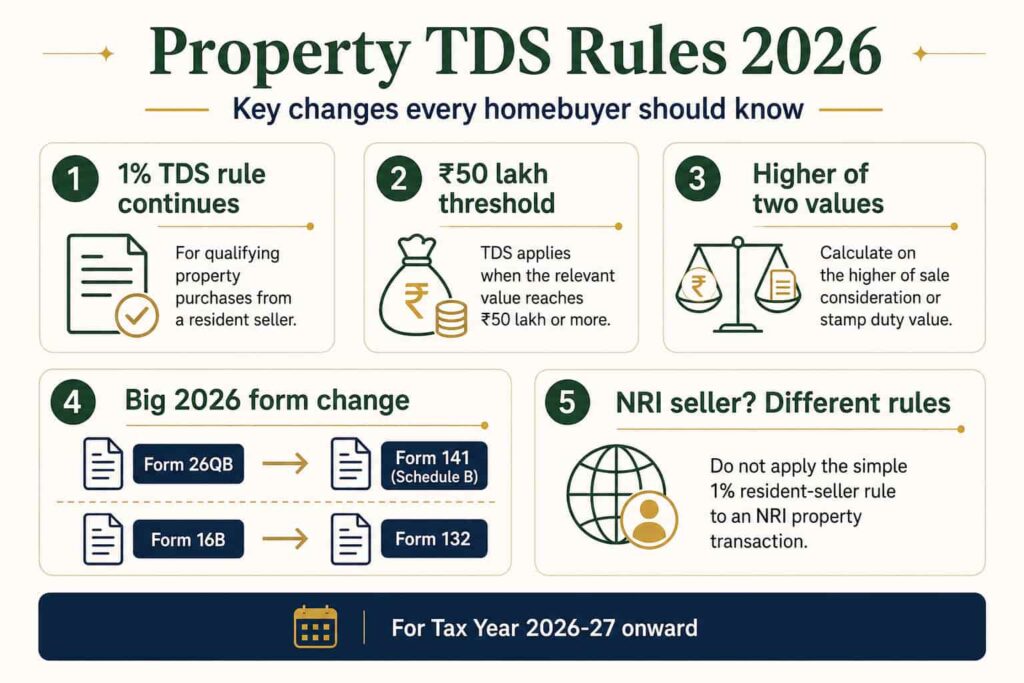
The basic 1% property TDS rule for purchases from a resident seller continues in 2026, but the compliance process has changed significantly from Tax Year 2026-27. The old Form 26QB has been replaced by Form 141, while Form 16B has been replaced by Form 132 under the Income-tax Act, 2025 and Income-tax Rules, 2026.
For homebuyers, this means many older online guides are now outdated.
Who has to deduct TDS while buying property?
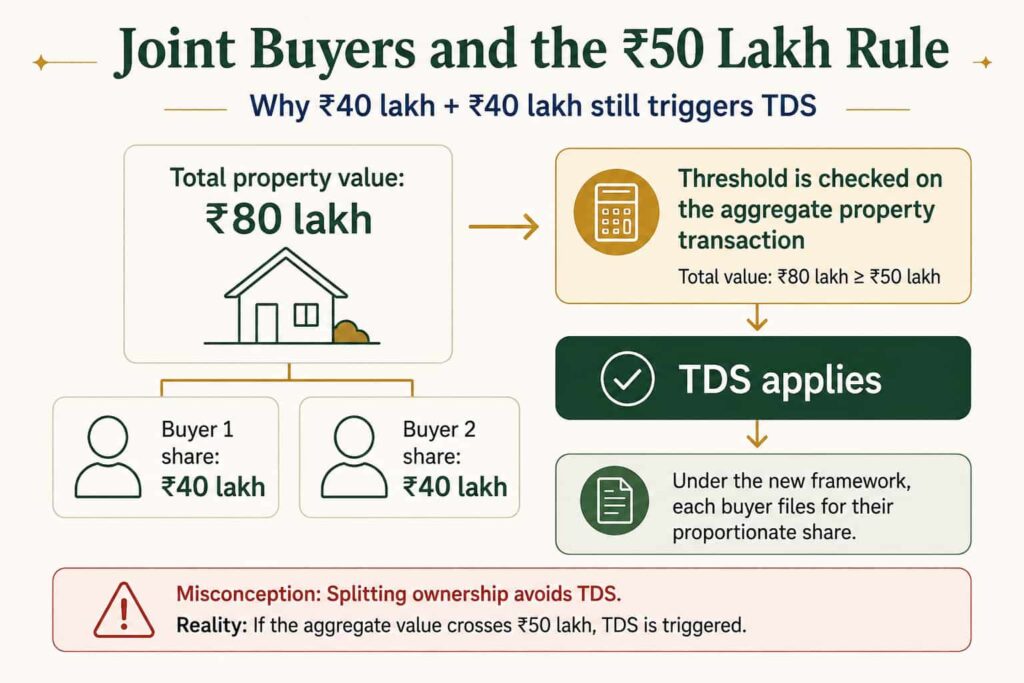
If you are buying an immovable property from a resident seller, the buyer is responsible for deducting TDS where the applicable threshold is met.
Under the current framework, TDS applies at 1% of the higher of:
Sale consideration, or
Stamp duty value of the property.
The ₹50 lakh threshold also looks at these values. If either the consideration or stamp duty value reaches ₹50 lakh, the property TDS provision can apply. Specified agricultural land is excluded.
Importantly, TDS is calculated on the entire applicable amount, not merely on the portion exceeding ₹50 lakh.
Quick example
Suppose:
| Particular | Amount |
|---|---|
| Property purchase price | ₹80 lakh |
| Stamp duty value | ₹84 lakh |
| Relevant TDS base | ₹84 lakh |
| TDS @ 1% | ₹84,000 |
The buyer should not calculate TDS only on the ₹80 lakh negotiated price because the stamp duty value is higher.
What if the agreement value is below ₹50 lakh?
This is where many buyers make a mistake.
Consider a property where:
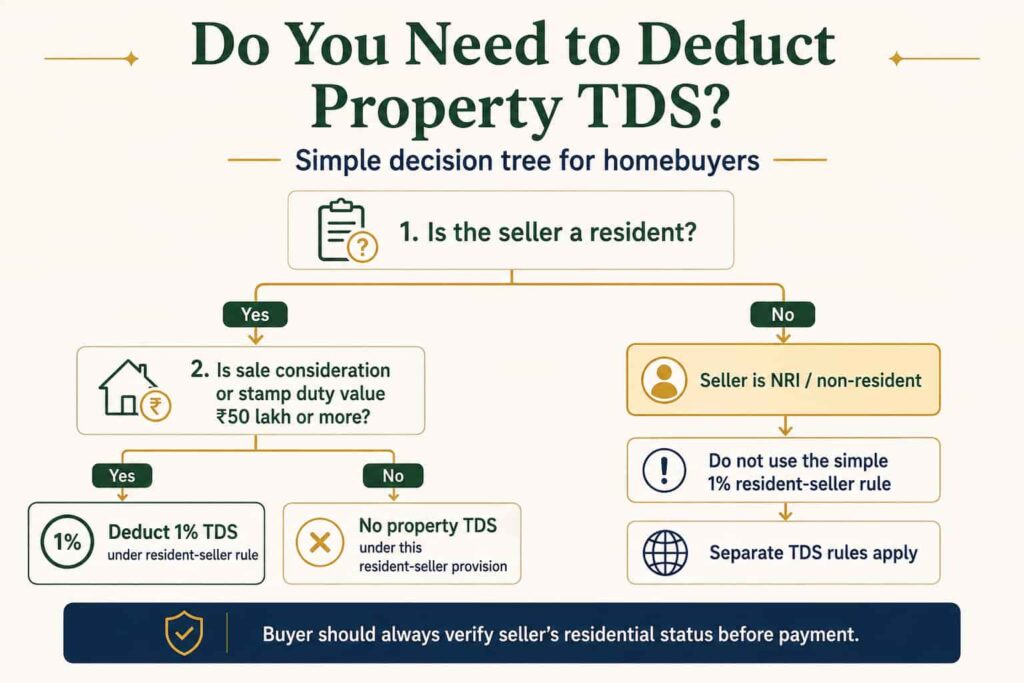
Agreement value: ₹48 lakh
Stamp duty value: ₹52 lakh
A buyer may assume that no TDS is required because the negotiated price is below ₹50 lakh.
That assumption would be wrong.
Because the stamp duty value has reached ₹50 lakh, the threshold is crossed. In this example, the relevant TDS base would be ₹52 lakh and 1% would amount to ₹52,000.
This is why buyers should check the stamp duty value before making a major property payment, not only the price written in the agreement.
Does joint ownership help avoid the ₹50 lakh TDS limit?
No.
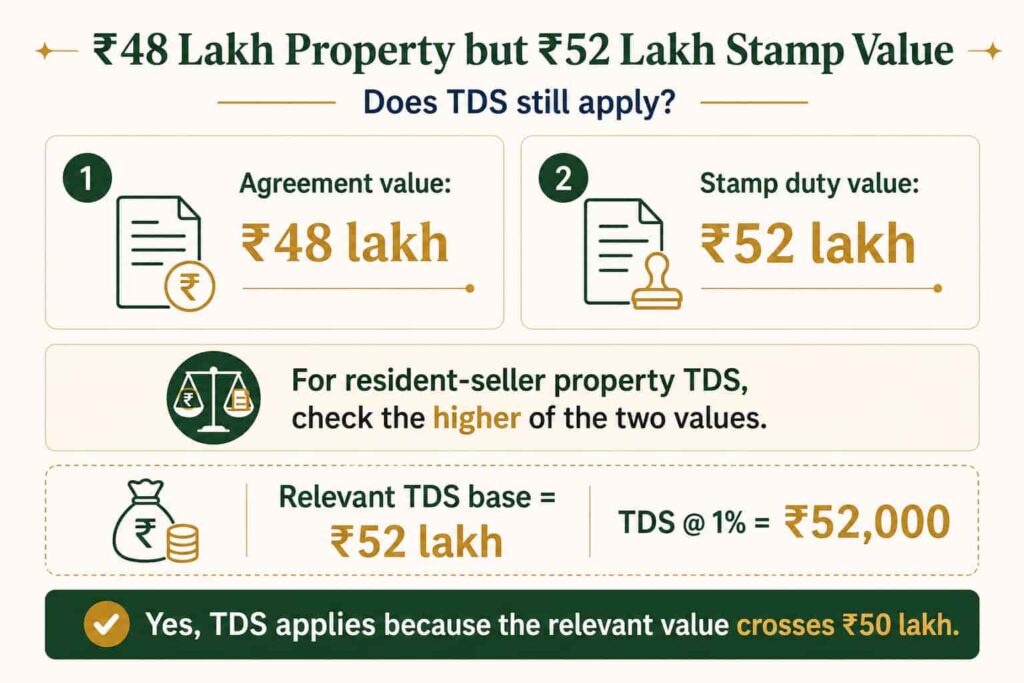
Suppose a husband and wife jointly purchase an ₹80 lakh home, with each owning 50%.
Their individual shares are:
Buyer 1: ₹40 lakh
Buyer 2: ₹40 lakh
But the ₹50 lakh threshold is not tested by pretending that the property is two separate ₹40 lakh transactions.
For property TDS purposes, where there are multiple buyers or sellers, the consideration is aggregated across the transaction for determining the threshold.
So the ₹80 lakh property crosses the threshold.
Under Form 141, each buyer acting as a deductor files for their proportionate share. The new form can also accommodate multiple sellers within the relevant filing structure.
That distinction is especially important for husband-wife purchases and family-owned properties.
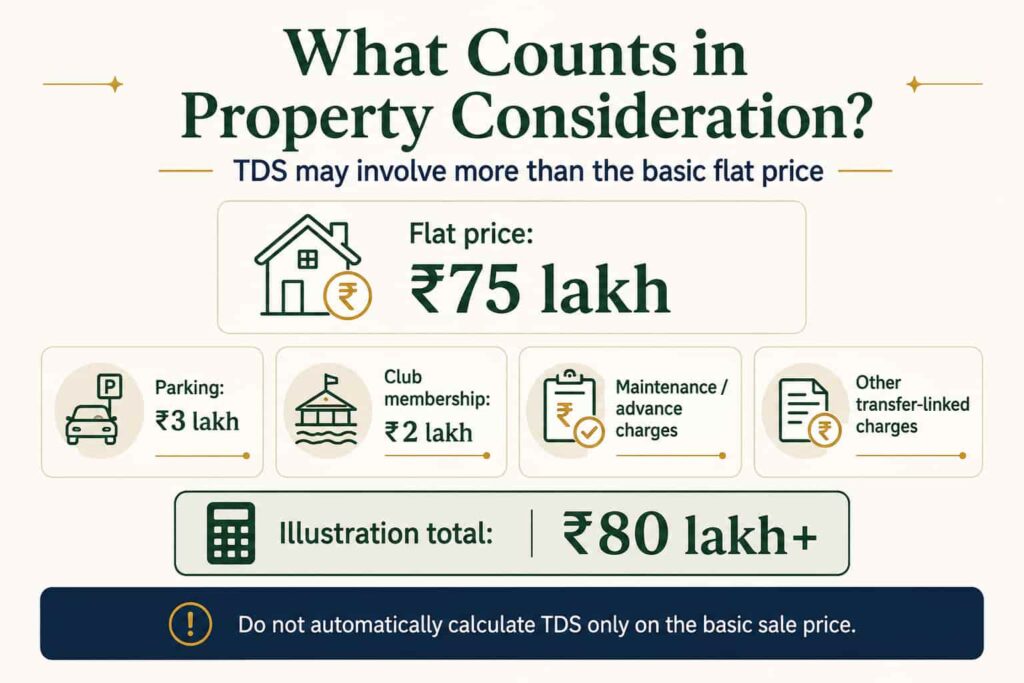
Is TDS calculated only on the basic flat price?
Not necessarily.
The Income-tax Act, 2025 defines consideration for transfer of immovable property broadly enough to include specified charges incidental to the transfer, including:
- club membership fee;
- car parking fee;
- electricity or water facility fee;
- maintenance fee;
- advance fee;
- other similar transfer-related charges.
For example, suppose a builder’s demand is structured as:
| Component | Amount |
|---|---|
| Flat price | ₹75 lakh |
| Parking | ₹3 lakh |
| Club membership | ₹2 lakh |
| Total considered for illustration | ₹80 lakh |
A buyer should therefore not automatically calculate TDS using only the headline “basic sale price”.
The complete demand and agreement should be examined.
The biggest 2026 change: Form 26QB has become Form 141
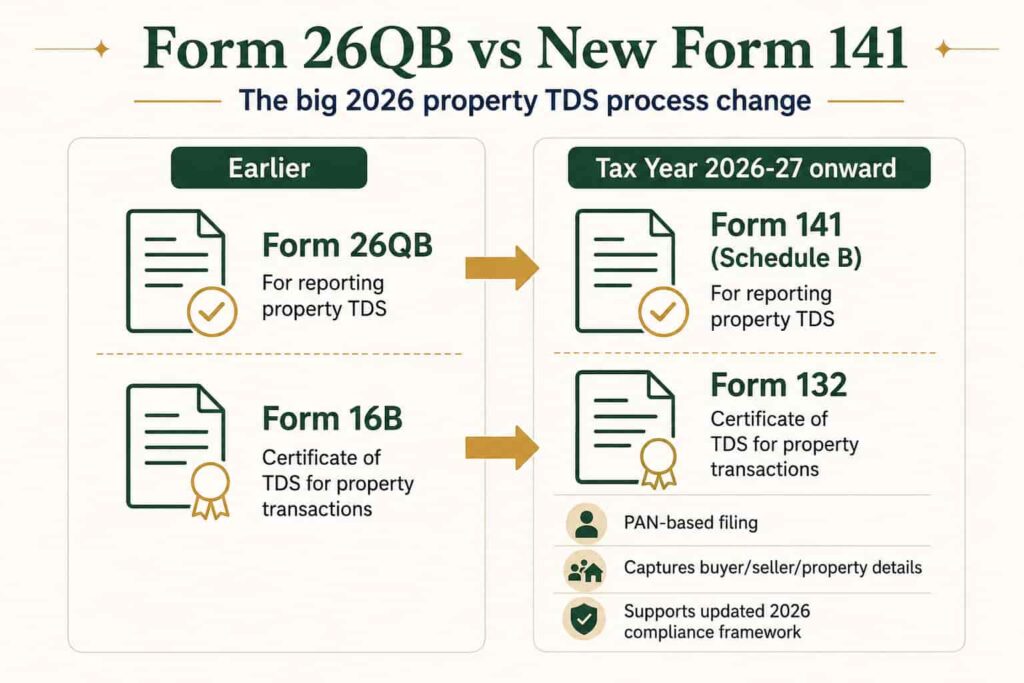
For transactions pertaining to Tax Year 2026-27 onwards, the Income Tax Department has introduced Form 141, combining several earlier PAN-based challan-cum-statement forms into one.
For property purchases:
Old system: Form 26QB
New system: Form 141 — Schedule B
Form 141 applies to property TDS under Section 393(1), Table Sl. No. 3(i) of the Income-tax Act, 2025.
The form is still PAN based, so a buyer purchasing from a resident seller under this provision does not need to obtain TAN.
This is one of the most important changes for anyone following an older property-TDS guide.
What information is required for Form 141?
For a property transaction, buyers should keep details such as buyer and seller PAN, contact details, property information, property value and payment details ready.
Form 141 also captures the relevant transaction structure and supports reporting involving buyers, sellers and their respective shares.
The basic filing flow is:
Login with PAN → e-Pay Tax → Form 141 → Schedule B → Enter property/TDS details → Pay TDS → Submit → Save acknowledgement
The Income Tax Department confirms that Form 141 has to be filed electronically.
When should property TDS be deducted?
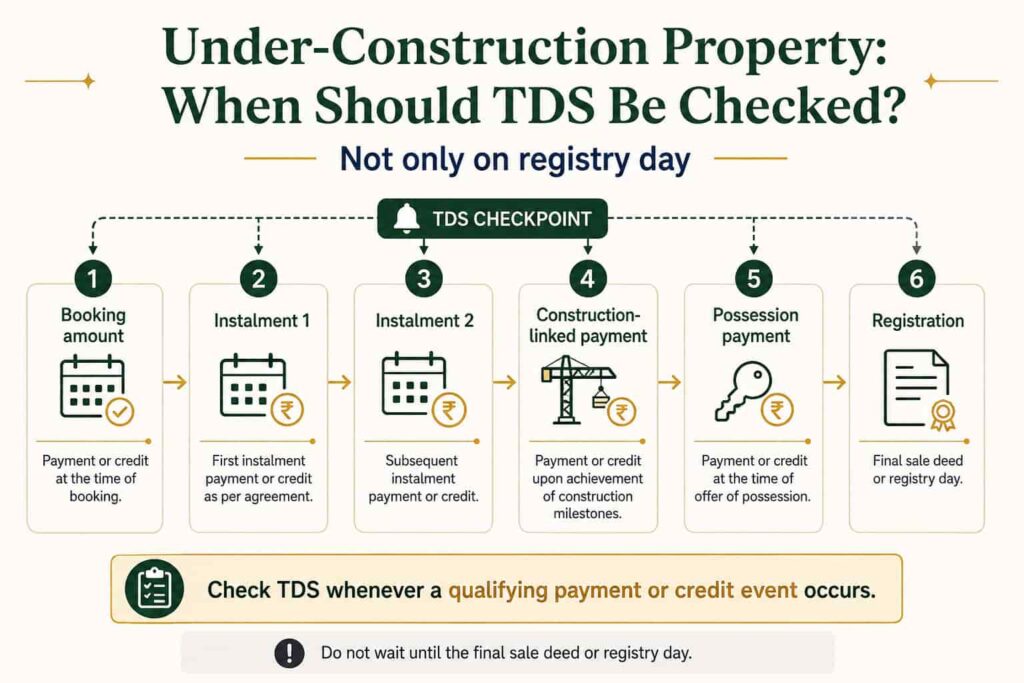
Another frequent mistake is waiting until property registration day.
The TDS obligation arises at the earlier of:
credit of the amount to the seller, or
actual payment to the seller.
This matters especially for under-construction homes where buyers may pay through multiple construction-linked instalments.
For example:
Booking amount
↓
Foundation instalment
↓
Structure instalment
↓
Possession instalment
↓
Registration
A buyer should examine TDS at the relevant payment stages instead of waiting for the sale deed to be registered.
How does TDS work for instalment payments?
The new Form 141 framework specifically accommodates property transactions with payment details and multiple transactions of the same nature for the same month of deduction.
Transactions falling in different months cannot simply be clubbed into one Form 141 filing.
For buyers of under-construction property, the practical rule is simple:
Check the TDS requirement before every qualifying payment—not only before registration.
What is the deadline for filing Form 141?
Form 141 must be furnished within 30 days from the end of the month in which TDS is deducted.
Example:
TDS deducted: 12 August 2026
Month ends: 31 August 2026
Form 141 deadline: within the following 30 days.
Once payment succeeds, a Challan Identification Number is generated against the relevant acknowledgement.
Buyers should save both the acknowledgement and payment proof.
Form 16B has also changed: Meet Form 132
The compliance process does not end after depositing TDS.
For Tax Year 2026-27 onwards, the new Form 132 replaces the earlier Forms 16B, 16C, 16D and 16E for the relevant transactions.
For a property purchase, Form 132 acts as the TDS certificate given by the buyer to the seller.
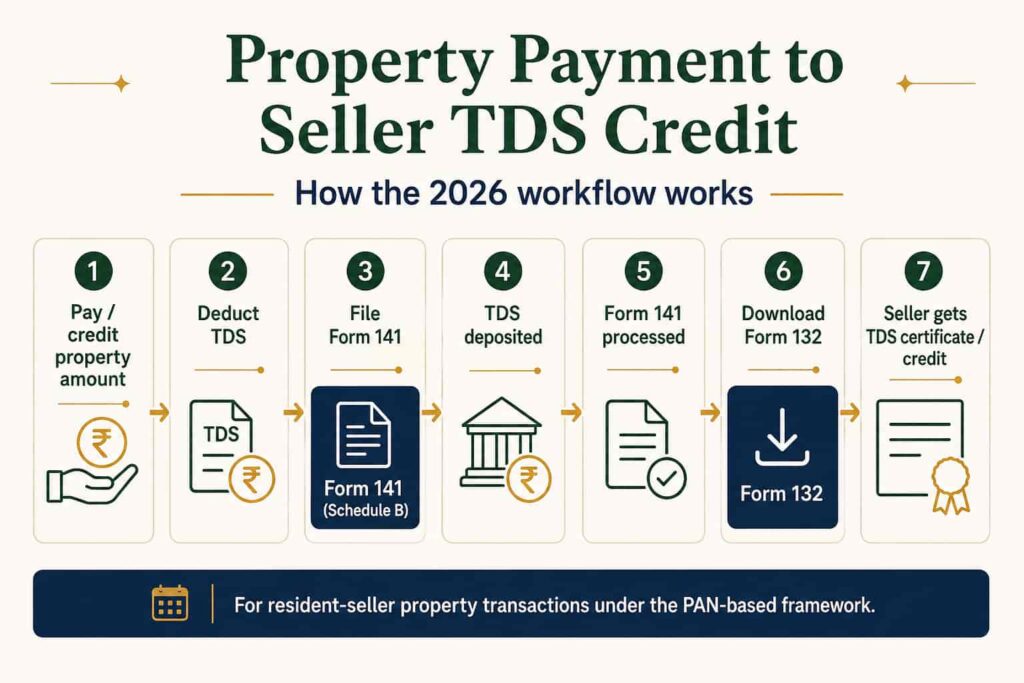
The process is:
Deduct TDS
→ File Form 141
→ Form 141 gets processed
→ Download Form 132 from TRACES
→ Provide Form 132 to seller
Form 132 must be issued within 15 days from the due date for furnishing Form 141.
The seller uses this certificate as evidence of TDS deposited on their behalf and for claiming the corresponding tax credit.
What if there is a mistake in Form 141?
The Income Tax Department allows a correction statement.
The official Form 141 FAQ states that corrections may be filed within two years from the end of the tax year in which the original statement was required to be delivered.
However, buyers should still carefully verify:
PAN details, ownership shares, property value, payment amount and seller information before final submission.
An incorrect seller PAN can prevent the TDS credit from appearing correctly and can also create higher-rate TDS consequences.
What if the seller does not provide a valid PAN?
A valid PAN is extremely important.
Under Section 397 of the Income-tax Act, 2025, failure by the recipient to furnish PAN can result in TDS being deducted at a substantially higher rate; for an ordinary property transaction falling in the general category, the higher-rate provision can reach 20%.
Therefore, buyers should verify the seller’s PAN before releasing the payment.
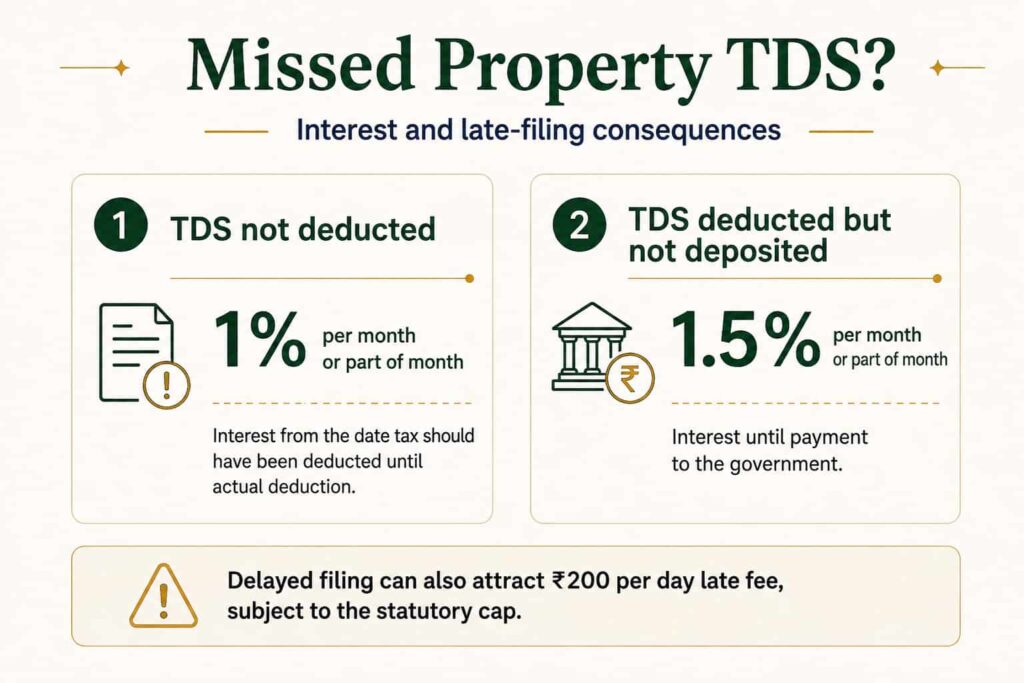
What happens if the buyer forgets to deduct or deposit TDS?
This can become expensive.
Under the current framework:
| Default | Interest |
|---|---|
| TDS should have been deducted but was not | 1% per month or part of month |
| TDS was deducted but not deposited | 1.5% per month or part of month |
The Income Tax Department confirms that these interest rates continue under the Income-tax Act, 2025.
Delayed filing can also attract a ₹200-per-day late fee, subject to the statutory cap linked to the deductible/collectible tax.
This is why property TDS should never be treated as the seller’s paperwork.
The buyer is the deductor and carries the compliance responsibility.
Buying property from an NRI? Stop before applying the 1% rule
This is the most important warning in the entire guide.
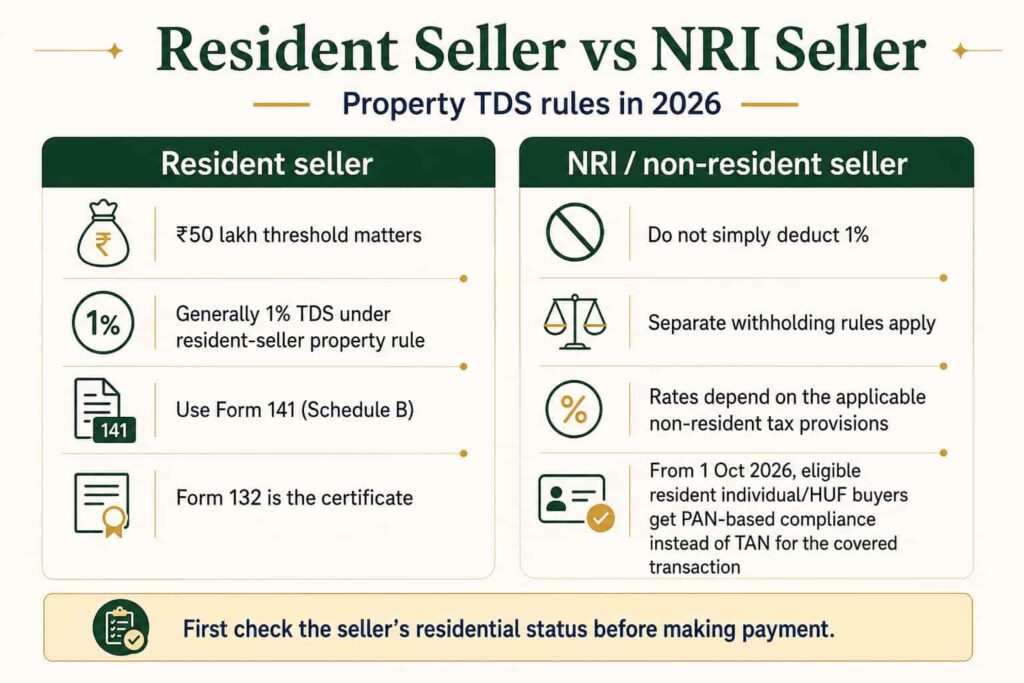
The simple resident-seller rule of:
₹50 lakh threshold + 1% TDS
does not apply in the same manner when the seller is a non-resident.
For an NRI/non-resident seller, TDS falls under the separate non-resident withholding provisions of Section 393(2), Table Sl. No. 17 under the Income-tax Act, 2025.
The applicable withholding can depend on the nature of income, tax rates in force and any valid lower/nil deduction certificate.
Therefore:
Never deduct only 1% merely because the property costs more than ₹50 lakh when the seller is an NRI.
This is one transaction where obtaining professional tax advice before payment is sensible.
Major NRI property TDS change from 1 October 2026
There is another important 2026 development.
At present, before 1 October 2026, a resident individual/HUF buying immovable property from a non-resident seller generally has to obtain a TAN for the applicable TDS compliance.
The Finance Act 2026 changes this from 1 October 2026.
Eligible resident individuals and HUFs will no longer need to obtain TAN solely for a covered purchase from a non-resident property seller. Instead, the compliance is moving to a PAN-based challan-cum-statement mechanism.
This simplifies the procedure—but it does not turn NRI property TDS into a 1% tax.
The calculation rules for a non-resident seller remain separate.
he 2026 property TDS process in one minute
For a qualifying purchase from a resident seller:
1. Check seller’s residential status.
2. Check both sale consideration and stamp duty value.
3. If the relevant value reaches ₹50 lakh, calculate TDS at 1% on the applicable higher amount.
4. Deduct TDS when payment/credit occurs—whichever is earlier.
5. For Tax Year 2026-27 onward, file Form 141 Schedule B instead of old Form 26QB.
6. Pay and report the TDS within 30 days from the end of the deduction month.
7. After processing, download Form 132 from TRACES and provide it to the seller.
8. If the seller is NRI, do not use this resident-seller calculation; follow the separate non-resident TDS rules.
Common property TDS mistakes buyers should avoid
The biggest mistakes are surprisingly simple: following an old Form 26QB tutorial, checking only agreement value and ignoring stamp duty value, assuming joint ownership avoids the ₹50 lakh threshold, waiting until registry day for an instalment-based property, ignoring parking or other transfer-linked charges, using an incorrect seller PAN, forgetting Form 132, or applying the resident-seller 1% rule to an NRI transaction.
Avoiding these mistakes can save a homebuyer from unnecessary interest, late fees and correction work.
Carpet Area takeaway
The 1% property TDS rate is not the biggest change in 2026. The bigger change is the process surrounding it.
For transactions pertaining to Tax Year 2026-27 onwards:
Form 26QB → Form 141 Schedule B
Form 16B → Form 132
The ₹50 lakh threshold remains crucial, stamp duty value cannot be ignored, joint buyers do not bypass the threshold, and under-construction instalments require timely attention.
And if the seller is an NRI, the first thing a buyer should do is stop treating the transaction like a normal 1% resident-seller purchase.
For a transaction involving tens of lakhs or crores of rupees, checking the seller’s residential status and TDS obligation before making payment is far easier than correcting a tax default later.
Sources:-
Income Tax Department — Form 141 FAQs
Confirms that Form 141 replaces Forms 26QB/26QC/26QD/26QE, Schedule B applies to immovable property, the 30-day filing deadline, multiple-buyer reporting and applicability from Tax Year 2026-27 onwards.
Official Form 141 FAQs
Income Tax Department — Comprehensive Note on Form 141
Explains the new form structure, filing process, multiple buyers/sellers and historical Form 26QB filing volumes.
Official Form 141 Comprehensive Note
Income Tax Department — Form 132 FAQs
Confirms Form 132 as the new TDS certificate and the timeline for issuing it.
Official Form 132 FAQs
Income-tax Act, 2025 — Section 393
Official provision covering TDS on transfer of immovable property.
Section 393 — Income Tax Department
Income-tax Act, 2025 — Section 402
Includes specified incidental charges within consideration for transfer of immovable property.
Section 402 — Income Tax Department
Income Tax Department — Budget 2026 FAQs
Explains removal of TAN requirement for eligible resident individual/HUF buyers purchasing property from a non-resident seller from 1 October 2026.
Official Budget 2026 FAQs



Leave a Reply