


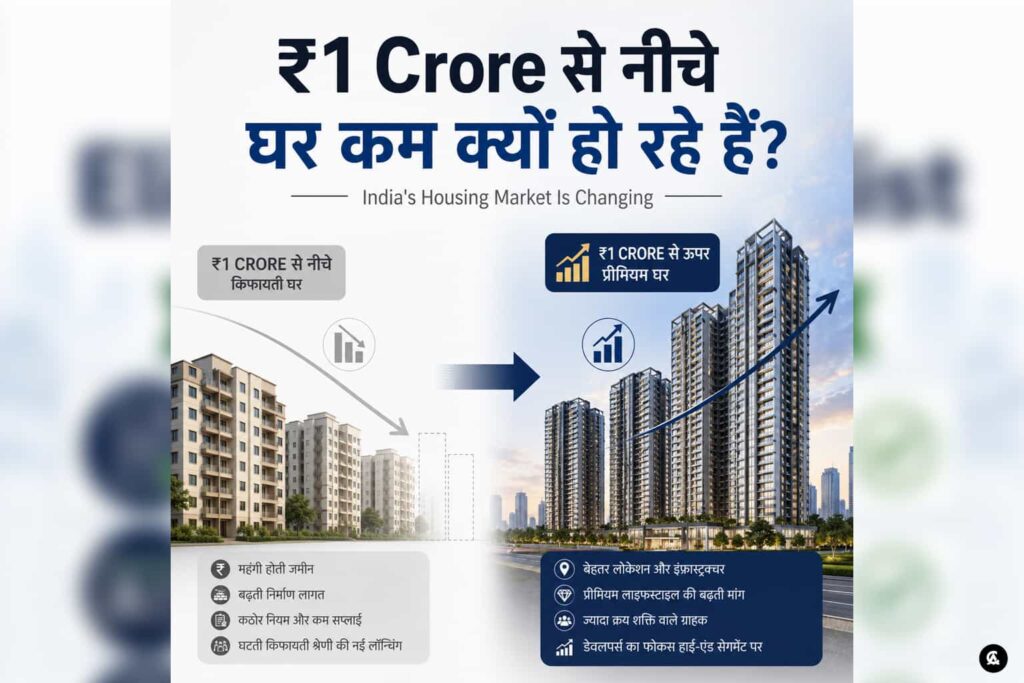
India’s residential market is changing in a way that directly affects ordinary homebuyers.
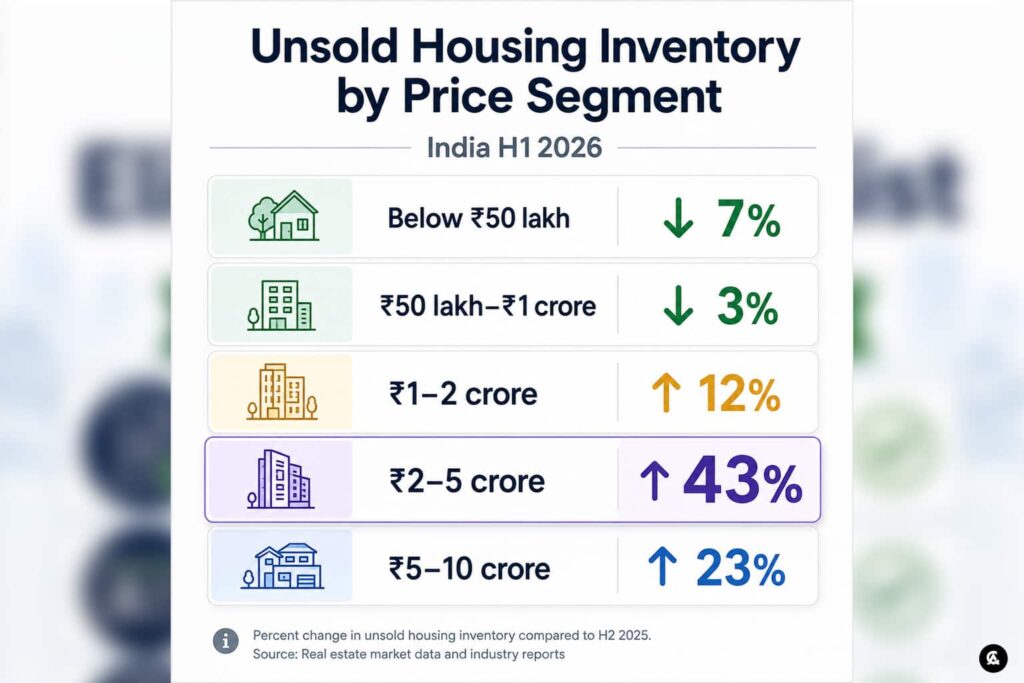
Homes priced below ₹1 crore are becoming relatively scarcer in unsold inventory, while developers are carrying substantially more stock in higher-priced categories. According to Knight Frank India’s H1 2026 residential-market data, unsold inventory in the ₹2–5 crore segment jumped 43% year-on-year to 65,671 units. In contrast, unsold homes below ₹50 lakh declined 7%, while inventory between ₹50 lakh and ₹1 crore fell 3%.
This does not mean affordable homes have completely disappeared, nor does it mean premium housing has stopped selling. The numbers instead point to a broader structural change: India’s housing market is increasingly concentrated in higher ticket-size properties.
What does the H1 2026 housing data show?
Across India’s eight major residential markets, developers sold 1,71,471 homes during H1 2026, while new launches reached 1,87,350 units. Total unsold inventory stood at 5,25,695 homes, up around 4% from a year earlier.
But the change becomes much clearer when inventory is divided by price.
| Housing price segment | Unsold inventory | YoY change |
|---|---|---|
| Below ₹50 lakh | 1,71,363 units | -7% |
| ₹50 lakh–₹1 crore | 1,34,841 units | -3% |
| ₹1–2 crore | — | +12% |
| ₹2–5 crore | 65,671 units | +43% |
| ₹5–10 crore | — | +23% |
The contrast is clear: lower-priced unsold inventory is declining while premium inventory is increasing.
Why are homes below ₹1 crore becoming harder to find?
A fall in unsold inventory does not automatically mean demand alone is booming.
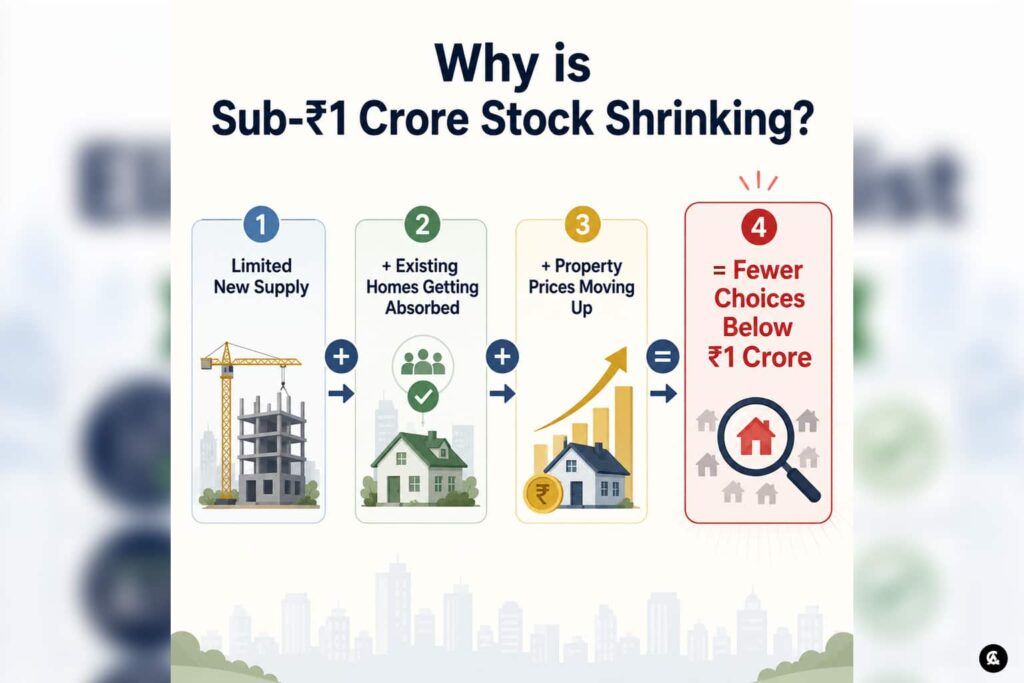
Knight Frank’s analysis points to a combination of continued absorption and relatively limited new supply in lower-priced housing, while sustained property-price appreciation has also pushed some homes that previously belonged to lower price brackets into higher categories.
For a homebuyer, the practical result can be straightforward:
A budget that once offered several options in a major city may now require a compromise on location, size, project age or distance from employment centres.
The problem therefore is not simply that homes have become more expensive. The mix of homes being supplied to the market is also changing.
Is ₹1 crore becoming the new dividing line in Indian housing?
There is another number that explains the shift.
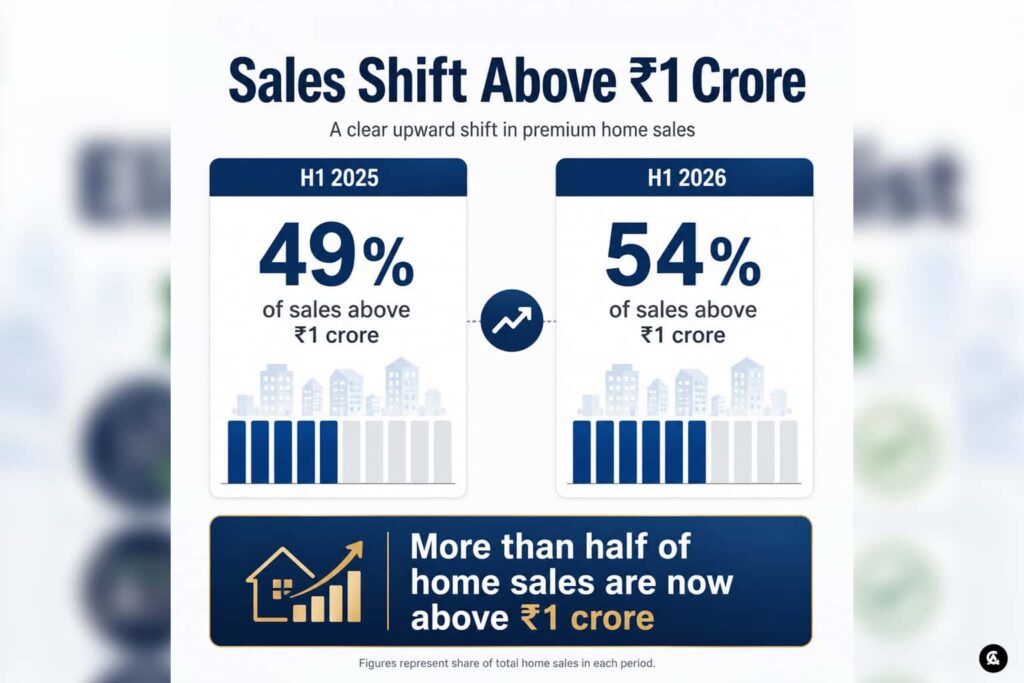
Homes priced above ₹1 crore accounted for 54% of residential sales in H1 2026, compared with 49% during the same period a year earlier.
That means more than half of all homes sold across the eight major markets tracked by Knight Frank were now priced above ₹1 crore.
Part of this is genuine demand for better locations, larger homes and premium developments. But price appreciation is also moving existing housing stock into higher ticket brackets.
So ₹1 crore should not automatically be interpreted as a luxury-home threshold anymore.
In several large urban markets, it is increasingly becoming a dividing line between the mass-market buyer and the upper-mid/premium housing market.
Why did ₹2–5 crore unsold inventory jump 43%?
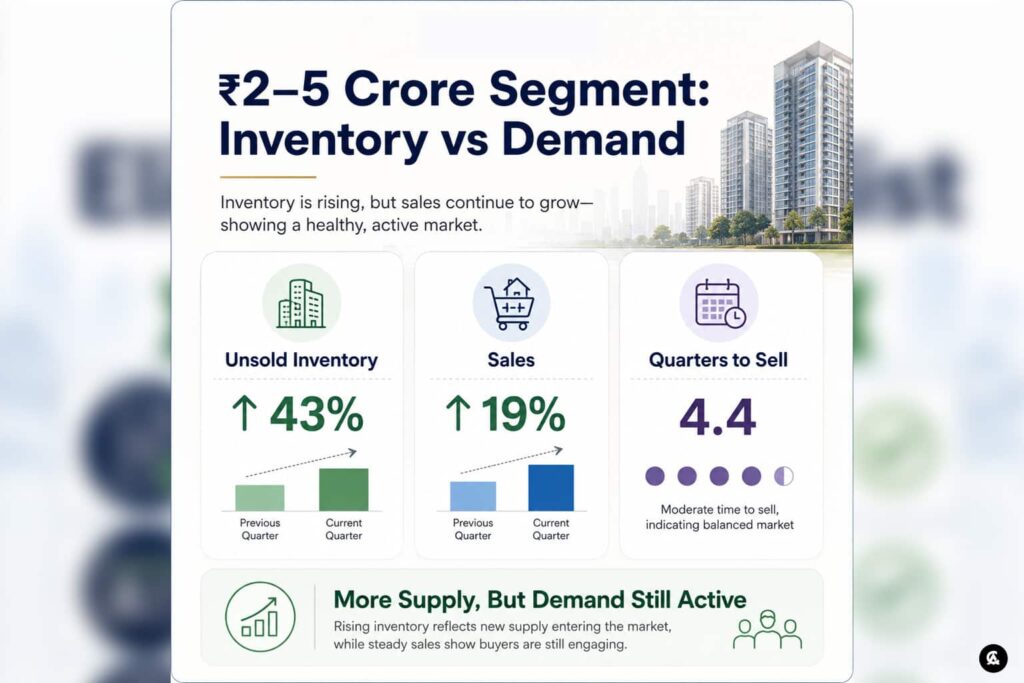
The ₹2–5 crore category recorded one of the sharpest inventory increases, reaching 65,671 unsold units, up 43% year-on-year.
But there is an important detail.
Sales in this same category increased around 19% year-on-year, and its Quarters-to-Sell ratio stood at approximately 4.4 quarters. That indicates homes are still being absorbed at a meaningful pace even though developers are adding supply faster.
Therefore:
43% higher inventory does not mean premium homes have stopped selling.
A better interpretation is:
Premium supply has expanded rapidly, while demand remains active—but inventory is building faster than before.
That distinction matters for buyers and investors.
Does higher premium inventory mean prices will fall?
Not necessarily.
A 43% increase in inventory may give buyers greater negotiating power in selected projects, particularly where new supply is increasing faster than sales. But the data does not indicate a broad distress situation or an immediate nationwide discount cycle.
Pricing will still depend heavily on:
- City
- Micro-market
- Developer
- Project stage
- Available competing inventory
- Unit configuration
- Actual sales velocity
A project with significant unsold stock may offer room for negotiation, while another project in the same city may continue selling without meaningful discounts.
That is why buyers should avoid treating a national inventory number as a guarantee of cheaper property.
What does this mean for a buyer with a budget below ₹1 crore?
This is where the trend becomes particularly relevant.
A buyer operating below ₹1 crore may increasingly have to choose between:
smaller home in a better location
or
larger home farther from the city centre
or
older ready property instead of a new premium project
Reuters reported earlier in 2026 that developers increasingly favour higher-end housing because premium buyers can absorb higher prices more easily, while affordability pressures are pushing some middle- and lower-income households toward longer periods of renting.
For first-time buyers, the sensible response is not simply to stretch the budget because newer projects are becoming expensive.
The better question is:
What combination of price, carpet area, commute, construction status and financing gives me the best usable home within my actual budget?
What should homebuyers compare before stretching beyond ₹1 crore?
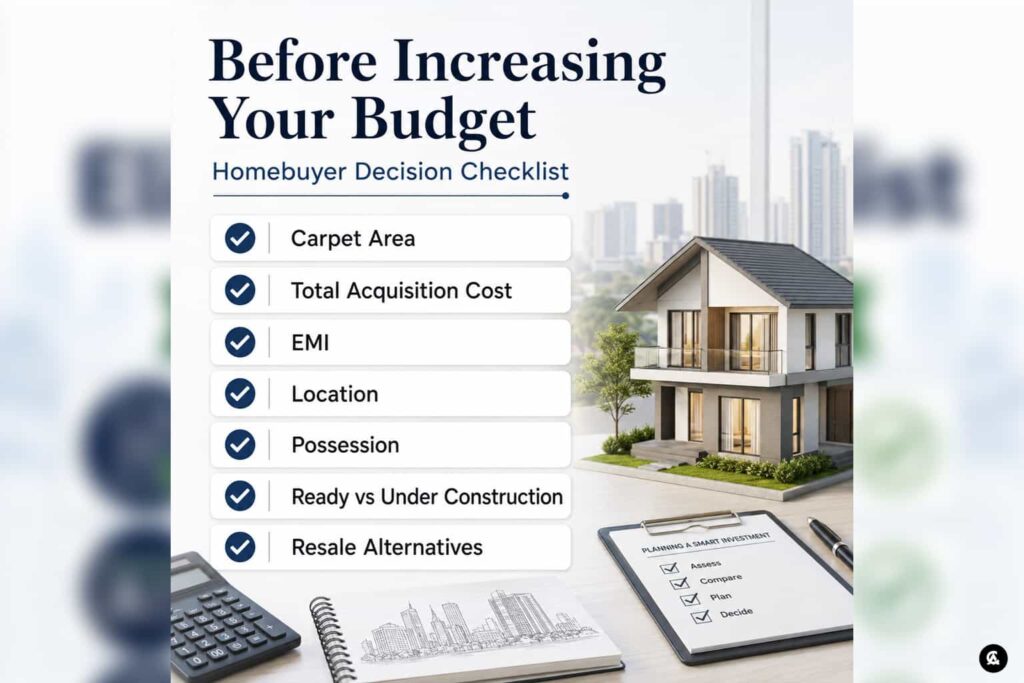
If your original budget is ₹70–90 lakh but the projects you are considering now cross ₹1 crore, compare the complete acquisition cost, not only the advertised basic price.
Check:
- Actual carpet area
- Basic sale price
- GST, where applicable
- Stamp duty and registration
- Parking and other compulsory charges
- Maintenance deposit
- Home-loan EMI
- Possession timeline
- Ready-to-move alternatives
- Resale properties in the same location
Is the affordable-housing market disappearing?
It would be inaccurate to say that affordable housing has disappeared.
There are still more than 3.06 lakh unsold homes below ₹1 crore across the markets covered by the Knight Frank data when the two lower ticket-size bands are combined.
The concern is the direction of the market.
Lower-priced unsold inventory is declining while inventory is accumulating in higher ticket sizes. At the same time, properties above ₹1 crore now represent the majority of residential sales across the eight tracked markets.
That suggests that the Indian housing market is gradually becoming more premium-oriented.
Carpet Area view
The headline number—43% growth in ₹2–5 crore unsold inventory—is eye-catching, but the more important story is happening at both ends of the market.
Below ₹1 crore, buyers are seeing a shrinking pool of unsold inventory.
Above ₹1 crore, developers are adding significantly more homes, and buyers are still purchasing them in large numbers.
This creates an increasingly divided residential market:
Lower budget → fewer new choices
Higher budget → more supply and wider choice
For homebuyers, that makes one principle more important than ever:
Do not judge affordability by the headline price alone. Compare the carpet area, total acquisition cost and location you are getting for that money.
India’s housing market is not simply becoming more expensive. The kind of housing being built and sold is changing as well.
Sources:-
- Knight Frank India — India Real Estate: Office and Residential Market H1 2026
Open Knight Frank H1 2026 Report
This is the primary Knight Frank research covering the eight major residential markets, sales, launches, inventory and price-segment trends. - ET Realty — Over 1.71 lakh residential units sold in top eight cities in H1 2026
Read ET Realty Report
Very useful for figures including 1,71,471 sales, 5,25,695 unsold units, 54% share of ₹1 crore+ homes and the 43% rise in ₹2–5 crore inventory. - Economic Times — India’s middle class may have little room in the richer housing market
Read Economic Times Analysis
This is particularly useful for explaining why affordable housing is shrinking while developers and buyers increasingly shift toward premium housing. - Business Today — Unsold premium homes surge 43%
Read Business Today Analysis
Key source for the ₹2–5 crore segment: inventory +43%, sales +19%, 65,671 unsold units and 4.4 quarters-to-sell. - Reuters — India’s luxury housing boom squeezing affordability
Read Reuters Report
Strong independent source for the broader argument that developers have increasingly focused on premium projects while affordability becomes more difficult for middle- and lower-income buyers.



Leave a Reply