


Delhi’s real-estate planning framework is set for a major overhaul. The Delhi Development Authority (DDA) approved the Master Plan for Delhi 2047 (MPD-2047) on August 12, 2026, bringing proposed changes to housing, redevelopment, Metro-oriented development, FAR, land pooling and the Yamuna O-Zone into focus.
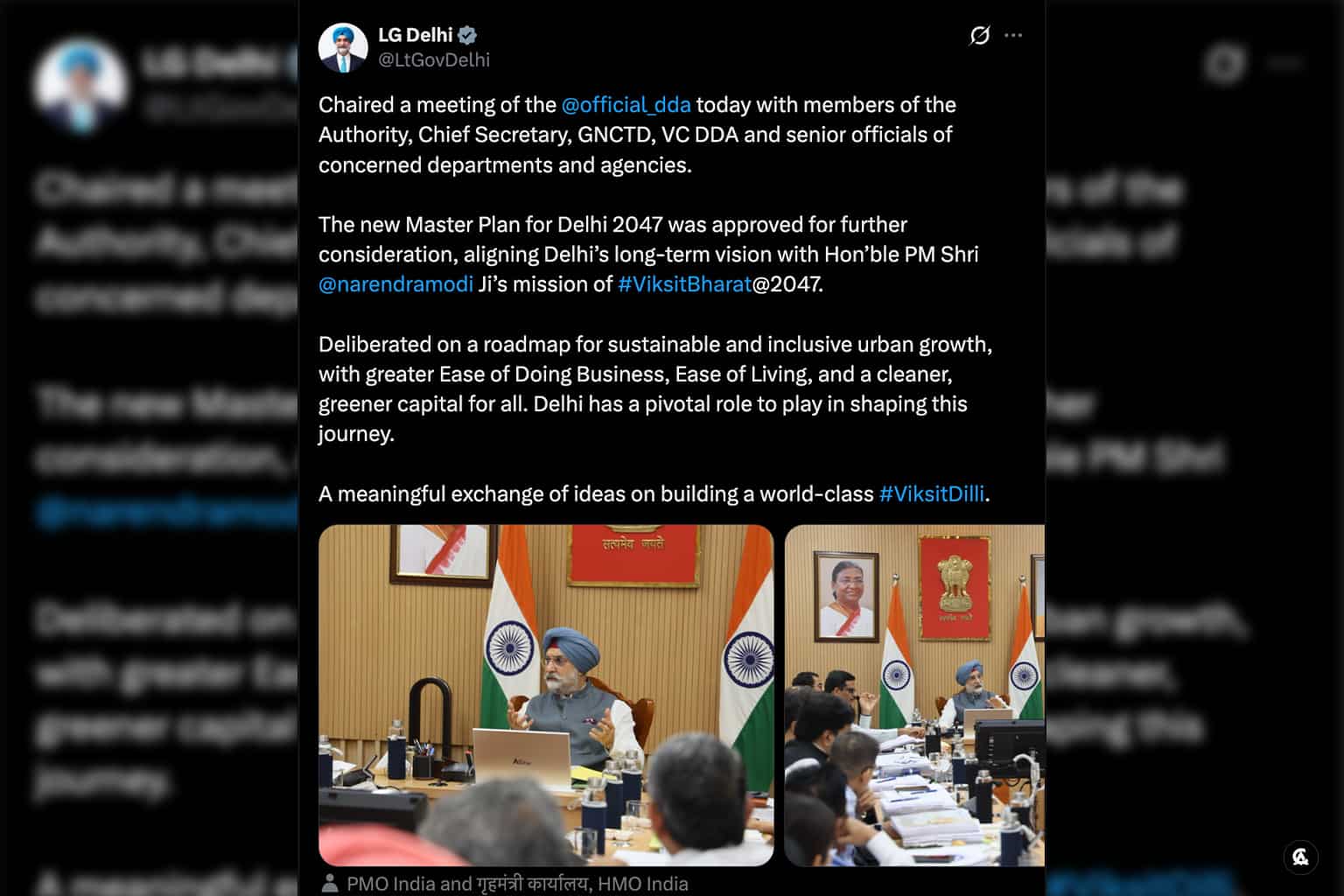
However, property owners and buyers need to understand one crucial point:
DDA approval does not mean every MPD-2047 provision has already become law.
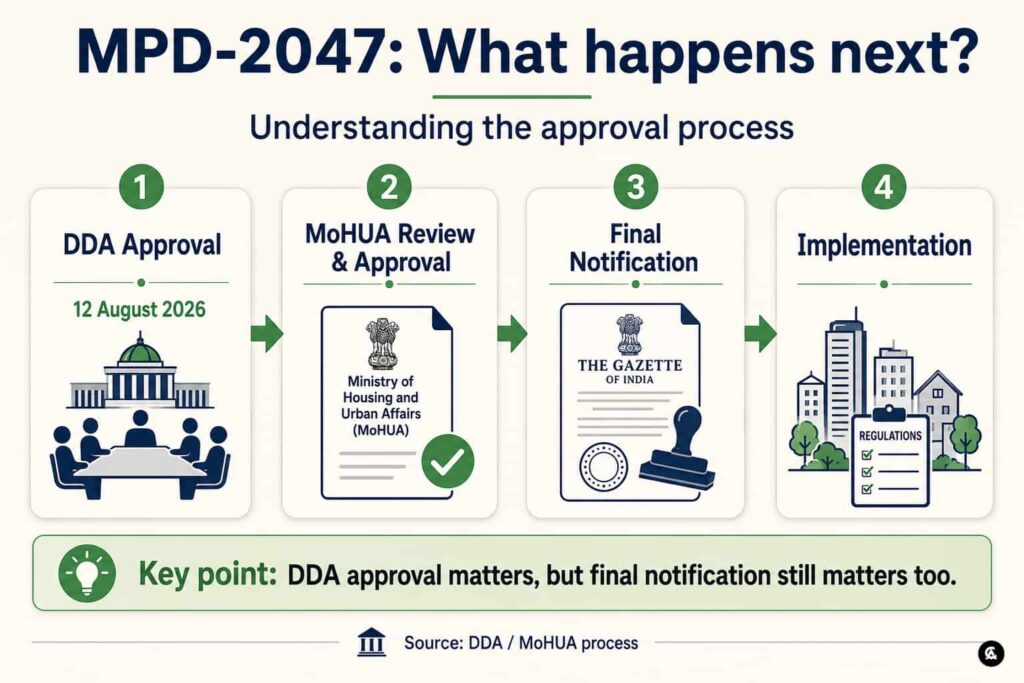
The plan is to be forwarded to the Ministry of Housing and Urban Affairs (MoHUA) for final approval and statutory notification. Until that process is completed, many of the changes should be treated as an approved planning framework rather than immediately enforceable property rules.
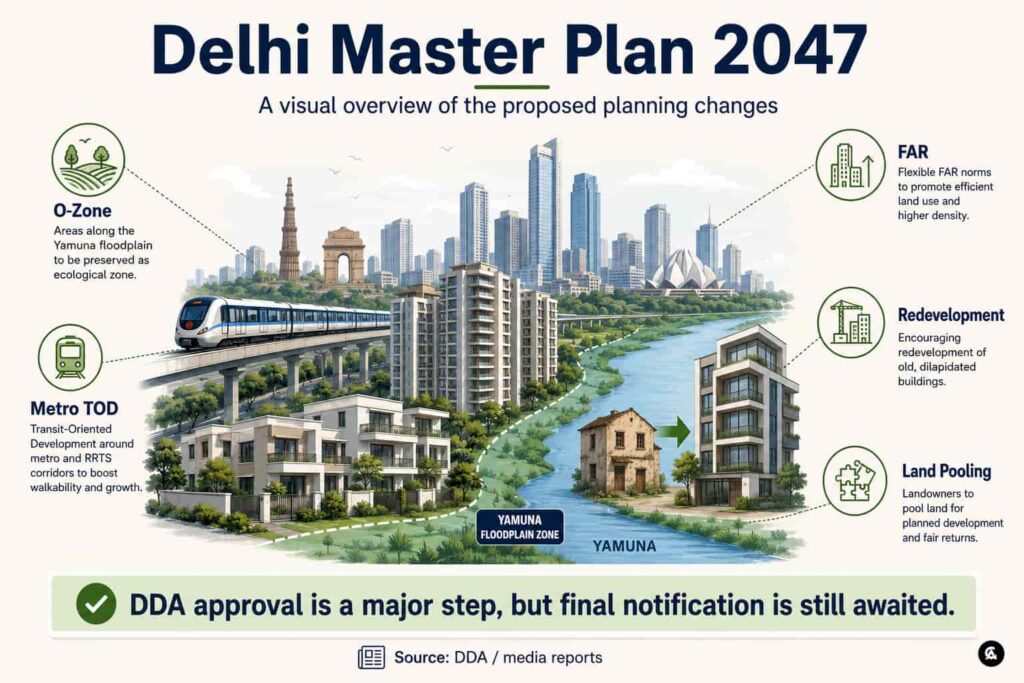
What is Delhi Master Plan 2047?
A Master Plan determines how a city can use its land and grow over the long term.
It influences:
- Residential development
- Commercial areas
- FAR and building density
- Transport corridors
- Redevelopment
- Affordable housing
- Land pooling
- Green and environmentally sensitive areas
- Infrastructure
- Urban villages
Delhi’s previous planning exercise was being developed as Master Plan Delhi 2041. DDA has now extended the planning horizon to 2047, bringing it in line with India’s broader Viksit Bharat 2047 vision.
For Delhi property owners, the importance of MPD-2047 lies not in the name change but in the proposed changes to where and how redevelopment can happen.
1. Yamuna O-Zone may get a new planning structure
One of the most sensitive elements of MPD-2047 is the future of Delhi’s Yamuna O-Zone.
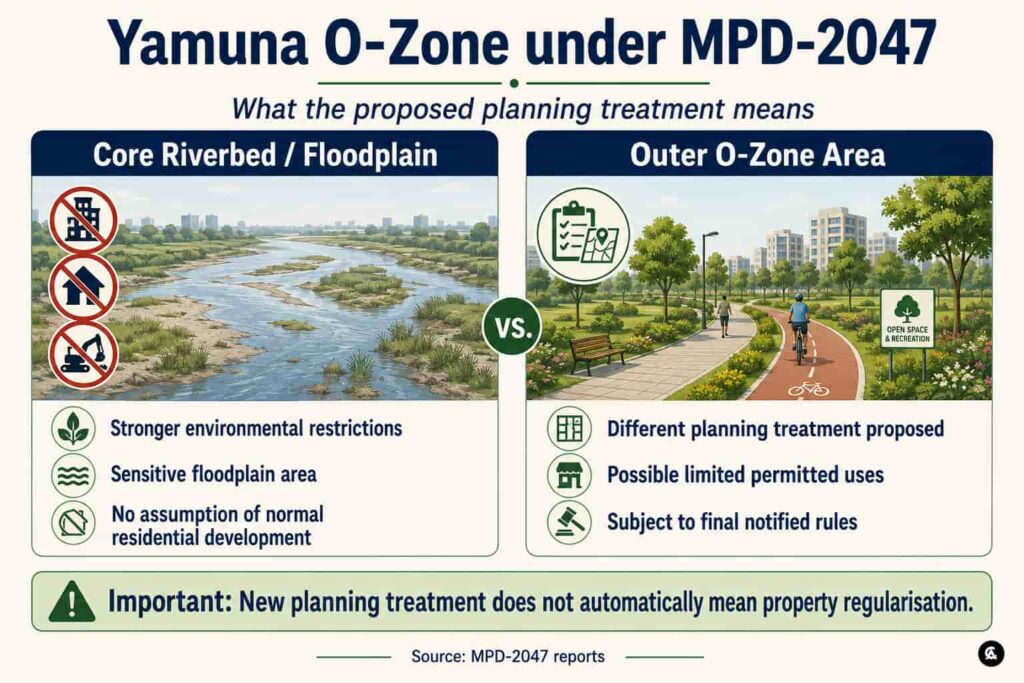
The O-Zone covers the Yamuna river and surrounding floodplain areas. According to current reports on the approved plan, DDA proposes dividing the approximately 9,934-hectare O-Zone into two broad parts.
One part would cover the core riverbed/floodplain, where strict environmental restrictions would continue.
The other would cover outer portions where limited uses, including certain recreational activities, may be considered under the new planning framework.
This is important, but it should not be interpreted as automatic legalisation of O-Zone houses or unauthorised colonies.
Existing Delhi High Court directions concerning fresh construction and floodplain protection continue to remain relevant unless the legal framework changes.
For O-Zone property owners
MPD-2047 potentially creates a new planning pathway, but owners should still verify:
- Exact land location
- Whether the property falls in the core floodplain
- Colony status
- Construction status
- Land-use classification
- Latest court directions
- Final MPD-2047 notification
2. Properties near Metro and RRTS corridors could see major development potential
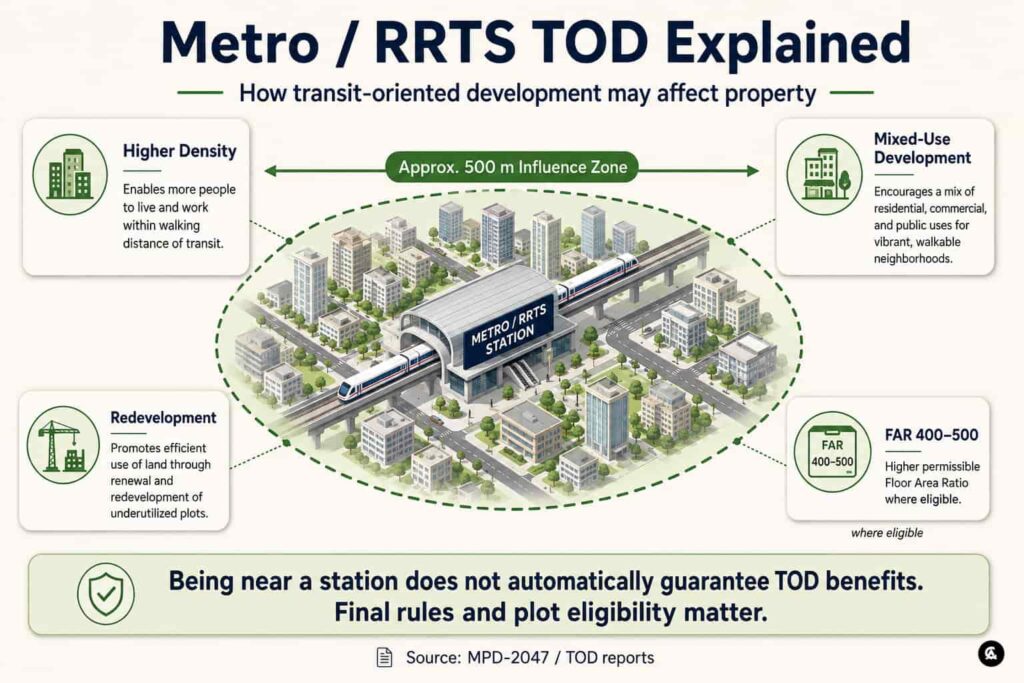
Another major part of MPD-2047 is Transit-Oriented Development (TOD).
TOD encourages higher-density residential, commercial and mixed-use development around mass-transit systems.
The proposed framework reportedly considers development within approximately:
500 metres on either side of Metro corridors, and around major RRTS and railway stations.
The TOD influence area could cover around 207 sq km of Delhi.
This is significant because property near major transport corridors could potentially support much more development than under conventional low-density planning.
FAR could reach 400–500 in eligible TOD areas
FAR — Floor Area Ratio — determines how much floor space can be constructed on a particular plot.
For example:
If a plot is 1,000 sq m and permissible FAR is 200, total permitted floor construction could broadly be around 2,000 sq m, subject to other development controls.
Under the proposed TOD framework, reports indicate FAR could reach:
FAR 400, with the possibility of going up to 500 against additional charges, subject to eligibility and final regulations.
This could significantly improve redevelopment potential around transport corridors.
But property owners should not assume that simply being close to a Metro station automatically gives them FAR 500.
Eligibility will depend on factors such as:
- Plot size
- Exact TOD boundary
- Road width
- Land use
- Development-control regulations
- Fire and structural requirements
- Applicable premium or charges
3. Old DDA two-storey houses get a major redevelopment opportunity
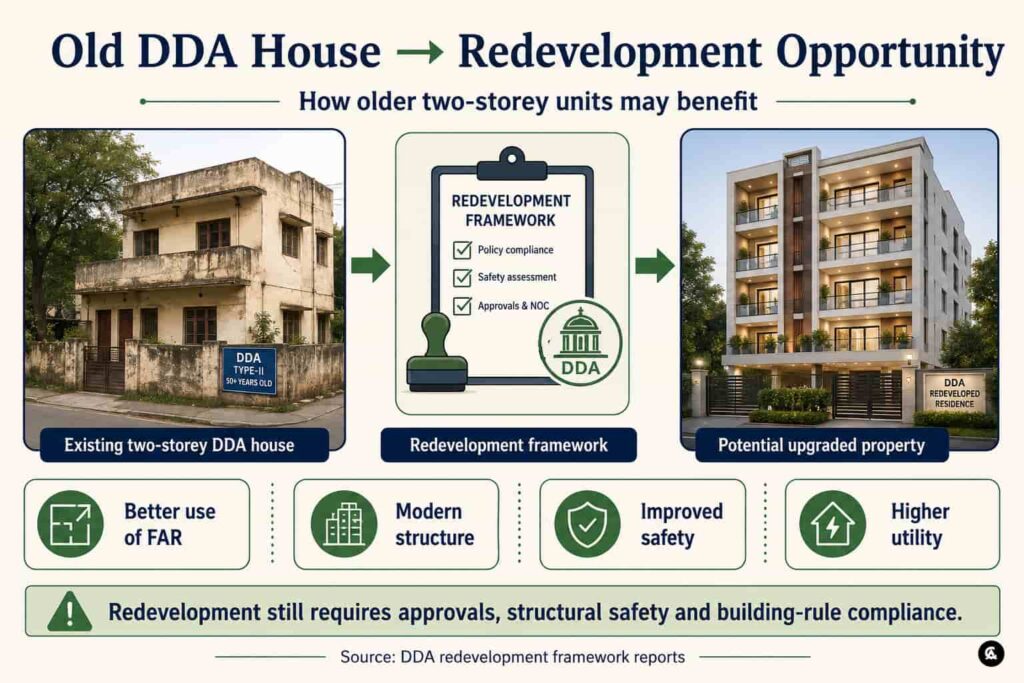
Alongside MPD-2047, DDA has approved a new framework for certain old two-storey residential units built under earlier DDA housing schemes.
Many of these properties are now more than 50 years old.
Earlier, owners of such built-up plots could face restrictions that differed from owners of vacant residential plots.
The new framework aims to provide a more uniform redevelopment route.
This could benefit owners in older DDA-developed residential colonies where original structures have become outdated or structurally inefficient.
However, redevelopment will still need to comply with:
- Permissible FAR
- Structural safety
- Fire regulations
- Building height rules
- Setbacks
- Parking requirements
- Other building bye-laws
So the approval should not be interpreted as:
“Any old DDA flat can now be demolished and rebuilt without permission.”
It creates a redevelopment opportunity—not an exemption from planning regulations.
4. Land pooling could unlock new housing supply
Land availability is one of Delhi’s biggest housing constraints.
MPD-2047 continues to focus on land pooling, where multiple landowners combine parcels for planned urban development.
Instead of acquiring every parcel directly, land can be pooled, infrastructure can be developed, and a portion of serviced land can be returned to participating landowners.
If implemented effectively, land pooling could support:
- New housing
- Roads
- Commercial areas
- Public infrastructure
- Parks
- Schools and social infrastructure
This is particularly relevant to Delhi’s peripheral areas where large-scale planned housing is still possible.
But land pooling is a long-term execution story. Property buyers should judge projects based on actual infrastructure and approvals—not only proposed Master Plan boundaries.
5. Building-plan approvals could become easier
DDA has also approved changes aimed at simplifying Delhi’s building approval process.
Reports indicate that separate NOCs from certain departments may no longer be required at the same stage of building-plan sanction.
The objective is to reduce multiple approvals and make the process more streamlined.
However, this does not necessarily remove underlying environmental, water, factory, forest or other statutory obligations.
The key change is likely to be procedural simplification rather than removal of all compliance.
For property owners, this could eventually mean:
Fewer approval bottlenecks + more integrated building-plan processing.
6. Delhi’s peripheral villages could see more organised development
MPD-2047 also focuses on areas beyond Delhi’s established urban core.
Peripheral villages and undeveloped zones could receive new planning opportunities through:
- Land pooling
- Planned housing
- Improved connectivity
- Mixed-use development
- Infrastructure investment
This could gradually move future housing supply towards Delhi’s outer areas.
However, investors should distinguish between:
Master Plan potential
and
actual on-ground development.
Roads, sewage, water, Metro connectivity and social infrastructure ultimately determine whether a planned location becomes a successful real-estate market.
7. Narela could receive another development push
Narela remains one of DDA’s largest housing and land-development areas.
MPD-2047 reportedly places renewed emphasis on Metro connectivity, land-use rationalisation and infrastructure-led development in Narela.
Better connectivity could improve the usability of existing and future housing stock.
For property buyers, however, the real trigger will be execution of connectivity and social infrastructure, not the Master Plan announcement alone.
Does MPD-2047 mean Delhi property prices will immediately increase?
Not necessarily.
A Master Plan can increase the development potential of land, but property values depend on multiple factors.
These include:
- Final notification
- Zoning
- FAR
- Infrastructure execution
- Metro/RRTS connectivity
- Road width
- Building permissions
- Redevelopment feasibility
- Market demand
For example, a property that eventually becomes eligible for higher FAR or TOD redevelopment could gain development value.
But a property merely located near an announced planning zone may not receive the same benefit.
What should Delhi property owners check before acting on MPD-2047?
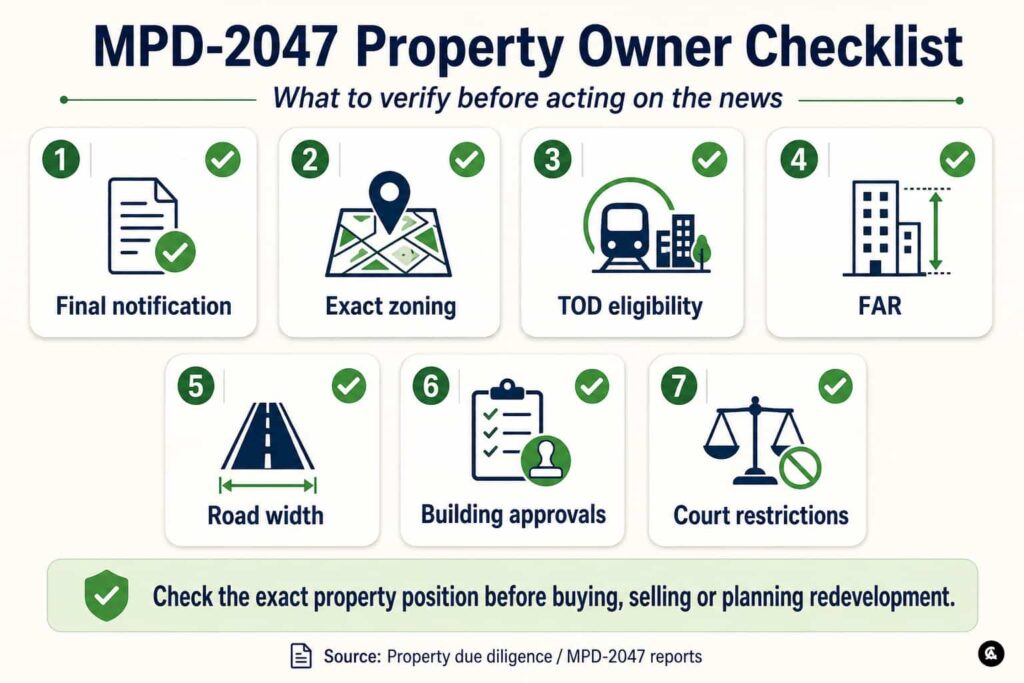
DDA approval vs final law: The most important distinction
Property owners should remember this simple difference:
DDA has approved MPD-2047.
But:
MoHUA final approval and statutory notification are still required.
Until the final notified document is available, buyers should avoid making expensive property decisions purely on the basis of headlines such as:
“FAR 500 approved everywhere near Metro”
or
“O-Zone property is now legal.”
Both would be oversimplifications.
What could MPD-2047 ultimately mean for Delhi real estate?
If the proposed provisions survive the final approval and notification process, MPD-2047 could reshape Delhi’s real estate in three major ways.
More redevelopment
Older buildings and under-utilised plots could be reconstructed more efficiently.
Higher density around public transport
More housing and commercial development could move towards Metro, RRTS and railway corridors.
More planned development on Delhi’s outskirts
Land pooling and infrastructure expansion could unlock housing supply outside the congested central city.
The result could be a gradual shift from horizontal expansion towards transit-led and redevelopment-led urban growth.
Delhi Master Plan 2047 is one of the most important planning developments for Delhi real estate in 2026.
DDA’s approval on August 12, 2026 is a major milestone, but it is not the final stage.
The biggest property-related proposals involve:
Yamuna O-Zone treatment, Metro/RRTS TOD, FAR 400–500, redevelopment of old DDA housing, land pooling, peripheral development and simpler building approvals.
For property owners, the opportunity could be substantial.
But the smartest approach right now is:
Understand the proposal → wait for final notification → verify your specific property → then make an investment or redevelopment decision.
A Master Plan can change development potential, but the value of an individual property depends on the rules actually applicable to that particular plot.
Sources:-
The Indian Express — Delhi’s Master Plan 2047 approved: What it means for housing, traffic and green spaces
Read the report
The Economic Times — Delhi Development Authority approves Delhi Master Plan 2047
Read the report
Times of India — DDA clears MPD-2047: FAR, Yamuna O-Zone and other changes
Read the report
Moneycontrol — Delhi Master Plan 2047 housing and infrastructure proposals
Read the report
DDA — Official Master Plan portal
Visit DDA Master Plan page



Leave a Reply