


Property owners across Gurugram’s licensed colonies are facing a fresh compliance drive. At least 180 properties have received notices from the Department of Town and Country Planning (DTCP) over alleged illegal construction, deviations from sanctioned building plans or misuse of residential properties.
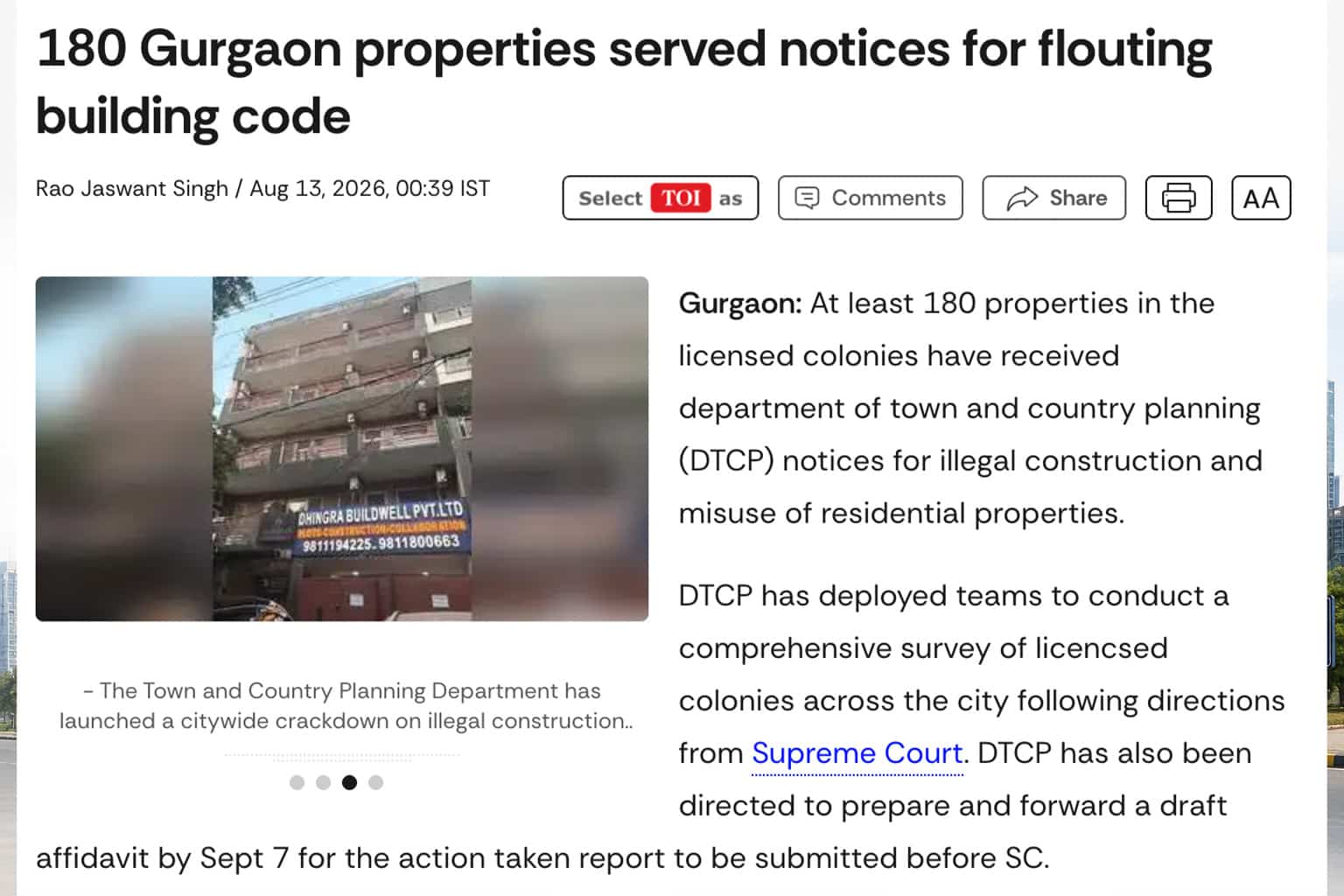
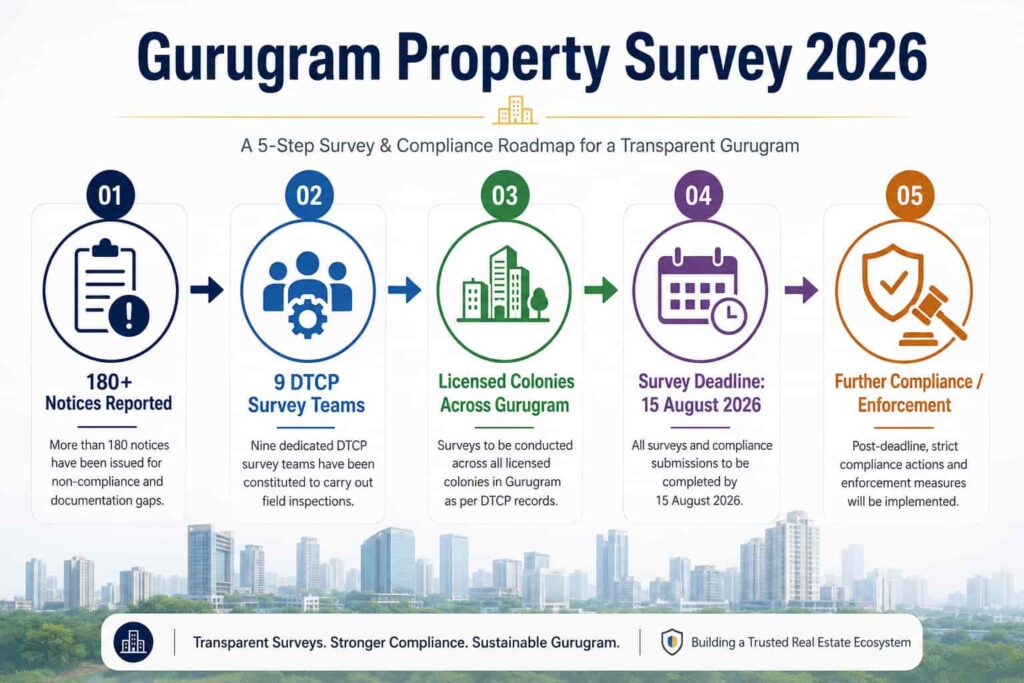
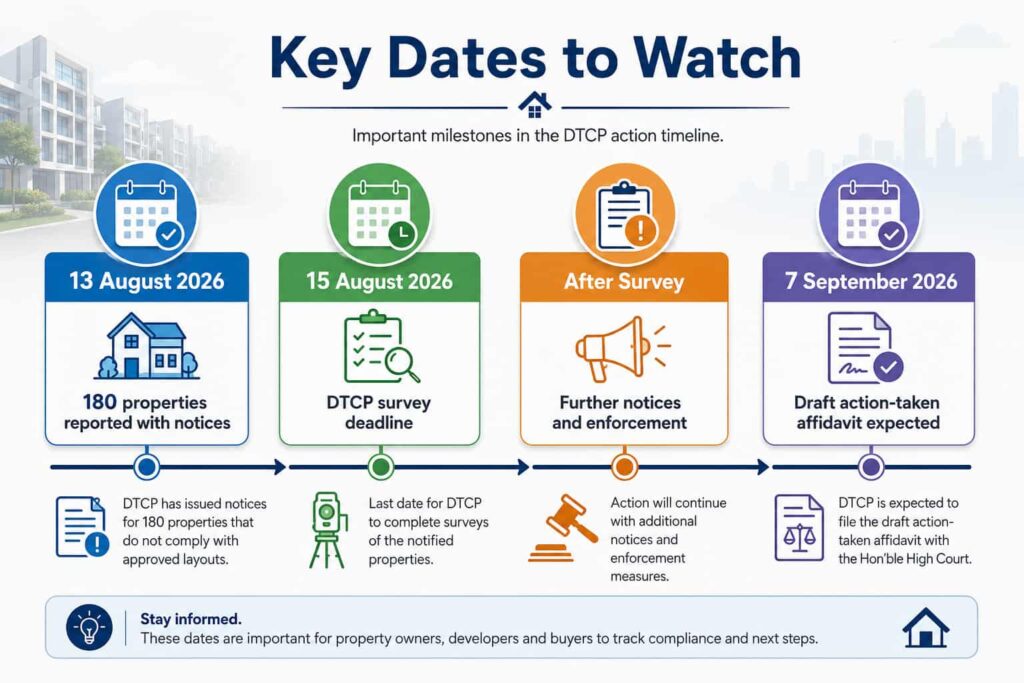
This is bigger than an isolated demolition drive. Nine survey teams have been deployed across Gurugram, and the citywide exercise is scheduled to be completed by 15 August 2026. The crackdown has expanded beyond DLF colonies to several major licensed residential areas.
The most important point for owners is:
Receiving a notice does not automatically mean your property will be demolished. But an established violation that remains unresolved can lead to sealing or demolition, depending on its nature.

Why has Gurugram started this new property survey?
The Town and Country Planning Department has started a comprehensive survey of licensed colonies across Gurugram to identify:
- Unauthorised construction
- Deviations from sanctioned building plans
- Misuse of residential properties
- Zoning violations
- Unauthorised commercial activities
The current exercise follows Supreme Court directions, according to the latest reports. DTCP has also been asked to prepare an action-taken report, with a draft affidavit to be forwarded by 7 September 2026.
Unlike earlier complaint-based enforcement, the current exercise involves teams inspecting wider residential areas and recording violations on the latest approved layout plans.
Which Gurugram areas are under survey?
The survey is not limited to one colony.
DTCP teams have been assigned licensed colonies and sectors covering areas such as:
- Sushant Lok
- South City
- Ardee City
- Rosewood City
- Nirvana Country
- Mayfield Garden
- Greenwood City
- Palam Vihar
- Malibu Towne
- Ramprastha City
- Sobha International City
- Emaar and BPTP areas
Multiple Gurugram sectors are also included in the survey.
This means the current enforcement exercise has a citywide licensed-colony focus, rather than being restricted to the earlier DLF cases.
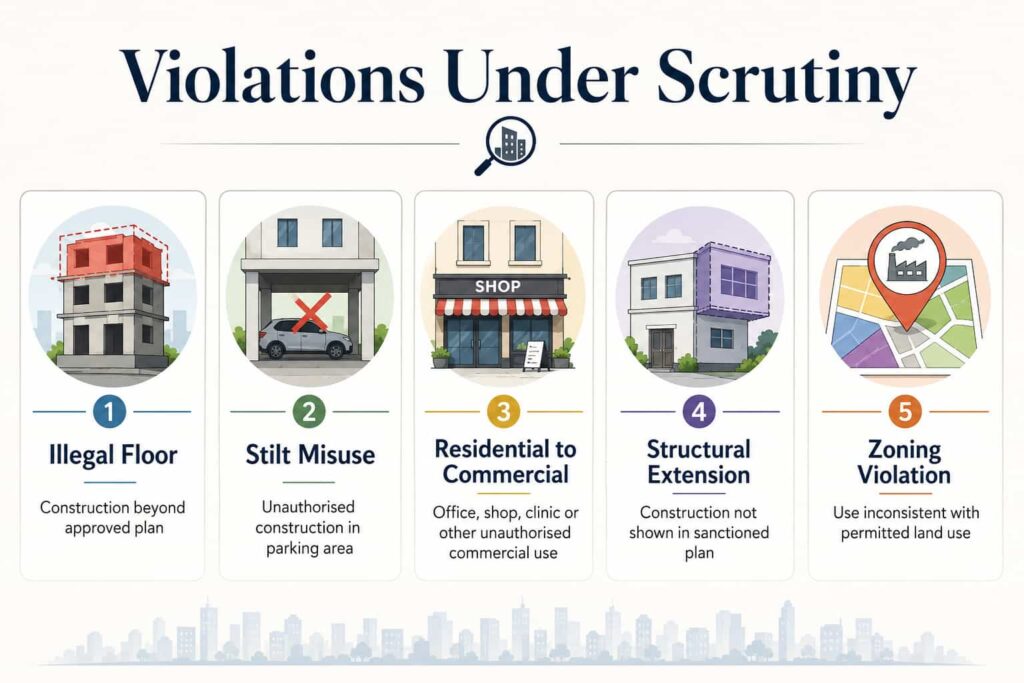
What violations are officials checking?
The survey is particularly important for owners who have modified their property after approval.
1. Construction beyond sanctioned building plan
If the actual building does not match the plan approved by the competent authority, DTCP can identify the deviation during inspection.
2. Illegal construction in stilt parking
Unauthorised structures created inside areas originally approved for stilt parking are specifically among the violations being examined. Reports indicate such illegal construction can face demolition action.
3. Residential property being used commercially
Officials are also checking residential premises being used for activities such as:
- Offices
- Clinics
- Salons
- Showrooms
- Guesthouses
- Paying guest accommodation
- Other commercial establishments
Unauthorised commercial activity in a residential property can potentially lead to sealing.
4. Zoning and land-use violations
Even if a structure physically exists, its actual use must comply with applicable planning and licensing conditions.
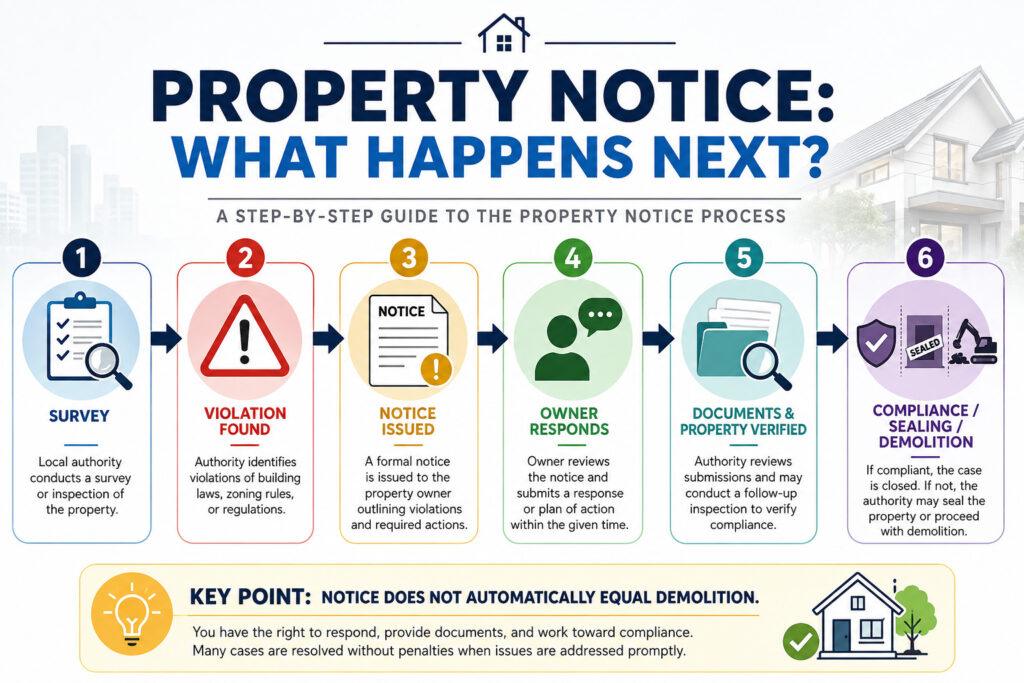
Does a DTCP notice mean demolition is certain?
No.
Reports on the current exercise indicate that properties found violating norms will first receive notices and, where applicable, owners will have an opportunity to respond or comply.
The possible path broadly looks like this:
Violation identified
↓
DTCP notice
↓
Owner response / documents / compliance
↓
Department verification
↓
Further action depending on violation
Serious or unresolved violations may result in sealing or demolition.
In some cases, reports say authorities may also consider action relating to occupation certificates or utility connections where permitted under applicable rules.
Who should check their Gurugram property immediately?
The current drive matters most if your property has:
- An extra floor not shown in the sanctioned plan
- Major construction added after approval
- Stilt parking converted into another use
- Residential space operating as an unauthorised commercial establishment
- Extensions outside approved building limits
- A previous DTCP notice that was never resolved
Owners should compare the actual building on site with the sanctioned building plan rather than relying only on what a seller, broker or previous owner told them.
Buyers should also be careful
This is not only an issue for existing homeowners.
A buyer considering a resale house, builder floor or plotted property in a licensed Gurugram colony should verify whether the construction being purchased actually matches approved records.
A beautifully renovated extra floor can become a liability if it was never legally approved.
Before purchasing, buyers should verify:
Sanctioned building plan
Does the existing construction match it?
Occupation Certificate, where applicable
Check what was actually approved for occupation.
Floor approval
Do not assume every constructed floor is sanctioned.
Property use
Check whether residential space has been converted to commercial use.
Previous DTCP notices
Ask whether any enforcement or restoration notice has been issued.
Stilt parking
Check whether common or parking areas have been enclosed or converted.

What should an owner do after receiving a notice?
Ignoring a DTCP notice can increase risk.
An owner should first understand exactly which construction or use has been questioned.
Then compare:
Approved plan vs actual construction.
Keep relevant documents ready, including sanctioned plans and permissions applicable to the property.
Where the issue involves sealing, demolition or a disputed approval, professional legal or planning advice may be necessary because the outcome depends on the exact violation and applicable rules.
Owners should also avoid carrying out further unauthorised construction while the property is under scrutiny.
Why the 15 August deadline matters?
The current survey teams have been directed to complete the inspection exercise by 15 August 2026 and submit daily reports.
That means the number 180 should not necessarily be treated as the final number of affected properties.
The more important development will be what happens after the wider survey is completed:
- How many additional notices are issued?
- Which violations are treated as serious?
- Which properties receive sealing orders?
- Where is demolition ordered?
- Which owners are allowed to restore compliance?
DTCP’s action-taken reporting process is expected to continue after the survey, with a draft affidavit due by 7 September 2026, according to current reporting.
Gurugram Property Buyer Checklist
Sanctioned Plan | Approved Floors | Occupation Certificate | Stilt Parking | Property Use | DTCP Notice History | Actual Construction
Never judge legality only from the physical condition of the property.
What should an owner do after receiving a notice?
Ignoring a DTCP notice can increase risk.
An owner should first understand exactly which construction or use has been questioned.
Then compare:
Approved plan vs actual construction.
Keep relevant documents ready, including sanctioned plans and permissions applicable to the property.
Where the issue involves sealing, demolition or a disputed approval, professional legal or planning advice may be necessary because the outcome depends on the exact violation and applicable rules.
Owners should also avoid carrying out further unauthorised construction while the property is under scrutiny.
What does this mean for Gurugram property owners?
The bigger story is not simply that 180 properties received notices.
The important change is that Gurugram is now seeing a broader survey of licensed colonies for building-plan and land-use compliance.
For owners, this means construction that remained unnoticed for years may now come under inspection.
For buyers, it makes sanctioned-plan verification even more important before purchasing a builder floor or resale property.
The fresh Gurugram DTCP drive has already resulted in notices to at least 180 properties, while nine teams continue surveying licensed colonies across the city.
The key distinction is simple:
Notice does not automatically mean demolition.
But if authorities establish that a property contains unauthorised construction, building-plan deviations or illegal commercial use and the violation remains unresolved, the case can progress towards sealing or demolition depending on the violation.
For Gurugram property owners and buyers, the safest approach now is:
Check the sanctioned plan → compare it with actual construction → verify property use → check notice history → resolve discrepancies before they become enforcement issues.
Sources:-
Times of India — 13 August 2026: 180 Gurgaon properties served notices for flouting building code.
Times of India — 12 August 2026: After demolitions at DLF colonies, survey on buildings begins at others in Gurgaon.



Leave a Reply