

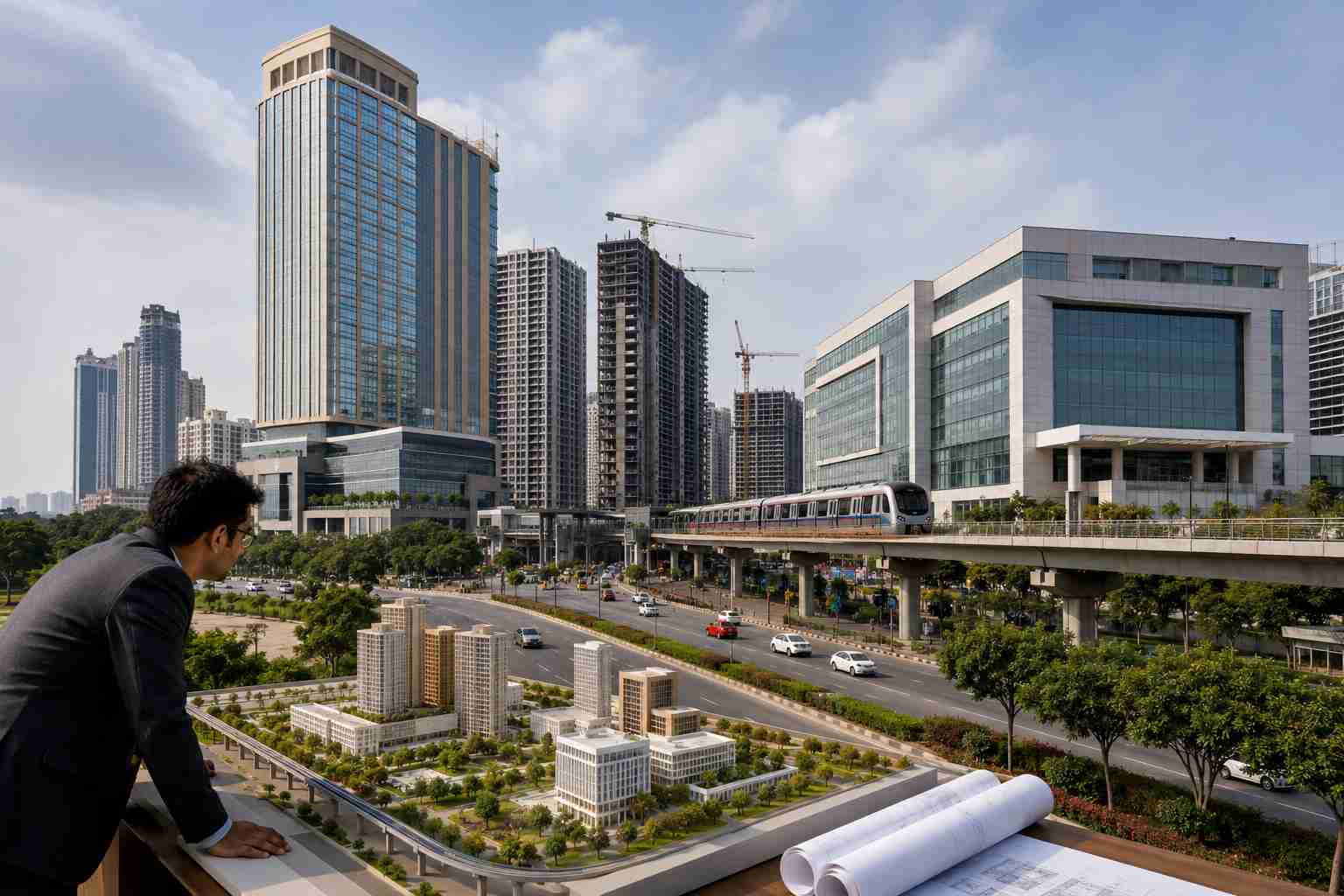
Delhi’s real estate story is no longer only about selling land, building flats or launching housing schemes. A new shift is becoming visible in the capital’s urban planning model. The Delhi Development Authority is now looking at long-term land monetisation, where public land is not sold permanently but leased for a long period through an annual licence fee structure.
This shift has come into focus because DDA is expected to generate more than ₹29,700 crore over 55 years from three major projects in Dwarka. These projects include a five-star hotel in Sector 23, a transit-oriented development project in Sector 22 and a 600-bed super-speciality hospital in Sector 9. For a city where land is limited and demand for better infrastructure is rising, this is not just a revenue story. It is also a signal of how Delhi may plan its future growth.
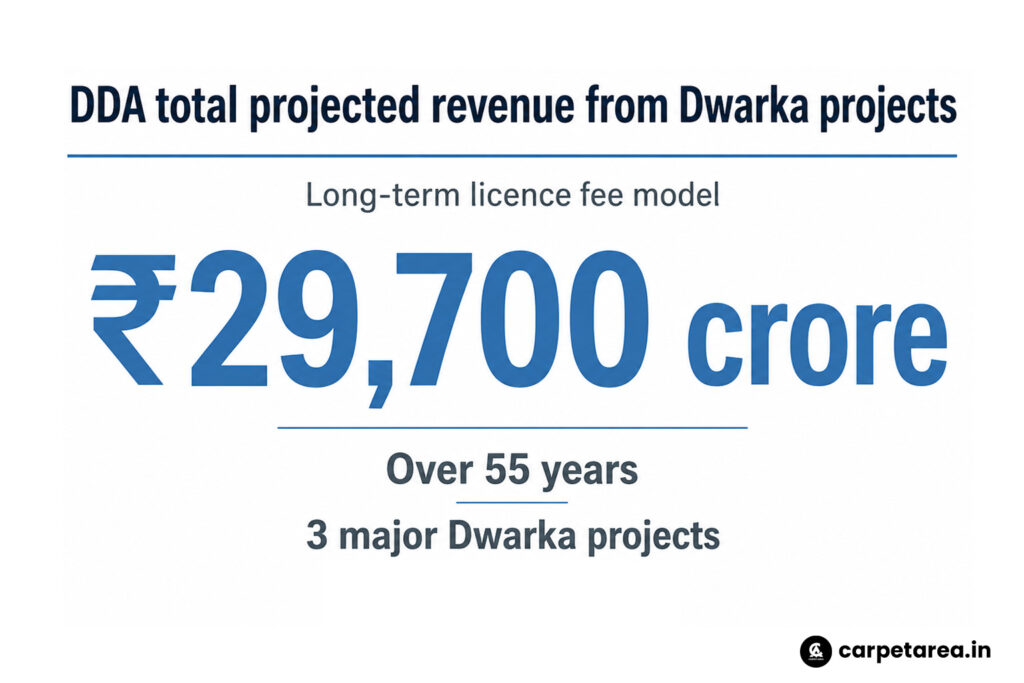
The most important point here is that DDA is trying to unlock the value of land without giving up ownership. Traditionally, public authorities have often raised money by selling land parcels or offering long leasehold rights. That gives immediate revenue but also reduces long-term control over valuable urban land. In this new model, the land remains with the authority, while private players develop and operate projects through a licence structure.
This is why the Dwarka plan deserves close attention. DDA is not just earning from one project. It is creating a recurring revenue pipeline spread across decades. According to the reported details, revenue will come through annual licence fees determined through competitive bidding, while the authority retains control over public land. This makes the model financially attractive for DDA and strategically important for city planning.
Dwarka is also a logical location for such a move. Over the years, Dwarka has grown from a residential sub-city into a larger urban zone with metro access, airport proximity, road connectivity and institutional development. Recent reports also suggest that DDA wants Dwarka, Rohini and Narela to be developed as decentralised economic hubs, with focus areas such as IT, IT-enabled services, healthcare, digital infrastructure and other non-polluting industries.
The first project is the five-star hotel in Sector 23. It is planned on nearly 2.5 acres and is expected to have at least 200 rooms. The project has reportedly been awarded at an annual licence fee of ₹16.1 crore plus GST and has a construction deadline of 42 months. Over the full licence period, it is expected to generate nearly ₹6,370 crore for DDA.
For Dwarka, this hotel is more than a hospitality project. A large hotel can support business travel, conferences, tourism and airport-linked demand. If planned well, it can improve the commercial identity of the area and support nearby retail, food, transport and service businesses. This is important because successful sub-cities need more than housing. They need employment, hospitality, healthcare, offices and social infrastructure.
The second project is the transit-oriented development project in Sector 22. This is especially important because it is described as Delhi’s first TOD project to be auctioned under the annual licence fee model. Spread over about 10.4 acres, it is expected to include a luxury shopping mall, corporate office spaces and residential units. The project has been awarded at an annual licence fee of ₹27.5 crore plus GST and is expected to generate around ₹10,887 crore over the lease tenure.
Transit-oriented development can become a powerful urban planning tool if executed properly. The basic idea is to encourage mixed-use development around public transport so that people can live, work, shop and access services without depending only on private vehicles. In a city like Delhi, where traffic congestion and pollution remain long-term concerns, TOD can help create denser, better-connected and more efficient urban pockets.


However, TOD should not be seen only as a real estate opportunity. It has to be backed by walkable streets, safe public spaces, last-mile connectivity, parking management and strong civic infrastructure. Without these, a mixed-use project can become another traffic-heavy commercial cluster. With them, it can become a better model for future urban growth.
The third and biggest revenue-generating project is the 600-bed super-speciality hospital in Sector 9. It is planned on nearly 9.3 acres and has reportedly been awarded to Apollo Hospitals Enterprise Ltd. The project is expected to be completed within 48 months. With an annual licence fee of ₹33.3 crore plus GST, the hospital alone is projected to contribute nearly ₹12,522 crore over 55 years.
This hospital can become a major civic asset for Dwarka and surrounding regions. Large healthcare infrastructure does not only serve patients. It creates jobs for doctors, nurses, technicians, support staff, administration teams and service providers. It can also increase demand for nearby housing, rentals, retail and daily services. For homebuyers and investors, such social infrastructure often becomes an important long-term value driver.
The larger story is that DDA seems to be treating land as a long-term public asset rather than a one-time sale opportunity. This matters because Delhi has limited land and high demand. If every valuable land parcel is sold, the public authority gets money once but loses future flexibility. A licence-based model allows the authority to earn recurring revenue while still keeping ownership with itself.
For real estate watchers, this also shows how government land-owning agencies may increasingly use public-private partnership models to build urban infrastructure. Private developers and operators get access to valuable locations, while the authority gets long-term income and the city gets new facilities. But the success of this model will depend on execution, transparency and public benefit.
There are also questions that need to be watched carefully. Will these projects be completed on time? Will the hospital remain accessible to a wider section of residents or become only a premium facility? Will the TOD project genuinely reduce travel dependence or simply add more commercial density? Will the hotel and mall create meaningful local economic activity? These questions will decide whether the Dwarka plan becomes a model for Delhi or just another high-value land monetisation exercise.
For homebuyers, this development is important because infrastructure changes the character of a location. A residential area with strong healthcare, hotels, offices, retail and transport becomes more complete over time. For investors, the signal is that Dwarka is being positioned as more than a housing market. It is being pushed as a larger commercial, healthcare and urban infrastructure destination.
At the same time, buyers should not treat revenue projections as an immediate price-growth guarantee. ₹29,700 crore is a long-term estimate spread over 55 years. Real estate value will depend on project completion, surrounding infrastructure, demand, accessibility, civic maintenance and overall market conditions. The smart way to read this news is not as a quick property-price trigger, but as a long-term urban direction.
DDA’s Dwarka plan is therefore important because it connects three major themes: public land monetisation, private-sector participation and decentralised urban growth. If implemented well, it can strengthen Dwarka’s position as a major urban hub in Delhi. If poorly executed, it may remain only a financial projection on paper.
For now, the message is clear. Delhi is trying to create more value from limited land without selling it permanently. Dwarka is becoming one of the key testing grounds for that strategy. And for anyone tracking Delhi real estate, urban planning or commercial development, this is a story worth following closely.

Leave a Reply