


For homebuyers in Ghaziabad, the Madhuban Bapudham Residential Plot Scheme 2026 is an important update because it gives applicants a chance to apply for residential plots through Ghaziabad Development Authority. Unlike apartment projects where the buyer gets a flat, this scheme is about land ownership in a planned residential layout.
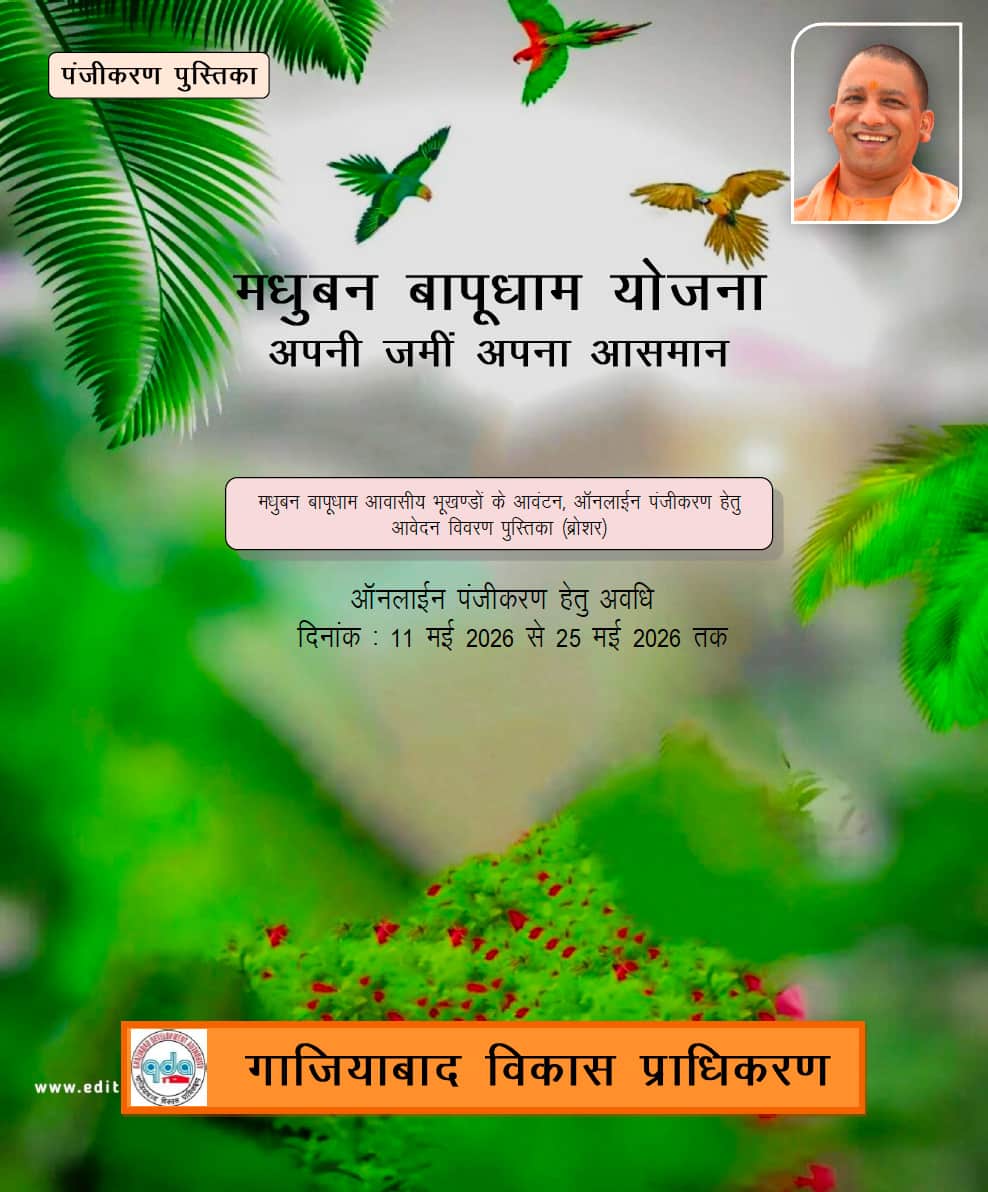
The scheme is named Madhuban Bapudham Residential Plot Scheme, Ghaziabad, and the official scheme code mentioned in the brochure is 935. The online registration window is from 11 May 2026 to 25 May 2026. This makes the timeline very important because applicants have a limited period to complete registration and submit documents.
The first thing buyers should understand is eligibility. The applicant must be an Indian citizen and should be above 18 years of age. The brochure also says the applicant or family member should not already have certain allotted residential property in the Ghaziabad area, and should not have more than one residential house or plot in Uttar Pradesh allotted by GDA, Awas Vikas Parishad or other government departments.
The scheme offers plots in different sizes. The listed categories include 200 sq m, 150 sq m, 120 sq m, 115 sq m, 112.50 sq m, 90 sq m, 60 sq m and 40 sq m. The number of plots mentioned in the table is 24, 49, 24, 12, 44, 60, 61 and 76 respectively. This adds up to 350 estimated plots, but buyers should remember that the brochure clearly states that plot numbers may increase or decrease.

Price is the biggest point for buyers. The allotment rate mentioned in the brochure is ₹35,000 per sq m across the listed plot categories. Based on the table, the minimum reserved price starts from ₹14 lakh for a 40 sq m plot and goes up to ₹70 lakh for a 200 sq m plot. The 60 sq m plot is shown at ₹21 lakh, 90 sq m at ₹31.50 lakh, 112.50 sq m at ₹39.37 lakh, 115 sq m at ₹40.25 lakh, 120 sq m at ₹42 lakh, and 150 sq m at ₹52.50 lakh.

However, buyers should not look only at the base plot price. The brochure says the quoted rates do not include the freehold charge. A 12% freehold charge plus GST will be payable separately on the plot value. This can increase the final cost, so buyers should calculate the total outgo before applying.
The registration amount also changes by category of applicant. For general category applicants, the registration amount is 10% of the plot value. For reserved category applicants under ST/SC, the registration amount is 5%. For example, for a 200 sq m plot priced at ₹70 lakh, the general registration amount is shown as ₹7 lakh and the reserved category amount is shown as ₹3.5 lakh.

The payment structure after allotment is also important. After reservation or allotment, a general category applicant has to deposit 15% of the plot value, while a reserved category applicant has to deposit 20% within one month from the date of issue of the allotment letter. The remaining 75% is payable in eight quarterly instalments at SBI’s current MCLR plus 1% ordinary interest.

There is also a penalty for delay. If instalments are not paid by the due date, the buyer has to pay with interest at MCLR plus 1% plus 2% penal interest. If payment is not made for three months, the allotment can be cancelled without prior notice, and time extension requests will not be accepted. This is a serious condition and should be understood before applying.
The scheme also offers a benefit for applicants who pay the remaining amount in one go after allotment. The brochure mentions 6% discount if payment is made within 45 days, 5% discount within 60 days, and 4% discount within 90 days. This can help buyers who have ready funds, but the discount should be calculated only as per GDA’s final computation.

The allotment process will be through a lottery draw. The brochure says all categories of plots will be allotted through lottery, and the information will be published through national and local newspapers. The lottery result will be displayed on the authority’s notice board and GDA website. The allotment letter can be downloaded after 15 working days from the date of lottery from the GDA website or registration portal.
For applicants interested in smaller plots, one important income condition is mentioned. For the 40 sq m and 60 sq m LIG category plots, applicants with annual income between ₹3 lakh and ₹6 lakh can apply. If the annual income is more than ₹6 lakh, the applicant will not be eligible for these plot categories.
The application process is online only. The brochure can be obtained by paying ₹1,100 including GST online during the registration period. Applications have to be submitted through the GDA website or the Janhit UPDA portal. Required uploads include applicant photographs, Aadhaar card, PAN card, scanned signature, reservation category certificate, and affidavit copy in the prescribed format.
Refund rules also need attention. Before the lottery draw, there is no normal provision for refund of registration money. For unsuccessful applicants after allotment, if registration money is refunded within three months after the registration period, no interest is payable. If refund takes more than three months, simple interest at 4% annually is payable on the deposited registration amount.
Possession will not be immediate. The brochure says possession of the plot will be given after 36 months from the allotment date, after full payment of plot value and other dues and after registration. This means buyers should treat this as a planned plot investment with a defined possession condition, not an instant possession plot.
For homebuyers, the scheme can be attractive because plotted development usually gives flexibility. A plot can allow future self-construction, long-term holding and better control over design. But the buyer must study cost carefully: base price, registration amount, freehold charge, GST, instalment interest, maintenance charges and any location-based premium.
The larger takeaway is simple. The GDA Madhuban Bapudham Plot Scheme 2026 offers a structured opportunity for buyers looking for residential plots in Ghaziabad. But it is not enough to look at only the plot size and price. Applicants must check eligibility, payment capacity, lottery rules, refund terms, possession timeline and extra charges before applying.
In short, this is a useful opportunity for serious buyers, but only those who understand the conditions should apply. A government authority plot scheme can offer confidence, but the responsibility of reading the brochure carefully still remains with the buyer.



Leave a Reply