


Ageing does not always mean losing independence, confidence or purpose.
For many people, later life becomes a period of better judgement, clearer priorities and stronger emotional balance. The real challenge is that while the person changes, the home, routine, finances and support system often remain designed for a younger stage of life.
A large house may become difficult to maintain. Stairs may become unsafe. Children may live in another city or country. Medical appointments may increase. Retirement income may need to support not only daily expenses but also medicines, home modifications and professional care.
That is why healthy ageing requires more than positive thinking.
It requires a practical redesign of:
- the home;
- health and mobility;
- retirement finances;
- relationships;
- daily purpose;
- future care.
The objective is not to make a senior dependent. It is to create an environment that protects independence for as long as possible.
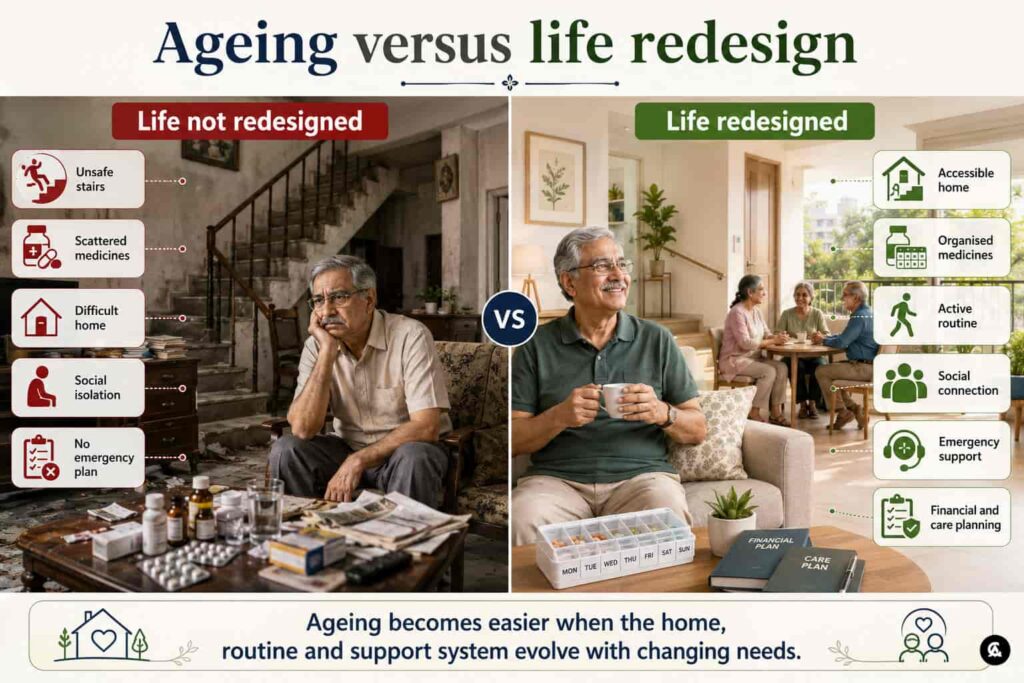
What does ageing as a redesign actually mean?
Ageing as a redesign means making deliberate changes before a crisis forces the family to act.
It may involve:
- moving the bedroom to the ground floor;
- installing bathroom grab bars;
- reducing unnecessary household responsibilities;
- organising medicines;
- creating an emergency contact system;
- strengthening retirement income;
- rebuilding social routines;
- discussing future care preferences.
This is not an admission of weakness.
It is similar to redesigning a business, property or lifestyle when circumstances change. The objective is to make the next phase more suitable, efficient and secure.
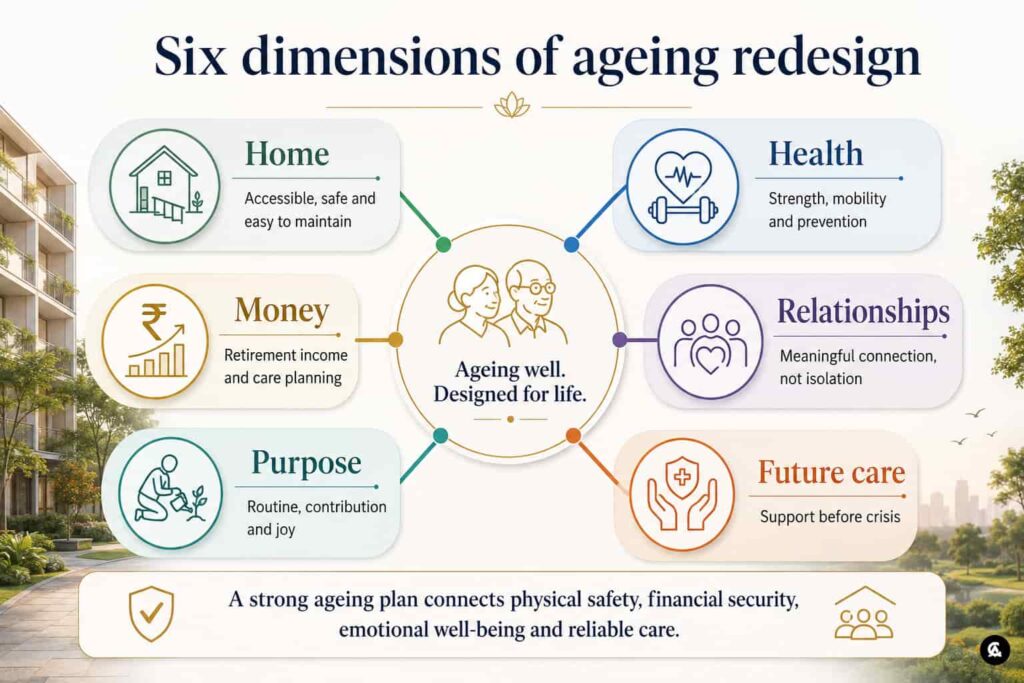
The six areas every family should redesign
A practical ageing plan should address six connected areas:
- Home and accessibility
- Health and mobility
- Money and retirement security
- Relationships and social connection
- Purpose and daily routine
- Future care and emergency support
Ignoring one area can affect the others.
For example, an unsuitable home may increase fall risk. A fall may increase medical expenses. Reduced mobility may increase isolation. Isolation may weaken emotional well-being.
Ageing should therefore be planned as a complete life system, not as a collection of separate problems.
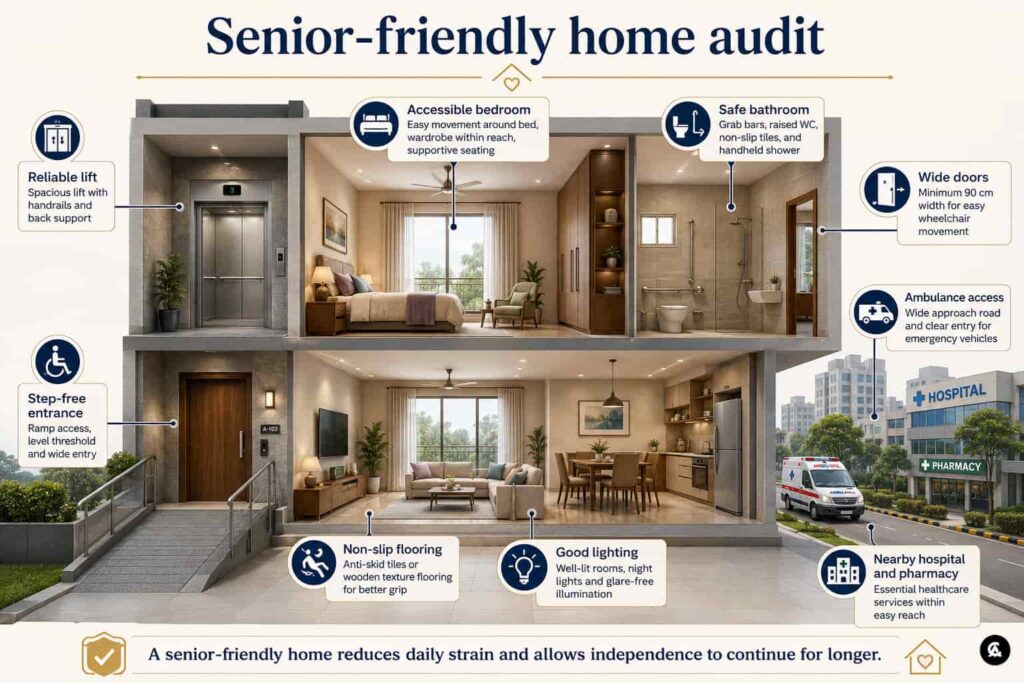
Redesign 1: Make the home suitable for ageing
Most Indian homes are selected during the working years.
The family may prioritise:
- additional bedrooms;
- school access;
- office commute;
- parking;
- social status;
- future property appreciation.
These priorities may change after retirement.
A senior-friendly home should support:
- safe movement;
- reduced physical strain;
- quick emergency access;
- manageable maintenance;
- proximity to healthcare;
- everyday independence.
Entrance and building safety
Check:
- Is there a step-free entrance?
- Can a ramp be installed?
- Is the lift reliable?
- Is power backup available for the lift?
- Can an ambulance reach the main entrance?
- Are corridors and staircases properly lit?
- Is security available at all hours?
A home may be excellent from an investment perspective but unsuitable for ageing because of difficult access or unreliable building services.
Bedroom suitability
The bedroom should preferably:
- be available without climbing stairs;
- be close to a bathroom;
- have space for a walker;
- allow access from both sides of the bed;
- have switches within easy reach;
- provide good ventilation and natural light.
A ground-floor or same-level bedroom can prevent unnecessary relocation after illness or surgery.
Bathroom safety
Bathrooms are among the highest-risk areas for older adults.
Check whether the bathroom has:
- non-slip flooring;
- grab bars;
- a shower chair;
- adequate lighting;
- a hand shower;
- a raised toilet seat, where required;
- a door that can be opened during an emergency.
A visually attractive bathroom is not automatically senior-friendly.
Kitchen and daily-use areas
Frequently used items should be easy to reach.
Avoid:
- high shelves;
- unstable stools;
- slippery flooring;
- heavy storage doors;
- poor lighting.
The kitchen should allow a senior to prepare simple meals without unnecessary bending or climbing.
Location matters as much as home design
A senior-friendly property should ideally be near:
- a hospital;
- a pharmacy;
- grocery shops;
- public transport;
- trusted relatives or friends;
- domestic-help services;
- open spaces;
- social or community facilities.
A beautiful home in an isolated location may become difficult to manage when driving is no longer practical.
Should seniors downsize to a smaller home?
Downsizing can improve life when a large property has become:
- expensive to maintain;
- physically difficult to manage;
- far from healthcare;
- mostly unused;
- socially isolating;
- dependent on multiple domestic workers.
A smaller, accessible home may offer:
- lower maintenance;
- easier movement;
- better security;
- simpler housekeeping;
- proximity to services;
- greater financial flexibility.
However, downsizing is not suitable in every case.
The family should consider:
- emotional attachment;
- neighbourhood relationships;
- space required for a caregiver;
- visits from children;
- storage needs;
- resale and transaction costs;
- adjustment to a new community.
The correct decision is not always “move to a smaller home.”
The correct decision is to select a property that remains manageable, safe and meaningful.
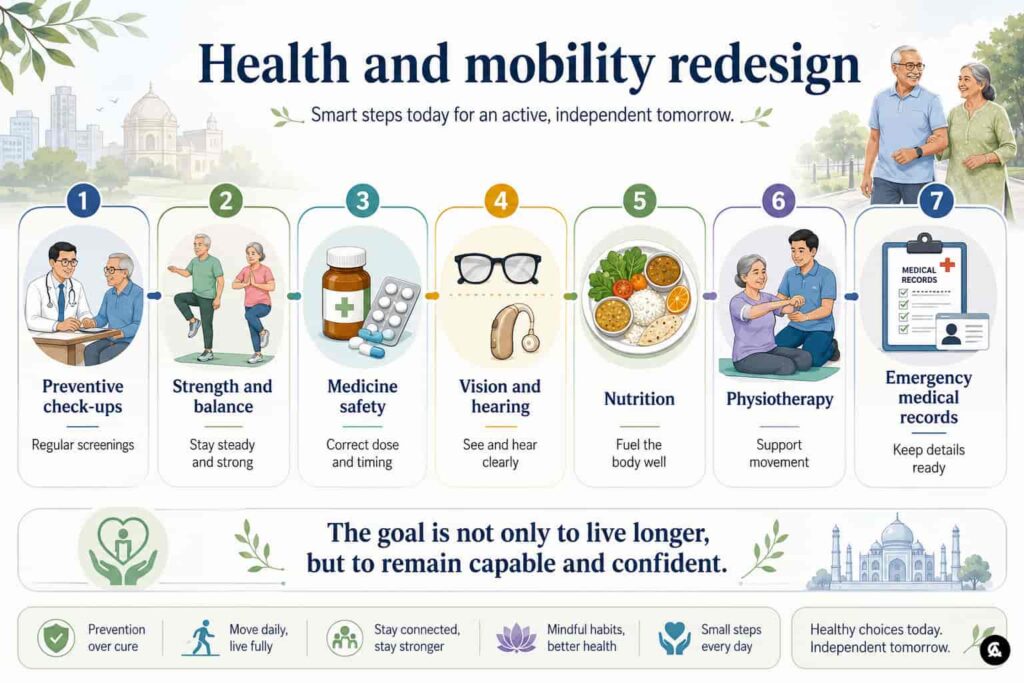
Redesign 2: Protect health and mobility before a crisis
Healthy ageing is not limited to treating illness.
The objective should be to preserve:
- strength;
- balance;
- flexibility;
- vision;
- hearing;
- memory;
- confidence in daily movement.
A practical health plan may include:
- regular medical check-ups;
- medicine reviews;
- strength and balance exercises;
- walking;
- physiotherapy;
- vision and hearing checks;
- dental care;
- vaccination;
- sleep management;
- proper nutrition.
Why mobility planning matters
Reduced mobility can affect more than movement.
It can also reduce:
- social interaction;
- independence;
- confidence;
- access to healthcare;
- participation in family activities.
Small changes can help:
- using a suitable walking aid;
- improving footwear;
- adding handrails;
- removing loose rugs;
- arranging transport;
- choosing a home near daily services.
Mobility support should be seen as a tool for independence, not as a symbol of decline.
Medicine management should be organised
Families should create a clear system for:
- medicine names;
- timing;
- dosage;
- refills;
- doctor instructions;
- allergies;
- emergency medicines.
Useful tools may include:
- pill organisers;
- reminder alarms;
- medicine charts;
- digital records;
- caregiver supervision.
Repeated medicine mistakes should not be ignored.
They may indicate the need for stronger supervision or a professional care assessment.
Redesign 3: Plan retirement money for real future needs
Many retirement plans focus on:
- household expenses;
- travel;
- social life;
- regular medical insurance.
They may not fully account for the future cost of support.
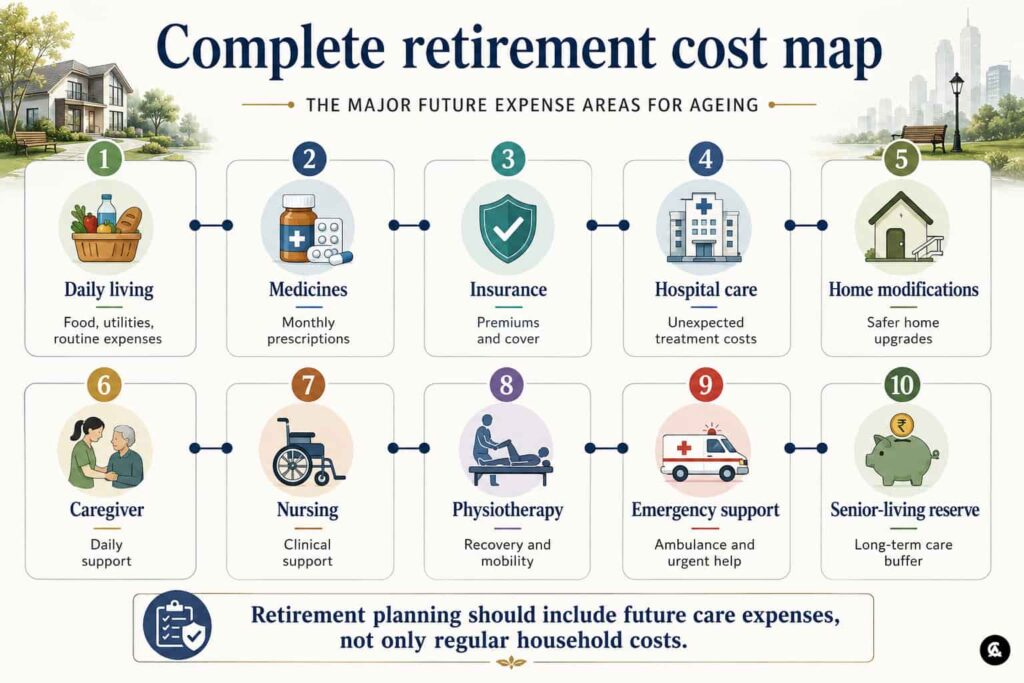
A complete retirement plan should include:
- medicines;
- medical tests;
- insurance premiums;
- hospital expenses;
- home modifications;
- caregiver costs;
- nursing support;
- physiotherapy;
- emergency transport;
- assisted-living expenses;
- inflation.
The hidden cost of ageing at home
Remaining at home may involve separate expenses for:
- attendant or caregiver;
- cook;
- housekeeping;
- nurse;
- physiotherapist;
- maintenance;
- utilities;
- home repairs;
- emergency response;
- accessibility modifications.
These costs should be calculated together.
Comparing only a caregiver’s salary with the monthly cost of senior living gives an incomplete picture.
Create three financial reserves
A practical retirement plan can be divided into three reserves.
1. Regular living reserve
For:
- food;
- utilities;
- maintenance;
- transport;
- personal expenses.
2. Healthcare reserve
For:
- medicines;
- insurance;
- consultations;
- tests;
- hospitalisation.
3. Long-term care reserve
For:
- attendants;
- home nursing;
- physiotherapy;
- home modifications;
- assisted living;
- memory care;
- nursing care.
The third reserve is often the most neglected.
Both spouses should understand the finances
In many families, only one spouse understands:
- bank accounts;
- investments;
- insurance;
- property papers;
- pension details;
- tax matters;
- digital passwords.
This creates serious risk.
Both spouses should know:
- where documents are stored;
- how income is received;
- which bills must be paid;
- whom to contact;
- how emergency funds can be accessed.
Financial independence is an important part of dignified ageing.
Redesign 4: Build meaningful relationships without social overload
Ageing often changes social preferences.
A senior may no longer enjoy:
- large gatherings;
- unnecessary obligations;
- constant social activity;
- stressful relationships.
Choosing fewer meaningful relationships can be healthy.
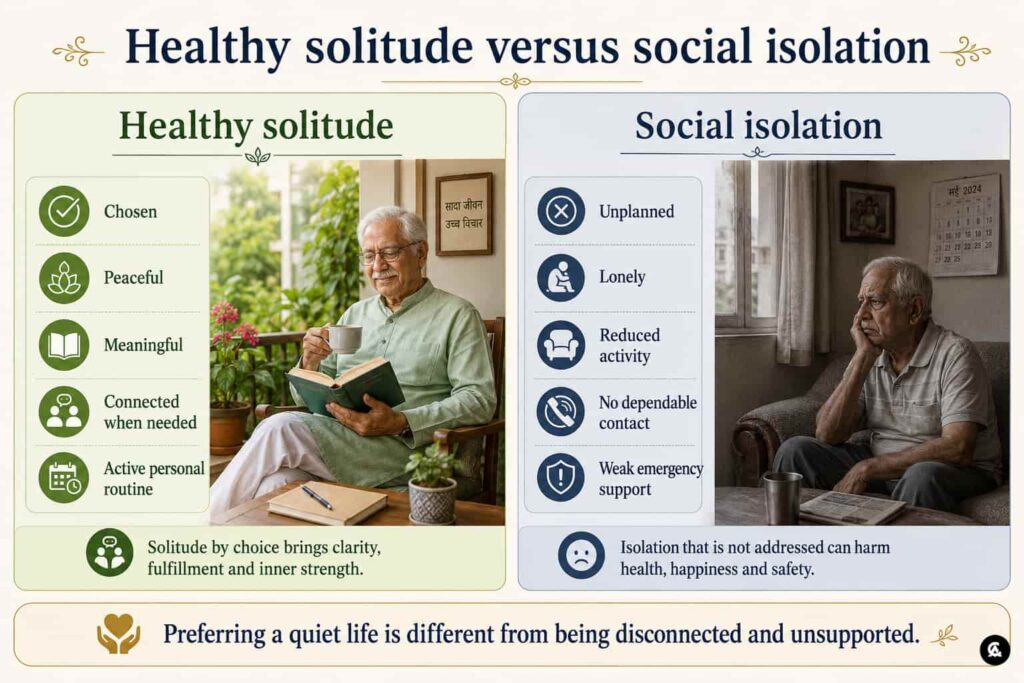
However, there is a major difference between:
- peaceful solitude; and
- harmful isolation.
Healthy solitude may look like:
- enjoying personal time;
- reading;
- gardening;
- prayer;
- music;
- creative work;
- independent routines;
- choosing meaningful company.
Social isolation may look like:
- no regular conversations;
- avoiding all visitors;
- eating alone every day;
- losing interest in activities;
- being unable to leave the house;
- depending on one person for all interaction;
- feeling forgotten.
Families should respect a senior’s preference for peace while ensuring that genuine isolation does not develop unnoticed.
Ways to maintain social connection
Useful options include:
- neighbourhood groups;
- volunteering;
- cultural associations;
- religious communities;
- hobby clubs;
- walking groups;
- scheduled family calls;
- community dining;
- senior-living activities;
- mentoring younger people.
Social connection does not require a large circle.
It requires regular, meaningful engagement.
Redesign 5: Create purpose after retirement
Work gives people more than income.
It may provide:
- routine;
- identity;
- social interaction;
- responsibility;
- achievement;
- recognition.
After retirement, the sudden loss of structure can create emptiness.
A meaningful later life should include activities that offer:
- responsibility;
- learning;
- connection;
- contribution;
- enjoyment.
Possible options include:
- mentoring;
- consulting;
- teaching;
- volunteering;
- gardening;
- writing;
- music;
- photography;
- travel;
- spiritual study;
- family-history documentation;
- community work.
Purpose does not have to generate income.
It should give the day direction.
Create a weekly routine, not just a daily schedule
A useful weekly plan may include:
- physical activity;
- social interaction;
- learning;
- family time;
- outdoor activity;
- personal reflection;
- rest.
A balanced routine can prevent the days from becoming repetitive and empty.
Redesign 6: Discuss future care before it becomes urgent
Many families avoid discussing care because they fear upsetting their parents.
As a result, decisions are often taken during:
- hospital discharge;
- a serious fall;
- sudden memory decline;
- caregiver breakdown;
- an emergency relocation.
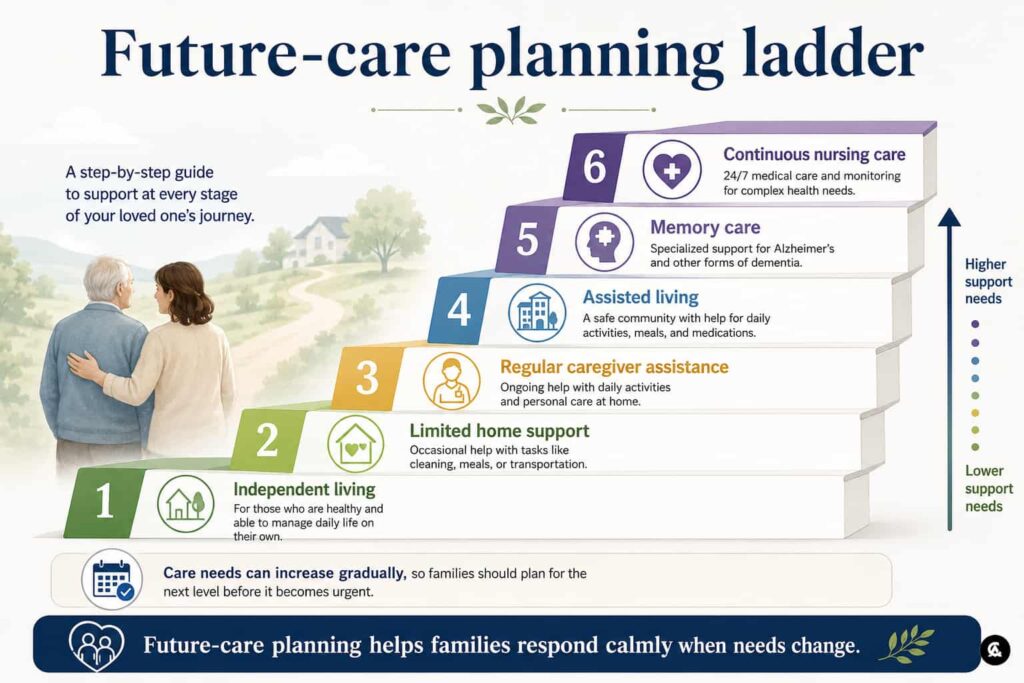
Planning early gives the senior more control.
The discussion should include:
- preference for ageing at home;
- willingness to accept a caregiver;
- assisted-living options;
- preferred hospitals;
- emergency contacts;
- financial limits;
- location preferences;
- medical wishes;
- legal and financial documents.
Future-care planning does not take away choice.
It protects choice before an emergency reduces the available options.
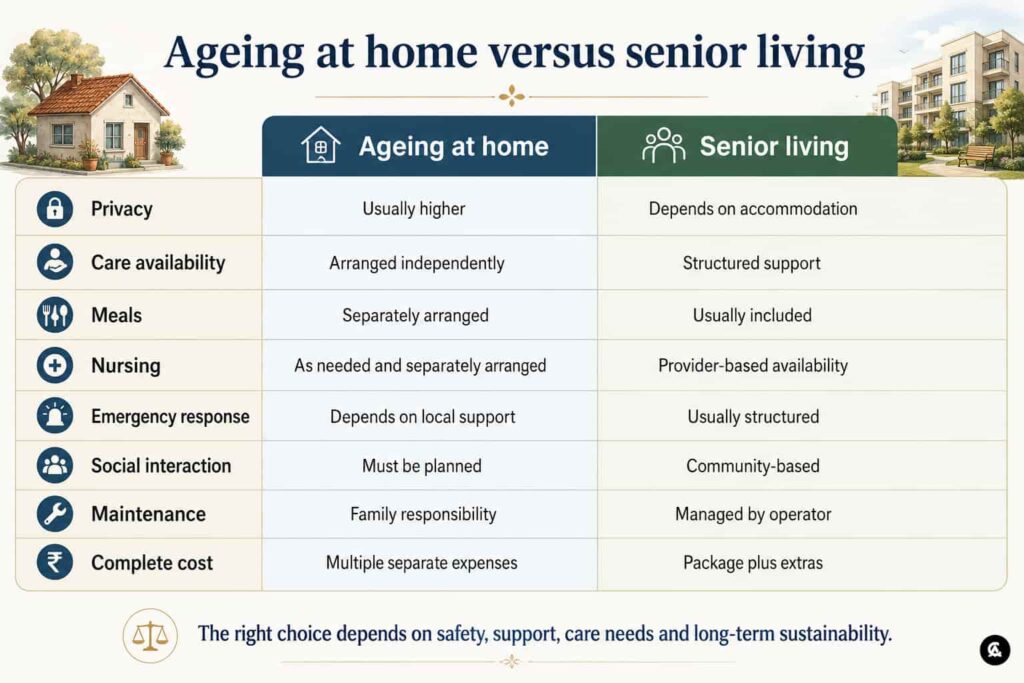
Ageing at home versus senior living
There is no universal answer.
Both options can work when they are properly planned.
| Factor | Ageing at home | Senior living |
|---|---|---|
| Familiarity | Existing home and neighbourhood | Requires adjustment |
| Privacy | Usually higher | Depends on accommodation |
| Maintenance | Family responsibility | Managed by operator |
| Meals | Separately arranged | Usually included |
| Care | Arranged independently | Based on provider capability |
| Emergency response | Depends on local support | Usually structured |
| Social interaction | Must be planned | Community-based |
| Medical coordination | Family-managed | May be available |
| Cost | Multiple separate expenses | Package plus extras |
| Family involvement | Often high | Shared with provider |
When ageing at home may work well
It may be suitable when:
- the home is accessible;
- medical needs are manageable;
- family or professional support is reliable;
- the senior is socially connected;
- emergency help is available;
- the cost is sustainable.
When senior living may become more practical
It may be suitable when:
- daily assistance is recurring;
- the home is unsafe;
- the senior is isolated;
- emergency response is weak;
- medical coordination is becoming difficult;
- the main caregiver is exhausted;
- the family lives far away.
Senior living should not be seen as a failure of family care.
In some cases, it can provide a safer and more structured environment.
Ageing roadmap by decade
Ageing should not be planned only after retirement.
Different decades require different priorities.
In your 40s
Focus on:
- healthy habits;
- retirement savings;
- health insurance;
- debt management;
- choosing adaptable property;
- maintaining professional and social networks.
In your 50s
Focus on:
- reducing major debt;
- reviewing retirement income;
- checking home suitability;
- organising health records;
- understanding future care costs;
- discussing retirement expectations.
In your 60s
Focus on:
- building a meaningful routine;
- maintaining strength and mobility;
- simplifying finances;
- strengthening social connection;
- organising emergency contacts;
- making the home safer.
In your 70s and beyond
Focus on:
- daily support;
- medicine management;
- emergency response;
- accessible housing;
- transport;
- continuity of care;
- caregiver sustainability.
The hidden cost of delaying the redesign
Families often delay action because the senior appears to be managing.
However, delayed planning may lead to:
- emergency home renovation;
- rushed caregiver hiring;
- expensive hospital discharge arrangements;
- forced relocation;
- family conflict;
- caregiver burnout;
- financial pressure;
- limited choice of suitable facilities.
A calm decision made early is usually better than an urgent decision made after a crisis.
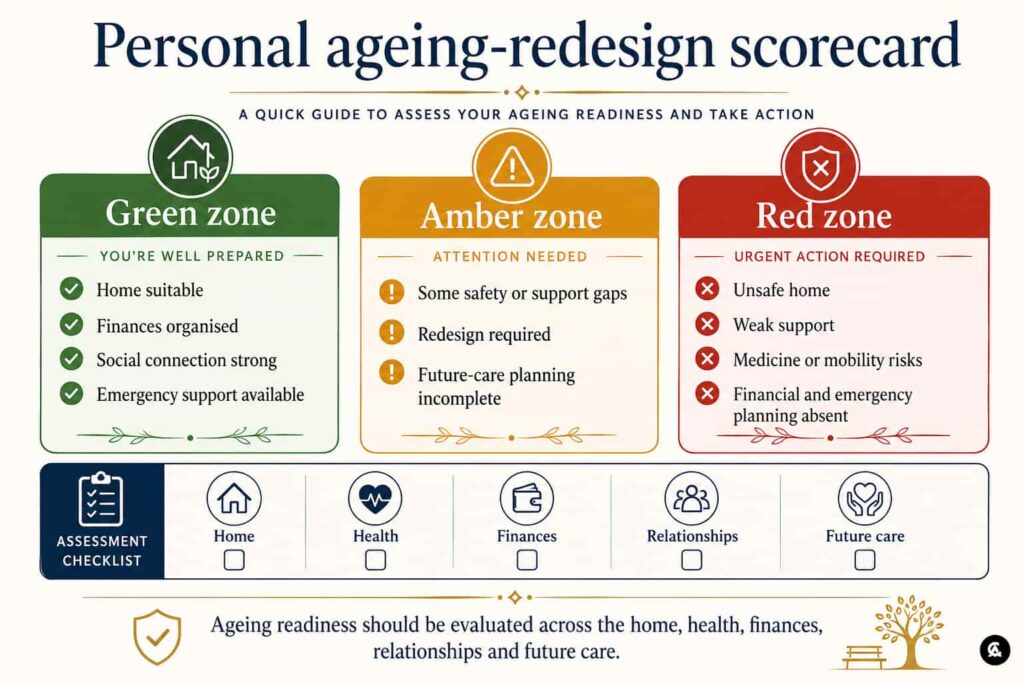
Personal ageing-redesign checklist
Answer each question with Yes, Needs attention or No.
| Question | Assessment |
|---|---|
| Is the home safe for reduced mobility? | |
| Can the senior access the bedroom without difficult stairs? | |
| Is the bathroom senior-friendly? | |
| Are medicines properly organised? | |
| Is emergency help available? | |
| Is the hospital reasonably close? | |
| Is there meaningful weekly social interaction? | |
| Is retirement income sufficient for future care? | |
| Do both spouses understand the finances? | |
| Are legal and medical documents organised? | |
| Is a reliable local support person available? | |
| Has the family discussed future-care preferences? |
How to understand the result
Mostly Yes
The present system appears suitable, but it should be reviewed regularly.
Several “Needs attention” answers
A planned redesign is required. Address housing, financial and support gaps before they become serious.
Several No answers
The current arrangement may be vulnerable. A professional home-safety, medical, financial and care assessment should be considered.
Frequently asked questions
Does ageing automatically mean losing independence?
No.
Many seniors remain active and independent for years. Independence depends on health, housing, mobility, support and planning—not age alone.
Can a senior remain independent while receiving help?
Yes.
Support with housekeeping, transport, meals or medicines can preserve independence by reducing unnecessary risk and physical strain.
When should a family start planning for future care?
Planning should begin before an emergency. The senior should participate while they can clearly express their preferences.
Is downsizing always better after retirement?
No.
Downsizing helps when a large property is difficult to maintain or unsafe. Emotional attachment, family visits, caregiver space and neighbourhood support should also be considered.
Is living alone the same as being lonely?
No.
Some seniors enjoy living alone and remain socially connected. Concern arises when the person lacks meaningful contact, emergency help or the ability to participate in daily life.
Can home modifications delay relocation?
Yes, in some cases.
Ramps, grab bars, better lighting, accessible bathrooms and a same-level bedroom can improve safety. Medical and cognitive needs must still be considered.
Is senior living only for dependent seniors?
No.
Senior living can include independent communities, assisted living, memory care and nursing care. Each model serves a different level of need.
Carpet Area verdict
Ageing is not simply a period of decline.
It is a stage in which the home, routine, finances and relationships may need to be redesigned around new priorities.
The strongest ageing plan is not the one that tries to preserve every old arrangement unchanged.
It is the one that protects:
- safety;
- dignity;
- independence;
- financial security;
- social connection;
- personal purpose;
- continuity of care.
A senior-friendly life does not remove freedom.
It removes avoidable obstacles.
Families should therefore ask:
Is the current home and lifestyle capable of supporting the next 10 or 20 years?
When the answer is uncertain, the right time to redesign is before a crisis—not after one.
Important disclaimer
This article provides general educational information. It does not replace medical, legal, financial, architectural or professional care advice.
Families should consult qualified doctors, financial advisers, accessibility specialists and senior-care professionals before making major health, housing or care decisions.
- World Health Organization — Age-friendly environments
Supports the discussion on housing, transport, physical surroundings and social environments affecting healthy ageing. - World Health Organization — Creating age-friendly cities and communities
Useful for sections on accessible communities, social participation and supporting older people at risk of falls or isolation. - World Health Organization — Social isolation and loneliness
Supports the distinction between meaningful solitude and harmful social isolation. - World Health Organization — Reducing social isolation and loneliness among older people
Explains how community groups, social support, transport and communication can reduce isolation. - National Institute on Aging — Aging in Place: Growing Older at Home
Supports the ageing-at-home section, emergency-alert systems, home support and planning for changing needs. - National Institute on Aging — Home Safety Tips for Older Adults
Useful for ramps, handrails, lighting, grab bars, non-slip surfaces and fall-risk reduction. - National Institute on Aging — Falls and Falls Prevention
Supports the sections on mobility, home hazards, fall prevention and maintaining independence. - National Institute on Aging — Falls and Fractures in Older Adults
Explains how medicines, dizziness, confusion and environmental hazards may increase fall risk. - National Institute on Aging — Taking Medicines Safely as You Age
Supports the medicine-management, dosage, side-effect and prescription-organisation sections. - National Institute on Aging — Maintaining Mobility and Preventing Disability
Useful for explaining why mobility affects independence, social participation and quality of life. - CDC — Healthy Aging at Any Age
Supports the idea that healthy ageing starts before old age and includes physical, mental and social well-being. - CDC — Physical Activity for Older Adults
Supports recommendations related to aerobic activity, muscle strengthening and balance exercises. - CDC — Older Adult Fall Prevention
Useful for the fall-prevention and independence sections. - CDC — Social Connectedness for Older Adults
Supports the discussion on reduced mobility, chronic illness, living alone and social isolation risks. - Alzheimer’s Association — Home Safety for Alzheimer’s and Dementia
Useful for home lighting, safe walkways, medicine storage and dementia-related home precautions. - Alzheimer’s Association — Wandering and Dementia
Supports the future-care and memory-care sections, particularly where wandering or confusion affects safety. - Alzheimer’s Association — Technology Safety for Older Adults
Useful for GPS, location sharing and technology-based safety support.




Leave a Reply