

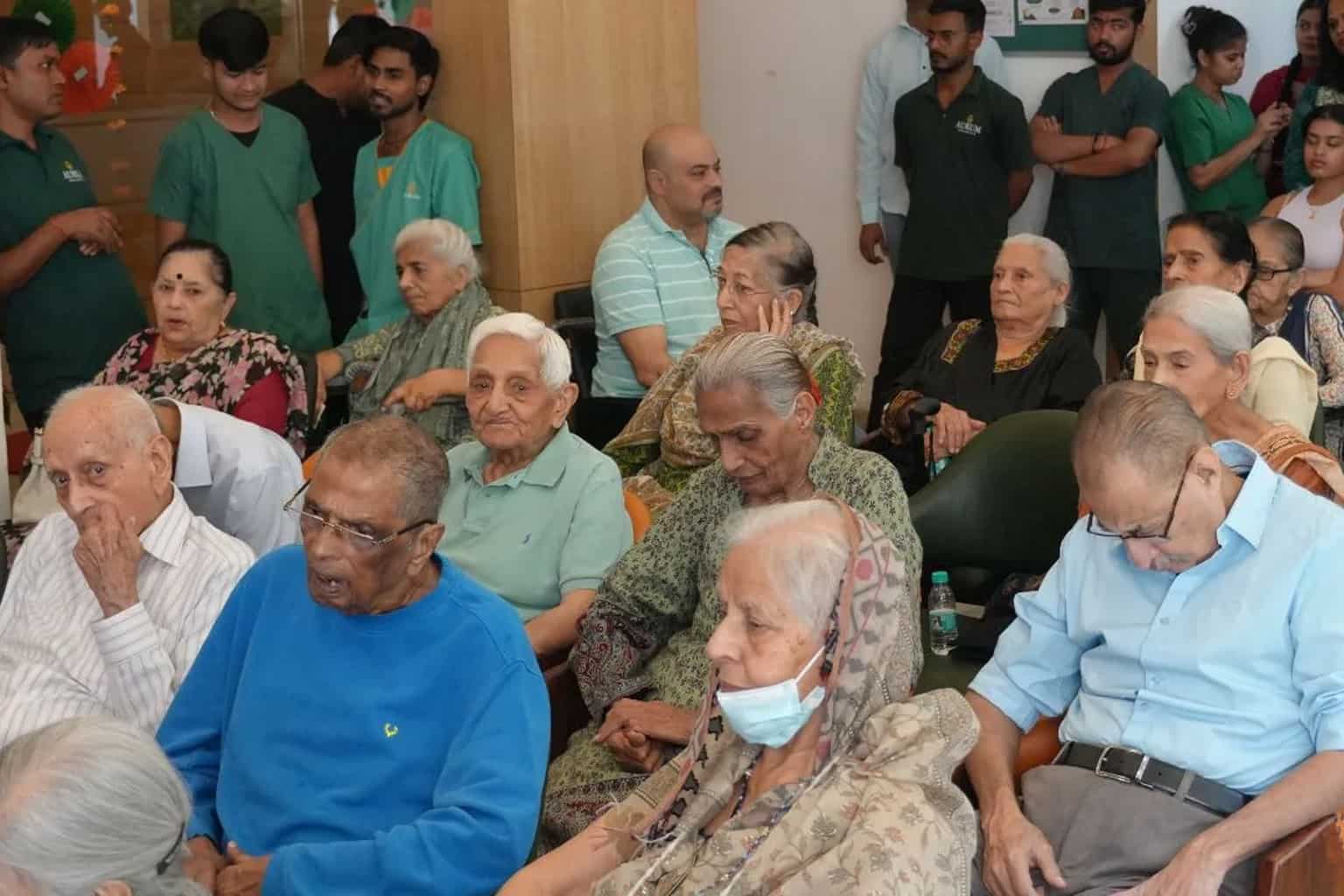
The monthly cost of an assisted-living facility in India can surprise families.
When a provider quotes ₹60,000, ₹80,000 or more than ₹1 lakh per month, the immediate reaction is often:
Why does one room for a senior cost so much?
That question is understandable.
However, assisted living should not be compared only with hotel accommodation, rented housing or the salary of one domestic helper.
A properly operated assisted-living facility may combine:
- Accommodation
- Housekeeping
- Meals
- Personal-care assistance
- Medication management
- Nursing support
- Emergency coordination
- Physiotherapy
- Social activities
- Security
- Family communication
At the same time, families should not accept a high monthly charge merely because the facility uses words such as premium care, personalised support or 24×7 medical assistance.
The correct question is not:
Is ₹80,000 expensive?
The correct questions are:
What is included in ₹80,000, which services cost extra and how will the monthly bill change if the senior’s care needs increase?
This Carpet Area guide explains assisted-living costs in India from the family’s perspective.
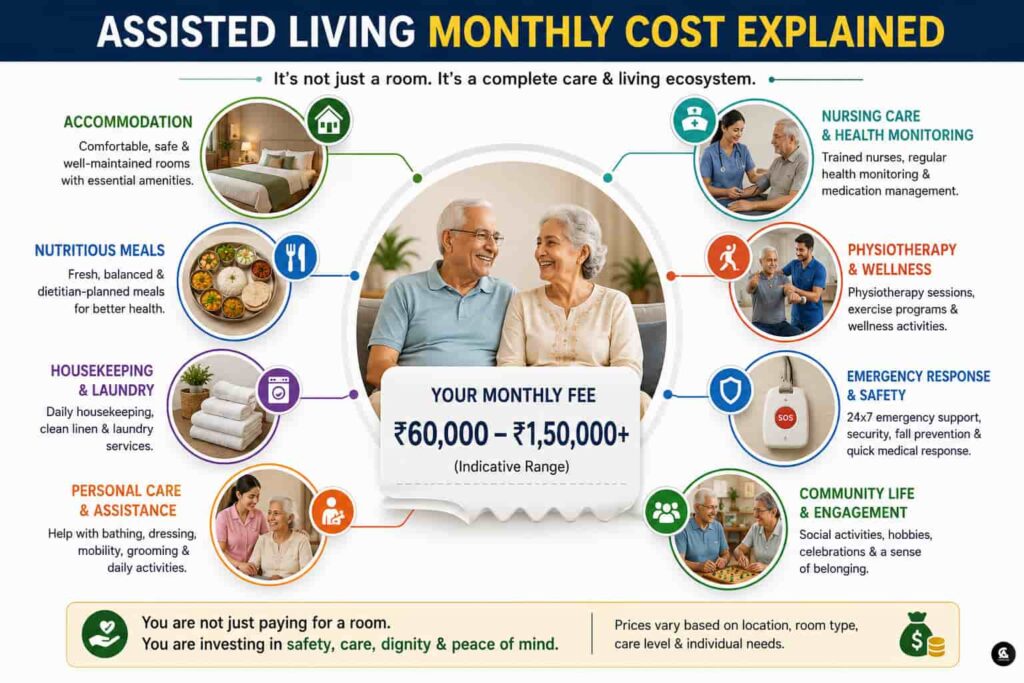
How much does assisted living cost in India?
India does not have one standard assisted-living tariff.
Pricing changes according to:
- City
- Location
- Room category
- Single or shared occupancy
- Length of stay
- Senior’s mobility
- Personal-care requirements
- Nursing needs
- Dementia or memory-care requirements
- Need for a dedicated attendant
Current provider-published examples show how widely prices can vary.
Artha Senior Care advertises care plans beginning at ₹69,999 per month, excluding GST. It states that the final amount is decided after a medical assessment and depends on room occupancy, care level and duration of stay.
Epoch Elder Care currently states that its assisted-living pricing begins at ₹1,00,000 plus GST per month. The final fee varies according to occupancy, stay duration and the assessed care requirement.
Antara’s Delhi NCR cost guide places assisted-living accommodation with nursing and medical monitoring broadly between approximately ₹60,000 and ₹1.5 lakh per month, depending on the service level and property category.
These are indicative market examples, not a uniform national rate.
A family may therefore encounter:
| Broad category | Indicative monthly positioning |
|---|---|
| Shared room with lower care needs | Around ₹60,000–₹80,000 |
| Private room with assisted care | Around ₹80,000–₹1.2 lakh |
| High-dependency or specialised care | ₹1.2 lakh–₹1.5 lakh or more |
| Dedicated attendant or complex care | May exceed standard packages |
Actual quotations must be obtained directly from the selected facility.
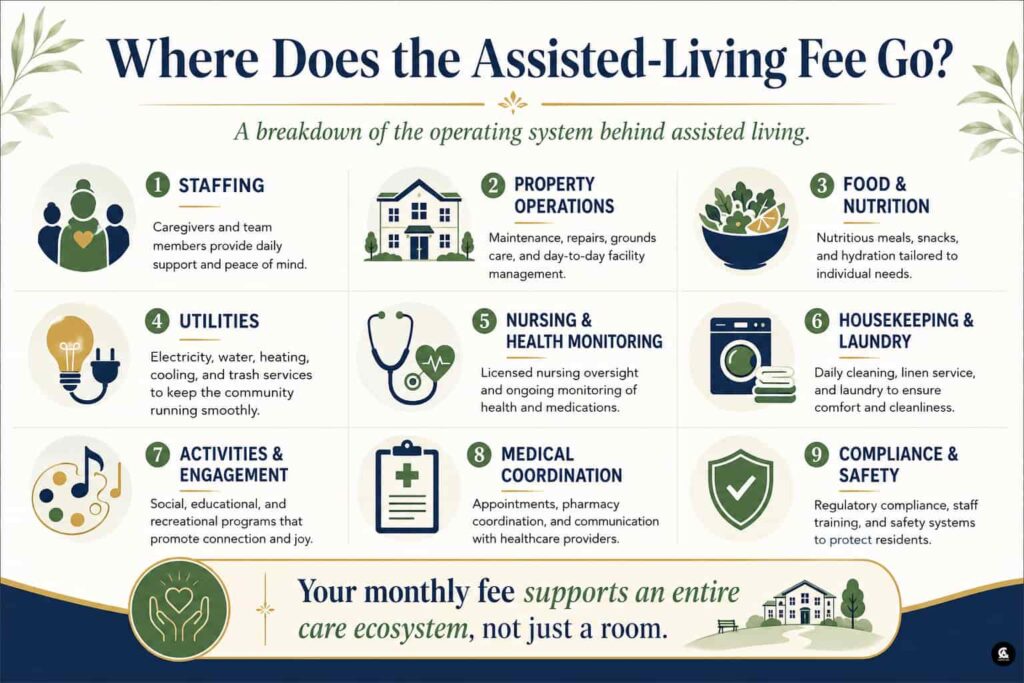
Why can the monthly fee be high?
An assisted-living operator is not charging only for the physical room.
It may need to maintain:
- Caregivers across multiple shifts
- Qualified nurses
- Facility managers
- Housekeeping staff
- Kitchen teams
- Security
- Activity coordinators
- Physiotherapy support
- Doctor coordination
- Emergency-response systems
The Jeevin Senior Care article uses an illustrative example of a 50–60-room facility requiring caregivers, nursing personnel, kitchen staff, management, physiotherapy and activity staff, in addition to security and other operating expenses. It uses this example to argue that a ₹50,000 starting charge may be operationally understandable.
However, families should not assume that every facility charging ₹50,000 or ₹1 lakh actually maintains the same staffing structure.
Ask the operator to disclose:
- Total number of residents
- Number of caregivers per shift
- Number of nurses during the day
- Number of nurses at night
- Whether the doctor is resident or on call
- Staff leave-replacement system
- Number of high-dependency residents
A long employee list is not the same as a strong resident-to-staff ratio.
What should be included in the basic monthly package?
Every provider structures its tariff differently.
A reasonably comprehensive package may include:
Accommodation
- Furnished room
- Bed and storage
- Air-conditioning
- Basic electricity
- Wi-Fi
- Attached or shared bathroom
Food and hospitality
- Regular meals
- Snacks
- Housekeeping
- Laundry
- Linen changes
- Common-area maintenance
Basic care
- Assistance with bathing
- Dressing support
- Mobility assistance
- Medication reminders
- Help with meals
- Basic health monitoring
Community and engagement
- Group activities
- Festivals
- Exercise
- Games
- Social interaction
- Spiritual or recreational programmes
Basic medical coordination
- Nursing observation
- Medication records
- Emergency escalation
- Communication with the family
- Coordination with a hospital or doctor
Epoch’s published starting package states that it includes round-the-clock care, assistance with activities of daily living, nutrition, medication management, nursing, activities and housekeeping.
This does not mean that every provider includes all these services at its entry price.
The written quotation should clearly state:
Included, excluded and chargeable when used.
What is usually charged separately?
The largest billing surprises often come from add-on services.
Potential additional charges include:
- Dedicated personal attendant
- Advanced nursing procedures
- Physiotherapy sessions
- Doctor consultations
- Specialist visits
- Medicines
- Diapers
- Gloves
- Dressings
- Catheters
- Medical equipment
- Ambulance use
- Hospital accompaniment
- Special diet
- Oxygen
- Laboratory tests
- GST
- Admission charges
- Refundable deposit
- Emergency petty cash
Artha, for example, publishes a starting monthly charge but separately lists a ₹20,000 admission fee, a ₹2.5 lakh refundable security deposit and a ₹25,000 petty-cash reserve.
A ₹69,999 headline price should therefore not automatically be interpreted as the complete amount required before admission.
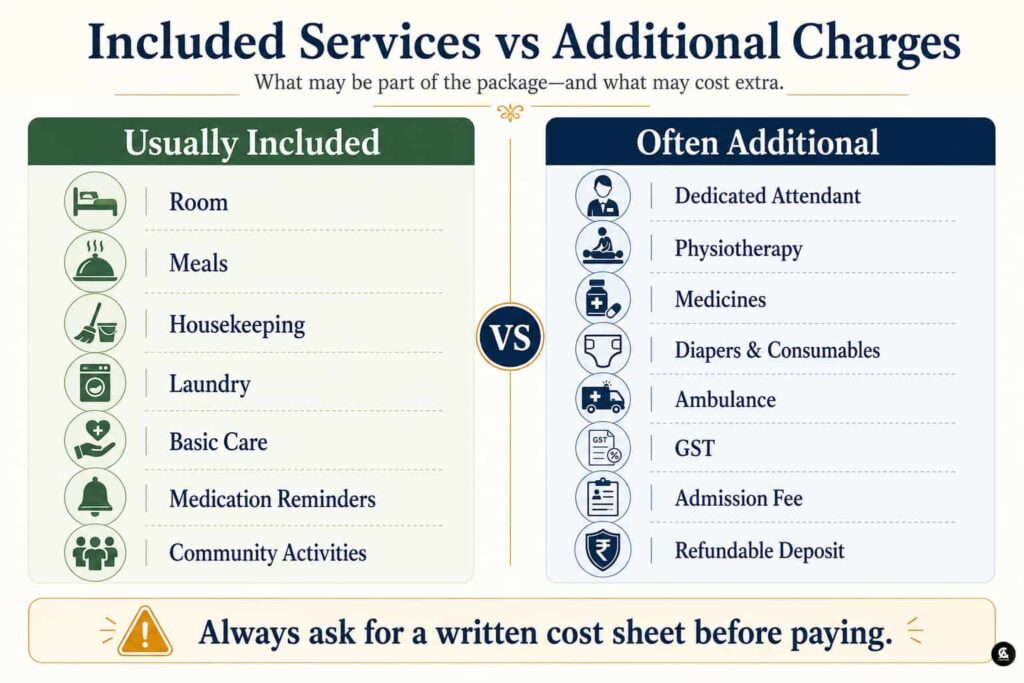
Request a complete cost sheet
Before paying any deposit, ask the provider to complete this table:
| Cost component | Included? | Additional charge | Monthly or one-time |
| Room and accommodation | |||
| Electricity and Wi-Fi | |||
| Meals and snacks | |||
| Housekeeping | |||
| Laundry | |||
| Bathing and dressing support | |||
| Medication management | |||
| Nursing | |||
| Dedicated attendant | |||
| Physiotherapy | |||
| Doctor visits | |||
| Special diet | |||
| Medicines | |||
| Medical consumables | |||
| Ambulance | |||
| Hospital attendant | |||
| GST | |||
| Admission fee | |||
| Security deposit | |||
| Petty cash |
The quotation should remain valid for a defined period.
It should also state:
- Refund policy
- Notice period
- Annual fee revision
- Deposit-deduction rules
- Hospitalisation policy
- Room-holding charges
- Conditions for shifting care categories
Room type can significantly change the cost
Assisted-living facilities may offer:
- Single occupancy
- Double occupancy for a couple
- Twin sharing with another resident
- Studio
- Suite
- High-dependency room
- Memory-care room
A shared room may reduce the accommodation portion of the fee.
However, care charges may remain similar if the resident still requires:
- Bathing assistance
- Night supervision
- Nursing
- Incontinence support
- Feeding help
- Frequent monitoring
Do not assume that sharing a room reduces the complete bill proportionately.
Care level is often more important than room size
Most professionally managed facilities assess the senior before confirming the tariff.
Providers may classify residents into:
- Low-support care
- Medium-support care
- High-support care
- Dementia care
- Palliative care
- Post-hospital rehabilitation
Artha states that its care plans are determined through a medical assessment and distinguishes between low, medium and high levels of support.
Epoch similarly states that care levels and final service fees depend on medical condition, mobility, emotional dependence, night-time routine and the amount of continuous attention required.
Two residents living in identical rooms may therefore receive very different quotations.
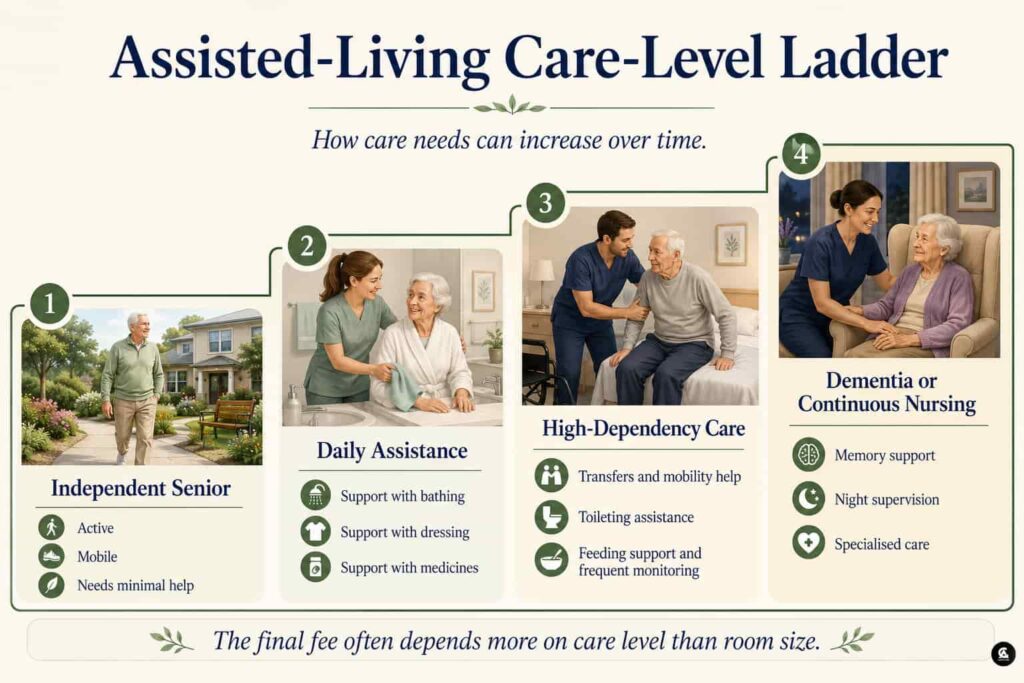
How does the cost increase as the senior becomes dependent?
A senior may enter assisted living while relatively independent.
Over time, they may require:
- Help getting out of bed
- Bathing assistance
- Toileting support
- Feeding
- Wheelchair transfers
- Night-time supervision
- Incontinence care
- Dementia support
- Dedicated nursing
This may lead to:
- Higher care-level fee
- Dedicated attendant charge
- Additional consumables
- Special medical equipment
- More frequent doctor visits
- Higher nursing cost
- Transfer to a specialised care area
Before admission, ask:
- What are the current care categories?
- What is the fee for each category?
- Who decides that the care level has changed?
- Is the family informed before the tariff is revised?
- Can the resident remain in the same room?
- Does the facility provide dementia and high-dependency care?
- What happens if the facility can no longer manage the resident?
A low entry price becomes meaningless if the family cannot afford the higher care category later.
Is assisted living cheaper than care at home?
There is no universal answer.
The comparison depends on what the senior needs.
Possible cost of home care
A home-based setup may require:
- Daytime caregiver
- Night caregiver
- Nurse
- Food
- Electricity
- Housekeeping
- Physiotherapy
- Doctor visits
- Medical equipment
- Staff replacement
- Emergency coordination
The Jeevin article estimates a daytime nursing professional at approximately ₹30,000–₹35,000 and adds food, electricity and nutrition support to demonstrate that home care can reach a similar monthly cost.
However, that comparison should be treated only as an illustration.
It may not include:
- Night support
- Housekeeping
- Rent or property maintenance
- Physiotherapy
- Ambulance
- Medical consumables
- Replacement caregivers
- Social engagement
What assisted living may provide more efficiently?
A managed community may share the cost of:
- Nursing staff
- Security
- Kitchen
- Activities
- Emergency systems
- Housekeeping
- Common facilities
It can also provide companionship that may be difficult to recreate at home.
What home care may provide better?
Home care may offer:
- Familiar surroundings
- Family proximity
- Personal routine
- Greater privacy
- No relocation stress
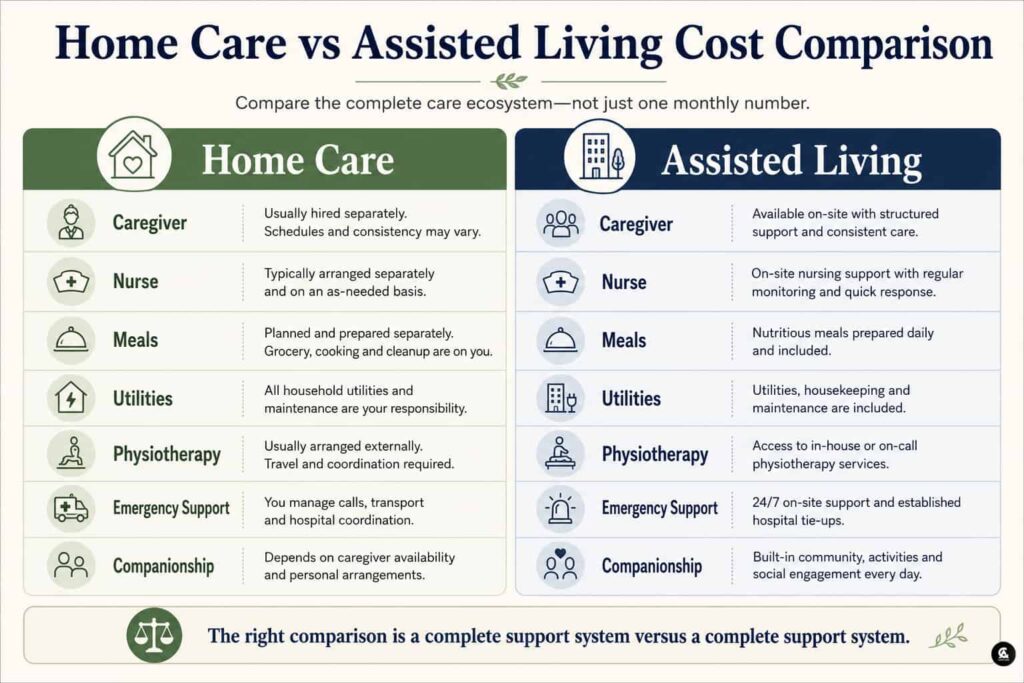
The right comparison is not:
One caregiver’s salary versus the assisted-living fee.
It is:
Complete home-care ecosystem versus complete assisted-living ecosystem.
When can assisted living offer better value?
It may offer better value when the senior:
- Lives alone
- Needs regular supervision
- Requires medication support
- Feels socially isolated
- Needs accessible infrastructure
- Has children living in another city or country
- Requires coordinated meals and activities
- Needs short-term post-hospital recovery
It may not be the right solution when:
- The senior strongly wishes to remain at home
- Reliable family and professional care already exist
- Care needs are minimal
- The monthly fee is financially unsustainable
- The facility cannot manage the senior’s condition
- The senior dislikes community living
Affordability must be considered over years, not only for the first month.
Does a higher price guarantee better care?
No.
A high tariff may reflect:
- Expensive location
- Larger room
- Luxury interiors
- Lower occupancy
- Premium food
- Higher staffing
- Specialised clinical care
But it can also reflect branding and real-estate cost.
Families should verify quality through measurable indicators:
- Caregiver-to-resident ratio
- Nurse availability
- Staff qualifications
- Night staffing
- Medication records
- Emergency-response time
- Resident hygiene
- Food quality
- Activity participation
- Family communication
- Complaint handling
The Government of India’s Ministry of Social Justice and Empowerment has issued minimum standards for senior citizen homes covering benchmarks for their establishment and operation, including infrastructure, healthcare, recreation and resident welfare.
Families should still verify how those principles are implemented at the specific property.
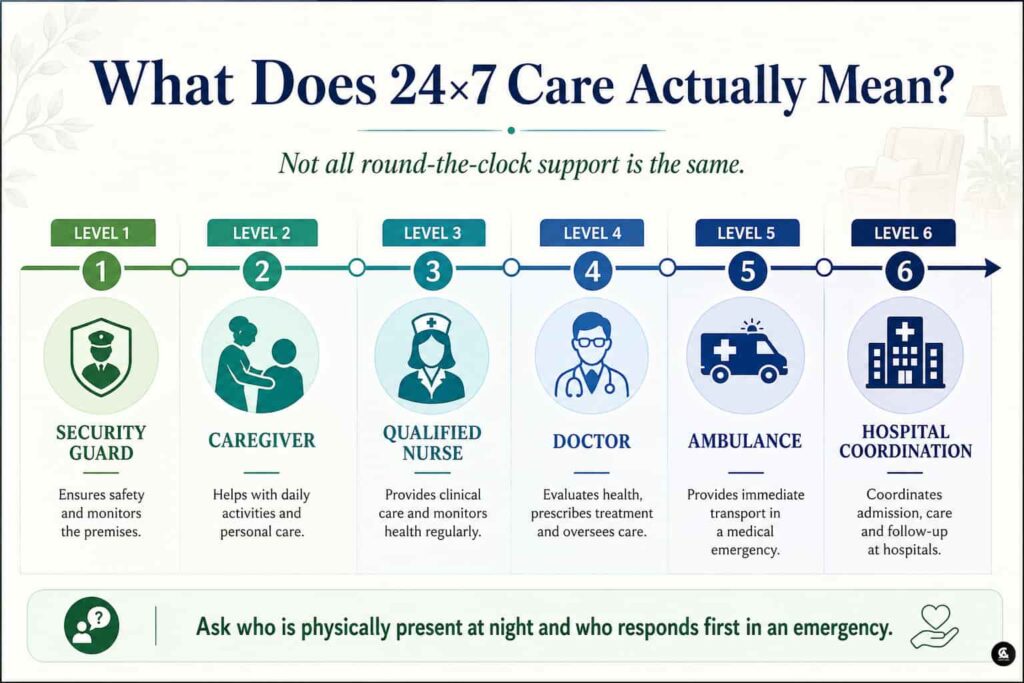
What does 24×7 care actually mean?
The phrase may refer to very different services.
| Claim | Possible meaning |
| 24×7 security | A guard is present |
| 24×7 caregiver | Attendants are available in shifts |
| 24×7 nursing | A qualified nurse remains physically present |
| Doctor available | Doctor may be resident, visiting or on call |
| Emergency support | Staff may arrange an ambulance |
| Hospital coordination | Facility may assist with admission and family communication |
Ask:
- Who is physically present at 2 AM?
- Who responds first after a fall?
- How many residents does the night team manage?
- Is the doctor on-site or reachable by phone?
- Which hospital receives the resident?
- Who travels with the senior?
- Is ambulance transport extra?
Watch for these hidden-cost red flags
Reconsider the facility when:
- The quotation is only verbal
- “Starting from” pricing is repeatedly used
- The care category is undefined
- GST is not mentioned
- Deposit-refund rules are unclear
- The provider cannot explain fee escalation
- Nursing is advertised but not continuously staffed
- Medicines and consumables are not itemised
- Ambulance and hospital accompaniment are vague
- Families are pressured to pay immediately
- The displayed room is unavailable at the quoted price
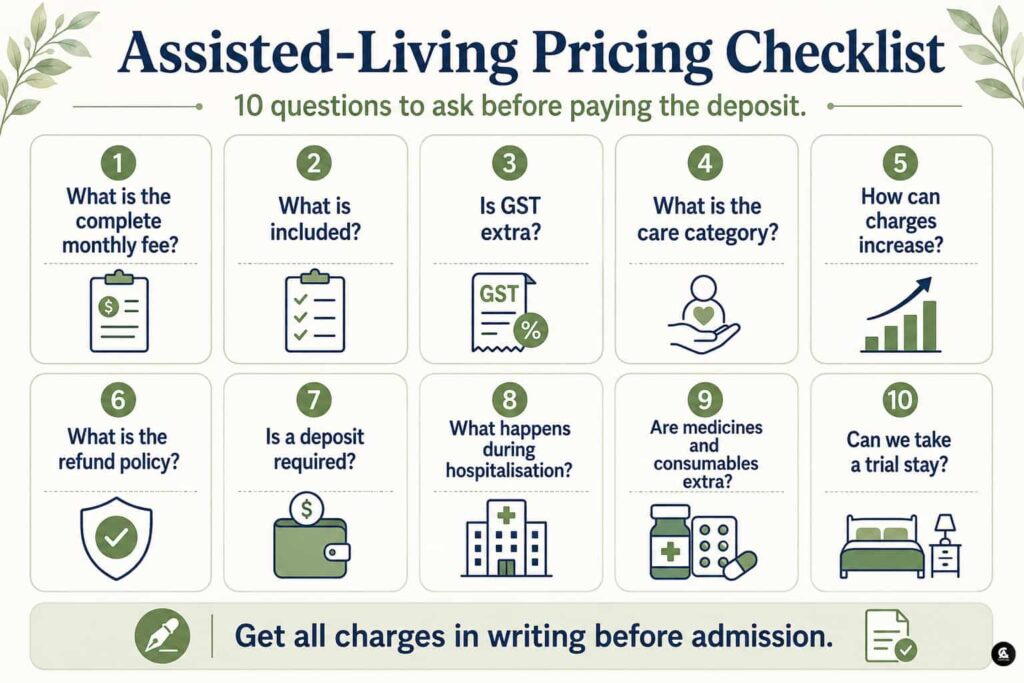
Ten questions to ask before paying
- What is the complete first-month payment?
- What will the regular monthly bill be?
- Which services are included?
- Which services are usage-based?
- What is the care level assigned to the senior?
- How can the care category change?
- What is the annual fee-increase policy?
- Which deposits are refundable?
- What happens during hospitalisation?
- Can we take a paid trial stay before committing?
Create a three-year affordability estimate
Families often calculate only the current monthly fee.
A better approach is:
Year-one cost
- Admission fee
- Deposit
- Monthly charges
- GST
- Medicines
- Consumables
- Additional care
Year-two cost
- Revised tariff
- Increased dependency
- More nursing
- Higher consumables
- Additional physiotherapy
Year-three cost
- Dedicated attendant
- Dementia care
- High-dependency category
- Medical equipment
- Hospital visits
For example, a current package of ₹80,000 per month equals ₹9.6 lakh annually before deposits, GST and extra medical expenses.
The family should test whether the arrangement will remain affordable if the monthly cost rises to:
- ₹1 lakh
- ₹1.25 lakh
- ₹1.5 lakh
This is especially important when the senior depends on pension income, savings or financial support from children.
Carpet Area verdict
Assisted living in India can appear expensive because families often see only the room.
The actual fee may support a complete operating system of:
- Housing
- Food
- Housekeeping
- Personal assistance
- Nursing
- Medication
- Emergency response
- Activities
- Community
But a high price should never be accepted without evidence.
The best assisted-living facility is not necessarily the cheapest or the most expensive.
It is the one that provides:
- The right care level
- Transparent pricing
- Safe infrastructure
- Reliable staff
- Sustainable long-term cost
- Respectful quality of life
Before making a decision, compare complete packages—not promotional starting prices.
Ask for every cost in writing and plan for the senior’s future care needs, not only their present condition.
Important note
This article provides general information about assisted-living pricing and senior-care planning. Prices vary by city, provider, room category and individual assessment. Families should obtain updated written quotations and medical guidance before admission.
Sources:-
- Jeevin Senior Care — What’s the Cost of an Assisted Living Facility in India?
Article का मुख्य reference, जिसमें staffing, home-care comparison और assisted-living operating costs समझाए गए हैं।
https://jeevinseniorcare.in/whats-the-cost-of-an-assisted-living-facility-in-india/ - Artha Senior Care — Official Pricing Page
Room type, care assessment और current pricing structure के लिए।
https://www.arthaseniorcare.com/pricing - Epoch Elder Care — Official Pricing Page
Assisted-living plans starting from ₹1,00,000 plus GST और care-level-based pricing के लिए।
https://www.epocheldercare.com/pricing - Antara Senior Care — Cost of Old Age Homes in Delhi NCR
Basic homes, assisted living और premium care की indicative monthly cost ranges के लिए।
https://www.antaraseniorcare.com/blogs/cost-of-old-age-homes-in-delhi-NCR - Ministry of Social Justice and Empowerment — Minimum Standards for Senior Citizen Homes
Accommodation, healthcare, staffing, safety, nutrition, recreation और resident-welfare standards का official Government of India document।
https://www.socialjustice.gov.in/writereaddata/UploadFile/88731710935901.pdf - Epoch Elder Care — Elder Care Costs in India 2026
Care intensity, staffing और specialised assisted-living costs की additional explanation के लिए।
https://www.epocheldercare.com/blog/elder-care-in-india-understanding-costs-and-budget-planning - Epoch Elder Care — Assisted Living Services
Daily-living assistance, medical conditions और low-to-high care-level requirements को समझने के लिए।
https://www.epocheldercare.com/our-care-and-services/assisted-living - Department of Social Justice — Senior Citizen Division
Senior-citizen-home standards, schemes और official government documents के लिए।
https://socialjustice.gov.in/whats-new/76743/archive


Leave a Reply