


At 43, Rajiv believed he had made the right property decision.
He had upgraded from a two-bedroom apartment to a spacious duplex. It had a terrace, a private entrance and enough rooms for visiting relatives. The home looked like proof that years of hard work had finally paid off.
What Rajiv did not consider was how the same property might work twenty-five years later.
The main bedroom was upstairs. There was no lift. The bathrooms were narrow. The nearest multi-speciality hospital was almost 40 minutes away, and daily essentials required a car.
The house was impressive in his 40s—but it had not been designed for his 70s.
This is the real meaning of future-proofing your 40s. It is not about predicting every health problem, market cycle or family situation. It is about creating enough physical, financial and housing flexibility to handle change without panic.
A widely shared Jeevin Senior Care article discusses seven areas that deserve attention in your 40s: health, money, relationships, learning, emotional wellbeing, success and purpose. Those principles are valuable, but for a homebuyer, property owner or family caring for ageing parents, one more question matters:
Will the home and lifestyle you are building today continue to support your independence tomorrow?
Thinking about ageing early is practical, not pessimistic. The National Institute on Aging notes that the best time to consider ageing in place is before extensive care is required.

1. Build a body that can remain independent
Most people in their 40s exercise to lose weight or improve appearance.
A better long-term goal is to develop a body capable of using a home independently.
Everyday independence depends on activities such as:
- climbing stairs;
- getting up from a chair;
- carrying groceries;
- using the bathroom safely;
- maintaining balance;
- recovering after illness;
- walking through the neighbourhood.
WHO guidance recommends regular aerobic activity and muscle-strengthening exercise involving major muscle groups on at least two days each week. The guidance also emphasises that some physical activity is better than none.
This does not mean following an extreme fitness programme. It means building sustainable habits before weakness, stiffness or poor balance begin restricting daily life.
Start in your 40s
- Include strength exercises in your weekly routine.
- Protect sleep rather than treating it as optional.
- Monitor blood pressure, blood sugar and other risks with your doctor.
- Maintain one organised folder for medical records.
- Learn your family’s health history.
- Review health insurance before medical needs increase.
Medical screening requirements vary by age, history and personal risk. A qualified doctor should decide which tests are appropriate.
The Carpet Area connection
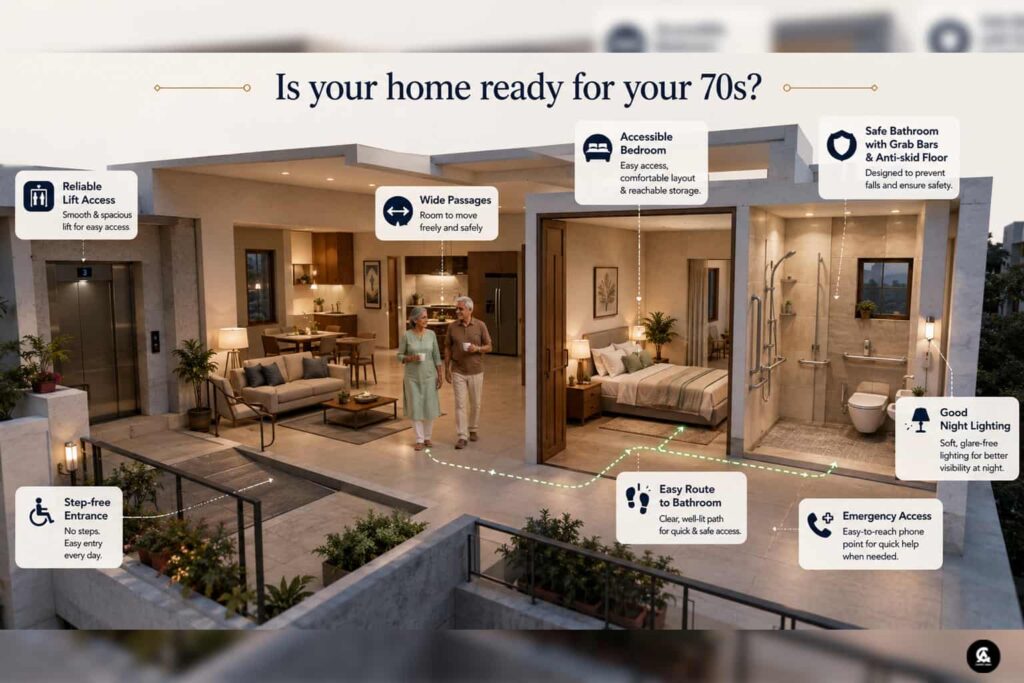
When choosing a home, examine whether it supports physical independence:
- Are there too many stairs?
- Is a reliable lift available?
- Can someone reach the bathroom easily at night?
- Are passages wide enough?
- Is the flooring excessively slippery?
- Can the entrance become step-free later?
A beautiful home that becomes difficult to use may eventually force an expensive and emotionally difficult move.
2. Make money buy flexibility—not only a bigger address
The most common property mistake in the 40s is not necessarily buying the wrong location.
It is committing so much income to the home that there is little money left for retirement, healthcare, emergencies and parents’ care.
A family may own a premium property but still feel financially trapped because of:
- a long home-loan tenure;
- high monthly maintenance;
- costly interiors;
- multiple investment properties with weak cash flow;
- inadequate health insurance;
- insufficient liquid savings.
This is the difference between being property-rich and being future-ready.
SEBI’s financial-education material stresses that retirement planning should begin before retirement and that people should estimate the income they may require to live comfortably later.
Questions to ask before upgrading your home
- Will the EMI continue close to or beyond retirement?
- Does the purchase reduce retirement investments?
- Can one income support the EMI during a job disruption?
- What will maintenance cost after ten or twenty years?
- Is money available for parents’ medical needs?
- Is there an emergency fund separate from the down payment?
- Are you buying usable value or mainly a prestigious address?
A bank’s loan approval tells you what you may be eligible to borrow. It does not prove that the EMI will remain comfortable through career breaks, health expenses or family changes.
A useful financial test
After paying the down payment and acquisition costs, the family should still have room for:
- emergency savings;
- insurance;
- retirement investments;
- children’s goals;
- healthcare;
- home repairs;
- future care requirements.
A home should improve security. It should not consume every resource required to remain secure.

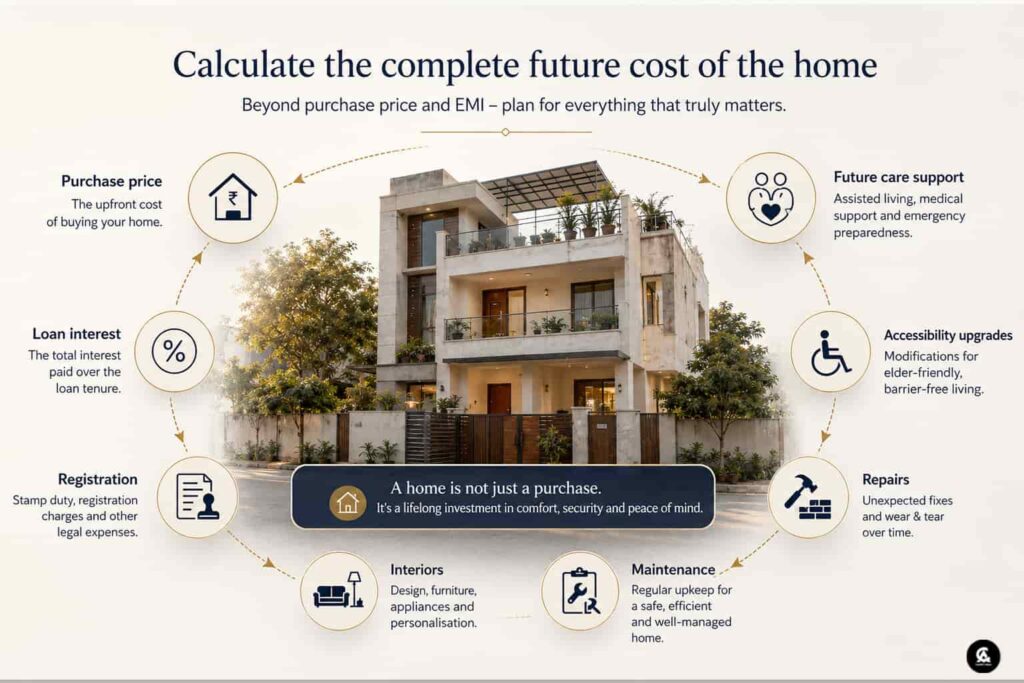
3. Calculate the complete future cost of the home
Most buyers calculate only the purchase price and EMI.
The actual long-term housing cost is broader:
Purchase cost + loan interest + registration + maintenance + repairs + accessibility modifications + future care support
Consider a purely illustrative example:
| Cost component | Illustrative range |
|---|---|
| Property price | ₹80 lakh |
| Registration and acquisition expenses | ₹6–₹9 lakh |
| Interiors and furnishing | ₹5–₹10 lakh |
| Accessibility upgrades later | ₹2–₹6 lakh |
| Monthly maintenance | Project-specific |
| Home-care or caregiving support | Need-based |
These are not quotations or universal estimates. Property, registration, modification and care costs differ substantially by location and individual need.
The purpose of the calculation is simple:
The home that looks affordable at purchase may become expensive to operate, modify and maintain later.
Do not ignore carpet-area efficiency
Under RERA, carpet area refers to the net usable floor area of an apartment, excluding external walls, service shafts, exclusive balconies or verandahs and open terraces, while including internal partition walls.
This matters because future usability depends on the space available inside the home—not merely the marketed super built-up area.
Compare two apartments marketed at 1,200 sq ft:
| Feature | Home A | Home B |
|---|---|---|
| RERA carpet area | 780 sq ft | 700 sq ft |
| Internal passage | Limited | Long and wasteful |
| Bathroom access | Practical | Tight |
| Bedroom layout | Rectangular | Awkward |
| Storage | Built-in potential | Limited |
The larger marketed number may not deliver the better long-term home.
A compact property with efficient circulation, proper light and accessible bathrooms can sometimes serve retirement better than a larger but poorly planned house.
4. Check whether your present home can age with you
Many people say they want to remain in the same home after retirement.
This is known as ageing in place: continuing to live in one’s own home and community as one grows older. The National Institute on Aging advises families to consider future health, support and home requirements before a crisis develops.
But affection for a home does not automatically make it suitable.
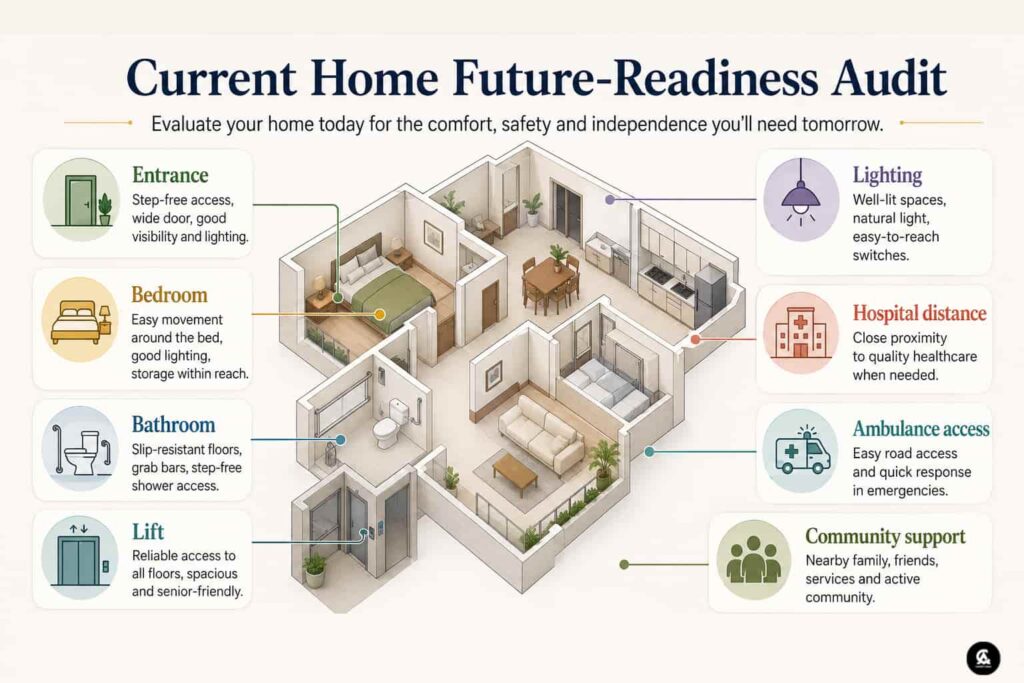
Audit these areas
Entrance
- Can at least one entrance become step-free?
- Is there enough width for assisted movement?
- Is ambulance access possible?
Bedroom
- Is a bedroom available on the entrance level?
- Can the bed be approached from both sides?
- Is there a clear route to the bathroom?
Bathroom
- Can grab bars be installed?
- Is the floor non-slippery?
- Can a shower chair fit?
- Is the doorway wide enough?
- Is there enough space for assistance?
Building
- Is the lift dependable?
- Is power backup available?
- Are corridors adequately lit?
- Is fire and emergency access maintained?
- Is maintenance affordable?
Location
- How far is the hospital?
- Are medicines and daily supplies available nearby?
- Is domestic help available?
- Does the area have a supportive community?
- Can the resident function without driving?
Practical accessibility improvements may include a step-free entrance, grab bars, better lighting, a walk-in shower and safer flooring.
Do not wait until modification becomes urgent
Making changes during a medical emergency is more stressful and usually limits choice.
Your 40s are a good time to identify whether the home can be modified economically—or whether downsizing or relocation may eventually be more practical.
5. Prepare for the sandwich-generation years
Many people in their 40s are supporting children while also becoming responsible for ageing parents.
This is often called the sandwich generation.
The pressure usually does not arrive through one dramatic event. It builds through small responsibilities:
- doctor appointments;
- medicine management;
- insurance claims;
- property paperwork;
- hospital emergencies;
- home modifications;
- caregiver arrangements;
- disagreements between siblings.
Families struggle most when important information is scattered and nobody has discussed responsibility.
Create a parent-care folder
Keep copies of:
- identity documents;
- health-insurance details;
- prescriptions and medical history;
- pension information;
- emergency contacts;
- preferred hospitals and doctors;
- property papers;
- bank nominations;
- will or estate documents, where applicable;
- household staff contacts;
- care preferences.
Have the difficult conversation early
Discuss:
- Would your parents prefer to remain at home?
- Who will coordinate medical care?
- Can the current home be modified?
- What happens if one parent needs daily assistance?
- How will siblings divide responsibility and cost?
- Would assisted living ever be considered?
- Which city offers the best support network?
This is not a conversation about removing parental independence. It is a plan for protecting it.

6. Choose location for support—not only appreciation
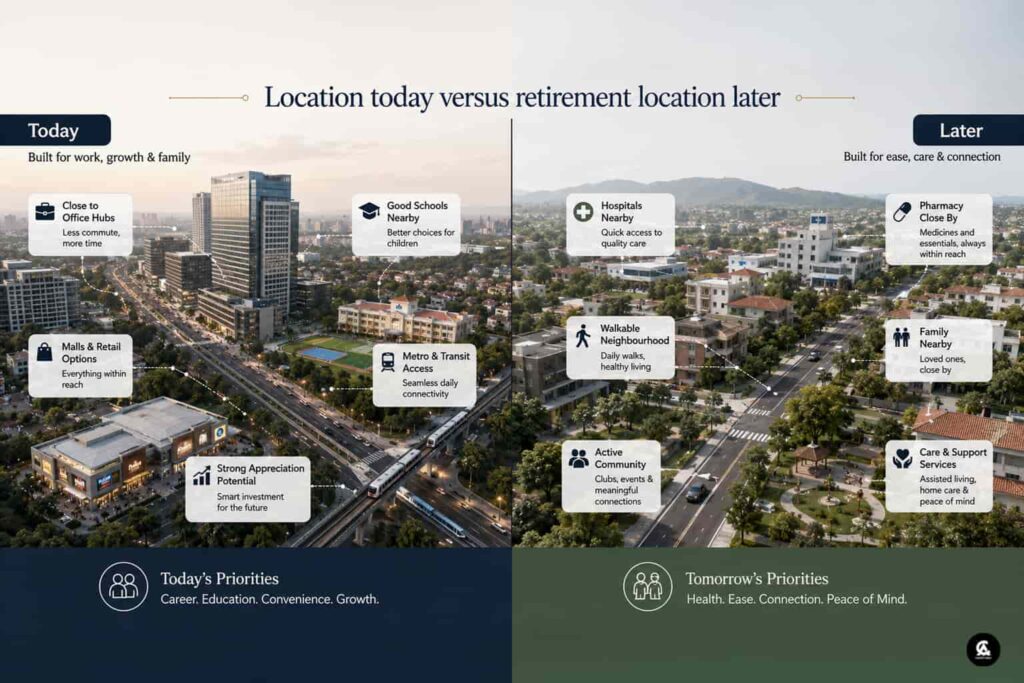
In your 30s and 40s, a property location may be judged by:
- office connectivity;
- schools;
- malls;
- metro access;
- expected price appreciation.
After retirement, the definition of a good location changes.
Future location value may depend more on:
- hospital access;
- pharmacy and diagnostics;
- friends and family nearby;
- walkability;
- public transport;
- domestic help;
- community activities;
- safety;
- reliable maintenance;
- availability of home-care services.
A remote villa may offer more space but create dependence on a car.
A central apartment may provide less space but improve healthcare access, social connection and daily convenience.
Neither option is automatically superior. The right answer depends on the person’s health, family, finances and lifestyle.
Calculate the convenience cost
A cheaper home far from essential services may require:
- more fuel;
- regular drivers;
- longer emergency travel;
- more dependence on children;
- greater delivery and service costs;
- fewer social opportunities.
Location should therefore be evaluated as part of the care system—not merely as an investment map.
The best retirement location is not always where the property may appreciate fastest. It may be where daily life remains easiest.
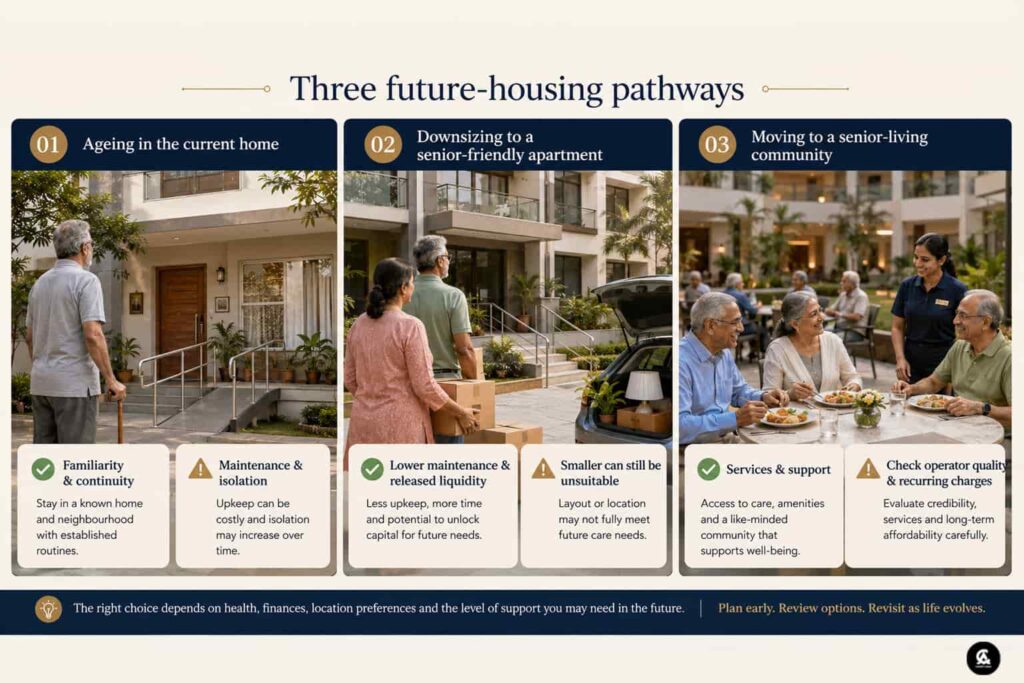
7. Compare three future-housing pathways before you need one
Most families assume they will remain in the current home forever.
A stronger plan is to understand all three realistic pathways.
Path 1: Ageing in the current home
This may work when:
- the property can be modified;
- stairs are manageable or a lift is available;
- hospital access is reasonable;
- family or neighbours are nearby;
- home-care services are available;
- maintenance remains affordable.
Main advantage
Continuity, emotional familiarity and established community.
Main risk
The family may underestimate isolation, home-maintenance pressure or future caregiving requirements.
Path 2: Downsizing to a senior-friendly apartment
This may work when:
- the present home is too large;
- maintenance is becoming difficult;
- children have moved away;
- a more central location is desired;
- an accessible layout is required;
- selling the larger property can release liquidity.
Main advantage
Lower maintenance and potentially better accessibility.
Main risk
A smaller apartment may still be unsuitable if it has poor carpet efficiency, an unreliable lift or weak healthcare connectivity.
Path 3: Moving to a senior-living community
This may work when:
- community life is preferred;
- meals or housekeeping support are useful;
- medical coordination is valued;
- adult children live elsewhere;
- future care continuity matters;
- the resident wants independence with structured support.
Main advantage
Services, social engagement and planned support in one ecosystem.
Main risk
The family may select a project based on amenities without evaluating the operator, care capabilities, recurring charges and future escalation.
No option is universally correct.
The purpose of planning in your 40s is not to decide the final answer immediately. It is to avoid discovering the options for the first time during a health crisis.
Relationships are part of your housing plan
A home can be physically accessible and still become emotionally isolating.
Long-term independence is supported by:
- family;
- friends;
- neighbours;
- trusted doctors;
- local shopkeepers;
- community groups;
- professional caregivers.
The original Jeevin article correctly emphasises relationships as an important investment in one’s 40s.
For Carpet Area readers, the practical point is:
Do not evaluate a future home without evaluating the community around it.
A cheaper or larger home may not be a good retirement choice when it separates residents from every meaningful relationship.
Practical actions
- Maintain friendships beyond professional networks.
- Know at least two dependable neighbours.
- Build emergency contacts in the same city.
- Participate in community or interest groups.
- Repair important family relationships where possible.
- Avoid depending on only one child for every future need.
Keep learning so that independence lasts longer
Future independence is not only physical.
It increasingly requires digital confidence.
People in their 40s should become comfortable with:
- online banking;
- digital payments;
- fraud awareness;
- health apps;
- online medical appointments;
- storing documents securely;
- property and utility portals;
- smart-home controls;
- emergency communication tools.
The objective is not to follow every new technology trend.
It is to reduce the risk of dependence and fraud later.
Learning also protects identity beyond employment. A person whose entire sense of purpose comes from a job may struggle after retirement even with adequate money and a comfortable home.
Build interests that can survive changing roles:
- mentoring;
- consulting;
- gardening;
- teaching;
- volunteering;
- travel;
- writing;
- community work;
- spiritual or cultural activity.
A successful future home is one that supports a meaningful routine—not merely one that stores possessions.

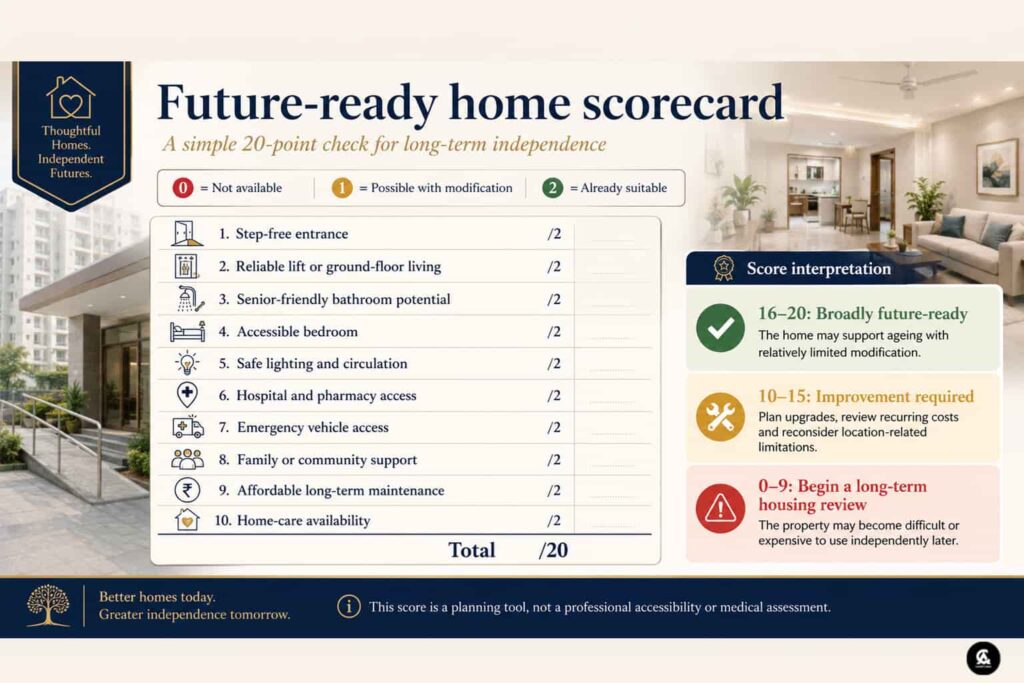
Use this 20-point future-ready home scorecard
Give each item:
- 0: Not available
- 1: Possible with modification
- 2: Already suitable
| Factor | Score |
|---|---|
| Step-free entrance | /2 |
| Reliable lift or ground-floor living | /2 |
| Senior-friendly bathroom potential | /2 |
| Accessible bedroom | /2 |
| Safe lighting and circulation | /2 |
| Hospital and pharmacy access | /2 |
| Emergency vehicle access | /2 |
| Family or community support | /2 |
| Affordable long-term maintenance | /2 |
| Home-care availability | /2 |
| Total | /20 |
Score interpretation
16–20: Broadly future-ready
The home may support ageing with relatively limited modification.
10–15: Improvement required
Plan upgrades, review recurring costs and reconsider location-related limitations.
0–9: Begin a long-term housing review
The property may become difficult or expensive to use independently later..
This score is a planning tool, not a professional accessibility or medical assessment
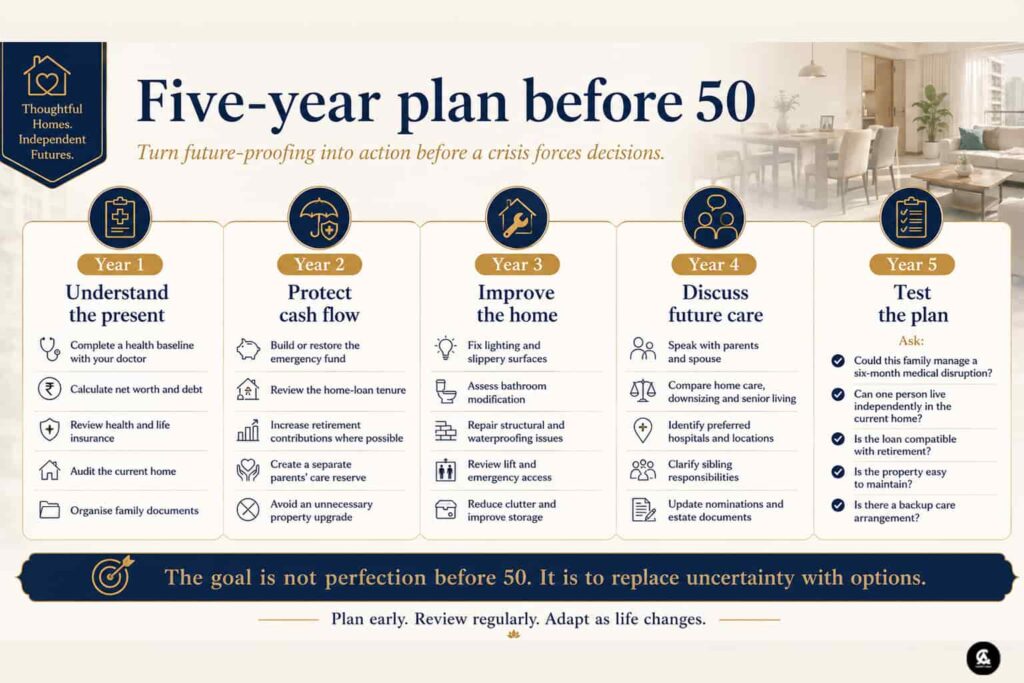
A five-year plan to complete before 50
Planning becomes useful only when it produces action.
Year 1: Understand the present
- Complete a health baseline with your doctor.
- Calculate net worth and debt.
- Review health and life insurance.
- Audit the current home.
- Organise family documents.
Year 2: Protect cash flow
- Build or restore the emergency fund.
- Review the home-loan tenure.
- Increase retirement contributions where possible.
- Create a separate parents’ care reserve.
- Avoid an unnecessary property upgrade.
Year 3: Improve the home
- Fix lighting and slippery surfaces.
- Assess bathroom modification.
- Repair structural and waterproofing issues.
- Review lift and emergency access.
- Reduce clutter and improve storage.
Year 4: Discuss future care
- Speak with parents and spouse.
- Compare home care, downsizing and senior living.
- Identify preferred hospitals and locations.
- Clarify sibling responsibilities.
- Update nominations and estate documents.
Year 5: Test the plan
Ask:
- Could this family manage a six-month medical disruption?
- Can one person live independently in the current home?
- Is the loan compatible with retirement?
- Is the property easy to maintain?
- Is there a backup care arrangement?
The goal is not perfection before 50. It is to replace uncertainty with options.
Frequently asked questions
Should I buy my retirement home in my 40s?
Not necessarily. Buying early may provide price and planning advantages, but it may also lock money into a property before future location, health and family needs are clear. Compare flexibility, loan tenure, maintenance and alternative uses of capital.
Is a ground-floor flat always better for retirement?
No. A ground-floor unit may reduce lift dependence but can have privacy, security, dampness or ventilation concerns. A higher-floor apartment with a reliable lift and power backup may be more suitable.
Should the home loan end before retirement?
A lower debt burden at retirement can improve cash-flow flexibility, but the best decision depends on interest costs, liquidity, income stability and other goals. Avoid using every liquid investment merely to become debt-free without reviewing the complete financial position.
Is a large house better for ageing parents?
Not always. Usable carpet area, bathroom access, room placement, maintenance and hospital connectivity may matter more than total size.
When should a family consider senior living?
The discussion can begin before care becomes urgent. Consider it when community, safety, daily support, medical coordination or future care continuity become important.
Can the current home be modified instead of selling it?
Often yes, but feasibility depends on layout, building rules, structural limitations, lift access, bathroom size and location. An architect or accessibility professional should assess major modifications.
Carpet Area verdict
Future-proofing your 40s is not about preparing to become old.
It is about protecting future choice.
A larger property, higher salary and rising net worth can create confidence, but they do not automatically provide independence. Independence comes from a combination of:
- physical strength;
- adequate savings;
- manageable debt;
- health protection;
- supportive relationships;
- organised parent care;
- a usable home;
- access to community and medical services;
- purpose beyond work.
The house that serves you best in your 40s may not automatically remain the right house in your 70s.
That does not mean you should sell it today.
It means you should begin asking better questions:
Can this home be modified?
Can I maintain it after retirement?
Will I remain connected here?
Can I reach healthcare quickly?
Will my savings survive the EMI?
What happens if one family member needs daily care?
The smartest property decision may not be the biggest house you can buy.
It may be the home that preserves your money, mobility, dignity and independence for the longest possible time.
Important disclaimer
This article provides general educational guidance and does not replace medical, financial, legal, architectural or care-planning advice. Health requirements, retirement needs, housing suitability and care arrangements differ by individual. Consult qualified professionals before making significant decisions.





Leave a Reply