

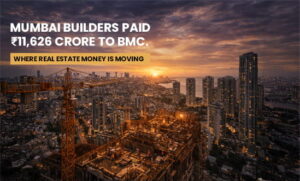
Mumbai’s property market has just produced a number that deserves more attention than it is getting. In FY 2025-26, developers paid ₹11,626 crore to the BMC through premiums and development charges, making builders the civic body’s biggest revenue source for the year. More importantly, this collection was far higher than the BMC’s record property-tax collection of ₹7,610.9 crore, which shows just how heavily city finances are now leaning on redevelopment and construction activity.
At one level, this is a municipal revenue story. At another, it is a powerful real-estate signal. When a city collects this much from developers, it usually means one thing: land is being unlocked, projects are moving, and capital is flowing into the parts of the city where construction economics still work. In Mumbai, that increasingly means redevelopment-led growth rather than old-style outward expansion. This is an analytical reading based on the premium-collection pattern and the reported role of redevelopment in driving it.
What makes the number even more interesting is the context. The FY26 figure is described as the highest such collection since the Covid-lockdown period. During the 2020-22 window, BMC had temporarily offered a 50% premium discount to support the sector, and that scheme helped generate an even larger ₹14,500 crore before it ended in January 2022. The current figure, however, has come without that extraordinary relief framework, which makes it a more organic sign of redevelopment momentum in the city.
The geography of this money tells its own story. The biggest contribution came from the Bandra-to-Jogeshwari belt, which generated ₹2,451 crore, followed closely by south and central Mumbai, from Colaba to Byculla, at ₹2,392 crore. The Goregaon-to-Dahisar stretch added another ₹1,811 crore. At the ward level, Andheri West led with ₹301 crore, followed by Bandra-Khar-Santacruz at ₹283 crore. These are not random concentrations. They point to the micro-markets where redevelopment, premium residential launches, and vertical value creation are strongest.
That is where the story becomes especially relevant for readers. Mumbai is no longer a market where growth is easy, cheap, or widely distributed. It is a market where redevelopment potential, extra FSI, and local land economics decide where serious money goes. Knight Frank’s Gulam Zia linked the strong premium inflows to the availability and utilisation of additional FSI in key micro-markets, especially in South Mumbai, where height restrictions are lighter and developers can unlock more value. In simpler terms, the city is rewarding locations where vertical development is financially viable.
This also helps explain why Mumbai’s real-estate story can no longer be read only through sales headlines. Premium collections reveal something that transaction data often hides: they show where developers are confident enough to pay heavily upfront to secure development potential. That makes them a useful indicator of construction intensity and redevelopment confidence. If developers are putting this kind of money into permissions and charges, they are clearly betting that demand, pricing, and project viability will support those decisions. This is an inference based on the scale of premiums paid and the redevelopment-driven explanation in the reporting.
There is a second layer to the story as well. According to Liases Foras data cited in the report, developer sales in Greater Mumbai touched ₹1.32 lakh crore in 2025, up 8% over 2024. That suggests the premium collections are not happening in isolation. They are part of a broader market where sales remain healthy enough to support aggressive development decisions, even if some segments may cool later.
For buyers and investors, the takeaway is practical. This does not automatically mean every corner of Mumbai is booming. It means the strongest redevelopment corridors are attracting disproportionate capital and attention. In a city shaped by limited land and aging built stock, that matters. It affects where supply comes up, which neighbourhoods change faster, and where future pricing power may remain stronger than the citywide average. This is an analytical interpretation based on the reported concentration of collections across specific belts.
For the market as a whole, this is one of the clearest recent signs that Mumbai’s growth engine is being powered by redevelopment more than by simple expansion. Builders are not just selling homes. They are paying enormous sums to unlock the right to build, rebuild, and build bigger. And that is often the earliest sign of where the next phase of value creation is taking shape.
The ₹11,626 crore paid by Mumbai developers to the BMC is not just a big civic revenue number. It is a map of confidence. It shows where construction is intensifying, where redevelopment is accelerating, and where developers believe the city still has room to create value. In Mumbai real estate, money rarely moves casually. When it moves at this scale, it usually points to the neighbourhoods and formats the market believes in most.




Leave a Reply