

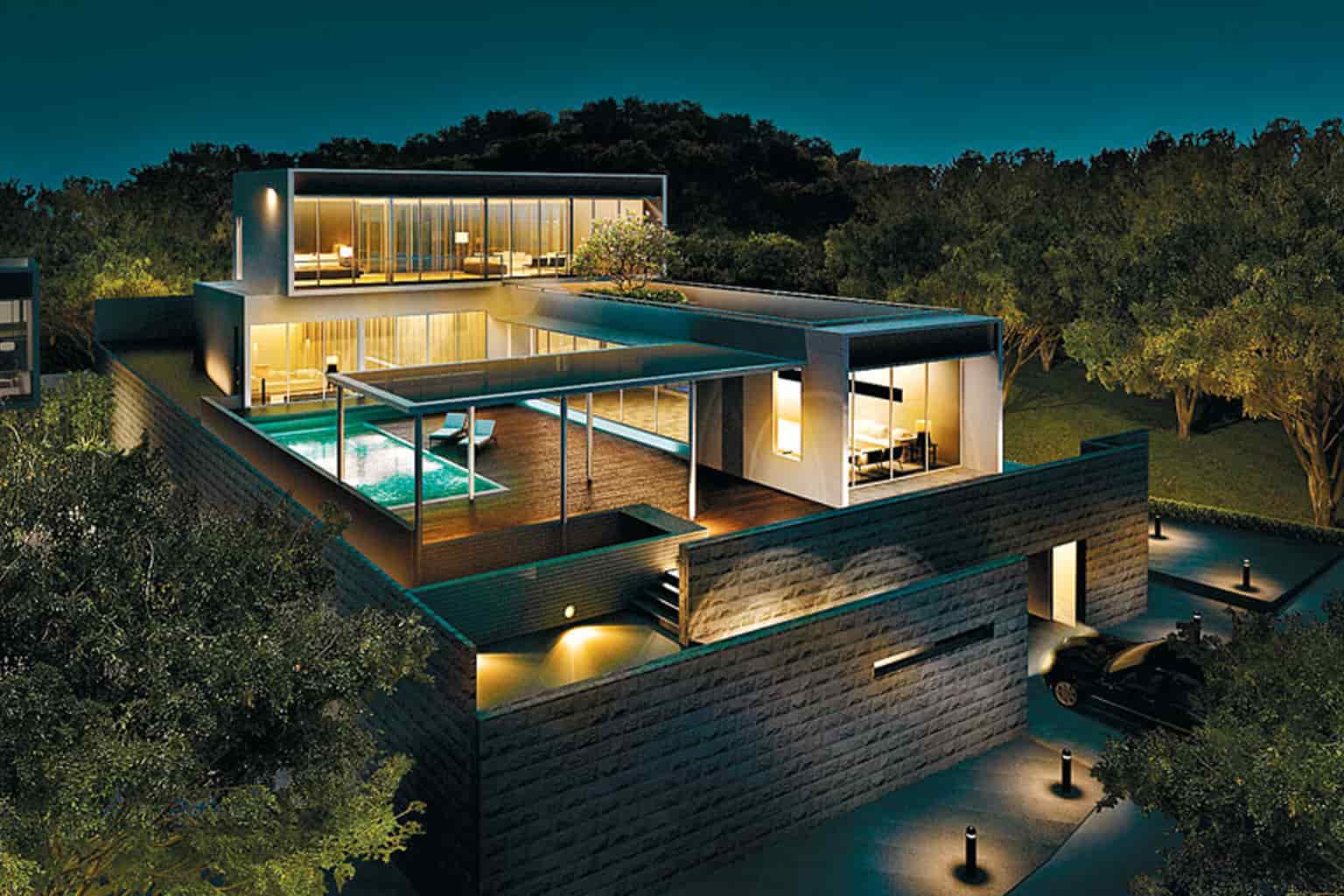
A luxury home can impress a buyer within minutes.
There may be imported marble, a grand entrance lobby, designer lighting, swimming pools, landscaped gardens and an expensive clubhouse.
Premium senior living must pass a very different test.
Its quality is determined by questions such as:
- Can a wheelchair move comfortably through the property?
- Are the bathrooms designed to reduce fall risk?
- Is a trained nurse physically present at night?
- How quickly can staff respond during an emergency?
- Can meals be adapted to the resident’s medical condition?
- Will the monthly cost remain affordable if care needs increase?
Premium senior living is therefore not merely a luxury housing project reserved for older buyers.
It is a combination of:
- Real estate
- Accessible design
- Hospitality
- Healthcare coordination
- Personal assistance
- Community management
- Long-term care planning
The building may look premium, but the senior-living experience becomes premium only when all these systems work together reliably.
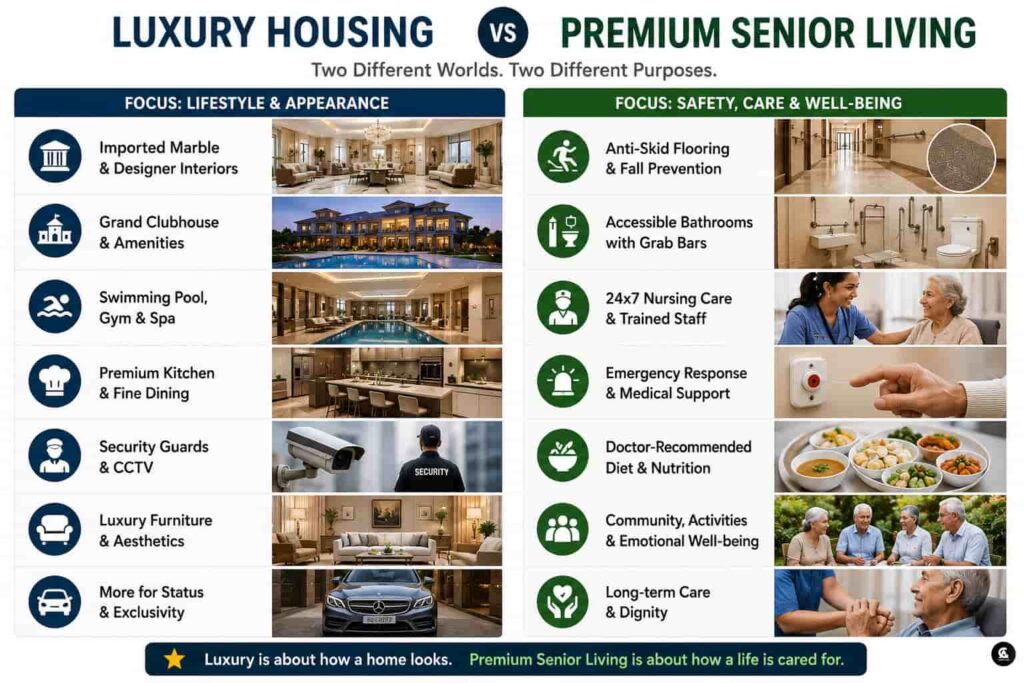
Luxury housing and senior living solve different problems
Luxury housing is generally designed around comfort, status, space and lifestyle.
Senior living must additionally support changing mobility, healthcare, nutrition, safety and social needs.
| Luxury housing | Premium senior living |
|---|---|
| Imported flooring and designer interiors | Anti-skid flooring and fall-risk reduction |
| Large clubhouse | Accessible community and activity spaces |
| Standard swimming pool and gym | Physiotherapy and age-appropriate wellness |
| Premium kitchen | Condition-specific diet support |
| Security guards | Emergency-response and escalation system |
| Standard bathroom | Grab bars and assisted-bathing space |
| Property-management team | Care, hospitality and community team |
| Lifestyle amenities | Long-term care continuity |
This does not mean that aesthetics are unimportant.
Seniors also deserve beautiful, aspirational and comfortable homes. The difference is that design should support independence rather than become an obstacle to it.
WHO’s age-friendly housing guidance highlights features such as elevators, wide passages, adaptable homes and environments that reduce physical barriers. Such features can help older adults remain comfortable and independent.
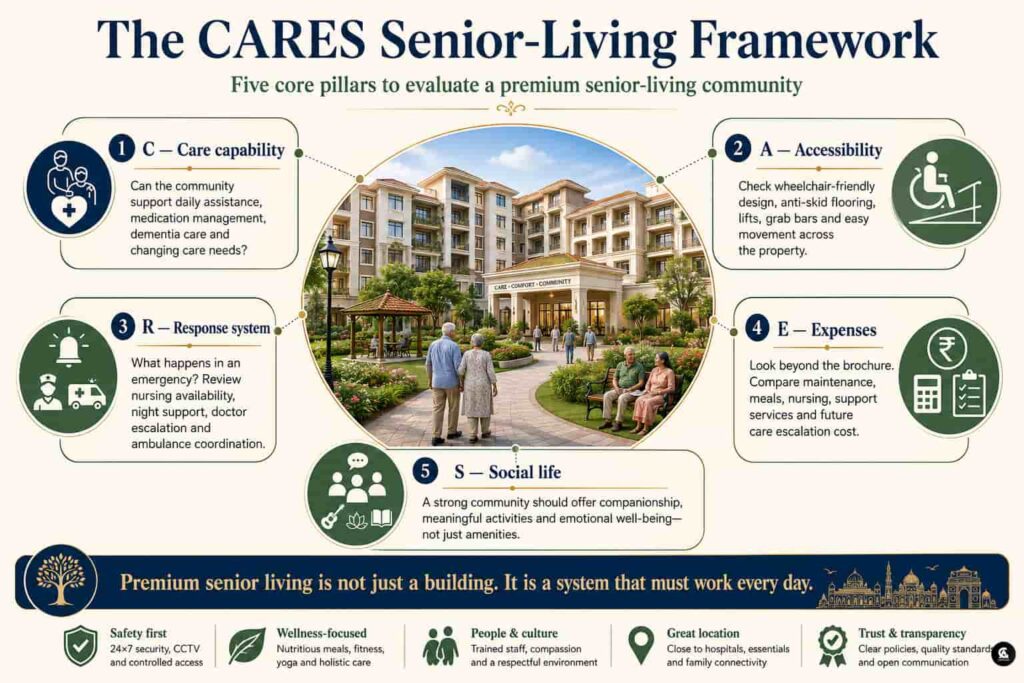
Use the CARES framework to evaluate a project
Families can use the following Carpet Area framework before buying or moving into a senior-living community.
C — Care capability
Can the project manage only active independent seniors, or can it also support:
- Bathing and dressing
- Medication management
- Reduced mobility
- Incontinence
- Dementia
- Night-time assistance
- Post-hospital recovery
The family should understand the maximum care level the project can safely provide.
A — Accessibility
Check whether the complete project—not just the sales office—is suitable for:
- Wheelchairs
- Walkers
- Reduced vision
- Reduced balance
- Assisted transfers
- Emergency evacuation
R — Response system
Ask what happens when a resident falls, becomes breathless or develops sudden confusion at 2 AM.
The answer should include:
- Who responds first
- Their qualification
- Response time
- Nursing availability
- Doctor escalation
- Ambulance process
- Hospital coordination
- Family communication
E — Expenses
Calculate the complete cost, including care and future escalation—not only the property price or headline maintenance charge.
S — Social life
Determine whether the project creates meaningful community or merely publishes an activity calendar.
A clubhouse is not a community unless residents are able and willing to use it.
A nursing station is valuable only when the system works
A project brochure may prominently display a nursing station.
That does not automatically mean residents receive continuous nursing care.
Families should ask:
- Is a qualified nurse physically present 24×7?
- How many residents does one nurse support?
- Are separate day and night shifts maintained?
- Is the doctor resident, visiting or only available by telephone?
- Who maintains medication records?
- How are missed doses or medical changes documented?
- Who accompanies a resident to hospital?
- Is the ambulance owned, contracted or called from outside?
- How are children living in another city informed?
The value of a nursing station is not determined by its furniture or location.
Its real value is determined by the quality of staff, documentation and emergency response—especially at night.
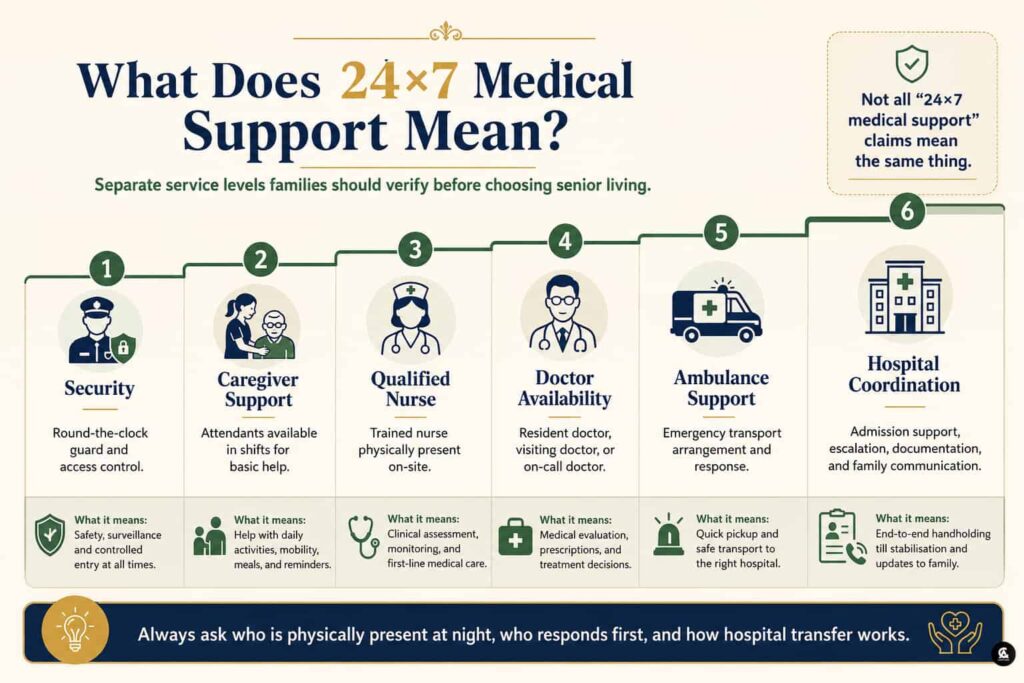
“24×7 medical support” can mean several different things
| Marketing phrase | What it may actually mean |
| 24×7 security | A guard is present |
| 24×7 caregiver support | Attendants work in shifts |
| 24×7 nursing | A qualified nurse remains on-site |
| Doctor available | A doctor may be reachable by phone |
| Hospital tie-up | Staff may only call the hospital |
| Emergency response | An ambulance may be arranged externally |
Ask the operator to define every service in writing.
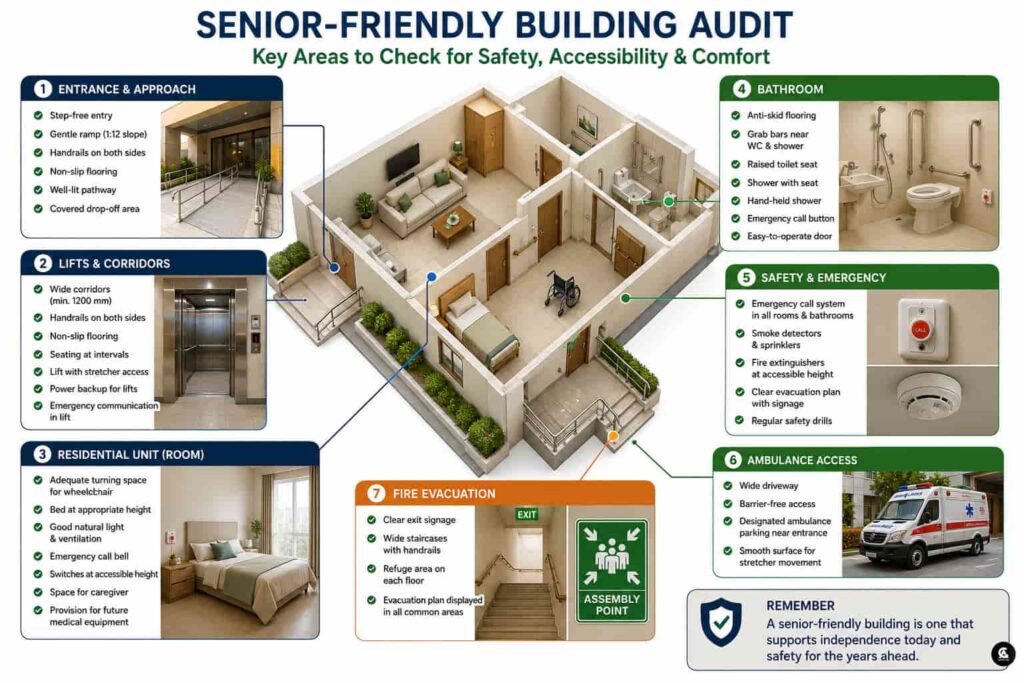
Inspect the project as a care environment
Senior living must be evaluated room by room.
Entrance and approach
Check:
- Step-free entrance
- Suitable ramp gradient
- Handrails
- Covered drop-off
- Wheelchair access
- Ambulance approach
- Adequate night lighting
Corridors and lifts
Check:
- Corridor width
- Handrails
- Anti-skid flooring
- Resting points
- Lift dimensions
- Lift power backup
- Emergency communication
- Evacuation plan
The residential unit
Check:
- Wheelchair turning space
- Bed height
- Natural light
- Ventilation
- Emergency bell
- Switch height
- Balcony safety
- Space for a caregiver
- Space for future medical equipment
The bathroom
Check:
- Grab bars
- Anti-skid flooring
- Shower chair
- Raised toilet
- Emergency call button
- Assisted-bathing space
- Door that can be opened during an emergency
A flat should not be labelled wheelchair-friendly only because the main entrance has a ramp.
Every regular route used by the resident must be accessible.
Food is part of the care system
Senior living operators often advertise restaurant-style dining.
However, a senior’s food requirement may change because of:
- Diabetes
- High blood pressure
- Kidney conditions
- Swallowing difficulty
- Dental problems
- Recovery after surgery
- Reduced appetite
- Medication timings
Ask whether the operator can provide:
- Low-salt meals
- Diabetic meals
- Soft food
- High-protein recovery diet
- Renal diet
- Portion control
- Meal assistance
- Dietitian consultation
Also verify:
- Is the special diet included?
- Who approves dietary changes?
- What happens when a resident refuses food?
- Are meal and fluid intake monitored when medically required?
- Can the family review the menu?
Premium dining is not only about presentation.
It is about ensuring that the food is enjoyable, appropriate and consistently delivered.
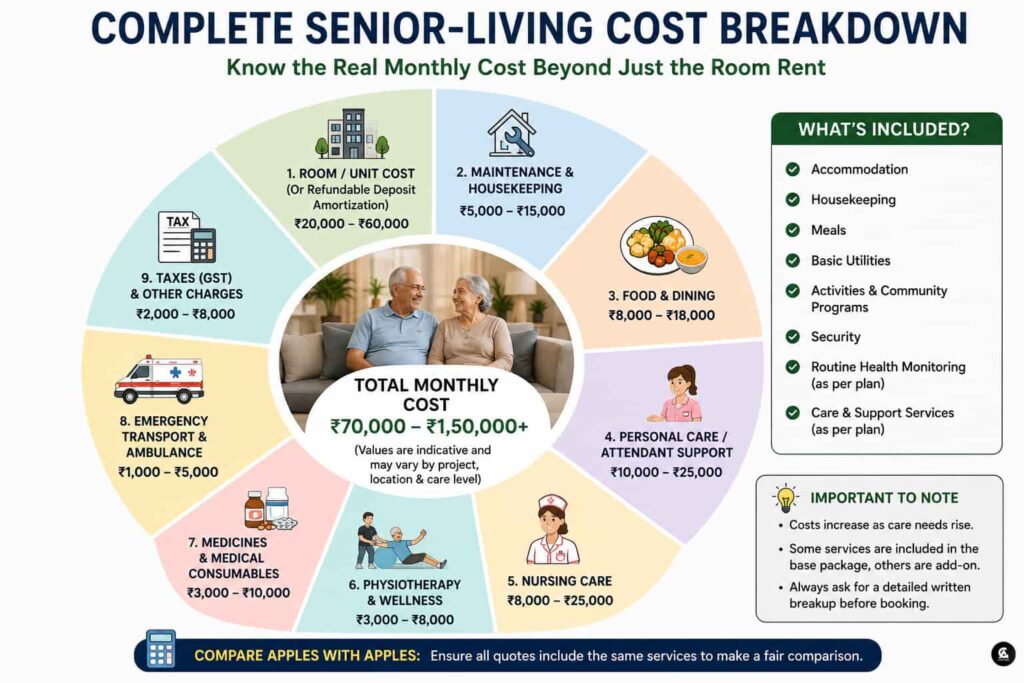
Calculate the complete monthly cost
A senior-living project may have three different financial layers:
- Property purchase or refundable deposit
- Monthly maintenance and hospitality
- Personal care and medical-support charges
The complete monthly cost may include:
- Common maintenance
- Housekeeping
- Meals
- Care-level fee
- Dedicated attendant
- Nursing
- Physiotherapy
- Doctor visits
- Medicines
- Diapers and medical consumables
- Special diet
- Emergency transport
- GST
- Activity charges
Use a written comparison table:
| Cost component | Included | Additional | Amount |
| Property or room cost | |||
| Monthly maintenance | |||
| Meals | |||
| Housekeeping | |||
| Personal assistance | |||
| Nursing | |||
| Physiotherapy | |||
| Doctor visits | |||
| Medicines and consumables | |||
| Emergency transport | |||
| GST and taxes |
A ₹70,000 package and a ₹1 lakh package cannot be compared until the included services are made identical.
Senior living is not compulsory for every family
A family living together with adequate space, time and care support may not need to move its parents into a senior-living community.
The decision may be relevant when:
- The senior lives alone
- Children live far away
- The home is inaccessible
- Property maintenance has become difficult
- Social isolation is increasing
- Emergency response is unreliable
- One spouse needs support
- The senior actively wants an independent community lifestyle
Moving to senior living should not be treated as abandonment.
Remaining in the family home should also not be treated as the only morally acceptable choice.
The right decision is the one that protects:
- Choice
- Safety
- Independence
- Dignity
- Social connection
- Long-term continuity
End users and investors must ask different questions
For end users
The priorities should be:
- Care quality
- Accessibility
- Food
- Community
- Hospital access
- Monthly affordability
- Future care continuity
- Distance from family
For investors
The priorities should include:
- Project registration
- Developer track record
- Care operator experience
- Operating agreement
- Occupancy
- Rental model
- Maintenance charges
- Resale restrictions
- Exit terms
- Buyer profile
- Long-term liquidity
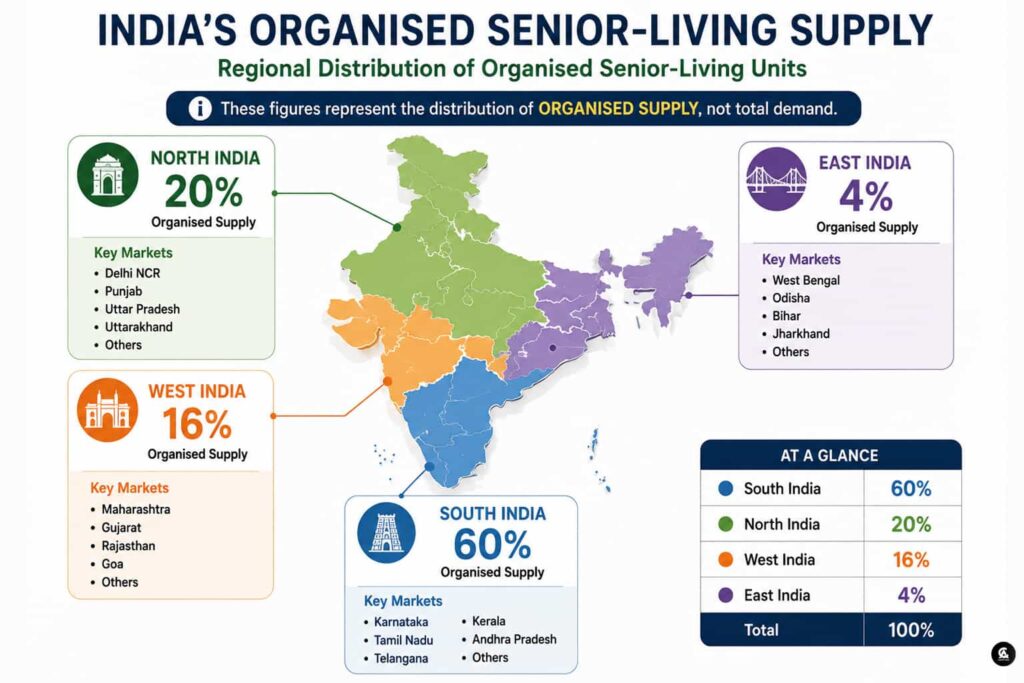
Senior living may be a growing real-estate category, but every senior-living unit is not automatically a good investment.
A property can be operationally successful yet difficult to resell.
It can also be well designed but struggle if the care operator leaves.
Where RERA registration is applicable, buyers should verify the project and its disclosures on the relevant state RERA portal rather than relying only on advertisements. The Ministry of Housing and Urban Affairs advises buyers to check project registration, payment terms and declared completion timelines before purchasing.
Marketing claim versus reality
| Marketing claim | What the family should verify |
| 24×7 medical support | Who is physically present at night? |
| Wheelchair-friendly | Are all residential routes accessible? |
| Premium food | Is medical-condition-based diet available? |
| Active community | How many residents regularly participate? |
| Hospital tie-up | Is there a documented emergency process? |
| Trained caregivers | What training and experience do they have? |
| Nursing station | Is it staffed continuously? |
| Luxury senior living | Is the care system as strong as the interiors? |
| Affordable maintenance | Does the quotation include future care? |
| Guaranteed returns | What supports the rental or resale claim? |
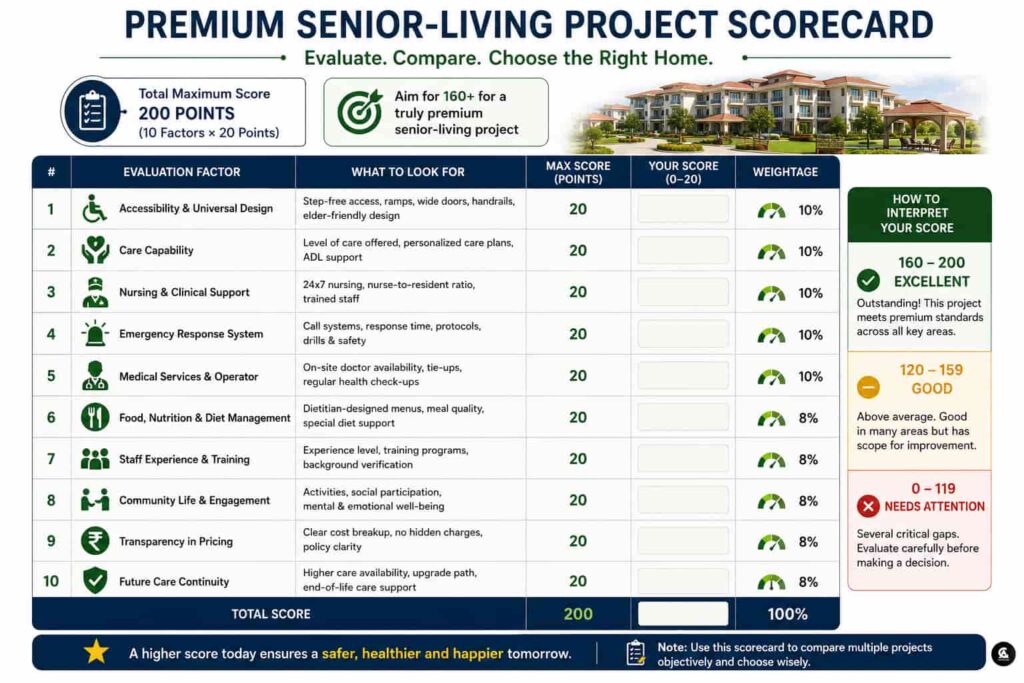
Use a senior-living project scorecard
Score each category from 0 to 2:
- 0: Weak, unavailable or unclear
- 1: Acceptable but needs verification
- 2: Strong and documented
| Evaluation area | Score |
| Accessible design | /2 |
| Care capability | /2 |
| Nursing availability | /2 |
| Emergency response | /2 |
| Medical operator | /2 |
| Food and diet support | /2 |
| Staff experience | /2 |
| Community engagement | /2 |
| Transparent pricing | /2 |
| Future care continuity | /2 |
| Total | /20 |
Score interpretation
- 16–20: Strong shortlist candidate
- 11–15: Further verification required
- 0–10: Major gaps remain
This is a family shortlisting tool, not an official certification or clinical rating.
Carpet Area verdict
Premium senior living should not be defined by marble, architecture or the number of amenities.
It should be defined by whether the project can deliver:
- Accessible housing
- Trained staff
- Reliable nursing
- Clear emergency response
- Appropriate food
- Meaningful community
- Transparent costs
- Future care continuity
A luxury housing project may be designed to impress the buyer during a visit.
A premium senior-living project must continue working every morning, every night and during every emergency.
That is the real difference.
Before buying or moving, families should ask one final question:
Are we paying for luxury features—or for a dependable system that will support the senior’s independence, safety and dignity over time?
The answer should determine whether the project deserves to be called premium.
Important note
This article provides general real-estate and senior-living evaluation information. It does not endorse a particular project or operator and does not replace medical, legal or financial advice.
Sources:-
- JLL–ASLI: Elevating the Golden Years — India’s Senior Living Market Landscape
Senior-living market size, organised supply और projected growth के लिए।
https://www.jll.com/en-in/insights/elevating-the-golden-years-a-report-on-indias-senior-living-market-landscape - JLL India: Senior Living Sector Projected to Reach ₹64,500 Crore by 2030
Market value, regional supply distribution और 2030 projections के लिए।
https://www.jll.co.in/en/newsroom/india-senior-living-housing-sector-to-skyrocket-over-300-percent-by-2030 - Colliers India: Senior Housing—Real Estate Opportunities Galore
India में लगभग 18–20 lakh senior-housing units की estimated demand के लिए।
https://www.colliers.com/en-in/news/india-senior-housing-real-estate-opportunities-galore - Colliers India: Senior-Living Market Could Grow Five Times by 2030
Senior-housing demand, growth potential और investment opportunity के लिए।
https://www.colliers.com/en-in/news/press-release-senior-living-to-grow-5x-by-2030-to-touch-usd12-billion - World Health Organization: Age-Friendly Housing
Elevators, wide passages, accessibility और senior-friendly housing design के लिए।
https://extranet.who.int/agefriendlyworld/age-friendly-practices/housing/ - WHO: Global Age-Friendly Cities—A Guide
Housing, accessibility, community participation और ageing comfortably के wider framework के लिए।
https://iris.who.int/bitstream/handle/10665/43755/9789241547307_eng.pdf - Ministry of Housing and Urban Affairs: RERA Information
Project registration, disclosures, timely completion और buyer protection के लिए।
https://www.mohua.gov.in/documents/acts-and-policies/rera-YDM4EzMtQWa?pageTitle=Real-Estate-%28Regulation-and-Development%29-Act%2C-2016-%5BRERA%5D - MoHUA: RERA Homebuyer Do’s and Don’ts
Agreement for sale, possession date, payment records, completion certificate और RERA verification के लिए।
https://www.mohua.gov.in/static/uploads/2026/01/bd301540fbe711d6c1f962008745848d.pdf - Ministry of Social Justice: Minimum Standards for Senior Citizen Homes
Accommodation, safety, staffing, healthcare और operating standards के additional reference के रूप में।
https://socialjustice.gov.in/writereaddata/UploadFile/88731710935901.pdf


Leave a Reply